Skip to content
How Did a Fashion Brand Improve Bodycon Dress Fit?
Your trusted Women’s Apparel Development & Manufacturing Partner from China
- Jerry

A bodycon dress can look perfectly balanced on a hanger and still fail within thirty seconds of being worn. The neckline may appear clean until the wearer raises her arms. The waist may look shaped in a front photograph but collapse from the side. The hip may fit while standing, then become restrictive when sitting. These failures are rarely caused by one incorrect measurement. They usually come from the interaction between the pattern, negative ease, fabric recovery, lining, seam construction, and grade rules.
The brand improved its bodycon dress fit by treating the garment as a connected fit system rather than adjusting one measurement at a time. The team tested the fabric, mapped tension by body zone, corrected the bust-waist-hip balance, reviewed grade rules, produced a revised fit sample, and locked the approved measurements, materials, and workmanship before bulk production.
The case below is an anonymized, technically representative development scenario based on recurring challenges faced by contemporary fashion brands. Confidential customer identities and unverified commercial figures are not disclosed. The turning point came during a fitting when the dress looked acceptable in the first photograph. Then the model walked across the room, sat down, and stood up again. The side seam rotated forward, the hem climbed, and the waist developed a horizontal fold. That short movement test revealed more than the original measurement chart had shown in several days.

What Fit Problems Did the Brand Find?
The first sample showed bust tension, loose waist shaping, restricted hips, rotating side seams, hem lift, and opacity loss under stretch. These problems became more obvious during walking and sitting. A size-set review also showed that the defects changed across sizes, proving that the issue involved pattern balance, fabric performance, and grading rather than one incorrect measurement.
First-Sample Warning Signs
The dress looked reasonably close to the reference image when placed on a hanger. Once worn, however, the relationship between the bust, waist, and hip immediately became unstable.
Diagonal lines appeared from the bust toward the armhole. The waist looked loose in the front but compressed at the side seam. Across the full hip, the fabric showed visible strain and became lighter in colour as it stretched. The side seams moved forward instead of hanging vertically, and the back hem sat higher than the front.
These defects should not be treated as isolated cosmetic problems. They show how one area of a fitted garment can borrow width or length from another area. A horizontal fold above the waist, for example, does not always mean the waist circumference is too large. It may come from excess front-body length, insufficient hip width, a low waistline, weak recovery, or upward tension from the skirt.
The team therefore resisted the common reaction of reducing the waist immediately. Each symptom was recorded before deciding whether the root cause involved circumference, length, shaping, material behaviour, or construction.
Visible symptom | Likely technical causes | What to check first |
Diagonal bust pulling | Insufficient bust shaping, short front length, tight armhole | Bust width, bust projection, and front balance |
Loose-looking waist | Excess width, excess length, misplaced shaping | Waist position, side seam, and vertical balance |
Hip strain | Excess negative ease, weak extension, poor back distribution | Full-hip width, back length, and fabric stretch |
Side seam rotating forward | Insufficient back width or length | Front-to-back pattern distribution |
Hem riding up | Hip restriction, short back length, poor recovery | Movement test and vertical measurements |
Fabric becoming transparent | Low opacity under extension | Fabric weight, knit structure, and stretch level |
Movement Revealed More
A static fitting can hide some of the most expensive problems in a bodycon dress. A garment may look clean while the wearer stands still, yet move out of position as soon as she walks or sits.
The fit model completed a practical sequence: walking at a normal pace, sitting for one minute, standing without adjusting the dress, raising both arms, reaching forward, turning the upper body, and walking again. After walking, the skirt climbed approximately 2-3 cm and did not fully return. After sitting, the front hem remained higher, while the side seams rotated farther toward the front.
When the model raised her arms, the whole dress lifted instead of allowing controlled movement through the upper body. That behaviour pointed to excessive negative ease at the hip, insufficient vertical length over the bust or seat, weak recovery after extension, or construction tension in stretch-sensitive areas.
Movement also exposed opacity loss. The material looked dense enough when relaxed but became noticeably lighter over the full hip. Increasing pattern width might reduce the extension, but the fabric specification still needed review. A party or occasion dress must perform during sitting, walking, dancing, and getting into a car, not only during a fitting-room pose.
Size-Range Differences
The fit problem was not identical in every size. In the smaller size, the upper chest and bust felt more restrictive than expected. The neckline remained stable, but the wearer experienced pressure around the armhole and side bust. In the larger size, the waist gained too much width while the back body still lacked sufficient length over the seat.
This showed that the grade rules were amplifying the imbalance. Grading is not simply enlarging or reducing a pattern by the same amount in every direction. The bust, waist, hip, armhole, and body length often require different growth relationships.
The review compared circumference increments, front and back width distribution, bust-point movement, armhole depth, waist-to-hip position, side-seam length, and finished dress length. The team found that one uniform grade rule could not protect the silhouette across the range. The waist needed restrained growth, the hip required a different increment, and the back length needed additional consideration in upper sizes.
The objective was not to promise a universal fit for every body shape. It was to make the brand’s chosen fit logic more consistent from size to size and to prevent a correct base size from becoming a different garment when graded.
Approval and Commercial Risk
Before the technical review, comments such as “the waist is not flattering” or “the dress feels too tight” were too broad to guide accurate corrections. “Too tight” may mean restricted movement, excessive visual compression, insufficient circumference, short vertical length, or a seam that cannot extend with the fabric. Each cause requires a different action.
The first sample therefore created more than an aesthetic problem. It threatened the development calendar, photography timing, size-chart confidence, and future repeatability. If the fit moved into production without a clear diagnosis, the brand could face avoidable alterations, fit-related returns, inconsistent reviews, or emergency rework.
The team translated every broad complaint into an observable condition. The side seam did not merely “look wrong”; it shifted forward after walking. The waist was not simply “loose”; a horizontal fold appeared above the natural waist while the side area remained under tension. Once the language became measurable, the second sample could be judged against an agreed standard rather than personal impression.

Why Did the Bodycon Fit Fail?
The bodycon fit failed because the negative ease, pattern distribution, fabric recovery, and grade rules were not working together. The garment removed too much room at the hip and bust while leaving poorly positioned fullness at the waist. The fabric extended during wear but did not recover evenly, and the original grading increased the imbalance across the size range.
Negative Ease by Body Zone
Negative ease means that the finished garment is smaller than the corresponding body measurement. It is essential for many bodycon dresses because it allows the fabric to follow and lightly compress the body. The mistake is applying one negative-ease percentage to the entire dress.
The bust, waist, and hip have different shapes, movement requirements, and pressure tolerances. A percentage that feels supportive at the waist may flatten the bust or restrict the hip. The same fabric may also behave differently along its crosswise and lengthwise directions.
A useful diagnostic calculation is: negative ease percentage = (body measurement – garment measurement) / body measurement x 100. For moderate-compression stretch dresses, some teams begin development around 5-12% at selected circumference points. This is a working reference, not a universal rule. Highly elastic fabrics may tolerate more, while low-recovery or dense structures may require less.
In this case, the hip had more effective negative ease than the material could manage comfortably. The waist did not create a clean contour because the shaping was poorly positioned, not simply because it was too large. The correction therefore had to redistribute pressure instead of making the whole dress larger or smaller.
Body zone | Common development concern | Practical starting consideration |
Bust | Flattening and neckline distortion | Allow projection, breathing room, and secure coverage |
Underbust | Weak shaping or excessive pressure | Place suppression below the bust rather than across it |
Waist | Lost contour or sharp indentation | Distribute shaping through seams or panels |
High hip | Horizontal folds | Confirm waist-to-hip length and curve |
Full hip | Restricted movement and hem lift | Test sitting and walking, not only standing |
Thigh | Limited stride | Check hem opening and usable fabric extension |
Fabric Stretch and Recovery
Stretch percentage alone does not determine whether a fabric is suitable for a bodycon dress. A material can extend a long way and still perform badly. If it does not recover, it may become loose at the seat, hip, or waist after a short period of wear. Strong recovery with insufficient extension can create compression, seam strain, and restricted movement.
The material review covered crosswise and lengthwise stretch, recovery after repeated extension, fabric weight, opacity under stretch, surface whitening, dimensional stability, hand feel, and compatibility with the lining. The original fabric passed a quick hand-stretch check but showed uneven recovery during repeated movement. It also lost opacity over the full hip.
A simple early-stage recovery check can be made by marking a known fabric length, extending it to a controlled distance several times, releasing it, and recording how closely it returns. Laboratory methods are more precise, but this basic check can reveal an obvious mismatch before a sample is cut.
The revised material direction prioritised balanced extension, dependable recovery, and acceptable opacity at the intended garment measurement. The team was not searching for the highest stretch percentage. It was searching for a fabric that could create the planned silhouette, survive real movement, and return to shape.
Pattern Balance
The garment’s total circumference was not the only problem. The available width and length were distributed incorrectly around the body. The front bodice lacked sufficient shaping over the bust. The back hip needed more usable room and vertical length. The waist had local excess, but part of that fullness was created by tension pulling material upward from below.
Pattern balance describes how the garment’s width, length, and shaping sit around the body. When balance is wrong, one area borrows material from another. A dress may match several points on a measurement chart and still twist, ride, fold, or pull.
The team examined front-to-back width distribution, bust projection, underbust position, side-seam angle, high-hip and full-hip curves, centre-front length, centre-back length, grain direction, and hem level. The forward-moving side seam was especially informative because it suggested that the back body was taking more tension than the front.
Adding width equally to the front and back would have diluted the silhouette without necessarily correcting the balance. The better solution was to place enough room and length where the body required it, allowing the seam to return to a more vertical position.
Grade-Rule Distortion
The original grade increased several circumferences too evenly. That weakened the waist shape in larger sizes while failing to provide enough additional back length. A reliable grade must preserve the design intention while recognising that body dimensions do not grow in identical proportions.
The team reviewed the grade nest visually and numerically. It checked waist growth against hip growth, bust-point movement, armhole depth, front-to-back allocation, back-length increase, waist-to-hip distance, neckline coverage, and finished length.
The correction did not involve making every upper size looser. It involved placing growth where the body needed it while maintaining the intended fitted silhouette. In the smaller size, upper-chest and armhole balance required closer attention. In the larger size, the back body required additional length, while waist growth needed tighter control.
No commercial size chart can represent every individual body shape. The practical objective is a coherent fit profile: the brand defines whom it is fitting, validates that logic across selected sizes, and avoids letting automatic grade increments undermine the design.
How Did the Team Diagnose the Causes?
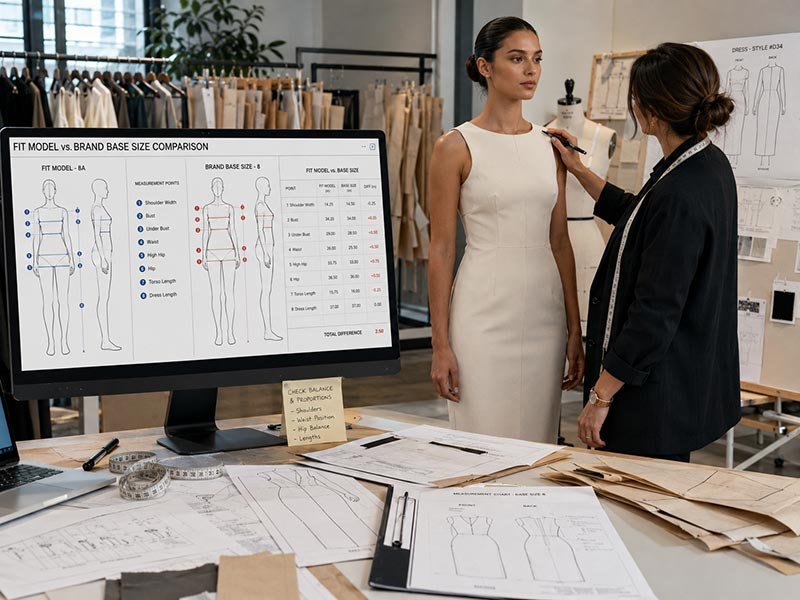
The team combined fit-model observations, garment measurements, fabric tests, movement checks, and pattern analysis. Each symptom was documented as an observation, linked to one or more probable causes, and converted into a specific action. This prevented random adjustments and gave the second sample a clear, measurable purpose.
Structured Fit Session
The fit session followed the same sequence for every sample. The garment was allowed to relax after transport and handling. The model wore the intended undergarment type because bra shape and support can change bust position, neckline tension, and posture. The team photographed front, side, and back views before making any physical adjustment.
The model was asked to stand naturally. Pulling down the hem, smoothing the waist, or repositioning the side seams would have hidden the garment’s actual behaviour. She then completed the same movement routine used for the first sample.
Three types of evidence were recorded separately: what the model felt, what the team observed, and what the measurements confirmed. These do not always agree. A dress may look tight but feel comfortable because the fabric distributes pressure well. Another may look smooth while causing local pressure that appears only during movement.
Fit comments were numbered directly on images and assigned to pattern, material, construction, or specification. That ownership prevented comments from circulating without a clear action and made it easier for design, technical, sourcing, and factory teams to work from the same evidence.
Critical Measurements
The team did not remeasure every point with equal urgency. It prioritised the points that could explain the visible defects: full bust, across chest, underbust, natural waist, high hip, full hip, front and back body length, waist-to-hip depth, side-seam length, armhole depth, dress length, and hem opening.
Stretch garments require a defined measuring method. One operator may stretch a garment lightly while another measures it completely relaxed, creating different results from the same sample. The team therefore specified whether each point was measured fully relaxed, gently smoothed, edge to edge, along a curved seam, with the lining included, and before or after conditioning.
Actual measurements were compared with the specification, but the specification itself was not treated as untouchable. A garment can sit within tolerance and still fit poorly when the original target is wrong. The chart was therefore updated as a controlled development document rather than used as proof that the sample must be correct.
This discipline also supports bulk inspection. A tolerance has value only when the measurement method is clear enough for different people to produce comparable results.
Fabric-Pattern Review
The pattern was reviewed using the intended production fabric, not a substitute with merely similar fibre content. Two polyester-elastane fabrics can behave very differently because of knit structure, weight, yarn, finishing, and recovery. The outer fabric was also assessed with the proposed lining because two layers can behave differently from either layer alone.
The team identified where stretch was desirable and where stability was necessary. The hip needed controlled extension. The waist needed recovery. The neckline needed stability. The zipper seam needed support. The hem needed enough flexibility for dressing and movement. The lining needed to move with the outer layer rather than fight it.
The direction of greatest stretch was compared with the pattern grainline. A fabric that grows significantly in length may allow the dress to drop during wear. A material with almost no lengthwise stretch may transfer more force into the bodice and armhole.
Pattern and fabric were therefore treated as one system. Altering one without retesting the other would have produced conclusions that looked logical on paper but failed on the body.
From Comments to Actions
General comments were rewritten into a practical four-part structure: observation, probable cause, development action, and verification. This stopped the team from making corrections simply because they sounded intuitive.
Observation | Probable cause | Development action | How to verify |
Side seam moves forward | Back pattern lacks width or length | Rebalance front and back hip | Check seam after walking |
Fold above waist | Excess local length or upward pull | Review waist position and vertical balance | Compare side view before reducing width |
Bust lines pull to armhole | Insufficient bust shaping | Add projection or redistribute front width | Recheck neckline and armhole |
Hem rises after sitting | Hip restriction or weak recovery | Release hip and retest material | Measure hem before and after sitting |
Fabric bags at seat | Poor recovery | Change fabric or reduce extension demand | Repeat recovery test |
Waist loses shape | Weak suppression or recovery | Adjust shaping and material | Check after 15-20 minutes of wear |
Every correction record included the original target, first-sample actual measurement, revised target, pattern alteration, material or construction change, expected result, and approval method. This history is especially valuable when a brand’s designer, technical team, sourcing office, and manufacturer are working in different countries.
The goal was not to make the paperwork heavier. It was to stop the same discussion from restarting at every sample round. A good correction record lets the next sample answer a specific technical question.

Which Changes Improved the Fit?
The fit improved through coordinated changes: better bust shaping, redistributed waist suppression, more usable back-hip room, corrected vertical balance, revised grade rules, stronger fabric recovery, and targeted seam stabilisation. No single alteration solved the dress. The improvement came from aligning pattern, material, and construction around the same fit objective.
Bust-Waist-Hip Balance
At the bust, the team added shape rather than simply increasing the entire front width. This allowed the garment to follow body projection without loosening the neckline or armhole. At the waist, suppression was redistributed through the available seam lines so that one narrow area did not carry all the reduction.
At the hip, room was added where the body required it, particularly through the back and full-hip curve. Vertical length was also reviewed over the seat so the garment did not borrow length from the hem. The improved silhouette was assessed as a complete relationship rather than three separate measurements.
- The bust was supported without flattening.
- The underbust sat at the intended level.
- The waist looked shaped without folding.
- The hip followed the body without severe strain.
- The side seam remained close to vertical.
- The hem returned after normal movement.
The final fit still looked close and sculpted. Comfort improved because unnecessary pressure was removed, not because the dress was made loose. That distinction protected the brand’s visual direction while making the garment more wearable.
Pattern-Line Corrections
Several modest pattern changes produced a greater result than one large circumference adjustment. The neckline and armhole were refined to maintain coverage without restricting movement. The side seam was redrawn to correspond more accurately with the bust, waist, and hip levels. The waistline was checked against the fit model and target size chart rather than assumed from the original block.
The back hip curve was reshaped, and centre-back length was adjusted to accommodate projection. The hem was then rebalanced so the correction did not create an uneven finished length. After every alteration, adjoining seams were walked to confirm that they still matched and that one correction had not introduced construction tension elsewhere.
Pattern comments were expressed in measurable language. Instead of “make the hip better,” the record identified the location of the release, whether it affected front, back, or both, the related length change, the expected side-seam position, and the movement test used for approval.
Exact values depend on the brand’s block, size chart, and fabric. The diagnostic method can be repeated, but copying another style’s millimetres without testing would create a new fit risk.
Fabric and Construction
The revised material direction prioritised balanced extension, dependable recovery, sufficient opacity, and stable bulk availability. The lining was also reconsidered. A lining that stretches much less than the outer fabric can restrict movement and cause wrinkling, while a lining with weak recovery can bag inside the garment.
The zipper seam received local stabilisation to prevent waving or distortion, but it was not made so rigid that it restricted the dress. Stitch type, thread, seam allowance, and machine tension were reviewed together. A high-stretch fabric cannot compensate for a seam that does not extend.
- Stretch-compatible seams and thread selection
- Controlled machine tension to avoid rippling
- Reinforcement at zipper ends and other stress points
- Stable neckline finishing without excessive rigidity
- Balanced lining attachment
- A hem construction that can recover after dressing and movement
The fabric change did not remove the need for pattern correction, and the pattern correction could not fully compensate for a poor material. The improvement came from matching both to the same fit and wear objective.
Comfort Without Losing Shape
The revised dress allowed the wearer to sit, walk, and raise her arms with less restriction and less displacement. The waist retained a defined line, while the hip released enough pressure for normal movement. After extension, the fabric returned more effectively to the intended shape.
The team used three approval questions: Does the garment maintain the intended contour? Can the wearer complete normal movements comfortably? Does the garment return close to its original position afterward? The first protects design, the second protects the wearer, and the third tests whether the product will continue looking acceptable after more than a few minutes.
This balance is particularly important for party, occasion, and going-out dresses. Customers may spend hours seated, standing, walking, and dancing. A style that looks good only when carefully arranged in a studio is not fully developed for real use.
The final result did not eliminate every movement wrinkle, which would be unrealistic. It reduced persistent pulling, twisting, riding, opacity loss, and local pressure while preserving the body-conscious character of the dress.

How Was the Revised Fit Tested?
The revised fit was tested through a second sample, repeated movement checks, size-set evaluation, fabric-performance checks, and pre-production confirmation. Every original fit comment was reopened and verified. Before bulk release, the approved measurements, tolerances, grade rules, materials, seam requirements, and first-piece standards were documented for production.
Second-Sample Review
The second sample was assessed against the original correction sheet rather than judged only by appearance. Each issue was classified as resolved, improved but still open, unchanged, or replaced by a new issue.
The bust pulling was substantially reduced, the waist sat more smoothly, and the side seams remained closer to vertical. The hem climbed less during walking and returned more consistently after sitting. The team also checked whether the corrections had introduced new problems. Adding hip room can weaken the contour, increasing back length can alter the hem, and stabilising the neckline can reduce dressing comfort.
Both samples were reviewed under similar conditions: the same fit-model profile, undergarment category, measurement method, movement routine, photography angles, and garment-resting time. This consistency made the comparison meaningful.
The second sample still needed minor neckline and waist refinement, but the major structural issues were closed. The team could now distinguish final polishing from fundamental fit reconstruction.
Size-Set Validation
Once the base size was stable, selected sizes across the range were reviewed. A bodycon dress should retain the same design language across the size range. It should not become excessively loose at the waist in upper sizes or disproportionately tight through the upper body in smaller sizes.
The review checked bust coverage, neckline position, waist level, hip contour, side-seam position, front-to-back balance, armhole comfort, finished length, and hem stability. The larger size confirmed the need for additional back-body length and controlled waist growth. The smaller size required upper-chest refinement so that the neckline remained secure without creating pressure.
Brands should avoid approving only the middle sample size when the style is strongly fitted. Reviewing at least one smaller and one larger size can expose grade problems that remain invisible in the base size.
The size set was not expected to fit every body shape perfectly. It was expected to show that the intended silhouette, coverage, movement, and balance remained coherent across the commercial range.
Performance Checks
Testing focused on the actual risks of the garment rather than using a long checklist with no decision criteria. The team linked each check to a possible development action.
Test | Practical development target | Main failure risk |
Crosswise stretch | Enough extension for dressing and movement | Restriction or seam strain |
Recovery | Return close to initial length after repeated extension | Bagging at seat or waist |
Opacity under stretch | Acceptable coverage at intended fit | Transparency complaints |
Seam extension | Seam moves with fabric without breaking | Popped stitches or tight seams |
Dimensional stability | Remain within the brand-approved change limit | Size change after care |
Zipper function | Operate under normal fitted tension | Distortion or zipper failure |
Movement test | Allow sitting, walking, and arm movement | Riding, twisting, or discomfort |
Surface appearance | No severe whitening, shine, or distortion | Reduced visual quality |
Acceptance limits depend on the fabric, target market, and buyer’s technical manual. Some teams control critical fitted points to approximately +/-0.5 cm during sample or pilot review while allowing around +/-1 cm at selected length points. These figures are working references, not universal standards. The correct tolerance depends on construction, measurement method, and brand requirements.
A result mattered only when it led to a decision. Weak recovery could require a new material, reduced negative ease, or both. Poor seam extension could require a different stitch, thread, seam allowance, or machine setting.
Bulk-Readiness Check
A good sample is not automatically a production-ready product. Before bulk release, the approved fit had to be translated into documents and checkpoints that production teams could repeat.
- Approved fit or pre-production sample
- Final graded patterns and size chart
- Defined measurement methods and tolerances
- Approved outer fabric, lining, trims, and zipper
- Stitch, seam, pressing, and finishing requirements
- Critical workmanship notes
- Packaging and labelling instructions
A first-piece or pilot-stage review confirmed that cutting, sewing, pressing, and operator handling did not change the approved fit. Bodycon dresses are sensitive to cutting distortion, fabric relaxation, uneven seam tension, over-stretching during sewing, zipper waving, incorrect pressing, and restrictive lining attachment.
Confirming the first completed garments before full-line production is more efficient than correcting the same error across hundreds or thousands of units. The first-piece review creates the practical bridge between an approved development sample and repeatable bulk execution.

What Results Did the Brand Achieve?
The revised dress achieved a cleaner bust line, more defined waist, improved hip mobility, straighter side seams, and better hem recovery. The larger benefit was the creation of reusable standards for future fitted styles, including a corrected block, clearer grade rules, material-performance requirements, measurement methods, and production checkpoints.
Fit and Wear Performance
The final dress sat more smoothly across the bust without obvious flattening. The waist retained a defined line without the previous horizontal fold. The hip followed the body more naturally, and the model could sit and walk with less restriction.
The side seams remained closer to their intended vertical position, showing that the front-to-back balance had improved. After the movement routine, the hem returned more consistently and required less manual adjustment.
Because the case is anonymized, unverified claims such as a specific return-rate reduction, sales increase, or shortened approval time are not presented. Those figures should be published only when the brand has reliable service, sales, or returns records.
The project still produced measurable development outcomes: fewer unresolved fit comments, clearer technical responsibilities, more consistent measurement methods, better alignment between pattern and fabric, improved size-set logic, and a more reliable production reference. These gains reduce uncertainty even when the commercial benefit has not yet been converted into a public percentage.
The Decisive Improvement
No single alteration created the final result. The strongest improvement came from correcting the relationship among pattern distribution, vertical balance, fabric recovery, grade rules, and seam performance.
Changing only the fabric would not have fixed the forward-moving side seams. Adding only hip width would not have corrected the waist fold. Reducing only the waist could have increased pressure and distortion. Revising only the grade rules would not have corrected the base-size imbalance.
The most valuable change in thinking was moving away from the question “Which measurement is wrong?” and asking instead: Where is the garment taking tension? Where is it borrowing width or length? How does the material behave after repeated movement? Does the pattern direct that behaviour intentionally? Will the correction remain consistent in other sizes? Can production repeat the approved result?
This systems view reduced the risk of solving one visible defect while creating another elsewhere. It also helped the team decide when a problem belonged to pattern, material, construction, grading, or several areas at once.
Standards for Future Styles
The brand converted the approved project into a stronger starting point for later bodycon dresses. The reusable standard included a corrected fitted-dress block, defined bust-waist-hip relationships, stretch and recovery expectations, opacity requirements, approved lining behaviour, size-specific grade rules, critical measurement points, movement tests, and first-piece checkpoints.
This did not mean every future style could use the same pattern unchanged. A double-knit midi, ruched jersey mini, and mesh-lined maxi will behave differently. The standard provided a verified diagnostic foundation rather than a rigid template.
It also improved communication. Instead of requesting “the same fit as last season,” the brand could provide a controlled reference sample, documented compression direction, known grade plan, critical non-negotiable points, and approved movement expectations.
For a larger product team, this standardisation protects continuity when employees, factories, or seasonal priorities change. Fit knowledge remains in the product-development system rather than living only in one technician’s memory.
Lessons for Other Brands
Other brands can apply the same method without copying the exact measurements of this case. The process begins by defining the intended fit in practical terms: bust support, waist definition, hip contour, coverage, movement, and finished length.
- Test the actual production-intent fabric for stretch direction, recovery, opacity, weight, and care stability.
- Review the fit by body zone: bust, underbust, waist, high hip, full hip, thigh, and vertical balance.
- Observe real movement, including walking, sitting, reaching, arm raising, and recovery afterward.
- Correct the pattern and material together rather than expecting one to compensate indefinitely for the other.
- Validate selected smaller and larger sizes instead of relying only on the base size.
- Lock measurements, tolerances, materials, workmanship, and first-piece execution before bulk production.
The main lesson is simple: a bodycon dress is not improved by making it tighter or looser everywhere. It improves when the right amount of stretch, shaping, support, and movement is placed in the right part of the garment.
Duolan Apparel focuses on fashion dresses, occasion dresses, party dresses, and body-conscious or fitted styles. Its dress-focused development system combines fabric and trim sourcing, pattern development, sample making, fit adjustment, grading, production-readiness review, and sample-to-bulk coordination. The wider manufacturing network includes 16 self-owned fashion factories, more than 20 long-term satellite factories, 300 sewing lines, and over 50 flexible production lines, supported by more than 30 years of fast-fashion womenswear development experience.
Planning a fitted dress, party dress, or bodycon collection?
Send your tech pack, reference sample, measurement chart, fabric direction, or current fit comments to Duolan Apparel development review, sampling quotation, and custom production proposal.
Share:
Our Services
Categories
Table of Contents
Here, developing fashion collections is more than manufacturing garments — it’s a collaborative process focused on transforming ideas into well-executed, market-ready products. From fabric sourcing and sample development to scalable production and delivery coordination, every stage is built to support quality, consistency, and efficient collection launches across global markets.