 Skip to content
Bodycon Dress Inspection Checklist: How Do You Check Fit, Stretch, Sewing, and Bulk Quality?
Your trusted Women’s Apparel Development & Manufacturing Partner from China
- Jerry

A bodycon dress can look perfect on a hanger and still fail the moment someone puts it on. A side seam may rotate toward the front, the hem may climb while walking, the bust may flatten, or a zipper may create a visible wave down the back. These problems are rarely obvious during a quick visual check. They appear when fabric tension, pattern balance, seam elasticity, lining behavior, and body movement begin working against one another.
A professional bodycon dress inspection verifies approved materials, garment measurements, stretch and recovery, opacity, fit balance, seam performance, closures, labels, and packaging. Inspectors compare production garments with the approved sample and specification, test them under movement and tension, classify defects by severity, and document enough evidence to support a clear pass, rework, hold, or rejection decision.
The commercial risk is also higher than it first appears. A difference of one centimeter at the hip may sound minor, yet a fitted dress distributes that difference across fabric tension, seam position, hem stability, and wearer comfort. A slightly weaker recovery rate can turn a clean silhouette into bagging around the seat after one evening of wear.
That is why the strongest inspection programs do not start at the final packing table. They start before production, when the brand and manufacturer agree on what approved actually means. The rest of the checklist is the evidence needed to prove that the agreement survived cutting, sewing, finishing, movement, and bulk packing.

What Should Be Approved Before Inspection?
A bodycon dress should be inspected against a controlled approval set, not memory or an early sample. Before inspection begins, confirm the latest tech pack, sealed sample, graded measurement chart, fabric and trim standards, construction details, color approval, tolerance rules, labels, and packing instructions. Every revision must be dated so the inspector knows exactly which standard governs the production lot.
Approval Documents
The inspection file should contain the final information used to release the style into production. At minimum, it should include the current tech pack, bill of materials, measurement specification, construction sheet, approved color reference, label artwork, packing instructions, and every written comment issued after the latest fitting.
Revision control matters because bodycon styles often change during sampling. A neckline may be raised by 1 cm, the waist may be reduced by 0.5 cm on the half measurement, or the lining may change from non-stretch tricot to stretch mesh. When those decisions remain only in email threads, the factory floor and inspection team can easily work from different standards.
The approval package should state which source takes priority when information conflicts. A practical hierarchy is the latest written approval, followed by the approved pre-production sample, the current tech pack, approved material standards, and the buyer’s general workmanship manual.
The measurement diagram must show exactly how each point is taken. Dress length is not precise unless the start and end points are defined. It may be measured from the high shoulder point, center-front neckline, center-back neckline, or another specified position. The same discipline applies to hip level, slit height, neckline depth, strap length, and hem opening.
Approval Item | Minimum Information | Why It Matters |
Tech pack | Style number, revision date, construction details | Prevents outdated sewing or design methods |
Measurement chart | Size-by-size values, measuring method, tolerances | Creates objective fit decisions |
Sealed sample | Size, color, approval date, known exceptions | Sets the visual and construction reference |
Fabric standard | Article code, weight, stretch, recovery, shade | Prevents material substitution |
Trim standard | Zipper, elastic, cup, boning, lining, embellishment | Protects fit and function |
Packing sheet | Labels, folding, polybag, assortment, carton marks | Prevents shipment and retail errors |
Sealed Sample Status
A sealed sample is useful only when its approval status is clear. Some garments are approved for appearance but still require fit correction. Others are approved for fit while the production fabric, zipper, or trim remains temporary. The inspection team should never assume that every visible detail on a sample is final.
The sample bag should identify the style, color, size, revision, approval date, and approving person. It should also list any known differences between the sample and bulk production, such as a temporary zipper color, hand-applied crystals, substitute lining, or a non-production label.
The inspector should compare the sample with the current documents before using it. A sample can become outdated after one late-stage correction. If the approved waist measurement changes but the physical sample is not remade, the written specification must clearly override the old sample measurement.
For fitted dresses, it helps to separate silhouette approval, fit approval, construction approval, and production approval. Silhouette approval confirms the visual shape. Fit approval confirms bust, waist, hip, balance, and movement. Construction approval confirms seams, internal finishing, lining, closures, and support components. Production approval confirms that final fabric and trims are suitable for bulk manufacturing.
Measurement Tolerances
Tolerance should be assigned by fit sensitivity rather than applying one limit to the whole garment. A general +/-1 cm tolerance may be acceptable for some lengths, but it can be too loose at a fitted waist, bust, or high hip.
Critical bodycon measurements usually include bust, underbust, waist, high hip, full hip, front length, back length, strap length, armhole depth, slit height, and hem opening. These points control compression, coverage, balance, and ride-up.
The specification should state whether measurements are taken flat, around the full garment, relaxed, or extended. If a waist is measured flat, a 0.5 cm deviation represents approximately 1 cm around the garment. That difference may be noticeable when the style is designed with limited ease.
Inspectors should also examine trends. Ten garments measuring 0.7 cm below target may all sit inside a +/-1 cm tolerance, but the repeated direction indicates a process shift. The pattern, cutting, seam allowance, or operator handling may be consistently reducing the waist. A tolerance is an acceptance boundary, not a production target.
Fabric and Trim Locking
Fabric approval should cover performance, not only composition and color. Two fabrics carrying the same fiber label can produce different garments because of knit construction, yarn count, finishing, weight, stretch force, and recovery.
The approved standard should identify the supplier, fabric article, usable width, weight range, stretch direction, expected extension, recovery behavior, hand feel, opacity, shrinkage, and approved shade. The production team should know whether bulk fabric must come from one dye lot or whether controlled shade grouping is allowed.
Trims must be locked with equal care. A heavier zipper can pull the back seam out of shape. A softer elastic may fail to stabilize the neckline. A rigid lining can stop the shell from stretching. A thicker cup can change bust projection, while longer boning can alter the waist curve.
Any material change after approval should trigger a technical review. The replacement should be checked in an actual garment whenever it can affect fit, drape, support, comfort, or appearance. Approving a trim from a loose sample card is not enough when its behavior changes after sewing.

How Do You Inspect Bodycon Fabric?
Bodycon fabric inspection should confirm weight, shade, stretch direction, extension, recovery, opacity, shrinkage, spirality, and surface quality. Testing must reflect real wear conditions because a fabric may look acceptable while relaxed but become transparent, shiny, distorted, or permanently stretched over the bust, waist, hips, and seat.
Weight, Shade, and Surface
Fabric weight affects coverage, compression, seam appearance, and drape. A lighter production lot may expose underwear lines or seam allowances. A heavier lot may increase compression, restrict movement, or make the approved pattern feel smaller.
Weight should be checked against the approved range using the agreed test method. A 10 gsm shift is more significant on a lightweight 140 gsm jersey than on a dense 320 gsm double knit, even though the numerical difference is the same.
Shade should be checked under controlled lighting. Inspect the bulk fabric against the approved lab dip or swatch, then compare roll to roll and panel to panel. Dark stretch fabrics should also be viewed under tension because the knit can open and make the color appear lighter across the hips or bust.
Surface inspection should identify barre, streaks, snags, holes, oil marks, knitting lines, shine, color contamination, uneven brushing, and finishing marks. These defects are particularly visible on plain bodycon silhouettes because there are few prints or loose folds to hide them. Sample early, middle, and late production to catch changes after roll replacement.
Stretch and Recovery
Stretch and recovery are separate properties. Stretch measures how far the fabric extends. Recovery measures how closely it returns to its original size after the force is removed.
A practical calculation is: Stretch percentage = (extended length – original length) / original length x 100. If a marked 10 cm section extends to 15 cm, the extension is 50%. The result is meaningful only when the force and method are controlled; maximum hand-pulled extension is not a repeatable standard.
Recovery can be checked after release. If the original 10 cm section returns to 10.3 cm, residual growth is 3%. The acceptable result depends on the approved fabric and product requirement. Lower residual growth usually supports better shape retention, but no single percentage suits every knit.
Fabric Check | Practical Method | What to Watch |
Crosswise stretch | Extend a marked section using an agreed force | Required fit extension without damage |
Lengthwise stretch | Repeat along the garment-length direction | Body-length growth and hem instability |
Immediate recovery | Measure directly after release | Rapid bagging or distortion |
Delayed recovery | Recheck after a fixed resting period | Permanent growth |
Surface under tension | View while stretched | Shine, whitening, open knit, transparency |
Seam interaction | Stretch sewn panels, not only loose fabric | Thread breakage and local deformation |
Test several rolls because elastane performance can vary between batches. Check stretch direction on cut panels as well. A panel cut in the wrong orientation may create twisting, length growth, or uneven compression even when the fabric itself meets the approved standard. Recovery should also be evaluated in garment form, since lining, zipper, thread, and elastic change how tension is distributed.
Opacity Under Tension
Opacity must be checked while the fabric is stretched to a realistic wearing condition. A relaxed swatch can appear fully opaque on a table but become transparent across the hip or seat.
Inspect under normal indoor lighting, stronger directional light, and backlighting. For ecommerce or occasionwear, flash photography can reveal issues that are not obvious under factory lighting. Check whether underwear lines, care labels, seam allowances, lining edges, cups, or body contours become visible.
The largest size should not be assumed to behave like the base size. If grading, ease distribution, or fabric utilization changes, the material may be stretched further in larger sizes. Opacity should therefore be reviewed across the size range and across colorways.
Lining can solve coverage problems only when it moves with the shell. A rigid lining inside a stretch bodycon dress may improve opacity while causing ride-up, pulling, and restricted movement. The lining needs compatible extension and recovery for the intended fit.
Shrinkage and Spirality
Shrinkage changes more than dimensions. Width loss can increase compression, length loss can increase ride-up, and uneven movement between shell and lining can cause bubbling or pulling.
Fabric should be tested or conditioned before bulk cutting according to the approved method. Knitted and elastane-rich fabrics often need time to relax after being unrolled. Cutting directly from a tightly wound roll can produce measurement changes after panels rest.
Spirality appears when side seams rotate toward the front or back, hems become diagonal, or center lines drift after washing or wearing. It may come from the fabric construction, off-grain cutting, pattern imbalance, or sewing tension.
Inspect grain before cutting and garment balance before and after finishing. When a twisted seam is found, do not assume pressing will solve it. Pressing may improve the appearance temporarily while the underlying grain or fabric problem remains. Review the affected rolls, lays, pattern alignment, and sewing process before release.
How Do You Check Fit and Measurements?
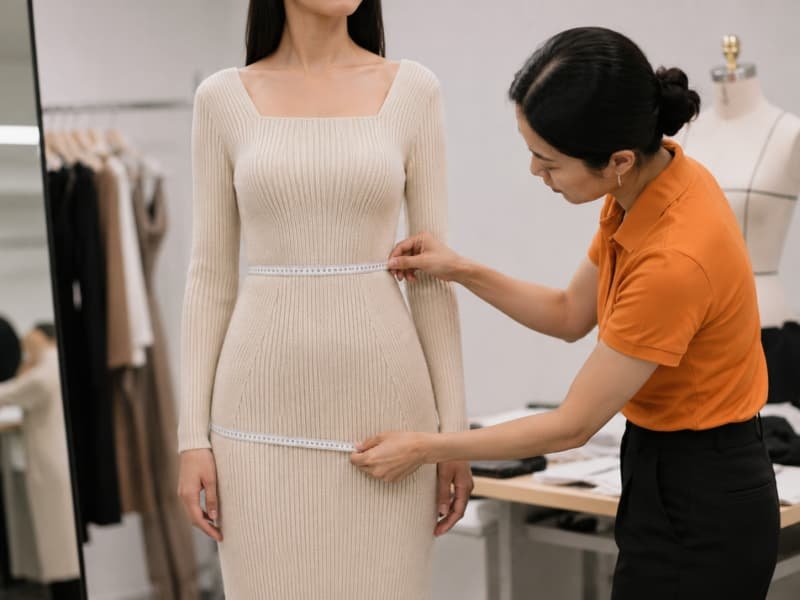
Bodycon fit should be checked through controlled garment measurement and movement-based fitting. The dress must follow the intended bust, waist, and hip contour while maintaining straight seams, stable coverage, balanced front and back lengths, and comfortable movement. Passing the measurement chart alone is not enough if the garment twists, gaps, compresses unevenly, or rides up.
Critical Measurements
The measurement chart should include every point that influences fit, balance, and function. For a simple sleeveless fitted dress, the most important points often include bust, waist, high hip, full hip, body length, armhole, neckline depth, strap length, and hem opening.
Structured styles may also require underbust, cup width, cup height, boning length, princess-seam length, waist seam position, side-seam length, slit height, sleeve opening, bicep, across-front, and across-back measurements.
The measuring method must be consistent. The garment should be rested, fastened, laid flat without tension, and smoothed gently. Pulling the fabric while removing wrinkles can easily change the result.
Point of Measure | Why It Matters | Common Failure |
Bust | Controls coverage, support, and compression | Flattening, gaping, drag lines |
Waist | Defines contour and garment position | Rolling, excessive pressure, loose folds |
High hip | Controls the transition below the waist | Horizontal creasing |
Full hip | Affects movement and ride-up | Pulling, seam rotation, transparency |
Body length | Controls coverage and balance | Short front, raised back hem |
Hem opening | Affects walking and upward movement | Restricted stride, constant ride-up |
Strap length | Controls neckline and armhole position | Low neckline, gaping armhole |
Slit height | Controls mobility and coverage | Excess exposure or restricted movement |
Inspect more than one garment per size. The first piece can be correct while production variation develops later. Record actual values rather than only pass or fail marks. The relationship between measurements also matters: a garment can pass bust, waist, and hip separately but still look unbalanced when the waist level or hip curve is misplaced.
Bust-Waist-Hip Balance
A bodycon dress should not simply feel tight. It should create controlled tension in intended areas without flattening the bust, cutting into the waist, or pulling excessively across the hip.
Inspect from the front, side, and back. Horizontal drag lines commonly point toward an area that lacks width or length. Vertical folds can indicate excess width. Diagonal lines often show an imbalance between pattern shape, body shape, and fabric behavior.
At the bust, check whether the neckline remains stable and the fullest point sits in the intended position. Structured styles should support rather than compress. At the waist, confirm that the narrowest point sits at the approved level. At the hip, inspect both width and level; correct circumference does not guarantee correct fit when fullness is positioned too high or too low.
The wearer should be able to breathe, sit, walk, and bend without the dress shifting dramatically. A style that looks good only when the wearer stands still is not commercially stable. Ask whether the wearer repeatedly pulls the hem down, lifts the neckline, or adjusts straps; those behaviors reveal fit instability.
Seam Balance and Ride-Up
Side seams are one of the clearest indicators of garment balance. They should remain close to the intended side position from the underarm or armhole to the hem.
A seam rotating forward may indicate insufficient front width, excess back width, incorrect grain, or sewing distortion. A seam rotating backward can indicate the opposite balance issue. Left and right seams should be checked separately because one panel may have been cut or sewn differently.
Ride-up should be tested through movement. A practical sequence includes 10-20 normal walking steps, sitting, standing without pulling the dress down, bending slightly, and repeating the sequence. Observe whether the whole garment rises or only one area moves.
Adding width is not always the correct solution. The cause may be the waist-to-hip curve, insufficient front or back length, restrictive lining, high fabric friction, or a hem opening that limits stride. The correction should preserve the intended silhouette while improving stability.
Size Grading
Grading should preserve proportion and fit logic across the size range. Increasing every measurement by the same amount rarely produces a balanced fitted dress.
Bust, waist, hip, neckline, armhole, strap spacing, body length, and hem opening may require different grade increments. Structured components such as cups, boning, seams, and slits may also need repositioning rather than simple enlargement.
Inspect at least the smallest, base, middle, and largest sizes when the range is broad. The base size may fit correctly while larger sizes develop low necklines, short front lengths, strained armholes, or excessive fabric tension. Smaller sizes may develop oversized cups, wide strap positions, or disproportionate slit heights.
Fit review should compare measurements and photographs across sizes. Front, side, and back images taken under similar conditions help identify changes in proportion that numbers can miss. When a defect repeats by size, correct the graded pattern rather than treating each garment as an isolated sewing issue.

Which Sewing Defects Should You Reject?
Reject sewing defects that weaken the garment, alter fit, create visible distortion, cause discomfort, or differ materially from the approved standard. Open seams, skipped stitches, broken stretch seams, severe puckering, wavy hems, unstable zippers, exposed boning, misplaced cups, and loose embellishments normally require repair, replacement, or lot-level investigation depending on frequency and severity.
Seam Security
Bodycon seams must remain secure under tension. A seam can look clean while the garment lies flat but open, grin, or break when stretched over the body.
Inspect side seams, waist seams, princess seams, armholes, necklines, sleeves, lining joins, and zipper areas. Check seam allowance, stitch formation, overlock coverage, thread tension, matching, reinforcement, and visible seam impressions.
Common rejection points include open seams, raw edges outside the overlock, skipped stitches, uneven seam allowance, loose loops, broken back-tacking, and seam grin. A narrow seam allowance may reduce strength, while excessive bulk can show through the outer fabric.
The inside matters as much as the outside. Rough overlocking, hard back-tacking, exposed thread ends, or bulky seam intersections can irritate skin because the dress sits close to the body. Identify whether a defect comes from sewing, pattern tension, or material instability; re-sewing will not solve a garment that is fundamentally too tight.
Stretch Stitch Performance
The stitch must extend with the fabric. A rigid stitch used on a high-stretch seam may break during dressing even when it survives normal handling on the inspection table.
Stretch the seam gradually to a realistic wearing extension. Watch for thread breakage, skipped stitches, needle holes, loose loops, seam opening, and permanent waviness. After release, the seam should return close to its original appearance.
Stitch density should match the fabric and function. Too few stitches can weaken the seam. Too many can perforate a fine knit and reduce elasticity. An unsuitable needle can cut yarns, leaving small holes that enlarge during wear.
Thread choice also affects performance. Construction seams, overlocking, cover stitching, and decorative stitching may require different thread properties. Test high-strain areas such as the hip, side seam, waist, armhole, hem, elastic joins, and lower zipper end. A repeat failure indicates a machine-setting or construction problem, not a one-off defect.
Hems, Zippers, and Linings
A bodycon hem should remain level, smooth, and stable after sewing, pressing, stretching, and wearing. Waviness commonly comes from excessive stretching during sewing, incorrect differential feed, unsuitable thread tension, high presser-foot pressure, or mismatch between the shell and hem construction.
Inspect the hem flat, hanging, on a form, and on the wearer. Check hem depth, tunneling, skipped cover stitches, twisting, flare, and seam impression. A pressed hem may look acceptable briefly and then return to a wavy condition after cooling or wear.
Zippers should open and close smoothly without catching fabric. Check tape exposure, stops, hook-and-eye position, seam matching, slider security, and stress at the lower end. Zipper waviness can result from stretched fabric during insertion, heavy tape, mismatched lengths, or insufficient reinforcement.
Lining should support coverage and comfort without restricting the shell. Check whether it twists, rolls out, pulls at the hem, shows through, or limits movement. Stretch shells generally need lining with compatible extension; when shell and lining behave differently, the outer dress may climb, wrinkle, or feel smaller than the approved sample.
Cups, Boning, and Trims
Cups, boning, elastic, straps, beads, sequins, crystals, mesh panels, and other trims affect fit as well as appearance.
Cups should be symmetrical, securely attached, and positioned relative to the approved bust points. Check shape, thickness, edge visibility, and movement during wear. A cup that shifts or collapses can change the entire front silhouette.
Boning should follow the correct channel, remain straight, and have protected ends. Sharp or exposed boning is a serious safety issue. Inspect whether it twists, pushes through the casing, creates a visible ridge, or restricts sitting and bending.
Elastic should have even tension. Overstretched elastic causes gathers, pressure, and waviness; weak elastic causes neckline or armhole gaping. Decorative trims should match the approved placement, count, spacing, color, and orientation. Light pull testing can identify insecure attachment, and trim application on stretch areas must allow movement without breaking or stopping extension.

Do Bulk Dresses Match the Approved Sample?
Bulk dresses match the approved sample only when materials, measurements, fit, construction, color, workmanship, function, labels, and packing remain consistent across the order. Inspectors should compare garments from different sizes, colors, cartons, production stages, operators, and lines rather than judging the shipment from one carefully selected piece.
Material and Color Consistency
The production fabric should match the approved material in weight, shade, stretch, recovery, surface, hand feel, and finishing. Inspection should include several rolls or garment groups, especially when the order contains multiple dye lots.
Compare front and back panels, sleeves, side sections, straps, facings, and self-fabric trims. Shade variation within one garment is often more noticeable than variation between separate garments.
Inspect early, middle, and late production. Roll changes may introduce differences after first output has passed. When possible, record the roll or dye-lot reference so affected garments can be isolated instead of rechecking the entire shipment without direction.
Color should also be checked under tension. A dark knit may appear lighter across the hip even when its relaxed shade matches approval. Surface consistency includes barre, knitting lines, uneven shine, print variation, finishing streaks, and pressure marks, all of which can reduce the perceived quality of a simple fitted silhouette.
Size and Measurement Stability
Bulk measurement inspection should cover every size and more than one production stage. Checking only the base size cannot reveal grading errors or size-specific sewing variation.
Useful sampling points include first output, inline production, end-of-line pieces, and packed garments. Samples should come from different operators, lines, and cartons when the order structure allows it.
Record actual measurements. Data can reveal whether a value is centered, drifting, or unstable. If the waist becomes progressively smaller through production, the cause may be operator handling, seam allowance, machine setting, bundle variation, or fabric relaxation.
Separate random variation from systematic error. One garment outside tolerance may need repair or replacement. A repeated deviation across many pieces requires process correction and broader inspection. Measurement relationships should also remain stable so the approved bust-waist-hip silhouette is preserved.
Construction and Wear Performance
Bulk construction should reproduce the approved seam type, stitch density, reinforcement, elastic application, lining method, zipper installation, cup placement, boning channel, hem construction, and internal finishing.
A visually similar substitute can still change performance. Replacing a stretch seam with a less elastic method may create breakage. Reducing seam allowance can weaken the garment. Changing elastic tension can alter neckline stability and fit.
When multiple lines or factories produce the style, each production path should pass a first-output review. Operator reference samples, photographs, and construction boards help keep workmanship consistent.
Wear testing should include walking, sitting, standing, bending, raising the arms, turning the torso, and operating all fastenings. After movement, check hem position, neckline stability, side-seam rotation, seat bagging, waist movement, strap position, lining behavior, zipper condition, and seam integrity. The test should reflect the use scenario, whether dancing, prolonged sitting, travel, or social occasions.
Labels and Packing
Final quality includes legal, retail, and logistical accuracy. A well-made dress can still be rejected for the wrong size label, incorrect fiber content, barcode errors, mixed assortments, or damaged packing.
Verify the main label, size label, care label, fiber declaration, country of origin, hangtag, barcode, SKU, color name, and destination-specific wording. Label information must match the actual garment and customer order.
Packing should preserve the product. Check fold method, tissue, hanger use, polybag size, warning text, size stickers, assortment ratio, carton quantity, carton marks, sealing, and gross weight.
Bodycon dresses should not be packed so tightly that cups collapse, zippers leave impressions, embellishments transfer pressure marks, or folds become difficult to remove. Open cartons from different parts of the shipment; checking only one top carton can miss variation in assortment, compression, moisture exposure, or packing discipline.

How Do You Make the AQL Decision?
An AQL decision requires an agreed lot size, inspection level, sample size, defect classification, and acceptance limits. Inspect selected garments randomly, count critical, major, and minor defects, and compare the results with the approved sampling plan. The final decision must also consider measurement, performance, labeling, safety, and systemic problems that defect counts alone may not reveal.
Defect Classification
Defect classification should reflect safety, function, fit, visibility, and customer impact. A critical defect creates a safety risk, legal failure, or unacceptable hazard. A major defect is likely to cause return, complaint, functional failure, or rejection. A minor defect departs from the standard but has limited effect on normal use.
Critical examples include broken needle contamination, sharp exposed boning, dangerous trim edges, or mandatory labeling failures that prevent legal sale. Major examples include an open seam, broken zipper, wrong size, severe fit deviation, excessive transparency, major shade difference, missing lining, incorrect neckline depth, or strong seam rotation.
Minor examples may include a loose thread, small removable mark, slight internal stitch variation, or minor label-position variation. The location and visibility of a defect can change its classification. A small stitch variation inside the lining may be minor, while the same issue at the center-front neckline may be major.
Defect | Common Classification | Reason |
Exposed sharp boning | Critical | Wearer safety risk |
Open side seam | Major | Structural failure |
Broken zipper | Major | Garment cannot function normally |
Wrong size label | Major | Retail and customer risk |
Severe transparency | Major | Product fails expected coverage |
Strong side-seam twist | Major | Visible fit failure |
Loose thread | Minor | Limited appearance issue |
Small removable chalk mark | Minor | Can be corrected without damage |
Classification must follow the buyer’s approved defect manual. The examples above are practical starting points, not universal rules. The brand’s market, product price, legal obligations, and established quality standard remain decisive.
AQL Setup
AQL is a sampling system, not a promise that every unit is defect-free. It allows a buyer to make a structured lot decision without inspecting every garment.
Before inspection, confirm the total lot quantity, presented quantity, inspection level, sample-size code, sample quantity, and separate limits for critical, major, and minor defects.
Many apparel programs use stricter limits for major defects than minor defects and allow no critical defects. The exact settings should be agreed by the buyer. First orders, complex constructions, high-profile launches, or unstable supplier history may justify stricter inspection.
Do not describe AQL as a simple defect percentage. Acceptance and rejection numbers come from the selected sampling plan. Random selection is essential: the sample should represent different cartons, sizes, colors, and packing positions. AQL should not replace separate measurement or performance testing, because a visual sample can pass while an entire size is too small or a stretch seam repeatedly fails.
Pass, Rework, or Fail
A lot may pass when defect counts remain within agreed limits, measurements comply, functional tests pass, labels are correct, packing is acceptable, and no unresolved systemic risk exists.
A hold or rework decision may be appropriate when defects are repairable, the affected scope can be identified, and correction can be completed without damaging the garments. Reworked goods should be inspected again.
Failure may be appropriate when defect counts exceed rejection limits, critical hazards appear, materials differ from approval, major measurements are systematically wrong, or repairs would create further damage.
The decision should explain more than the AQL count. For example: Visual AQL passed, but the lot is held because all inspected size M garments measured below the approved hip tolerance. Or: Reinspection is required after 100% zipper screening and repair. Systematic defects deserve broader action than isolated defects.
Inspection Evidence
The report should allow someone who was not present to understand what was inspected, what failed, and why the lot received its decision.
Record the style, order, color, size range, lot quantity, presented quantity, inspection date, location, inspection level, AQL plan, sample size, defect counts, measurement results, functional tests, label findings, packing results, photographs, and final disposition.
Photographs should show both detail and location. A close-up of puckering should be paired with a wider image showing where it appears on the garment. Measurement photographs should show tape position and the relevant specification.
Use precise observations. Side seam rotated 2.5 cm toward the front after the walking test provides more value than fit is bad. Waist measured 1.2 cm below tolerance in six of eight checked garments supports stronger corrective action than measurements inconsistent. Over time, these records reveal recurring problems by size, fabric, color, construction, line, or supplier.
Turn the checklist into a production-control system
A strong final inspection protects a shipment, but the largest quality gains happen earlier. Fabric selection, pattern engineering, size grading, seam construction, sample approval, and production-readiness control determine whether inspectors find a stable product or a list of preventable failures.
Duolan Apparel develops and manufactures fashion dresses, occasion dresses, party dresses, and body-conscious fitted styles for established brands, buying teams, product teams, and sourcing organizations. Its dress-focused development process covers stretch, recovery, opacity, contour control, fit correction, difficult structures, sample approval, and the transition from approved samples to scalable repeat production.
For a useful technical review, send the current tech pack or reference sample, target fabric performance, size chart, intended fit, color range, construction details, lining and trim requirements, quantity by style and color, required testing, and target sample and launch dates. The development team can review the relationship between design intent, fabric behavior, pattern balance, workmanship risk, and bulk feasibility before production begins.
Share:
Our Services
Categories
Table of Contents
Here, developing fashion collections is more than manufacturing garments — it’s a collaborative process focused on transforming ideas into well-executed, market-ready products. From fabric sourcing and sample development to scalable production and delivery coordination, every stage is built to support quality, consistency, and efficient collection launches across global markets.

