 Skip to content
Custom Mesh Top Manufacturer
Fashion-focused mesh top development and manufacturing for established womenswear brands, product teams and global sourcing offices.
- 8 core product directions, from sheer second-skin tops to structured corset-mesh designs
- 6 material variables reviewed before cutting: composition, GSM, stretch, recovery, opacity and color
- Multi-style programs commonly include 10–30 styles and 20,000–80,000 pieces per order
- Sample-to-bulk controls cover mesh, lining, print, fit, workmanship, labels and retail packing
Duolan develops custom mesh tops from tech packs, reference garments, original samples or collection briefs. Our work covers mesh selection, lining coordination, pattern engineering, fit revision, print development, decorative processes, production readiness and controlled bulk manufacturing.
Developed for Established Fashion and Product Teams
Established Fashion Brands
Seasonal mesh tops often sit inside going-out, partywear, contemporary womenswear, resort or festival collections. Brand teams need one supplier to understand the visual direction while controlling fit, material behavior and production repeatability.
Duolan supports:
- Collection-based development rather than isolated sample making
- Multiple styles, colorways and size ranges under one project structure
- Defined sample stages and revision records
- Fabric, lining, print and workmanship coordination
- Production planning for launch orders, repeat orders and scale-up programs
Product Development Teams
Duolan helps product teams review:
- Whether the proposed mesh supports the intended silhouette
- Which areas require lining, stabilization or double layering
- Whether the artwork can remain balanced after stretch
- Which construction points require testing before approval
- Whether the approved sample can become a repeatable bulk standard
Sourcing and Buying Offices
Sourcing offices often manage several brands, categories and delivery windows at once. Clear documentation, material locking and production checkpoints reduce confusion across development, merchandising, quality and logistics teams.
Duolan provides structured support for:
- Supplier capability review
- Project feasibility assessment
- Multi-style order planning
- Quality and inspection coordination
- Brand-specific labeling and packing instructions
- Shipment documentation and nominated forwarder coordination
Full Garment Development Beyond Blank Customization
Blank Garment Printing
Blank customization usually starts with an existing mesh T-shirt, tank or jersey. Available changes may be limited to logos, numbers, artwork or neck labels. Such a route can work for promotional and sports applications, but offers limited control over:
- Silhouette
- Neckline shape
- Sleeve proportion
- Body length
- Lining position
- Stretch allowance
- Edge finish
- Fabric handfeel
Print-on-Demand Production
- Body stretch
- Panel seams
- Ruching
- Different garment sizes
- Transparent and layered areas
- Neckline and armhole shapes
Full Mesh Top Manufacturing
Duolan builds the product from the required brand direction. The development route can include:
- Custom pattern development
- Mesh and lining sourcing
- Lab dips and print strike-offs
- Fit and proportion review
- Ruching and panel engineering
- Embellishment trials
- Size grading
- PP sample approval
- Bulk manufacturing
- Final inspection and retail packing
Why Mesh Tops Need Specialist Development
Opacity and Coverage
Transparency changes according to mesh density, garment color, stretch level, layering and lighting conditions. A swatch placed flat on a table cannot fully predict the worn result. Development checks should review:
- Flat and stretched opacity
- Bust and underarm coverage
- Lining boundaries
- Skin-tone contrast
- Print coverage
- Dark and light color behavior
Stretch Direction
- Fabric grain
- Main stretch direction
- Pattern orientation
- Negative ease
- Print placement
- Size grading
Print Distortion
Artwork can appear balanced in a digital file but become wider, longer or uneven when the garment stretches over the body. Ruching, side seams and different sizes create additional distortion. Print approval should consider:
- Repeat size
- Stretch compensation
- Panel placement
- Size scaling
- Seam interruption
- Lining influence
Elastic Recovery
Seam Waviness
Edge Instability
Custom Mesh Top Product Range

Sheer Long-Sleeve Tops
- Neckline stability
- Sleeve twist prevention
- Underarm seam comfort
- Cuff recovery
- Body length under stretch
- Flatlock, overlock or narrow-seam selection

Printed Second-Skin Tops
Printed second-skin tops rely on a controlled relationship between artwork, fabric stretch and body fit. Distortion becomes especially visible across the bust, waist and sleeves.
Duolan reviews:
- Artwork repeat and orientation
- Color saturation on transparent mesh
- Print behavior after stretching
- Pattern placement across panels
- Seam interruption
- Grade rules for different sizes
Strike-offs are evaluated both flat and under extension before the print becomes a bulk standard.

Ruched Mesh Tops
Ruching adds volume and visual texture but can change garment measurements, opacity and seam tension. Uneven gathering may create left-right imbalance or inconsistent lengths.
Development includes:
- Ruching ratio
- Elastic or drawstring specification
- Gathering distribution
- Lining construction
- Finished measurement method
- Size grading strategy
Ruching must remain visually balanced across all sizes rather than appearing dense in smaller sizes and weak in larger sizes.

Mesh Crop Tops
Crop proportions depend on the intended styling position: high-waisted skirts, low-rise bottoms, matching sets or layered looks.
Control points include:
- Finished length under stretch
- Hem recovery
- Bust-to-waist shaping
- Sleeve-to-body proportion
- Lining length
- Riding-up behavior
Duolan can coordinate crop tops with matching skirts, trousers or dresses to maintain one fabric, color and workmanship direction across a collection.

Halter Mesh Tops
Halter structures transfer garment tension toward the neckline. Poorly planned patterns can create neck pressure, gaping armholes or unstable bust coverage. Development checks include:
- Neck strap width
- Closure method
- Armhole contour
- Bust shaping
- Lining support
- Back opening
- Wear comfort
Elastic recovery and neckline construction must support the garment without relying on excessive tightness.

Off-Shoulder Mesh Tops
Off-shoulder silhouettes require enough hold to stay in position while allowing arm movement. The upper edge may use elastic, silicone grip, binding or an internal support layer.
Duolan evaluates:
- Upper-edge circumference
- Elastic extension
- Shoulder movement
- Sleeve attachment
- Bust coverage
- Top-edge recovery
- Lining placement

Double-Layer Mesh Tops
Double layering improves coverage, color depth and surface smoothness. Problems occur when the two layers have different stretch or recovery properties.
Material and pattern controls cover:
- Mesh-to-mesh compatibility
- Layer tension
- Cutting alignment
- Seam allowance control
- Twisting prevention
- Hem construction
- Neckline bulk reduction

Corset Mesh Tops
- Bust cup placement
- Boning channels
- Power mesh support
- Seam reinforcement
- Hook-and-eye or zipper closures
- Modesty panels
- Decorative outer mesh
Mesh Tops for Coordinated Fashion Collections

Going-Out Collections

Partywear Programs

Festival Capsules

Resort Directions

Contemporary Womenswear

Seasonal Multi-Style Drops
Mesh Fabrics Selected for the Intended Result

Soft Stretch Mesh
Soft stretch mesh creates a smooth, lightweight feel suited to close-fitting tops and layered designs.
Best suited for:
- Second-skin silhouettes
- Long sleeves
- Printed fitted tops
- Double-layer bodies
- Soft ruching
The material should be checked for recovery, snag sensitivity and seam impression before final selection.

Power Mesh
- Corset interiors
- Bust support
- Waist shaping
- Reinforced side panels
- Structured bodysuits

Fine Sheer Mesh
- Needle marks
- Edge curling
- Snagging
- Seam puckering
- Uneven transparency under stretch

Stretch Tulle
- Gathered sleeves
- Ruffle panels
- Layered yokes
- Decorative overlays
- Sculpted details

Printed Mesh
Printed mesh combines surface artwork with stretch behavior. Print quality cannot be approved only through color accuracy.
Development must also review:
- Ink penetration
- White base requirements
- Stretch cracking
- Pattern enlargement
- Color change when layered
- Repeat alignment

Flocked Mesh
Flocking creates a raised velvet-like pattern over a transparent base. The visual effect is strong, but flock adhesion and surface shedding require evaluation. Control points include:
- Pattern definition
- Adhesion
- Handfeel
- Heat sensitivity
- Cutting orientation
- Packing protection

Embroidered Mesh
Embroidery adds texture and premium detail. Stitch density, backing material and thread tension can distort lightweight mesh.
Development should control:
- Embroidery weight
- Mesh stabilization
- Shrinkage around motifs
- Skin-facing comfort
- Motif placement
- Seam interaction

Glitter Decorative Mesh
- Glitter shedding
- Foil cracking
- Color consistency
- Skin contact
- Pressing limitations
- Polybag protection
Mesh Fabric Specification and Selection Matrix
Material approval should convert visual preferences into repeatable specifications. The matrix below shows how each variable influences fit, appearance and bulk consistency.
| Evaluation Item | Why It Matters | Development Review | Bulk Control |
|---|---|---|---|
| Fiber Composition | Influences handfeel, stretch, dye response and heat sensitivity | Confirm composition and intended wear result | Match approved specification and test documents |
| Fabric Weight | Affects opacity, drape, support and seam appearance | Compare swatches at relaxed and stretched states | Check incoming rolls against approved range |
| Stretch Direction | Determines pattern orientation and body movement | Measure lengthwise and crosswise stretch | Control cutting direction and roll identification |
| Stretch Modulus | Defines how much force is needed to extend the fabric | Compare comfort and support on fit sample | Maintain consistent material source and batch |
| Recovery | Controls neckline, cuff, hem and body shape retention | Review repeated extension and relaxation | Verify bulk fabric against approved behavior |
| Opacity | Influences coverage, lining and color depth | Examine flat, stretched and layered conditions | Use approved layer and color reference |
| Surface Texture | Affects appearance, snag risk and print clarity | Review close-up, touch and wear behavior | Inspect rolls for runs, holes and surface defects |
| Color | Transparent fabrics react strongly to skin tone and lining | Approve lab dip or color standard under relevant light | Separate lots and monitor shade consistency |
| Print Compatibility | Determines saturation, definition and stretch behavior | Approve strike-off flat and extended | Lock artwork, process and production standard |
| Lining Compatibility | Prevents twisting, pulling and uneven recovery | Compare stretch, weight and recovery of both layers | Lock mesh and lining as one material system |
| Edge Behavior | Influences neckline, armhole and hem finishing | Trial binding, narrow hem, elastic or raw finish | Approve production seam and handling method |
| Care Performance | Affects shrinkage, colorfastness and long-term shape | Arrange project-specific testing where required | Apply approved care label and inspection basis |
Coverage and Lining Engineered by Garment Zone
Unlined Sheer Construction
- Layering pieces
- Second-skin tops
- Graphic printed mesh
- Editorial or festival directions
Full Double Layer
Two mesh layers can create richer color, smoother coverage and a more finished appearance. Layer compatibility is essential. Duolan checks:
- Equal or compatible stretch
- Recovery balance
- Layer tension
- Cutting alignment
- Neckline thickness
- Hem construction
- Twisting after wear
Partial Bust Lining
- Lining edge position
- Bust coverage
- Underarm concealment
- Seam connection
- Color matching
- Movement during wear
Nude-Tone Lining
- Target market
- Intended visual contrast
- Available lining tones
- Mesh color
- Photography lighting
- Wearer diversity
Contrast Lining
Contrast lining creates color depth and highlights the mesh pattern. The combination may influence color perception more strongly than either material alone.
The sample should confirm:
- Color interaction
- Print visibility
- Seam appearance
- Stretch compatibility
- Lining exposure at openings
Integrated Modesty Panels
Modesty panels may be built into corset, halter or cut-out styles. The panel needs enough coverage without appearing as an afterthought. Construction should control:
- Panel shape
- Edge concealment
- Stretch direction
- Attachment points
- Lining color
- Bulk at seams
Print and Color Development for Stretch Mesh
All-Over Print Development
- Repeat width and height
- Directional orientation
- Scale after stretch
- Seam matching priorities
- Placement across size ranges
- Cutting efficiency
Placement Print Control
Placement graphics need a defined relationship with the neckline, bust, waist, side seams and hem. A single fixed artwork position may not work across every size. Duolan can coordinate:
- Pattern reference points
- Artwork center lines
- Size-specific scaling
- Print tolerance
- Cutting markers
- Finished garment checks
Strike-Off Approval
- Color saturation
- Edge definition
- Ink penetration
- White-base coverage
- Stretch cracking
- Transparency changes
- Handfeel
Lab Dip and Color Matching
Solid-color mesh and lining should be evaluated together. Similar color codes can appear different because the materials have different weights and surface structures. Approval can include:
- Mesh lab dip
- Lining lab dip
- Trim color
- Elastic color
- Thread color
- Daylight and store-light comparison
Design Details Built for Commercial Production

Controlled Ruching

Cut-Out Panels

Mock Necklines

Thumbhole Sleeves

Lettuce Edges

Asymmetric Necklines

Ties and Drawstrings
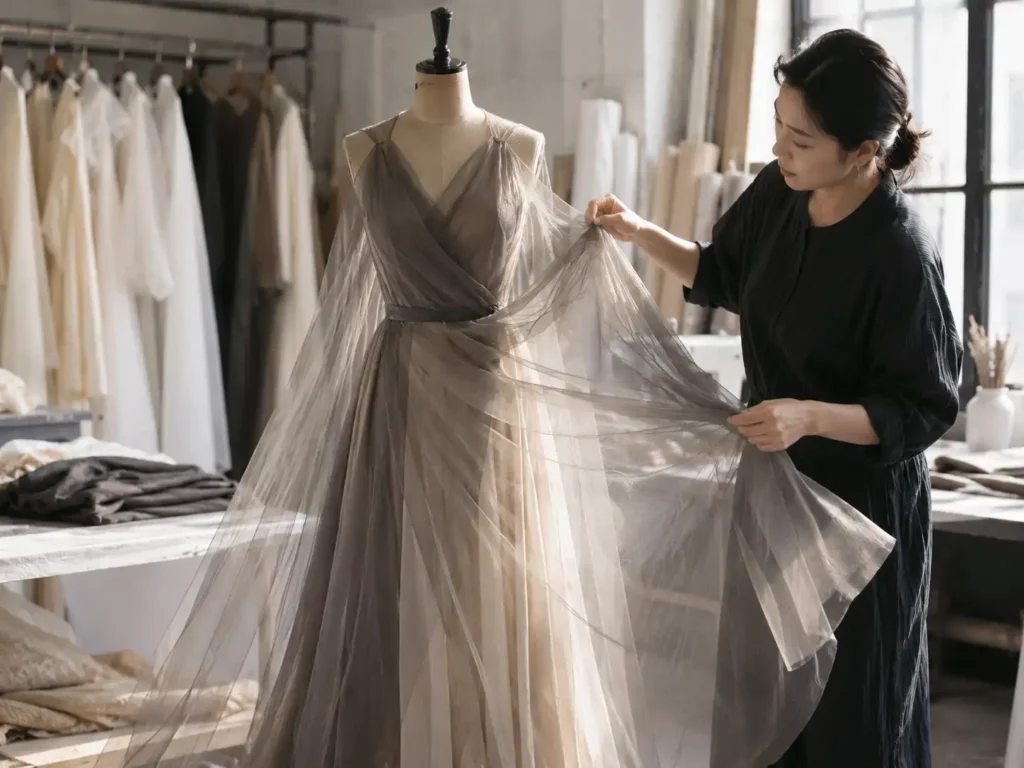
Layered Panels
Embellishments Applied Without Damaging the Mesh
Hotfix Rhinestones
- Adhesive compatibility
- Stone spacing
- Stretch zone placement
- Heat effect
- Wash durability
- Packing protection
Sewn Sequins
- Sequin size
- Thread strength
- Backing
- Motif density
- Seam placement
- Lining coverage
Beads and Pearls
- Attachment count
- Reinforcement
- Distance from edges
- Garment balance
- Skin contact
- Replacement allowance
Embroidery
Lace Appliqué
Decorative Binding
Workmanship Controls That Keep Mesh Stable
Needle Selection
A needle that is too large can leave visible holes, break knit loops or cause runs. A needle that is too fine may deflect when sewing layered areas. Needle choice should consider:
- Fabric fineness
- Elastane content
- Number of layers
- Decorative treatments
- Seam position
- Thread size
Thread Selection
- Seam extension
- Skin contact
- Garment color
- Decorative requirement
- Care method
- Stitch type
Stitch Extensibility
A fitted mesh top stretches during dressing, wear and movement. Seams must extend without thread breakage or visible opening.
Development trials should compare:
- Stitch type
- Stitch density
- Thread tension
- Seam allowance
- Fabric direction
- Expected garment extension
Differential Feeding
- Trial seams
- Feed adjustment
- Operator method
- Seam length comparison
- Relaxation after sewing
- First-piece confirmation
Seam Stabilization
- Shoulder seams
- Necklines
- Off-shoulder edges
- Hanger points
- Zipper areas
- Corset transitions
Edge Finishing
The correct edge depends on fabric behavior and design direction.
Options may include:
- Narrow overlock
- Turned narrow hem
- Binding
- Elastic finish
- Rolled edge
- Lettuce edge
- Controlled raw edge
Layer Alignment
- Paired cutting
- Temporary securing
- Direction marking
- Balanced seam allowances
- Controlled handling
- Resting before measurement
Pressing and Finishing
Synthetic mesh may react to heat, pressure and steam.
Finishing should remove seam impressions and improve presentation without flattening texture or damaging surface treatments.
Pattern Engineering for Stretch Mesh Silhouettes
Negative Ease Based on Fabric Behavior
- Crosswise stretch
- Lengthwise stretch
- Recovery strength
- Fabric weight
- Lining structure
- Desired compression
- Target wearing comfort
Bust and Armhole Balance
Fitted mesh can pull toward the fullest body area. Excess tension may cause armhole distortion, side-seam movement or neckline gaping.
Duolan reviews:
- Bust width
- Front-to-back distribution
- Armhole depth
- Side-seam position
- Shoulder balance
- Sleeve cap relationship
- Lining coverage
Fit comments should identify whether a problem comes from the pattern, fabric or construction method.
Neckline and Shoulder Stability
A neckline may stretch during sewing, dressing or hanger storage. Pattern shape and stabilization should work together.
Possible control methods include:
- Adjusting neckline circumference
- Adding binding or elastic
- Using clear stabilization tape
- Changing seam direction
- Refining shoulder width
- Reducing bulk in layered areas
Mesh and Lining Pattern Relationship
Mesh and lining do not always require identical pattern dimensions. Different stretch and recovery values may require separate pattern adjustments. The sample should check:
- Layer tension
- Bust shaping
- Armhole alignment
- Hem movement
- Neckline smoothness
- Twisting after wear
- Recovery after removal
Measurement and Size Grading Under Stretch

Define Critical Measurement Points
Critical points commonly include:
- Chest width
- Waist width
- Hem width
- Shoulder width
- Armhole depth
- Body length
- Sleeve length
- Bicep width
- Cuff opening
- Neck opening
Each point should include a clear diagram and measurement method.

Build Around a Confirmed Base Size
The base-size fit establishes silhouette, compression and proportion. Grading should begin only after the base pattern, material and construction are sufficiently stable.
A size-set review can include at least three strategic sizes when required:
- Base size
- Smaller validation size
- Larger validation size
The review checks whether neckline, bust, waist, body length and sleeve proportions remain balanced.

Grade Design Features, Not Only Width
Ruching, prints, cut-outs, lining panels and decorative motifs require their own grading logic.
The grade plan may need to adjust:
- Ruching quantity
- Artwork position
- Cut-out size
- Strap length
- Lining coverage
- Embellishment spacing
- Closure length

Establish Project-Specific Tolerances
A universal tolerance is unsuitable for every measurement. High-risk fitted zones may require tighter control than decorative or non-critical areas.
Tolerance decisions should consider:
- Measurement importance
- Fabric recovery
- Seam construction
- Garment size
- Fit sensitivity
- Inspection method
Tech Pack and Feasibility Review Before Sampling
What Your Team Can Submit
Development can begin from one or more of the following:
- Tech pack
- Reference photographs
- Original garment
- Sketches
- Construction details
- Fabric direction
- Print artwork
- Color standards
- Target quantity
- Launch calendar
- Label and packing guide
What Duolan Reviews
The feasibility review covers:
- Product category and intended market
- Mesh and lining compatibility
- Required coverage
- Pattern complexity
- Fit sensitivity
- Print or embellishment process
- Stitching and edge construction
- Size range
- Material availability
- Production scalability
- Inspection requirements
- Launch timing
Development Output
Depending on project maturity, the response may include:
- Recommended sample route
- Material questions
- Construction risk notes
- Artwork requirements
- Missing measurements
- Suggested test points
- Preliminary timeline basis
- Quotation information checklist
Fit Comments Converted Into Controlled Revisions
Comment Classification
- Fit correction
- Measurement adjustment
- Fabric change
- Lining change
- Workmanship correction
- Print adjustment
- Trim modification
- Visual preference
Cause Identification
Duolan reviews how each issue relates to:
- Pattern
- Material
- Construction
- Size specification
- Wearing method
- Intended styling
Revision Summary
A revision record can include:
- Original issue
- Approved instruction
- Pattern change
- Measurement change
- Material change
- Workmanship change
- Expected result
- Remaining point for review
Controlled Mesh Top Production Process
Fabric Receiving
Fabric Inspection
Relaxation and Preparation
Marker and Cutting
Print or Decoration
Sewing
Inline Inspection
Finishing
Packing and Shipment
Mesh Inspection Before Cutting Begins

Shade and Lot Control
Transparent material can show visible shade differences even when color variation appears minor on a folded swatch.
Checks include:
- Roll-to-roll comparison
- Mesh and lining color relationship
- Daylight and controlled-light observation
- Lot identification
- Segregation where required

Surface Defect Inspection
Mesh requires inspection for:
- Holes
- Runs
- Broken knit structures
- Snags
- Oil marks
- Contamination
- Uneven texture
- Flocking gaps
- Print faults

Print Inspection
Printed mesh is reviewed for:
- Color consistency
- Missing areas
- Registration
- Repeat accuracy
- Streaking
- Surface handfeel
- Stretch response

Stretch and Recovery
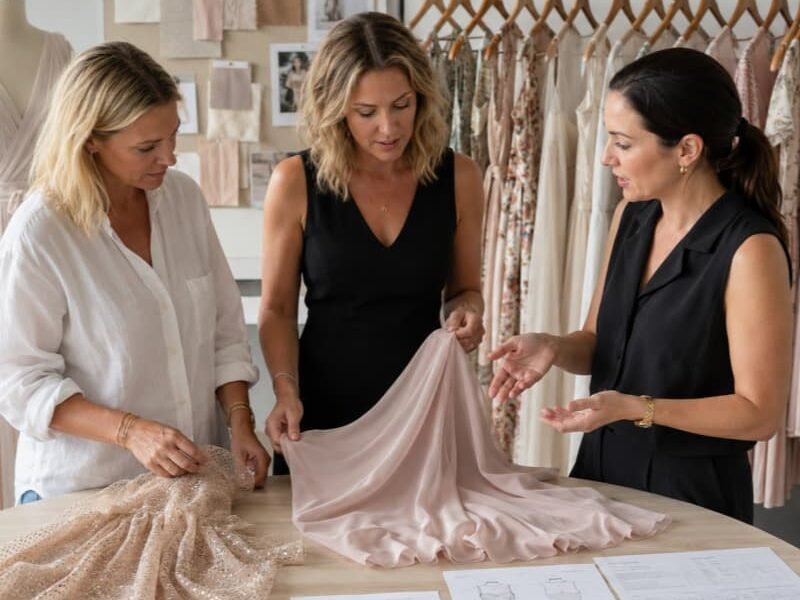
Weight and Width

Material Disposition
Mesh Top Risk and Control Matrix
The following control matrix connects visible garment problems with their technical causes, prevention points and approval evidence.
| Risk | Likely Cause | Main Control Point | Approval Evidence |
|---|---|---|---|
| Excessive Transparency | Low fabric density, high stretch or insufficient lining | Opacity review in relaxed and stretched states | Layered swatch and worn sample |
| Neckline Gaping | Weak recovery, excessive opening or missing stabilization | Pattern correction and edge trial | Fit sample and neckline measurement |
| Seam Waviness | Fabric stretching during sewing or unbalanced feed | Sewing trial and first-piece check | Relaxed seam close-up |
| Thread Breakage | Insufficient seam extension or incorrect thread system | Seam extension test | Dressing and stretch review |
| Layer Twisting | Different recovery between mesh and lining | Material matching and paired cutting | Wear test and hanging review |
| Print Distortion | Artwork not adjusted for body extension | Strike-off and fitted sample review | Flat-versus-worn comparison |
| Ruching Imbalance | Inconsistent elastic length or gathering ratio | Defined operation and measurement standard | Left-right visual comparison |
| Snagging and Runs | Delicate knit structure or surface damage | Fabric inspection and handling control | Roll inspection record |
| Embellishment Loss | Incompatible adhesive or insufficient attachment | Process trial and attachment check | Approved decorated panel |
| Size Deviation | Incorrect negative ease or inconsistent measurement method | Fit approval, grading review and inline measurement | Approved size chart and audit record |
| Color Variation | Mixed material lots or inconsistent print process | Lot control and shade comparison | Lightbox or color-reference photo |
| Packing Marks | Heat, pressure, folding or surface abrasion | Packing trial and protective materials | Approved packed sample |
Quality Control Across Production and Packing

Pre-Production Review
Before line release, teams confirm:Approved sample,Material and trim basis,Measurement chart,Workmanship points,Artwork and color,Labels,Packing requirements,High-risk areas.

First-Piece Check
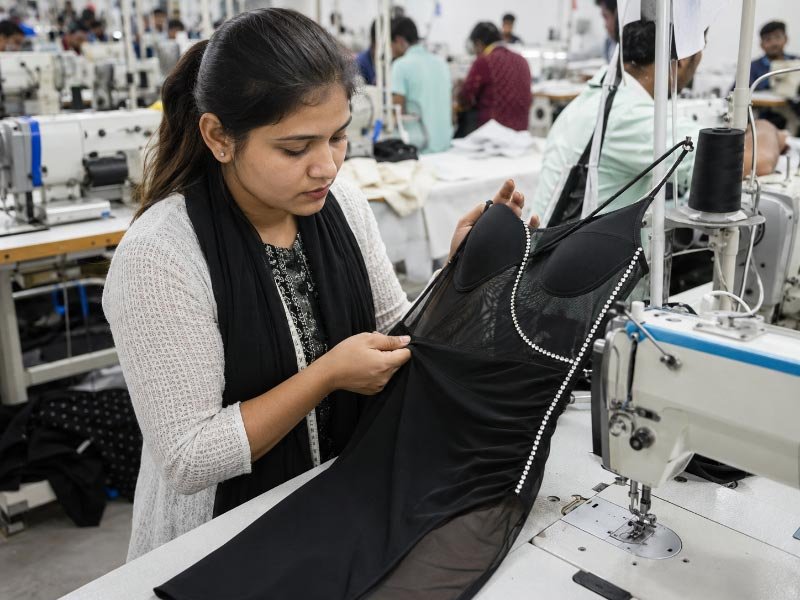
Inline Inspection
Inline checks monitor:Key measurements,Seam waviness,Needle damage,Ruching balance,Layer alignment,Print placement,Opening recovery,Decorative attachment.

Measurement Audit

Final Inspection

Packing Verification
Packing checks confirm:Correct style,Correct color,Correct size,Hangtag and label,Polybag,Barcode,Assortment,Carton quantity,Carton marks.
Manufacturing Structure for Multi-Style Fashion Programs
Nearly 30 Years’ Industry Foundation
16 Owned Womenswear Factories
20+ Coordinated Satellite Factories
12,000+ Supporting Workers
300 Sewing Lines
50+ Flexible Response Lines
Compliance and Documentation Prepared Early
Factory and Social Audit
Duolan’s manufacturing system has completed a SMETA audit and SMETA 2-Pillar audit and maintains a SMETA social audit record.
Brand-Specific Standards
Duolan can review vendor manuals, quality manuals, packing guides, RSL documents and inspection requirements supplied by the brand.
Standard Application
AATCC, ASTM, OEKO-TEX®, EN, China GB, GOTS and other standards may be relevant to different materials or markets.
Fabric and Material Testing
- Fiber composition
- Colorfastness
- Dimensional stability
- pH
- Restricted substances
- Print or decoration performance
- Care performance
Labeling Information
Label preparation may cover:
- Fiber content
- Country of origin
- Size
- Care instructions
- Brand label
- Barcode
- Product code
- Market-specific wording
Shipment Documentation
Shipment coordination may include:
- Commercial invoice
- Packing list
- HS code information
- Inspection documents
- Testing records
- Carton details
- Forwarder coordination
Private Labels and Retail-Ready Mesh Top Packing
Main Brand Labels
Care and Composition Labels
Hangtags
Hangtag attachment should avoid snagging. Fine mesh may require placement through a seam, label loop or reinforced area.
Size and Barcode Labels
Individual Packing
Folding and Cartons
Representative Multi-Style Mesh Top Programs

U.S. Going-Out Mesh Capsule
Program Profile:
- Region: United States
- Collection: Printed and ruched going-out tops
- Styles: 18
- Total quantity: 42,600 pieces
- Colorways: 2–4 per style
- Size range: Six sizes
- Product mix: Long-sleeve second-skin tops, ruched crops, asymmetric styles and lined bust panels
Development Challenge: Artwork looked balanced on flat mesh but became enlarged across the bust and compressed inside ruched zones. Several styles also used different levels of transparency within one collection. Control Route:
- Artwork repeats were reviewed against pattern dimensions
- Strike-offs were checked relaxed and stretched
- Ruching ratios were defined by style
- Partial lining boundaries were adjusted during fit review
- Print placement was revised across the size range
- Mesh and lining colors were approved together
- First production pieces were reviewed for print position and seam waviness
Program Result: Two controlled sample rounds established the final print, fit and lining direction. Production was divided by style complexity, with printed fitted styles and ruched styles receiving separate first-piece checks. The collection moved into a planned 32–38-day production window after PP approval and material readiness.

UK Double-Layer Contemporary Tops
Program Profile:
- Region: United Kingdom
- Collection: Refined double-layer mesh tops
- Styles: 12
- Total quantity: 24,800 pieces
- Colorways: Black, chocolate, burgundy and muted neutral shades
- Size range: Five sizes
- Product mix: Mock necks, draped fronts, off-shoulder tops and long-sleeve fitted shapes
Development Challenge: The first material combination produced twisting at the hem and uneven tension around the neckline because the outer mesh and inner layer had different recovery values. Control Route:
- Outer mesh and lining stretch were compared
- The lining pattern was separated from the outer pattern
- Neckline construction was reduced in bulk
- Layer direction marks were added
- Paired cutting and temporary securing were introduced
- Size-set validation checked smaller, base and larger sizes
- First-piece review focused on neck opening, body length and layer balance
Program Result: A revised material system removed the visible twisting and improved neckline recovery. The final program used shared mesh and lining standards across several styles, helping maintain color continuity and simplifying repeat-order planning.

European Embellished Partywear Program
Program Profile:
- Region: Europe
- Collection: Embellished mesh party tops
- Styles: 26
- Total quantity: 71,400 pieces
- Product directions: Rhinestone mesh, flocked panels, corset-mesh combinations and lace appliqué
- Size range: Six sizes
- Order structure: Launch quantities followed by planned repeat capacity
Development Challenge: The collection combined heat-applied stones, embroidery, lace and structured internal components. Decorative weight, skin comfort, heat sensitivity and production consistency varied by style. Control Route:
- Decoration trials were separated by material type
- Hotfix temperature was checked on approved mesh
- High-density motifs received localized reinforcement
- Corset styles used internal support and lining reviews
- Decorative placement was connected to pattern reference points
- High-risk styles entered first-piece and inline attachment checks
- Packing methods were adjusted to protect raised surfaces
Program Result: The order was divided into production paths according to decoration and structure. Shared color standards, labeling and packing instructions kept the multi-style program coordinated while allowing different workmanship controls for each product group.
Frequently Asked Questions About Custom Mesh Tops

Start Your Custom Mesh Top Development Program
Send the information already available, whether it is a complete tech pack, a reference image, an original garment, print artwork or an early collection brief. Duolan will review the product direction, material requirements, fit sensitivity, construction risks, sample path and bulk-production basis before recommending the next step.
Useful project information includes:
- Company or brand name
- Target market
- Mesh top category
- Tech pack or reference images
- Original sample photographs
- Fabric and lining direction
- Print or decoration files
- Target colors
- Size range and measurement chart
- Estimated quantity by style
- Number of planned styles
- Label and packaging requirements
- Required sample stage
- Target launch or delivery date
- Quality, testing or compliance manual
Duolan can support development from a single defined product group through coordinated programs containing 10–30 styles and total order quantities of approximately 20,000–80,000 pieces. Final sample timing, commercial terms and production planning are confirmed after the available project information has been reviewed.


