 Skip to content
What Is a Sealed Sample in Garment Manufacturing?
Your trusted Women’s Apparel Development & Manufacturing Partner from China
- Jerry
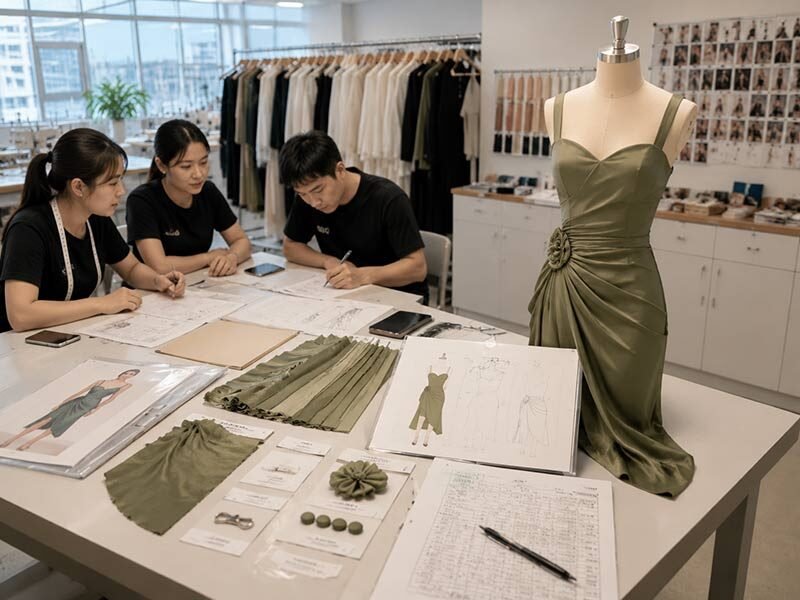
One approved dress can prevent hundreds or thousands of inconsistent garments, but only when everyone agrees on exactly what that dress represents. In fast-fashion production, many costly disputes begin after a sample ‘looks approved’ while important details remain open: a zipper changes, the lining becomes lighter, the waist tolerance is unclear, or an embellishment layout is interpreted differently on the production line. A sealed sample turns approval from a casual email into a controlled production reference.
A sealed sample is the final garment sample formally approved by the brand and manufacturer as the physical benchmark for bulk production. It usually begins as a pre-production sample and becomes sealed after fit, measurements, fabric, trims, workmanship, color, labels, and packing requirements are accepted and recorded. Bulk garments and inspections are then judged against that approved standard.
The word ‘sealed’ does not necessarily mean the garment is locked inside a plastic bag. Depending on the company, it may carry a signed tag, dated approval card, numbered seal, stamp, or controlled sample-room record. The important point is traceability: the sample must be identifiable, protected from undocumented alteration, and linked to the correct style, color, size, revision, and approval comments. Imagine approving a fitted satin dress on Friday and discovering three weeks later that production used a softer lining and a different zipper tape. The silhouette may still look similar on a hanger, yet the fit, drape, and customer experience can change completely. That is why the sealed sample matters long after the sample meeting ends.
What Is a Sealed Sample?
A sealed sample is the final approved garment used as the physical standard for bulk production and inspection. It normally begins as a pre-production sample and becomes sealed after the buyer confirms its fit, measurements, fabric, trims, construction, color, labels, and finishing. The sample must be clearly identified so it cannot be confused with an earlier or unapproved version.
Approval Status, Not Packaging
The word ‘sealed’ often causes unnecessary confusion. In apparel manufacturing, it does not usually mean the garment has simply been placed inside a closed plastic bag. It means that the sample has been formally accepted, identified, and protected as the production reference.
Different brands use different control methods. A sample may carry a signed approval tag, a dated card, a numbered security tie, an official stamp, or a label stating ‘Approved for Bulk Production.’ Some companies call it a gold seal sample, red seal sample, red tag sample, approved PP sample, or production reference sample.
The name matters less than the control behind it. A useful sealed sample should answer five basic questions:
- Which style does it represent?
- Which color and size were approved?
- Which revision is final?
- Who approved it?
- Does it authorize bulk production?
If those questions cannot be answered from the sample and its records, the garment may be approved informally but is not well controlled. In practice, the sealed sample is the point where product development stops being open-ended. Before sealing, the neckline, fit, lining, zipper, or embellishment placement may still change. After sealing, any change should be treated as a controlled revision rather than a casual production adjustment.
PP Sample and Sealed Sample
A pre-production sample and a sealed sample are closely connected, but they are not technically identical. A PP sample describes a stage in the development process. It is produced before bulk manufacturing to show how the final garment is expected to look and be constructed. Ideally, it uses the intended bulk fabric, lining, trims, labels, and sewing methods.
A sealed sample describes the approval status of that garment. When the buyer, technical team, and manufacturer accept the PP sample, it may be signed, tagged, dated, and retained as the sealed sample.
This distinction becomes important when a factory says, ‘The PP sample is finished.’ Finished does not necessarily mean approved. The buyer may still be reviewing fit, color, workmanship, or packaging. Similarly, a sample may look visually correct while still containing temporary fabric or substitute trims.
A reliable production release should identify whether the PP sample is submitted for review, rejected, approved with comments, approved for bulk production, or sealed as the controlling reference. ‘Approved with comments’ should be handled carefully. If the remaining comments affect the pattern, construction, material consumption, or appearance, bulk cutting should normally wait until those issues are formally closed.
What the Sample Locks
A sealed sample does not replace the tech pack, measurement chart, bill of materials, or approval comments. It works with those documents. The garment shows the intended physical result, while the records provide values and instructions that may not be visible from appearance alone.
Control area | What the sealed sample should represent | Supporting evidence | Risk if unclear |
Style identity | Final style, color, size, and revision | Style code and approval date | Wrong version used |
Fit | Silhouette, balance, contour, and wearing result | Fit comments and images | Bulk fits differently |
Measurements | Approved points of measure | Final spec and tolerances | Inconsistent sizing |
Fabric | Weight, stretch, drape, hand feel, and finish | Approved swatch or lot | Different appearance |
Trims | Zipper, cups, boning, elastic, buttons, and hardware | Approved trim card | Function changes |
Construction | Seams, stitch types, reinforcement, and lining | Workmanship sheet | Weak or distorted sewing |
Decoration | Print, embroidery, sequins, and placement | Artwork or placement guide | Visual mismatch |
Branding | Main label, size label, care label, and hangtag | Approved artwork | Retail or compliance error |
Packaging | Folding, polybag, barcode, and carton method | Packing instructions | Warehouse rejection |
The exact scope depends on the garment. A loose day dress may require fewer controls than a fitted corset dress with cups, boning, lining, and embellishment. The approval checklist should reflect the actual construction and commercial risk rather than treating every garment as if it has the same failure points.
Physical and Digital Control
A physical sealed sample remains valuable because it shows three-dimensional shape, hand feel, drape, seam appearance, and overall balance in a way that photographs cannot fully capture. However, the sample should also be supported by a digital approval file. This usually includes dated photos, close-up construction images, final measurements, comments, trim references, and the approved tech-pack revision.
This dual system is useful when the order involves multiple factories, production lines, or inspection locations. The original garment may remain in a controlled sample room, while production teams work from approved images and operation sheets. Inspectors can refer to the original whenever a dispute or unclear point appears.
Storage is also part of sample control. A sample can lose value if it becomes stretched, stained, faded, or altered. Narrow straps may lengthen after hanging for months. Elastic garments may distort if stored under tension. Sequins or decorative parts may be lost through repeated handling.
For long-running repeat orders, the factory should periodically confirm that the physical sample remains usable and that the digital records still match the latest approved production standard.

Why Is a Sealed Sample Important?
A sealed sample is important because it gives the brand, factory, and inspection teams one agreed physical standard. It reduces subjective interpretation, limits unauthorized changes, and helps identify whether bulk garments match the approved fit, materials, workmanship, and appearance. Its real value is not the seal itself, but the shared production discipline it creates before large quantities are manufactured.
Reducing Production Risk
The cost of a mistake increases sharply as a garment moves from development into bulk production. A fit issue found during sampling may require one new pattern and one revised garment. The same issue found after hundreds or thousands of pieces have been cut may cause recutting, material shortages, rework, delivery delays, or unsellable stock.
A sealed sample reduces that risk by narrowing the number of acceptable interpretations. Before approval, the team may be considering two lining weights, several zipper options, or different strap constructions. Once the sample is sealed, the selected option becomes the reference.
This control is especially important when small changes affect the whole garment. A softer zipper tape can change how a fitted satin dress falls at the center back. A boning substitute can reduce bust support. A lining with lower stretch can make a bodycon dress feel tighter even when the outer measurements remain unchanged.
The sealed sample does not eliminate natural textile variation, nor does it make every garment mathematically identical. It helps separate reasonable production variation from an unapproved change in product direction. The best risk control happens before fabric cutting. Once the buyer and factory agree that the sample is genuinely production-ready, the chance of costly late-stage disagreement becomes much lower.
Creating One Quality Standard
Without an approved reference, quality inspection can become subjective. One inspector may accept a neckline shape that another inspector rejects. A sewing supervisor may interpret ‘cleaner waist shaping’ differently from a technical designer. A pressing team may flatten a seam that was intended to remain softly rolled.
The sealed sample provides a common visual and construction standard. It can be used during first-piece approval, pilot production, inline inspection, top-of-production review, final inspection, and repeat-order comparison.
Written measurements remain essential, but they do not fully describe the product. Two garments can have similar bust and waist measurements while looking different because of strap length, seam tension, cup placement, or fabric recovery. Experienced QC teams compare the whole garment, not just individual numbers.
The sample is particularly useful for cumulative deviation. A slightly wider waist, slightly longer straps, and a slightly lower armhole may each appear minor. Together, they can completely weaken the intended fitted shape.
Protecting Dress Fit and Appearance
Fashion dresses are often more sensitive to small production changes than basic garments. A T-shirt can tolerate some variation without losing its identity. A corset, halter, backless, bodycon, or satin dress may not.
A structured dress can depend on the precise relationship between cup shape, boning position, waist contour, zipper tension, and lining support. If one component changes, the garment may still measure correctly while fitting poorly.
Satin styles create different risks. Seam puckering, grain direction, pressing marks, and lining weight can become highly visible under light. Mesh garments require control of transparency, stretch direction, seam allowance, and attachment tension. Sequin garments need consistent motif placement, safe seam treatment, and secure decoration.
For these categories, the sealed sample provides an appearance benchmark as well as a construction benchmark. It helps the production team understand what the garment should do on the body, not merely how the pattern pieces should be joined. Fashion customers judge the product by how it looks, feels, photographs, and moves – not by whether the specification was followed in isolation.
Supporting Better Commercial Decisions
A sealed sample also supports purchasing, costing, and delivery decisions. Once the final materials and construction are approved, the factory can calculate consumption more accurately, confirm production methods, assign suitable lines, and plan realistic lead times.
Before sealing, changes remain possible. A longer lining, wider hem, heavier cup, or different embellishment density can affect cost and material use. Approving the sample without closing those issues creates commercial uncertainty.
For buyers, the sealed sample provides evidence that the quoted product and the manufactured product should be the same. For factories, it protects against late requests that were not included in the approved version.
This does not mean the sealed sample should be used to avoid reasonable problem-solving. Production realities can require changes. A bulk fabric lot may behave differently from the sample yardage, or an approved trim may become unavailable. The correct response is controlled communication: document the problem, propose an alternative, make a trial when needed, and obtain approval. The sealed sample gives both parties a clear starting point for evaluating that change.
How Is a Sealed Sample Approved?
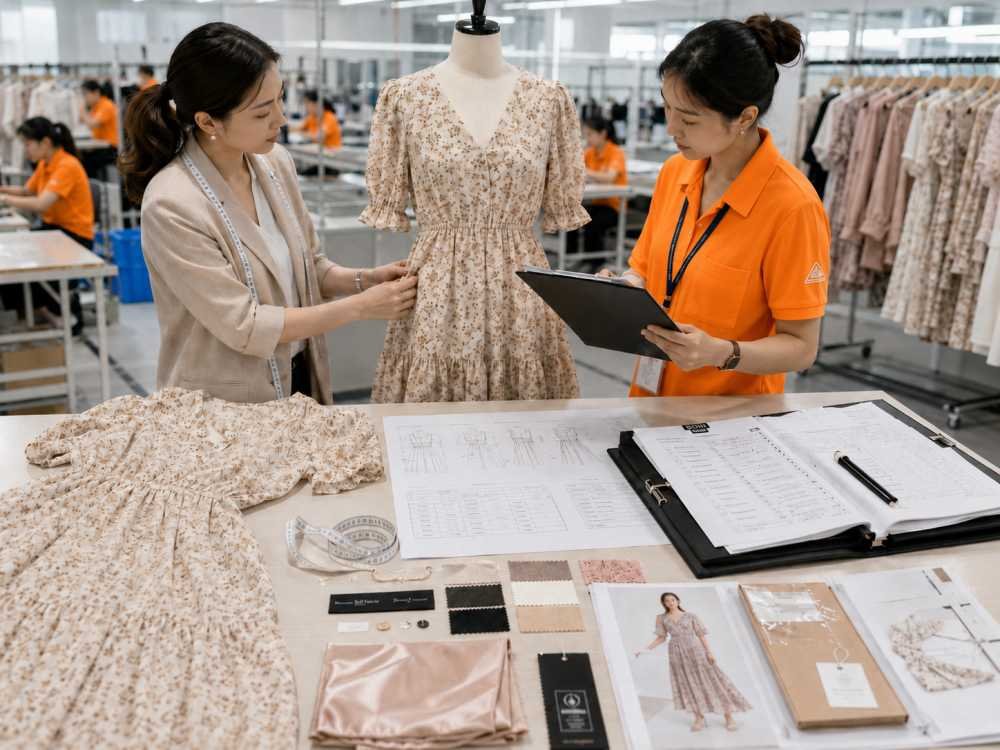
A sealed sample is approved through a documented review of fit, measurements, materials, construction, appearance, branding, and packaging. The final garment must be linked to the correct style, color, size, and revision. Bulk production should begin only after the responsible buyer and factory teams close product-critical comments and confirm that the approved result can be repeated consistently.
Who Gives Approval?
Approval authority depends on the structure of the brand. A smaller fashion company may rely on the founder, designer, or product manager. A larger brand may involve several departments, each responsible for a different part of the decision.
The design team may approve the overall look, proportion, and brand direction. A technical designer or garment technologist may approve fit, measurements, grading, and construction. The buyer may confirm cost and delivery. Quality or compliance teams may review labels, testing, and market requirements.
The manufacturer also has responsibilities. The merchandiser, pattern team, sample room, production technician, and quality team should confirm that the approved result can be reproduced under normal bulk conditions.
A visually attractive sample should not be approved if its construction relies on hand adjustments that cannot be repeated on a production line. Similarly, a technically correct garment should not be released if it clearly misses the intended brand look. The strongest approval is cross-functional. It brings together commercial, visual, technical, and manufacturing readiness rather than allowing one department’s approval to stand for everything.
Approval Gate
A practical approval process uses clear status labels rather than informal messages such as ‘looks fine’ or ‘please proceed.’
Approval gate | Main review | Typical owner | Production implication |
Design review | Silhouette, details, and visual direction | Designer or product team | Development continues |
Fit review | Balance, measurements, and wearing result | Technical team | Pattern may be revised |
Material review | Fabric, lining, trims, and color | Buyer and material team | Bulk materials can be confirmed |
Construction review | Seams, support, and workmanship | Factory technician and QA | Production method is fixed |
Branding review | Labels, artwork, and placement | Brand and compliance team | Labels can be ordered |
Packaging review | Folding, barcodes, and carton method | Logistics or operations | Packing can be prepared |
Bulk release | All critical comments closed | Authorized buyer representative | Cutting and production may begin |
These stages do not always happen one after another. In fast-fashion development, several may run in parallel. Fabric may be approved while fit revisions continue, and packaging may be finalized after the garment is technically accepted.
The important point is that bulk release should not be assumed simply because most elements have been approved. The final record should state clearly whether production is authorized and which, if any, conditions remain open.
Required Records
The sealed sample should be supported by enough information that a qualified person can understand the approval months later without relying on memory. The basic record should include:
- Brand and supplier name
- Style number, color, and sample size
- Sample type and revision number
- Approval date
- Approver name or role
- Final approval status
It should also reference the current tech pack, measurement specification, bill of materials, fit comments, color approval, artwork approval, and packaging instructions.
Complex dresses often require additional close-up records. A corset style may need images showing cup position, boning termination, waist seam, and zipper reinforcement. A mesh dress may require a clear record of lining coverage and transparency. A sequin style may need a placement map and instruction for clearing sequins from seam allowances.
Any limitation must be visible. If the sample uses substitute trims, temporary labels, or non-bulk fabric, the approval should state exactly what remains subject to confirmation. A partly representative sample should not be presented as fully final.
Production Release
Bulk production should start when the approved sample, materials, pattern, and manufacturing method are aligned. A practical production release asks:
- Is this the latest approved sample?
- Are the production fabric and trims confirmed?
- Are all fit and construction comments closed?
- Is the pattern updated to match the sample?
- Are labels and artwork approved?
- Can the factory repeat the result at the required quantity?
- Have any approved exceptions been documented?
Some preparatory work can begin before full approval. The factory may reserve capacity, plan markers, source materials, or prepare operation breakdowns. Irreversible work deserves more caution.
Bulk cutting is usually the most important decision point. If an open comment can change garment dimensions, fabric consumption, placement, or construction, cutting should normally wait. Fast production should come from strong coordination, not from skipping approval gates. A delay of one or two days at the correct stage may prevent weeks of rework later.

What Should Buyers Check Before Sealing?
Before sealing, buyers should confirm that the sample is not only attractive but also repeatable in bulk. The review should cover actual production materials, fit, measurements, construction, artwork, labels, and packaging. Every comment should be closed or clearly marked as conditional. A sample should not be approved merely because the launch deadline is approaching.
Materials and Color
The approved sample should use actual bulk materials whenever practical. A substitute fabric may look similar while behaving differently during cutting, sewing, pressing, wearing, or washing.
For fitted dresses, buyers should pay attention to stretch and recovery. Two fabrics may have the same fiber composition but produce different fit because of construction, yarn, finishing, or stretch direction.
For satin, weight and surface finish influence drape, shine, seam puckering, and pressing behavior. Mesh varies in transparency, softness, and recovery. Velvet can show significant visual shade differences depending on pile direction. Sequin fabrics may vary in motif density and base-fabric stability.
Trims deserve the same level of review. Zippers, boning, cups, elastic, hooks, rings, and sliders affect function as well as appearance. Color should be reviewed against an approved standard under agreed lighting. Shell fabric, lining, thread, zipper tape, and decorative components may appear matched under one light source and noticeably different under another. When bulk material is not yet available, the approval record should state that the final production lot remains subject to bulk shade or quality confirmation.
Fit and Measurements
Fit review should combine body evaluation with measurement data. Numbers alone are not enough. A dress can meet the specification and still gape at the neckline, twist at the side seam, ride up while walking, or pull across the hip.
Critical control points depend on the style. Fitted dresses usually require closer attention to bust, underbust, waist, high hip, full hip, strap length, neckline depth, armhole, garment length, and slit position.
The following ranges are common working examples in fashion manufacturing, but each brand should define its own tolerance standard based on fabric, construction, size, and product risk.
Control point | Common working tolerance example | Higher-risk situation |
Bust, waist, or hip on fitted styles | +/- 0.5-1.0 cm | High-stretch bodycon or corset styles |
Garment length | +/- 1.0 cm | Asymmetric hems or floor-length dresses |
Strap length | +/- 0.5 cm | Halter, backless, or narrow-strap styles |
Neckline or slit depth | +/- 0.5 cm | Deep necklines or high slits |
Print placement | +/- 0.5-1.0 cm | Engineered or centered motifs |
Embellishment placement | +/- 0.5-1.0 cm | Symmetrical bust or waist decoration |
Label placement | +/- 0.5 cm | Visible external branding |
Color shade | Buyer-approved standard | Satin, velvet, and mixed materials |
These examples are not universal acceptance rules. A loose casual dress may allow wider variation, while a structured occasion dress may require tighter control.
The buyer should also confirm the base size and grading approach. Approving one medium-size sample does not prove that the smallest and largest sizes will fit correctly. Highly fitted collections often benefit from a size-set review before full production.
Construction and Workmanship
A sample-room garment may be made by one highly skilled machinist who spends considerably more time on difficult operations than a bulk line can. Before sealing, the buyer and factory should confirm that the approved workmanship is repeatable.
Important checks include seam type, stitch density, seam allowance, reinforcement, thread tension, edge finishing, pressing, lining attachment, closure installation, and internal support. High-risk dress operations commonly include:
- Invisible zipper insertion
- Narrow straps and curved necklines
- Mesh seam joins and bias-cut panels
- Boning channels and cup attachment
- Side slits and stretch-to-non-stretch joins
- Sequin seam clearing and secure decoration
The inside of the garment should be inspected as carefully as the outside. Rough boning ends, loose lining, exposed seam edges, unsecured threads, or poorly finished zipper ends may not appear in product images but can create comfort and durability problems.
For complicated garments, a small pilot run is often more informative than relying on one sample. It shows whether different operators can reproduce the same result and whether machinery, templates, pressing methods, or operation sequences need adjustment.
Labels, Packaging, and Open Comments
Labels and packaging often appear secondary during sampling, but they can delay shipment just as easily as a fit problem. Buyers should verify the main label, size label, care label, fiber content, country-of-origin statement, hangtag, barcode, price ticket, and required market language. Placement should be measurable rather than described vaguely.
Packaging should cover folding method, tissue, hangers, polybag dimensions, warning text, stickers, barcode position, carton quantity, assortment ratio, shipping marks, and any retailer-specific requirements.
Every development comment should also be traceable. A useful closure record shows the original comment, the action taken, the sample version containing the correction, the person who reviewed it, and the final status.
Verbal approval can be useful for speed, but it should be summarized in writing. When one item remains open, the record should state who must approve it, the deadline, and whether production can proceed beforehand. The most dangerous approval is not an obvious rejection. It is a sample everyone assumes someone else has fully approved.

How Is It Used in Bulk Production?
The sealed sample is used as a production, training, and inspection reference. Pattern, cutting, sewing, finishing, and QC teams compare bulk garments with the approved sample and its supporting documents. It should guide first-piece review, inline control, and final inspection. Any meaningful deviation should be contained, investigated, and approved instead of becoming an undocumented production standard.
Before the Line Starts
The sealed sample must be converted into practical production controls before sewing begins. It is not enough to place it in the sample room and expect every operator to understand it.
The pattern team should confirm that the final pattern reflects the approved fit. Cutting should verify grain direction, nap direction, placement, matching, and fabric orientation. The sewing team should receive an operation breakdown showing seam types, stitch requirements, reinforcement points, and critical assembly details.
For difficult garments, the factory may prepare close-up construction photographs, approved operation samples, marked pattern references, stitch and seam standards, placement templates, pressing guides, and first-piece checklists.
The original sealed sample should remain protected. Production teams can use controlled photographs and temporary access rather than repeatedly handling the garment throughout the day. Multi-line orders require additional discipline. When two factories or several production lines are involved, every location should receive the same information. Duplicate samples should be verified against the original before they are treated as authorized references.
A production meeting should highlight the features most likely to fail. For a satin dress, this may be seam puckering and pressing. For a corset dress, it may be cup shape and boning position. For a mesh dress, it may be transparency and lining coverage.
First Piece and Inline Control
The first completed production pieces show whether the sample-room result can be reproduced under real factory conditions. Bulk fabric may behave differently from sample yardage. Operators may handle curved seams or slippery materials differently. Pressing may change measurements. A production zipper may have slightly different stiffness from the approved sample.
These issues should be identified before the line reaches high output. A strong first-piece review compares critical measurements, overall fit and balance, fabric direction, seam appearance, closure function, lining and internal support, decoration placement, pressing, and finishing.
Inline inspection then monitors whether the result remains stable. Quality can drift when operators change, machines are adjusted, new fabric rolls enter production, or output pressure increases.
Inspection frequency should reflect product risk. Complex fitted dresses normally require more attention than simple loose styles. The aim is not to inspect every low-risk detail repeatedly. It is to detect the problems most likely to affect customer satisfaction, returns, or brand presentation.
Managing Deviations
When bulk production differs meaningfully from the sealed sample, the first step is containment. The affected garments should be separated, and production should pause where continuing would increase the quantity of defective goods.
The team should identify whether the problem comes from fabric variation, pattern error, cutting, sewing method, machine setting, pressing, trim substitution, or misinterpretation of comments. The factory should then assess the affected quantity, commercial impact, possible repair, and delivery effect.
Clear communication is essential. A useful deviation report includes photographs, measurements, estimated quantities, root cause, proposed correction, and timing.
Some differences can be corrected safely. Others may require replacement, re-cutting, or formal buyer acceptance. If the buyer approves a deviation, that decision should be recorded so the final inspection team does not later reject an authorized change.
Not every minor variation requires production stoppage. The response should be proportional. However, fit, safety, legal labeling, visible appearance, closure function, and customer-use problems should never be accepted informally.
Repeat Orders and Revisions
A sealed sample can remain useful for repeat orders, but it should not be assumed to remain valid forever. A new approval may be needed when fabric comes from a different mill, color changes, trim suppliers change, the pattern is revised, the size range expands, construction is simplified, the style has been inactive for a long period, or production moves to another factory.
The previous sample may still be used when the style, materials, pattern, supplier, and specifications remain unchanged. Even then, it is wise to check the sample’s condition and confirm that the current bill of materials matches the original record.
Any change after approval should create a controlled revision. The sealed sample should not be physically altered without documentation. A new reference, date, and approval status should identify the revised version.
A repeat order can behave like a new development when the manufacturing conditions change significantly. The correct decision should be based on risk, not simply on whether the style number is familiar.

How Does It Compare With Other Samples?
A sealed sample differs from other garment samples mainly through its approval status and purpose. Fit samples test shape and measurements, size sets test grading, PP samples demonstrate production readiness, TOP samples verify early bulk output, and shipment samples represent completed goods. The sealed sample is the formally controlled standard used to guide production and judge whether bulk garments are acceptable.
Sample Types at a Glance
Garment sample terminology varies between brands and factories. The clearest way to understand each sample is to ask what decision it is intended to support.
Sample type | Main purpose | Typical materials | Timing | Bulk authority |
Prototype | Test the initial design concept | May use substitutes | Early development | No |
Fit sample | Review shape, balance, and measurements | Similar fabric preferred | Fit development | Usually no |
Size set | Confirm grading across sizes | Production-like materials | Before or around PP | Not by itself |
Salesman sample | Support sales, photography, or presentation | May use close substitutes | Before bulk | Usually no |
PP sample | Demonstrate production readiness | Intended bulk materials | Immediately before bulk | After approval |
Sealed sample | Establish the final approved standard | Final approved materials | At production release | Yes |
TOP sample | Confirm early bulk output | Actual production materials | Start of production | Verifies production |
Shipment sample | Represent completed goods | Actual bulk product | Before or after shipment | No |
Counter sample | Provide a duplicate reference | Should match approved sample | After approval | Only if authorized |
The same garment may change status. A PP sample can become the sealed sample after approval. A duplicate made later can become an authorized counter sample after side-by-side verification. The critical point is not what the garment is called, but what it has been approved to prove.
Fit Sample and Size Set
A fit sample focuses on how the base pattern sits on the body. It helps the team review balance, proportion, comfort, movement, and measurements. It may not contain every final trim or label. In some cases, a substitute fabric is used to speed up development, although the substitute should behave similarly enough to make the fit review meaningful.
A size set applies the approved grading rules across selected sizes. It checks whether the garment maintains its intended proportions as it becomes smaller or larger. This matters greatly for fitted dresses. The base size may fit well, while larger sizes develop poor bust balance or smaller sizes become too tight at the armhole. Grading is not simply the process of adding or subtracting the same amount everywhere.
Neither sample automatically becomes the sealed production standard. A fit sample may approve pattern direction while materials remain open. A size set may confirm grading while labels or finishing are still incomplete.
The sealed sample should represent the final approved result after the relevant fit and size issues have been resolved.
PP Sample and TOP Sample
The PP sample is submitted before production to show that the style is ready for bulk manufacturing. It should normally combine the final pattern, fabric, lining, trims, construction, color, and finishing. Once it is approved and formally identified, it may become the sealed sample.
The TOP sample is different because it comes from actual bulk production. It is selected near the beginning of the production run to confirm that the line is reproducing the sealed standard.
The two samples answer different questions. The sealed sample asks, ‘What exactly should we manufacture?’ The TOP sample asks, ‘Is the live production line manufacturing it correctly?’
A TOP review is valuable because sample-room conditions are not identical to bulk production. Real production may expose differences in fabric behavior, operation sequence, pressing, seam handling, or operator consistency. If a TOP sample differs from the sealed sample, it should not automatically become the new standard. The production process should be corrected, or the buyer should formally approve a controlled change.
Shipment and Counter Samples
A shipment sample is selected from completed bulk goods. It shows what the buyer is actually receiving and may be retained for archive, showroom use, photography, final review, or dispute investigation.
It should match the sealed sample within the agreed specifications and tolerances. If it differs materially, that difference should already have been identified and approved during production.
A counter sample is a duplicate reference kept by another party, such as the factory, brand office, sourcing office, or inspection team. It is useful when the original sealed sample cannot remain in every location.
However, a counter sample is only reliable when it has been compared with the original and formally accepted. A garment made on another day, from another fabric roll, or by another sample machinist may contain subtle differences. The duplicate should carry the same style, color, size, revision, and approval information. It should also be clear whether the original or the counter sample takes priority if a disagreement appears. A random duplicate is not automatically an approved standard. The authority comes from verification and control, not from physical similarity alone.
From Sample Approval to Reliable Bulk Production
A sealed sample is not just another garment hanging in a sample room. It is the point where design intent, technical approval, and manufacturing responsibility meet. When the sample is supported by accurate records and used actively throughout production, it helps brands protect fit, materials, workmanship, and presentation while giving the factory a stable target to reproduce.
The strongest process is simple to describe but disciplined to execute: confirm the correct sample version, close critical comments, lock the production materials and methods, record the approval, review first production pieces, and control every later revision. That structure is especially valuable for occasion, party, bodycon, corset, halter, backless, satin, mesh, and embellished dresses, where small changes can have a visible effect on fit and customer experience.
Duolan Apparel is a custom women’s fashion manufacturer based in Guangdong, China, with a dress-focused development and production system for fashion dresses, occasion dresses, party dresses, fitted styles, fashion sets, and related premium women’s fashion products. Brand buying teams, product developers, and sourcing offices can submit a tech pack, reference sample, material brief, size range, order plan, and target launch date for project evaluation.
Share:
Our Services
Categories
Table of Contents
Here, developing fashion collections is more than manufacturing garments — it’s a collaborative process focused on transforming ideas into well-executed, market-ready products. From fabric sourcing and sample development to scalable production and delivery coordination, every stage is built to support quality, consistency, and efficient collection launches across global markets.

