 Skip to content
What Is AQL in Garment Inspection : A Practical Guide for Fashion Brands
Your trusted Women’s Apparel Development & Manufacturing Partner from China
- Jerry

A dress can look perfect in a campaign photograph and still create hundreds of returns once it reaches customers. A weak zipper, an unstable neckline, inconsistent measurements, missing labels, puckered seams, or a lining that twists after pressing may affect only a small part of production, yet that small part can damage an entire launch. Fashion brands therefore need a repeatable way to evaluate bulk orders without checking every garment individually.
AQL, or Acceptance Quality Limit, is a statistical sampling method used to decide whether a garment production lot should be accepted or rejected. An inspector selects a defined sample, classifies defects as critical, major, or minor, and compares the findings with predetermined acceptance and rejection numbers.
AQL does not promise that every shipped garment is flawless. It creates a structured decision rule that lets a brand, manufacturer, or inspection company evaluate a large order through a representative sample. Its value comes from combining that rule with approved samples, measurement tolerances, workmanship standards, material controls, and effective production checkpoints.
Imagine an inspector opening the final carton of a 1,200-piece occasion-dress order. Five dresses have serious zipper failures. The next defective dress may decide whether the shipment leaves the factory or returns to the production floor. Understanding AQL explains why that single finding can carry so much commercial weight.
What Is AQL in Garment Inspection?
AQL is a sampling-based acceptance system used to determine whether a garment production lot meets an agreed quality threshold. It connects lot quantity, inspection level, sample size, defect classes, and acceptance or rejection numbers. It is a shipment decision tool, not permission to produce a fixed percentage of defective garments.
What AQL Actually Measures
AQL is not simply a factory quality score. It is one part of an acceptance-sampling plan that links the total quantity presented for inspection, the selected inspection level, the required sample size, the chosen AQL value for each defect class, and the acceptance or rejection numbers.
For example, a brand may order 1,200 dresses and request General Inspection Level II. The lot size and inspection level determine how many pieces must be selected. The inspector then counts critical, major, and minor findings according to definitions approved before production.
The decision is made at lot level. The inspector is not merely judging whether the selected dresses look attractive. The sample is being used to estimate whether the complete production lot presents an acceptable commercial risk.
AQL is normally applied through inspection by attributes. Each characteristic is judged as conforming or nonconforming: a zipper works or it does not; a measurement is within tolerance or outside it; a label is correct or incorrect; a neckline is symmetrical or visibly distorted. This makes AQL practical for garments, where quality includes construction, function, fit, appearance, labeling, and packing.
An AQL plan should answer five connected questions:
- How many garments are in the inspection lot?
- Which inspection level has been agreed?
- How many units must be selected?
- How many critical, major, and minor defects were found?
- At what count does the lot pass or fail?
Why AQL Is Not a Defect Allowance
AQL 2.5 is often described casually as allowing 2.5% defects. That explanation is misleading.
The number 2.5 is used to locate an acceptance plan in a sampling table. It does not automatically mean that 2.5% of the order may be defective, and it does not mean that exactly 2.5% of the inspected sample can fail.
Suppose 80 garments are inspected under a commonly used normal single-sampling plan. At AQL 2.5, the table may provide an acceptance number of 5 and a rejection number of 6. The lot can pass with five applicable findings but fails when the sixth is reached. Five findings in a sample of 80 are more than 2.5% of that sample, which is why simple percentage calculation gives the wrong interpretation.
A manufacturer should never use the AQL limit as a production target. If a sewing line aims to remain just below the rejection number, the quality system is already weak. Internal production control should aim for far fewer defects, while AQL operates as an independent final gate.
Why Fashion Brands Use AQL
Inspecting every unit can be justified for safety-sensitive products, very small lots, repeated failures, or high-value garments. For larger commercial orders, however, a full inspection requires substantial time, labor, handling, unfolding, measuring, refolding, and repacking. It can also introduce new damage.
AQL provides a repeatable basis for making shipment decisions. It helps brand teams, factories, sourcing offices, and inspection companies work from the same rules rather than subjective comments such as “the quality looks fine.”
- Creates a consistent pass-or-fail decision rule.
- Focuses inspection resources on a defined sample.
- Separates safety risk from commercial and cosmetic defects.
- Supports supplier and repeat-order comparisons.
- Provides documented evidence for correction and reinspection.
- Reduces disputes caused by undefined expectations.
The system is particularly useful when a brand manages multiple styles, colors, sizes, factories, and launch dates. A failed zipper on a fitted dress is not treated like a removable thread inside a lining. The classification and agreed limit determine how strongly the finding affects the result.
What AQL Cannot Prove
A passing AQL result does not prove that every unit is perfect. Most of the production lot remains uninspected, so sampling risk always exists.
AQL also cannot replace fabric testing, colorfastness testing, seam-strength evaluation, needle-control procedures, measurement specifications, approved production samples, inline quality control, or legal compliance checks. A visually acceptable sample may still contain fabric that shrinks excessively after washing. A dress may meet measurements while carrying the wrong fiber-content label. A zipper may work during inspection but fail durability testing.
The strength of AQL depends on the quality of the underlying specification. If a brand has not approved measurement tolerances, workmanship standards, fabric references, packaging instructions, and defect classifications, the inspector has no dependable basis for judgment.
AQL answers whether the presented lot met an agreed sampling rule. It does not answer every question about product safety, durability, performance, or long-term customer satisfaction.

How Does AQL Sampling Work?
AQL sampling begins by defining the inspection lot and selecting an inspection level. These determine a code letter and sample size. Garments are selected randomly across cartons, sizes, colors, and production batches, checked against approved requirements, and compared with the acceptance and rejection numbers for each defect category.
Lot Size and Code Letter
The inspection lot is the quantity presented as one group for acceptance. It may be the full purchase order, one style, one color, one production batch, or another buyer-approved unit.
Lot formation matters more than many sourcing teams realize. Imagine a purchase order containing three dress styles made in two factories. Combining all styles and production locations into one lot may hide a serious problem in a smaller group. A heavily defective style can appear acceptable when its findings are diluted by larger quantities of conforming products.
A practical lot should contain garments produced under reasonably consistent conditions: the same style or related construction, approved material specification, production location, manufacturing period, and packing instruction. Once the lot is defined, its quantity is matched with the selected inspection level. The table provides a code letter, which leads to the required sample size.
Lot Size | Code Letter | Sample Size |
91-150 | F | 20 |
151-280 | G | 32 |
281-500 | H | 50 |
501-1,200 | J | 80 |
1,201-3,200 | K | 125 |
3,201-10,000 | L | 200 |
10,001-35,000 | M | 315 |
35,001-150,000 | N | 500 |
Note: These figures illustrate sample sizes commonly associated with General Inspection Level II in a normal single-sampling framework. The licensed table and contractual standard must control the actual inspection.
The sample does not increase in direct proportion to the order. A 10,000-piece order does not require ten times the sample used for a 1,000-piece order. Statistical sampling is designed to improve decision efficiency without examining the same percentage of every lot.
Inspection Levels
General inspection levels I, II, and III determine inspection intensity.
Level I produces a smaller sample and may be used where lower intensity is justified. It reduces inspection time but gives less discrimination between good and poor lots.
Level II is frequently selected for routine commercial garment inspection because it balances sample size, cost, and decision confidence.
Level III produces a larger sample and may be appropriate when product risk is higher, supplier performance is unstable, or the buyer needs stronger discrimination.
Special inspection levels S-1 to S-4 provide smaller samples for checks that are costly, slow, destructive, or technically specialized. They may be used for selected tests rather than the complete workmanship inspection.
A higher inspection level does not improve production by itself; it only changes the sample size. The level should be agreed before inspection, not reduced because the factory is behind schedule or because the required sample takes too long to check.
Random Sample Selection
A statistically calculated sample is useful only when the selected garments genuinely represent the production lot. The inspector should control carton and unit selection. Factory staff can move cartons, but they should not decide which garments determine the result.
- Cartons from different pallet and warehouse positions.
- Early, middle, and late production.
- Different sewing lines and packing dates.
- All available colors and a reasonable spread of sizes.
- Different fabric, trim, print, or embellishment batches.
- More than one production area when applicable.
Size representation is especially important for fitted products. A medium dress may look correct while the smallest or largest size reveals grading problems. Cup position, strap length, waist shaping, armhole depth, and skirt balance can change unevenly across a size range.
Color coverage matters too. Pale colors reveal stains and transparency issues that may be invisible in black. Printed fabrics can show placement or shade variation limited to one colorway.
Random selection does not mean careless selection. It means preventing preference for the best-looking units while ensuring the sample reflects meaningful production variation.
Sampling Risks
Every sampling system involves risk. A buyer may accept a lot that contains more defects than expected because the sample happened to perform well. A factory may also have a broadly acceptable lot rejected because the sample contained an unusually high concentration of defects.
These risks cannot be removed completely without inspecting every unit, but they can be managed through correct lot definition, genuine random selection, suitable inspection levels, clear defect classifications, reliable production records, strong inline controls, and additional checks for known high-risk operations.
Sampling risk becomes greater when defects are concentrated. If one line produced all dresses with a zipper-setting problem, a sample that misses that line may not detect it. This is why reports should connect findings with size, color, carton, production line, and material batch whenever possible.
A total count tells the brand whether the lot passed or failed. Distribution data helps explain why the problem occurred and how the factory should correct it.

Which AQL Level Should You Use?
The appropriate AQL depends on product risk, retail positioning, construction complexity, legal obligations, customer expectations, sales channel, and supplier history. Lower AQL values are stricter, but the numerical limit must be paired with product-specific defect definitions, measurement tolerances, and inspection instructions agreed before production.
Common AQL Values
Garment programs often use different values for different defect categories. Critical defects are frequently managed through a strict buyer-defined rule, often Ac 0 and Re 1. Major defects may be controlled at AQL 1.0, 1.5, 2.5, or another agreed value. Minor defects may use AQL 2.5, 4.0, or another selected level.
A lower number generally produces an earlier rejection point under the same sample size. AQL 1.0 is therefore normally stricter than AQL 2.5. The value alone, however, does not define the complete quality expectation.
Consider two brands using major AQL 2.5. One classifies visible satin seam puckering as major. Another treats it as minor unless it affects the front bodice. Their real quality standards are different even though their numerical AQL is identical.
A workable agreement requires both a numerical sampling plan and a product-specific defect dictionary.
Product Situation | Possible Major AQL Approach | Additional Controls |
Stable repeat order, simple construction | 2.5 may be commercially suitable | Routine inline and final checks |
First order with a new supplier | 1.5-2.5 depending on risk | Earlier inline inspection and stronger measurement review |
Premium fitted occasion dress | 1.0-2.5 depending on brand policy | Expanded fit, symmetry, zipper, lining, and measurement checks |
Corset or bustier construction | A stricter threshold may be justified | Boning, cup position, support, sharp-end, and closure checks |
Heavy sequin or beaded garment | Based on retail risk and workmanship standard | Attachment, shedding, snagging, weight, and backing checks |
Safety-sensitive product | Buyer-defined strict limits | Testing, compliance review, and zero-tolerance safety rules |
Practical note: The examples above are risk-based planning considerations, not universal mandatory limits. The purchase contract and approved inspection standard must control the final requirement.
Product Risk Matters
The correct AQL should reflect how the garment can fail in the real market. A loose casual dress and a structured corset dress do not carry the same risk. A small measurement deviation may be barely noticeable in a relaxed silhouette but can make a fitted dress uncomfortable or unwearable.
- Strapless, halter, and backless dresses.
- Corset and bustier structures.
- Bodycon and other fitted silhouettes.
- Sheer mesh or lace constructions.
- Satin and other fabrics that expose seam distortion.
- Sequin, bead, pearl, and rhinestone styles.
- White or pale garments that show stains and transparency.
- Multi-layer occasion dresses with cups, boning, or complex closures.
For a strapless dress, neckline stability may be more important than a small internal stitch variation. For a white mesh dress, opacity and lining placement may matter more than a removable thread end.
A stronger quality plan does not always mean lowering one AQL value. It can include a higher inspection level, tighter tolerances, more measurement samples, special tests, 100% needle detection where required, extra inline checks, or third-party final inspection.
The most effective plan focuses on actual failure modes. A corset dress needs checks for cup balance, boning ends, closure performance, neckline stability, symmetry, comfort, and support. Inspecting only general stitching quality would miss the risks that customers are most likely to notice.
Supplier and Channel Risk
Supplier history should influence inspection planning. A manufacturer that has completed several stable repeat orders may justify a different approach from a new factory making the style for the first time.
- Previous first-inspection pass rates.
- Repeated defect categories and root causes.
- Corrective-action performance.
- Consistency between samples and bulk production.
- Stability across colors, sizes, and repeat orders.
- Peak-season performance and schedule discipline.
- Experience with similar fabrics and constructions.
- Accuracy of document control and communication.
The sales channel changes the commercial effect of defects. E-commerce products can generate expensive returns if fit, color, or appearance differs from the listing. Retail distribution centers may reject cartons for incorrect barcodes, assortments, labels, or shipping marks. Premium products face stricter appearance expectations than basic items.
The AQL plan should therefore consider the complete cost of failure: rework, missed launch dates, chargebacks, customer returns, negative reviews, lost margin, and lost repeat sales.
Style-Specific Limits
Using the same defect interpretation for every garment category is convenient but often unrealistic. Different styles have different critical measurements and visible priorities.
A bodycon dress may require tight control over bust, waist, hip, side-seam balance, and fabric recovery. A halter dress needs attention to strap length, neckline tension, underarm coverage, and neck comfort. A sequin dress requires defined rules for missing sequins, attachment security, pattern gaps, exposed backing, and skin irritation.
The numerical AQL can remain the same while the defect list changes by style. Brands should identify critical measurements, fit-sensitive areas, symmetry points, closure requirements, lining coverage, fabric behavior, embellishment attachment, pressing standards, and packaging details.
This becomes especially important when one purchase order contains several styles. “Good workmanship required” does not tell an inspector how much neckline asymmetry is acceptable or when seam puckering becomes a major defect.

What Are Critical, Major, and Minor Defects?
Critical defects create unacceptable safety, legal, or compliance risks. Major defects materially affect function, fit, durability, appearance, saleability, or customer acceptance. Minor defects reduce finish quality without seriously affecting normal use. Classification depends on location, visibility, frequency, product purpose, approved specifications, and retail positioning.
Defect Class | Main Question | Garment Examples | Typical Decision Impact |
Critical | Could it harm the wearer or violate a mandatory requirement? | Broken needle, exposed sharp component, hazardous trim, serious mandatory safety-label failure | Usually zero tolerance or Ac 0 / Re 1 when specified |
Major | Would a customer reject, return, or be unable to use the garment? | Open seam, failed zipper, hole, severe stain, wrong construction, significant measurement deviation | Counted against the major AQL |
Minor | Does it reduce finish quality without materially affecting use? | Removable thread, small hidden stitch irregularity, non-prominent cosmetic issue | Counted against the minor AQL |
Critical Defects
A critical defect presents a serious safety, legal, or compliance risk and normally requires immediate action. It is not simply a very unattractive workmanship issue.
- Broken needle fragments or metal pieces inside a garment.
- Exposed sharp boning, wire, or hardware ends.
- Hazardous components or prohibited small parts in applicable products.
- Confirmed restricted-substance failures.
- Serious mandatory safety-label omissions.
- Construction that could reasonably injure the wearer.
Critical findings often indicate a process failure beyond the sampled unit. If a broken needle piece is discovered, removing it from one dress is not enough. The factory may need to isolate affected production, review needle records, inspect the work area, check related garments, and complete metal detection under the agreed procedure.
The same principle applies to an exposed boning end. One sharp point may indicate that cutting length, end protection, casing construction, or final inspection was not controlled correctly.
Critical classifications should be used carefully. A prominent stain can make a garment unsaleable, but it is normally major rather than critical unless it creates a defined health or safety risk.
Major Defects
A major defect is likely to cause rejection, return, loss of function, poor fit, or a substantial reduction in product value.
- Open seams, skipped stitches, holes, cuts, or prominent stains.
- Broken, jammed, or distorted zippers and closures.
- Incorrect fabric, lining, color, trim, or garment construction.
- Missing labels, straps, cups, hooks, or decorative components.
- Serious shade differences or asymmetric visible details.
- Measurements outside tolerance where fit is affected.
- Severe seam puckering on satin or other sensitive materials.
- Incorrect labels, barcodes, or packing that prevents sale or distribution.
Major defects are especially important in fashion dresses because a small construction error can change the complete silhouette. A side seam twisting forward alters the skirt fall. An invisible zipper set too tightly creates rippling. A cup positioned too high or low changes the appearance and comfort of a fitted bodice.
Measurement failures should be judged through fit impact. A 1 cm deviation at a loose skirt hem may be less important than a 1 cm deviation at the bust, waist, strap, neckline, or cup position of a fitted dress.
Minor Defects
A minor defect departs from the approved standard but does not materially affect safety, function, fit, durability, or normal wear. It still matters, especially in premium fashion, because several small workmanship issues can make a garment feel poorly produced.
- A removable loose thread in a non-prominent area.
- Slight internal stitch unevenness that does not weaken the seam.
- A small hidden marking invisible during normal wear.
- Minor pressing inconsistency that is easily corrected.
- Slight internal overlock variation with no durability effect.
- A small cosmetic variation within the approved tolerance.
Location changes classification. A loose thread inside a lining may be minor; the same thread hanging from the center front of a satin dress can affect retail presentation much more strongly.
The brand’s market position also matters. Customers buying occasionwear often inspect visible stitching, symmetry, pressing, lining, closures, and embellishment more closely than customers buying a basic casual item.
Minor defects should not be ignored internally. A passing lot with a high minor count may indicate workmanship drift that could become a major-defect problem on future orders.
When Classification Changes
The same physical issue can move between categories depending on location, visibility, frequency, product use, and buyer requirements.
A small missing sequin in a concealed area may be minor. A visible gap in the center-front pattern can be major. The component becomes critical only when it creates a defined safety risk. A measurement deviation with no visible fit effect may be minor, while the same deviation at a critical fitted area can be major.
Frequency changes the commercial meaning of a defect. One slightly uneven internal seam may be minor. The same issue repeated across a large share of the sample suggests a systematic process problem and may require broader sorting or corrective action.
Inspectors should record severity and pattern. Style, size, color, carton, production line, and material-batch information reveal whether the problem is isolated or widespread. Defect reference photographs showing acceptable, borderline, and unacceptable conditions can make classification much more consistent across inspectors and factories.

How Do You Read an AQL Table?
To read an AQL table, locate the lot-size range, move to the selected inspection level, and identify the code letter. Use that code in the applicable sampling-plan table to find the sample size, then read the acceptance and rejection numbers under the chosen AQL values. Every defect category must remain within its limit.
Finding the Code Letter
Begin with the total quantity presented for inspection. Suppose an order contains 1,200 dresses. Under a commonly used General Inspection Level II plan, the lot-size range of 501-1,200 leads to code letter J. Code J normally corresponds to a sample size of 80 units in a normal single-sampling framework.
- Confirm the inspection lot quantity.
- Confirm the inspection level.
- Locate the lot-size range.
- Read the corresponding code letter.
- Find the matching sample size.
- Locate the chosen AQL columns.
- Record each acceptance and rejection pair.
The correct table must match the standard and sampling condition named in the inspection instruction. Normal, tightened, and reduced plans may not produce the same decision.
The code letter is not a quality grade. It is a link between the lot-size table and the sample-size table. The inspector should also confirm that the required production quantity is completed and available for random selection. Inspecting a small early portion of production and treating it as the final lot can give a misleading result.
Reading Ac and Re
Ac means acceptance number. It is the highest applicable count that can be accepted under the selected plan. Re means rejection number. Reaching that count causes the lot to fail for the relevant defect class.
Suppose the plan gives critical Ac 0 / Re 1, major AQL 2.5 with Ac 5 / Re 6, and minor AQL 4.0 with Ac 7 / Re 8. The lot can pass with five major findings but fails when the sixth is confirmed. It can pass with seven minor findings but fails at eight. One critical finding rejects the lot under the stated rule.
Each category is assessed separately. A low minor count does not compensate for excessive major defects. Inspectors should not average all findings into one combined total because critical, major, and minor defects represent different levels of risk.
A useful inspection report records:
- Defect description and classification.
- Quantity found.
- Style, color, and size.
- Clear photographs.
- Carton, production line, or batch reference where possible.
- Measurement result and tolerance where relevant.
Worked Order Example
The following example illustrates a normal single-sampling decision. It is not a replacement for the licensed table or the buyer’s approved inspection instructions.
Inspection Item | Example |
Product | Fitted occasion dress |
Lot size | 1,200 pieces |
Inspection level | General Level II |
Code letter | J |
Sample size | 80 pieces |
Critical rule | Ac 0 / Re 1 |
Major level | AQL 2.5, Ac 5 / Re 6 |
Minor level | AQL 4.0, Ac 7 / Re 8 |
Result A | 0 critical, 5 major, 6 minor – pass under the illustrated limits |
Result B | 0 critical, 6 major, 4 minor – fail because major defects reached Re 6 |
Result C | 1 critical, 2 major, 2 minor – fail because the critical limit was exceeded |
A failed result does not mean that only the sampled defective garments need repair. The sample represents the lot. If six dresses in the sample have zipper failures, removing those six units does not prove that the remaining order is acceptable. The failure may be connected to one zipper batch, sewing operator, production line, or construction method.
The shipment should be held while the manufacturer identifies the affected scope, completes sorting or correction, and prepares the lot for reinspection.
Defects and Defective Units
A defect is one nonconforming characteristic. A defective unit is one garment containing one or more defects. The distinction can change the result.
One dress may have a broken zipper, an open side seam, and a visible oil stain. That is one defective garment with three defects. Depending on the agreed method, the report may count three defects, one defective unit, or one unit classified by its most serious problem.
The counting method must be defined before inspection. Brands should avoid vague instructions such as “count all problems normally,” because different inspectors may interpret that statement differently.
- Whether defects or defective units control the decision.
- How multiple findings on one garment are recorded.
- Whether repeated identical defects are counted separately.
- How measurement failures are counted.
- Whether packaging findings use separate limits.
- How one systematic issue affecting many units is treated.
Clear counting rules make reports more comparable across factories, countries, inspection companies, and repeat orders.
How Should AQL Be Applied in Garment Production?
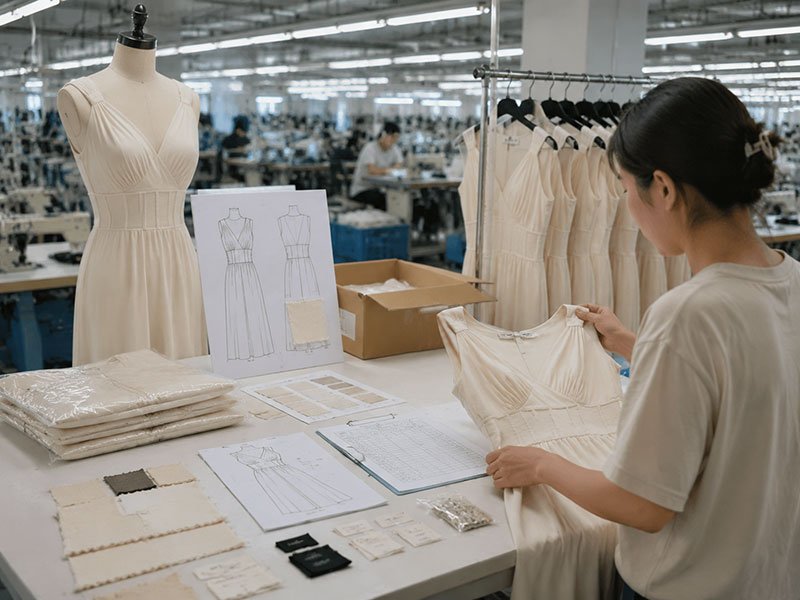
AQL should be the final verification stage of a broader garment quality system. Approved materials, samples, measurements, and construction standards should be controlled before production; first-piece and inline checks should prevent defects during sewing; and a randomized final inspection should confirm whether the completed lot meets the agreed acceptance plan.
Before Production
Reliable final inspection begins before the first bulk garment is sewn. The brand and manufacturer should lock the references that define an acceptable product.
- Approved pre-production or sealed sample.
- Final tech pack, bill of materials, pattern, and grading information.
- Measurement chart, measurement method, and tolerances.
- Approved fabric, lining, color, trim, and closure references.
- Approved lab dips, prints, embroidery, and embellishment standards.
- Construction, workmanship, label, folding, and packing instructions.
- Product-specific defect classification and testing requirements.
- AQL standard, inspection level, values, and counting method.
The approved sample should represent the intended bulk standard, not an early development sample with unresolved comments. Document consistency is equally important. If the tech pack shows one zipper length, the sample uses another, and an email gives a third instruction, production teams may follow different versions.
For fitted dresses, the inspection file should define critical dimensions such as bust, waist, hip, front length, strap length, cup position, neckline opening, and zipper length. For embellished dresses, the standard should define placement, density, attachment, acceptable loss, backing, and skin-contact requirements.
AQL cannot compensate for a moving target. Many quality disputes begin with document control rather than sewing quality.
Inline and Final Controls
Strong garment factories do not wait for final AQL inspection to discover preventable defects.
- Incoming-material inspection: fabric width, shade, weight, faults, trims, zippers, labels, and embellishments.
- Pre-production meeting: construction, measurements, risk points, special operations, packing, and inspection requirements.
- First-piece approval: initial completed garments checked before full-line production continues.
- Inline inspection: recurring issues tracked by operation, line, style, size, or operator.
- End-line inspection: workmanship, measurement, function, appearance, and missing components.
- Finishing inspection: pressing, stains, loose threads, labels, folding, and presentation.
- Final random inspection: completed goods sampled according to the agreed plan before shipment.
AQL is more meaningful when the manufacturer can show evidence from earlier stages. Inline defect records, measurement reports, material approvals, and corrective-action logs help determine whether the final result reflects a stable process or simply a fortunate sample.
Duolan Apparel’s documented manufacturing framework includes fabric and garment inspection equipment such as color light boxes, needle-detection systems, pull-test equipment, inspection tables, and measurement stations. Its operating model also supports client-specific quality requirements and third-party inspection coordination for formal brand programs.
What to Do After Failure
A failed inspection should trigger a controlled corrective process rather than an argument about whether the findings really matter. The first step is to hold the shipment and identify how widely the problem may extend.
- Review defect photographs, measurements, quantities, and classifications.
- Identify affected styles, colors, sizes, cartons, lines, and material batches.
- Separate isolated workmanship issues from systematic process failures.
- Complete full sorting where the risk justifies it.
- Repair, replace, re-press, relabel, repack, or reproduce affected units.
- Investigate the root cause and record corrective action.
- Verify the corrected quantity before reinspection.
- Arrange reinspection under the agreed sampling conditions.
The corrective action should match the failure. An isolated removable stain may require sorting and cleaning. Repeated zipper failure may require checking all garments using the affected zipper batch. Incorrect labels may require full relabeling. A grading problem may affect every unit in one size.
The factory should not present a small group of specially selected good garments as proof that the full lot has been corrected. The reinspection lot must be clearly defined and genuinely reworked.
Building a Repeatable System
The long-term purpose of AQL is not simply to pass individual shipments. Inspection data should help the brand and manufacturer reduce recurring problems across collections and repeat orders.
- Major and minor findings per inspected sample.
- Measurement-failure frequency.
- First-inspection pass rate.
- Reinspection frequency.
- Repeated defect categories.
- Defects by style, line, color, and size.
- Corrective-action closure time.
- Differences between initial and repeat orders.
Patterns often provide more value than one pass-or-fail result. If seam puckering appears repeatedly on satin styles, the cause may involve needle selection, thread tension, feed balance, seam construction, handling, or pressing. If the largest sizes repeatedly fail at the hip, the grading rule may require review.
Brands developing party dresses, occasion dresses, fitted silhouettes, mesh products, satin styles, corset structures, or embellished collections should discuss these risks before sampling and bulk production. Clear tech packs, realistic tolerances, approved materials, style-specific defect standards, and early checks reduce the chance that final inspection becomes an expensive surprise.
AQL works best when both sides treat it as part of a shared production system rather than a last-minute negotiation over whether a shipment is “good enough.”
Share:
Our Services
Categories
Table of Contents
Here, developing fashion collections is more than manufacturing garments — it’s a collaborative process focused on transforming ideas into well-executed, market-ready products. From fabric sourcing and sample development to scalable production and delivery coordination, every stage is built to support quality, consistency, and efficient collection launches across global markets.

