Skip to content
Custom Embroidered Dress Manufacturer
Dress-focused development and controlled embroidery production for established fashion brands, occasionwear labels, buying teams and product development departments.
- 30+ years of fashion womenswear development and manufacturing experience behind the Duolan production system.
- 2–3 regularly coordinated embroidery production partners selected according to fabric, workmanship, volume and delivery requirements.
- 16 owned womenswear factories, 20+ satellite factories, 300 sewing lines and 50+ flexible production lines.
- Structured to support embroidered dress programs containing 10–30 styles and approximately 20,000–80,000 total pieces.
- Artwork review, fabric evaluation, strike-off development, pattern making, sample revision, PP approval, bulk production and quality control managed through one project path.
Embroidered Dress Manufacturing for Established Fashion Teams
Fashion Dress Brands
Occasionwear Labels
Product Development Teams
Sourcing Offices
What Strong Embroidered Dress Production Must Control
Dress Development
Artwork Translation
Fabric Compatibility
Fit Coordination
Bulk Repeatability
Scalable Delivery
Complete Dress Manufacturing Versus Basic Embroidery Services
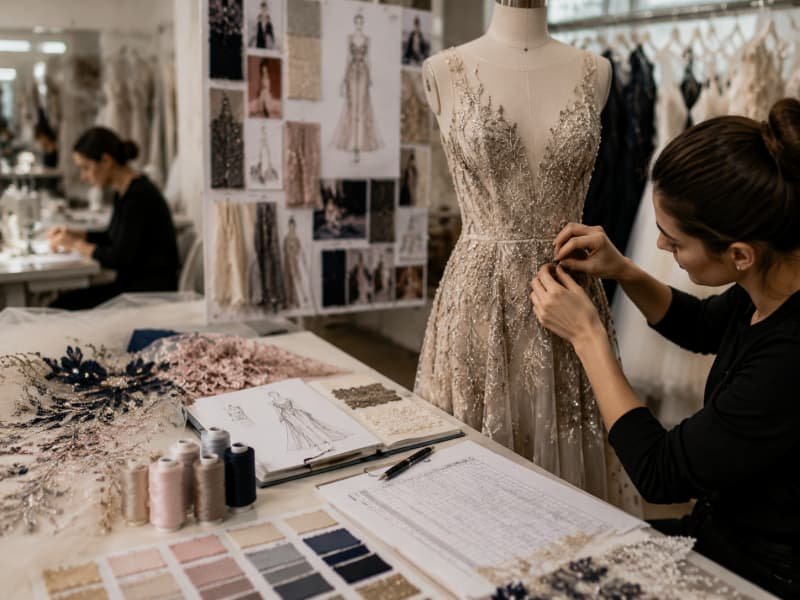
Duolan develops the full garment around the embroidery. The production path covers the base fabric, pattern, fit, internal structure, stitching, lining, labels, inspection and delivery rather than adding a motif to an already finished blank garment.
| Evaluation Area | Basic Embroidery Service | Duolan Embroidered Dress Manufacturing |
|---|---|---|
| Starting Point | Ready-made blank garment or finished panel | Tech pack, reference garment, sketch, original sample or collection direction |
| Product Scope | Logo or decorative embroidery application | Complete mini, midi, maxi, party, occasion and resort dress development |
| Fabric Responsibility | Limited to embroidery execution | Fabric sourcing, behavior review, backing, lining and shrinkage considerations |
| Pattern and Fit | Normally excluded | Pattern development, fit review, grading and placement coordination |
| Sample Process | Embroidery sample only | Strike-off, garment sample, revision, PP reference and bulk-readiness review |
| Bulk Control | Stitching inspection | Embroidery, garment measurement, sewing, lining, finishing, labeling and packing control |
| Delivery Result | Embroidered garment or panel | Private-label dresses prepared for brand distribution and repeat production |
Risks Hidden Behind Attractive Embroidery Samples
Fabric Puckering
Motif Distortion
Size Placement Drift
Stiff Garment Areas
Visible Backing
Transparent mesh, pale chiffon and partially lined garments can reveal backing, thread tails and internal finishing. The internal view must be planned with lining coverage, skin contact, opacity and the intended visual transparency.
Thread Color Variation
Cross-Seam Misalignment
Sample-to-Bulk Difference
Custom Embroidered Dress Categories We Develop

Embroidered Mini Dresses

Embroidered Midi Dresses

Embroidered Maxi Dresses

Party Dresses

Occasion Dresses

Resort Dresses
Floral Embroidered Dresses

Mesh Embroidered Dresses

Tulle Embroidered Dresses

Cotton Embroidered Dresses
Cotton poplin, voile and lightweight woven structures support clean casual and resort embroidery. Shrinkage, washing response, thread compatibility and seam distortion require assessment before bulk production. Scalloped hems and border motifs need accurate cutting references.

Satin Embroidered Dresses
Satin highlights every needle mark, tension line and handling defect. Embroidery density must protect the surface from puckering while maintaining drape and luster. Pressing, backing removal, lining and packing methods require special attention.

Corset Embroidered Dresses
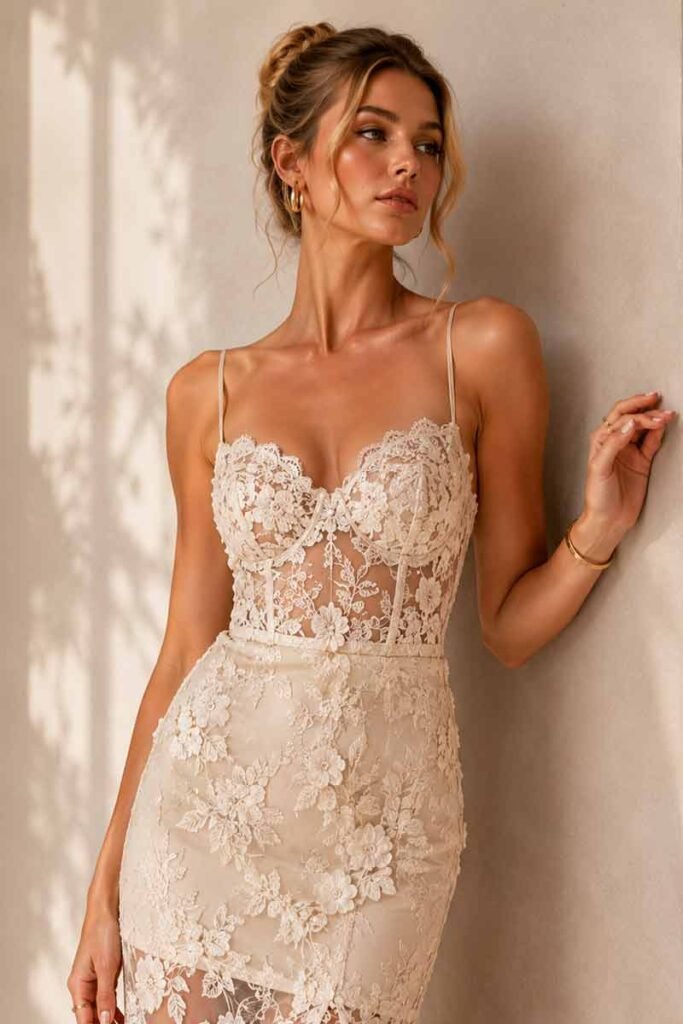
Corset dresses combine embroidery with cup shaping, boning, seam construction, lining and body support. Motifs must align with shaped panels without blocking seam movement or distorting the bust line. Panel-level embroidery is normally reviewed before full garment assembly.
Building a Consistent Embroidered Dress Collection
Motif Architecture Across Styles
- Master motifs are defined before style variations begin.
- Scale is adjusted according to bodice width, dress length and visual priority.
- Placement follows garment construction rather than arbitrary flat measurements.
- Repeated elements help maintain family recognition across the range.
- Simplified versions can reduce cost without breaking collection identity.
Color Planning Across Fabrics
The same thread color can appear different on satin, mesh, cotton and matte woven fabric.
Collection development compares thread sheen, ground color, lining and lighting before approvals are separated by style.
- Core thread colors create continuity across the program.
- Accent colors can be reserved for leading styles.
- Pale bases require backing and transparency checks.
- Dark bases need edge definition and contrast control.
- Metallic threads require handling and wear review.
- Color approval records are maintained by style and material.
Silhouette and Embroidery Balance
Embroidery should strengthen the purpose of each dress. A fitted mini may need vertical placement to lengthen the torso, while a resort maxi may benefit from a border or neckline focus that preserves movement.
- Bust motifs are aligned with cup and neckline positions.
- Waist motifs are coordinated with seam and fit balance.
- Skirt motifs follow flare, pleats, gathers or panel construction.
- Sleeve embroidery considers movement and armhole assembly.
- Hem borders are checked against length grading.
- Back placements respect zipper, opening and strap structures.
Production Planning by Complexity
- Standard machine embroidery can follow a repeatable panel route.
- Transparent or stretch fabrics may require separate testing.
- Mixed embroidery and embellishment styles need additional checkpoints.
- High-risk styles can enter controlled trial production first.
- Core commercial styles can be assigned to scalable production paths.
- Shared materials and thread colors are coordinated to reduce confusion.
Embroidery Techniques Matched to Fashion Dress Design

Flat Embroidery

Appliqué Embroidery

Sequin Embroidery

Cord Embroidery

Cutwork Embroidery

Border Embroidery

Placement Embroidery

Mixed Surface Work
Turning Embroidery Artwork Into Production Instructions
Artwork Cleaning and Structural Review
- Fine lines are checked against the selected thread and fabric.
- Small enclosed shapes are reviewed for filling pressure.
- Overlapping elements are separated into controlled stitch layers.
- Sharp corners may need adjusted stitch direction.
- Repeated motifs are checked for consistent scale.
- Decorative detail is preserved wherever production remains stable.
Stitch Direction and Density
- Satin stitches suit defined edges and narrow shapes.
- Fill stitches cover larger areas but add weight.
- Underlay supports edge stability and surface control.
- Density is reduced where the fabric cannot carry heavy stitching.
- Direction changes can create texture without adding colors.
- High-stress corners receive additional review.
Thread Color and Surface Effect
Thread selection considers hue, sheen, thickness and interaction with the ground material. Pantone references can guide direction, but physical comparison is required because embroidery thread and dyed fabric reflect light differently.
- Matte thread creates a softer, quieter finish.
- High-luster thread increases contrast and event appeal.
- Metallic thread adds impact but may require slower handling.
- Tonal colors create texture without strong contrast.
- Multicolor motifs require controlled sequence planning.
- Pale-on-pale combinations need edge visibility checks.
Approval should be made with the actual base fabric and lining rather than isolated thread cards.
Production File and Approval Basis
- Approved file version
- Stitch count or density reference
- Thread supplier and color code
- Base fabric and backing reference
- Motif dimensions
- Placement map
- Special handling notes
- Approved physical strike-off
Embroidery Placement and Grading Across Dress Sizes
Body Reference Points
- Bust embroidery is reviewed against cup, dart or princess-seam positions.
- Waist motifs follow the finished waist rather than the unsewn panel.
- Neckline borders must account for seam allowance and turning.
- Back motifs avoid zipper teeth, hooks and opening allowances.
- Sleeve placements consider cap shape and arm movement.
- Hem borders use finished length and fold allowance references.
Size-Specific Placement Logic
Duolan follows the brand’s size chart and grading standard.
A five-size run such as XS–XL or a broader US size range can require separate placement coordinates where body length and panel width change noticeably.
- Vertical movement may differ from horizontal movement.
- Motif size can remain fixed or scale by size depending on design intent.
- Bust-level motifs should not drift toward the armhole.
- Waist motifs must remain centered on the visual waist.
- Larger sizes may require repeat extension rather than motif stretching.
- Border repeats need controlled start and finish points.
Symmetry and Panel Matching
Mirrored motifs require left-right balance after cutting and sewing.
Continuous motifs crossing seams require panel registration before assembly.
- Pair panels are grouped and identified.
- Center-front matching is checked before sewing.
- Side-seam motifs are compared at key points.
- Skirt panels follow repeat references.
- Neckline and yoke motifs are aligned after seam allowance.
- First-piece checks confirm the cutting and assembly method.
Placement Approval Evidence
Approval should include more than one close-up image. A complete reference normally combines a flat panel view, full garment view, measurement map and approved sample.
- Motif width and height
- Distance from defined reference points
- Orientation and angle
- Symmetry requirements
- Size grading instruction
- Seam or edge alignment
- Tolerance priorities
- Approved garment photograph
Fabrics Selected for Stable Embroidered Dress Results

Mesh and Power Mesh
Mesh creates a refined floating effect and supports fitted or transparent occasionwear. Stretch percentage, recovery and openness must be reviewed before embroidery begins.
- Dense motifs reduce stretch around the stitched area.
- Backing can become visible through open constructions.
- Skin-tone lining changes the visual contrast.
- Motifs near side seams or zippers can affect fit.
- Power mesh may support fitted styles better than soft decorative mesh.
- Embroidered panels may require adjusted pattern dimensions.

Tulle
Tulle is suitable for layered occasion dresses, illusion panels and full-skirt designs.
Stability varies significantly by fiber, yarn and net structure.
- Soft tulle can collapse under heavy motifs.
- Stiffer tulle supports shape but may feel harsh against skin.
- Multiple layers change motif visibility.
- Raw edges and seam handling require planning.
- Appliqué or lighter fill structures may protect softness.
- Lining coverage must be confirmed from front, side and back views.

Satin
- Motif density must avoid pulling the reflective surface.
- Hoop or frame marks require prevention.
- Backing removal should not scar the fabric.
- Pressing temperature and direction need control.
- Pale satin shows oil, dirt and thread tails easily.
- Packing folds should avoid high embroidery areas.

Chiffon and Georgette
Lightweight sheer fabrics need low-pressure embroidery structures and careful stabilization.
- Excessive underlay can become visible.
- Dense fills create local stiffness.
- Fine fabric can shift during stitching.
- Seam allowances may show through.
- Layered construction can improve stability.
- Motif placement should avoid high-stress fitted areas unless reinforced.
Georgette often carries slightly more structure than chiffon , but both require physical testing .

Cotton and Linen Blends
Cotton and linen-based fabrics suit resort, vacation and elevated day dresses. Their natural appearance works well with floral, geometric and border embroidery.
- Pre-shrinkage behavior should be understood.
- Washing may change fabric and thread appearance.
- Slub yarns can affect edge smoothness.
- Border embroidery needs cutting accuracy.
- Open weaves require sufficient stabilization.
- Heavy thread can overpower lightweight fabric.

Stretch Woven and Jersey
- Stretch loss is measured around the motif.
- Recovery after wear needs consideration.
- Placement should avoid areas with maximum body expansion.
- Backing must support stitching without excessive stiffness.
- Pattern measurements may need compensation.
- Fitted styles require try-on assessment after embroidery.
Backing, Lining and Internal Comfort Engineering
Backing Selection
- Cut-away backing offers lasting support for stretch or unstable fabrics.
- Tear-away options may suit stable woven structures after testing.
- Wash-away solutions can support selected sheer applications.
- Local reinforcement can reduce unnecessary coverage.
- Backing color matters under transparent fabric.
- Removal methods must protect the embroidered area.
Lining Coverage
Lining affects opacity, comfort, support and the visible color of embroidery.
- Full lining protects large embroidered areas.
- Partial lining can preserve intentional transparency.
- Bust lining must coordinate with cups and support.
- Skirt lining should not pull against embroidered layers.
- Skin-tone options are assessed against target markets.
- Lining seam positions should avoid creating visible ridges.
Front, side and back views are reviewed because coverage can appear different under movement and light.
Skin-Contact Control
- Contact areas are identified during sample review.
- Soft covering or lining can isolate rough surfaces.
- Neckline and armhole areas receive special checks.
- Side seams and waist seams should not trap bulky embroidery.
- Raised details are kept away from pressure points where possible.
- Try-on review includes sitting, walking and arm movement.
Internal Workmanship
- Thread tails are trimmed and secured.
- Backing removal follows an approved method.
- Lining remains free from pulling and twisting.
- Seam allowances are controlled around embroidered panels.
- Closures operate without catching embroidery.
- Care labels are placed away from sensitive contact areas.
Pattern and Fit Control Around Embroidered Areas
Bodice and Bust Balance
Fitted bodices need close coordination between embroidery, cups, darts, princess seams, boning and lining.
- Motifs should not force seams away from the intended line.
- Dense stitching near the bust can reduce shaping flexibility.
- Cup position and motif center must remain visually aligned.
- Neckline embroidery must allow clean turning and support.
- Boning channels should not create visible ridges through embroidery.
- Fit comments are reviewed on the embroidered sample, not only the plain toile.
Waist and Hip Contour
- Waist seams are checked against motif boundaries.
- Side-panel motifs should not widen the visual hip unintentionally.
- Fitted styles may require measurement adjustment around dense areas.
- Ruching and embroidery must be planned in the correct production sequence.
- Zippers need clearance from raised motifs.
- Sitting and walking tests reveal pressure or stiffness not visible on a mannequin.
Skirt Movement
Skirt construction determines how embroidery appears during movement.
- Flared panels can rotate motifs visually.
- Gathered skirts compress repeated artwork.
- Pleats may hide or divide motif sections.
- Slits need clean motif endings.
- Maxi hems require size and length planning.
- Heavy embroidery can pull lightweight skirts downward.
Seam and Construction Planning
Embroidery can be completed before or after selected assembly stages. The route depends on motif location, garment access and alignment requirements.
- Panel embroidery offers better access and placement control.
- Partial assembly can improve alignment across shaped areas.
- Finished-garment embroidery is limited by frame access and construction.
- Seam allowances are kept clear where necessary.
- Pair pieces require identification after embroidery.
Information Needed Before Embroidered Dress Development
Tech Pack
Reference Garment
Embroidery Artwork
Placement Map
Fabric Direction
Size Standard
Order Structure
Launch Timing
Embroidery Feasibility Review Before Sample Investment

Visual and Product Review
The team reviews the target occasion, garment silhouette, brand identity and visual priority of the embroidery.
- Is the motif the main selling feature or a supporting detail?
- Should the embroidery look soft, dimensional, glossy or tonal?
- Does the scale suit the dress length and body area?
- Will the artwork remain clear after seams, gathers or shaping?
- Does the visual level match the intended retail positioning?
- Can commercial styles use simplified variations?

Fabric and Process Review
- Fabric weight and construction
- Stretch and recovery
- Transparency and lining needs
- Surface sensitivity
- Shrinkage and wash behavior
- Backing compatibility
- Stitch density limits
- Handling and pressing risks

Construction and Fit Review
Pattern and embroidery interactions are checked before sample cutting.
- Motifs crossing seams
- Bust and cup positions
- Waist-seam alignment
- Zipper and opening clearance
- Sleeve and arm movement
- Hem-border grading
- Corset or boning integration
- Areas requiring reinforcement

Production and Timing Review
Production suitability depends on quantity, complexity and the number of approvals.
- Number of styles and colors
- Artwork versions
- Thread-color combinations
- Embroidery route
- Manual detail content
- Inspection level
- Packaging sensitivity
- Delivery deadline
Controlled Embroidery Strike-Off Development Process
Artwork Review
Fabric Confirmation
Thread Selection
First Digitizing
First Strike-Off
Technical Revision
Garment Placement Test
Approval Reference
Production-Ready Embroidered Dress Sample Development
First Development Sample
The first sample translates the design direction into a complete garment. Main review points include silhouette, proportions, fabric behavior, embroidery scale, placement and construction feasibility.
- Pattern balance is checked on the intended body shape.
- Embroidery is evaluated in the full garment context.
- Lining and transparency are reviewed under light.
- Sensitive seams and closures are tested.
- Major visual and technical deviations are recorded.
- The next sample objective is defined clearly.
Fit and Embroidery Revision
- Bust, waist, hip and length corrections
- Neckline or armhole adjustments
- Motif movement after pattern correction
- Density or color revision
- Lining coverage adjustment
- Backing and comfort improvement
- Construction simplification where required
- Updated measurement and placement records
Photo or Sales Sample
A presentation sample may require refined finishing, approved color and strong visual accuracy for campaigns, showrooms or internal range reviews.
- Photography lighting is considered for thread shine.
- Embroidery is checked from full-distance and close-up views.
- Garment pressing and packing protect the presentation.
- Temporary decisions are identified if bulk materials remain pending.
- Photo approval is not automatically treated as PP approval.
- Remaining production risks are documented separately.
PP and Bulk-Ready Sample
- Approved fabric and lining
- Approved embroidery file and strike-off
- Confirmed thread colors
- Final placement map
- Final measurements and tolerance priorities
- Confirmed construction
- Label and packaging direction
- Bulk inspection reference
Sample Revision Records That Prevent Repeated Mistakes
Version Identification
- Style number
- Sample stage
- Fabric version
- Artwork version
- Pattern version
- Measurement version
- Date and reviewer
- Pending decisions
Comment Prioritization
- Critical fit corrections
- Visual embroidery corrections
- Material changes
- Construction changes
- Comfort issues
- Bulk feasibility concerns
- Optional refinements
- Points retained without change
Before-and-After Evidence
- Full front, side and back photographs
- Detail photographs
- Measurement comparison
- Placement comparison
- Strike-off version comparison
- Marked pattern or garment images
- Internal construction photographs
- Revision summary
Handover Into Production
Approved comments are transferred into the files used by production and QC.
- Final pattern
- Final measurement chart
- Final artwork version
- Approved strike-off
- Placement instruction
- Workmanship notes
- PP sample reference
- QC checkpoints
Cost Drivers in Custom Embroidered Dress Production

Embroidery Area

Stitch Density

Thread Colors

Fabric Sensitivity

Placement Accuracy

Garment Construction

Manual Decoration

Order Structure
Manufacturing Capacity Behind Multi-Style Embroidery Programs
Duolan combines dress development, owned manufacturing, satellite capacity and established special-process coordination. Scale is used to organize complex programs rather than replace the control required for each style.
16 Owned Factories
20+ Satellite Factories
300 Sewing Lines
50+ Flexible Lines
2–3 Embroidery Partners
Multi-Style Capacity
The system is structured to manage collection orders containing approximately 10–30 styles, multiple colors, broad size runs and total quantities commonly reaching 20,000–80,000 pieces per program.
The broader platform includes stable monthly garment capacity of approximately 6.5 million pieces, with peak capacity reaching approximately 10 million pieces across the manufacturing system. Capacity is planned according to confirmed project conditions rather than offered as an unsupported promise for every style.
Quality Control Standards for Embroidered Dresses
Inspection standards combine embroidery appearance with complete garment quality. Control points are defined before production so inspectors do not rely on subjective statements such as “looks acceptable.”
| Control Stage | Main Inspection Points | Risk Being Controlled | Approval Evidence |
|---|---|---|---|
| Strike-Off Review | Motif size, line definition, density, thread color, backing, fabric response | Incorrect visual effect, stiffness, puckering | Approved physical strike-off and artwork version |
| First Embroidered Panel | Placement, orientation, symmetry, dimensions, fabric distortion | Bulk panels produced in the wrong position | First-piece measurement and photograph |
| Embroidery Inline Check | Missing stitches, thread breaks, loose threads, color sequence, stains | Repeated embroidery defects | In-process inspection record |
| Pre-Assembly Check | Pair matching, cross-seam alignment, panel identity, seam clearance | Misaligned garment construction | Approved panel set |
| Sewing Inline Check | Garment measurements, seams, lining, zipper, cups, boning, motif alignment | Fit and construction deviation | Inline QC record |
| Finishing Check | Thread trimming, backing removal, pressing, surface protection | Skin irritation, marks and damaged embroidery | Finishing standard reference |
| Final Garment Check | Full appearance, placement, symmetry, measurements, closures and cleanliness | Sample-to-bulk inconsistency | Approved sample comparison |
| Packing Check | Label, barcode, folding, tissue, polybag, carton ratio | Retail and delivery errors | Packing instruction and carton record |
Testing and Compliance Support for Global Dress Programs

Dimensional Stability

Colorfastness

Embroidery Durability

Attachment Security
Needle and Metal Control

Audit and Documentation
Duolan’s core manufacturing system has completed SMETA and SMETA 2-Pillar audit processes and maintains a social-audit record.
Private Labels and Packaging for Embroidered Dresses
Main Brand Labels
Size and Care Labels
Hangtags and Barcodes
Surface Protection
Folding Method
Carton Planning
Embroidered Dress Projects Managed Across Multiple Styles
US Occasionwear Collection
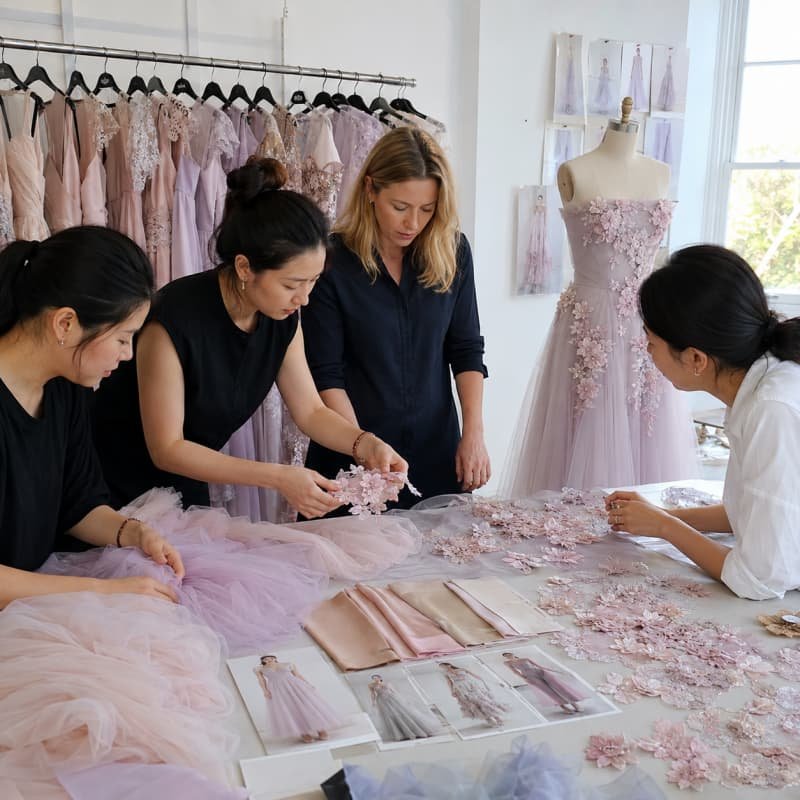
A US occasionwear label developed an 18-style embroidered collection containing fitted midi dresses, mesh minis and structured evening silhouettes. The confirmed production program reached approximately 48,600 pieces across six colors and a five-size run.
The central challenge involved floral embroidery crossing shaped bodice panels. Early samples showed motif movement around the bust after fit corrections. Duolan separated fit approval from placement approval and rebuilt the position map after the base pattern was corrected. Development actions included:
- Individual strike-offs on mesh, satin and structured woven bases
- Separate motif coordinates for bodice and skirt panels
- Five-size placement review
- Revised lining coverage around transparent sections
- First embroidered panel confirmation before bulk processing
- Inline checks for pair matching and side-seam alignment
The approved method protected the floral balance across sizes while allowing the sewing team to assemble shaped panels without cutting through critical motif areas.

UK Resort Embroidery Program
A UK resortwear label planned 24 styles and approximately 72,000 pieces across cotton, viscose and linen-blend dresses. The range used one botanical language through maxi, midi and short relaxed silhouettes. The original artwork included too many dense fill areas for lightweight resort fabrics. Full-density stitching made the first development swatches feel rigid and reduced the natural fall of the skirts. Duolan coordinated the program through:
- One master motif system with three complexity levels
- Open-stitch alternatives for lightweight fabrics
- Simplified commercial versions for higher-volume styles
- Border layouts adjusted to finished garment length
- Shared thread palettes across the 24 styles
- Wash and shrinkage review on selected cotton qualities
- Style grouping by embroidery and sewing complexity
The final structure allowed hero pieces to retain richer embroidery while commercial styles remained softer, lighter and more suitable for repeat production.

European Partywear Embellishment Line
A European partywear brand developed 12 styles totaling approximately 28,800 pieces. The range combined machine embroidery with sequins, crystals and localized hand finishing on mesh and satin bases.
The principal risk involved weight and surface abrasion. Early decoration concentrated too much density near the waist and underarm, affecting comfort and creating rubbing during packing. Control actions included:
- Decoration maps identifying no-contact and low-pressure zones
- Reduced density under the arm and at side seams
- Full lining on selected bodices
- Attachment checks for sequins and crystals
- Packing tissue between decorated surfaces
- First-piece verification for every style and color
- Final inspection focused on missing pieces, loose threads and scratching risk
Production proceeded through separate high-risk and standard routes, allowing complex styles to receive additional checks without slowing the full collection unnecessarily.
Evidence Behind Embroidered Dress Development and Production
Artwork Evidence
Material Evidence
Strike-Off Evidence
Sample Evidence
Production Evidence
Delivery Evidence
Frequently Asked Questions About Embroidered Dress Manufacturing

Send Your Embroidered Dress Project for Evaluation
Share your embroidered dress direction with Duolan for a structured review of the artwork, base fabric, silhouette, fit, placement, construction and bulk-production path. A clear first submission helps the development team identify which details are ready, which points require strike-offs, and which decisions should be confirmed before full garment sampling.
Useful project information includes:
- Company and brand name
- Brand website or product reference
- Tech pack, sketch or original sample
- Editable embroidery artwork
- Motif dimensions and intended placement
- Target fabric, lining and color direction
- Base size, size range and grading standard
- Number of styles and colors
- Estimated quantity per style and total program quantity
- Target launch or delivery date
- Destination market
- Required labels, packaging and inspection standards
Duolan will review the development basis, embroidery feasibility, material risks, fit-sensitive areas, sample stages, production structure and information needed for quotation.