Skip to content
Appliqué Techniques for Fashion Dresses
Your trusted Women’s Apparel Development & Manufacturing Partner from China
- Jerry
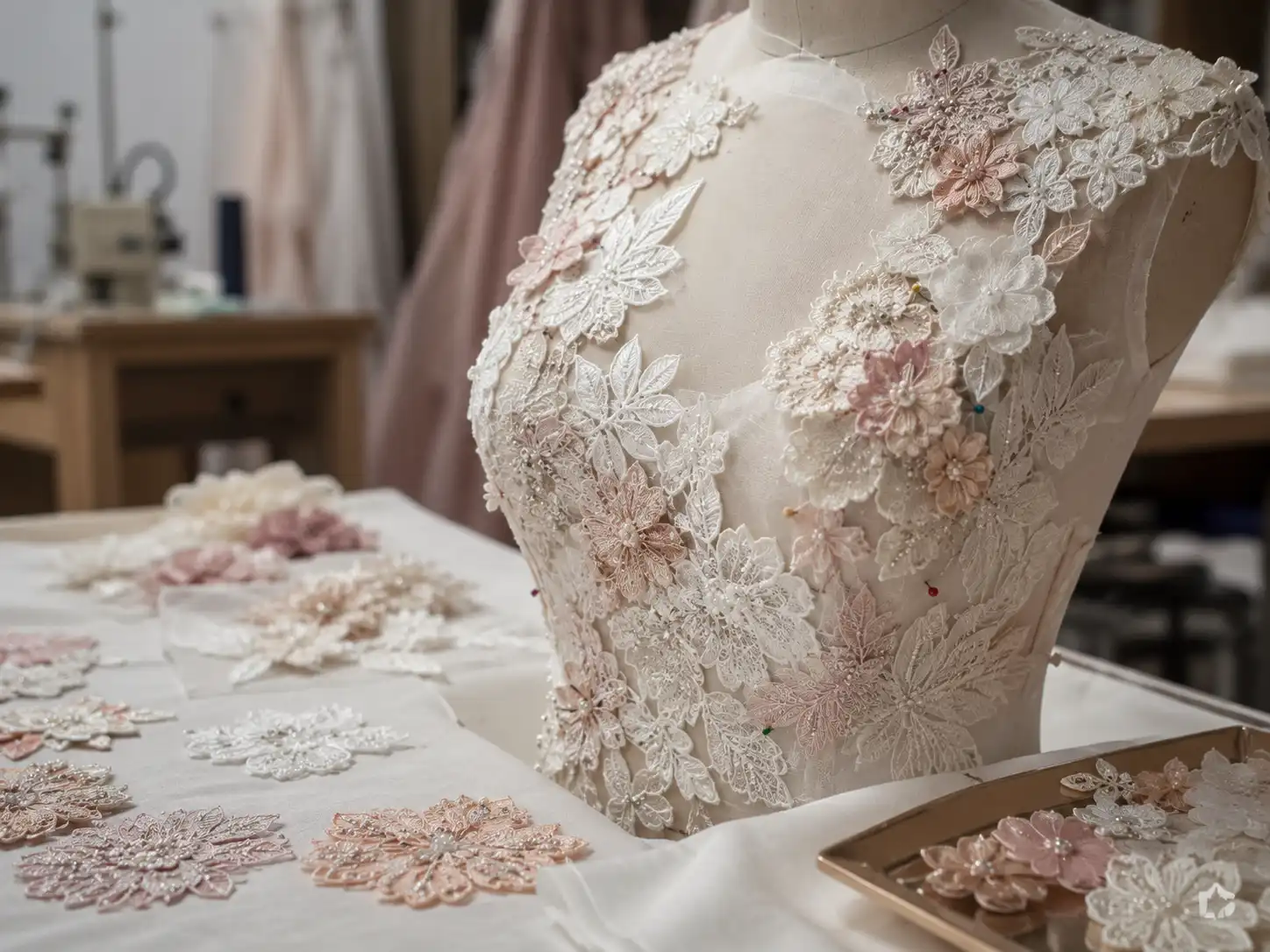
An appliqué can turn a familiar dress shape into the piece customers remember from a campaign, save to a wishlist, or choose for an important event. The same decoration can also create puckering, stiffness, poor fit, loose edges, scratching, or inconsistent bulk production when it is selected only for appearance. A floral motif is never just a flower once it is placed on a dress. It becomes additional weight, a new layer, a local change in stretch, and another operation that must survive sewing, pressing, fitting, care, packing, and repeated wear.
The best appliqué method is the one that matches the base fabric, dress silhouette, motif construction, desired edge finish, expected movement, care method, and production quantity. Hand appliqué offers precise control; machine methods improve consistency; fused support helps positioning; and lace, embroidered, reverse, or three-dimensional appliqués create different textures. Every option must remain attractive, secure, comfortable, and repeatable.
That combination matters most on fitted, mesh, satin, corset, occasion, and party dresses, where a few millimeters of placement, a slightly rigid backing, or an uneven stitch tension can change the whole product. One development team once received a sheer mesh dress covered with dense floral motifs. It looked impressive on a flat table. On the fit model, the flowers pulled the neckline downward, the mesh stretched unevenly, and the backing scratched the skin. The visual idea was strong; the engineering sequence was not. Understanding that difference is where professional appliqué development begins.
What Is Dress Appliqué?
Dress appliqué is a construction and decoration method in which separate fabric, lace, embroidered, sequined, beaded, or dimensional motifs are attached to a garment surface. It adds color, texture, depth, and focus, but it also changes weight, stretch, drape, fit, comfort, care performance, production time, and cost.
Appliqué in Dressmaking
In dressmaking, appliqué means adding a separate decorative component to a base fabric rather than creating the whole design directly on that fabric. The component may be cut from lace, organza, velvet, mesh, embroidered cloth, sequined yardage, or several layers shaped into a flower. It may lie completely flat or project from the garment as a three-dimensional feature.
Once attached, the motif becomes part of the dress structure. A lace flower on stable crepe may need only discreet perimeter stitches. The same flower on fine stretch mesh may pull the surface out of shape unless its weight is distributed and the stitching remains compatible with movement. Appliqué that crosses a princess seam, boning channel, bust cup, zipper, dart, gathered area, or lining edge also changes the sewing sequence. It may need to be divided, matched after assembly, or partially applied before the lining is closed.
A usable specification should identify the motif material, finished size, color reference, orientation, edge treatment, attachment stitch, backing, placement measurements, fixed and free edges, care restrictions, and any security requirements for beads, stones, pearls, or petals. Without those details, the sample maker may create a beautiful one-off piece that the production line cannot reproduce consistently.
Appliqué and Embroidery
Appliqué and embroidery often appear together, but they are different processes. Embroidery creates a design mainly with thread stitched directly into a fabric or onto a backing. Appliqué uses a separate piece of material as the main visible element and secures that element to the garment. An embroidered patch becomes an appliqué when it is produced separately and attached later; direct embroidery remains integrated with the garment panel.
The distinction matters on lightweight fashion fabrics. Dense direct embroidery concentrates thread tension in the base cloth and can cause satin, mesh, chiffon, or fine jersey to pucker. A separately produced embroidered motif may reduce direct stitching in the garment, but it can introduce a firm backing or hard perimeter. The cleaner solution depends on the motif scale, stitch density, garment layer structure, and intended drape.
Decoration Method | Main Material | Added Thickness | Main Risk | Best Use |
Direct embroidery | Thread stitched into the panel | Low to medium | Puckering or tension distortion | Stable panels and controlled motifs |
Fabric appliqué | Cut woven, knit, or layered fabric | Medium | Fraying or lifting edges | Strong color and texture contrast |
Lace appliqué | Cut lace motifs | Low | Irregular edges or visible backing | Mesh, tulle, and occasion dresses |
Embroidered patch | Thread plus stabilizer | Medium to high | Stiffness or hard outline | Repeatable focal motifs |
Beaded or sequin appliqué | Decorative components on a base | Medium to high | Weight, snagging, loose parts | Party and evening styles |
3D floral appliqué | Layered petals and a support center | High profile | Crushing, catching, weak anchoring | Statement dresses and campaign pieces |
Why Brands Use It
Appliqué lets a brand refresh a proven mini, midi, corset, bodycon, halter, or column dress without rebuilding the entire silhouette. Floral placement, tonal lace, metallic embroidery, layered petals, or asymmetric motifs can change the emotional character of the garment while preserving a familiar fit block. That is valuable when a collection needs recognizable novelty rather than a completely new construction every season.
- Frame a neckline, shoulder, waist, slit, or open back.
- Connect several styles through a repeated collection motif.
- Create texture that remains visible in product photography and short video.
- Add a premium focal detail to an established commercial silhouette.
- Introduce a seasonal floral, romantic, metallic, or evening theme.
- Use a localized decoration instead of committing to an allover embellished fabric.
More decoration does not automatically create more value. Dense coverage may slow production, increase weight, restrict alterations, complicate grading, and make the product uncomfortable. Strong commercial styles usually have a clear hierarchy: one focal area, supporting details, and enough undecorated space for the silhouette and fabric to remain visible.
Suitable Dress Types
Appliqué is particularly effective on occasion dresses, party dresses, cocktail dresses, prom dresses, graduation dresses, wedding guest dresses, vacation dresses, mesh dresses, corset dresses, fitted dresses, and fashion-led sets. The best method changes with the structure of the style. A corset dress can carry denser motifs because boning, lining, cups, and multiple layers spread the load. A bias-cut satin dress usually needs lighter work because concentrated weight interrupts the fluid fall. A bodycon jersey dress requires motifs and stitches that move with the body.
Wear conditions should be considered before placement is approved. Underarm motifs face friction. Shoulder flowers may be crushed under a jacket. Hem decoration can catch on shoes or furniture. Back motifs may press against chairs. Waist decoration can become uncomfortable when sitting. The right application is not simply the one that looks most dramatic in a flat sketch; it is the one that remains balanced after the wearer walks, turns, raises her arms, and spends several hours in the dress.

Which Appliqué Techniques Are Used?
Fashion dresses use hand, machine, fused, raw-edge, turned-edge, reverse, lace, embroidered, sequined, beaded, and three-dimensional appliqué. The correct method depends on motif shape, base-fabric stability, required edge finish, garment stretch, desired texture, care method, available production time, and the consistency expected across every size and unit.
Hand and Machine Methods
Hand appliqué is useful when a motif has irregular lace edges, narrow petals, beads, pearls, stones, or areas that are difficult to reach by machine. Slip stitches, blind stitches, small running stitches, couching, needle-turn edges, and individual component anchors can be adjusted one point at a time. That control helps preserve delicate contours and allows selected petals or leaves to remain free.
The weakness of handwork is variation. Two skilled operators may use different stitch spacing, tension, knot placement, or reinforcement unless they work from the same approved standard. An instruction such as “hand sew securely” is too vague for bulk production. The operation should define where the motif is fixed, which edges remain free, the maximum stitch spacing, the required reinforcement points, acceptable thread visibility, and how knots or thread tails are enclosed.
Machine appliqué is faster and easier to standardize. It may use a straight stitch, narrow zigzag, satin stitch, decorative stitch, programmable pattern, or embroidery-machine sequence. Settings must be developed on the actual production fabric. As a starting trial, a fine straight attachment stitch may be tested around 2.0-2.5 mm in length, while a narrow zigzag may begin around 1.0-2.0 mm in width. These are not universal standards; the final setting should be approved after checking puckering, flexibility, edge coverage, and appearance.
Fused and Edge-Finished Methods
Fused appliqué uses a heat-activated film, web, or coated backing to hold the motif against the dress. It is particularly useful during positioning because it reduces shifting before stitching. Adhesive alone should not automatically be treated as permanent security. Heat, steam, washing, dry cleaning, humidity, fabric finishes, and repeated bending can weaken the bond. Satin may develop shine or pressure marks, while a rigid film on jersey can create a non-stretch island.
Raw-edge appliqué leaves the cut edge visible. It suits layered, organic, relaxed, distressed, or intentionally unfinished designs. The fabric must be selected with fraying in mind. A tightly woven organza can hold a laser-cut edge better than a loose woven cloth. Some motifs use an embroidered or stitched perimeter to control the edge while keeping the raw appearance.
Turned-edge appliqué folds the allowance beneath the motif to create a clean enclosed edge. It gives a refined result but adds preparation time and thickness, particularly around small curves and narrow points. The decision should answer four practical questions: should the edge disappear or remain visible, will the material fray during wear or care, can the base fabric tolerate heat, and does the intended price level support the required labor?
Reverse Appliqué
Reverse appliqué places one fabric over another and removes selected areas from the upper layer so that the color, texture, or transparency beneath becomes visible. The method can create geometric openings, floral shapes, tonal layering, controlled cutouts, or contrast panels. It looks simple in a sketch, but cutting accuracy, layer stability, edge control, and compatible fabric behavior are essential.
The two layers should have compatible shrinkage, stretch, and care characteristics. A stable woven upper layer over a highly elastic underlayer may bubble or twist. Materials with different shrinkage rates can ripple after washing, steaming, or pressing. Openings placed across the bust, waist, hip, or high thigh should also be tested under the expected wearing extension, because the shape can widen or collapse when the dress is on the body.
Reverse appliqué works well for graphic bodycon dresses, tonal mesh panels, geometric evening styles, decorative waist sections, and cutout-inspired designs that need more control than a true open cutout. A trial panel should be flexed repeatedly before the garment sample is approved. The edge may appear stable when flat but distort after repeated movement.
Decorative and 3D Methods
Decorative appliqué includes cut lace motifs, embroidered patches, sequin units, pearl clusters, rhinestone pieces, laser-cut flowers, layered mesh, organza petals, folded fabric flowers, and complete three-dimensional floral groups. Lace is widely used because it follows body curves and creates detail without the weight of dense beads. On sheer mesh, however, thread color, stabilizer, knots, and backing may be visible from the outside.
Three-dimensional flowers require a different attachment plan. Their effect depends on some petals remaining free. Sewing every edge flat removes the depth; securing only the center may allow the flower to rotate, sag, or catch. A balanced construction often uses a reinforced center, two to four secondary anchoring points, a hidden support layer, controlled free petals, and packaging that prevents crushing.
Large flowers on one shoulder, one hip, or one side of the bodice should be evaluated on a fit model. Even a visually light flower may rotate a neckline or pull a strap outward when its center is positioned away from the garment’s structural support. The sample should be checked from the front, side, and back while the wearer moves.

Which Fabrics Work Best?
Stable woven fabrics, structured mesh, organza, lace, crepe, velvet, and selected satins can support many appliqué methods. Chiffon, lightweight mesh, jersey, and bias-cut fabrics need greater control because added weight, dense stitching, heat, adhesive, or firm backing can change drape, stretch, recovery, transparency, and fit.
Fabric Behavior
The base fabric determines how much decoration a dress can carry and how the attachment should be built. Stable crepe accepts moderate stitching with limited distortion. Fine satin records needle marks and pressing damage easily. Mesh stretches around dense motifs. Chiffon can sag under decoration that feels surprisingly light in the hand. Velvet may shift during sewing and lose pile under pressure. Jersey moves well, but a rigid motif can interrupt its recovery.
The complete system must be tested together: dress fabric, appliqué, backing, thread, adhesive, lining, beads, stones, and pressing method. A plain swatch cannot predict how the finished decorated panel will behave. Lighting also changes what the customer sees. Satin puckering that is barely visible in soft room light may look severe under studio lighting. Backing beneath nude mesh may disappear on a worktable and become obvious against skin.
Base Fabric | Useful Characteristic | Main Appliqué Risk | Practical Control |
Satin | Smooth surface and strong light reflection | Puckering, needle marks, heat shine | Fine needle, low tension, light motif, press trial |
Mesh | Sheer, flexible, contemporary appearance | Distortion and visible thread or backing | Transparent support and distributed attachment |
Tulle | Lightweight and suitable for layered volume | Tearing around dense stitches | Lower stitch density and local underlayer |
Chiffon | Fluid movement and soft drape | Sagging, seam draw, edge damage | Very light motifs and temporary stabilization |
Crepe | Controlled drape and good surface stability | Local stiffness or pressing marks | Moderate stitch density and press testing |
Velvet | Rich depth and texture | Crushed pile and shifting | Hand basting and low-pressure handling |
Jersey | Stretch and close-body fit | Rigid zones and reduced recovery | Flexible motifs and stretch-compatible stitching |
Organza | Crisp support with low weight | Fraying and sharp cut edges | Laser cutting or controlled edge finish |
Stretch and Recovery
Stretch dresses need compatible movement between the base fabric and the appliqué. A rigid decoration across the bust, waist, hip, or high thigh can make the garment feel smaller even though the paper pattern and finished measurements remain unchanged. The surrounding fabric extends while the decorated zone resists, producing drag lines, pressure, edge lifting, thread breakage, or permanent growth.
A useful development record includes widthwise stretch, lengthwise stretch, recovery after extension, fabric weight, lining stretch, direction of greatest body movement, and garment wearing ease. For a simple check, mark a 10 cm section of fabric and extend it to the expected wearing condition. If it reaches 12 cm, the test represents 20% extension. Apply and assess the complete motif under the same movement level.
- Do the attachment stitches tighten or become visible?
- Does the base fabric ripple around the motif?
- Does the motif edge lift during extension?
- Does the fabric return to its original length after release?
- Does the decorated area create a hard line across the body?
- Does repeated movement damage the base fabric rather than the appliqué?
Where possible, place denser motifs in lower-extension areas and use lighter, segmented, or more open motifs across active zones. Lace may look flexible before application and become rigid after a dense perimeter stitch, so the final test must include the attachment method, not just the motif itself.
Backing and Stabilizers
Backing supports the fabric during attachment and may remain as permanent reinforcement. Common options include tear-away, cut-away, wash-away, heat-away, fusible knit, organza, lightweight mesh, temporary paper, and water-soluble topping. The correct choice improves accuracy; the wrong choice remains visible, feels rough, creates noise, changes opacity, or restricts movement.
Tear-away backing is convenient but can damage delicate mesh or chiffon when removed. Cut-away backing gives stronger support, although the cut edge may show through a sheer dress. Wash-away film is useful for open lace effects, but complete removal and residue control must be verified. Fusible knit can stabilize stretch cloth while retaining some movement if the adhesive and temperature are compatible.
- Will the backing remain permanently or be removed?
- Can it be seen through the finished garment?
- Will it touch the wearer’s skin?
- Does it change stretch, drape, or opacity?
- Can it survive the stated care method?
For sheer, unlined dresses, the reverse-side finish becomes visible product detail. Thread tails, knots, stabilizer edges, and adhesive marks should be evaluated against the wearer’s skin tone as well as against a white inspection surface.
Weight and Drape
Decoration turns the original fabric into a new composite. Backing, adhesive, stitches, beads, lace, and lining may change the hand and movement far more than expected from the motif alone. A weighted neckline can lower the center front. Dense hip decoration can rotate a fitted dress. A heavily decorated hem can reduce swing. A motif near a slit can interfere with opening and walking.
The sample should be checked while hanging for several hours, on a fit model, during walking and turning, and while sitting or raising the arms. Fabric growth may not appear immediately. Bias-cut satin, open mesh, and some jerseys can relax gradually under uneven load.
Visual volume and physical weight are not the same. Open embroidery, laser-cut organza, layered mesh, and hollow petal constructions can produce a strong image with less mass than dense beadwork or heavily backed patches. When two development options look similar, weighing the complete decorated panel can provide a useful comparison, even when there is no formal weight limit in the specification.

How Should Appliqué Be Placed?
Appliqué placement should strengthen the silhouette, remain comfortable during wear, and be measurable in production. Necklines, shoulders, bodices, waists, backs, sleeves, slits, and hems can work well, but every layout must account for seams, darts, cups, boning, zippers, stretch zones, movement, grading, and left-to-right balance.
Visual Balance
Placement directs the viewer’s eye. Neckline motifs frame the face. Shoulder decoration adds width and drama. Vertical motifs lengthen the torso. Waist-focused layouts emphasize shape. Hip placement adds visual volume. Hem decoration brings movement to the lower part of the dress. Before any motif is attached, the team should define what the placement is meant to achieve.
- Frame a neckline or open back.
- Connect the bodice and skirt visually.
- Emphasize the waist or create an asymmetric line.
- Conceal or soften a seam transition.
- Build a floral path across several panels.
- Create a strong focal point for campaign photography.
The most visible position is not always the best. A large flower centered over the bust may distort when the garment is worn. A motif crossing a concealed zipper may prevent smooth opening. Decoration under the arm may rub the skin. A flat panel review should therefore be followed by a fit-model review in the intended sample size. Body curves can rotate a motif several degrees and move an edge closer to the armhole or neckline.
Scale and Density
Motif scale changes the perceived proportions of the garment. Small repeated motifs create texture and rhythm. Large motifs create stronger focus but require more accurate placement. Dense coverage adds visual and physical weight; open spacing allows the fabric and body line to remain visible.
- Largest motif width and height.
- Distance between neighboring motifs.
- Distance from center front, center back, neckline, waist, and hem.
- Number of motifs per panel and total decorated area.
- Direction of leaves, petals, or geometric lines.
- Change in density from bodice to skirt.
Size grading needs a written rule. A brand may keep motif size and quantity unchanged, retain motif size while increasing spacing, or add motifs in larger sizes. Keeping everything unchanged can look sparse; scaling every flower can make the design heavy; adding motifs changes cost and sewing time. The layout decision should be made during development and included in the grading plan rather than left to production judgment.
Seam and Panel Matching
Motifs that cross center fronts, princess seams, side seams, waist seams, or skirt panels require a complete placement map. If every panel is decorated separately without shared registration points, leaves and lines may stop abruptly after assembly. A reliable process uses full-garment artwork, panel templates, seam-allowance marks, registration notches, first-piece assembly, and finished-garment checks.
Placement Area | Reference Point | Useful Starting Tolerance | Main Risk |
Center-front focal motif | Center-front line | ±2-3 mm | Immediate visual imbalance |
Mirrored bust motifs | Center front and neckline | ±2-3 mm per side | Uneven left-to-right spacing |
Organic side placement | Side seam and waist | ±3-5 mm | Rotation around the body curve |
Hem motif row | Finished hemline | ±3-5 mm | Uneven visual level after hemming |
Seam-crossing motif | Panel registration marks | Continuous visual alignment | Broken design flow |
Large 3D flower | Fixed center anchor | About ±3 mm | Weight shift and silhouette imbalance |
These values are useful development starting points, not universal standards. The approved tolerance should reflect motif size, visual importance, fabric movement, and customer expectation. Lace cut from allover yardage also introduces natural repeat variation. The brand should state whether exact motif matching is required or whether controlled organic variation is acceptable.
Fit and Comfort
Appliqué should not interfere with the parts of a dress that create fit. Bust darts, princess seams, cups, boning channels, side seams, waist seams, elastic panels, ruching, and zippers each perform a structural function. A decoration that covers them may restrict shaping, create thickness, prevent access, or transfer pressure to the body.
- Rough backing or knots against the skin.
- Sharp sequins near the underarm.
- Thick motif overlaps at side seams.
- Rigid patches across the waist or high hip.
- Loose petals that catch on jewelry.
- Heavy shoulder flowers that pull straps outward.
- Appliqués pressing against cups, boning, or a zipper guard.
The fit model should sit, walk, turn, raise both arms, and wear the sample long enough to reveal friction. A five-minute standing review can miss problems that appear after twenty minutes. Lining may cover rough construction, but it can also reduce stretch or add thickness. The complete layer system – base fabric, stabilizer, motif, stitching, lining, and internal support – should be fitted and approved together.

How Is Appliqué Developed for Production?
Production-ready appliqué begins with controlled artwork, approved materials, measurable placement, attachment trials, and a representative garment sample. Before bulk cutting, the brand and manufacturer should approve motif dimensions, colors, backing, edge finish, stitch method, fit, care performance, grading rules, acceptable variation, and the sealed pre-production reference.
Artwork and Motif Preparation
A reference image can communicate mood, but it rarely contains enough information for repeatable production. The development file should state finished dimensions, material, color, orientation, cut lines, stitch lines, mirrored versions, bead maps, and placement points. Vector artwork is especially useful for laser cutting, embroidery digitization, and clean scaling because it defines curves and outlines more accurately than a low-resolution screenshot.
- Vector artwork in AI, EPS, SVG, or production-ready PDF.
- High-resolution visual reference and approved physical swatch.
- Finished motif width, height, direction, and mirror instruction.
- Cut path, embroidery path, free edges, and fixed edges.
- Thread, bead, sequin, pearl, stone, or petal map.
- Placement drawing with fixed garment reference points.
For embroidered appliqués, digitization controls stitch direction, density, underlay, edge definition, jump stitches, thread consumption, and machine time. Greater stitch density does not always improve quality. Excess density can make the motif hard, increase thread breaks, and distort the backing. A motif strike-off should therefore be produced before the full dress sample so the team can assess scale, color, stiffness, edge condition, backing visibility, and compatibility with the actual dress fabric.
First Sample
The first sample should test the full product system rather than imitate the sketch from the front. It must show whether the selected fabric, motif, backing, attachment, placement, pattern, lining, and internal construction work together.
- Review the tech pack, reference, target fit, and intended visual effect.
- Confirm base-fabric weight, stretch, recovery, shade, and finish.
- Produce motif, embroidery, or embellishment strike-offs.
- Test attachment on a panel and check heat, needle marks, puckering, and flexibility.
- Build the garment sample using the intended construction layers.
- Position and attach the motifs using fixed reference points.
- Fit the dress on a model and review the front, side, back, and reverse finish.
- Record measurable corrections before the revised sample.
Comments should be specific. “Move the flower slightly higher” leaves room for interpretation. “Move the flower center 12 mm upward from the current point while maintaining the same distance from center front” can be repeated. The sample should also rest on a hanger after pressing because bias satin, open mesh, and some jerseys may relax under uneven decoration weight.
Bulk Approval
Bulk approval should freeze every variable that can change appearance, fit, labor, or durability. A message saying that the sample “looks good” is not enough when different operators, production lines, or cooperating facilities may later reproduce the style.
- Final artwork version and motif code.
- Approved motif, base fabric, lining, trim, thread, and color references.
- Finished dimensions, placement coordinates, orientation, and mirror rules.
- Stitch type, stitch visibility, backing, edge treatment, and free-edge plan.
- Bead, stone, pearl, or flower reinforcement method.
- Size grading, measurement tolerances, care instructions, and required testing.
- Sealed pre-production sample and approved close-up photographs.
Cost should be rechecked at this point. Motif material, cutting method, embroidery stitch count, handwork minutes, number of anchoring points, placement complexity, matching requirements, rejection allowance, and order volume all influence the finished price. A technique may be technically possible but commercially weak if labor is concentrated in low-visibility areas. Good cost engineering protects the details customers notice and simplifies operations that do not materially improve the product.
Production Replication
The sealed sample is the primary visual reference, but it needs measurable production tools. Full-size templates, panel markings, operation sheets, workmanship boards, stitch-setting records, approved needles and threads, first-piece confirmation, operator training, in-line checks, and final comparison all reduce interpretation.
Application timing is critical. Some motifs should be attached to flat panels before assembly because the surface is easier to control. Others need to be added after seams are completed so they align across the finished silhouette. Beaded and three-dimensional components may be applied late to reduce damage during sewing and pressing. A technique that depends entirely on one highly skilled sample maker is not ready for several thousand garments until the process is simplified, documented, trained, and checked.
Complex fitted, mesh, satin, corset, sequined, or highly decorated dresses benefit from a first-piece or pilot review before unrestricted production. That review should confirm pattern and measurement accuracy, motif position, sewing sequence, machine settings, pressing method, reverse-side finish, realistic handling time, and packing risk. Any correction should be completed before the operation is repeated across the full quantity.

How Is Appliqué Quality Controlled?
Appliqué quality control checks appearance, placement, attachment security, fabric condition, comfort, care performance, and consistency with the sealed sample. Inspection should identify loose edges, puckering, distortion, adhesive marks, visible backing, broken embellishments, incorrect orientation, color variation, poor reverse finishing, and uneven placement before packing.
Visual Defects
Defects can begin during motif production, panel preparation, attachment, garment assembly, pressing, finishing, or packing. Inspectors should distinguish intentional organic variation from workmanship that changes appearance or performance.
- Loose edges, missing anchors, skipped stitches, loops, and untrimmed thread tails.
- Frayed edges, distorted motifs, incorrect orientation, and uneven spacing.
- Puckered fabric, heat shine, scorch marks, adhesive stains, or visible backing.
- Broken beads, missing stones, sharp components, or rough reverse-side finishing.
- Decoration caught incorrectly in seams, zippers, lining, or hemming operations.
Inspection should take place on a flat surface, on the correct hanger, and on a form when body shape changes the placement. A side motif may appear correctly positioned when flat and rotate too far forward when worn. Defect severity also depends on visual importance. A small shift in an irregular leaf may be acceptable; the same shift in two mirrored center-front flowers may be immediately obvious. Focal zones deserve tighter control than background decoration.
Placement Checks
Placement should be measured from stable finished-garment points such as center front, center back, neckline, shoulder point, armhole, waist seam, side seam, zipper, slit, or hem. Records should identify the approved value, allowed tolerance, size rule, checking frequency, result, and corrective action. Measurement after pressing is important because sewing and heat can slightly change the final position.
Size grading must also be inspected. A layout that works in the sample size may sit too close to an armhole or side seam in another size. Templates should be checked for correct print scale and wear. A damaged or stretched template can create the same error across many garments before anyone notices.
When the motif is organic, numerical measurement and visual comparison should be used together. A flower may be within the stated distance from center front and still look unbalanced because its leaves point in a different direction. First-piece photographs from the front, side, and back provide useful visual references for line inspectors and final QC staff.
Strength and Wear
Attachment strength should match the motif, base fabric, dress location, and expected use. Useful checks include gentle edge lifting, repeated flexing, stretch-and-recovery testing, pulling around anchor points, bead or stone retention, rubbing, dressing and undressing, hanger-rest observation, packing simulation, and care testing.
A very tight stitch is not always safer. On delicate mesh, a strong concentrated stitch can tear the base cloth. Reinforcement may need to spread the load through a hidden underlayer or several anchors. Three-dimensional flowers need a stable center without flattening the petals. Beaded motifs need both component retention and a reverse side that does not scratch the wearer.
Testing should reproduce realistic stress. Pulling a petal with extreme force may not represent normal use, while ignoring repeated underarm friction can miss a genuine failure. A motif may survive one firm pull and begin lifting only after the fabric has flexed repeatedly around the waist or hip. Wear review therefore needs both immediate security checks and repeated movement.
Care and Final Control
The test plan should follow the intended care label. Depending on the style, it may include washing, hand washing, dry cleaning, steaming, pressing, colorfastness, rubbing, snagging, dimensional stability, attachment retention, and packing recovery. The complete appliquéd section should be tested rather than the fabric and motif separately.
QC Stage | Main Checks | Practical Frequency |
Motif approval | Size, color, edge, stiffness, backing, component security | Every new motif, color, or material |
First-piece review | Placement, fit, attachment, reverse finish, pressing result | First completed bulk-production unit |
In-line inspection | Position, stitching, puckering, missing parts, surface damage | At defined intervals during each line shift |
Mid-production review | Consistency against the sealed sample and approved tolerances | At least once in each production batch |
Final inspection | Appearance, measurements, security, labeling, and packing | Before shipment release |
Care verification | Shrinkage, lifting, color change, distortion, shape recovery | Before bulk approval and whenever a material changes |
After care, check more than whether the motif remains attached. Look for edge curl, puckering, color change, adhesive marks, loss of three-dimensional shape, broken thread, base-fabric damage, reduced stretch, and changes in fit. Packing is also part of quality. Raised flowers, pearls, beads, and dense embroidery may need tissue, protective inserts, garment bags, controlled folding, or hanging shipment to avoid crushing and snagging.
Clear documentation reduces variation. The tech pack should record artwork revision, motif code, dimensions, color, backing, stitch method, free edges, reinforcement points, placement tolerance, grade rules, care requirements, test expectations, and approved photographs. The sealed sample then becomes one link in a complete control chain rather than the only instruction available to production.
Developing a Custom Appliqué Dress Collection
A successful appliqué dress is built through a chain of connected decisions: the right motif, the right fabric, the right pattern, the right attachment method, measurable placement, representative sampling, a realistic production sequence, and inspection that protects both appearance and wearability. When one link is missing, the problem usually appears later as poor fit, discomfort, inconsistent bulk quality, avoidable rework, or customer returns.
Duolan Apparel develops fashion, occasion, party, fitted, mesh, satin, corset, sequined, and other design-led dresses from tech packs, reference images, original samples, artwork, fabric ideas, or collection briefs. Its dress-focused manufacturing network includes development, pattern, embroidery, special-process, sampling, first-piece, and coordinated production resources designed to move a concept from sample approval into repeatable bulk manufacturing.
To discuss a custom appliqué dress program, share the target silhouette, artwork, base fabric, size range, estimated quantities, destination market, care expectations, and launch schedule. Contact duolan apparel for material review, motif development, sampling, cost analysis, and production planning.
Share:
Our Services
Categories
Table of Contents
Here, developing fashion collections is more than manufacturing garments — it’s a collaborative process focused on transforming ideas into well-executed, market-ready products. From fabric sourcing and sample development to scalable production and delivery coordination, every stage is built to support quality, consistency, and efficient collection launches across global markets.