Skip to content
Corset Dress vs Bustier Dress: What Is the Difference and Which Is Better?
Your trusted Women’s Apparel Development & Manufacturing Partner from China
- Jerry
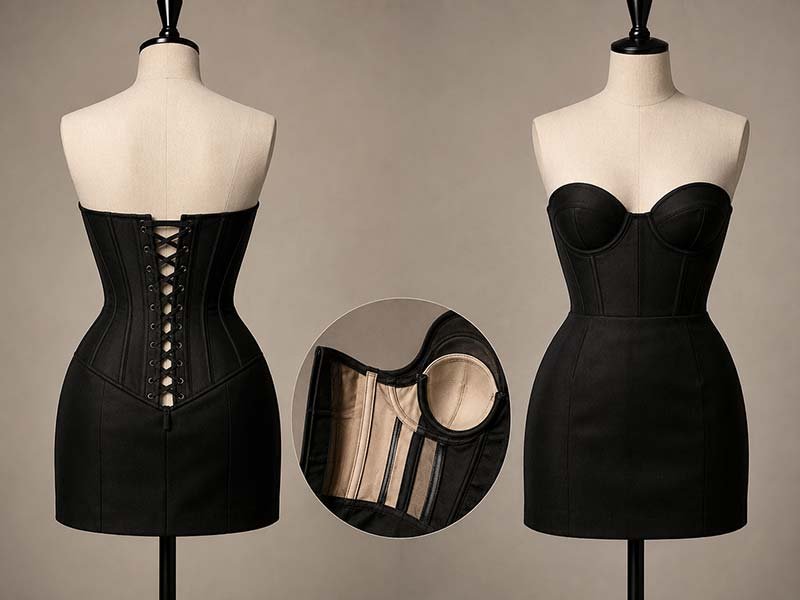
A corset dress and a bustier dress can look almost identical in a campaign photograph. Both may feature a sweetheart neckline, visible boning, a close waist and a body-conscious silhouette. Once the dress is worn, however, the differences become easier to feel. One design may distribute tension through the torso and create a controlled waistline, while the other may rely on cups, underwire and underbust anchoring to lift the bust and keep the neckline secure. Those differences influence comfort, size grading, product descriptions, customer expectations and return risk.
A corset dress primarily shapes and stabilizes the torso, with greater emphasis on waist definition. A bustier dress primarily supports and contours the bust through shaped cups, underwire, padding, seaming or a structured underbust foundation. Modern occasionwear often combines both systems, so the internal construction is a more reliable guide than the product name alone.
This distinction matters most in party, prom, cocktail, wedding guest and going-out collections, where the bodice must look sharp in photographs and remain wearable through movement. A style can appear flawless on a mannequin yet slide down, gape at the neckline or press painfully into the ribs after twenty minutes. The expensive lesson usually arrives after production: the dress was approved as an image, not as a support system. The sections below show how to judge both the visible design and the engineering hidden underneath it.
What Is the Difference Between a Corset Dress and a Bustier Dress?
A corset dress is mainly designed to shape and stabilize the torso, especially the waist, while a bustier dress focuses more directly on lifting, supporting and defining the bust. Modern fashion styles often combine both systems, so the most reliable way to distinguish them is by examining the cups, boning, lining, waist construction and closure rather than relying only on the product name.
Feature | Corset Dress | Bustier Dress |
Main function | Waist definition and torso control | Bust lift and upper-body shaping |
Support focus | Ribs, waist and full bodice | Cups, underbust and neckline |
Typical structure | Panel seams, boning and stable foundation | Shaped cups, underwire, foam and side support |
Common length | Natural waist to upper hip | Usually ends around the natural waist |
Typical closure | Lacing, zipper, hooks or a combination | Zipper, hooks or concealed fastening |
Primary fit risk | Incorrect torso length or waist position | Incorrect cup depth or underbust fit |
Visual effect | Sculpted, elongated and structured | Lifted, rounded and neckline-focused |
Corset Structure
A corset dress is defined by the way its bodice manages tension across the torso. The outer layer may be satin, velvet, crepe, lace or mesh, but the shaping normally comes from a separate internal foundation. That foundation can include a low-stretch lining, reinforced panel seams, boning channels, waist tape and a closure strong enough to hold the pattern in its intended position. The result should be controlled rather than simply tight: tension is spread across the bodice instead of being concentrated at one zipper, one side seam or the top edge.
Boning alone does not make a corset. Many fashion dresses use narrow plastic strips to keep seams upright or to create the visual language of corsetry. If the pattern contains generous ease, the lining stretches heavily and the lacing is decorative, the garment may provide very little waist control. A functional corset-style dress needs the panel shape, waist level, lining and fastening system to work together. In most contemporary ready-to-wear collections, the commercial goal is a clean, defined waist and stable neckline rather than dramatic waist reduction.
Bustier Structure
A bustier dress is built around the cup and underbust area. Its support may come from molded foam cups, cut-and-sew cups, underwire, side panels, underbust elastic, short boning or a combination of these parts. The bodice is intended to position the bust and hold the upper edge close to the body, which is particularly important in strapless, sweetheart, balconette and low-cut designs. The waist may still be fitted, but it is usually not the main source of the garment’s structure.
Cup geometry has a larger effect than most product photographs reveal. Cup width determines how far the support extends toward the side body, while cup depth determines the amount of projection it can contain. A shallow cup may flatten the bust or create overflow even when the dress circumference looks correct. An overly deep cup can leave empty space and cause the neckline to stand away from the body. The weight of the skirt must also be considered, because a full, embellished or layered skirt can pull a weak bustier downward during wear.
Hybrid Designs
Many current party and occasion dresses are hybrids. A style may combine underwired bustier cups with an elongated corset waist, use molded cups above flexible spiral boning, or add adjustable back lacing to a bodice that is otherwise closed by a zipper. Retailers may choose whichever name is more familiar or more searchable, which explains why visually similar products appear in both categories. The technical structure, not the marketing label, determines how the garment will fit and perform.
Hybrid construction can deliver an excellent balance of bust lift and waist definition, but it is more demanding to develop. The cup seams must align with the torso panels, the underwire must not clash with vertical boning, and the bodice must remain stable without pulling the cups downward. Each added layer also increases thickness around the neckline and waist. If cups, boning, lacing and lining are added as separate decorative features rather than designed as one system, the dress may look impressive on a hanger yet feel bulky, unstable or restrictive on the body.
How to Identify Them
The simplest way to tell the styles apart is to find the center of the support system. When most of the engineering runs vertically through the torso and controls the waist, the garment is closer to a corset dress. When shaped cups, underwire and the underbust seam do most of the work, it is closer to a bustier dress. A long bodice, strong waist panels and adjustable lacing point toward corsetry; independent cups and a shorter foundation point toward bustier construction.
The inside view is often more informative than the front image. Check whether the cups are independently shaped, whether the boning extends below the natural waist, whether the lining is stable and whether the closure can genuinely adjust tension. Decorative lacing may provide no adjustment, and visible seams may imitate corset panels without carrying structural pressure. In a technical package, a description such as ‘underwired bustier with waist-length boning and fixed zipper closure’ is far more useful than the single phrase ‘corset dress.’
How Do Their Structure and Support Compare?

Corset dresses usually provide stronger waist and torso control, while bustier dresses usually provide more direct bust lift and shaping. The actual level of support depends on the complete construction system, including cup shape, boning position, lining stability, fabric stretch, closure strength and garment length. A rigid-looking dress is not necessarily supportive, and a softer-looking dress may still be carefully engineered.
Boning and Stability
Boning keeps a fitted bodice from folding, rolling or collapsing under tension. In a corset dress, it is commonly distributed along princess seams, side seams, center-front panels and back sections so the entire torso remains vertically stable. In a bustier dress, boning may be shorter and concentrated beside the cups, at the side seams or near the center front. Its main job is often to stabilize the neckline and prevent downward movement rather than to reshape the full waist.
Material selection changes both support and comfort. Flexible synthetic boning is light, washable and suitable for moderate fashion support. Spiral steel can follow curved panel lines while resisting collapse, which makes it useful in more demanding occasionwear. Flat steel offers stronger resistance in one direction and is normally reserved for straighter areas such as the center back. More bones do not automatically create a better dress. Eight well-positioned channels can perform more effectively than twelve channels placed without regard to ribs, waist level, cup position and seated movement.
Component | Common Working Range | Practical Use |
Flexible synthetic boning | About 4-8 mm wide | Light to moderate support in fashion dresses |
Spiral steel boning | About 5-7 mm wide | Curved seams and stronger torso stability |
Flat steel boning | About 5-10 mm wide | Center back and firm vertical support |
Boning end clearance | Often 8-15 mm from seam ends | Reduces poking and seam damage |
Stable foundation stretch | Usually minimal | Carries tension and protects the outer fabric |
Stretch outer fabric | Often 10-25% crosswise | Improves comfort but normally needs stable backing |
These figures are practical development ranges rather than universal standards. Boning suppliers use different thicknesses, coatings, edge finishes and stiffness levels, so materials should be tested in the actual bodice. A seven-millimeter synthetic bone from one source may behave very differently from another. The final choice should be based on the intended silhouette, care method, target wear time, seam curvature and the pressure created when the garment is closed.
Waist Shaping
A properly engineered corset dress normally shapes the waist more effectively because its pattern is developed to control a larger part of the torso. Curved panel seams remove volume in planned areas, while the closure maintains tension around the body. The visible result may come from moderate negative ease rather than strong compression. For many modern party dresses, customers want a smoother waist and a clear hourglass impression without the breathing restriction associated with traditional waist-training corsets.
It is useful to separate actual waist control from visual waist emphasis. Dark side panels, pointed waist seams, long center-front shapes and angled boning can make the waist appear narrower even when the garment measurement changes very little. These methods often produce a more comfortable and commercially adaptable result. Bustier dresses can also define the waist, especially when the bodice extends to the natural waist, but the hourglass effect commonly comes from contrast between a lifted bust and a fitted middle rather than from full torso compression.
Bust Support
Bustier dresses usually provide more targeted bust support because each cup can be developed around breast volume. Underwire, cup seams, foam, side panels and a secure underbust section can lift the bust while controlling its position. Molded cups create a smooth, consistent appearance that works well in clean satin or jersey styles. Cut-and-sew cups offer greater control over depth, projection and side support, making them useful for fuller-bust designs or necklines that cannot rely on a standard molded shape.
An overbust corset can also support the bust, but it often lifts from below and holds the upper torso as one structure rather than separating each breast inside an individual cup. The resulting shape may be rounded, shelf-like or gently compressed depending on the pattern. In larger sizes, simply increasing the full bodice circumference is rarely enough. Cup depth, cup width, center-front height, underwire shape and underbust tension must be considered separately from the waist, otherwise the dress can become loose through the middle while remaining too shallow at the bust.
Bra-Free Wear
A customer may be able to wear either dress without a separate bra when the bodice contains a complete support system. Built-in pads alone do not guarantee lift. The cups need to be anchored through underwire, an underbust seam, elastic, boning, a waist stay or a stable torso foundation. Strapless designs also need enough friction and vertical support to resist the downward pull created by the skirt and normal body movement.
The answer changes across body types. A lightly structured style may feel secure for a smaller bust but offer insufficient containment for a fuller bust. Product pages should therefore describe the actual construction rather than promise that no bra is needed for everyone. Phrases such as ‘molded cups with side boning and silicone grip tape’ give customers more useful information. Wear testing should include walking, sitting, raising the arms and several minutes of ordinary movement, because a dress that stays in place only during a static fitting has not proved its support.
Which Dress Is Better for Your Body Shape?

Neither style is automatically better for every figure. Bustier dresses are often more suitable when cup shape and bust lift are the main priorities, while corset dresses are often better when the wearer wants stronger waist definition and torso control. The best choice depends on bust volume, torso length, waist position, shoulder balance, fabric stretch and the amount of support expected during real movement.
Fuller Busts
For a fuller bust, cup depth is usually more important than visible padding. A shallow cup may push breast volume upward or toward the side even when the overall dress size appears correct. The underwire should follow the base of the bust without resting on breast tissue, while the cup edge should contain movement without cutting into the body. A higher center front, stronger side cup and stable underbust foundation can improve security without making the neckline look excessively covered.
Bustier dresses often work well because their cup system can be adjusted independently from the waist. Multi-panel fabric cups can provide more projection than thin molded cups, and a reinforced side panel can direct the bust forward. Corset dresses may also suit fuller busts when the overbust pattern includes enough upper volume. The common mistake is to grade the entire bodice outward while leaving the cup shape almost unchanged. This makes the waist loose but does not solve compression, overflow or underwire placement. Bust, underbust and waist should be reviewed as separate fit zones.
Smaller Busts
Bustier dresses offer several ways to create shape for a smaller bust. Light foam, removable padding, curved cup seams and a carefully positioned apex can add lift without producing an artificial look. Sweetheart and balconette necklines can increase visual fullness, while gathered overlays and angled seam lines can create dimension. The cup still needs to sit close to the body; an oversized molded shape may look full on a hanger but leave a visible gap when worn.
Corset dresses create a different effect by defining the waist and lifting the upper body from below. This can make the bust appear more prominent without thick padding. Neckline gaping is the most common fit problem in smaller-bust samples. Tightening the entire top edge may cause pressure near the underarm or distort the center front. A better correction usually involves refining the cup curve, moving the apex, changing the side-cup angle or reducing only the excess area. The neckline should remain close during movement without flattening the bust or rolling outward.
Torso Length
Torso length has a major effect on both styles. Two customers can share the same bust, waist and hip measurements but need different vertical proportions. In a corset dress, the distance from the underarm to the natural waist determines whether the boning follows the body or presses into the ribs and upper hip. If the waist is too high, the bodice can feel restrictive under the bust. If it is too low, the lower edge may dig in when the wearer sits.
In a bustier dress, the vertical relationship between the bust apex, underbust and waist determines whether the cups sit in the correct place. Adjustable straps can correct small differences but cannot fix a cup positioned several centimeters too high or too low. Important measurements include front bodice length, back bodice length, shoulder-to-apex, apex-to-waist and side length. Even a one- to two-centimeter error can be obvious in a rigid bodice because the garment cannot drape around the problem. Petite and tall ranges may require dedicated pattern changes rather than simple proportional grading.
Common Fit Problems
Fit Problem | Likely Cause | Practical Correction |
Neckline gaping | Cup edge too long or apex misplaced | Reduce the cup edge and rebalance cup shape |
Bust overflow | Cup too shallow or neckline too low | Add cup depth, coverage or side support |
Dress sliding down | Weak underbust anchor or heavy skirt | Reinforce the waist and internal foundation |
Boning poking | Bone too long, misplaced or poorly finished | Shorten, cap and reposition the bone |
Waist wrinkles | Incorrect waist level or uneven panel tension | Correct vertical balance and seam shaping |
Center front lifting | Torso too short or cup too shallow | Adjust front length and cup projection |
Side seams pulling forward | Insufficient front-body volume | Redistribute width between front and back |
Zipper rippling | Excess stretch, ease or weak reinforcement | Stabilize the zipper area and correct fit |
Fit should be reviewed from the front, side and back while the wearer stands, sits, walks, raises both arms and rotates the torso. These movements reveal problems that a mirror test cannot show. The dress should remain secure without requiring constant adjustment at the neckline or waist. Moderate pressure is expected in a structured bodice, but sharp discomfort, restricted breathing, numbness or concentrated pressure at a boning end indicates a pattern or construction problem rather than a normal corset effect.
Which Fabrics and Details Work Best?

Corset and bustier dresses need materials that support the intended shape without making the garment unnecessarily heavy or rigid. Stable woven fabrics work well for sharp structure, while stretch satin, mesh and jersey improve comfort but usually require stronger internal support. Cups, linings, boning, closures and seam reinforcement should be selected as one coordinated system rather than as separate decorative details.
Fabric Performance
The same pattern can fit very differently when cut in another fabric. A non-stretch satin creates a clean, sculpted surface but allows little tolerance for body variation. Stretch satin can improve comfort, yet poor recovery may allow the bodice to relax during wear. Fashion mesh creates a light, modern appearance but normally cannot carry meaningful tension without power mesh, organza, tricot or another stable backing. Velvet adds visual richness and weight, while crepe is comfortable and commercially versatile but may need reinforcement to hold a sharp strapless neckline.
Useful fabric checks are simple and repeatable. Measure stretch in both directions, hold the fabric extended to assess recovery, hang a cut panel for several hours to observe growth, and compare opacity over cups, seams and lining. Pressing trials are also important because heat can change shine, texture, bonding and elasticity. A fabric that stretches twenty percent across the body but also grows vertically can gradually pull the cups downward. Bulk yardage should be compared with the approved sample fabric, because small differences in weight, coating or elastane content can alter fit enough to require adjustment.
Cups and Linings
Cup selection should begin with the target silhouette. Molded foam cups are useful for smooth, rounded shapes and consistent production, especially in clean party dresses. Their limitation is that the wearer must fit the predetermined mold. Cut-and-sew cups are assembled from two or more fabric panels, allowing the pattern maker to adjust depth, projection, lift and side control. They are often more adaptable for fuller-bust designs, unusual necklines and collections that need a specific cup profile rather than a generic rounded shape.
A structured cup may contain outer fabric, stable lining, foam, underwire channel, side support and edge tape. Each layer should have a clear job. Adding extra layers without managing thickness can make the neckline bulky and difficult to sew. The corset foundation should normally stretch less than the decorative outer fabric so it can carry tension while the surface layer provides color and texture. In sheer styles, seam allowances and boning channels remain visible, so their width, placement and finishing must look intentional rather than hidden as an afterthought.
Closures and Adjustment
Back lacing offers the widest adjustment range and creates an unmistakable corset appearance. It can accommodate limited variation in waist and torso measurements, but the opening must be reinforced so eyelets or loops do not distort under pressure. A modesty panel may be needed for coverage and comfort. The lacing also needs enough length and a practical method of tightening; a beautiful but difficult closure can lead to negative customer feedback even when the garment fits well once fastened.
A concealed zipper gives a cleaner commercial finish and is faster for the wearer, but it offers little adjustment. Pattern accuracy and fabric consistency therefore become more important. Hook-and-eye tape can sit beneath the zipper to reduce strain during dressing, while an internal waist stay can help carry the skirt’s weight. Some designs combine a zipper with decorative lacing, which should be described accurately so customers do not assume it changes the fit. Closures must be tested under body tension because a zipper that runs smoothly on a hanger may ripple, catch or separate when the wearer sits.
Preventing Fit Failure
Fit failure is best prevented before production begins. The team should first define the expected function: bust lift, neckline security, visible waist definition, moderate compression or simply the appearance of corsetry. Without that decision, the designer, pattern maker and sample room may interpret the same sketch differently. A reliable process includes fabric testing, first pattern, prototype, fit sample, revised sample and pre-production confirmation. Higher-risk styles may also need a first-piece review or a short pilot run before the full order is released.
Fit comments should be measurable and specific. ‘Cup too small’ is less useful than ‘add one centimeter of lower-cup depth while keeping the neckline length unchanged.’ Photos should show front, side and back views, with the fit model’s measurements and the actual sample measurements recorded. The production team also needs approved references for boning length, cup position, seam tension and closure reinforcement. A skilled sample maker may correct small problems by hand during development; if those adjustments are not documented, bulk production may not repeat the approved result.
How Should Brands Choose Between Them?

Choose a corset dress when the collection needs visible waist definition, an elongated torso and a strong structural statement. Choose a bustier dress when bust lift, shaped cups and neckline presentation are the main priorities. A hybrid design can deliver both effects, but it requires more careful fitting, grading and production control because every added support component affects comfort, cost and consistency.
Occasion and Customer Use
Corset dresses are effective for statement partywear, prom collections, birthday dresses, clubwear and fashion-led evening capsules. Their vertical lines and controlled waists create a strong image in campaign photography and merchandising. Bustier dresses often suit cocktail, graduation, wedding guest and polished occasion collections, where shaped cups and a secure neckline can feel feminine without the stronger historical reference of a corset. Both styles can work across these categories, but the expected wear time and movement should influence the amount of structure.
A highly rigid corset may perform well as a dramatic hero style yet feel restrictive during a long seated dinner. A softer bustier may remain comfortable for several hours but need stronger anchoring for dancing. Collection balance also matters. A commercially sensible range can combine one high-impact corset dress, several softer bustier styles and simpler fitted dresses that share a color or fabric story. This keeps the visual identity strong without making every product equally difficult to fit, grade, manufacture and sell across a broad size range.
Comfort and Wearability
Bustier dresses are often considered more comfortable because they usually apply less pressure around the ribs and waist. That assumption can be misleading. A narrow underwire, shallow cup, stiff side bone or unstable neckline can make a bustier uncomfortable within minutes. A well-fitted corset dress may distribute tension more evenly over the torso and feel secure. Problems arise when the bodice is too long, the natural waist is misplaced, the lower edge presses into the hips or the closure concentrates pressure at the back.
Wear testing should resemble actual use rather than a brief fitting. The model should raise both arms several times, walk at least twenty normal steps, sit for ten to fifteen minutes, move repeatedly from sitting to standing, bend slightly forward and rotate the torso. The team should then check neckline movement, underwire pressure, boning ends, zipper strain and breathing comfort. A structured dress should feel secure without feeling punishing. If the wearer must repeatedly pull up the neckline or cannot sit naturally, the design is not ready for approval.
Development Difficulty
Corset dresses are demanding because the panels, boning and closure must distribute tension evenly. Bustier dresses are demanding because cup geometry, underwire position and neckline contact must match the bust. Complexity rises quickly when the design includes a deep plunge, low back, strapless neckline, sheer mesh, heavy embellishment, long skirt or highly elastic outer fabric over a stable foundation. Each of these features removes space for support, adds weight or increases the number of layers that must meet cleanly.
Grading is another major risk. Increasing every pattern measurement by the same proportion can move the bust apex too far outward, make the boning too long or change the neckline angle. Larger sizes may need deeper cups, stronger lining, wider elastic or different support placement rather than only larger dimensions. Visually simple styles are often the least forgiving. Smooth satin reveals rippling, asymmetry and cup edges immediately, while embellishment can hide minor surface issues but adds weight, cost and process variation. Development difficulty should be reflected in the sample plan and approval timeline.
Tech Pack and Approval
Development Item | Specification to Confirm |
Cup type | Molded, padded, cut-and-sew, underwired or wireless |
Cup position | Width, depth, apex location and neckline coverage |
Boning | Material, width, length and exact placement |
Foundation | Stable lining, power mesh, fusible or woven support |
Closure | Zipper, hooks, lacing or a combined system |
Core measurements | Bust, underbust, waist, bodice length and side length |
Fabric behavior | Stretch direction, percentage and recovery expectation |
Fit model | Body measurements and approved base size |
Grading | Separate rules for cup, torso, waist and vertical length |
Approval stage | Fit sample, revised sample, pre-production sample and first piece |
The technical package should describe what the bodice is expected to do, not only how it should look. A phrase such as ‘medium waist control with secure strapless support’ gives the development team a clearer target than ‘tight corset fit.’ Sample approval should include photographs, measured results, construction notes and approved component references. The team should inspect the dress during movement and confirm that the sample can be repeated using documented methods rather than temporary padding, hidden hand tacking or one-off manipulation by an experienced sample maker.
Before requesting a quotation, a brand can reduce uncertainty by sharing front, back and side views, a target measurement chart, size range, preferred fabric behavior, cup and underwire requirements, boning expectations, closure choice, estimated order volume and required launch date. Reference samples and fit comments are valuable when they explain what should be preserved and what should be improved. Clear information allows the manufacturer to assess pattern complexity, material risks, sample stages and production controls before cost and timing are committed.
From Concept to Production-Ready Structure
Corset and bustier dresses expose weak development quickly. A small change at the cup edge can create gaping, a slightly misplaced waist can make boning painful, and a different fabric batch can alter stretch, recovery and neckline stability. The most reliable approach is to treat the outer fabric, cups, foundation, boning, closure and skirt weight as one connected system. A beautiful sample is only the first milestone; the real goal is a dress that remains attractive, comfortable and repeatable across the approved size range and production quantity.
Duolan Apparel develops fashion dresses, party dresses, occasion dresses and fitted silhouettes for established fashion teams that need support from concept interpretation through sampling and bulk execution. For a custom corset dress, bustier dress or structured occasionwear collection, send the team your tech pack, reference garment, measurement chart or collection brief. The development discussion can then focus on cup construction, boning, fabric behavior, fit risks, sample stages and production requirements before the project moves forward.
Share:
Our Services
Categories
Table of Contents
Here, developing fashion collections is more than manufacturing garments — it’s a collaborative process focused on transforming ideas into well-executed, market-ready products. From fabric sourcing and sample development to scalable production and delivery coordination, every stage is built to support quality, consistency, and efficient collection launches across global markets.