 Skip to content
Corset Top vs Corset Dress Construction: What Changes in Pattern, Support, Fit, and Production?
Your trusted Women’s Apparel Development & Manufacturing Partner from China
- Jerry
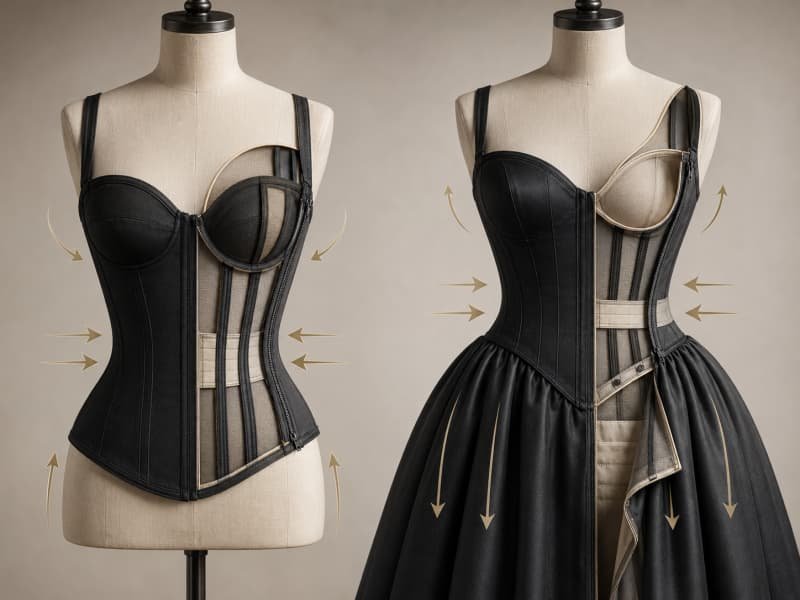
A corset top and a corset dress can look almost identical from the waist up, yet the two products behave very differently once a pattern is placed on a real body. The top has to hold itself in position as an independent garment. The dress has to do the same job while carrying a skirt, crossing the waist, accommodating hip movement, and remaining balanced when the wearer walks or sits. That difference affects panel shape, boning, cups, lining, closure strength, fitting sequence, grading, sewing time, and quality inspection. It also explains why a strong corset top pattern cannot simply be lengthened or attached to a skirt without another development cycle.
A corset top is a self-contained fitted bodice, while a corset dress combines that bodice with a skirt that adds weight, movement, and extra fit points. Corset dresses usually require more control at the waist seam, closure, hip, and skirt balance, so they are generally more complex to fit, grade, and reproduce consistently in production.
The most expensive mistakes often begin with a sample that looks impressive on a mannequin. After twenty minutes of wear, the neckline may drop, the waist may twist, or the boning may push upward because the lower half of the garment is changing the load. Understanding that hidden relationship helps design and product teams choose the right construction before time and budget are committed to repeated samples.
What Is the Construction Difference Between a Corset Top and a Corset Dress?
A corset top is engineered as an independent upper-body structure, while a corset dress connects that structure to a skirt. The dress must control extra weight, waist-seam tension, hip movement, and total garment balance. Because more components interact, it normally needs broader fit testing and more checkpoints during sampling and production.
Standalone Bodice Structure
A corset top must remain stable without support from a skirt, waistband, or lower garment. Its position is controlled by the relationship between the neckline, bust, underbust, waist, back, and finished lower edge. When those zones are not balanced, the garment may slide down, ride upward, flare away from the body, or place too much pressure on the ribs. The lower edge is especially important because a cropped top ending above the natural waist behaves differently from a longer top extending toward the high hip. Even a 10-20 mm change in finished length can alter comfort and movement on a close-fitting style.
The product brief should define the intended support level before pattern work starts. A fashion corset top may use shaped seams, selective fusible reinforcement, and flexible synthetic boning mainly to prevent collapse. A more supportive version may require separate cups, underwire, a stable inner foundation, waist tape, and a reinforced closure. These products can look similar in online photography, but their wear performance, cost, sewing sequence, and fitting requirements are not the same. Clear classification prevents the sample room from building either too little structure or unnecessary stiffness into the garment.
Integrated Dress Structure
A corset dress adds a lower section that changes how the bodice behaves. The skirt can pull downward, push upward when the wearer sits, or rotate around the body during walking. These forces move through the waist seam, side seams, center back, and closure, which means the bodice cannot be approved as an isolated component. A lightweight mini skirt may add limited tension, while a full satin skirt, layered mesh skirt, or embellished occasion skirt can place much greater load on the waist and back. The same neckline may therefore need different support in two visually similar dresses.
The waist connection is a structural decision rather than a simple joining line. Straight waist seams are usually easier to stabilize, while curved, dropped, and basque waists require more precise seam matching, clipping, pressing, and reinforcement. The finished dress should also be checked after hanging and movement, not only immediately after sewing. Bias sections and loosely woven fabrics can continue to relax, allowing the waistline to drop and the cup position to change. A problem that appears at the neckline may have started in the skirt several hours earlier.
Functional vs Decorative Corsetry
Visible channels, contrast stitching, piping, and curved panel lines do not automatically create a functional corset. Many commercially successful garments use these details to deliver a corset-inspired appearance with a softer and more comfortable feel. Functional corsetry, by contrast, uses an internal system to stabilize the relationship between the bust, underbust, waist, and back. The system may include shaped panels, boning, cups, underwire, interlining, elastic support, waist tape, or a reinforced closure. Each component has a specific job, and no single material can correct an inaccurate pattern.
Product descriptions and technical documents should match the real performance of the garment. Words such as supportive, structured, and built-in corset create expectations beyond appearance. A lightly fused party dress can still be well designed, but it should not be developed as though it must provide foundation-level support. A useful commercial classification is decorative corset styling, light shaping, bust-supportive construction, or stronger foundation-backed shaping. That decision helps the development team select the correct materials, estimate sewing time, plan fittings, and avoid adding cost that the customer will not feel or value.
Load and Movement
The main construction difference is the number of forces that must be controlled. A corset top primarily manages bust, waist, and back tension. A corset dress also manages skirt weight, hip movement, stride, total length, and the way the lower garment reacts when the wearer sits. A heavier dress does not automatically need harder boning. In many cases, better load distribution through a waist stay, stabilized seam, balanced skirt, or improved grain control is more effective than making the bodice rigid. The goal is to share pressure across the garment instead of concentrating it at the zipper or one boning channel.
Construction factor | Corset top | Corset dress | Main concern |
Primary load | Bust and torso tension | Bust, torso, and skirt load | Pressure distribution |
Lower boundary | Finished hem | Waist seam or continuous body | Rolling versus seam distortion |
Balance area | Front-to-back bodice balance | Bodice, waist, hip, and skirt balance | Small errors move the neckline |
Movement risk | Riding up or top-edge gaping | Waist pulling, skirt rotation, bodice shifting | Walking and sitting tests |
Closure demand | Upper-body tension | Upper and lower garment tension | Thickness and zipper stress |
Fitting scope | Bust, underbust, waist, torso | Bust, waist, hip, skirt, total length | More measurements interact |
Typical risk | Medium to high | High for fitted or heavy styles | More process checkpoints |
Do Corset Tops and Corset Dresses Use the Same Pattern?
Corset tops and corset dresses may begin with a related bodice block, but the final patterns should not be identical by default. A dress must account for skirt attachment, waist tension, hip movement, closure length, and complete-garment balance. Even small changes in skirt weight or shape can require adjustments to bodice length, seam angles, and support placement.

Panel Shape and Contour
Corset shaping comes mainly from pattern geometry, not from boning. Curved panels distribute volume around the bust, ribcage, and waist, while boning keeps those seams from folding or collapsing. A design with more panels can control three-dimensional contour more precisely, but every added seam also creates another sewing operation and another tolerance point. If several shaped seams are each sewn only 1 mm wider than planned, the finished circumference can change by several millimetres before lining and closure allowances are considered. On a tightly fitted bodice, that accumulated difference can be visible and uncomfortable.
Princess seams, separate cups, and curved center-front panels each solve different design problems. Princess seams can create a smooth, elongated line; separate cups allow more independent control of bust projection and neckline coverage; curved center-front panels emphasize a traditional corset appearance. Panel placement must also work with the boning plan. A rigid channel directly over the fullest bust curve may become visible or uncomfortable, while a channel placed too far from a high-tension seam may provide little support. Pattern shape, visual lines, and internal structure should therefore be developed together.
Waist Seam Changes
When a corset bodice becomes part of a dress, the waist changes from a finished edge into a load-bearing connection. Its position must match both the intended proportion and the wearer’s body. A waist seam only 10-15 mm too high can shorten the torso visually and pull the skirt upward. A seam sitting too low may collapse above the waist or restrict sitting. Bodice and skirt seam lengths should be matched after fusing, stay-stitching, and handling because curved or stretch-prone edges can grow during sewing while a stable lining remains unchanged.
Curved and basque waists need particular control. The sharper the center-front point, the more carefully the allowance must be clipped, turned, and reinforced. Excess allowance prevents the point from lying flat, while excessive clipping can weaken the seam. The pattern should also anticipate the thickness created where outer fabric, support layer, lining, skirt, and zipper meet. Grading or reducing internal seam allowances often produces a smoother closure than forcing a zipper across an uncontrolled stack of fabric. The visual waistline is successful only when it also works as a repeatable production joint.
Skirt Volume and Balance
A fitted skirt, gathered skirt, circle skirt, and bias skirt place different forces on the same bodice. A fitted skirt can push upward when the wearer walks or sits. A gathered skirt adds bulk and downward pull at the waist. A circle skirt contains large bias areas that may continue to lengthen after sewing. For this reason, the decisive fitting should use the actual skirt construction or a technically accurate substitute. A bodice tested with a temporary lightweight panel can appear correct and then fail once the final fullness, lining, and embellishment are attached.
Full skirts may require stay tape or an internal waist support, while gathers should be distributed so that excessive bulk does not collect at the zipper or side seams. Narrow skirts may need more walking ease, a longer slit, or a different lining shape so movement does not push the bodice upward. Long or bias-heavy skirts are often allowed to hang for 12-24 hours before final hemming, although the exact time depends on fabric and length. During that period, the team should check not only the hem but also whether the waistline and neckline have shifted.
Cup and Torso Adjustments
Cup volume and torso length are related, but they are not interchangeable. Increasing the whole front bodice to solve insufficient bust coverage can lower the waist and create excess fabric below the bust. Adding width at the side seam may loosen the waist when the actual problem is limited cup projection. Useful measurements therefore extend beyond full bust, waist, and hip. Underbust circumference, apex position, apex-to-apex distance, front waist length, back waist length, side seam length, and intended neckline height provide a more reliable picture of how the bodice should sit.
Grading must preserve the original contour rather than enlarge every panel by the same percentage. Bust projection, cup height, neckline coverage, and torso length often change at different rates across a size range. Mechanical grading can make larger cups too tall or move boning away from the intended anatomical position. Many brands begin with tighter tolerances around the neckline, cup position, and fitted waist than on less sensitive lengths. The exact tolerance must be written in the tech pack, but key fitted measurements are often controlled more closely than general garment dimensions because small deviations are immediately visible.
Measurement area | Purpose | Typical issue when incorrect | Useful control |
Full bust | Overall circumference | Tightness, spillage, or excess ease | Measure at intended wearing level |
Underbust | Anchors lower cup area | Gap below bust or weak support | Confirm on fit model |
Apex-to-apex | Positions cup volume | Cups too wide or too close | Mark on pattern and sample |
Front waist length | Sets front vertical balance | Waist rises or drops at center front | Measure over bust contour |
Back waist length | Controls back balance | Back neckline gaps or waist tilts | Keep separate from front length |
Side seam length | Connects front and back | Armhole pressure or twisting | Check underarm comfort |
High hip | Controls longer top hem | Flaring, rolling, or sitting restriction | Test standing and sitting |
Which Support Materials Does Each Style Need?
Both styles can use boning, cups, underwires, lining, interlining, reinforced closures, and waist support, but the correct package depends on the promised silhouette and comfort. Corset dresses often need additional reinforcement at the waist and closure because the skirt adds load. Materials should be selected as a coordinated system rather than as isolated upgrades.

Boning Selection
Flexible synthetic boning is common in fashion products because it is lightweight, economical, and easy to use in moderately curved seams. It works well when the goal is to prevent panel collapse and preserve a corset-like outline rather than create strong waist reduction. Common fashion boning widths often fall around 4-12 mm, but width alone does not indicate quality. Spiral steel can follow curved seams in more than one direction and is useful for stronger occasionwear structures, while flat steel is usually reserved for straighter, high-tension areas such as center back or beside a laced closure.
Boning quantity should never be treated as a simple quality score. Eight channels placed near the seams that need stabilization can perform better than twelve channels added without regard to movement or pressure. The sample team should confirm channel width, end finishing, clearance from seam intersections, and the direction each bone must flex. In many fashion constructions, leaving roughly 10-20 mm between the end of the bone and a sensitive finished edge helps reduce pressure, although the exact allowance depends on the seam and binding method. Sitting and repeated-bending tests are essential because some failures appear only when the body changes position.
Cups and Underwires
Cups shape the bust but do not create support by themselves. A molded foam cup gives a smooth surface and consistent volume, yet the garment may still slide if the underbust and back are loose. Fabric cups can be less bulky and more adaptable, but their shape depends on accurate stitching, stabilization, and pressing. The cup decision affects neckline depth, panel shape, lining, seam thickness, and the location of the bust apex, so it should be made before the pattern is close to approval rather than added late as a corrective accessory.
Underwires can improve lift, separation, and anchoring when the wire shape matches the cup and intended wearer. A poor match may sit on breast tissue, extend too far into the underarm, or break through the casing. Brands should also decide whether the garment is designed to be worn with a bra. A backless or low-neck dress may need to provide its own coverage and support, while a corset-inspired top intended for layering may require only light shaping. Two garments with similar exterior seams can therefore need very different internal cup and wire systems.
Lining and Interlining
The outer fabric creates the visible finish, while the internal layers usually determine stability. Lining improves comfort, covers internal construction, and helps the garment move over the body. Interlining strengthens panels, supports boning channels, and prevents delicate outer fabrics from carrying all the tension. A firm woven outer fabric may need only selective reinforcement. Soft satin often needs a more stable backing because it can reveal every seam and channel. Stretch mesh may use power mesh to control extension, while lace and sequin surfaces usually perform best over an independent structural base.
Fusible interlining is efficient, but heat, pressure, adhesive, and shrinkage must suit the outer fabric. The wrong combination can cause bubbling, stiffness, or visible strike-through. Non-fusible foundations avoid adhesive problems but need more careful handling. The full layer package should be tested together because materials that look stable separately may react differently after steaming. If the outer fabric, support layer, and lining shrink at different rates, the completed panel can twist or ripple. Testing only the face fabric does not reveal how the finished garment will behave.
Closures and Waist Support
The closure must withstand real wearing tension, not just close on a flat sample. Invisible zippers create a clean look but are sensitive to thick waist seams, stretch during insertion, and pressure from multiple support layers. Exposed zippers can provide more strength and become part of the design. Hook-and-eye tapes offer controlled fastening, while laced backs provide adjustment but require reinforced eyelets, suitable lacing, an intentional gap range, and often a modesty panel. For dresses, the opening must also allow the garment to pass over the bust or hips without damaging the zipper.
A waist stay can reduce strain on the closure and help hold a strapless or heavy dress at the correct vertical position. It usually sits close to the natural waist and may fasten independently inside the garment. The stay must be secure enough to anchor the bodice without creating a narrow pressure line. Support works best as a system: strong boning with a weak zipper and unstable waist will still fail. Panels, closure, waist reinforcement, fabric, and lining should share the load so that no single component becomes the point of breakdown.
Support component | Common specification | Best use | Main risk |
Synthetic boning | Often 4-12 mm wide | Light to moderate fashion structure | Permanent bending or ridges |
Spiral steel | Selected by seam curve and support level | Curved supportive bodices | Weight and end finishing |
Flat steel | Used in straighter high-tension zones | Back closure or lacing support | Excess rigidity |
Foam cup | Shape selected by cup width and depth | Smooth bustier appearance | Visible edge or size mismatch |
Underwire | Matched to cup and casing | Lift and separation | Pressure or casing failure |
Power mesh | Stretch and recovery matched to style | Controlled stretch support | Recovery loss |
Woven interlining | Weight matched to outer fabric | Satin and structured panels | Bulk or shrinkage mismatch |
Waist stay | Stable tape at natural waist | Strapless or heavier dresses | Incorrect position or discomfort |
How Do Fabric and Fit Change the Construction?
Fabric decides how much shaping comes from the pattern and how much support must come from internal layers. Stable wovens hold a clear silhouette but allow little fitting tolerance, while stretch fabrics improve movement but may lose recovery. The final pattern should be tested in the intended bulk fabric or a technically comparable substitute.

Stable Wovens and Soft Fabrics
Firm woven fabrics such as taffeta, faille, structured crepe, and heavier satin can hold defined corset shapes because their limited stretch makes panel curves more predictable. That stability also reduces fitting tolerance. A waist that is only slightly too small can feel immediately uncomfortable, while a seam sewn off grain can twist instead of relaxing into place. Satin is particularly revealing because reflected light highlights puckering, uneven pressing, boning ridges, and small differences between left and right panels. Needle size, stitch length, thread tension, fusing, and pressing should therefore be confirmed during development rather than left to individual operator preference in bulk.
Softer materials such as chiffon, lightweight mesh, and delicate lace normally cannot carry corset tension on their own. They are better used as surface layers over a stable foundation. Heavily embellished fabrics add weight and can obstruct seams; sequins or stones may need to be cleared from allowances and restored after assembly. The internal base should carry body tension so decorative fabric is not repeatedly stressed. The best outer fabric is not simply the most luxurious swatch. It is the material that can create the intended silhouette, survive cutting and pressing, and remain stable after wear, cleaning, and packing.
Stretch and Recovery
Stretch describes how far a fabric extends, while recovery describes how closely it returns to its original measurement. For close-fitting garments, recovery is often more important than maximum extension. A fabric may stretch comfortably and still remain enlarged after wear, causing the neckline, waist, or back to loosen. Horizontal stretch mainly affects circumference. Vertical stretch can lower the bust point and waist position. Bias movement can also change woven panels, especially in curved skirt sections. These directions should be tested separately because one fabric may be stable across the width but mobile in another direction.
A practical test records the relaxed length, extended length, and recovered length after a defined rest period. A 100 mm specimen extending to 120 mm has 20% stretch. If it returns only to 104 mm, it has retained 4 mm of growth. That seems small on a test strip but can become significant around a fitted bodice. Two fabrics with the same extension may therefore require different negative ease. When a substitute differs in recovery, direction, or shrinkage, the pattern should be reviewed again even if the weight and appearance are similar. Repeat orders also need lot checks because finishing and dyeing variations can alter fit.
Skirt Weight and Dress Balance
Skirt weight can lower the bodice, distort the waist, and change neckline position, particularly in strapless dresses, thin-strap styles, and low backs. The effect should be assessed after the complete garment has hung and after the wearer has moved in it. Bias-cut skirts may lengthen, gathered skirts can concentrate load at the waist, and uneven decoration can pull one area more strongly than another. Common warning signs include a dropping center-front neckline, a waist seam curving downward, a wavy zipper, or boning pressing upward into the bust.
Tightening the bodice is not always the correct response. More negative ease may increase discomfort while leaving the load path unchanged. Better solutions may include stabilizing the waist seam, adding a waist stay, supporting the skirt from an internal layer, redistributing fullness, or correcting grain. A narrow skirt may also push the bodice upward when the wearer walks. Increasing step room, adjusting the slit, or changing the lining can solve an upper-body issue more effectively than altering the cups. The garment must be judged as one moving system, not as separate top and bottom pieces.
Common Fit Problems
Corset products make fitting errors easy to see because panel lines, cups, and channels create strong visual references. Upper-cup gaping may come from excessive cup volume, an incorrect neckline curve, or too little top-edge tension. Side spillage may indicate a cup that is too narrow rather than a garment that is generally too small. Empty space below the bust often points to poor underbust shaping or a cup positioned too high. Boning that bows outward may be too long, too rigid, or placed over a curve it cannot follow.
Dress-specific problems include a tilted waist, rotating skirt, rippled zipper, and inconsistent hem. Fit comments should describe location, amount, and likely cause rather than simply asking to make the garment tighter. A useful review combines garment measurements, fit-model measurements, photographs from front, side, and back, and observations after several minutes of movement. Body heat and movement allow the fabric and support materials to settle, so some problems do not appear immediately. A sample that looks smooth for a photograph may still need structural correction before it is reliable for real wear and graded production.
How Should Brands Develop and Produce Each Style?
Development should begin with a clear performance brief, detailed technical information, and a defined support level. Corset products should move through structured fitting, revised sampling, pre-production confirmation, and targeted bulk checks. Higher-risk styles may need a pilot or first-piece review before full sewing, especially when close fit, delicate fabric, and complex support are combined.

Technical Pack Requirements
A corset technical pack must explain the exterior design and the internal structure. Flat sketches alone cannot communicate support level, panel tension, or the relationship between cups, boning, lining, and closure. The pack should identify main fabric, lining, interlining, stretch direction, cup type, underwire, boning material and width, channel position, closure, waist support, and seam construction. It should also show neckline shape, cup coverage, waist position, finished bodice length, skirt attachment, and any internal details that must remain invisible from the outside.
Measurements should include more than standard bust, waist, and length points. Neckline width, cup height, underbust, front and back waist length, side seam length, apex position, and the distance between bust apex and waist are valuable on fitted styles. The document should distinguish functional seams from decorative seams and identify which design details are non-negotiable. Reference images help communicate mood, but two garments can share the same exterior appearance while using different internal systems. Clear written specifications allow the sample room to quote more accurately, choose the right materials, and avoid building the wrong level of support.
Sample and Fit Review
Sampling should move from structural confirmation to final presentation. The first prototype establishes whether panel shape, cup volume, waist position, and support direction are workable. During fitting, vertical balance should be reviewed before circumference. The neckline, bust apex, underbust, and waist must sit at the intended heights; tightening a garment that is sitting too low may hide the cause rather than solve it. The fit model should wear the intended undergarment, or no bra when the product is designed to provide built-in support, so each sample round is assessed under consistent conditions.
Corset dresses should be reviewed with the final skirt structure attached during the decisive fit round. The review should include standing, sitting, walking, and arm movement, followed by a short wear period to reveal sliding or pressure. Fit comments should be measurable and prioritized so the pattern team understands which correction controls the others. A brand may use first prototype, fit sample, revised sample, sales sample, and pre-production sample in different combinations, but the bulk materials and sewing method should be verified before production release. Skipping that verification is risky when the style contains sensitive cups, satin, mesh, or a shaped waist.
Pilot Production and Risk Control
A pilot or first-piece review is valuable when several risks occur together, such as shaped cups, underwire, numerous channels, a pointed waist, delicate satin, transparent mesh, dense embellishment, or a narrow skirt. The purpose is to test repeatability, not to create a miniature sales order. A limited set across selected sizes can reveal whether sewing operators reproduce cup height, channel width, waist matching, and zipper finish consistently. Critical operations should be identified in advance so the first pieces are checked before the line continues.
The pilot should also confirm realistic sewing time and production bottlenecks. A sample-room method may rely on one highly skilled operator and become difficult to repeat across a line. Small engineering changes can often preserve the appearance while improving stability and efficiency. The review must lead to a clear decision: release the style, correct the process and repeat the check, or stop until the risk is resolved. Continuing full production with known cup asymmetry, seam distortion, or channel inconsistency usually turns a manageable development issue into costly rework.
Bulk Quality and Style Choice
Bulk quality starts with material approval. Main fabric, lining, cups, boning, zippers, and trims should be checked against the approved references. Stretch, recovery, shrinkage, colour, and width can all affect fit. Cutting accuracy is especially important because small differences across several shaped panels accumulate in the finished circumference. Inline inspection should focus on cup assembly, channel stitching, neckline finishing, waist connection, and zipper insertion. Waiting until the garment is complete makes structural corrections difficult and expensive.
Final inspection should include symmetry, seam smoothness, channel security, closure operation, lining alignment, measurements, movement, and packing protection for molded areas. The commercial choice between a top and a dress should also reflect the collection plan. A top offers styling flexibility and may allow customers to combine separate sizes. A dress delivers a complete occasion look and can support stronger visual impact, but it adds hip, skirt, length, and balance risks. The better choice is the one that fits the brand’s customer data, price position, launch schedule, and available development control rather than the version that looks simplest in a sketch.
Stage | Main purpose | Critical checks | Typical decision |
First prototype | Confirm structural direction | Panel shape, cup volume, waist position, basic support | Revise pattern or continue |
Fit sample | Correct body balance | Neckline, bust, underbust, waist, back, movement | Issue measured fit comments |
Revised sample | Verify corrections | Pattern changes, support placement, comfort | Approve or request one more revision |
Sales sample | Confirm presentation | Fabric, colour, finishing, photography standard | Commercial approval |
Pre-production sample | Confirm bulk method | Actual materials, operation sequence, measurements | Release production |
First production piece | Verify line execution | Cup symmetry, channels, waist, zipper, tolerance | Continue, correct, or stop |
Inline and final QC | Control repeatability | Key measurements, function, appearance, packing | Accept, repair, or reject affected units |
Develop Your Corset Collection With Duolan Apparel
The difference between a successful corset top and a successful corset dress is rarely one visible feature. It lies in the relationship between panel geometry, cup capacity, torso length, fabric recovery, boning placement, internal layers, waist control, skirt load, and movement. Product teams reduce development risk when they define the intended performance early, fit the garment as a complete system, and approve the actual material package before full production.
Duolan Apparel focuses on fashion dresses, occasion dresses, party dresses, body-conscious styles, refined fashion tops, and corset and bustier products. The company’s documented manufacturing system includes 16 owned womenswear factories, more than 20 long-term satellite factories, 300 sewing lines, and over 50 flexible production lines, supported by dedicated fabric, pattern, sample, process, and quality teams. These resources are intended to support collection development, sampling, pilot verification, bulk production, and repeat-order coordination for established fashion programs.
For a custom corset top, corset dress, or coordinated collection, send the development team your tech pack, design sketch, reference sample, intended fabric, size specification, target price range, order plan, and launch schedule. A complete brief makes it easier to evaluate the correct support package, flag fit or material risks, estimate the sampling route, and prepare a production-ready proposal.
Share:
Our Services
Categories
Table of Contents
Here, developing fashion collections is more than manufacturing garments — it’s a collaborative process focused on transforming ideas into well-executed, market-ready products. From fabric sourcing and sample development to scalable production and delivery coordination, every stage is built to support quality, consistency, and efficient collection launches across global markets.

