Skip to content
What Is the Best Fabric for Corset Dresses?
Your trusted Women’s Apparel Development & Manufacturing Partner from China
- Jerry
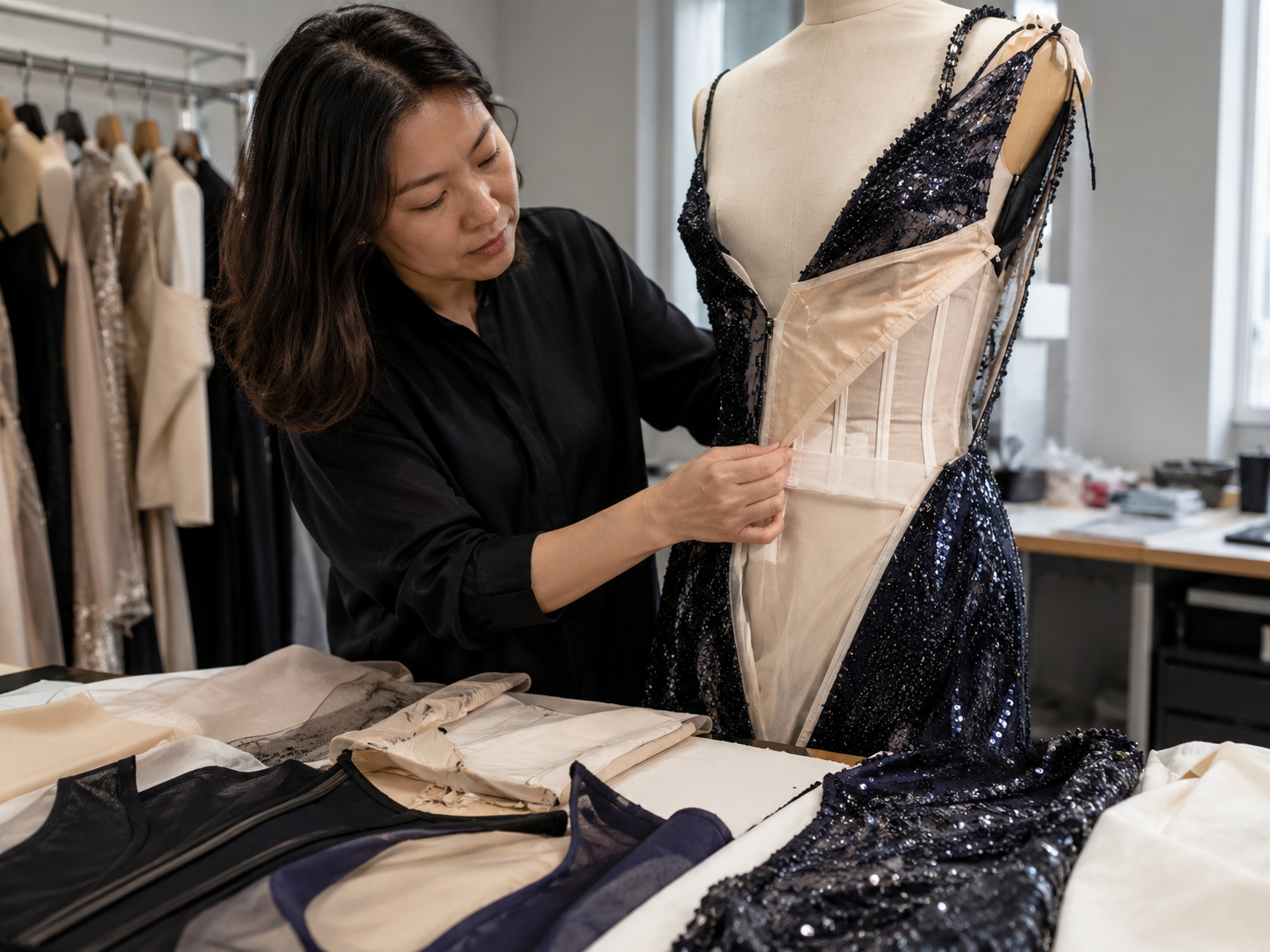
A corset dress can look deceptively simple in a campaign image: a sculpted waist, a clean neckline, a smooth skirt, and perhaps a few visible boning channels. Behind that polished appearance, the fabric is doing several jobs at once. It must hold the bust, control the waist, stay stable around the neckline, survive repeated movement, and still create the visual mood expected from a party, occasion, bodycon, or evening dress. That is why choosing fabric by color, shine, or hand feel alone often produces a sample that looks promising on a hanger but behaves very differently once it is fitted on a body.
The best fabric for a corset dress is usually a coordinated material system rather than one fabric. A stable woven layer such as coutil, cotton twill, drill, or firm satin can support the bodice, while satin, velvet, brocade, lace, mesh, crepe, or chiffon creates the outer look. The final choice must match the required support, stretch, silhouette, comfort, and production method.
This is where many promising designs go wrong. A team selects a beautiful satin from a swatch book, approves the shade, and expects the finished dress to resemble the reference image. The first sample then wrinkles between the boning, the neckline opens away from the body, or the waist loses its definition after thirty minutes of wear. The material was not necessarily poor; it was simply asked to perform a job it was never designed to do. Understanding which layer carries tension, which layer creates appearance, and which details protect fit is the difference between a photogenic prototype and a dress that can be produced, worn, reordered, and trusted.
What Makes a Fabric Suitable for Corset Dresses?
A suitable corset-dress fabric must hold the intended shape without excessive stretching, wrinkling, seam movement, or discomfort. The best choice balances dimensional stability, support, drape, recovery, opacity, surface appearance, and production consistency. Because the bodice and skirt perform different jobs, reliable dresses usually combine several coordinated materials instead of relying on one attractive outer fabric for every function.
Layer Functions
A corset dress is better understood as a fabric system than as a single-material garment. The visible shell creates the color, texture, shine, print, transparency, or embellishment that defines the style. Beneath it, a strength layer supports the fitted pattern and resists the tension created by the bust, waist, zipper, lacing, cups, and boning. Interlining may stabilize a delicate shell, while the lining covers internal construction, improves opacity, and reduces friction against the skin.
These layers can be combined in different ways. A firm duchess satin may contribute both appearance and moderate structural control. Lightweight satin, lace, velvet, sequined mesh, or fashion mesh usually needs a separate foundation because it cannot reliably resist concentrated stress on its own. A bodycon corset dress may use a supported woven bodice attached to a controlled-stretch skirt, while a transparent design may use rigid mesh framed with reinforced seams and carefully positioned opaque panels.
Adding more layers does not automatically improve quality. Excessive thickness can make curved bust seams bulky, create visible ridges over boning channels, restrict movement, and complicate pressing. The more useful approach is to assign a clear task to each material. The shell delivers the visual result, the strength layer controls shape, the lining supports comfort, and reinforcement is concentrated at the neckline, center front, underbust, side seams, waist, zipper, lacing panel, cup frame, and bodice-to-skirt seam.
Performance Properties
Fabric selection should go beyond fiber content and color. Two materials labeled polyester satin may perform very differently because of differences in yarn size, weave density, finishing, weight, and stretch. One may remain smooth under tension, while another develops seam puckering, pulls away from the neckline, or reveals every internal component. The figures below are useful screening references rather than universal standards; final limits should always reflect the silhouette, care method, construction, target market, and brand specification.
Property | Practical Starting Point | Why It Matters |
Structural-layer weight | Approximately 180-350 gsm | Lighter materials may lack control; excessive weight can create bulk. |
Woven bodice stretch | Commonly below about 5-8% | Helps maintain bust, waist, and neckline stability. |
Controlled-stretch shell | Often 10-25%, depending on style | Supports movement in bodycon or fitted dresses. |
Dimensional change | Frequently targeted within +/-3% | Reduces fit change after steaming, washing, or finishing. |
Fabric skew or bow | Minimized before cutting | Prevents twisted seams and uneven hems. |
Shade variation | Compared with an approved standard | Important when panels are cut from different rolls. |
Seam slippage risk | Tested at high-stress seams | Critical for satin, loose weaves, and fitted bodices. |
Opacity | Checked relaxed and under stretch | Prevents cups, seams, labels, and undergarments from showing. |
Fit and Movement
The same paper pattern can fit differently when cut in different fabrics. A rigid woven material holds a clear silhouette but offers little tolerance for body variation. A stretch fabric feels more forgiving, yet it may weaken the neckline, waist, and cup position when recovery is insufficient. Even changing from one satin source to another can alter the fit because the new quality may have different thickness, bias movement, surface friction, or finishing.
At the bust, the material must travel smoothly over curved seams without forming sharp points, hollows, or drag lines. Around the waist, it should resist permanent growth while allowing the wearer to breathe and sit. Along the neckline, it must remain close to the body rather than rolling outward. Where the bodice joins the skirt, both materials should carry their own weight without pulling the waist seam downward or creating a visible horizontal ridge.
A fitting should therefore include more than a stationary front view. The wearer should raise both arms, sit, turn, walk, and remain in the dress long enough for the fabric to warm and respond to movement. The team should then review neckline contact, cup position, side-seam rotation, waist level, zipper strain, boning visibility, skirt pull, lining rollout, and recovery after sitting. These checks often expose problems that never appear on a mannequin.
Commercial Reliability
A fabric can produce an excellent sample and still be unsuitable for a commercial program. Brands also need repeatable color, hand feel, stretch, weight, and surface finish across production lots. If the bulk material differs substantially from the development yardage, the approved pattern may no longer produce the same fit. Availability, dye-lot continuity, reorder potential, and lead-time stability therefore belong in the fabric decision from the beginning.
Production behavior matters as much as wear performance. Fabrics that slip during cutting, stretch under the presser foot, mark easily, fray aggressively, or require tightly controlled pressing may increase repair and rejection risk. That does not mean they should be avoided, but the cutting plan, machinery, operator allocation, seam method, pressing equipment, and quality checkpoints must be matched to the material. The best option is the one that reproduces the intended silhouette consistently, not simply the swatch that feels most luxurious.

Which Fabrics Work Best for Corset Bodices?
Coutil remains a strong choice for highly structured corset bodices, but cotton twill, drill, selected canvas, firm satin, brocade, stabilized velvet, lace, and rigid mesh can also perform well. The correct material depends on whether the dress requires strong shaping, moderate fashion support, transparency, stretch, or a lightweight occasionwear finish. Decorative shells usually need an internal layer that carries structural tension.
Coutil and Stable Wovens
Coutil is associated with traditional corsetry because its dense construction resists stretching and distortion under sustained tension. It is especially useful when a dress requires strong waist control, substantial bust support, a lace-up back, or a bodice that must retain its geometry through extended wear. Its real advantage is dimensional stability rather than simple stiffness, which is why a thin but tightly woven coutil can outperform a heavier material with a looser construction.
Traditional coutil is not necessary for every corset-inspired dress. Many party, cocktail, occasion, and bodycon designs use corset seam lines, molded cups, visible channels, and shaped necklines without applying true waist-reduction pressure. In these garments, dense cotton twill, poly-cotton twill, drill, or another stable woven quality may provide sufficient internal support with less weight, easier color sourcing, and a more practical cost structure for repeat collections.
Before replacing coutil, check cross-grain movement, bias stretch, shrinkage, seam strength, and bulk at multi-layer intersections. A fabric that feels firm in the hand may still grow around the waist once cut into shaped panels and exposed to body heat. The support layer must also sit cleanly beneath the shell: dark twill can shadow through pale satin, a coarse surface can leave texture marks, and different shrinkage rates can create bubbling after pressing.
Satin and Structured Shells
Satin is one of the most widely used corset-dress shells because it creates a smooth, formal, and highly photographic surface. It appears across birthday dresses, party minis, prom styles, cocktail dresses, bridesmaid collections, and eveningwear. Yet satin describes a surface construction rather than one reliable performance level. Duchess satin and dense bridal-style satins may offer useful body, while charmeuse and lightweight satin usually need considerably more internal support.
Stretch satin can work well in fitted styles when its recovery is strong and the critical zones are stabilized. If the material keeps growing after extension, the neckline may open, the waist may soften, and the cups may move during wear. Satin also exposes workmanship more clearly than many matte fabrics: uneven feeding creates puckering, pressing leaves shine, needle holes remain visible, and boning channels or cup edges can show through pale colors under direct light.
A satin bodice should be tested with the actual interlining, stitch type, needle size, seam allowance, pressing method, cup package, and boning arrangement. Review the sample in daylight, side lighting, and flash photography rather than only under soft factory lighting. A surface that looks smooth from the front may reveal internal ridges, adhesive marks, or tension lines when photographed from an angle.
Velvet, Brocade, and Lace
Velvet creates depth, rich color, and a strong autumn or winter identity. It can work beautifully for evening minis, formal midis, and seasonal party dresses, but its pile direction, thickness, and sensitivity to pressure require controlled handling. Panels should normally be cut in a consistent direction, and pressing must avoid crushing the surface. Heavy seam intersections may need careful grading so the finished bodice does not look padded or feel uncomfortable around curved areas.
Brocade often has more natural body than a plain weave and can support structured silhouettes while adding decoration without separate embellishment. Large motifs, however, need deliberate placement across the center front, princess seams, waist, and skirt. Metallic yarns may abrade the skin or break during sewing, and heavy brocade can become bulky around cups and boning channels. A lighter internal foundation is often more effective than stacking two heavy layers.
Lace is usually an appearance layer rather than a strength layer. It may be mounted over satin, organza, mesh, or another stable foundation. Motif placement deserves early planning at the neckline, cup seams, center front, waist, and side seams so the finished dress looks balanced from both sides. Heavily beaded lace needs cleared seam allowances, additional support, and attachment testing because decorative elements can interfere with needles, pressing, comfort, and repair.
Mesh and Transparent Structures
Transparent corset dresses require a clear distinction between rigid corset mesh, power mesh, fashion mesh, stretch tulle, and illusion net. These materials can look similar in a small swatch but behave very differently under tension. Rigid mesh offers transparency with limited stretch and can be used in structural panels when its seams and edges are reinforced. Power mesh is better suited to controlled support or compression, while soft fashion mesh is usually more appropriate for overlays, sleeves, draping, and skirts.
Illusion mesh is lightweight and visually subtle, but it normally needs reinforcement near cups, boning, zippers, and lace-up sections. Stress often concentrates at the edge of a transparent panel rather than in the middle of the fabric. Narrow woven tapes, enclosed seams, stable framing panels, or reinforced channel construction can distribute that load without sacrificing the sheer effect.
Transparent designs should be reviewed on several skin tones and under daylight, warm indoor lighting, and camera flash. Cup color, seam tape, boning casings, labels, and lining become visible design elements once the dress is worn. Internal construction that appears nearly invisible on a pale dress form may look obvious on the body, so the support system must be selected for both performance and appearance.
Fabric Type | Best Use | Typical Advantage | Main Risk |
Coutil | Strong structural bodices | High dimensional stability | Can feel heavy in lightweight fashion styles. |
Cotton twill | Internal support layers | Practical, sewable, widely available | Performance varies with weave density. |
Drill | Firm waist and bodice panels | Strong and stable | May add bulk on tight curves. |
Duchess satin | Formal outer shell | Smooth, sculptural appearance | Shows pressing and seam defects. |
Stretch satin | Bodycon corset dresses | Comfort and close fit | Neckline growth if recovery is weak. |
Brocade | Decorative structured bodices | Texture and natural body | Motif matching and seam thickness. |
Velvet | Premium seasonal styles | Rich color and depth | Pile crushing and directional cutting. |
Lace | Decorative overlay | Detailed, feminine surface | Usually requires a supporting base. |
Rigid mesh | Transparent corset panels | Sheer appearance with control | Stress concentration at seams. |
Power mesh | Support or compression zones | Strong recovery | May feel firm against the body. |

Which Fabrics Suit Different Corset Dress Styles?
Bodycon corset dresses generally need controlled stretch and strong recovery, while formal occasion styles often benefit from firm satin, Mikado, taffeta, brocade, or structured crepe. Soft skirts can use chiffon, georgette, mesh, or fluid satin beneath a stable bodice. The bodice and skirt may use different fabrics, provided their weight, color, stretch, and movement are balanced deliberately.
Bodycon Styles
A bodycon corset dress combines two competing requirements. The upper body needs enough stability to control the neckline, bust, and waist, while the lower body needs enough movement for the wearer to walk, sit, and dance comfortably. Using one unrestricted stretch fabric throughout the dress often weakens the structure. Using one rigid woven fabric throughout may create restriction, horizontal drag lines, and a skirt that rides up.
A more reliable method is to divide the garment into functional zones. The corset bodice can use a stable woven foundation beneath stretch satin, bonded jersey, stretch crepe, or another fitted shell. The skirt can retain greater elasticity, while the waist seam, zipper, neckline, cup frame, and center front receive targeted reinforcement. Ponte-type knits and dense double knits can work well because they combine body, opacity, and recovery, while stretch crepe offers a smoother and more refined surface.
Negative ease should be established through fitting rather than selected from one fixed percentage. The appropriate reduction depends on stretch, recovery, garment length, lining, body coverage, and the intended customer. Too much reduction can rotate side seams, flatten cups, distort the waist, and create transparency at the hips. Too little can leave the dress loose after extended wear. A wear trial lasting thirty to sixty minutes reveals far more than a quick standing fit.
Structured Occasion Dresses
Formal, cocktail, prom, birthday, and event-driven corset dresses often need a clearer, more architectural silhouette. Firm satin, Mikado-style fabric, taffeta, brocade, structured crepe, and velvet can hold shaped panels, pleats, flares, bubble hems, and clean formal volumes more effectively than highly fluid materials. The choice should reflect not only the visual reference but also how the dress will be worn, transported, steamed, photographed, and displayed.
Mikado and taffeta work well for crisp A-line skirts, sculpted necklines, and strong proportions. Duchess satin produces a heavier, smoother eveningwear appearance. Structured crepe provides a quieter matte finish, while brocade adds texture and velvet brings seasonal depth. The total garment weight should be checked early because a layered tulle skirt, beaded overlay, or full satin skirt can drag a narrow bodice downward if the waist seam carries the entire load.
Weight can be distributed through an internal waist stay, reinforced seam, stable tape, separate skirt support, or carefully placed structural panels. Packing behavior also matters. Highly sculptural fabrics may crease in cartons, require professional steaming, and occupy more shipping volume. Testing recovery after folding and steaming helps prevent a dress from arriving with a different silhouette from the one approved in the showroom.
Soft and Draped Skirts
A structured corset bodice paired with a fluid skirt creates a strong contrast between support and movement. Chiffon, georgette, crepe, soft satin, lightweight mesh, and layered tulle can all work below a fitted upper body. Chiffon produces light movement but generally needs lining. Georgette has slightly more texture and weight, while crepe can create a refined fall in midi, column, and bias-influenced silhouettes.
The transition between bodice and skirt deserves as much attention as either fabric alone. A rigid bodice attached directly to a highly elastic skirt may ripple at the waist, while a heavy skirt attached to a lightweight bodice can pull the entire structure downward. Gathering, pleating, bias drape, multiple layers, and seam placement all change the load carried by the waist and must be tested with the real materials.
Different fabrics can be combined successfully when the relationship looks intentional. The color should be checked under daylight and artificial light because satin, chiffon, crepe, and mesh can reflect the same dye differently. Matte and glossy surfaces may complement one another, but the contrast should support the design. A coordinated fabric system feels designed; an untested combination often looks like the bodice and skirt belong to separate garments.
Style and Season
Season and occasion should influence both the shell and the lining. Velvet, dense crepe, brocade, and heavier satin suit cooler periods but may feel uncomfortable in warm venues. Chiffon, mesh, lightweight crepe, and breathable linings are more comfortable for summer events, although the bodice still needs enough stability to hold its shape. Humidity, body heat, and long wearing time can change recovery, cling, and comfort even when the fabric performs well in an air-conditioned fitting room.
The wearing situation also changes priorities. A dance or club dress needs recovery and leg movement. A formal dinner dress must remain comfortable while seated. A prom dress may prioritize camera-friendly volume, while a vacation dress needs support without unnecessary weight. The most suitable fabric is the one that serves the real environment in which the garment will be worn, not only the campaign image or the hand feel of an isolated swatch.
Dress Style | Bodice Direction | Skirt Direction | Key Control |
Bodycon mini | Supported stretch satin or crepe | Dense stretch crepe or knit | Recovery and hem movement. |
Formal A-line | Firm satin, Mikado, or brocade | Matching structured fabric | Skirt weight and seam bulk. |
Draped midi | Stable base with satin or crepe shell | Georgette, crepe, or soft satin | Waist-seam balance. |
Sheer party dress | Rigid mesh with reinforced panels | Mesh, tulle, or chiffon | Transparency and seam stress. |
Velvet evening dress | Stabilized velvet | Velvet or fluid satin | Pile direction and total weight. |
Lace occasion dress | Lace over firm foundation | Lace, chiffon, or crepe | Motif placement and lining color. |
Corset maxi | Structured woven bodice | Chiffon, satin, or layered tulle | Weight distribution. |
Resort corset dress | Lightweight supported bodice | Breathable crepe or cotton blend | Heat comfort and movement. |

How Do Stretch, Weight, and Lining Affect Fit?
Stretch controls movement and body conformity, fabric weight affects how the garment hangs, and lining influences support, opacity, and comfort. Too much stretch can weaken the neckline and waist, while excessive weight can drag the bodice downward. A lining with incompatible stretch or shrinkage may twist, bubble, or restrict the shell. All three elements should be tested together on the intended pattern.
Stretch and Recovery
Stretch can improve comfort, but it is not automatically suitable for every part of a corset dress. The bust frame, neckline, center front, zipper, and waist normally require more control than the skirt or back body. A four-way stretch shell used without reinforcement may feel comfortable during the first fitting but gradually lose shape as body heat and movement relax the material.
Stretch should be measured in both principal directions. A fabric may extend twenty percent across the width but only five percent vertically, which can be useful because the garment moves around the body while retaining its length. Excessive vertical stretch can cause the bodice to drop, the waistline to shift, or the skirt to pull the cups downward. Recovery should be assessed after repeated extension rather than after one quick pull.
A simple development check uses a marked ten-centimeter section. Extend it to the intended wearing range, hold it for about thirty seconds, release it for several minutes, and measure any remaining growth. Repeat the cycle several times. A fabric that stays noticeably longer may need less negative ease, stronger reinforcement, or removal from high-stress zones. Targeted stay tape, woven zipper support, firm cup frames, power mesh, and stable waist panels can preserve comfort without making the whole garment rigid.
Weight and Balance
Fabric weight changes how the bodice hangs, how seams carry tension, and how the skirt interacts with the upper body. A heavy embellished skirt can drag a narrow bodice downward, while a very light shell may reveal cups, boning, and seam allowances. A heavy shell combined with thick interlining, lining, cups, channels, and trims can also become uncomfortable around the waist and underarm.
The complete garment should be considered rather than the grams per square meter of one layer. A moderate shell can become surprisingly heavy after lining, interlining, padding, multiple skirt layers, sequins, beads, or stones are added. Weight can be distributed through an internal waist stay, reinforced waist seam, separate skirt support, stable straps, wider load-bearing panels, reduced seam bulk, and lighter internal materials in low-stress areas.
Balance must be reviewed in movement. If the bodice rises when the wearer sits or drops when she walks, the cause may involve skirt weight, bodice length, stretch distribution, or internal support rather than the circumference measurements alone. Full-circle, pencil, gathered-tulle, and heavily embellished skirts each transfer weight differently, so the final construction should be assessed as a complete garment rather than as separate bodice and skirt samples.
Lining Choices
Lining affects comfort, opacity, fit, and the way layers move against one another. A stable woven lining can support structured satin or brocade, while stretch lining moves more naturally with bodycon shells. Power mesh can add control through the waist and back. Lightweight polyester lining helps the dress slide over the body, whereas cotton-rich qualities may improve breathability but can create more friction or bulk.
The lining should not fight the shell. A rigid lining beneath a stretch outer fabric can restrict movement and create bubbling, while an elastic lining beneath a stable shell may twist or fail to support the structure. Different shrinkage rates can cause rippling after steaming or cleaning. Color also matters: skin-tone lining may be less visible beneath pale or sheer fabrics than white, and dark lining can alter the apparent shade of a light satin.
Lining should be included in the first realistic prototype rather than added after the shell has been approved. Check stretch compatibility, shrinkage, opacity under flash, skin feel, static, dye transfer, seam bulk, neckline rollout, and movement between layers. Adding lining late can change the stiffness, thickness, balance, and measurements enough to invalidate earlier fit decisions.
Boning and Interlining
Interlining supports the fabric surface, while boning controls the vertical form of the bodice. Interlining can reduce stretching, stabilize seams, improve opacity, support embroidery, and create a smoother exterior. Boning helps prevent collapse, rolling, and folding along shaped panels. The two components should complement one another; more boning cannot fully correct an unstable shell, and heavy interlining cannot solve poor channel placement.
Common defects often reveal where the system is unbalanced. Wrinkles between channels may indicate insufficient surface support. A gaping neckline may result from stretch, pattern imbalance, or missing edge stabilization. Bubbling can come from incompatible shrinkage or incorrect fusing. Visible boning may indicate a thin shell or bulky casing, while rolling at the waist can point to inadequate vertical control or an incorrect bodice length.
Fusible interlining should be tested with the actual shell and production press because adhesive temperature, pressure, and dwell time can change shine, hand feel, color, and shrinkage. Some satins, velvets, and textured fabrics respond better to sewn underlining than direct fusing. The shell, support layer, cups, boning, channels, lining, closure, and seam allowances should be approved as one construction system.

How Do You Test Fabric Before Production?
Corset-dress fabric should be reviewed through sourcing specifications, physical testing, prototype fitting, movement trials, and bulk-lot confirmation. Important checks include stretch, recovery, shrinkage, seam strength, seam slippage, colorfastness, opacity, pilling, abrasion, pressing response, and trim compatibility. Testing should use the intended lining, interlining, cups, boning, zipper, and construction rather than evaluating the shell in isolation.
Sourcing Checks
A useful fabric brief begins with the dress function. The supplier should know whether the material will form a rigid bodice, stretch skirt, sheer panel, draped overlay, or embellished surface. Without that context, a swatch may look correct while performing poorly in the garment. A proper brief can include fiber composition, construction, weight, usable width, stretch direction, recovery, shade standard, opacity, drape, care method, intended lining, planned embellishment, order volume, reorder potential, and delivery timing.
Fabric continuity should be checked before the first sample is treated as final. Development yardage may come from existing stock, while the production lot is newly dyed or woven. The new lot can differ in shade, width, weight, stretch, recovery, or hand feel, and those differences can alter fit and cutting consumption. When the first option has unstable supply, a long lead time, or an impractical minimum, alternative materials should be identified early and compared through measurable performance and garment trials.
Test Priorities
Testing should reflect the target market, care method, fabric type, and garment construction. A lightweight fashion corset dress and a strongly structured evening style do not carry identical risks. Laboratory or in-house results should also be interpreted through the proposed seam, reinforcement, and fit. A material may meet a general strength requirement but still need a wider seam allowance, lower stitch density, reinforcing tape, or a different needle at the zipper, cup, and waist.
Test | What It Measures | Main Corset-Dress Risk |
Dimensional stability | Change after washing, steaming, or cleaning | Fit change, bubbling, and lining mismatch. |
Stretch and recovery | Extension and return | Waist growth, neckline gaping, and loose fit. |
Seam strength | Force a sewn seam can withstand | Failure at the bust, waist, zipper, or side seam. |
Seam slippage | Yarn movement beside the seam | Opening at fitted satin or loose-woven seams. |
Colorfastness | Resistance to rubbing, perspiration, and care | Color transfer and visible fading. |
Pilling | Surface fiber entanglement | Wear damage at the underarm, waist, and hip. |
Abrasion | Resistance to repeated rubbing | Damage from boning, sequins, or body movement. |
Pressing trial | Reaction to heat, steam, and pressure | Shine, shrinkage, flattening, and adhesive marks. |
Opacity | Visibility relaxed and stretched | Visible cups, seams, labels, or underwear. |
Trim compatibility | Interaction with boning, cups, zippers, and elastic | Staining, distortion, rust, or attachment failure. |
Embellishment security | Retention of beads, stones, pearls, or sequins | Detachment during wear or care. |
Skew and bow | Alignment of yarns or courses | Twisted seams and uneven hems. |
Sample Evaluation
Fabric should move through increasingly realistic development stages. A swatch reveals color, hand feel, shine, and approximate stretch. A larger drape trial shows movement and opacity. A partial bodice trial can test curved seams, cups, fusing, boning, and neckline control. A complete prototype then reveals how the shell, support layer, lining, skirt, closure, and trims behave together.
The first fitting should record both measurements and functional observations. Check neckline contact, cup position, waist level, side-seam direction, zipper flatness, boning smoothness, lining control, sitting comfort, skirt pull, recovery after movement, internal visibility, skin irritation, and hem balance. Fit comments should identify the likely cause where possible. Noting that the waist is loose is less useful than distinguishing between excess pattern circumference, fabric growth, zipper movement, and insufficient support.
The sample should also be photographed from the front, side, and back under several lighting conditions. Satin, mesh, pale colors, and highly fitted dresses often look different under direct flash. A style approved only in soft indoor lighting may later reveal transparency, internal shadows, pressing marks, or surface irregularities in campaign images. Extended wear testing can also expose recovery loss, cup movement, rolling, or irritation that a short fitting misses.
Bulk Approval
Before bulk cutting, the production lot should be compared with the approved development material for shade, weight, width, hand feel, stretch, recovery, shrinkage, and surface finish. Multiple rolls may need grouping by shade or performance so panels from visibly different lots do not appear in the same garment. The production package should also lock the lining, interlining, cups, padding, boning type and placement, zipper, elastic, support tapes, trims, pattern version, measurements, grade rules, seam methods, pressing process, care instructions, and approved sample.
A first-piece confirmation or limited pilot run is especially useful for satin, mesh, velvet, heavily embellished, bodycon, and complex corset styles. It allows the team to identify seam puckering, cup imbalance, boning distortion, lining problems, pressing marks, and handling difficulties before the full order is committed. The first pieces should be reviewed after the real factory sequence, including cutting, sewing, pressing, finishing, inspection, and packing, because a dress can change after steam or compression.
Fabric approval is complete only when the entire material system has demonstrated the required appearance, support, comfort, movement, and repeatability. A beautiful swatch is the beginning of development, not the final decision. The strongest programs treat testing as a way to protect fit, reduce rework, and keep the approved sample connected to the production result rather than as a box-ticking exercise.

Develop Your Corset Dress Collection
For brands developing a corset mini dress, structured occasion midi, satin bustier style, mesh-panel party dress, or coordinated capsule collection, the most useful starting point is a complete product brief rather than a fabric name alone. Share the intended silhouette, target customer, size range, support level, wearing occasion, visual references, expected quantity, target market, and launch calendar. That information allows the fabric, lining, interlining, cups, boning, pattern, and construction method to be considered together before sampling begins.
Duolan Apparel supports fabric sourcing, material alternatives, pattern development, fit correction, sample execution, construction review, and bulk-production preparation for corset and bustier dresses, fitted dresses, satin styles, mesh designs, partywear, and occasionwear. Send your tech pack, reference images, original sample, fabric direction, target quantity, market, size range, and required delivery window to duolan apparel to request a practical development assessment and quotation for your custom collection.
Share:
Our Services
Categories
Table of Contents
Here, developing fashion collections is more than manufacturing garments — it’s a collaborative process focused on transforming ideas into well-executed, market-ready products. From fabric sourcing and sample development to scalable production and delivery coordination, every stage is built to support quality, consistency, and efficient collection launches across global markets.