 Skip to content
Bodycon Dress vs Bandage Dress: What Is the Difference and Which One Should You Choose?
Your trusted Women’s Apparel Development & Manufacturing Partner from China
- Jerry
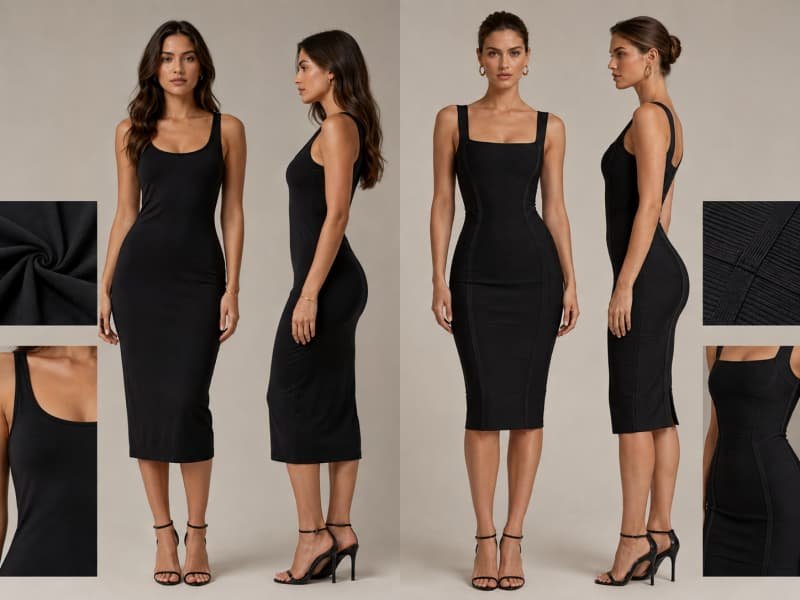
Two fitted dresses can look almost identical in a product photograph and behave completely differently once someone wears them. A soft jersey mini may closely follow every curve but provide little support, while a heavier panelled dress may feel firm, smooth the waist and stay in position throughout an evening. Both products are often labelled bodycon, and some sellers also use the word bandage even when the garment has no meaningful compressive structure.
A bodycon dress is a broad category of close-fitting dresses designed to follow the wearer’s natural silhouette. A bandage dress is a more structured form of bodycon dress, normally made from dense, high-recovery stretch fabric or shaped elastic panels. Bodycon dresses mainly reveal existing curves, while bandage dresses are engineered to hold, smooth and visually reshape the figure with stronger compression.
The real difference appears after the fitting-room mirror. Imagine two customers choosing similar black midi dresses before a special event. One feels comfortable at first but becomes transparent, stretches around the hips and rides upward after walking. The other feels firmer when zipped but remains smooth through dinner, sitting and dancing. The photographs looked similar, yet the fabric, pattern reduction, seam structure and recovery performance created two completely different garments.
What Is the Difference Between a Bodycon Dress and a Bandage Dress?
A bodycon dress is defined mainly by its close-fitting silhouette, while a bandage dress is defined by both silhouette and construction. Bodycon dresses can be soft, lightweight or moderately structured. A genuine bandage dress normally uses denser, stronger-recovery fabric and carefully controlled panels that create more noticeable compression, support and shape retention around the body.
Category and Construction
The simplest way to understand the difference is to treat bodycon as a silhouette category and bandage as a more specific construction category. Bodycon is short for body-conscious, describing any dress that sits closely around the bust, waist, hips and often the thighs instead of falling loosely away from the figure. A bodycon dress may be casual, formal, lined, unlined, knitted, ruched, printed or embellished.
A bandage dress also belongs to the bodycon family because it fits close to the body, but it normally depends on greater fabric resistance, stronger recovery and more deliberate panel placement. Traditional designs often use horizontal sections that appear to wrap around the figure, while contemporary versions may use curved, diagonal or vertical panels. The direction can change, but the fabric must still create controlled tension and support.
A soft jersey dress with decorative horizontal seams does not automatically become a bandage dress. Some garments imitate the surface appearance without providing meaningful compression. The most accurate distinction is therefore practical: every true bandage dress can be described as bodycon, but most bodycon dresses should not be marketed or classified as bandage dresses.
Shape and Compression
A regular bodycon dress usually follows the wearer’s natural proportions. The fabric stretches over the body with light or moderate resistance, allowing the waist, bust and hips to remain visible without significantly changing their shape. Comfort, flexibility and close fit are often more important than strong support, especially in casual rib-knit, lightweight jersey or soft evening styles.
A bandage dress creates greater pressure because its material resists extension and attempts to return to its original dimensions. That recovery force can provide a firmer feeling around the torso, waist, abdomen and hips. When the pattern and fabric are properly balanced, the dress can smooth the silhouette and remain more stable during movement, photography and prolonged wear.
Compression should never be confused with wearing a dress that is simply too small. An undersized bodycon garment may feel extremely tight but still offer no useful shaping. Instead, it may become transparent, pull the neckline downward, create horizontal strain lines, distort the side seams or force the hem upward. Controlled compression distributes tension; poor sizing concentrates it in uncomfortable areas.
How to Identify Each Dress
Product names alone are not always reliable, particularly on marketplaces where keywords may be chosen for visibility rather than accuracy. The garment itself offers stronger evidence. Begin with the hand feel. Ordinary bodycon fabrics may feel soft, flexible, fluid or moderately firm, while genuine bandage material usually feels denser, heavier and more resistant when stretched by hand.
Stretch a small section and release it. A suitable bandage fabric should return quickly without remaining loose, rippled or visibly lengthened. Slow or incomplete recovery suggests that the garment may grow around the seat, hips or waist after several hours. Fabric weight is another clue, although it must be considered together with density and knit structure rather than used as a single test.
Construction also matters. A well-made bandage dress usually includes shaped panels, stable edges, controlled seam tension and joins that remain flat under pressure. Decorative topstitching or horizontal seam lines may copy the appearance, but they do not create structural support unless the material and pattern work together.
Feature | Bodycon Dress | Bandage Dress |
Main definition | Close-fitting silhouette | Close-fitting, compressive construction |
Typical hand feel | Soft to moderately firm | Dense, firm and substantial |
Compression | Light to moderate | Moderate to strong |
Construction | Simple panels, ribs, ruching or layered mesh | Contour panels, bands or engineered sections |
Garment weight | Usually lighter | Usually heavier |
Movement | Generally easier | More controlled and restrictive |
Main visual effect | Shows natural curves | Holds and smooths curves |
Common use | Casualwear, partywear and eveningwear | Cocktailwear, occasionwear and statement styles |
Common Misunderstandings
One common misunderstanding is that visible horizontal strips are required for a dress to qualify as bandage. Traditional designs often use that appearance, but modern versions may rely on clean vertical or curved panel arrangements. The important issue is whether the material and pattern generate purposeful compression, not whether the garment copies one recognisable surface detail.
Another misunderstanding is that every thick fitted dress is a bandage dress. Ponte, scuba, bonded jersey and double-knit fabrics can produce a smooth, structured bodycon shape, yet they may offer only light or medium support. Thickness can improve opacity and polish, but it does not automatically create the recovery strength associated with authentic bandage construction.
Retail price is equally unreliable. A high price may reflect branding, distribution, embellishment or marketing rather than superior compression. A lower-priced garment may still perform well when the manufacturer uses an appropriate fabric and controls the pattern carefully. Fit testing, stretch recovery, opacity and construction provide more useful evidence than either the product name or the price tag.
Which Fabrics and Structures Define Each Dress?
Bodycon dresses can be made from many stretch fabrics because the category is defined mainly by shape. Bandage dresses need denser materials with stronger recovery and enough resistance to maintain compression. Fibre composition is only one part of the decision; fabric weight, knit structure, stretch direction, opacity, recovery and layer compatibility determine how the finished garment performs.

Common Bodycon Fabrics
Bodycon dresses appear in a wide range of materials because different customers expect different combinations of comfort, structure and visual impact. Lightweight polyester-elastane jersey is common in trend-led styles because it provides consistent colour, easy care and flexible stretch. Rayon or viscose blends often feel softer and more fluid, although they may require closer control for shrinkage, growth and distortion.
Cotton-spandex jersey is popular for casual styles because of its familiar touch and breathability. Lower-quality constructions, however, may bag at the seat, elbows or knees after repeated wear. Rib knits naturally expand across the body and can create a comfortable close fit, but loosely knitted ribs may become transparent at the bust and hips or lose their original width.
Ponte is often selected when a brand needs a cleaner and more polished bodycon shape. Its double-knit structure usually provides better opacity, seam definition and dimensional stability than lightweight jersey. Stretch velvet, mesh, lace, sequined bases and bonded fabrics can create stronger occasionwear products, but their outer layers and linings must be tested together because incompatible stretch can restrict movement or distort fit.
Bandage Fabric Performance
Traditional bandage fabrics often combine rayon or viscose, nylon and elastane. Rayon contributes weight and a smooth hand feel, nylon can improve strength and recovery, and elastane provides extension. The exact percentages do not guarantee performance, because yarn quality, knitting density, finishing and fabric structure can change the behaviour more than the fibre label suggests.
A fabric containing more elastane is not automatically more compressive. A loosely knitted material may stretch easily and recover poorly despite having a high elastane content. Another fabric with a lower percentage can feel much firmer when the knit structure creates greater resistance and returns quickly after extension.
Bandage material is normally denser than ordinary bodycon jersey, helping it remain opaque and distribute pressure across the body. During development, the fabric should be tested after repeated extension rather than judged only during a short fitting. A dress that feels stable for five minutes may loosen around the waist or hips after sitting, walking and moving for several hours.
Weight, Stretch and Recovery
Fabric weight is commonly expressed in grams per square metre, or GSM. A higher number often indicates greater density and opacity, but it does not automatically mean more compression. Two fabrics with the same GSM can behave very differently because one may stretch with little resistance while the other requires noticeably more force.
Stretch should be measured in both the width and length directions. Crosswise extension affects fit around the bust, waist and hips. Lengthwise stretch influences sitting comfort, shoulder movement and whether the skirt grows longer during wear. A fabric with high width stretch but very limited length stretch can support the waist effectively while feeling restrictive through the seat.
Recovery indicates how well a material returns after extension. Testing should include repeated cycles and a defined resting period. The following figures are useful development references, but they should never replace testing of the actual selected fabric, colour and finish.
Technical Factor | Soft Bodycon | Structured Bodycon | Bandage Dress |
Typical fabric weight | 180–260 GSM | 280–400 GSM | 400–650 GSM |
Crosswise stretch | 25–60% | 20–45% | 35–70% |
Lengthwise stretch | 5–35% | 5–25% | 15–50% |
Common negative ease | 3–10% | 5–12% | 8–18% |
Expected compression | Light | Light to medium | Medium to strong |
Opacity risk | Medium to high in pale colours | Low to medium | Usually lower when correctly sized |
These ranges overlap because one measurement cannot describe the entire performance of a stretch fabric. A dense 360 GSM knit may create more holding power than a loose 450 GSM material. The development team must therefore assess hand feel, extension force, recovery, opacity and comfort together.
Structure and Layering
Basic bodycon construction may use only front and back panels, side seams and a simple hem. More developed styles can include princess seams, waist shaping, cutouts, draping, ruching, double-layer fronts or contrast mesh. Each feature changes how tension is distributed and how the dress responds when the wearer moves.
Bandage construction usually requires more deliberate panel engineering. Horizontal sections can create a wrapped visual effect, while curved panels may define the waist and diagonal pieces can direct attention across the torso. Vertical divisions can visually lengthen the body and create a cleaner contemporary appearance. The seam placement must support the design rather than merely decorate the surface.
Lining has a major effect on fit. A lightweight bodycon dress may need a compatible stretch lining to improve opacity. A dense bandage dress may not need full lining at all. Adding a heavy lining to an already compressive product can double the pressure, reduce movement and make the zipper difficult to close. Partial lining or targeted power mesh often provides a more balanced solution.
How Do Bodycon and Bandage Dresses Fit?
Bodycon dresses usually use lighter negative ease and follow the wearer’s natural shape, while bandage dresses rely on stronger fabric resistance and greater pattern reduction. Good fit is not measured by tightness alone. The wearer should still be able to breathe, sit, walk, raise her arms and keep the garment in position without repeatedly adjusting the neckline, side seams or hem.

Compression and Negative Ease
Negative ease means the finished garment is smaller than the body measurements it is designed to fit. When worn, the fabric stretches and creates contact with the body. Soft bodycon dresses may use modest reduction because the main objective is a close silhouette. Bandage dresses generally use more reduction, but the exact amount depends on fabric resistance rather than maximum stretch alone.
Applying the same percentage across every body area rarely produces a balanced result. The waist may accept greater reduction, while the bust, seat and upper thigh need more space for three-dimensional shape and movement. Excessive reduction at the bust can flatten the figure or pull the neckline downward. Insufficient reduction at the waist can make the garment appear loose even when the hips feel tight.
Fit should therefore be evaluated zone by zone. Measurements matter, but the physical sensation of the wearer is equally important. A sample may technically match the specification and still feel wrong because one panel carries too much pressure, one seam twists or the fabric lacks adequate vertical extension.
Fit Area | Bodycon Priority | Bandage Priority | Common Risk |
Bust | Smooth contour and stable neckline | Support without flattening | Gaping or excessive pressure |
Waist | Close shaping | Controlled compression | Horizontal wrinkles |
Hip | Curve definition | Even tension and recovery | Transparency or seam strain |
Seat | Movement and coverage | Support with enough extension | Ride-up while sitting |
Upper thigh | Comfortable walking | Stable hem and stride | Restricted movement |
Neckline | Secure but flexible | Strong edge control | Stretching away from the body |
Comfort and Movement
Bodycon dresses are often more comfortable for extended wear because softer fabric moves with less resistance. Jersey, rib and flexible ponte styles can work well for travel, casual dinners and events where the wearer expects to sit or walk for several hours. Bandage dresses feel firmer, which some customers appreciate, but others may find the pressure tiring around the ribs, abdomen or thighs.
Construction details strongly influence comfort. Seams should lie flat and avoid hard ridges against the skin. Zippers need enough flexibility to follow the centre-back curve without forming a rigid wave. Armholes should remain close without cutting into the underarm, and the neckline should stay secure when the wearer lifts both arms.
A useful fitting session should include normal activities rather than standing still in front of a mirror. The model should sit, walk, climb steps, bend slightly and remain in the sample for at least 20 to 30 minutes. Body heat and repeated movement often reveal growth, ride-up and pressure points that are not visible during the first few minutes.
Sizing and Body Measurements
Customers should normally choose the size designed for their body measurements rather than deliberately sizing down. Fitted patterns already contain negative ease, so selecting a smaller size can distort the neckline, reduce garment length, strain seams and increase transparency without creating a smoother appearance.
Bust, waist and full hip measurements remain essential, but they do not explain every fit issue. Torso length, bust depth, seat shape and thigh circumference can significantly affect the result. A fuller bust may require additional front length, while a stronger waist-to-hip difference may need more curved side seams and a shaped centre-back line.
A useful online size guide should state the body measurement range, model measurements, worn size and expected compression level. When customers fall between sizes, guidance should reflect both the fabric and their preferred fit. For firm bandage products, the zipper should close smoothly and breathing should remain comfortable, even when the dress initially feels secure.
Extended sizes require more than adding equal increments around every edge. Bust depth, armhole shape, panel width, waist position, hip curve and skirt balance should be reviewed throughout the graded range to maintain similar comfort and appearance.
Shapewear and Internal Support
Shapewear is optional rather than essential. A well-developed dress should deliver its intended silhouette without requiring every customer to add a second heavy compression layer. Lightweight bodycon fabrics may reveal underwear lines, especially in pale colours, but seamless underwear or a soft smoothing slip can often solve the problem more comfortably.
Strong shapewear under a bandage dress can create excessive pressure, visible edges and competing tension between layers. The smooth surfaces may also cause the outer dress to slide upward. More compression is not always more flattering, particularly when the garment already contains substantial negative ease.
Built-in support can be more effective when it solves a specific need. Options include bust cups, a stabilised neckline, an internal underbust elastic, partial power mesh, a double-layer front or targeted waist support. Each layer must stretch compatibly with the outer material. A rigid lining can restrict movement, change the waist position and make the dress difficult to put on.
Which Dress Is Better for Each Occasion?
Bodycon dresses are generally more versatile because their appearance can range from casual to glamorous depending on fabric, length and styling. Bandage dresses are better suited to situations where a firm, sculpted silhouette is the priority. The right choice depends on wear duration, climate, movement, dress code, undergarment compatibility and the customer’s preferred level of support.

Everyday and Casual Wear
Soft bodycon dresses are generally more suitable for everyday use because they provide a fitted shape without constant pressure. Rib-knit midis, cotton-blend minis and flexible ponte styles can work for brunch, shopping, travel and relaxed social occasions. Length, neckline and fabric opacity determine whether the garment feels effortless or overly demanding.
For casual products, customers often value comfort, easy care and styling flexibility more than maximum shaping. A fitted midi with a square, scoop or crew neckline can be worn with trainers, boots, sandals, a blazer or an oversized shirt. One dress can therefore support several outfit combinations and remain relevant beyond a single event.
Ruching, ribs, prints and double-layer fronts can make everyday bodycon products easier to wear by reducing the visibility of underwear lines and small fit variations. A strong bandage dress can still be worn during the day, but it may feel too formal or restrictive for long periods. Structured ponte or a dense double knit often provides a useful middle ground.
Parties and Evening Events
Bandage dresses naturally suit cocktail parties, birthdays, formal dinners and occasions where customers want a secure, polished silhouette. Dense fabric can remain stable during movement and photography, while contour panels may create stronger waist definition. This makes the category useful for statement styles and products designed around visual impact.
Bodycon dresses can be equally effective for eveningwear when the fabric and details create enough interest. Stretch velvet, double-layer mesh, metallic jersey, sequins, draping, asymmetric necklines and cutouts can produce a glamorous appearance without full bandage compression.
Wear duration should influence the design choice. A customer attending a short dinner may enjoy the firmness of a bandage midi, while someone dancing for several hours may prefer a lighter bodycon mini with greater breathability and hip movement. Bra compatibility, coat layering and ease of dressing also affect whether a striking design becomes genuinely wearable.
Body Shape and Design Details
No fitted dress is automatically best for one body shape. The result depends on proportion, neckline, waist placement, seam direction, fabric support, skirt length and individual preference. Vertical panels can visually lengthen the torso, while curved waist seams may emphasise an hourglass effect. Diagonal lines can create movement and shift attention across the body.
A fuller bust may benefit from wider straps, additional front shaping and a stable neckline. A stronger hip curve often needs a shaped centre-back seam and enough length over the seat. Straighter proportions can gain definition from contour panels, colour blocking and measured waist reduction.
Ruching is widely useful because it distributes fabric across the waist and abdomen and makes small fit differences less visible. Placement should remain intentional, since heavy gathering at the hip can add bulk while controlled waist ruching can improve comfort. Fit imagery should show different proportions whenever possible, because customers in the same nominal size can have very different bust depth, torso length and hip shape.
Style Longevity
Bodycon dresses remain relevant because the category can adapt to changing fashion through fabric, length, neckline and surface detail. A soft ribbed midi, a clean ponte column and a sheer layered mini all belong to the bodycon family, yet each speaks to a different customer and occasion.
Bandage dresses are more closely associated with particular fashion periods, especially late-1990s and early-2000s occasionwear. Contemporary interpretations often feel cleaner than older versions, using midi lengths, muted colours, square necklines, strategic cutouts and fewer visible horizontal bands.
Online attention does not always guarantee commercial success. A dramatic silhouette may perform strongly on social media but generate limited repeat purchases if it is difficult to size or uncomfortable to wear. A balanced collection can test demand through a small group of focused products, such as one black structured midi, one seasonal colour and one fashion-led variation.
How Should Brands Manufacture Each Dress?
Brands should define the intended fit, compression level, customer and wearing occasion before selecting fabric or approving a pattern. Bodycon and bandage dresses require different negative ease, seam construction and quality controls. Reliable development depends on testing the actual material, fitting the complete garment and maintaining one accurate production reference from sampling through bulk delivery.

Pattern Development and Grading
Pattern development should begin after the main fabric has been tested, because a pattern created for one stretch material may fail when transferred to another. The team should measure fabric weight, width, crosswise stretch, lengthwise stretch, recovery and shrinkage before deciding how much negative ease to apply.
A soft jersey and a dense bandage knit may both extend by 40 percent, yet the pressure they create can be completely different. Maximum stretch does not reveal how much force is required or how quickly the material returns. Pattern reduction must therefore reflect resistance and recovery rather than relying on one percentage.
The base size should be fitted on a model with recorded measurements. Comments should cover garment balance, pressure, waist placement, neckline stability, seam alignment, hem position and movement. Once the base is approved, smaller and larger sizes must be reviewed carefully. Bust depth, armhole shape, torso length, panel width and hip curve may need separate adjustments rather than uniform grading.
Preventing Ride-Up and Sheerness
Ride-up usually results from a combination of excessive negative ease, insufficient skirt width, limited vertical stretch, body movement and friction between layers. A dress that is too narrow below the hip will move upward as the wearer walks. Adding more length may reduce exposure, but it does not correct the underlying tension imbalance.
The seat and upper thigh should be tested while sitting, walking and climbing steps. Hem sweep, side-seam balance, centre-back shaping and lining behaviour all influence stability. Smooth shapewear can cause the dress to slide, while rough internal surfaces may catch and bunch during movement.
Sheerness should be assessed while the fabric is stretched to the intended worn dimensions. Looking through a relaxed swatch is not enough, particularly for pale colours and lightweight knits. Common solutions include selecting a denser fabric, reducing negative ease, using a compatible stretch lining, adding a double-layer front or increasing width through the hip and thigh.
Tech Pack Requirements
A useful bodycon or bandage dress tech pack needs more than a flat sketch and a basic measurement chart. Stretch garments are highly sensitive to material behaviour, so design information must be connected with fabric weight, stretch direction, recovery, negative ease and intended compression.
The document should include front and back technical drawings, colourways, fabric composition, target GSM, panel placement, seam types, lining details, trims, measurement diagrams, tolerances, labels and packaging. Instead of writing only “tight fit,” the brand should define whether the garment needs light contouring, medium support or firm compression.
Critical measurements usually include bust, waist, full hip, body length, skirt length, neckline opening, armhole, hem sweep and zipper length. All sample corrections must be added to the latest version. Instructions left only in emails or messaging threads can easily be missed when the style moves from development into bulk production.
Production Quality Control
Quality control begins before cutting. Once an unstable or incorrect fabric has been cut into thousands of panels, sewing inspection cannot recover the loss. Bulk rolls should be compared with the approved standard for shade, width, weight, hand feel, stretch, recovery and visible defects.
Pre-production testing may include shrinkage, colourfastness, opacity, seam strength and repeated recovery. Cutting teams must control grain direction, fabric face, shade grouping and panel accuracy. This is particularly important for rib, velvet, brushed surfaces and colour-sensitive materials that can look inconsistent when pieces are cut in different directions.
Inline sewing inspection should focus on panel alignment, stitch stretch, seam flatness, zipper installation, neckline stability and hem appearance. Final measurements should be taken after a consistent rest period because stretch garments can remain temporarily longer or wider after fitting or pressing.
Production Stage | Main Checks | Practical Purpose |
Fabric approval | GSM, width, shade, stretch and recovery | Confirm bulk matches the approved standard |
Pre-production testing | Shrinkage, colourfastness, opacity and seam stretch | Identify risks before cutting |
Pattern approval | Measurements, balance and compression | Confirm fit with the actual fabric |
PP sample | Construction, labels, zipper and lining | Establish the final production reference |
Cutting | Direction, panel accuracy and shade grouping | Prevent size and colour inconsistency |
Inline sewing | Stitch quality, alignment and seam strength | Detect problems early |
Finishing | Measurements, pressing and appearance | Avoid distortion and surface damage |
Final inspection | Workmanship, quantity and packing | Confirm shipment readiness |
The approved pre-production sample, graded specification, fabric standard, construction notes and packing instructions should form one complete reference package. Realistic tolerances are equally important. Critical points may require closer control, but extremely narrow tolerances on highly elastic materials can create disputes without improving customer fit.
Which Dress Should You Choose?
A bodycon dress is usually the better choice when comfort, styling flexibility, soft movement and broader occasion coverage matter most. A bandage dress is more appropriate when the wearer wants a substantial hand feel, stronger hold and a deliberately sculpted silhouette. The best decision depends on the intended experience rather than which product name sounds more fashionable.
For a commercial collection, these categories do not need to compete with each other. A ribbed bodycon midi can serve everyday customers, a double-layer mesh mini can address trend-led partywear, a ponte dress can bridge dinner and occasion use, and a dense bandage midi can act as a statement product. Each style should have its own fabric, pattern, construction and fit expectations.
The most useful question is what the customer should feel while wearing the garment. She may want softness and freedom, controlled waist support, dependable opacity, a secure neckline or a dress that stays stable through an evening event. Once that experience is clear, the development team can select the right material, negative ease, panel design and internal support.
Duolan Apparel supports custom bodycon and bandage dress development from fabric evaluation and pattern creation through sampling, fitting, bulk production and quality control. Brands can submit a tech pack, reference sample, design image or collection plan for evaluation. Include the target market, size range, quantities, colourways, preferred fabric, compression level and expected launch date so the team can recommend a practical sampling and manufacturing route.
Share:
Our Services
Categories
Table of Contents
Here, developing fashion collections is more than manufacturing garments — it’s a collaborative process focused on transforming ideas into well-executed, market-ready products. From fabric sourcing and sample development to scalable production and delivery coordination, every stage is built to support quality, consistency, and efficient collection launches across global markets.

