 Skip to content
Spiral Steel vs Flat Steel Boning: Which Is Better for Corset Dresses?
Your trusted Women’s Apparel Development & Manufacturing Partner from China
- Jerry
A corset dress can look convincing in a sketch, on a hanger, and even during a brief standing fitting, yet still fail once the wearer sits down, raises her arms, or spends an evening moving through a real event. The neckline may roll outward, the center back may bow, the waist may crease, or a steel end may begin pressing into the ribs. These problems are often blamed on “weak boning,” but the real cause is usually a mismatch between the boning type, seam direction, fabric behavior, pattern shape, and level of support promised by the garment.
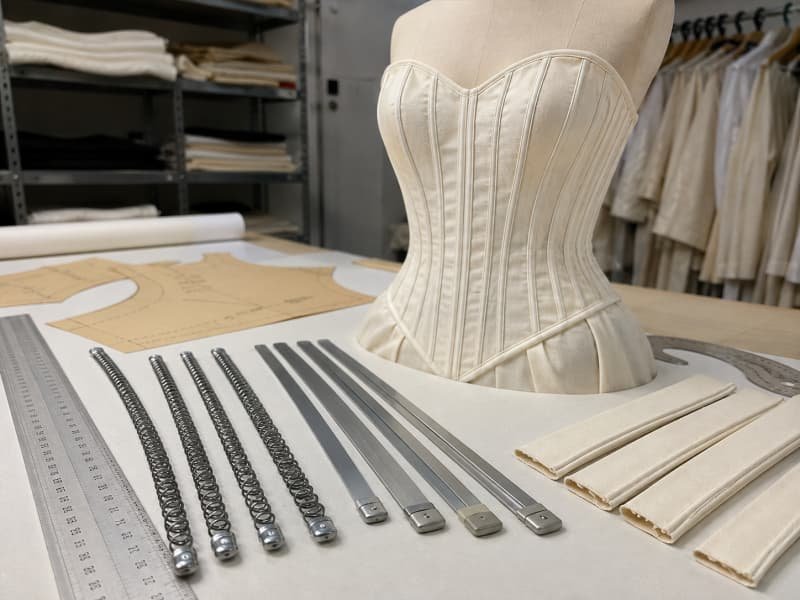
Spiral steel is generally the better choice for curved seams and body areas that need multidirectional movement, while flat steel is usually better for straight, high-tension areas that must resist twisting. Most well-developed corset dresses combine both: spiral steel follows the bust, waist, and hip; flat steel stabilizes closures, lacing panels, and firm center lines.
That distinction matters because a fashion corset mini dress, a strapless occasion dress, and a functional waist-reducing corset do not need the same internal structure. A development team must consider the silhouette, wearing time, cup construction, fabric stretch, closure method, size range, care label, and production volume before approving any steel. The most expensive boning mistake is not buying the wrong component; it is discovering after a production run that customers cannot sit comfortably or that the sample standard cannot be repeated in bulk. The sections below explain how the two steels behave, where each belongs, and how to test the full dress before production.
What Are Spiral and Flat Steel Boning?
Spiral steel boning is a flattened coil that bends in several directions, while flat steel boning is a solid spring-steel strip that mainly bends forward and backward. Spiral steel follows curved body seams more naturally. Flat steel gives stronger control beside closures, straight edges, and lacing panels. Both are often combined because they solve different structural problems.
Spiral Steel Basics
Spiral steel boning is made from tightly wound steel wire that has been compressed into a flat, narrow strip. The coil construction lets it move forward, backward, and laterally, which is valuable when a boning channel travels across the changing contours of the torso. A princess seam may project over the bust, narrow sharply at the waist, and open again toward the upper hip. Spiral steel can follow that three-dimensional path with less resistance than a solid strip.
This flexibility does not mean that spiral steel is merely decorative. In an appropriately stabilized channel, it helps prevent vertical collapse, supports the shape of fitted panels, and reduces folding as the wearer moves. Its limitation is directional control: it resists twisting less effectively than flat steel. For that reason, a highly tensioned zipper edge, lace-up opening, or straight closure panel may need a different material even when the adjacent curved seams use spiral steel.
Product quality varies among suppliers. Coil density, wire thickness, finished width, coating, end caps, and edge smoothness all influence performance. Two samples listed as 6 mm spiral steel may bend differently or recover at different speeds. During sourcing, the approved physical component should be retained with the technical package so that a similar-looking substitute is not introduced during repeat production.
Component | Main Function | Common Development Concern |
Outer fabric | Creates the visible fashion surface | Stretch, drape, seam marking, abrasion |
Interlining | Stabilizes the shell and spreads force | Weight, stiffness, shrinkage, show-through |
Boning channels | Hold each bone in position | Width, seam strength, twisting, migration |
Cups or bust panels | Shape and contain the bust | Volume, projection, neckline balance |
Waist support | Controls horizontal waist tension | Position, comfort, attachment strength |
Lining | Covers structure and protects the wearer | Friction, breathability, opacity |
Closure | Controls entry and wearing tension | Zipper strain, bowing, lacing distortion |
Boning | Resists collapse and local rotation | Type, width, length, placement, end pressure |
Flat Steel Basics
Flat steel boning, also called spring steel or sprung steel, is a narrow strip of hardened steel. It bends readily across its broad face but strongly resists sideways bending and rotation. That directional stiffness makes it useful beside center-front and center-back openings, zippers, busks, hook-and-eye tapes, and lacing panels where the garment edge must remain straight under concentrated tension.
Flat steel is often described as the stronger material, but that statement needs context. It is stronger at resisting lateral distortion, yet it may perform poorly when forced through a seam that curves in several directions. In the wrong position it can press into the body, pull a seam away from the intended contour, or show as a hard ridge through the outer fabric. A heavier component can therefore make a dress less wearable rather than more supportive.
The practical value of flat steel is controlled rigidity. It should be placed where the pattern requires a stable line, not used throughout the bodice simply because it sounds more premium. A successful fashion corset often feels firm at the center front and back while remaining more responsive through the side body, allowing the wearer to sit, turn, and breathe without losing the designed silhouette.
How Steel Supports a Dress
Boning is one part of an internal system. It does not create correct fit by itself and cannot repair a shallow cup, inaccurate waist position, unstable neckline, or fabric that stretches away from the foundation. In a well-developed dress, the outer shell, interlining, cups, channels, waist support, lining, and closure are engineered to carry different forces while the bones stop vertical collapse and local twisting.
The relationship between layers is especially important in satin, mesh, lightweight woven fabric, and stretch jersey. A steel bone placed directly against a delicate shell can become visible, abrade the fabric, or create puckering. The same bone attached to a stable internal layer may perform cleanly. Development should therefore evaluate the complete bodice cross-section rather than approving the steel as an isolated trim.
Terms and Specifications
Supplier terminology is not fully standardized. Flat steel may be listed as spring steel, sprung steel, white steel, or rigid steel, while spiral products may be described as flexible steel or spiral wire boning. A bill of materials should never rely on the name alone. It should record boning type, finished width, thickness or supplier gauge, cut length by channel, coating, end treatment, supplier reference, and the approved physical sample.
Widths around 5-12 mm are commonly encountered in fashion bodices, although specialized corsetry may use different dimensions. Nominal width does not reveal stiffness, because alloy, hardening, and construction also matter. The development team should compare physical samples, check recovery after normal bending, and confirm that the component can be cut, capped, inserted, pressed, cleaned, and packed without damaging the garment.
How Do Spiral and Flat Steel Boning Differ?
Spiral steel bends more freely in several directions and is usually better for curved seams and body movement. Flat steel resists sideways bending and twisting, making it better for straight edges, closures, and high-tension areas. The meaningful difference is not simply strength; it is how each material responds to force while the wearer stands, sits, turns, and fastens the garment.

Flexibility and Direction
The most important distinction is the direction in which the material can move. Spiral steel can bend toward and away from the body while also following a lateral curve. Flat steel mainly bends across its broad face and resists side-to-side movement. On a paper pattern, a seam may appear almost straight, yet once the panels wrap around a three-dimensional torso the channel may curve over the bust, ribs, waist, and hip.
A side-front princess channel usually benefits from flexibility because it must follow those changing contours. A center-back zipper edge has a different task: it needs to stay vertical and resist bowing. The right question is therefore not “Which bone bends more?” but “Which directions of movement and resistance does this specific channel need?” That channel-by-channel approach produces more reliable results than choosing one material for the entire bodice.
Performance Factor | Spiral Steel | Flat Steel |
Front-to-back flex | High | Moderate to high |
Side-to-side flex | High | Low |
Resistance to twisting | Moderate | High |
Curved-seam compatibility | Excellent | Limited |
Straight-edge control | Moderate | Excellent |
Closure stabilization | Moderate | Excellent |
Movement comfort | Usually high in curved areas | Good when correctly positioned |
Visibility through light fabrics | Possible coil texture | Possible hard ridge |
Support and Shape Control
Support can mean preventing vertical folding, stabilizing a neckline, controlling a zipper, holding a cup frame in position, or maintaining a straight lacing edge. Flat steel normally gives stronger directional stability when force is concentrated along a straight line. Spiral steel gives adaptable vertical support through shaped areas, but it depends more heavily on the channel and surrounding fabric to prevent rotation.
Wider or thicker steel normally increases resistance, but it also increases weight, visibility, and pressure at the ends. The best specification is often the lightest component that consistently preserves the intended silhouette during movement. A rigid bone cannot compensate for inaccurate pattern shaping. If the waist, cup, or hip line is wrong, heavier steel may simply make the incorrect shape harder and more uncomfortable.
Comfort and Movement
Spiral steel often feels more comfortable along mobile body areas because it responds to side bending and torso rotation. This is valuable in party dresses, occasion dresses, and corset-inspired styles expected to be worn through dinner, travel, photography, and dancing. Flat steel can also improve comfort when it keeps a closure straight and distributes tension evenly; the problem is not rigidity itself, but rigidity placed where the body needs to curve.
A meaningful fit review should include sitting, walking, raising both arms, leaning forward slightly, and rotating the torso. Twenty to thirty minutes of wear during a development fitting often reveals pressure that is invisible during a two-minute standing check. Upper and lower bone ends deserve special attention because a correctly chosen material can still cause pain when it finishes too close to the underarm, sternum, natural waist crease, or top of the hip.
Weight and Durability
Both boning types are available in several widths and gauges. Flat steel often feels denser and more rigid at the same nominal width, while spiral steel may feel lighter as a single component but still add noticeable weight when a bodice contains many channels. Lightweight satin, fine mesh, and soft jersey are more likely to reveal the steel or channel texture, so internal stabilization and seam placement need careful testing.
Durability risks include coating damage, corrosion, sharp cut ends, detached end caps, permanent bending, spiral-coil separation, and migration inside the channel. Care testing should be performed on the complete garment because steam, washing, shrinkage, and retained moisture act on the fabric and steel together. Packing should also be reviewed; tightly folding a long rigid bodice or heavily compressing cartons can leave flat steel permanently bent before the dress reaches the customer.
Which Boning Works Best by Garment Area?
Spiral steel usually works best along curved side-front, side, and side-back seams. Flat steel is generally more effective beside center-front or center-back openings, zippers, lacing panels, and straight sections under concentrated tension. Many structured dresses perform best with a mixed layout, allowing flexible steel to follow the body while rigid steel controls closures and stable center lines.

Curved Seams
Spiral steel is normally the more dependable choice for princess seams and shaped side seams because those channels pass over changing body contours. A solid flat strip may pull the seam away from the bust, press inward at the waist, or rotate because the channel is asking it to bend in more than one direction. Spiral steel follows the route more naturally, but the pattern still has to provide the correct bust, waist, and hip shaping.
The channel must also be stable. If it is formed only from stretch fabric, the bone may twist or move independently of the seam. Lightweight outer fabrics often need an internal woven layer, non-stretch channel tape, or a dedicated foundation. During fitting, check whether the channel remains smooth while standing and sitting, whether the lower end clears the upper hip, and whether coil texture or ridge lines show through the outer shell.
Garment Area | Common Starting Choice | Main Reason |
Center front | Flat steel | Maintains a straight, controlled line |
Side front | Spiral steel | Follows bust and waist contours |
Side seam | Spiral steel | Allows movement and body curvature |
Side back | Spiral steel | Follows back waist and upper hip |
Beside zipper | Flat steel | Reduces rippling and rotation |
Beside lacing | Flat steel | Supports eyelet tension |
Under-bust curve | Spiral steel | Adapts to shaped seam lines |
Straight neckline section | Test flat or spiral | Depends on shape, fabric, and movement |
Front and Back Openings
Flat steel is generally preferred beside straight closures because it resists bowing and lateral rotation. A fitted center-back zipper is exposed to both vertical and horizontal force, and an unsupported zipper tape can ripple even when the seam measurements are correct. Flat steel placed nearby can maintain a cleaner line, provided it does not interfere with the zipper teeth, seam allowances, or stitching.
Lace-up panels usually need flat steel near both eyelet rows so that the edge does not fold inward when the laces are tightened. The steel should be close enough to support the hardware but far enough away to avoid coating damage during eyelet application. At the center front, lower bone length requires a seated test; an overly long rigid strip can press into the abdomen, while a very short strip may allow the panel to fold below the waist.
Bust and Waist Areas
Boning around the bust stabilizes the surrounding panels but does not replace correct cup engineering. Cup volume, projection, under-bust position, neckline tension, side containment, and back balance must be resolved first. Spiral steel often suits curved side-front channels, while flat steel may support a straighter center-front panel or closure edge. Adding a heavier bone to an incorrect cup can push the bust upward or outward and make the fit problem more visible.
At the waist, vertical bones stop the panels from folding, while the pattern and any internal waist stay manage horizontal tension. Fashion occasionwear generally aims for shaping and stability rather than aggressive waist reduction. The wearer should be able to breathe and sit without the lower bone ends digging into the hip. Fit comments should identify the exact channel and condition rather than using a broad note such as “the bodice feels too stiff.”
Mixed Boning Layouts
Using both types in one garment is often the most balanced solution. A corset mini dress may place flat steel beside the center-back zipper and at a straight center front, with spiral steel through the side-back, side, and side-front seams. This creates control where the garment is under concentrated tension and flexibility where the torso changes direction and moves during wear.
The layout must be documented channel by channel. Each position should have an identifier, finished length, boning type, width, supplier reference, and end treatment. A statement such as “use steel boning throughout” is not detailed enough for repeat production. The pre-production sample should contain the final layout, because substituting one type during development can produce an approved silhouette that changes once the correct material is installed.
How Do You Choose Boning for a Dress?
Choose boning by defining the dress’s function, seam shape, fabric behavior, closure, target support, size range, and expected movement. Corset dresses often need mixed steel, while bustier and strapless styles need coordinated bust and neckline support. Bodycon garments require careful stretch control. The final choice should be approved in a complete fit sample, not made from material name or cost alone.

Dress Type and Function
The first decision is whether the garment is truly structural or only visually inspired by corsetry. A fashion corset dress may need enough reinforcement to keep the neckline and waist smooth, while a functional waist-reducing corset manages much greater tension and requires specialized construction. The two products should not share a boning specification simply because their surface styling looks similar.
Before development, define how long the garment is expected to be worn, whether the customer will sit or dance, whether the bodice contains cups or underwire, whether the closure is adjustable, and whether the shell is woven or stretch. Care instructions and price position also matter. A social-event dress should deliver reliable support without unnecessary hardness, while a costume or specialist corset may prioritize a different balance of control and movement.
Requirement | Steel Boning | Plastic Boning |
Strong structural support | Usually better | Limited to moderate |
Curved-seam performance | Spiral steel performs well | Depends on product |
Shape recovery | Generally strong | Highly variable |
Garment weight | Higher | Lower |
Component cost | Usually higher | Usually lower |
Metal-free product | Not suitable | Suitable |
Wash compatibility | Must be validated | Often easier, still requires testing |
Long-term deformation resistance | Usually stronger | Depends on polymer quality |
Ease of cutting | Requires proper tools | Usually easier |
Visible ridging risk | Possible | Also possible |
Fabric and Stretch
Fabric behavior can change the boning choice completely. A stable woven shell and interlining distribute tension more predictably than a soft stretch knit. Stretch percentage, direction, recovery, weight, opacity, shrinkage, and seam sensitivity should be measured before the channel layout is finalized. A high-recovery bodycon fabric may need little steel below the bust, while a soft satin silhouette may need a stable foundation and several channels to maintain the same visual line.
The outer fabric should not be expected to carry the steel when it is delicate, slippery, or highly elastic. Internal channels can be built from stable lining, woven tape, or a dedicated foundation layer. Any fabric substitution should trigger a fit review. Changing from a firm stretch satin to a softer satin can alter cup position, neckline stability, waist control, and channel behavior even when the paper pattern and nominal fabric weight remain similar.
Body Shape and Size Range
Torso length, bust projection, waist position, and hip shape affect bone length and placement. A shorter torso may need reduced length to avoid pressure under the bust or against the upper hip. A fuller bust often needs more accurate cup depth, side containment, and back balance rather than simply thicker steel. A pronounced waist-to-hip difference may benefit from spiral steel in the lower curved channels.
Grading should not be handled by adding the same percentage to every bone. Some channels need to shift relative to body landmarks as the size changes, while others may need different increments. When the commercial size range is broad, more than one fit body should be reviewed. A base-size dress form cannot reveal breathing, soft-tissue distribution, side-seam rotation, or pressure differences that appear on real wearers across the range.
Steel or Plastic
Steel is generally more durable and supportive than common plastic boning, but plastic can be appropriate for lightweight fashion structure, metal-free requirements, lower garment weight, or selected washable styles. High-quality synthetic whalebone also behaves differently from inexpensive generic plastic strips, so the category should not be judged by the weakest product available.
For a premium corset or bustier dress that must remain stable through repeated wear, steel is often the safer development starting point. For a lightly shaped summer dress, it may be unnecessary. The material should be chosen through performance testing rather than a blanket rule. Cost, washability, recovery, ridging, ease of cutting, and long-term deformation all matter, but none should override the actual support and comfort required by the design.
How Should Boning Be Tested Before Production?
Boning should be tested inside the complete garment, not as a loose component. Development must confirm type, width, length, channel fit, end finishing, movement comfort, closure stability, and care performance. Before bulk production, the approved sample should define exact placement and measurable controls so the intended support can be repeated across sizes, colors, and production batches.

Component Checks
Steel should be inspected before installation. Incoming checks normally cover boning type, width, supplier gauge, surface coating, straightness, recovery, cut length, sharp edges, end-cap security, and any separation in spiral coils. Finished lengths should be specified by channel because even visually similar positions can end at different body landmarks. Using one standard length throughout the bodice increases the risk of pressure, migration, or weak support.
Cutting tolerance depends on channel clearance and the position of the bone. A difference of only a few millimeters can matter near the underarm, sternum, or hip. The end finish should be rubbed against test fabric to reveal burrs that are difficult to see. Dipped, crimped, heat-shrink, or metal caps may all work, but the approved method must remain secure through insertion, fitting, finishing, care testing, and repeated wear.
Channel Construction
The channel should restrain the bone without gripping it so tightly that the fabric puckers. As a practical starting point, the finished internal channel is often about 1-2 mm wider than the bone, depending on steel thickness and the materials used. Excessive clearance can allow rotation and vertical migration, while insufficient clearance can damage the coating, split stitching, or create hard local stiffness.
Channel stitching should remain parallel and secure, with reinforced ends that do not form a hard lump against the body. For satin, mesh, and stretch fabric, channels are often better attached to an internal foundation than stitched directly through the shell. This reduces visible stitch lines and surface distortion. The development team should also verify that seam allowances, cups, zipper tapes, and lining joins do not obstruct the bone or create uneven thickness.
Fit and Movement Tests
A fit sample should be evaluated in the conditions the customer is likely to experience. The wearer should stand naturally, raise both arms, sit in a normal chair, lean forward slightly, rotate the torso, walk, and operate the closure several times. Wearing the sample continuously for twenty to thirty minutes can reveal gradual pressure, neckline movement, zipper bowing, or channel rotation that a brief standing review will miss.
Comments should identify the exact channel, body location, and movement that causes the problem. “Too stiff” is difficult to act on, while “the left side-front bone presses at the lower rib when seated” leads to a measurable correction. After revisions, the same movement sequence should be repeated rather than relying on appearance alone. The goal is not only a smooth photograph but stable support during realistic wear.
Care and Bulk Controls
The complete garment should be tested according to the proposed care label. Even dry-clean-only products experience steam finishing, spotting, humidity, and storage. Washable styles should be checked for shrinkage around channels, coating damage, corrosion, migration, twisting, abrasion, end-cap security, and recovery after drying. Any difference between shell, lining, and channel shrinkage can create pressure that was not present before care testing.
Bulk production requires clear checkpoints for correct boning type, length, position, end security, channel closure, left-right symmetry, surface smoothness, and closure stability. The pre-production sample should contain the intended steel, fabric lot, lining, zipper, and channel method rather than temporary substitutes. Final inspection should include handling and light flexing, because a dress may look correct on a table while hiding a twisted bone, loose cap, or missing component.
For brands developing corset, bustier, strapless, or structured bodycon dresses, the most useful starting package is a clear technical specification, reference sample or design image, target fabric, size chart, and expected support level. Duolan Apparel can review these materials, develop the internal structure, prepare fit and pre-production samples, and coordinate the approved construction into bulk manufacturing.
Share:
Our Services
Categories
Table of Contents
Here, developing fashion collections is more than manufacturing garments — it’s a collaborative process focused on transforming ideas into well-executed, market-ready products. From fabric sourcing and sample development to scalable production and delivery coordination, every stage is built to support quality, consistency, and efficient collection launches across global markets.

