 Skip to content
Foam Cups vs Molded Cups in Bustier Dresses: Which Is Better for Fit, Shape, and Production?
Your trusted Women’s Apparel Development & Manufacturing Partner from China
- Jerry
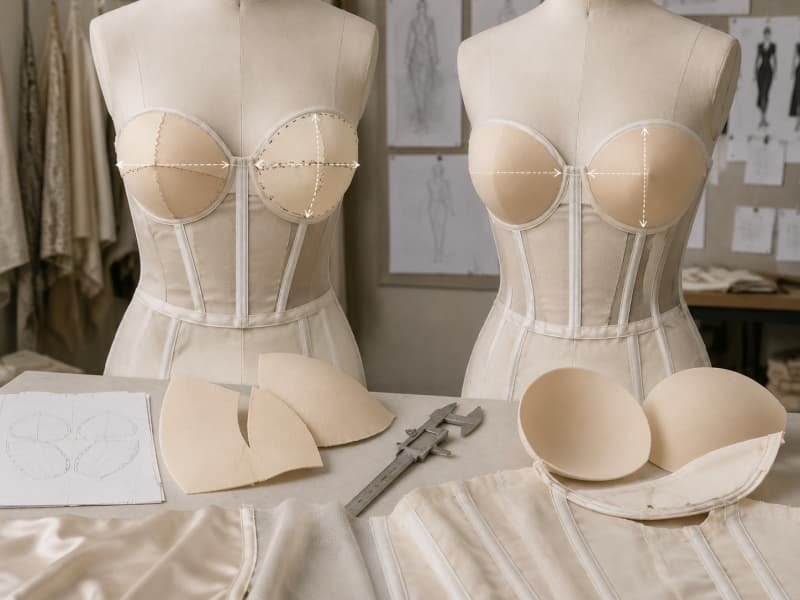
A bustier dress can look beautifully engineered on a hanger and still fail within minutes of wear. The neckline may stand away from the chest, the bust point may sit too high, the cup edge may become visible beneath satin, or the whole bodice may slide downward as the wearer walks. These problems are often blamed on sizing, yet the cause may begin much earlier, when the product team selected a cup because it looked smooth in a catalog rather than because it matched the dress architecture, target body, and fabric behavior.
Foam cups are generally the stronger option when a dress needs adjustable shaping, custom neckline development, or closer control over bust proportions. Molded cups are often the better option when the design needs a smooth, seam-free surface and an available molded shape already matches the target fit. Neither cup is automatically more supportive; reliable support comes from the cup, cradle, boning, lining, waist, side panels, and back working together.
One satin bustier sample can explain the entire problem. The first version may look flawless on the table because the molded cups are round and symmetrical. Once fitted, their projection pushes the neckline away from the body, while tightening the outer satin only creates drag lines. Replacing the cup alone does not solve the dress: the underbust seam, center front, boning, and neckline all need to be reconsidered. That is why cup selection is not a trim decision. It is one of the earliest structural decisions in bustier dress development.
What Are Foam and Molded Cups?
Foam identifies a cup material, while molded identifies how a cup receives its three-dimensional shape. In bustier dresses, the useful comparison is usually between cut-and-sew foam cups assembled from shaped panels and pre-molded foam cups formed into a fixed profile. The first gives the pattern team more control; the second offers a smoother surface when its existing shape already suits the dress.
Is a Molded Cup Also Foam?
Many molded cups are made from foam, so the terms are not true opposites. A foam component may begin as a flat sheet, be laminated to fabric, cut into panels, or be shaped through heat and pressure. A molded cup is simply one whose volume has been formed before it reaches the dress. Product teams therefore need more precise language: cut-and-sew foam cup, seamless molded cup, graduated push-up cup, or removable insert. These items behave differently in fit and production. Foam also varies in density, compression resistance, recovery, color, lamination, and thickness. Around 2-5 mm is a common development range for many fashion bustier applications, although softer or graduated products may be thicker. Thickness alone does not determine support. A firm 3 mm foam can hold a cleaner profile than a soft 5 mm foam, while a rigid cup may create a visible edge or discomfort if it does not match the body. The material specification must therefore be linked to the neckline, outer fabric, lining, padding level, size range, and intended bust shape.
How Are Foam Cups Built?
A cut-and-sew foam cup begins as flat or lightly laminated foam. Two or three curved pattern pieces are cut and joined, often with an abutted zigzag seam that creates volume without a bulky conventional seam allowance. The panel geometry controls the finished profile. A vertical seam can encourage upward projection and a rounded appearance, while a three-piece construction can add lower-cup depth and side containment. Small changes to panel curvature alter cup width, maximum depth, bust-point position, upper coverage, and center-front behavior. After the shell is assembled, it may be covered with lining, self-fabric, mesh, or lace. The covering layer must be applied with balanced tension because stretching one side more than the other can twist the cup or flatten its projection. The lower edge also needs to align accurately with the cradle or underbust seam. A well-shaped foam cup cannot perform correctly if it is installed too high, too far apart, or against an outer fabric that compresses the intended volume.
What Does Pre-Molded Mean?
A pre-molded cup arrives with its width, height, depth, projection, bust point, edge shape, and padding distribution largely fixed. That can shorten sampling when a suitable component already exists, because the team can concentrate on placement, neckline balance, outer-fabric tension, and the surrounding support structure. The seamless surface is particularly useful beneath reflective satin, smooth stretch crepe, or minimalist bodycon styles. The limitation is that ordinary pattern changes cannot fundamentally alter the mold. Trimming the upper edge may lower coverage, but it does not move the bust point or create more lower-cup depth. A cup that is only several millimeters too tall can conflict with a sweetheart neckline, while a cup that is too shallow can push the neckline away from the wearer. The dress must therefore be developed around the selected component. Before the neckline, cradle, side panel, and center front are locked, the molded cup should be fitted inside the actual bodice using the intended production fabric or the closest reliable substitute.
What Is the Main Difference?
The main difference is where shape control sits. With a cut-and-sew foam cup, the pattern maker controls volume through the panel shapes and seam directions. With a molded cup, the supplier’s form controls the shape, so the bodice must accept that geometry. This changes the commercial workflow. A sewn cup usually demands more technical development at the beginning, yet it can be revised for a distinctive balconette profile, deep plunge, asymmetric neckline, or brand-specific bust point. A molded cup can move quickly when it already matches the design, but it may create hidden constraints in grading and future sourcing. A practical rule is to use cut-and-sew foam when the cup shape itself is part of the design and to use a molded cup when a suitable stock form provides the required smoothness. Neither option should be approved from an empty-cup photograph. It should be assessed on the fit model, inside the full dress, under realistic movement and lighting conditions.
Development Factor | Cut-and-Sew Foam Cup | Pre-Molded Cup |
Shape source | Curved pattern panels and seams | Supplier mold or formed tooling |
Typical thickness | Often about 2-5 mm for fashion applications | Often about 2-8 mm, including graduated padding |
Bust-point control | Adjustable through pattern revisions | Fixed by the molded form |
Neckline flexibility | High; cup edge can be developed with the design | Limited by the existing edge and mold geometry |
Surface finish | May show internal seam lines | Usually smooth and seamless |
Sampling path | More pattern and sewing development | Faster when a suitable stock cup exists |
Size development | Can be graded with the bodice | Requires accurate cup-to-dress-size mapping |
Main risk | Seam visibility or assembly inconsistency | Fixed shape does not match the target body |
Reorder concern | Pattern, foam, and workmanship consistency | Long-term availability of the same cup reference |

Which Cup Creates the Better Shape?
Molded cups usually create a smooth, rounded, seam-free bust surface, while cut-and-sew foam cups provide greater control over projection, lift, upper coverage, and bust-point placement. The better shape depends on the intended silhouette, neckline, fabric, and size range. It should be judged on the body from several angles and during movement, not from an empty cup resting on a worktable.
Which Gives a Smoother Line?
Pre-molded cups normally give the cleanest visible line because there are no structural seams running across the cup surface. That is valuable beneath satin, compact jersey, stretch crepe, fine double knit, and other fabrics that reveal small ridges under studio lighting. Seamless does not mean invisible, however. A thick perimeter can form a ring beneath the shell, uneven attachment can create dents, and excessive tension can flatten the cup or pull the fabric diagonally toward the side seam. A tapered edge and a stable covering layer can soften the transition, but too many layers may make the bodice bulky. Cut-and-sew cups can still look polished when their seams follow exterior design lines or sit beneath ruching, draping, lace, or gathers. In those styles, accurate shape may matter more than a completely seamless foundation. The final evaluation should include strong side light, close photography, and the intended colorway, because pale satin and reflective fabrics often reveal construction that remains hidden in black development samples.
Which Allows More Shape Control?
Cut-and-sew foam gives the development team more direct control because each panel can be revised separately. The lower cup can gain depth without raising the entire neckline, the side panel can direct volume inward, and the upper edge can be changed to improve containment or create a lower line. This flexibility matters when a brand wants a distinctive bust profile rather than a generic round cup. A shallow balconette shape, strong sweetheart curve, lifted partywear profile, or softer natural contour may require different panel geometry. A molded cup can only deliver those effects if the appropriate form already exists. Shape comments should also be translated into measurable specifications. Cup width, cup height, maximum depth, bust-point location, center-front spacing, and upper-edge length provide a more reliable language than comments such as make it rounder or lift it more. Creative language is useful for direction, but repeatable production depends on converting that direction into pattern changes, component codes, and clear approval measurements.
Which Creates Better Cleavage?
Neither construction automatically produces better cleavage. The visible result comes from cup spacing, center-front height, lower-cup volume, side pressure, neckline shape, padding distribution, and the stability of the bodice around the cup. A graduated molded cup with additional lower or side padding can create immediate lift, but only when the wearer matches the fixed mold. If it is too shallow, the bust may spill over the upper edge; if it is too wide, the shape may spread outward rather than inward. Cut-and-sew foam can create a controlled plunge or balconette effect by changing the inner cup, lower-cup curvature, and side support. The support path remains critical. Adding padding without strengthening the underbust, waist, and back often makes the cup rise while the dress itself slides down. Cleavage should be reviewed from the front, side, and three-quarter views while the model sits, turns, and raises her arms. A dramatic static image is not a successful fit if the neckline loses containment during normal movement.
Which Works Under Fitted Fabrics?
The right choice depends on the fabric’s thickness, stretch, recovery, surface reflection, and ability to hide internal construction. Molded cups are often chosen for fitted smooth shells because they remove cup seams, yet their fixed edges and curvature must still work with the fabric. A highly elastic jersey can compress a soft molded cup, while a rigid woven satin may bridge across a cup that is too rounded. Cut-and-sew foam is often more effective when the exterior already has corset seams, cup panels, draping, ruching, or lace placement that hides the internal joins. Fabric color changes the result as well. Ivory, blush, pale blue, champagne, and metallic surfaces tend to reveal edge transitions more clearly than dark shades. A commercially useful trial should use the intended fabric construction and color whenever possible, then be checked after pressing, steaming, several minutes of wear, and photography. The cup should remain centered and smooth without the outer fabric flattening the projection or pulling the neckline away from the body.
Fabric or Surface | Useful Starting Option | Main Risk | Practical Approval Check |
Lightweight satin | Smooth molded cup | Cup edge and attachment showing | Inspect with side light and photography |
Heavy or structured satin | Either option | Bridging or pressure marks | Check contour after pressing and movement |
Stretch jersey | Low-profile molded or sewn foam | Compression flattening the cup | Test recovery after extended wear |
Power mesh overlay | Either option | Foam color and seams becoming visible | Review under bright light and flash |
Lace bustier | Sewn foam or molded base | Motif imbalance and edge visibility | Match lace placement across both cups |
Stretch crepe | Molded cup often works well | Surface bubbling or perimeter ridges | Recheck after steaming and fitting |
Rigid woven shell | Custom sewn cup often gives control | Fabric failing to follow the cup shape | Inspect wrinkles, bridging, and neckline contact |

How Do Cups Affect Fit and Support?
Cups shape and contain the bust, but they do not support a bustier dress by themselves. Reliable support comes from the cup, cradle, underbust seam, lining, boning, waist fit, side panels, closure, and back working as one structure. Changing the cup may improve shape, yet it cannot correct a bodice that lacks proper anchoring, balance, or resistance to movement.
Do Cups Provide Support Alone?
A cup mainly provides coverage, shape, and a place for bust volume to sit. It must be held at the correct level by the surrounding dress. Without a stable underbust, waist, side, and back, both molded and sewn cups can move downward. In a successful bustier, support follows a path: the bust enters the cup, the cup transfers load into the cradle or underbust seam, that structure connects to the boned bodice, and the bodice anchors around the waist and back. This explains why increasing cup thickness rarely solves a slipping dress. The cup may remain round while the entire front drops. Fit symptoms such as a rising back, rotating side seams, a collapsing center front, or cups sitting below the natural bust point usually indicate a larger structural problem. During a fitting, the technician should trace the movement through the whole garment rather than adjusting the visible cup edge first. The correct solution may involve the underbust measurement, waist balance, closure tension, boning layout, or back height.
How Do Boning and Underwire Help?
Boning helps the bodice resist folding, rolling, twisting, and vertical collapse, keeping the cup, neckline, and waist in a stable relationship. Placement matters as much as material. Common positions include the center front, side front, princess seams, side seams, and back panels. Lightweight plastic boning is widely used in fashion dresses, while spiral steel can follow curved channels and flat steel provides stronger resistance in straighter areas. Underwire has a different role: it defines the lower bust boundary and can improve separation, containment, and lower-cup stability. The wire must correspond to the cup curve and target body. A wire that is too narrow can press into tissue, while an overly wide wire can sit toward the armhole without anchoring the bust. Not every bustier needs underwire. A shaped underbust seam, stable lining, elastic support, and well-balanced bodice may be enough for some fashion styles. The decision should reflect the support expectation, size range, comfort target, neckline, wearing occasion, and price position.
Which Fits More Bust Shapes?
Cut-and-sew foam usually adapts to more bust shapes because the pattern can be revised for width, depth, projection, upper fullness, lower fullness, spacing, and bust-point position. Molded cups can fit very well when the wearer’s proportions match the form, but a fixed cup cannot respond equally to every body assigned to the same dress size. Two customers may share a waist and hip measurement while having different underbusts, breast-root widths, projection, or upper fullness. Brands therefore need a clear size and fit policy. One molded cup may serve two adjacent dress sizes in a stretch program, but that should be validated rather than assumed. Larger sizes also need more than a visibly larger cup. The team must review side containment, back height, underbust stability, boning strength, neckline security, and grading. A shallow fashion insert placed into a larger bodice does not become supportive simply because more fabric surrounds it. At minimum, fitting should cover the base size and representative sizes near both ends of the planned range.
How Can Gaping Be Prevented?
Cup gaping appears when the upper cup or neckline follows a different line from the wearer’s body. The position of the gap helps identify the source. A center-front gap may come from excessive cup spacing or an open inner edge, while a gap near the armhole can indicate too much side volume, weak side control, or an incorrect halter angle. A gap across the full upper edge often means the cup is too deep, too high, or installed above the natural bust point. Tightening the outer fabric is not a universal correction. It can flatten the cup, create drag lines, and distort the neckline while leaving the underlying fit unchanged. The technician may need to alter the cup pattern, replace the molded form, reshape the cradle, shorten the neckline, or strengthen the underbust and back. Testing should include sitting, walking, bending, turning, and raising the arms. A neckline that lies flat only while the model stands still is not ready for bulk production or real customer wear.
Fit Symptom | Likely Cause | Practical Correction |
Gap at center front | Cups too far apart or inner neckline too open | Reduce spacing or reshape the inner cup edge |
Gap near armhole | Excess outer-cup volume or weak side control | Adjust the outer cup, side panel, or halter angle |
Gap across upper edge | Cup too deep, too high, or upper edge too long | Reduce upper volume or reposition the cup |
Bust sits below cup point | Cup installed above the natural bust point | Lower the cup and revise the cradle relationship |
Bust spills over the top | Cup too shallow or coverage too low | Increase depth, select another mold, or raise coverage |
Cup collapses inward | Outer shell too tight or foam too soft | Reduce compression or select firmer foam |
Neckline gaps after movement | Weak underbust, waist, or back anchoring | Strengthen the entire support path rather than only the edge |

Which Cup Suits Each Bustier Dress?
Molded cups often suit smooth satin, minimalist bodycon, and other dresses that need a seamless bust surface. Cut-and-sew foam is often better for custom necklines, sculpted corset shapes, mesh or lace styles, and designs requiring closer fit control. Strapless, plunge, halter, asymmetric, and backless dresses still need carefully engineered support systems regardless of the cup selected.
Which Works for Satin?
Satin exposes internal construction because its smooth surface reflects light and records pressure changes. A molded cup is often the strongest starting option for a minimalist satin bustier because it removes structural seams beneath the shell. The integration still needs careful control. A thick edge can create a visible ring, uneven tacking can form dents, and excessive tension can flatten the cup or create diagonal drag lines. A light intermediate layer may soften the transition, but too much padding makes the bodice bulky and can reduce clean neckline definition. Cut-and-sew foam remains valuable when the satin is ruched, draped, pleated, gathered, or divided by visible corset lines. These surface treatments can hide internal cup seams while allowing more accurate shaping. Approval should use the intended satin weight, stretch, finish, and color. Matte satin, high-shine satin, stretch satin, and rigid woven satin behave differently, and pale champagne or ivory generally reveals more internal detail than dark colors. Pressing and steaming also need testing because heat and pressure can mark the shell or affect the foam.
Which Suits Mesh and Lace?
Mesh and lace can either conceal or deliberately reveal the cup construction. The creative direction needs to be decided early: the cup may be fully covered, partly visible, lined in a skin-tone shade, or emphasized as a corset feature. Cut-and-sew foam works well when its seams align with exterior corset lines, lace motifs, or decorative panels, and it provides useful control for balconette, plunge, and sculpted shapes. A molded cup can create a cleaner opaque panel under transparent mesh, but its edge must be blended so it does not resemble a loose bra pad inserted into the dress. Color is especially sensitive. Nude is not a single shade, and the wrong foam or lining can become obvious under fine mesh or flash photography. Lace placement also needs left-right control because large floral motifs, scallops, and repeats make asymmetry visible. A reliable sample review includes normal light, backlight, and camera flash, together with an internal check for scratchy seams, exposed foam edges, and uncomfortable wire or boning ends.
Which Works for Bodycon?
Bodycon dresses place continuous tension across the bust and torso, so the cup must work with the fabric’s stretch and recovery. A molded cup can maintain a smooth round profile, yet a highly compressive shell may flatten it or push it away from the intended position. Cut-and-sew foam is often effective when the style includes visible cup seams, boned panels, a strong sweetheart line, or a corset-inspired upper body, because the cup can be developed with the stretch behavior rather than treated as a generic insert. Fabric stretch should be assessed in both directions and recovery should be checked after repeated extension. A material may stretch 30 percent and still perform poorly if it does not recover, leading to a loose neckline or rotating side seams after wear. The lining changes the effective fit as well. A stable lining improves control but can make the garment feel smaller, while a stretch lining increases comfort but contributes less support. Movement testing should confirm that the cup stays centered without relying on uncomfortable compression.
How Do Necklines Change the Choice?
The neckline often decides whether a stock molded cup is practical. Straight, gently curved, and conventional sweetheart necklines may align with existing forms, while sharp plunges, asymmetric cuts, sculpted balconettes, and unusually low side lines often need a custom cup. Strapless dresses require strong underbust and waist anchoring because shoulder straps are absent; elastic support, stay tape, silicone grip, or carefully controlled upper-edge tension may also be needed. Backless styles are more difficult because lowering the back removes a major source of horizontal support. The remaining side, waist, and internal structures must compensate through stronger panels, elastic, boning, or alternative closures. Halter necklines create upward force from the neck, which can help positioning but may pull the cups inward or increase pressure. Plunge styles need center-front control so the bust remains contained while the neckline stays low. Asymmetric designs should be evaluated separately on each side because unequal upper-body tension can change the visible cup height even when the internal components are symmetrical.

How Should Brands Choose for Production?
Cup selection should follow a controlled production process: define the target silhouette, choose the cup system, test it with the actual fabric, map it across dress sizes, document every component, and approve a pre-production sample. The best option is not merely attractive in the first fitting. It must also remain sourceable, gradeable, inspectable, packable, and repeatable across bulk orders and future reorders.
How Should the Cup Be Selected?
Selection should begin with the customer result rather than with whatever cups happen to be available in a supplier catalog. The team should define whether the bust should appear natural, round, lifted, compressed, balconette-shaped, or strongly pushed up, then connect that direction to the neckline, outer fabric, lining, support target, back height, closure, size range, care method, price, and reorder plan. Useful cup measurements include width, height, maximum depth, bust-point position, center-front spacing, and upper-edge length. These make supplier comparisons more reliable than photographs alone. The component also needs to be tested across the planned size range. A cup that suits the base-size model may be too shallow or wide at the upper end of the range, and one cup family may not be enough for an extended program. The actual fabric matters just as much. A molded cup that performs well in stretch crepe may look rigid beneath woven satin, while a sewn cup developed for a high-back style may lose stability when the back is lowered.
How Do Sampling and Grading Differ?
A molded-cup sample can progress quickly when the correct component already exists. The cup is positioned, the bodice is built around it, and the team refines neckline contact, underbust balance, and outer-fabric tension. When the component is wrong, that speed disappears because repeated bodice changes cannot correct a form that is fundamentally too shallow, too wide, or too high. Cut-and-sew foam usually needs more work at the first stage. Panel curvature, seam direction, projection, upper coverage, and lower depth may require several controlled revisions. Once approved, however, the cup pattern becomes part of the dress and can be graded with the bodice. Cup grading is not simple proportional enlargement. Width, height, depth, bust-point movement, underbust length, center spacing, and side containment may change at different rates. At minimum, brands should review the base size and representative sizes near both ends of the range. Extended size programs often require additional fit models, more than one cup family, or separate support details rather than a single cup enlarged by a fixed percentage.
What Should the Tech Pack Specify?
The tech pack should treat the cup as a controlled component rather than using a vague instruction such as add padding. It should record the supplier, reference code, construction, material, nominal thickness, lamination, color, cup dimensions, left-right orientation, edge shape, placement, attachment method, and mapping to each dress size. It should also define the surrounding support system, including underwire code where used, wire channel, boning material and length, elastic, stay tape, lining, interfacing, seam method, and closure. Placement measurements should be taken from stable pattern reference points rather than from an edge that stretches during assembly. For visually sensitive satin bustiers, cup position may need control within a few millimeters, although the exact tolerance should be set by the brand and the design. Approved front, side, and inside photographs are valuable because they show projection, symmetry, neckline contact, and finishing more clearly than a measurement table alone. Clear documentation also allows costing, replacement sourcing, and repeat production to remain traceable.
How Are Bulk Risks Controlled?
Bulk risks begin before sewing. Molded cups can be dented by compression, heat, poor storage, or careless handling, while foam sheets can vary in density, recovery, thickness, or lamination between batches. Incoming inspection should therefore check left-right symmetry, width, depth, edge damage, color, recovery, surface condition, and batch traceability. During production, placement templates or stable reference marks can improve consistency. The first completed garment should be reviewed before the line runs at full speed, with attention to cup height, spacing, bust-point position, neckline contact, underbust alignment, and surface smoothness. Inline inspection should look for reversed cups, twisted placement, crushed foam, incorrect wire or boning lengths, and lining tension that pulls the cup inward. Packing also matters because deep folding and excessive stacking pressure can create permanent dents. For reorders, the approved cup code, supplier, foam specification, pattern, placement method, fit comments, and physical approval sample should be retained. A visually similar replacement component must be refitted because a small curvature change can alter the neckline and entire bodice balance.
Production Control Point | Information or Check to Lock |
Cup identity | Supplier, style or mold code, construction, color, and approved sample |
Material specification | Foam type, thickness, density or recovery direction, lamination, and edge profile |
Size mapping | Dress size assigned to each molded cup code or cut-and-sew pattern |
Placement | Distance from center front, underbust seam, neckline, and stable pattern notches |
Attachment | Stitch type, tacking points, bonding method, seam allowance, and tension |
Support system | Underwire, boning, elastic, lining, interfacing, stay tape, and closure |
Appearance standard | Approved front, side, inside, and strong-light photographs |
Bulk verification | Incoming check, pre-production sample, first piece, inline inspection, and final review |
Packing and reorder | Cup protection, folding limits, carton pressure, batch traceability, and retained approval sample |

The final cup decision should pass five commercial tests at the same time: it creates the intended bust shape, remains stable within the complete bodice, behaves cleanly beneath the final fabric and color, scales sensibly through the planned sizes, and can be repeated in bulk. A strong sample should allow the wearer to walk, sit, bend, turn, and raise her arms without neckline gaping, cup shifting, overflow, or downward movement. It should also survive pressing, photography, packing, and a second production run without the visual result changing.
For custom bustier, corset, party, occasion, bodycon, satin, mesh, halter, or backless dress development, Duolan Apparel can review a tech pack, original sample, reference images, target fabric, size chart, expected quantity, and launch calendar before sampling begins. The company’s dress-focused development system combines pattern, fit, fabric, trim, sample, process, quality, and scalable production resources, supported by nearly three decades of womenswear experience, 16 owned production factories, more than 20 long-term satellite factories, 300 sewing lines, and over 50 flexible quick-response lines.
Share:
Our Services
Categories
Table of Contents
Here, developing fashion collections is more than manufacturing garments — it’s a collaborative process focused on transforming ideas into well-executed, market-ready products. From fabric sourcing and sample development to scalable production and delivery coordination, every stage is built to support quality, consistency, and efficient collection launches across global markets.

