Skip to content
How to Balance a Halter Dress: Fit, Proportion, Support, and Styling
Your trusted Women’s Apparel Development & Manufacturing Partner from China
- Jerry
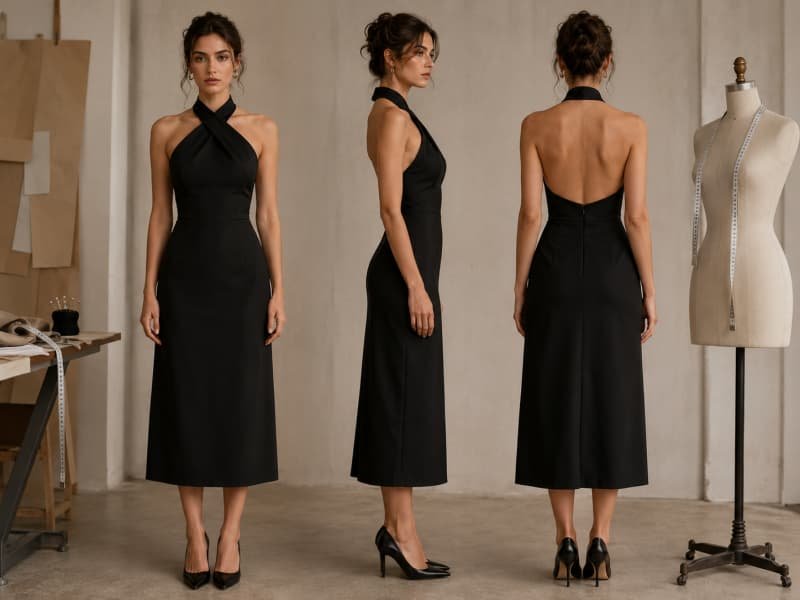
A halter dress can look effortless on a hanger and surprisingly complicated once it is worn. Because the neckline directs attention toward the neck, shoulders, bust, and upper back, a small problem with strap tension, bust coverage, waist placement, fabric weight, or skirt volume can affect the whole silhouette. Styling cannot always rescue a structural problem, and a technically sound pattern can still feel visually crowded when the jewelry, hairstyle, shoes, or outer layer compete with the neckline.
A balanced halter dress coordinates five elements: neckline shape, bust support, waist position, skirt behavior, and styling. The neckline should frame the upper body without pulling or gaping, the bust should remain stable during movement, and the waist should keep the dress anchored. The skirt should provide suitable visual and physical weight, while accessories should reinforce the strongest design feature instead of fighting for attention.
Picture a guest arriving at a summer evening event in a beautiful satin halter. The first photographs look polished, but after dinner she begins lifting the neckline, checking the side bust, and moving her hair away from the strap. Nothing is dramatically wrong, yet several small imbalances are working together. Understanding those relationships is what separates a dress that looks impressive for one photograph from one that remains flattering, secure, and comfortable for an entire occasion.
What Makes a Halter Dress Look Balanced?
A halter dress looks balanced when its neckline, bust, waist, skirt, and accessories create one clear visual direction. The neck should frame the upper body without carrying excessive weight, the bust should remain stable, and the skirt should provide enough volume or length to support the stronger shoulder focus. True balance must remain visible and comfortable during movement, not only in a front-facing photograph.
Visual and Structural Balance
Visual balance describes how the eye travels through the garment, while structural balance determines whether the dress stays in the intended position. The two are connected, but they are not interchangeable. A dress may look elegant from the front while placing too much weight on the neck, or it may feel secure but appear top-heavy because a high gathered neckline, large earrings, and voluminous hair all concentrate attention above the waist.
A useful review begins from a short distance, where the whole silhouette can be seen before individual details. Notice whether the neckline remains the main focal point and whether the waist, skirt, color, and footwear continue the visual direction. Then move closer and check whether the center front stays centered, the neckline lies flat, the side seams hang vertically, and the waist remains level. These checks reveal whether an attractive first impression is supported by reliable construction.
Neckline and Skirt Proportion
The neckline and skirt act like two ends of the same composition. A high, wide, or heavily gathered halter creates more visual weight above the bust, while a deep V, narrow crossover, or fine tie produces a lighter and more vertical upper-body line. The skirt can either continue that direction with a straight or bodycon shape, or counterbalance it with an A-line, flared, tiered, or softly gathered silhouette.
Length changes the result as much as volume. A mini dress already creates openness through the exposed leg and may need less skirt fullness. A maxi dress introduces more fabric below the waist and can visually support a dramatic neckline, although the additional material also increases the load carried by the bodice. The aim is not to make the top and bottom equal in size. The aim is to make the relationship feel deliberate, stable, and appropriate for the occasion.
Waist Position and Body Line
The waist controls the transition between the exposed upper body and the skirt. A natural waist usually creates the clearest hourglass division. A raised waist can lengthen the legs and give a fluid skirt more room to fall, but it may shorten the visible bodice. A drop waist lengthens the torso and creates a more directional fashion shape, although it reduces traditional waist definition and can make the skirt feel visually lower.
The correct waist position must be judged on the body rather than from a flat measurement alone. Bust projection, shoulder slope, fabric stretch, and strap angle can all change where the garment settles. A loose waist lets the dress slide downward and transfers more weight to the neck, while an overly tight waist may ride upward and distort the bust. A balanced waist remains level during normal movement and anchors the garment without compressing the wearer.
Movement and Wearability
A halter dress should be reviewed while the wearer turns her head, raises her arms, reaches forward, sits, and walks. These movements expose problems that remain hidden in a static fitting. The side bust may open only when the arms lift, a deep neckline may separate when the wearer leans forward, and a heavy skirt may gradually lower the bodice after the fabric has relaxed for several minutes.
Some temporary creasing is normal because fabric must respond to the body. The important question is whether the garment returns to its intended position after movement. If the neckline stays twisted, the waist moves off level, or the wearer repeatedly pulls the dress upward, the construction is not fully balanced. A practical fitting should last long enough to reveal pressure and stretching, because a neckband that feels acceptable for two minutes may become uncomfortable during an evening event.
Area | Target Condition | Warning Sign | First Check |
Neckline | Flat contact without throat pressure | Rolling, pulling, or standing away | Strap angle, neck opening, edge stability |
Bust | Stable coverage through movement | Side gaping or downward shift | Cup position, contour seams, underbust support |
Waist | Level and secure without compression | Riding up or sliding down | Bodice length, closure, waist shaping |
Skirt | Even fall with independent movement | Twisting, drag, or bodice pull | Grain, panel balance, fabric and trim weight |
Styling | One clear upper-body focal point | Crowded neck and shoulder area | Jewelry scale, hair volume, outer layer |
Which Halter Shape Suits Your Proportions?
The most suitable halter shape is the one that frames the shoulders, supports the bust, and creates the desired vertical or horizontal emphasis without forcing constant adjustment. Deep-V and crossover halters usually draw the eye inward, while high-neck and wide-band styles create a stronger upper-body statement. Body proportions matter, but fabric, coverage, comfort, and internal construction are equally important.

Broad or Defined Shoulders
Broad or defined shoulders do not need to be hidden. A halter dress naturally frames this area, and the exposure can look confident when the neckline directs attention inward instead of adding unnecessary horizontal width. Deep-V shapes, narrow center panels, crossover fronts, and diagonal draping often create a longer path through the upper body. A very wide high-neck panel with dense horizontal gathering creates a stronger shoulder block and should be chosen deliberately.
Using the thinnest possible strap is not always the best answer. Fine ties can appear delicate but may cut into the neck or fail to support a heavier bodice and skirt. A medium-width band can distribute pressure more comfortably while preserving a clean vertical direction. The skirt also matters: a flared shape introduces movement below the waist, while a narrow bodycon skirt produces a sharper, more athletic result that intentionally emphasizes the shoulders rather than disguising them.
Fuller Busts and Support
A fuller bust generally benefits from a halter construction that shares tension across the torso rather than relying on a narrow neck tie. Wider straps, shaped cups, an underbust seam, stable lining, secure side panels, and a controlled back closure can work together. A deep-V halter may create an attractive vertical line, but the plunge must be stabilized with suitable overlap, hidden mesh, internal elastic, or carefully positioned cups.
High-neck halters can also work well when the bodice uses shaped panels instead of excessive gathers. Too much uncontrolled gathering may add bulk, collapse below the bust, or create uneven folds. Fit testing should include side coverage with the arms raised, center-front stability while leaning forward, and neck comfort after extended wear. Bust circumference alone cannot predict these results because cup depth, bust spacing, shoulder slope, and torso length all influence the required pattern shape.
Neck Length and High Halters
A high-neck halter can reduce the visible space between the neckline and chin, but it does not automatically make the neck look short. A narrow neckband, vertical drape, clean shoulder opening, and open back can create a long, elegant line. The effect becomes heavier when the collar is wide, the gathers run horizontally, the fabric is bulky, or the hairstyle and earrings add more volume around the face.
Comfort is the more important test. A neckline that is too tight may roll, wrinkle, or press against the throat, while a loose neckline may collapse forward and expose the facing. Flat circumference measurements provide only a starting point because seam thickness, closure design, fabric compression, and neckline angle change the wearing feel. The wearer should be able to turn her head and breathe normally without pulling the bodice or creating sharp tension below the neck.
Deep-V and Crossover Shapes
Deep-V and crossover halters often feel flattering because they direct the eye toward the center of the body and create a longer vertical line. Their success depends on control. A V that is too wide may expose the side bust, while a narrow V may pull across the bust and collapse at the center. Soft fabrics can stretch during wear, and rigid fabrics can stand away from the body when the contour is inaccurate.
Crossover fronts add diagonal movement and can provide adjustable coverage, but the overlapping panels must carry similar tension. If one layer is longer, softer, or more heavily stretched, the neckline may twist or sit unevenly. The intended occasion should guide the final depth. A club dress may use a more dramatic plunge than a wedding guest or graduation style, while hidden mesh, a narrower opening angle, or a removable modesty panel can preserve visual impact with greater security.
Halter Shape | Visual Effect | Support Potential | Main Fit Risk | Common Use |
Deep V | Lengthens and draws inward | Medium with internal support | Plunge opening or side exposure | Evening and occasion dresses |
High neck | Strong, polished upper body | Medium to high | Neck pressure or visual bulk | Formal and minimalist styles |
Crossover | Soft diagonal shaping | Medium | Uneven overlap or twisting | Draped and fitted dresses |
Gathered neck | Romantic, fluid volume | Low to medium | Excess fullness over the bust | Resort and summer styles |
Wide band | Defined shoulder frame | High when engineered well | Heavy upper-body block | Structured or fuller-bust designs |
Narrow tie | Light, delicate appearance | Low | Pressure and limited stability | Lightweight vacation dresses |
How Do Fabric and Fit Affect Balance?
Fabric determines whether a halter dress drapes, stretches, supports, or collapses. Soft materials create movement but often need stabilization, stretch fabrics improve comfort but require reliable recovery, and structured fabrics hold clean lines while exposing pattern errors. The pattern, lining, cups, elastic, closures, and skirt construction must be developed for the actual fabric rather than transferred unchanged from another material.

Drape and Fabric Weight
The best fabric is not simply the softest or most expensive option. It is the material whose drape, weight, opacity, stretch, recovery, and surface finish support the intended silhouette. Chiffon works well for layered skirts and gathered necklines but usually needs lining and a stabilized bodice. Satin creates a smooth, reflective finish, yet its surface makes puckering, drag lines, and uneven tension more visible than they would be on a matte fabric.
Crepe often provides controlled movement and can suit fitted or semi-fitted dresses, while jersey follows the body and improves mobility. Jersey quality varies widely, and weak recovery may allow the neckline or waist to grow after several hours. Fabric should be reviewed as a hanging length rather than only as a small swatch. The team should observe how it falls from shoulder and waist height, whether it twists, clings, becomes transparent, or changes shape after resting.
Stretch, Recovery, and Stability
Stretch percentage describes how far a fabric can extend, but recovery determines whether it returns to its original dimensions. A jersey that stretches easily but recovers poorly may feel comfortable in the first fitting and then loosen around the neckline, bust, or waist. A firmer stretch fabric may provide better shaping even when its total extension is lower. Both widthwise and lengthwise behavior need attention in a halter dress.
Widthwise stretch affects bust, waist, and hip comfort, while lengthwise stretch can lower the neckline and increase total garment growth. Bias movement influences drape and twisting, and repeated stretching gives an indication of how the material may behave during wear. Structured woven fabrics have the opposite challenge: they maintain shape but expose contour errors quickly. The final pattern should therefore be developed in the bulk fabric or in a material with genuinely comparable stretch, recovery, thickness, and drape.
Cups, Lining, and Boning
Internal support works best as a coordinated system. Sewn-in cups provide coverage and shape, but their height, width, spacing, and thickness must match the pattern and target wearer. A cup placed too high creates an unnatural bust line, while one placed too low provides little support. Lining may improve opacity, skin comfort, edge stability, and control, especially when a stable stretch layer or power mesh is used behind a soft fashion fabric.
Boning is useful when the bodice needs vertical support, but it cannot correct an inaccurate neckline or waist. Flexible plastic boning is common in fashion dresses and may be positioned at side seams or shaped panels. Underbust elastic, a stable back, a secure closure, and waist anchoring often contribute more than one isolated component. The neck strap should guide the neckline and hold its shape; it should not be expected to carry the full combined weight of the bust, bodice, and skirt.
Waist and Skirt Engineering
The skirt should move without dragging the bodice out of position. This is particularly important in maxi dresses, layered chiffon styles, velvet garments, and heavily embellished designs. A fitted waist can act as an anchor, while a loose waist allows the dress to slide downward and increases neck pressure. In structured occasionwear, an internal waist stay can transfer part of the skirt weight to the torso and reduce dependence on the halter strap.
Grain direction, panel shape, lining, and embellishment placement all influence skirt balance. Bias-cut panels create fluid movement but may lengthen unevenly after hanging, so the hem often needs to be leveled after the fabric has relaxed. Dense crystals, beads, or sequins add cumulative weight, especially when concentrated near the hem. Side seams should remain vertical, the waist seam should stay level, and the center front and back should remain aligned while the wearer walks.
Fabric | Typical Development Range | Behavior | Useful Halter Application | Primary Risk |
Chiffon | 60-110 gsm | Light, sheer, fluid | Layered skirts and gathered necklines | Transparency and weak support |
Georgette | 80-140 gsm | Fluid with textured grip | Occasion and resort styles | Seam stretching and edge growth |
Satin | 90-220 gsm | Smooth and reflective | Party and evening dresses | Puckering and visible tension |
Crepe | 120-230 gsm | Controlled drape | Fitted and semi-fitted styles | Behavior varies between qualities |
Jersey | 160-280 gsm | Stretch and body-following | Bodycon and casual halters | Weak recovery and neckline growth |
Mesh | 40-140 gsm | Sheer and flexible | Panels, overlays, fitted styles | Instability at openings |
Velvet | 180-320 gsm | Dense with directional pile | Winter and evening dresses | Weight and cutting direction |
How Should You Style a Halter Dress?
Style a halter dress by allowing the neckline to remain the main upper-body feature. High or decorated halters usually need little or no necklace, while deep-V styles may suit a fine pendant. Hair should reveal important straps or back details, shoes should complement the dress length and fabric weight, and bags or outer layers should match the occasion without hiding the design.

Jewelry and Neckline Space
The amount of open space around the neck determines whether a necklace improves the outfit or interrupts it. A high-neck, gathered, sequined, or heavily draped halter already fills the upper chest, so earrings, bracelets, or rings are often more effective than a necklace. A deep-V neckline leaves a clearer central space, where a fine pendant or narrow Y-shaped chain can repeat the vertical direction without colliding with the fabric edge.
Scale matters as much as jewelry type. Large earrings can balance a clean high-neck dress, but large earrings, a statement necklace, decorative straps, and voluminous hair rarely need to appear together. Fabric finish also changes the decision. Satin, sequins, crystals, and metallic mesh already reflect light, while matte crepe, plain jersey, or solid chiffon can carry stronger accessories. Identify the dress’s strongest feature first, then choose one main focal point above the waist.
Hair and Back Details
Hair can reveal, soften, or completely cover the construction that defines a halter dress. An updo, low bun, sleek ponytail, or pulled-back style exposes the neck, shoulders, and back, making it useful for high-neck designs, open backs, decorative straps, and sculpted bodices. Side-swept waves create a softer effect and can reveal one shoulder while framing the other, which often suits draped or deep-V styles.
The fabric and trims should influence the hairstyle as well. Long loose hair may catch on sequins, beads, hooks, and textured straps, while a very high hairstyle can make a tight high-neck halter feel visually and physically concentrated. Product photography should include at least one front view with the neckline uncovered and one back view that clearly shows the strap, knot, closure, and opening. Customers need to understand the real construction rather than seeing only a styled impression.
Shoes and Dress Length
Shoes influence the visual ending of the silhouette. Mini halter dresses already expose more leg and can work with fine sandals, pointed pumps, platforms, or sleek boots, depending on the mood. Midi dresses require more attention to the hem position because a hem at the widest part of the calf may feel visually heavy. An open vamp, pointed toe, or moderate heel can extend the visible leg line without overpowering the dress.
Maxi dresses need practical hem clearance, and the intended heel height should be available during the fitting. A difference of 30-50 mm can change the finished hem, posture, and walking comfort. The shoe should also match the material weight. Chiffon and georgette usually pair naturally with lighter footwear, while velvet, dense satin, heavy jersey, and embellished fabrics can support a stronger shoe. The goal is to continue the dress’s visual weight rather than introduce an unrelated ending.
Bags and Outer Layers
A compact clutch, mini top-handle bag, or small shoulder bag usually suits a formal or party halter, while a woven tote or relaxed crossbody works more naturally with resort and casual dresses. Oversized everyday bags may rub against the side opening, catch embellishment, or overpower a narrow fitted silhouette. When a larger bag is necessary, a clean shape and controlled material make the contrast feel more intentional.
Outerwear is challenging because it can hide the shoulder and neckline construction. Cropped jackets preserve the waist, tailored blazers add structure to simple midi styles, fine cardigans suit softer daywear, and wraps provide formal coverage without permanently concealing the dress. The layer should not crush cups, boning, gathers, or decorative straps, and it should be checked for snagging. A successful layer adds warmth or formality while allowing the halter line to reappear clearly when the garment is opened or removed.
How Do You Fix Common Halter Problems?
Minor movement can sometimes be managed with fashion tape, a suitable bra, or a simple alteration. Persistent side gaping, neck pressure, bust instability, waist movement, or skirt drag usually indicates a pattern or construction problem. The correct fix begins by identifying where excess fabric, tension, or garment weight is traveling before tightening straps, adding support, or changing the neckline.

Side-Bust Gaping
Side-bust gaping appears when the edge between the halter neckline and underarm does not follow the body closely. It may remain hidden while the wearer stands still and appear only when she raises her arms, turns, or leans forward. Fashion tape can manage a small opening in a finished garment for limited wear, but it should not be expected to provide major support or correct the underlying pattern.
In development, the cause may be excess side-front length, insufficient bust projection, an inaccurate armhole curve, poor cup placement, weak edge stabilization, or a strap angle that pulls too far inward. Corrections can include reshaping the armhole, adjusting a dart or princess seam, changing the cup position, adding clear elastic, or revising strap tension. The corrected edge should sit close without cutting into the body, compressing the bust, or creating new drag lines toward the neckline.
Neck Pressure
Neck pressure usually indicates that too much garment weight is suspended from the halter strap. Simply loosening the strap may provide short-term relief, but it can lower the bust, increase gaping, and change the neckline position. A stronger solution redistributes the load through a fitted waist, stable underbust, supportive lining, secure back panel, wider strap, or internal waist stay.
The strap finish also matters. Narrow binding, bulky seam allowances, hard knots, rough fasteners, or uncovered trim edges can become uncomfortable even when the overall garment is not especially heavy. Layered skirts, velvet, dense satin, sequins, and crystals may create pressure that begins below the waist rather than at the neck. A fitting should last long enough for the material to settle, because discomfort that is invisible during a quick photograph may become clear after sitting and walking.
Bra and Bust Support
The appropriate bra depends on the neckline depth, back opening, side coverage, fabric transparency, and internal construction. A convertible halter bra works when the dress conceals the band and cups, while a strapless bra may suit a high-neck dress with a closed back. Adhesive cups and breast tape can help with open-back or deep-side designs, although performance varies with bust size, movement, climate, skin sensitivity, and wear time.
A well-developed halter dress may reduce reliance on separate underwear through correctly positioned cups, power mesh, underbust elastic, shaped panels, side boning, stable waist construction, and adjustable closures. Built-in cups provide coverage and shape but do not guarantee equal support for every wearer. The phrase bra-friendly should be treated as a testable product requirement: the team should identify the intended bra shape and confirm that the sample hides it during movement rather than relying on a front-view assumption.
Waist, Skirt, and Pattern Corrections
A loose waist lets the dress slide downward and can make the neck strap feel tighter, particularly in maxi, layered, velvet, or embellished styles. A finished garment may improve through a small waist alteration or internal support band, while a development sample may require changes to the darts, side seams, bodice length, back closure, or waist stay. The skirt weight should be reviewed at the same time because tightening the waist alone may not solve a poorly distributed load.
Pattern adjustment is necessary when the same problem returns after styling changes or appears across several samples. Persistent gaping, twisting, neckline lifting, uneven waist position, bust displacement, and skirt drag should be documented with front, side, back, and three-quarter photographs. Fit comments should describe the location and intended result rather than simply saying make it tighter. Precise comments reduce the risk of solving one issue while creating pressure, distortion, or loss of coverage somewhere else.
Problem | Temporary Wear Option | Likely Cause | Development Correction |
Side-bust gaping | Fashion tape for minor opening | Excess side-front length or weak contour | Reshape armhole, dart, cup, or princess seam |
Neck pressure | Small strap adjustment | Too much weight carried at the neck | Add waist, underbust, back support, or wider strap |
Bust line dropping | Adhesive support where suitable | Incorrect cup height or strap angle | Reposition cups and revise neckline tension |
Waist riding upward | Minor alteration or closure adjustment | Bodice too short or waist too tight | Correct bodice length and waist shaping |
Dress sliding downward | Temporary internal belt | Loose waist or heavy skirt | Add waist stay and improve load distribution |
Twisted skirt | Steam and rehang | Grain or seam imbalance | Recut panels and rebalance seams |
Uneven hem | Temporary re-hemming | Bias growth or uneven weight | Allow fabric to hang, then level the hem |
Neckline rolling | Careful pressing or temporary tape | Weak interfacing or edge construction | Stabilize neckline and revise facing |
A successful halter dress is not created by choosing one attractive neckline and solving every other decision later. The neckline, bust, waist, skirt, fabric, internal support, and styling must work as one system. This matters to an individual wearer, but it becomes even more important when a fashion brand needs the same design to remain consistent across sizes, colors, fabric lots, campaign samples, production orders, and repeat runs.
Duolan Apparel supports established fashion brands, product teams, and sourcing offices with custom halter dress development based on tech packs, reference images, original samples, fabric concepts, and collection direction. A useful inquiry normally includes the target silhouette, size specification, fabric preference, expected quantity, intended market, and launch date. With that information, the development team can assess neckline structure, bust support, waist balance, skirt behavior, sample requirements, and production feasibility before preparing a quotation.
Share:
Our Services
Categories
Table of Contents
Here, developing fashion collections is more than manufacturing garments — it’s a collaborative process focused on transforming ideas into well-executed, market-ready products. From fabric sourcing and sample development to scalable production and delivery coordination, every stage is built to support quality, consistency, and efficient collection launches across global markets.