 Skip to content
Tie Halter vs Clasp Halter Construction: Which Is Better for Fit, Comfort, and Production?
Your trusted Women’s Apparel Development & Manufacturing Partner from China
- Jerry
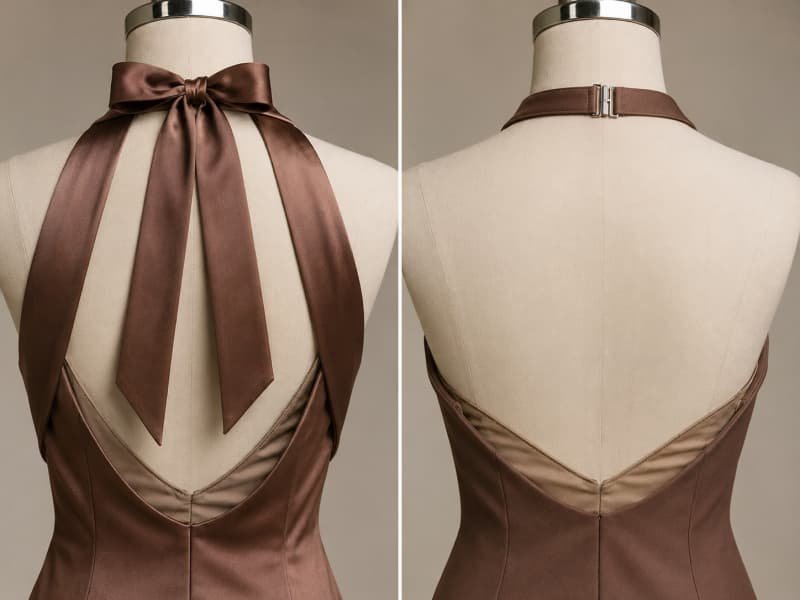
A halter closure looks like a small detail on a sketch, but it can quietly decide whether a dress feels secure, adjustable, polished, or uncomfortable after twenty minutes of wear. The tie or clasp changes how tension travels from the neckline into the bust, underbust, side seams, lining, and back. It also affects how accurately the garment can be graded, how easily the wearer can fasten it, and how consistently a factory can reproduce the approved sample across multiple sizes and colors. That is why experienced product teams do not choose a closure only because one option looks cleaner in a back-view photograph.
Neither construction is universally better. A tie halter offers broader wearer adjustment and naturally suits soft, fluid designs, while a clasp halter gives a cleaner and more repeatable neck length. The right choice depends on strap width, fabric friction, bust support, grading, hardware quality, wearer access, and whether the approved construction can remain stable in bulk production.
Consider two samples that both look perfect on a fitting model. The first uses satin ties that slowly loosen while the wearer moves, lowering the front neckline. The second uses an elegant metal clasp that rotates, presses into the neck, and pulls the strap seam out of shape. Neither failure is obvious in a static fitting, yet both can become expensive once a style reaches production. The following comparison looks at the closure as part of the complete garment, not as an isolated decorative trim.
What Is the Construction Difference?
A tie halter uses fabric straps that the wearer knots to establish the final neck length and tension. A clasp halter uses a fixed or adjustable strap joined by hardware. The deeper difference is how each system controls the neckline, distributes load, accommodates body variation, and translates the approved sample into measurable, repeatable bulk production.
Tie Construction
A tie halter normally begins with two straps extending from the upper front bodice. They may be cut as part of the front pattern, inserted into a neckline seam, formed from extended binding, or sewn separately and attached after the main bodice is assembled. Separate straps are easier to replace or revise during development, while integrated straps can create a smoother transition from the neckline. The choice should follow the fabric, the intended knot size, and the amount of load the strap must carry.
Fine rouleau ties create a delicate finish for mesh, chiffon, satin, and occasion styles, but narrow straps concentrate pressure and demand very accurate turning. Wider folded straps distribute pressure more comfortably and are easier to reinforce, although they create a larger knot behind the neck. During early development, approximately 5-8 mm may suit decorative or very light-load rouleau ties, 10-18 mm may suit lightweight fashion straps, and 20-35 mm may be explored when comfort and support matter more. These ranges are starting points, not universal standards.
The strap-to-bodice junction is usually the most highly stressed point. A reliable construction may use an extended seam allowance, lining support, narrow stay tape, a small internal backing piece, controlled bartacks, or two lines of stitching. Lightweight outer fabric should not be expected to carry the entire load by itself. Long straps also require careful grain direction, pressing, and pairing because even a small difference in width or stretch becomes obvious once both sides are tied together.
Clasp Construction
A clasp halter replaces the wearer-tied knot with a mechanical closure placed at the back or side of the neck. Common options include G-hooks, S-hooks, swimsuit clasps, low-profile buckles, concealed hooks, snaps, loops, and custom decorative hardware. The strap may be fixed in length or may include a slider, a short elastic section, or several fastening positions. A fixed clasp gives a controlled neckline, while an adjustable clasp preserves a cleaner appearance without removing all fit flexibility.
Hardware should be selected as a functional construction component rather than as decoration added at the end. Its internal opening must suit the finished strap width and thickness. When the opening is too wide, the clasp may rotate or allow the strap to slide sideways. When it is too narrow, it may crush, curl, or abrade the fabric. The hardware weight also matters: a heavy clasp attached to a fine mesh or satin strap can drag the back neck down and become visible from the front.
The strap end often needs folding, interfacing, woven tape, elastic, or a stable lining extension before it is secured around the hardware. Reinforcement should spread the pulling force beyond the final stitch line, yet remain discreet enough that it does not show through pale satin or transparent mesh. This balance is one reason clasp development should begin before the pattern is finalized, because changing the hardware opening later may force changes to strap width, seam allowance, and neckline proportion.
Load Distribution
The visible closure is only one part of the support system. Neck straps control vertical lift and neckline position, but the underbust seam, side seams, back closure, cups, boning, elastic, power mesh, and lining should share the load. When the bodice is stable through the torso, the neck closure can guide position rather than carry the full weight of the bust and skirt. This usually improves comfort regardless of whether the final closure is a tie or clasp.
Problems appear when a fitted or structured dress is developed like a soft halter top. The wearer may tighten a tie to compensate for a loose underbust or unstable back, creating neck pressure without correcting the real fit issue. A clasp can create the same problem in a different way: the fixed neck length holds the front up, but the rigid hardware becomes a concentrated pressure point. The correct diagnosis therefore starts with the whole bodice rather than the closure alone.
Garment weight must also be considered. A lightweight jersey top places far less load on the neck than a lined maxi dress with ruching, embellishment, or a heavy hem. A closure copied from one product category may fail in another even when the neckline shape looks similar. Development teams should review the tension path from front neckline to underbust, side body, back, and skirt before approving the strap width or hardware.
Pattern Implications
Tie and clasp halters require different pattern decisions. A tie provides more tolerance in total neck length, but its exit angle still controls the upper bodice. If the strap begins too close to center front, it may pull the neckline inward and disturb bust coverage. If it begins too far toward the armhole, it can create side-neck pressure or distort the upper edge. The attachment angle should be judged on the body, not only on a flat pattern.
A clasp strap requires a defined finished neck measurement for every size. The measurement must be taken between clear reference points, such as the bodice seam line, the finished strap junction, or the hardware edge. Measuring from different points during sampling and bulk production can create avoidable variation. The pattern should also show hardware allowance, fold-back length, seam intake, reinforcement placement, and the finished measurement with the clasp fastened.
Grading should not be reduced to adding the same amount to every size. Neck circumference, bust projection, upper-torso length, and shoulder-to-bust proportions do not increase at identical rates. The front bodice, cup position, armhole, strap angle, and finished neck length need to be reviewed together. A base-size sample can look excellent while the smallest or largest sizes become uncomfortable because the neck grading rule was too simple.
Construction Point | Tie Halter | Clasp Halter |
Final neck length | Set by the wearer | Set by pattern or adjustment system |
Visual effect | Soft, relaxed, decorative | Clean, controlled, engineered |
Fit flexibility | Generally high | Low to moderate unless adjustable |
Primary risk | Slipping, twisting, knot pressure | Hardware failure, rotation, incorrect length |
Key reinforcement | Strap-to-bodice junction | Strap-to-hardware junction |
Main bulk variable | Strap width and length consistency | Hardware consistency and neck measurement |
Wearer action | Tying and adjusting | Locating and closing the clasp |
Which Option Gives Better Fit and Comfort?
Tie halters usually provide more fit flexibility because the wearer can change the neck length. Clasp halters produce a cleaner, more repeatable neckline but rely on accurate grading or a controlled adjustment system. Comfort depends more on strap width, garment weight, bust support, edge softness, and closure placement than on the closure name alone.

Fit Adjustability
The strongest fit advantage of a tie halter is its adjustment range. The wearer can raise the front neckline, increase lift, reduce neck tension, or change the amount of coverage. This can accommodate variation in neck circumference, upper-body length, bust projection, and personal preference. For ecommerce products, where customers cannot try the garment before purchase, that flexibility can help one size work across a broader range of upper-body proportions, although it cannot repair an inaccurate cup, armhole, or underbust pattern.
Adjustability also introduces inconsistency. One wearer may tie the dress firmly and reproduce the intended neckline, while another may leave it loose and experience gaping. Product photographs normally show a carefully adjusted sample, but customers may not recreate that setting at home. Very long ties can hang awkwardly, become caught under outerwear, or create an oversized bow, while short ties may be difficult to double-knot and may exclude wearers with limited shoulder mobility.
A fixed clasp produces a more predictable front position, which is useful for structured partywear, fitted tops, and designs where neckline height must remain consistent. The drawback is a narrower tolerance window. An adjustable clasp often provides the best compromise when the brand wants a clean back without removing all wearer control. The adjustment range should be intentionally limited and measured so that loose strap ends, visible sliders, and hardware migration do not become new problems.
Neck Pressure
Neck pressure is governed by the amount of load reaching the neck and the area over which that load is distributed. A narrow 6 mm cord carrying meaningful tension will usually feel sharper than a softly finished 25 mm strap on the same garment. This is why elegant, delicate ties can become uncomfortable on heavier dresses even when they look proportionally correct. Strap width should be considered together with skirt weight, bust support, and the stiffness of the strap edge.
Tie halters add a knot, and the knot can become the main comfort issue. Thick fabric may produce a bulky knot that presses against the spine when the wearer leans into a chair or car seat. Smooth satin may require a tighter or double knot to remain secure, increasing pressure. A narrow cord can also dig into the skin before the overall garment feels heavy, especially when the wearer unconsciously tightens it to prevent the neckline from dropping.
Clasp halters remove the bulky knot but introduce a rigid object. Poorly selected hardware can press into the skin, rotate during movement, catch hair, or present a sharp edge. Comfort should be reviewed through a realistic wear trial rather than a short standing fitting. An initial 20-30 minute trial that includes sitting, walking, turning the head, raising both arms, and bending forward often reveals pressure or movement that is invisible in a mirror.
Fuller-Bust Support
A tie halter can offer useful lift for a fuller bust because the wearer controls tension, but the tie should not become the garment’s only support system. When the wearer must pull very tightly to achieve stability, the front may look lifted while the neck becomes increasingly uncomfortable. Better support comes from the bodice through shaped cups, an underbust seam, stable side panels, elastic, power mesh, boning, or a secure back closure.
A clasp can work very well on fuller-bust styles when the internal structure already stabilizes the dress. In that case, the clasp controls neckline position rather than carrying the complete bust load. The closure and strap attachment still need adequate strength, but comfort improves because tension is shared through the torso. A fixed clasp may also protect the intended coverage level more reliably than a tie, provided the finished neck measurement has been validated across sizes.
Fit review should include bust apex position, neckline coverage, underbust contact, center-front stability, side-body containment, armhole shape, and pressure at the neck. A frequent mistake is tightening the neck strap to correct gaping caused by the bodice pattern. That may raise the neckline temporarily, but the real cause could be an oversized upper bust, incorrect cup shape, insufficient underbust tension, or the wrong strap exit angle.
Grading and Tolerance
Tie halters are more forgiving in overall neck length, yet the strap attachment point, front neckline, cup position, armhole depth, and tie length still require accurate grading. A larger wearer may need more strap length, but simply extending the ties does not correct changes in bust projection or upper-torso shape. The closure must remain part of the full size-set review rather than being treated as a one-size decorative component.
Clasp halters need a clear finished neck specification. In close-fitting rigid styles, a variation of approximately 0.5-1.0 cm may already be noticeable, particularly in smaller sizes, although the final tolerance should always follow the brand’s specification, fabric behavior, and risk level. The factory should measure the completed neck loop with the clasp fastened, because cut strap length alone does not account for seam intake, fold-back allowance, hardware size, and assembly variation.
Size-set fitting is especially important for fixed clasps. Reviewing only the base size can hide problems at the top or bottom of the range. The smallest size may become too tight, while the largest size may still lack enough length if the grading rule is overly conservative. A practical review compares neckline height, neck comfort, bust coverage, and armhole behavior in at least the key graded sizes before bulk release.
Fit Check | Practical Development Target | Main Risk |
Strap symmetry | Left and right straps visually equal | Off-center closure or uneven neckline |
Fixed neck length | Controlled to the approved tolerance | Tight neck or front gaping |
Strap width | Consistent from bodice to end | Uneven pressure and poor appearance |
Bust apex | Aligned with the size specification | Distorted cups or incorrect lift |
Underbust position | Stable during movement | Neck strap carries too much load |
Armhole edge | Flat without cutting or gaping | Restricted movement or exposure |
Initial wear trial | 20-30 minutes with movement | Delayed pressure or slippage |
Closure operation | Repeated comfortably and securely | Poor wearer experience |
How Do Fabric and Design Affect the Choice?
Fabric can change the performance of both closures. Tie halters need materials that fold, turn, knot, and recover cleanly, while clasp halters need stable attachment areas that resist concentrated pulling. Stretch, friction, thickness, drape, transparency, and recovery should be tested together with the lining, cups, elastic, boning, and complete garment weight.

Fabric for Tie Halters
Tie straps perform best when the fabric is soft enough to knot but stable enough to retain its width and length. A fabric that looks attractive across the bodice may behave poorly when cut into a long narrow strip. Development should therefore test turning quality, seam rotation, knot security, surface friction, stretch growth, recovery, and the way the strap feels against the neck. These checks are more useful than relying on the commercial fabric name alone.
Satin creates a smooth, refined finish, but low-friction satin may loosen during wear. A wider strap, internal tape, adjusted grain direction, or a different tying method can improve security. Chiffon and lightweight georgette can produce elegant ties, although they may need doubling or a stronger hidden foundation. Crepe often holds a knot more securely because of its surface texture, but bias-cut or mechanically stretchy crepe can still lengthen after hanging and wear.
Jersey feels soft and is easy to tie, yet recovery must be checked because the strap can gradually lengthen and lower the neckline. Velvet naturally resists slipping, but multiple layers may create a bulky knot and narrow velvet tubes can be difficult to turn cleanly. For any fabric, the two straps should be allowed to relax under the same conditions before final measurement so that one side does not grow more than the other.
Fabric for Clasps
Clasp attachments concentrate pulling force in a small area. Stable woven fabrics can often support hardware with a carefully folded strap end and suitable stitching, while delicate, sheer, or stretchy materials normally need reinforcement. The support may come from lining, narrow woven tape, elastic, soft interfacing, or a concealed internal strap foundation. The objective is to spread load without creating a rigid patch that is visible or uncomfortable.
Mesh should rarely be expected to hold a clasp by itself. The closure normally needs a stable internal base, and in a transparent garment that base must be treated as part of the visual design. Chiffon and pale satin show internal layers easily, so a small dense reinforcement patch can look worse than a longer, softer support that distributes tension gradually. Stretch jersey also needs a smooth transition between the reinforced area and the flexible strap to avoid puckering.
Hardware finish should be matched to the textile. Rough casting, sharp edges, narrow metal bars, or inconsistent plating can damage fine satin and sheer fabrics. A clasp that works well on swimwear elastic may be unsuitable for an occasion dress even when the size appears similar. The development team should review edge smoothness, opening force, component weight, internal width, and contact with skin before approving the final trim.
Internal Structure
Cups, boning, lining, elastic, and underbust construction can reduce dependence on the neck closure. A soft unlined halter top may use the tie as its main source of lift, while a structured dress with molded cups and boned side seams can maintain most of its shape through the bodice. In the second case, the tie or clasp controls position rather than carrying the entire load, which usually improves comfort and stability.
Cups should match neckline depth, bust coverage, and the intended size range. A cup that is too rigid may fight against the outer fabric, while a cup that is too soft may collapse inside a fitted shell. Boning can stabilize princess seams, side seams, or center-front panels, but it should not be added automatically. Unnecessary rigidity can make a soft vacation style feel stiff and can transfer even more pressure into the neck.
Power mesh and underbust elastic are useful when flexible support is needed. They can control the lining without making the garment completely rigid. A stable back closure is also important because it anchors the torso circumference. When the back is loose or overly stretchy, the wearer often tightens the halter to compensate, increasing pressure and changing the intended neckline. The complete support system should therefore be tested before the closure is judged.
Style Matching
The same closure can produce very different results across garment categories. A soft vacation dress often benefits from a visible tie because the bow supports the relaxed design language and gives the wearer useful adjustment. A structured bustier halter may look cleaner with a fixed or adjustable clasp because the bodice already provides support and the back neckline needs to remain controlled. A minimal backless dress may use concealed hardware to preserve an uninterrupted silhouette.
Fabric and style must be considered together. A satin party dress can use either solution, but tie slippage, knot pressure, reinforcement shadowing, and hardware visibility must be compared on the actual sample. A mesh occasion dress may require a clasp mounted on an internal foundation, while a stretch bodycon dress may need an adjustable closure or recovery-tested tie. Embellished maxi dresses require particular caution because the garment weight can turn an attractive narrow strap into an uncomfortable load-bearing component.
Garment Type | Commonly Suitable Closure | Useful Starting Point | Main Development Risk |
Soft vacation dress | Tie | 15-30 mm soft strap | Slipping or neckline movement |
Satin party dress | Tie or refined clasp | Reinforced strap with controlled edge | Knot slippage or visible reinforcement |
Structured bustier halter | Fixed or adjustable clasp | Stable strap and internal support | Incorrect neck length |
Mesh occasion dress | Clasp on internal foundation | Concealed woven or elastic support | Visible backing or pull-out |
Stretch bodycon dress | Tie or adjustable clasp | Recovery-tested strap | Strap growth and neckline drop |
Minimal backless dress | Concealed clasp | Low-profile hardware | Difficult access or skin pressure |
Embellished maxi dress | Structured clasp system | Wide supported strap | Excessive garment weight at neck |
Lightweight fashion top | Tie | Narrow-to-medium self-fabric strap | Twisting and uneven turning |
Which Construction Is Safer for Bulk Production?
Neither system is automatically safer in bulk. Tie halters are vulnerable to uneven straps, twisting, weak attachment, and knot slippage, while clasp halters depend on accurate hardware, reinforcement, and neck measurement. The lower-risk construction is the one supported by approved materials, measurable specifications, functional testing, first-piece control, and repeatable inspection across sizes and colors.

Tie Failure Points
Long narrow ties can vary during cutting, sewing, turning, and pressing. Even a small difference in finished width becomes visible when two straps sit next to each other at the back neck. If one strap stretches more than the other, the bow shifts away from center and the front neckline may also sit unevenly. Slippery, bias-cut, or loosely constructed fabrics are especially sensitive because the strap can grow before final pressing or during wear.
Twisting is another frequent defect. The seam may rotate from the inside toward the visible face, particularly when the tube is narrow or the fabric is difficult to control. Poorly finished ends may become bulky, pointed unevenly, fray after care, or expose raw fabric. Because the knot draws attention to the ends, minor inconsistencies are more obvious than they would be on a hidden internal component.
Attachment failure is more serious. A tie inserted into a narrow neckline seam may pull out or distort the upper bodice. Heavy bartacking can increase strength, but on delicate fabric it may create puckering or cut the yarns. The factory should control finished length, width, seam position, end shape, attachment angle, and reinforcement method. A note that simply says “same as approved sample” does not provide enough information for repeated production.
Clasp Failure Points
Clasp quality can vary between suppliers and production batches. Two pieces that look identical in a photograph may differ in opening force, internal width, edge smoothness, weight, spring strength, or plating quality. Rotation is common when the hardware opening is wider than the strap or the component is poorly balanced. Once the clasp turns sideways, it may press into the neck, expose a sharp edge, or disturb the back appearance.
Strap pull-out can occur when the folded area is too short, stitching is too close to the cut edge, or reinforcement does not extend far enough into the strap. Stretch fabrics may narrow under tension and slip through the hardware even when the first sample appears secure. Fixed-length errors create a direct fit problem because a small difference in the completed neck loop can raise or lower the entire front neckline.
Hardware should be approved by supplier reference, dimensions, finish, and physical sample rather than a generic description such as “gold hook.” Inspection should include burrs, rough edges, incomplete closing, hair-catching gaps, visible scratches, color variation, and inconsistent operation. Any substitution should require approval because a visually similar clasp may change strap thickness, fold-back allowance, neck length, and closing performance.
Testing the Closure
Development testing should imitate real use rather than stopping at visual approval. The complete garment should be fitted with the closure fully fastened, then worn while sitting, walking, raising the arms, bending, and turning the head. The team should recheck neckline position, strap length, pressure points, closure movement, and bust coverage after the activity. This simple sequence often reveals problems that are invisible during a short stationary fitting.
Repeated operation is useful during screening. Twenty-five to fifty opening-and-closing cycles can expose early clasp weakness, while repeated tying can reveal seam movement, surface wear, stretch growth, or knot instability. These cycles do not replace a required laboratory standard, but they are practical development checks. Care testing should also follow the product label because washing, steaming, dry cleaning, or moisture can change fabric recovery, plating appearance, and strap dimensions.
Pull testing should follow the brand’s specification, target market, garment weight, and applicable method rather than a universal number copied from another product. A low-load chiffon top and a heavily embellished maxi dress do not present the same risk. The important point is that the requirement, method, sample condition, and acceptance result are recorded before bulk production instead of being discussed only after a failure.
Bulk Control
Bulk repeatability depends on converting the approved sample into measurable instructions. Tie styles need a finished strap length, width, seam position, end shape, attachment angle, and reinforcement method. Clasp styles need the exact hardware reference, internal opening, strap thickness, finished neck length, adjustment range, fold-back allowance, and orientation. The physical sample remains important, but it should support the specification rather than replace it.
First-piece approval is especially useful for satin, mesh, bodycon, backless, corset, bustier, and embellished halter styles. These products combine fit-sensitive patterns with fabrics that reveal small workmanship errors. Inspecting and correcting the first pieces is far less disruptive than discovering the same problem after several hundred garments have been assembled. Inline inspection should then confirm that the agreed method remains stable as different operators and production bundles move through the line.
Final inspection should verify function as well as appearance. A tie must be secure, symmetrical, comfortable to handle, and free from twisting. A clasp must open and close correctly, remain in the approved orientation, and produce the intended finished neck measurement. Inspection records should make it possible to trace whether a later complaint came from material variation, construction, measurement, or an unapproved component change.
Production Stage | Tie Halter Check | Clasp Halter Check | Record Needed |
Material approval | Stretch, friction, turning quality | Hardware size, finish, edge quality | Approved material or trim reference |
Pattern review | Length, width, exit angle | Finished neck length, hardware allowance | Pattern and measurement sheet |
Fit sample | Knot position, comfort, neckline control | Clasp pressure, access, front position | Fit comments and photos |
Pre-production sample | Equal straps, secure reinforcement | Correct hardware and attachment | Signed approval sample |
First-piece inspection | Width, length, symmetry | Neck measurement, clasp orientation | First-piece report |
Inline inspection | Twisting, weak seams, unequal ties | Rotation, pull-out, component variation | Inline QC report |
Final inspection | Tying function and appearance | Closing function and measurement | Final inspection record |
How Should Brands Choose the Right Halter?
Choose a tie halter when wearer adjustment, softness, and a visible bow support the design. Choose a clasp when the garment needs a cleaner back, controlled neckline, or faster closure. Confirm the choice through actual fabric trials, fit and movement testing, grading review, component availability, and pre-production approval rather than selecting from appearance alone.

Decision Factors
The visual direction is the first question, but it should not be the only one. A tie often suits romantic, vacation, soft partywear, and relaxed occasion styles because the bow belongs to the design language. A clasp may feel more appropriate for minimal, structured, polished, or hardware-led garments. A beautifully proportioned self-fabric tie can look more premium than generic metal hardware, while a refined custom clasp can elevate a clean backless silhouette.
Wearer operation matters as much as appearance. A tie requires enough length and hand mobility to create a secure knot behind the neck. A small clasp may be difficult to locate without a mirror, especially for wearers with long hair, long nails, or limited shoulder movement. The design team should decide whether the closure is expected to be operated independently and whether it remains comfortable against a chair, coat collar, or long hair.
Fit tolerance, supply continuity, and repeat-order planning should also shape the decision. A tie provides broad adjustment and avoids dependence on specialized hardware, but it adds sewing and finishing time. A custom clasp can create a distinctive signature, yet it may introduce minimum order quantities, plating variation, longer replenishment, and supplier risk. The best construction balances visual intent, wearer comfort, fit flexibility, material availability, and repeatability.
Tech Pack Details
A tie-halter specification should state finished length, finished width, grain direction, seam position, turning method, end shape, reinforcement, attachment point, and measurement method. The document should make clear whether strap length is measured from the bodice seam line, the finished neckline edge, or another reference. Without a fixed measurement origin, the sample room and production line may report different results even when both believe they are following the specification.
A clasp-halter specification should identify the hardware type, approved supplier or physical reference, material, finish, color, internal opening, overall dimensions, finished strap width and thickness, fixed neck length or adjustment range, reinforcement, stitch type, hardware orientation, tolerance, and functional requirement. Close-up photographs are useful, but they cannot show seam intake, internal support, fold-back allowance, or the exact finished neck measurement.
The closure should be documented together with cups, boning, lining, underbust elastic, back closure, and side-seam structure. Otherwise, the factory may reproduce the clasp or tie accurately while the overall garment still lacks support. A practical tech pack connects visual design, finished measurements, internal construction, materials, and testing expectations so that pattern makers, sample technicians, sewing operators, quality staff, and sourcing teams work from the same standard.
Sample Confirmation
A first prototype checks whether the construction concept is workable. A fit sample checks neckline position, bust support, comfort, and movement. A revised sample confirms comments, while a pre-production sample verifies the final fabric, lining, hardware, workmanship, and measurements intended for bulk. Treating all samples as the same approval stage makes it difficult to understand which risk has actually been resolved.
When the choice remains uncertain, developing both closure versions can be worthwhile. The comparison should use the same bodice pattern, fabric, lining, and fitting model so that the closure is the main variable. The wearer should sit, move, bend, raise the arms, and operate each closure without being told which version the design team prefers. Feedback should identify where pressure occurs, how long it takes to appear, and whether adjustment solves the problem.
The final approval should combine the physical sample, measurement chart, construction method, trim reference, fit comments, and testing expectations. This creates a production standard that can be understood across departments and repeated in later colors or reorders. A closure that looks convincing in one sample but cannot be measured, sourced, or inspected consistently is not yet ready for bulk production.
Hybrid Options
A hybrid closure can combine the strengths of both systems. Examples include a decorative tie over a concealed snap, a tie-look strap attached to a fixed internal neck support, a clasp with a short elastic insert, or an adjustable slider hidden beneath a soft fabric cover. These solutions are useful when the design needs the visual softness of a tie but the neckline requires more controlled support or easier fastening.
Hybrid construction should solve a clearly defined problem. A concealed snap may stop a smooth satin tie from lowering the neckline, while a short elastic section can improve comfort without creating a visibly adjustable strap. A hidden internal support can also carry load so that a decorative outer tie remains soft. Each added component, however, creates another sewing operation, tolerance point, and potential source of misalignment.
The final choice should be judged against six priorities: visual intent, fit flexibility, neck comfort, wearer operation, component supply, and bulk repeatability. A closure that appears sophisticated but creates ongoing fit complaints or unstable production is not a successful construction. The strongest result is usually the simplest system that protects the design, performs comfortably on the body, and can be reproduced without interpretation.
Request a Halter Development Review
For brands developing halter, backless, bodycon, satin, mesh, corset, party, or occasion dresses, the closure is most effective when it is reviewed as part of the complete product. Duolan Apparel can work from a tech pack, reference image, original sample, fabric direction, or collection brief, then support fabric and hardware sourcing, pattern development, fit correction, sample revision, pre-production confirmation, and scalable manufacturing. This approach helps resolve support, coverage, comfort, and repeatability before the style reaches a larger production run.
The company’s documented manufacturing network includes 16 owned womenswear factories, more than 20 long-term satellite factories, 300 sewing lines, and over 50 flexible production lines, with a product focus on fashion dresses, occasion dresses, party dresses, fitted dresses, fashion tops, and related collection development.
Share:
Our Services
Categories
Table of Contents
Here, developing fashion collections is more than manufacturing garments — it’s a collaborative process focused on transforming ideas into well-executed, market-ready products. From fabric sourcing and sample development to scalable production and delivery coordination, every stage is built to support quality, consistency, and efficient collection launches across global markets.

