Skip to content
What Is the Best Fabric for Backless Dresses : A Guide to Drape, Support, Stretch, and Fit
Your trusted Women’s Apparel Development & Manufacturing Partner from China
- Jerry
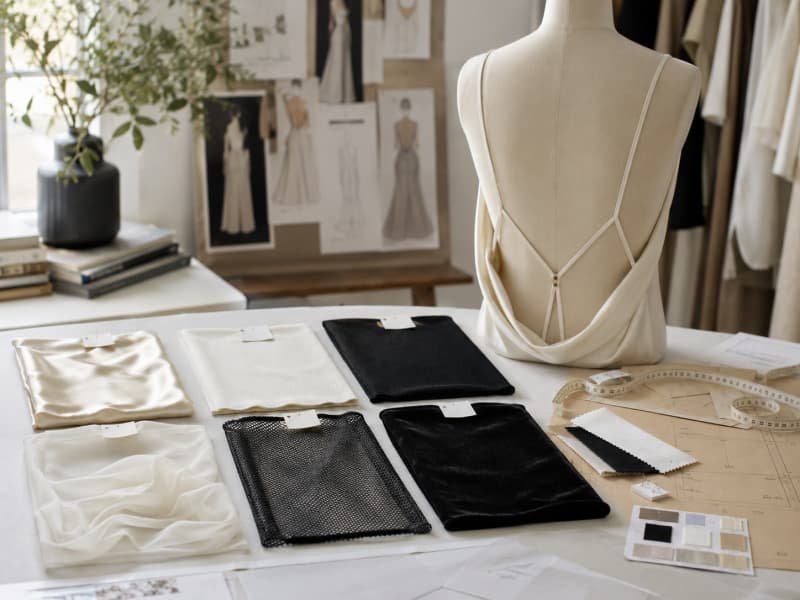
A backless dress can look almost weightless in a campaign image, yet it is one of the easiest silhouettes to get wrong in development. Removing the back also removes a large part of the structure that normally controls the bust, shoulders, waist, and upper-body circumference. The remaining fabric must therefore create the visual effect, carry the garment weight, stay close to the body, conceal internal support, and remain comfortable while the wearer moves. A fabric that looks luxurious on a small swatch can still produce a poor dress when it grows on the bias, pulls the neckline backward, shows every cup edge, or lets the open back stand away from the skin.
The best fabric for a backless dress is the one that matches the silhouette and support plan. Satin and soft crepe suit fluid occasion styles, compact jersey and stretch crepe suit fitted shapes, while chiffon, mesh, lace, and velvet work best when their weight, opacity, lining, and edge control are deliberately engineered. No single fabric is best for every open-back design.
That is the useful way to approach the question: not as a contest between fashionable fabric names, but as a decision about how the entire garment will behave. In practice, the most expensive-looking sample is often not the one made from the most expensive material. It is the one in which the shell, lining, pattern, straps, bust support, and skirt weight cooperate so well that the wearer never notices the engineering. The goal is to stop a promising sketch becoming an unstable sample or bulk-production problem.
What Makes a Fabric Suitable for Backless Dresses?
A suitable backless-dress fabric must create the intended drape while keeping the neckline, side bust, waist, and open-back edge stable. The main factors are weight, stretch direction, recovery, opacity, surface finish, and compatibility with lining or internal support. The fabric is suitable only when it works with the pattern and construction, not merely when it looks attractive as a swatch.
Drape and Structure
Drape describes how fabric falls under gravity and around the body, but more drape is not always better. A fluid satin may create a beautiful slip dress, yet the same material can make a sharply shaped low-back bodice twist or collapse. A compact crepe may look less dramatic on the roll, but it usually gives the pattern cutter more control around the bust, waist, and open edge. The right balance depends on whether the design is meant to skim, cling, flow, or hold a clearly defined shape.
A small hand swatch is useful for colour, texture, and surface finish, but it rarely shows how a fabric behaves over a full skirt length. For satin, chiffon, georgette, or other fluid materials, a larger hanging piece reveals whether the grain remains straight, whether the edge twists, and whether the cloth continues to lengthen. Drape should also be checked over a mannequin or fitting body, because a fabric that falls beautifully from a hanger can still form drag lines across the bust, hips, or waist once it meets three-dimensional curves.
Weight and Load
Fabric weight affects much more than comfort. In a backless dress, the skirt can pull downward on the remaining support points, including shoulder straps, a halter neck, side seams, an underbust seam, or the waist. The longer and fuller the skirt, the more carefully that load must be distributed. A chiffon shell may appear almost weightless, but several gathered layers plus lining can create a surprisingly heavy lower section. A floor-length stretch velvet dress can place even more pressure on the neckline or straps.
Weight must therefore be reviewed together with dress length, skirt volume, layer count, strap width, closure placement, and the amount of embellishment. A narrow halter tie may be comfortable on a lightweight mini dress but unpleasant when attached to a lined maxi skirt. In that case, the design may need a wider neck band, a fitted waist, an internal underbust support, or a different strap arrangement. GSM ranges are helpful during sourcing, but fibre, yarn, construction, and finishing can make two fabrics of the same weight behave very differently.
Material property | Common development range | What it affects | Primary risk |
Chiffon weight | 40-90 GSM | Layering, movement, transparency | Weak edge stability and show-through |
Lightweight satin | 80-140 GSM | Fluidity, bias behaviour, shine | Seam shadow, slippage, growth |
Soft to medium crepe | 100-220 GSM | Controlled drape and coverage | Different qualities behave inconsistently |
Compact jersey | 180-300 GSM | Close fit, opacity, compression | Heat, seam visibility, poor recovery |
Stretch velvet | 200-350 GSM | Seasonal depth and body coverage | Neck load, pile direction, length growth |
Widthwise stretch | About 10-50% by construction | Bust, waist, and hip fit | Gapping if recovery is weak |
Recovery check | Measure at 0, 1, and 30 minutes | Shape retention after movement | Back edge remains permanently extended |
Note: The ranges above are common development references rather than fixed standards. Fibre content, weave or knit construction, finishing, garment length, colour, lining, and layer count can change the result substantially. A fabric near the centre of a suggested range can still fail if recovery is weak or skirt load is high, so the wearable sample and movement fitting remain the final judges.
Stretch and Recovery
Stretch tells you how far a fabric can extend; recovery tells you how effectively it returns. For open-back styles, recovery is often the more important property. A fabric may feel flexible and comfortable during the first fitting, then become loose around the back opening after the wearer sits, walks, or raises her arms. This is common with lightweight jerseys, loosely knitted mesh, and some stretch woven fabrics. Once the edge grows, the dress may reveal more skin than intended or pull away from the body.
Stretch should be checked in both width and length. Widthwise extension affects bust, waist, and hip fit, while lengthwise extension can alter neckline position, strap length, and final garment drop. A simple development check uses a marked ten-centimetre section: extend it to a controlled distance, release it, and measure immediately, after one minute, and after thirty minutes. This does not replace laboratory testing, but it quickly exposes obvious instability. The shell, lining, elastic, and mesh support should also be tested together because mismatched stretch can create rippling or twisting.
Opacity and Surface
Backless dresses often expose internal construction more clearly than closed-back styles. Thin satin can reveal cup edges, boning channels, seam allowances, and adhesive solutions. Lightweight jersey may show every line beneath it, while pale chiffon can look acceptable indoors and almost transparent in sunlight. Opacity should be checked in daylight, strong retail lighting, and direct camera flash, using the intended lining and at the expected wearing stretch. A fabric that looks covered on the table may become far more transparent across the bust or hips.
Surface finish also changes how the finished dress is perceived. Glossy satin highlights folds, seams, and pressure points, whereas matte crepe hides minor irregularities but may look too quiet for a highly polished evening style. Velvet creates depth and stronger visual coverage, although it can show pressure marks and pile-direction differences. Lace and embroidered mesh can add substantial visual value, but motif placement, backing colour, and seam position become critical. The right surface is not simply the one that looks most expensive; it is the one that supports the design while concealing the engineering that should remain invisible.
Which Fabrics Work Best for Backless Dresses?
Satin, crepe, compact jersey, chiffon, georgette, mesh, lace, and velvet can all work for backless dresses, but they serve different silhouettes. Satin creates fluid polish, crepe offers controlled drape, jersey supports fitted comfort, and sheer fabrics create layered movement. The best option is the one that matches the dress shape, support method, season, price position, and expected wearing conditions.

Satin and Crepe
Satin remains one of the strongest visual choices for a backless dress because its smooth surface reflects light and makes movement look polished. It suits slip dresses, bias-cut midis, cowl necklines, and clean occasion silhouettes. The word satin, however, describes a weave rather than one fixed quality. Polyester satin, silk satin, acetate satin, stretch satin, and crepe-back satin can look similar in photographs while behaving very differently during cutting, pressing, sewing, and wear.
Light satin may expose seam allowances and internal support, slip during cutting, grow on the bias, or retain needle marks. A slightly heavier satin or crepe-back satin often gives better control, particularly when the dress includes bust seams, waist shaping, or a long skirt. Crepe is usually more forgiving because its fine textured surface reduces harsh reflections and hides minor seam impressions. Woven crepe suits softly tailored silhouettes, while stretch crepe can produce a close fit without the casual appearance of ordinary jersey. Satin is strongest when shine and fluidity lead the design; crepe is often safer when stability and clean seaming matter more.
Jersey and Double Knit
Jersey works well for fitted, ruched, and draped backless dresses because it moves with the wearer and can reduce the need for complex closures. Not every jersey is suitable, however. Lightweight single jersey may feel soft but can become transparent, cling unevenly, expose internal stitching, and grow around the neckline or open back. Compact jersey, double knit, and ponte-like constructions provide more body, stronger recovery, and a cleaner surface for body-conscious shapes.
Compact jersey in the region of 200-300 GSM is commonly considered for fitted dresses, while lighter qualities around 140-190 GSM are more appropriate for soft draping or gathered designs. These ranges are only starting points. A double-layer bodice can improve opacity and create a clean interior, but it also adds heat and weight. Power mesh may provide more targeted control around the bust or waist while keeping the skirt lighter. The real advantage of jersey is not stretch by itself; it is the combination of movement, coverage, and predictable recovery.
Chiffon and Georgette
Chiffon and georgette are most successful in layered, flowing, and softly gathered backless dresses. They are widely used for occasionwear, resort styles, maxi skirts, sleeves, overlays, and cape-like panels. Chiffon is usually lighter and more transparent, while georgette has a slightly grainier surface and more body. Those differences affect how the fabric gathers, hangs, and handles during sewing, even when the colour and fibre content appear similar.
Neither fabric should be expected to provide primary bust support. Stability must come from the lining, waist seam, straps, cups, elastic, or another internal layer. Layer count also matters: one chiffon layer can look delicate but reveal too much, while three gathered layers can add unexpected weight and bulk. Long, fluid skirts may need twenty-four to forty-eight hours of hanging before the hem is levelled, especially when panels are cut on the bias. Roll width, snagging, shade consistency, and grain control should all be confirmed before bulk cutting begins.
Mesh, Lace, and Velvet
Mesh is valuable when the design needs the appearance of exposure with discreet control. Fine stretch mesh can connect sections, stabilise side openings, or form illusion panels without visually closing the back. Power mesh provides stronger internal support, although it is usually concealed. Quality varies widely: some meshes recover firmly and remain smooth, while others stretch out quickly, curl at the edge, or show needle damage. Testing with the intended elastic, seam type, and lining is essential.
Lace is most reliable as an overlay, decorative panel, or supported back treatment rather than the sole structural layer. Motif size, stretch direction, scalloped borders, and placement waste all affect cost and consistency. Velvet is suited to autumn, winter, holiday, and evening dresses because it provides depth and strong visual coverage, but it can create considerable weight and seam bulk. Stretch velvet should be checked for lengthwise growth, and all panels must normally be cut in one pile direction to prevent apparent shade differences.
Fabric | Typical useful range | Best applications | Key production checks |
Satin | 80-180 GSM depending on style | Slip, bias, cowl, evening dresses | Needle marks, seam shadow, bias growth, pressing shine |
Crepe | 100-280 GSM | Soft tailoring, fitted occasionwear, clean minis | Recovery, surface quality, shrinkage, opacity |
Compact jersey | 180-300 GSM | Bodycon, ruched, stretch fitted dresses | Recovery, colour change when stretched, seam bulk |
Chiffon | 40-90 GSM per layer | Layered maxis, overlays, sleeves | Transparency, shifting, snagging, hem growth |
Georgette | 60-130 GSM | Flowing occasionwear and gathered skirts | Grain control, lining weight, seam finish |
Stretch mesh | 60-180 GSM by function | Illusion backs, fitted panels, inner support | Curling, recovery, needle damage, edge finish |
Lace | Highly variable | Overlays, decorative backs, statement panels | Motif placement, backing, seam matching, waste |
Velvet | 200-350 GSM | Seasonal evening and party dresses | Pile direction, neck load, seam bulk, length growth |
Note: Material names do not guarantee performance, because two fabrics sold under the same category can differ sharply in density, yarn, finish, stretch, recovery, and surface behaviour. Always compare the exact supplier quality, colour, usable width, construction, and bulk availability that will be used for the approved sample. Substitution should be reviewed against the finished dress rather than accepted from a similar-looking swatch.
How Does Fabric Affect Fit and Support?
Fabric determines whether a backless dress stays close to the body, supports the bust, and keeps its shape during movement. Gaping, slipping, rolling edges, and unstable side coverage usually come from the interaction between pattern shape, fabric stretch, recovery, garment weight, lining, and support placement. Fit improves when these elements are developed together instead of corrected separately after the first sample.

Back-Edge Control
The open-back edge must follow a three-dimensional body curve even though the pattern is cut from a flat sheet. If that edge is too long, too elastic, or poorly shaped, it will stand away from the body. The first correction should usually happen in the pattern, not through increasingly tight elastic. Excess tension can hide a shaping problem while creating ripples, dragging the side seams backward, or making the edge bite into the skin.
Pattern cutters may use contour reduction, dart manipulation, curved seam shaping, or controlled negative ease to make the opening sit inward. The amount changes with the fabric. A stable woven crepe needs a different approach from four-way stretch jersey. Clear elastic, stay tape, facing, lining, fold-over elastic, or crossed straps may then reinforce the shape. Fit testing should include sitting, twisting, reaching forward, raising both arms, and wearing the dress long enough for body heat to relax the fabric. A back edge that looks clean in a static fitting can still roll after ten minutes of movement.
Bust and Side Support
A built-in cup can shape the bust, but it does not provide reliable lift unless it is held against the body. Because a backless dress cannot use a conventional bra band, support must be transferred to other anchor points such as shoulder straps, a halter neck, an underbust seam, side-front panels, a fitted waist, boning, internal elastic, power mesh, or a waist stay. The design should clearly answer where vertical garment weight is carried and what prevents the bodice from moving away from the body.
Side-bust coverage is especially sensitive when the back opening approaches the side seam. A small pattern imbalance can allow the fabric to pull away, and the issue often becomes more visible as bust volume increases. A construction that works on a sample-size model may not perform equally across a broader range. Larger sizes may need wider straps, stronger elastic, altered cup dimensions, extra side support, or different boning placement. The dress is secure only when ordinary movement does not change the neckline position or expose the side bust.
Lining and Internal Layers
Lining can improve opacity, hide seams, stabilise the shell, reduce clinging, and create a clean finish around the open back. Full lining is not always necessary, and in warm-weather dresses it can add more heat and weight than the design can comfortably carry. Partial bodice lining, targeted power mesh, a double-layer front, or a narrow facing may provide enough control while preserving a lighter skirt and a cooler wearing experience.
The lining and shell must have compatible stretch. A highly elastic shell over a stable lining can feel restrictive and produce wrinkles, while a very soft lining beneath a stable shell may fail to control the edge. Colour also matters. A lining that matches the shell is not always the least visible option, especially under white, champagne, blush, or pale pastel fabrics. The complete layered system should be viewed against different skin tones, in daylight, retail lighting, and direct flash because campaign photography often reveals internal construction that appears hidden during an ordinary fitting.
Fabric and Grading
Fabric behaviour changes how a backless dress should be graded across sizes. A stable woven design needs sufficient wearing ease and carefully controlled contouring, while a stretch design may use negative ease. The same percentage reduction should not be copied across every knit or stretch woven fabric. Firm compact jersey can support more controlled compression than a thin knit with weak recovery, and stretch satin may behave very differently from four-way mesh even when both extend across the width.
Critical graded measurements include back-opening width and depth, strap length, side-bust coverage, underbust circumference, cup position, waist level, armhole depth, and centre-front length. As sizes increase, the opening should remain visually balanced rather than simply becoming proportionally larger. Some brands control back depth more tightly in larger sizes while adding volume through the bust and torso. Fit tolerances should also reflect importance: a small strap-length error can change the entire position of an open-back dress, so it deserves tighter control than a less critical lower-skirt measurement.
Which Fabric Suits Each Backless Style?
The right fabric follows the silhouette rather than the trend name. Slip and flowing maxi dresses need controlled drape, bodycon styles need recovery and opacity, corset dresses require a stable foundation, and halter dresses must balance skirt weight against neck pressure. Selecting by finished shape, support plan, and wearing conditions produces more reliable results than selecting by fabric popularity alone.

Slip and Bias Styles
Backless slip dresses are commonly developed in satin, silk-like woven fabrics, crepe-back satin, and soft crepe because these materials create a smooth line and skim the body without looking heavily structured. Bias cutting gives a woven fabric limited mechanical stretch and helps it follow curves, but it also creates technical challenges. Panels can grow after cutting, sewing, pressing, and hanging, so a dress that appears level immediately after assembly may develop an uneven hem the following day.
The fabric should be allowed to relax before cutting, particularly when it has been tightly rolled. Panels need gentle handling to avoid distortion, and the assembled dress may require a hanging period before the hem is marked. Seam quality is equally important because satin can show puckering, needle marks, and seam shadow. A long skirt can also place more load on narrow straps than expected. Crossed straps, adjustable hardware, underbust shaping, or internal waist support can make the style more wearable without disturbing the clean appearance.
Bodycon and Ruched Styles
Compact jersey, stretch crepe, double knit, and layered stretch mesh are generally effective for bodycon backless dresses. The main priorities are recovery, opacity, smoothness, and resistance to lengthwise growth. If the fabric is too thin, it may cling to every small body change and expose internal seams. If it is too firm, it can feel restrictive or pull the neckline and back opening out of position when the wearer walks or sits.
Ruching adds visual texture and can accommodate limited fit variation, but it also increases fabric consumption and seam bulk. The direction of stretch should be considered when the ruched panel is cut because a section that stretches too easily along the gathering line may flatten during wear. Double-layer construction is common in fitted minis because it improves coverage, although it increases heat. A thirty-minute wear test is particularly valuable: measure whether the back opening widens, the waist loosens, or the skirt drops after repeated movement.
Corset and Bustier Styles
Corset and bustier backless dresses should be treated as structured garments even when the outer surface appears soft. Stable satin, woven crepe, bonded fabrics, taffeta-like materials, lace, and decorative mesh can all form the visible shell, but the actual support usually comes from an internal foundation. Cups, boning channels, a stable centre-front panel, power-mesh sides, underbust elastic, and a waist stay may be combined according to the neckline, back depth, cup shape, and size range.
The shell must be able to conceal these components. Thin glossy satin can reveal every boning channel, while very thick material creates bulky seam intersections. Stretch fabric may move independently from a rigid inner bodice and form wrinkles unless it is mounted carefully. Boning should stop the garment from collapsing rather than force the body into an uncomfortable shape. Cups should be developed with the neckline and outer bust panel rather than inserted late as generic components, because incorrect projection or visible edges are difficult to correct after the pattern is finalised.
Halter and Flowing Maxis
Halter dresses can be made in satin, crepe, jersey, chiffon, georgette, mesh, or lightweight woven blends, but fabric weight must be balanced against neck pressure. A lined floor-length skirt attached to a narrow tie may feel comfortable for a short fitting and painful after an evening of wear. Wider neck bands spread the load more effectively, while a fitted waist, underbust seam, or internal support panel prevents the entire dress from hanging from the neck.
Jersey halters offer flexibility but may stretch longer during wear. Stable woven fabrics maintain strap length more effectively, although they need accurate shaping because they offer less forgiveness. Flowing maxis often work best when a stable bodice is paired with a softer skirt. Chiffon and georgette create light movement, while satin and crepe fall with more weight and a cleaner line. Layer count, gather density, lining weight, high slits, and strap reinforcement should all be reviewed together because each one changes the load placed on the upper body.
Backless style | Suitable fabric options | Useful performance focus | Main approval point |
Bias slip dress | Satin, crepe-back satin, soft crepe | Controlled bias growth and smooth seam finish | Hem balance after hanging |
Bodycon mini | Compact jersey, stretch crepe, double knit | Strong recovery and adequate opacity | Shape retention after a 30-minute wear test |
Corset dress | Stable satin, woven crepe, bonded base | Low-stretch shell over engineered support | Visibility of cups, boning, and seam intersections |
Halter dress | Crepe, satin, jersey, georgette | Strap extension and total skirt weight | Neck comfort after prolonged wear |
Flowing maxi | Chiffon, georgette, soft crepe, satin | Layer count, gather density, lining weight | Bodice stability under skirt load |
Mesh or lace style | Stretch mesh, lace over backing | Controlled stretch and supported edges | Seam stability and motif placement |
Note: The matrix is a starting point for development rather than a universal specification. Colour, dress length, layer count, trim weight, target size range, lining, and internal support can move a fabric from a strong choice to a high-risk choice within the same silhouette. The decision should be confirmed with the intended pattern and a wearable sample, especially when the back is deep or the skirt is heavy.
How Should Brands Test Fabric Before Production?
Fabric should be tested as part of the complete garment, not approved from colour and hand feel alone. Review GSM, stretch, recovery, opacity, drape, shrinkage, seam response, pressing behaviour, and compatibility with lining and trims. A higher-risk backless style should then pass a wearable prototype, movement fitting, revised sample, and pre-production confirmation before full bulk cutting begins.

Swatch and Material Checks
Every fabric review should begin with recorded information rather than memory. Note the supplier reference, fibre composition, usable width, colour standard, finish, stated GSM, stretch direction, minimum order conditions, and intended placement in the dress. The swatch must be checked with the proposed lining because many problems appear only when the layers are combined. The lining may change the drape, create static, restrict stretch, alter colour, or expose seam allowances that were not visible in the shell alone.
Basic checks should cover actual usable width, approximate GSM, widthwise and lengthwise stretch, immediate and delayed recovery, opacity when stretched, colour under different lighting, surface snagging, seam response, pressing marks, shrinkage, colour transfer, and pilling where relevant. A larger cut is essential for drape assessment. One metre reveals far more than a small swatch when reviewing satin, chiffon, mesh, or velvet. Approvals should identify the exact supplier and quality reference; a generic description such as stretch satin leaves too much room for later substitution.
Prototype and Movement Tests
A backless dress must be evaluated on a moving person rather than only on a mannequin. A mannequin can show drape and proportion, but it cannot reproduce breathing, sitting, shoulder movement, body heat, or the way a garment gradually relaxes. During fitting, the wearer should walk, sit and stand repeatedly, raise both arms, reach forward, rotate the torso, and wear the dress for at least twenty to thirty minutes before the back opening and straps are checked again.
Photograph the front, side, three-quarter, and back views before and after movement. Fit comments should be measurable: stating where the opening gaps, approximately how much it lifts, and during which action is more useful than simply requesting a tighter back. A complex style may require a first prototype, fit sample, revised sample, pre-production sample, and first-piece confirmation. Not every dress needs every stage, but skipping wearable verification is risky for deep backs, narrow halters, structured busts, long bias skirts, and high-stretch bodycon designs.
Bulk Risk Controls
Bulk fabric can differ from the sample lot in shade, width, finish, stretch, recovery, and shrinkage. These changes are not always obvious before cutting, which is why roll inspection, shade grouping, relaxation, and a pilot quantity matter. A reliable sequence is to verify the bulk fabric against the approved reference, record roll numbers, test higher-risk lots, allow the material to relax, cut a controlled pilot, approve the first completed garment, and monitor critical measurements during sewing.
Backless styles have several measurements that deserve close control: strap length, side-bust coverage, back-opening width and depth, cup position, elastic tension, waist placement, and final garment length after hanging. Shade grouping is especially important for multi-panel satin, chiffon, velvet, and mesh styles. Production lines should use approved physical samples, clear notches, templates, and measurable instructions. Verbal descriptions such as slightly tighter or cleaner edge are too vague when several operators need to reproduce the same result across hundreds or thousands of garments.
Alternative Fabric Approval
A replacement fabric should be compared by performance rather than appearance alone. Two materials can share a similar colour and surface while behaving differently once cut and worn. The review should compare fibre content, GSM, thickness, usable width, stretch, recovery, drape, opacity, shine, shrinkage, colourfastness, seam behaviour, pressing response, availability, repeatability, and cost impact. When the performance changes, the pattern may also need to change.
Replacing a stable crepe with a softer stretch crepe can alter the back opening, bust fit, skirt drop, and final length. Replacing a matte material with satin can make previously invisible seams or cups suddenly obvious. A visually similar alternative is not truly equivalent until it has been tested in the critical construction areas and, for a higher-risk style, sampled on the body. Material substitution is therefore a product-development decision, not a routine purchasing change. The safest approval is based on the finished dress behaviour, not on a supplier card or screen image.
Development stage | Practical check | Documented output | Main risk controlled |
Initial swatch review | GSM, stretch, recovery, opacity, finish, colour | Recorded material specification | Wrong fabric selected before sampling |
Large drape test | Hang on grain and bias for 24-48 hours where relevant | Drape and growth observations | Twisting, drop, and uneven length |
Prototype fitting | Static fit plus 20-30 minute movement test | Pattern and support comments | Gapping, slipping, poor coverage |
Revised sample | Confirm measurable corrections | Approval-ready fit sample | Repeated fit errors and unclear comments |
Bulk fabric check | Shade, width, shrinkage, and stretch by lot | Roll grouping and material release | Batch inconsistency |
Pilot or first piece | Complete garment in bulk-intended materials | Production reference sample | Sample-to-bulk variation |
Inline inspection | Critical measurements and workmanship checks | Corrective action during sewing | Repeated line defects |
Final inspection | Appearance, key measurements, pressing, packing | Shipment release decision | Returns, complaints, and rework |
Note: The sequence can be shortened for a simple and stable style, but deep backs, narrow straps, corset construction, high-stretch fabric, bias-cut skirts, multiple sheer layers, or a broad size range usually justify more checkpoints. The cost of one additional fitting or pilot approval is often lower than the cost of correcting repeated gaping, uneven hems, visible support, or inconsistent strap length after bulk cutting has started.
The best overall fabric is therefore not a single universal material. Satin or soft crepe is usually strongest for fluid occasionwear; compact jersey, double knit, or stretch crepe is more dependable for fitted styles; chiffon and georgette create layered movement; mesh and lace work when the edge and support system are intentionally designed; stable satin or woven fabric over an engineered inner bodice suits corset shapes; and velvet offers rich seasonal depth when its weight and pile are controlled. The useful question is not which fabric sounds most luxurious, but which complete material and construction system will deliver the intended fit, comfort, appearance, and repeatable production result.
Duolan Apparel supports established fashion brands and product teams with fabric sourcing, material alternatives, pattern development, sample making, fit correction, pre-production confirmation, and bulk manufacturing for backless, halter, corset, bodycon, satin, mesh, party, and occasion dresses. A quotation can be prepared more accurately when the enquiry includes a tech pack or reference images, target fabric or visual mood, size range, estimated quantity, target price position, launch date, and any expectations for lining, cups, boning, elastic, or other internal support.
Share:
Our Services
Categories
Table of Contents
Here, developing fashion collections is more than manufacturing garments — it’s a collaborative process focused on transforming ideas into well-executed, market-ready products. From fabric sourcing and sample development to scalable production and delivery coordination, every stage is built to support quality, consistency, and efficient collection launches across global markets.