Skip to content

Babydoll Dress vs Empire Waist Dress: What Is the Difference in Fit and Construction?
Your trusted Women’s Apparel Development & Manufacturing Partner from China
- Jerry
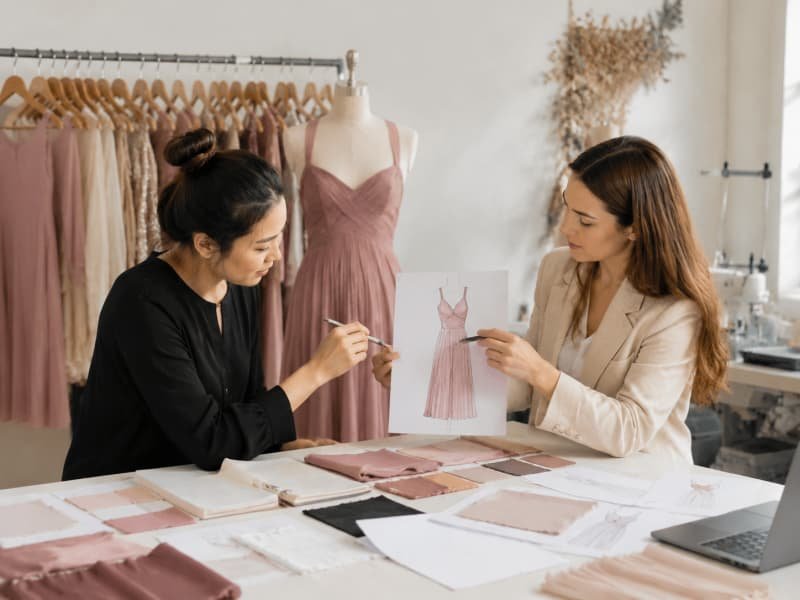
Babydoll and empire waist dresses are easy to confuse because they often share the same first visual clue: a horizontal break somewhere above the natural waist. From a distance, both can appear loose through the stomach, light around the hips, and comfortable to wear. Once the garment reaches a pattern table, however, the difference becomes much more practical. A designer has to decide exactly where the bodice ends, how firmly it controls the bust, where the skirt volume begins, how much fabric enters the joining seam, and whether the finished shape should feel compact and playful or long and fluid. Those decisions affect fabric usage, fit risk, grading, sample revisions, and even how consistently the style can be reproduced in bulk. This is why a reference image labeled only “babydoll” or “empire waist” is often not enough for accurate development. The name helps identify a direction, but the real silhouette comes from measurable relationships between the upper bodice, raised seam, skirt, fabric, and finished length.
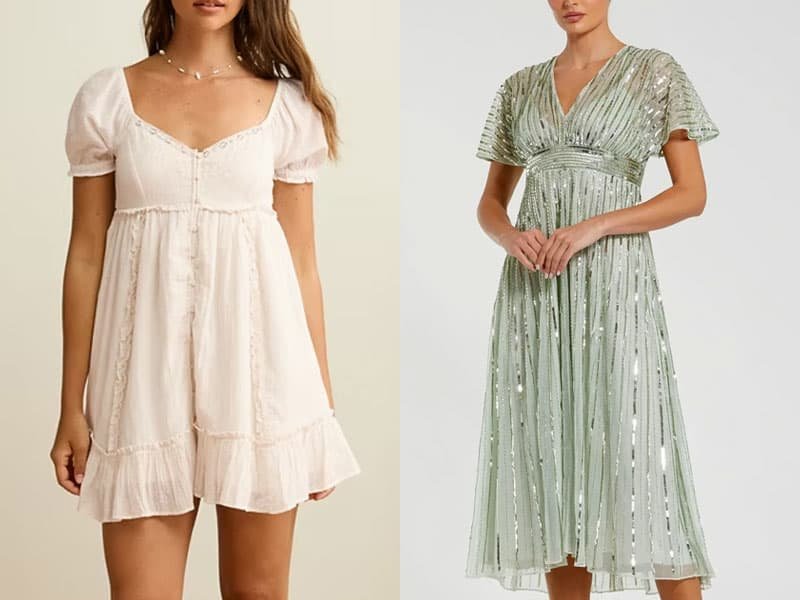
A babydoll dress is primarily a silhouette defined by visible ease and volume released high on the body, while an empire waist dress is primarily defined by a raised waistline positioned above the natural waist, usually close to the under-bust. The two can overlap, but they are not interchangeable. Skirt fullness, bodice control, fabric drape, and dress length determine how the final garment is perceived.
A useful way to see the distinction is to imagine two sample rooms receiving the same photograph. One team notices the short length and loose skirt, then builds a fuller babydoll shape. The other focuses on the seam beneath the bust and develops a cleaner empire line with less gathering. Both samples may look related, yet only one may match the brand’s intention. The difference is rarely one dramatic construction detail; it is usually a series of small proportion choices that become obvious only when the dress is worn, viewed from the side, and moved through a fitting.
What Is the Difference Between a Babydoll Dress and an Empire Waist Dress?
A babydoll dress is mainly defined by its overall silhouette: a short or relatively short bodice, generous ease, and fullness released high on the body. An empire waist dress is defined primarily by waist placement, with the main seam positioned above the natural waist, usually near the under-bust. A dress can therefore use an empire waist and still have a babydoll silhouette, but the terms describe different design information.
What Defines a Babydoll Dress?
A babydoll dress is easiest to recognize by the relationship between its compact upper section and the amount of space created below it. The skirt usually gains width quickly rather than following the natural waist and hip line. That width may come from gathers, flare, pleats, tiers, trapezoid panels, or combinations of those methods. The result is intentionally loose through the midsection, with the skirt reading as an active part of the design rather than simply a lower extension of the bodice. Short lengths strengthen that effect because the viewer can see the contrast between a relatively small upper body and a larger lower silhouette immediately.
The waist seam alone does not define a babydoll. A dress can have an under-bust seam and still look narrow, elongated, or formal if the skirt falls close to the body. Conversely, a babydoll effect can be created through a high yoke, smocked upper panel, or raised seam that does not sit at a textbook empire position. In development, it is more useful to ask how quickly the garment releases volume and how the skirt behaves in front, side, and back views. Bodice depth, skirt joining width, hem sweep, finished length, and fabric stiffness usually tell more about the final identity than the style name by itself.
What Defines an Empire Waist Dress?
An empire waist dress is more specifically connected to the position of the main horizontal seam. Instead of sitting around the natural waist, that seam is raised toward the lower bust or upper ribcage. The bodice above it may be softly shaped, tightly fitted, elasticated, smocked, or internally supported, but the visual anchor remains the elevated waist. Below the seam, the skirt can be narrow, softly flared, lightly gathered, pleated, or very full, which explains why empire waist construction appears in casual minis, chiffon midis, evening maxis, and other dress categories without all of them reading as babydoll styles.
The seam position has to be developed against real body landmarks rather than copied as a fixed distance from a photograph. Bust projection, cup volume, shoulder-to-bust length, and front torso length all influence where an under-bust seam finally sits when the garment is worn. If the upper bodice is too short, the seam may climb into the bust; if it is too long, the dress can start to look simply high-waisted. For this reason, an empire waist is a construction decision first and an aesthetic outcome second. The pattern has to hold the intended waist level before fabric and skirt design can create the final mood.
Are They the Same Style?
They are overlapping categories rather than opposite ones. A short dress with a fitted bust, an under-bust seam, and a visibly gathered skirt can accurately be described as both empire-waisted and babydoll. The empire term explains where the waistline is placed; the babydoll term explains the larger silhouette, volume, and proportion. Problems occur when a development brief uses one word as if it automatically communicates all of the other decisions that still need to be made.
For a design or product team, a clearer brief combines the terms with measurable instructions. Instead of writing only “babydoll dress,” it is more precise to state that the style requires an under-bust empire seam, a fitted upper bust, moderate gathering, a mini length, and a skirt that stands slightly away from the body. The same principle works in reverse for a softer empire dress: specify the seam position, bodice fit, low gathering, fluid fabric, and intended midi or maxi length. A few extra technical details can prevent an entire sample round built around the wrong interpretation.
Development Point | Babydoll Dress | Empire Waist Dress |
Primary definition | Overall silhouette and volume | Raised waist position |
Main visual cue | Fullness released high on the body | Seam positioned near the under-bust |
Bodice fit | Relaxed to fitted | Commonly semi-fitted to fitted |
Skirt fullness | Usually medium to high | Can be low, medium, or high |
Common length | Often mini or above knee | Mini, midi, maxi, or floor length |
Waist definition | Usually soft | Usually clearer |
Typical visual effect | Airy, playful, youthful | Elongated, fluid, refined |
Can both terms apply? | Yes | Yes |
How Do Their Silhouettes and Proportions Differ?
The biggest proportional difference is how quickly volume is released below the bust. Babydoll dresses usually widen earlier and more visibly, creating obvious space around the waist and hips. Empire waist dresses can keep the skirt closer to the body and emphasize a longer vertical line. Seam height, bodice depth, skirt sweep, gathering placement, and total length work together, so changing one variable can shift the style noticeably.

Where Is the Waist Seam Placed?
On an empire waist dress, the raised seam should visually relate to the lower bust rather than to the natural waist. That description is simple, but the correct position varies from body to body. During sample fitting, a useful review normally includes high-point shoulder to seam, bust apex to seam, center-front bodice length, side-seam height, and center-back height. Looking only at the front photograph can hide problems such as a seam that slopes down toward the back or a side seam that has been pulled forward by insufficient front length.
Babydoll designs allow slightly more freedom because the raised seam often acts as a visual break and a release point for fullness rather than a tightly controlled anatomical waist. Even so, a small change can have a strong effect on a short dress. Moving the seam about 1 to 3 cm during development can make the bodice appear noticeably shorter or longer, especially when the total garment length is compact. Raising the seam increases the visual share of the skirt; lowering it lengthens the upper body and can make the dress feel less playful. Seam position should therefore be approved together with finished length rather than treated as an isolated measurement.
How Does Bodice Fit Change the Look?
Bodice control is one of the clearest ways to separate a loose babydoll impression from a more deliberate empire line. Empire waist dresses often need a stable upper section because the raised seam is expected to remain close to a specific body landmark. If the bust area is too loose, the bodice can drop and the seam loses its intended position. If the upper body is too tight or too short, the seam can climb, the armhole can distort, and the front skirt can appear shorter than the back even when the paper pattern was balanced.
Babydoll bodices can also be fitted, particularly in contemporary mini dresses, but the garment usually stops shaping the torso once the skirt begins. A close-fitting bust followed by immediate skirt volume creates a strong babydoll contrast, while a soft bodice and narrow lower section will not. When developing a style, it is useful to separate upper-body ease from skirt ease rather than asking for the whole dress to be “looser” or “tighter.” Neckline security, armhole shape, bust support, and shoulder balance should remain controlled even when the lower half is intentionally generous.
How Do Skirt Volume and Length Work Together?
Skirt volume can change the perceived category even when the bodice and seam stay exactly the same. A high-waisted sample with a narrow skirt may look elegant and elongated, while the same upper body joined to a wider gathered skirt can become recognizably babydoll. This is why development teams should document both the joining width at the raised seam and the hem sweep. Two skirts can use similar total fabric quantities but create different effects depending on whether the extra width is concentrated at the top, distributed through side flare, or added closer to the hem.
Short dresses can carry strong upper fullness more easily because there is less fabric weight pulling the skirt downward. This is one reason many babydoll silhouettes are especially effective at mini length. Extending the same panel into a midi or maxi without changing its construction can flatten the gathers, increase seam weight, and alter movement. Empire waist dresses often adapt to longer lengths more naturally because their design can rely on gradual flare, bias direction, panels, or controlled gathering. When a brand develops a family of mini, midi, and maxi versions, the lower pattern usually needs to be rebalanced rather than simply lengthened.
Which Fit Works Better for Different Body Proportions?
Neither silhouette is automatically more flattering for every body. Babydoll dresses provide more freedom through the waist and hips, while empire waist dresses usually create a clearer upper anchor and a longer vertical line. The better choice depends on bust projection, torso length, desired ease, fabric behavior, and how much volume is introduced below the raised seam. Fit should be judged against real body landmarks rather than broad body-shape labels.
Which Style Gives More Midsection Ease?
Babydoll construction usually gives the greatest immediate ease because the skirt begins expanding high on the torso. The natural waist and upper hip can have considerably more garment circumference than the body needs, making the style comfortable and easy to move in. That extra space is not always visually light, however. A crisp fabric with concentrated gathers can project forward from the under-bust and create much more apparent volume than a fluid fabric with the same circumference. This is why physical ease and visible fullness should be treated as different development variables.
Empire waist dresses can provide similar comfort while looking narrower because the skirt can gain room through gradual flare instead of dense gathering. If a fitting comment says the stomach area needs more freedom, increasing every skirt panel equally is only one option. The pattern maker may instead add controlled side flare, redistribute front gathering, increase front length, or adjust the relationship between lining and shell. The best correction depends on what the wearer feels and what the designer wants the viewer to see. More fabric is not automatically a better solution, especially when the original problem is balance rather than circumference.
How Do Bust and Torso Length Affect Fit?
Raised seams sit close to one of the most three-dimensional areas of the body, so bust projection has a direct effect on vertical balance. When the front bodice is too short, fabric travels over the bust and pulls the under-bust seam upward. The side seam may then swing forward, and the front skirt can appear shorter even though the pattern lengths match on paper. The correct adjustment may involve bust shaping, darts, princess seams, cups, or additional front length rather than a simple increase in total bust circumference.
Torso length creates a different challenge. On a short torso, a standard upper bodice may drop the seam too low; on a longer torso, the same pattern can place it too high. For size grading, the goal is not to add identical vertical increments everywhere. The goal is to preserve the visual relationship between bust apex, raised seam, and skirt release. This is especially important when a style is sold across a wide size range, because mathematically clean grading can still create a visibly inconsistent silhouette if the key landmarks migrate. Fitting at more than one representative size is often more informative than trusting the base size alone.
What Fit Problems Appear Most Often?
One common problem is a seam that looks correct while standing but rides upward when the wearer raises her arms or walks. Loosening the entire bodice is not necessarily the answer because the root cause may be insufficient front length, a restrictive armhole, bust tension, or poor front-to-back balance. Another frequent issue is excessive center-front fullness, which can make a dress project outward more than intended. Reducing gathering only at the front while preserving side and back volume often produces a cleaner result than shrinking the whole skirt.
A third problem is visual imbalance between the front and back. Bust projection can consume front length and make the front hem look shorter, while a heavy back skirt can pull the raised seam down behind the body. These issues are easy to miss in flat-lay review. A useful fitting should include front, side, and back views as well as walking, sitting, turning, and arm movement. The objective is not simply to make the dress look good for one still photograph; it is to keep the raised seam and skirt relationship stable during normal wear.
Fit Issue | Common Cause | Practical Check |
Raised seam rides upward | Insufficient front length or upper-body restriction | Check bust depth, armhole, and movement |
Raised seam sits too low | Bodice too long or too much upper ease | Recheck shoulder-to-seam length |
Front skirt projects | Excess center-front gathering or stiff fabric | Reduce or redistribute fullness |
Side seam swings forward | Front/back bodice imbalance | Compare front and back vertical balance |
Front hem appears short | Bust projection consuming front length | Review on a fit model, not flat only |
Dress looks oversized | Excess bodice ease combined with skirt volume | Correct upper and lower ease separately |
How Do Fabric and Gathering Change the Shape?
Fabric and gathering can change the silhouette as much as the pattern itself. Lightweight materials collapse into softer folds, while crisp or heavier fabrics hold volume away from the body. The same gathering ratio can therefore produce completely different shapes. Fabric weight, bending stiffness, drape, transparency, lining, skirt width, and seam bulk should be evaluated together before the silhouette is approved for production.

Which Fabrics Work for Babydoll Shapes?
Babydoll dresses can work in many materials, but the chosen fabric determines whether the volume feels soft, crisp, romantic, or architectural. Cotton poplin and structured cotton blends hold the skirt away from the body and make even moderate gathering visually obvious. Chiffon, georgette, and soft mesh collapse into smaller folds and create movement instead of projection. Satin sits somewhere between these behaviors depending on weight, weave, finish, and lining. A fabric that seems perfect as a swatch may behave very differently once a large width is compressed into a short raised seam.
Fabric weight can help narrow choices, but GSM should never be used alone as a quality rule. During early development, lightweight woven options around roughly 70 to 120 GSM often produce softer volume, while fabrics around roughly 120 to 180 GSM can create more structure. These are only screening ranges, not universal standards, because yarn, resin finish, weave density, thickness, and stiffness can make two fabrics with similar GSM behave very differently. Small gathered test panels are often more useful than a swatch card because they reveal fold size, seam bulk, recovery after pressing, and how far the material stands away from the body.
Which Fabrics Work for Empire Lines?
Empire waist dresses often benefit from fabrics that can fall cleanly from the raised seam. Crepe, chiffon, georgette, soft satin, lightweight jersey, rayon blends, mesh, and fluid polyester qualities are common directions because they allow the skirt to follow gravity rather than build a rigid shelf around the torso. Structured fabrics can also work, but the pattern usually needs less gathering and more controlled flare so the high waist remains visually clean. The fabric should support the intended line instead of forcing the pattern to fight against it.
Lining needs to be developed at the same time as the shell. A light chiffon outer layer over a heavy or narrow lining can lose movement, while a very full lining can add unexpected bulk directly below the bust. If shell and lining are both gathered into the same seam, their combined thickness may be much greater than the designer expected from the outer fabric alone. Stretch versions require another check: recovery. A fabric may feel comfortable in the fitting room but gradually lengthen under wear if it does not recover well, allowing the raised seam to drop and changing the entire proportion of the dress.
How Much Gathering Is Practical?
Gathering ratio describes how much fabric is being compressed into a finished seam. If the bodice joining seam measures 80 cm and the skirt edge measures 120 cm before gathering, the ratio is 1.5:1. Joining 160 cm into the same 80 cm seam creates a 2.0:1 ratio. Those numbers are useful because they let a development team reproduce or revise fullness systematically instead of relying on comments such as “more gathered” or “less puffy.”
There is no universal ideal ratio because fabric thickness, stiffness, seam length, lining, and design intent all matter. As practical sample-room starting points, a controlled light-woven empire shape may be tested around 1.15:1 to 1.40:1, while a softer romantic empire may move toward 1.40:1 to 1.70:1. Babydoll trials often begin around 1.50:1 to 2.20:1, and extremely light chiffon or mesh can sometimes accept more without creating the seam bulk that a crisp poplin would produce. These ranges should be treated as trial values and confirmed with the actual fabric rather than copied directly into a final specification.
Fabric / Silhouette | Practical Trial Range | Typical Result |
Soft empire, light woven | 1.15:1-1.40:1 | Controlled softness with low seam bulk |
Romantic empire | 1.40:1-1.70:1 | Noticeable but fluid fullness |
Soft babydoll | 1.50:1-1.90:1 | Clear volume with moderate gathering |
Fuller babydoll | 1.80:1-2.20:1 | Stronger volume and shorter visual line |
Very light chiffon or mesh | About 1.80:1-2.50:1 for testing | Fuller appearance with relatively low bulk |
Crisp poplin | Often lower ratios than sheer fabrics | Strong projection even with moderate gathering |
How Are These Dresses Patterned and Sampled?
Pattern development should separate three decisions: where the raised seam sits, how the upper bodice controls the bust, and where the skirt gains its volume. Sampling then confirms whether those decisions work together on a moving body. A strong review records both measurements and visual behavior so that revisions can be repeated accurately and the approved sample can become a reliable production reference rather than a one-off garment.

How Do the Patterns Differ?
An empire waist pattern commonly starts with an upper bodice shaped around the bust and ending close to the under-bust. Depending on the design, control can come from darts, princess seams, separate cups, curved panels, elastic, smocking, internal support, or stretch fabric. The skirt is then attached below that controlled section. Its volume may be introduced gradually through flare or panels, or concentrated through gathering, but the upper seam remains the main structural boundary that the fit team needs to keep stable.
Babydoll construction can use a similar upper bodice, yet the lower pattern usually carries more intentional width. That volume can come from slash-and-spread, gathered rectangles, trapezoid panels, circular sections, tiers, or godets. Where the extra width is added matters. Adding 30 cm entirely at center front creates a different silhouette from distributing the same 30 cm across front, side, and back panels. For this reason, pattern comments should record bodice joining circumference, skirt joining width before gathering, hem circumference, front-to-back distribution, and finished length. Terms such as “flowier” or “less puffy” become much easier to manage when they are translated into specific pattern changes.
How Should Grading Be Controlled?
Grading a raised-waist dress is not simply a matter of making bust, waist, and hip measurements larger. The relationship between bust apex, seam position, side seam, and skirt release has to remain visually consistent as the size changes. One common error is applying the same vertical grade mechanically through the entire bodice, which can slowly move the under-bust seam away from the intended landmark. Another is adding a fixed amount of skirt width at each size, which can make larger sizes appear proportionally less full because the added amount becomes a smaller percentage of the overall circumference.
Maintaining one exact gathering ratio across every size is not automatically better. In a thicker fabric, larger circumferences can create excessive bulk even when the mathematical ratio remains constant. Good grading therefore combines measurement logic with visual review. The base size establishes the design, but at least one additional representative size should be checked whenever bust balance, raised seam position, or gathering is sensitive. For brands selling across different markets, the fit block also matters because body proportions can vary even when the nominal size is the same. Grading should preserve the silhouette, not merely satisfy arithmetic increments.
Which Sample Points Should Be Approved?
A reliable sample approval combines measurable checkpoints with visual ones. Useful measurements include high-point shoulder to raised seam, center-front and center-back bodice lengths, bust circumference, under-bust seam circumference, armhole, neckline, skirt joining width, hem sweep, and finished length. The exact tolerance for each point depends on fabric, construction, and the brand’s specification, but the measurements should be recorded consistently so that every revision has a clear reference. Comments such as “slightly higher” or “a little fuller” become difficult to repeat when several people or factories are involved.
Visual review should include seam level, bust balance, side-seam position, gather distribution, front projection, skirt fall, transparency, lining relationship, and movement. A practical fitting sequence is to assess the upper bodice first, then check whether the raised seam stays level, then review the skirt from front, side, and back, and finally test walking, sitting, turning, and raising the arms. When the sample is close to approval, the team should also confirm that the proposed fabric and construction can be repeated in normal production conditions. A strong sample is not just attractive; it contains enough measurable information for another team to reproduce the same result later.
Which Style Should a Fashion Brand Develop?
Babydoll works best when a collection needs visible ease, youthful volume, short proportions, and an intentionally relaxed fashion message. Empire waist is more flexible when the goal is a raised waistline with controlled drape, longer lengths, or a more refined silhouette. The commercial choice should consider the target customer, occasion, fabric cost, fitting risk, collection balance, and repeat-production stability rather than following a style label or trend in isolation.

Which Style Fits Casual and Vacation Collections?
Babydoll dresses fit naturally into summer, vacation, brunch, day-party, and casual fashion collections because the silhouette creates a strong visual identity without requiring close waist fitting. A crisp cotton mini can feel clean and youthful, while a printed chiffon version can move toward a softer romantic direction. Mesh, embroidery, ruffles, puff sleeves, square necklines, and tie details can update the same basic body without changing its core silhouette, which makes babydoll construction useful for brands that want recognizable product families rather than unrelated one-off styles.
Commercial development still requires restraint. A dramatic sample with extreme sweep may photograph beautifully but use more fabric, occupy more carton volume, and appeal to a narrower customer group. During refinement, reducing hem sweep or upper gathering by around 10 to 20 percent can sometimes improve wearability while keeping the original idea, although any change should be confirmed through fitting rather than treated as a universal formula. The strongest commercial babydoll styles usually keep the neckline, shoulder, armhole, and bust controlled while allowing freedom lower on the body. That contrast makes the dress look intentionally designed rather than simply oversized.
Which Style Fits Occasion and Event Collections?
Empire waist construction offers a wider route into occasion and event dressing because the same raised-waist principle can support short, midi, and long silhouettes. A satin mini may still feel playful, while a chiffon midi or layered mesh maxi can look more refined without abandoning the core proportion. As the garment becomes more formal, the upper bodice may require additional shaping through cups, darts, princess seams, internal elastic, boning, or other support. The raised seam then becomes more than a visual line; it can also help stabilize the upper body and organize the transition into a fluid skirt.
The right choice also depends on the role of the style inside the collection. A campaign hero can justify more fabric, more complex drape, and a higher-risk construction if the visual impact supports the price and marketing purpose. A repeat commercial style often benefits from fewer unstable details, easier-to-reorder materials, and a construction that can be repeated consistently across colors and production runs. Empire waist silhouettes are particularly useful when a brand wants a coordinated mini, midi, and maxi family because the upper proportion can remain recognizable while the lower body changes according to occasion, season, and price point.
What Should Be Confirmed Before Production?
Once a sample looks right, the style still has to be translated into repeatable production standards. This step is especially important for raised-waist dresses because small differences in seam position, fabric lot, gathering distribution, pressing, or lining can visibly change the silhouette. Before bulk cutting, the team should confirm the approved shell and lining materials, color, handfeel direction, relevant shrinkage behavior, trims, raised-seam measurement, skirt joining width, gathering distribution, hem sweep, finished length, workmanship points, pressing method, and the physical or documented sample that serves as the final reference.
The sewing method at the raised seam deserves close attention. Stretching the seam during stitching can enlarge it and allow it to drop, while uneven gathering can make one side of the dress look fuller than the other. Thick seam allowances under a lightweight shell can create a visible ridge that was not present in the sample. For shape-sensitive styles, a first-piece confirmation or short pilot run can reveal these problems before the full quantity is released. Brands working with a development-focused manufacturer such as Duolan can use this stage to review fabric behavior, fit priorities, and production-critical details together, keeping the approved silhouette connected to the way the garment will actually be made at scale.
Conclusion
The practical answer to babydoll dress versus empire waist dress is not that one style is better. They solve different design problems. Babydoll is the stronger choice when a collection needs obvious ease, playful volume, and a short, youthful proportion. Empire waist is more adaptable when the design needs a raised seam with a controlled upper body, fluid lower line, or the flexibility to move from mini into midi and maxi lengths. Many successful dresses intentionally combine both ideas, which is why the terms often appear together in product descriptions.
For designers and product teams, the most useful question is not simply what to call the dress. It is where the raised seam should sit, how firmly the bodice should control the bust, how quickly the skirt should release, how much fullness the fabric can carry, and which relationships must remain stable across sizes and production. Once those decisions are measurable, the style stops being a vague reference-image concept and becomes a product that can be sampled, fitted, graded, costed, and reproduced with much greater consistency.
Frequently Asked Questions
Is a babydoll dress the same as an empire waist dress?
No. A babydoll dress describes an overall silhouette with a relatively short upper section and visible fullness released high on the body, while an empire waist describes the location of the waist seam above the natural waist, commonly near the under-bust. One dress can use both ideas at the same time. A short, full skirt attached to an under-bust seam may be both babydoll and empire-waisted, while a long, narrow empire dress may not look babydoll at all.
Can a babydoll dress have an empire waist?
Yes, and many contemporary babydoll dresses do. An under-bust seam gives the pattern a high point from which the skirt can gather or flare, so it naturally supports a babydoll proportion. What makes the finished dress read as babydoll is the amount and placement of volume, the relative length of the bodice, and the total dress length. If the same high seam is combined with a narrow, flowing maxi skirt, the visual result will usually read more strongly as empire than babydoll.
Which dress is better for creating more room around the waist and stomach?
Both can create generous midsection ease because neither depends on a fitted natural waist. Babydoll dresses usually create that space more visibly by releasing volume immediately from a raised seam, while empire waist dresses can create room through controlled flare and softer drape. If the goal is comfort without a very wide appearance, a fluid empire shape may be easier to control. If the design intentionally calls for playful volume, a babydoll silhouette gives the pattern more freedom to expand early.
What fabrics are best for a babydoll dress?
The best fabric depends on the intended volume. Crisp poplin, cotton blends, lightweight jacquard, and similar structured fabrics create clearer projection and make moderate gathering look fuller. Chiffon, georgette, soft mesh, and fluid satin produce smaller folds and more movement. During sampling, fabric weight should be considered together with stiffness, drape, lining, and gathering ratio. A small gathered panel made from the actual fabric often gives a more reliable prediction than choosing from a flat swatch alone.
What gathering ratio works for a babydoll dress?
There is no single correct ratio, but sample development often begins around 1.5:1 to 2.2:1 for many babydoll effects, depending on fabric and desired fullness. Very light chiffon or mesh may tolerate more because the gathered seam remains relatively soft, while crisp poplin can create strong projection at a lower ratio. These figures are practical testing ranges rather than production standards. The final ratio should be approved using the actual fabric, lining, seam construction, and fit sample.
How should an empire waist seam fit under the bust?
The seam should sit close enough to the under-bust to create the intended raised-waist proportion without cutting into the bust or dropping toward the natural waist. Its exact position depends on bust depth, cup volume, torso length, and bodice construction, so one fixed vertical measurement will not fit every size equally well. During fitting, teams should check shoulder-to-seam length, bust apex position, front and side seam levels, and movement to make sure the seam stays stable instead of riding up or falling down.
Which style is easier to develop across mini, midi, and maxi lengths?
Empire waist construction is generally easier to extend across several lengths because the raised waist can remain consistent while the skirt changes through flare, panels, bias direction, or controlled gathering. Babydoll proportions are strongly associated with shorter lengths, so simply extending a mini pattern into a midi or maxi can make the skirt heavier and reduce the airy effect. Longer babydoll-inspired versions can work, but they usually need the skirt width, fabric weight, gathering, and hem sweep to be rebalanced rather than only adding length.
Share:
Our Services
Categories
Table of Contents
Here, developing fashion collections is more than manufacturing garments — it’s a collaborative process focused on transforming ideas into well-executed, market-ready products. From fabric sourcing and sample development to scalable production and delivery coordination, every stage is built to support quality, consistency, and efficient collection launches across global markets.