Skip to content

What Is the Best Fabric for Strapless Dresses : Fabric, Fit & Support Guide
Your trusted Women’s Apparel Development & Manufacturing Partner from China
- Jerry
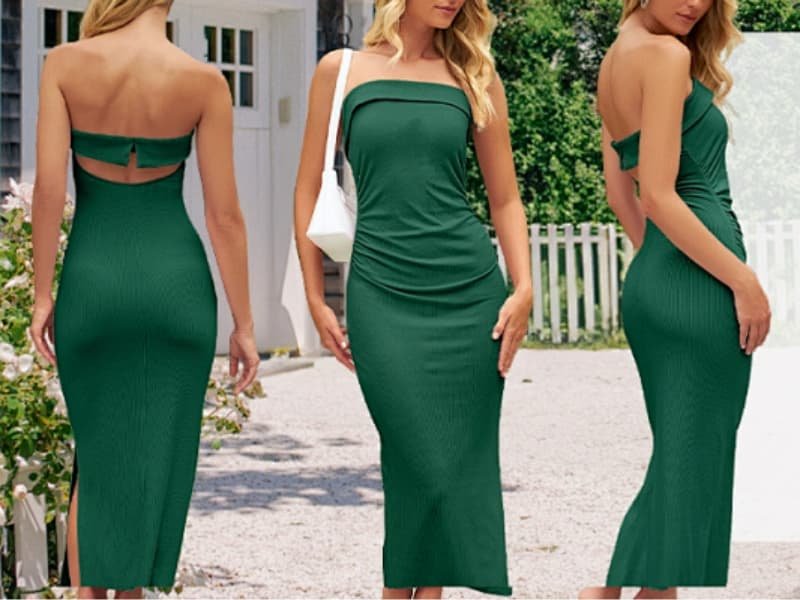
A strapless dress can look surprisingly simple on a hanger. Remove the straps, shape the neckline, fit the bodice closely, and the design appears almost effortless. In reality, few dress categories place as much responsibility on the fabric. Without shoulder straps helping to stabilize the garment, the shell fabric, lining, pattern, cups, boning, zipper, and waist structure must work together while the wearer walks, sits, raises her arms, dances, or moves through a long event. A fabric that looks beautiful on a swatch card can therefore create a disappointing dress if its stretch, recovery, weight, or drape does not match the intended silhouette.
The best fabric for a strapless dress is a material that provides enough stability for the neckline, appropriate stretch for the required fit, reliable recovery after movement, and the correct drape for the silhouette. Stretch crepe, stretch satin, Duchess satin, Mikado, taffeta, scuba, and ponte can all work well, while chiffon, mesh, and lace usually perform better over a more supportive inner bodice.
This is where fabric selection becomes more interesting than simply choosing between satin and crepe. Imagine approving two black fabrics that look almost identical when laid flat. The first holds a smooth neckline throughout a fitting; the second begins to open slightly at the side bust after ten minutes of movement. One keeps the waist and hip line clean, while the other slowly grows around the body. The difference may come from only a few percentage points of stretch or residual growth, yet that small difference can decide whether a strapless dress feels secure or becomes the kind of garment a customer keeps pulling up all evening.
What Is the Best Fabric for a Strapless Dress?
The best fabric for a strapless dress combines structure, recovery, appropriate stretch, and controlled drape. Stretch crepe, satin, Mikado, taffeta, scuba, and ponte are common choices, but no single material is best for every silhouette. Structured styles need stability, bodycon dresses need stretch with strong recovery, and lightweight fabrics usually need a firmer inner foundation to keep the neckline secure.
Fabric Suitability
A good strapless fabric should first be judged by what it does under tension rather than by how luxurious it feels on the roll. The upper bodice is exposed to downward garment weight, horizontal body pressure, movement around the bust, repeated sitting and standing, and the normal expansion of the ribcage during breathing. Because there are no shoulder straps helping to carry those forces, the fabric has to maintain its dimensions well enough for the pattern and internal support system to do their jobs. A fabric may feel thick and substantial yet still grow significantly around the body, while another may feel lighter but remain stable because of its yarn structure, weave, knitting construction, or finishing.
Several characteristics are especially useful when evaluating fabrics for strapless product development. Horizontal stretch shows how much the garment can accommodate body movement, while vertical stretch indicates whether the dress may lengthen under its own weight. Recovery shows how closely the material returns to its original dimensions after extension. Weight and thickness influence seam bulk and the amount of load pulling downward on the bodice. Opacity must be checked under stretch rather than only when the fabric is relaxed, and drape determines whether the lower part of the dress looks fluid, controlled, or overly stiff.
A fitted mini dress and a structured midi dress may therefore need completely different materials despite sharing the same strapless neckline. For a close-fitting style, moderate stretch with strong recovery may be more useful than maximum firmness. For a sculptural A-line design, very little stretch may be required, but the fabric still needs enough body to maintain a clean neckline and controlled shape. For a draped occasion dress, a softer outer fabric can work beautifully if the inner bodice provides the missing support.
Structure and Drape
Structure and drape are often treated as opposite fabric characteristics, yet many successful strapless dresses need both. The upper bodice usually benefits from stability, while the skirt may need softness, movement, or controlled fluidity. Asking one fabric layer to perform every function can unnecessarily restrict the design and can lead to a dress that is either too soft at the top or too rigid through the lower body.
A practical way to develop the garment is to think in terms of a support zone and a movement zone. The support zone normally includes the neckline, bust, side bodice, zipper area, and waist. The movement zone includes the lower waist, hip transition, skirt, flounces, godets, or draped sections. The outer fabric can remain continuous across both zones, but the internal construction can change. A stretch satin might be underlined through the bodice while remaining softer through the skirt, and chiffon can move freely below the waist while a stable foundation supports the upper body.
More structure is not always better. A very stiff fabric may produce thick princess seams, bulky neckline turnings, uncomfortable pressure under the arms, visible ridges around cups or boning, and an abrupt transition from bodice to skirt. In those cases, the outer material may actually be doing work that should be handled by the foundation. A refined strapless dress usually feels secure without looking overbuilt, which means the fabric and internal structure should divide the workload rather than compete with each other.
Stretch and Recovery
Stretch is useful in fitted strapless dresses, but the more important question is what happens after the fabric has been stretched repeatedly. Two fabrics may both be described as having 20% stretch, yet one returns almost immediately to its original width while the other remains noticeably longer. That difference in recovery can become visible around the neckline, side bust, zipper, and waist after the wearer has moved for several minutes.
For many close-fitting commercial styles, horizontal extension somewhere around 10–30% can be workable, depending on the construction, silhouette, fiber blend, and intended negative ease. Compact knits such as scuba may extend considerably more, while structured woven fabrics may have almost no measurable stretch. These ranges should be treated as development references rather than fixed standards because a 15% stretch crepe and a 15% stretch satin can still behave very differently after sewing and pressing.
A simple internal comparison can begin with a 100 mm marked section of fabric. If the design is expected to work at 15% extension, the mark can be extended to approximately 115 mm, held briefly, released, and measured again after recovery. Repeating this cycle several times gives a clearer picture than pulling the fabric once by hand. If the 100 mm section repeatedly settles at 103 or 104 mm, that residual growth deserves attention before the pattern is approved.
Making the garment smaller is not always an effective solution for poor recovery. Excess negative ease can create bust compression, zipper strain, seam grin, rolling edges, or uncomfortable pressure without solving the underlying material problem. Selecting a fabric with better recovery, or adding a more suitable support layer, often produces a cleaner result than simply tightening the pattern.
Which Fabrics Work Best for Strapless Dresses?
Stretch crepe and stretch satin are versatile for fitted fashion dresses, while Duchess satin, Mikado, and taffeta suit more sculptural silhouettes. Scuba and ponte are strong options for body-conscious styles, and chiffon, mesh, or lace can work well as decorative or draped layers over a supportive foundation. The right fabric depends on the dress shape, internal construction, visual finish, and expected wearing conditions.

Crepe and Satin
Stretch crepe is one of the most adaptable fabrics for contemporary strapless dresses because it can combine moderate stretch, useful body, and a relatively clean surface without creating the rigid appearance of a heavily structured fabric. It works particularly well for fitted mini dresses, clean midi silhouettes, modern occasionwear, and styles where the waist and hip line need to look smooth. Crepe surfaces also tend to be more forgiving than highly reflective satin, which can help small seam variations appear less obvious under normal retail and photography lighting.
Satin offers a very different visual benefit. Its reflective face can make an otherwise simple strapless silhouette look polished and elevated, which is one reason satin remains common in party and occasion collections. The disadvantage is that the same shine can reveal almost every construction weakness. Slight zipper rippling, uneven bust tension, seam puckering, lining ridges, pressing marks, and inconsistent grain direction may become much more noticeable than they would be on a matte crepe.
The word “satin” is therefore not specific enough for product development. Lightweight stretch satin, heavy satin, Duchess satin, and different fiber blends can behave very differently despite sharing a similar surface appearance. A useful fabric specification should also record weight, stretch direction, recovery, opacity, face finish, fiber composition, and whether the bodice will be lined, underlined, or internally supported.
Fabric | Typical Working Weight* | Common Stretch Profile | Suitable Strapless Uses | Main Development Risk |
Stretch crepe | 160–280 gsm | 8–25% horizontal | fitted mini, midi, occasion | growth, seam movement |
Stretch satin | 120–230 gsm | 5–20% horizontal | party, fitted evening styles | puckering, shine marks |
Duchess satin | 220–330 gsm | little to none | structured occasion dresses | seam bulk |
Mikado | 180–300 gsm | little to none | sculpted mini and midi styles | excessive stiffness |
Taffeta | 90–190 gsm | little to none | shaped or voluminous silhouettes | creasing, seam marks |
Scuba | 220–350 gsm | 20–45% | bodycon and fitted mini dresses | heat, edge rolling |
Ponte | 240–380 gsm | 15–35% | stable body-conscious styles | thickness at seams |
Chiffon | 50–100 gsm | usually low | overlays and draped skirts | insufficient support alone |
*These are practical commercial reference ranges rather than universal standards. Actual performance varies with yarn, fiber content, finishing, supplier construction, and fabric width.
Mikado and Taffeta
Mikado and taffeta become valuable when the design depends on visible shape rather than fluid drape. Their relative firmness helps maintain sharp necklines, controlled waist shaping, bubble hems, pleats, sculptural minis, and fuller occasion silhouettes. Mikado often feels smoother and more substantial, while taffeta tends to feel crisper and can produce stronger fold definition. The correct choice depends less on which fabric is considered more luxurious and more on how much body the pattern actually requires.
These materials can also create production challenges if the garment architecture is not planned carefully. Princess seams may become bulky where several seam allowances meet, neckline turnings can become too thick, boning channels may show through the face, and excessive heat during pressing may change surface appearance. A fabric that looks impressive while flat can therefore behave very differently when four or five layers meet around the bust or neckline.
For that reason, an actual bodice section is more informative than a small swatch when the style is highly structured. A 30 × 30 cm fabric sample can show handfeel, color, and basic drape, but it cannot demonstrate how the fabric behaves around a curved neckline, cup edge, princess seam, zipper, or underlined panel. Early sewing trials are especially useful when the intended silhouette relies on sharp shape rather than stretch.
The weight of the complete dress also matters. A structured bodice connected to a full skirt can create substantial downward pull even when the shell fabric itself is stable. In those situations, waist anchoring, seam placement, lining weight, or internal support may improve security more effectively than simply selecting an even stiffer outer fabric.
Scuba and Ponte
Scuba and ponte are particularly useful for modern body-conscious strapless styles because they combine thickness, stretch, and a relatively smooth surface. Their compact structure can help soften small surface irregularities and produce a clean silhouette without requiring the obviously corseted appearance of a traditional structured bodice. These characteristics make them popular for fitted mini dresses, club styles, simple bandeau silhouettes, and other garments where the fabric itself contributes significantly to body contouring.
High stretch, however, should not be confused with good recovery. A heavy scuba with 40% extension but weak recovery can gradually move downward during wear, while a compact ponte with 20% extension and excellent recovery may feel more stable. For this reason, developers should compare horizontal stretch, vertical stretch, recovery after repeated extension, fabric weight, edge rolling, seam extension, and opacity rather than relying on a single stretch percentage.
Vertical stretch deserves particular attention in longer strapless styles. When a fabric stretches significantly from neckline to hem, the weight of a midi or maxi skirt can gradually pull the entire garment downward. Even moderate vertical growth may shift the waistline, change bust placement, and reduce neckline security after several hours of wear.
Comfort should also be considered. Dense synthetic knits can retain more heat than lightweight woven fabrics, and a secure bodycon dress may still perform poorly commercially if the wearer feels too warm during a party or summer event. Fit, support, and comfort should therefore be evaluated together rather than as separate product qualities.
Chiffon, Lace and Mesh
Chiffon, lace, and mesh are not unsuitable for strapless dresses; they simply need a different construction strategy. These materials are often excellent for transparency, drape, layering, texture, gathers, embroidery, or visual softness, but many of them should not be expected to carry the structural load of a fitted strapless bodice by themselves.
A common approach is to separate the visual layer from the structural foundation. The outer material creates the intended appearance, while a firmer underlayer, lining, power mesh, or internal bodice controls the bust and neckline. Stretch mesh may sit over a stronger tricot or power mesh, lace can be mounted onto satin or crepe, and chiffon can remain fluid through the skirt while a concealed foundation stabilizes the upper body.
This division of roles can improve both fit and manufacturing consistency. Fragile outer materials are less likely to absorb concentrated stress, and pattern corrections can be made in the foundation without dramatically changing the visual effect of the shell. It also gives design teams more freedom to use soft or decorative fabrics without sacrificing the security expected from a strapless garment.
For brands developing fitted, party, occasion, mesh, satin, corset, or other shape-sensitive dresses, fabric sourcing works best when drape, support, stretch, opacity, lining, boning, cups, and trims are reviewed as connected development decisions rather than isolated purchasing choices. That approach is consistent with Duolan’s documented dress-development process.
How Do Fabric Properties Affect Fit and Support?
Fabric weight, thickness, stretch, recovery, and drape directly change the fit of a strapless dress. Heavy fabrics increase downward load, weak recovery allows the bodice to grow during wear, and excessively soft materials can contribute to neckline collapse or gaping. Even when two fabrics look similar, a meaningful change in weight or stretch can require pattern, lining, or support adjustments.

Weight and Thickness
Fabric weight affects far more than how substantial a dress feels in the hand. It changes how much downward force the bodice needs to manage, particularly when the design includes a long or full skirt. A strapless mini made from a 200 gsm fabric places very different demands on the neckline from a floor-length dress using several meters of a heavier material. The upper bodice may fit correctly during an early toile fitting but behave differently once the final shell, lining, zipper, embellishment, and complete skirt weight have been added.
Thickness also changes the effective fit of the garment because fabric occupies physical space. A pattern developed in a lightweight stretch satin may feel noticeably tighter when transferred to a dense 300 gsm knit, even when the finished garment measurements appear identical on the specification sheet. Multiple layers at princess seams, neckline edges, zipper seams, cups, and underlining can add further bulk and alter how closely the bodice sits against the body.
Whenever the fabric weight or thickness changes substantially, the upper bust circumference, side seam, underarm edge, waist position, zipper area, and neckline turning should be reviewed again. Seam allowance grading, trimming, underlining placement, and pressing technique may also need adjustment to keep the outside surface smooth.
This is particularly relevant for highly polished strapless designs where the appeal depends on a clean uninterrupted bodice. A small ridge caused by excessive thickness may be almost invisible in textured crepe but immediately noticeable on satin. Material performance and visual finish therefore need to be considered at the same time.
Stretch and Recovery
Stretch describes how far a fabric extends, while recovery describes how effectively it returns toward its original size. For strapless garments, recovery is often the more useful measure because the dress remains under repeated tension throughout wear. A material that stretches comfortably but retains part of that extension can make the upper bodice feel progressively looser even when the initial fitting looked correct.
A consistent internal test makes fabric comparisons more useful. A 100 mm reference section can be extended to 115 mm for a 15% test or 125 mm for a 25% test, held for a controlled period, released, and measured again. Repeating the procedure five to ten times provides more meaningful information than stretching the fabric once by hand. The same test should be carried out in both directions when the fabric has measurable vertical stretch.
Imagine two fabrics tested at 20% extension. Both reach 120 mm without difficulty, but one returns to approximately 101 mm while the other repeatedly settles around 104 mm. Both can technically be described as having 20% stretch, yet the second fabric carries a greater risk of visible growth around the neckline, side bust, or zipper during extended wear.
There is no universal residual-growth tolerance that applies to every strapless dress. Acceptability depends on fabric category, garment compression, silhouette, quality level, and the brand’s own testing requirements. The most important principle is that fabric behavior should be understood before negative ease and final pattern dimensions are locked.
Neckline Stability
A gaping neckline is often blamed immediately on the fabric, but several different issues can create the same visible symptom. Excess top-edge length, incorrect bust shaping, insufficient underbust control, unstable lining, poorly balanced side seams, weak recovery, inadequate waist anchoring, or the wrong cup shape can all cause the neckline to move away from the body.
This is why a proper fitting should test more than the neckline itself. The wearer should raise her arms, rotate the torso, walk, sit, stand, and move naturally. A simple routine might include five to ten arm raises, several torso rotations, approximately ten sit-to-stand movements, and a short period of walking. The exact sequence matters less than using the same sequence when comparing different samples or revisions.
After movement, the development team should examine the upper-edge position, center-front height, side-bust fit, side seams, center back, zipper tension, cup placement, and waistline. If the entire bodice has moved downward, reducing the neckline circumference alone may simply make the top edge tighter without fixing the real instability.
Measuring key points before and after movement can also help distinguish material growth from pattern imbalance. This is particularly useful for fitted dresses where a few millimeters of movement may be difficult to identify by eye but become obvious when measurements are recorded consistently.
Which Lining and Support Should Be Used?
Most close-fitting strapless dresses perform better with a coordinated support system rather than relying on the outer fabric alone. Depending on the style, this may include lining, underlining, boning, cups, gripper elastic, or a waist stay. The goal is not to make every dress heavily corseted, but to distribute support so the garment remains secure without excessive pressure at the neckline.
Lining Choice
Lining is often viewed simply as an inside finish, yet in a strapless dress it can influence stability, comfort, opacity, and fit. It can help control the upper edge, reduce friction between the outer fabric and the body, conceal boning or cups, and prevent delicate shell fabrics from carrying concentrated stress. Selecting the lining only because it is inexpensive or readily available can therefore undermine an otherwise well-developed garment.
The lining should be compatible with the stretch characteristics of the shell. A rigid woven lining inside a highly elastic bodycon dress may restrict movement and create drag lines, while an extremely stretchy lining inside a stable woven bodice may move independently and contribute to twisting or bubbling. The two layers do not need to have identical stretch, but their behavior should be deliberate rather than accidental.
Typical fashion dress linings may sit somewhere around 60–150 gsm, while firmer underlining or foundation materials can be heavier. These ranges are only practical references because fiber content, construction, finish, and stretch matter just as much as weight. Horizontal and vertical extension, surface friction, breathability, opacity, shrinkage, seam slippage, and pressing behavior should all be considered.
The most useful test is to sew the actual shell and lining together. Two separate swatches cannot show what happens once the layers share a neckline seam, zipper, boning channel, cup, and internal tension. The combined test frequently reveals issues that are invisible when each material is evaluated alone.

Boning and Cups
Boning helps maintain vertical shape and can reduce collapsing through the side bodice, princess seams, or other areas where the dress needs to resist folding. It also helps transfer part of the pressure toward the waist rather than forcing the neckline to do all the work. This can be valuable in fitted party dresses as well as more obvious corset-inspired designs.
Not every strapless dress needs heavy corsetry. A soft mini dress may require only a few lightweight boning channels, while a structured bustier style may need more deliberate panel support. Boning width, stiffness, placement, and channel construction should follow the pattern and intended shaping rather than a fixed formula.
Bra cups provide shape and coverage but do not automatically provide complete support. A cup surrounded by an unstable bodice can shift or float with the garment. Stronger results usually come from treating cup volume, cup position, underbust placement, neckline shape, boning, and waist fit as one system.
Changing the outer fabric can affect that system. A firm woven satin may hold a molded cup differently from a softer stretch satin, even when the paper pattern remains unchanged. Cup placement and neckline tension should therefore be reviewed again when the shell fabric changes materially.
Support Component | Common Purpose | Typical Working Reference* | Main Risk if Misused |
Lightweight lining | comfort, opacity, clean finish | approx. 60–100 gsm | insufficient stability |
Stable lining/underlining | upper-bodice control | approx. 90–160+ gsm | excessive stiffness |
Lightweight boning | vertical shape retention | often 4–8 mm wide | visible ridges or twisting |
Bra cup | bust shape and coverage | selected by required volume | floating or poor placement |
Gripper elastic | increase neckline friction | often approx. 8–15 mm | excessive pressure |
Waist stay | anchor bodice or heavy skirt | commonly 15–25 mm tape | discomfort if overtightened |
*These are development references rather than universal garment standards. Final construction should follow the design, wearer requirements, size range, and selected materials.
Grip and Anchoring
Silicone-backed elastic or gripper tape can help keep the upper edge of a strapless dress in position by increasing friction against the body. It is particularly useful in fitted bandeau styles, party dresses, and cleaner internal constructions where a full corset foundation would be unnecessary. The material should be soft enough to remain comfortable while still creating useful grip.
Gripper tape should not be used as a rescue solution for a poorly balanced pattern. If the dress remains secure only because the elastic is extremely tight, the wearer may experience pressure marks, rolling, or discomfort during a long event. The original problem may also remain unresolved underneath the extra tension.
Waist anchoring can be even more important on heavier garments. A properly fitted waist section or waist stay can carry part of the garment load so that the neckline does not have to resist the entire downward force of the skirt. This is especially useful in longer occasion styles or dresses with substantial embellishment.
The objective is to distribute support throughout the garment. A successful strapless dress should not depend on one narrow strip at the upper edge. For that reason, the shell, lining, cups, boning, zipper, gripper, and waist structure should ideally be reviewed together before the fit is approved.
How Should Fabric Match the Dress Style?
Fabric should follow the intended silhouette rather than being selected from appearance alone. Stretch crepe, stretch satin, scuba, and ponte suit many fitted mini and bodycon dresses; Mikado, taffeta, and firmer satin support sculptural styles; corset dresses depend on material compatibility with the inner foundation; and lightweight summer designs can use softer fabrics if stability is concentrated in the upper bodice.
Mini and Bodycon
Strapless mini and bodycon dresses place the fabric under continuous tension through the bust, waist, hip, and often upper thigh. Good recovery is therefore essential because the garment must accommodate movement without gradually becoming larger. Compact stretch crepe, ponte, scuba, and selected stretch satins are common choices because they can create a smooth fitted line while still allowing enough movement for everyday or event wear.
Opacity should always be tested at the intended working stretch. A fabric that looks completely opaque while relaxed can become noticeably transparent when extended by 20% or 30%, particularly in white, cream, pale colors, or finely knitted constructions. This is important at the bust and hip, where the material is normally under the greatest tension.
Negative ease should be developed from the actual fabric rather than copied from another style. A bodycon dress perfected in a 35% stretch scuba should not automatically use the same garment measurements when the fabric changes to a 12% stretch woven crepe. The new material may create completely different bust pressure, zipper load, and seam behavior.
Seam grin should also be checked under extension. When a fitted seam opens, visible needle holes or yarn gaps can make an otherwise premium-looking dress appear poorly made. Flash photography and strong event lighting can make these problems even more obvious, so sewing trials should reproduce the actual tension expected during wear.
Corset Styles
Corset-inspired strapless dresses range from styles that merely borrow visual corset details to garments that genuinely shape the bust and waist. That distinction changes the role of the outer fabric. When a stable inner foundation performs most of the structural work, softer materials such as satin, velvet, lace, mesh, or crepe can be used more freely on the outside. When the shell itself must maintain sharp panel definition, greater fabric stability becomes necessary.
Before fabric approval, the pattern team should define the intended bust projection, underbust position, neckline height, waist suppression, cup type, boning direction, and closure position. These elements determine how much tension the outer shell is expected to manage and whether a fabric substitution can be made without further pattern work.
Changing from a stable satin to a softer stretch satin may look harmless on a swatch board, yet it can change bust tension, neckline shape, cup presentation, and side-seam position. The closer the design comes to functional corsetry, the more carefully those substitutions need to be reviewed.
This is also one of the areas where experienced product development can save several unnecessary sample rounds. Duolan’s documented workflow includes checking fabric behavior, support, fit priorities, and potential construction risks before a style moves further into sampling, particularly for shape-sensitive dress development.
Party and Occasion
Party and occasion dresses often depend strongly on fabric character because the garment has to perform visually in photography, video, artificial lighting, and social settings. The material may need to provide shine, sculptural volume, transparency, sparkle, fluid drape, or a strong body-conscious line. Fabric selection is therefore both a technical and commercial decision.
Stretch satin can create a polished fitted look, crepe offers a cleaner matte effect, Mikado and Duchess satin build stronger silhouettes, taffeta provides volume, mesh creates transparency and layering, and velvet adds depth and softness. None of these choices is automatically more premium; the fabric has to fit the intended design language, price point, comfort expectation, and manufacturing method.
When developing a new commercial style, comparing three to five candidate qualities can be more useful than approving the first fabric that resembles the reference image. Each candidate can be reviewed for drape, recovery, opacity, color depth, seam appearance, pressing behavior, supplier consistency, fabric minimum, and expected production yield.
Repeat availability should not be ignored. A fabric that creates an excellent first sample but is difficult to reproduce consistently can become a serious problem when a style sells well. For fashion programs that depend on repeat orders, material continuity can be just as important as the appearance of the first approved sample.
Summer Styles
Summer strapless dresses need support without unnecessary heat, which usually means placing structure strategically rather than adding heavy reinforcement across the entire garment. Lightweight crepe, stretch satin, cotton-rich woven fabrics, viscose blends, soft mesh, and chiffon can all be useful when their behavior matches the silhouette.
A lightweight shell does not automatically produce a cool dress. Dense polyester lining, thick foam cups, multiple fusible layers, and full bodice boning can make a garment feel hot even when the outer fabric appears airy. Breathability therefore needs to be assessed across the complete garment rather than inferred from one fabric layer.
During summer fittings, it is useful to ask the wearer about upper-edge pressure, lining cling, heat around the bust, sitting comfort, sweat visibility, and freedom of movement. These comments frequently reveal issues that cannot be seen from photographs or measurements alone.
A secure strapless dress that feels uncomfortable after twenty minutes is not fully developed. In commercial fashion, comfort is part of fit because the wearer judges the garment as a complete experience rather than as a technical construction exercise.

How Do You Test Fabric Before Production?
Fabric should be tested as part of the complete garment system before bulk cutting. Weight, stretch, recovery, dimensional change, opacity, shade, seam behavior, pressing response, lining compatibility, and neckline stability should all be reviewed. If a fabric changes materially after sample approval, the pattern and internal support should be checked again because a visually similar substitute may behave very differently on the body.
Before Sampling
The least expensive time to identify a material problem is before the full sample has been completed. Once the pattern has been fitted, the lining selected, the sewing method confirmed, and comments issued, changing the fabric can invalidate several previous decisions at the same time. Early material review reduces that risk.
A practical fabric record should include fiber content, usable width, weight in grams per square meter, horizontal stretch, vertical stretch, recovery, opacity, handfeel, drape, surface finish, and expected care treatment. The information does not need to become a complicated laboratory document during early development, but the measurements should be consistent enough to compare one option with another.
Some elastic or knitted fabrics also benefit from being allowed to relax before cutting because roll tension can temporarily distort their dimensions. Depending on fabric construction and supplier handling, allowing material to rest for roughly 12–24 hours can be a useful development precaution. This is not a universal rule, but it can help when highly elastic qualities have been stored or transported under tension.
Dimensional change should be tested using a treatment that reflects the expected care or production process. A fabric exposed mainly to steaming may behave differently from one intended for washing, and the test should reflect the final garment as closely as possible. Comparing several candidate qualities at this stage is usually far cheaper than correcting an unsuitable material after multiple sample rounds.
Stretch and Recovery Tests
A repeatable stretch test gives product teams much more useful information than pulling a swatch casually by hand. A simple method begins with a 100 mm gauge length. If the target extension is 15%, the fabric can be extended to 115 mm; if the target is 25%, it can be extended to 125 mm. The fabric is held for a controlled period, released, and measured again.
Repeating the test five to ten times shows whether the material becomes progressively longer. The same procedure should be carried out vertically when the fabric has measurable lengthwise stretch. This is especially important for midi and maxi styles because vertical growth can lower the waist and neckline as the dress hangs.
The test should also be repeated on a sewn seam. Needle penetration, stitch density, thread selection, seam construction, and heat can all change how a fabric returns after extension. Knitted fabrics should be checked for tunneling, skipped or broken stitches, seam growth, and edge distortion, while stretch woven fabrics should be checked for seam opening and permanent deformation.
These simple development tests do not replace formal laboratory methods where a brand requires them. Their value is that they expose obvious risks early enough for the design, pattern, sourcing, and production teams to make a better decision before the product becomes expensive to change.
Fit and Neckline Tests
A strapless dress should always be tested in motion because a static fitting cannot reproduce the conditions of real wear. Standing in front of a mirror for two minutes says very little about what will happen during dinner, dancing, walking, commuting, or a long social event. The garment needs to maintain its position while the body changes shape continuously.
A practical movement check can include arm raises, torso rotation, walking, sitting, bending, and repeated standing. The exact number of movements can vary, but consistency makes comparison between sample versions more meaningful. Around 25–30 controlled movements across several actions can provide a useful development check without turning the fitting into an endurance test.
Before and after movement, the team should look at upper-edge position, center-front height, side-bust gaping, center-back tension, side-seam position, zipper waviness, cup movement, lining movement, and boning placement. The inside of the garment should also be inspected because twisted boning, stretched lining, uneven elastic tension, and distorted seam allowances may be easier to identify from the inside.
If the whole garment has dropped, simply shortening the neckline may create a tighter edge without fixing the actual instability. Waist fit, bust shaping, garment weight, vertical stretch, and internal anchoring should then be reviewed together.
Bulk Approval
The approved sample provides a reliable production reference only when bulk material behaves similarly to the sample fabric. Before cutting, production fabric should therefore be compared against the qualities that affect both fit and appearance, not just against color or handfeel.

Check | Practical Method | What Should Be Compared |
Fabric weight | gsm measurement | approved sample material |
Horizontal stretch | measured gauge extension | approved working range |
Vertical stretch | measured gauge extension | expected length stability |
Recovery | repeated stretch cycles | residual growth |
Dimensional change | planned wash/steam treatment | brand tolerance |
Opacity | relaxed and stretched inspection | approved coverage |
Shade | approved light source | lab dip or bulk standard |
Seam behavior | production sewing trial | puckering and seam growth |
Pressing | heat/steam trial | shine, glazing, distortion |
Lining compatibility | assembled bodice trial | tension and drape |
Neckline stability | PP fit and movement test | approved silhouette |
Construction | first-piece review | approved workmanship |
For larger orders, checking material from more than one roll becomes increasingly important because shade, width, stretch, handfeel, and finishing can vary within a production lot. The number of rolls reviewed should depend on order size, fabric history, supplier reliability, and the brand’s quality-control procedure rather than a single universal percentage.
A fabric substitution made after sample approval should never be treated only as a purchasing change. Different weight, stretch, recovery, surface finish, or thickness can alter bust tension, zipper behavior, seam appearance, skirt weight, and neckline security. Even when the replacement matches the original color perfectly, the garment may need another fit or construction review.
Duolan’s documented bulk-readiness process follows the same basic logic by confirming fabric, lining, trims, measurements, workmanship, and the approved sample basis before production release. For brands developing strapless collections, involving an experienced manufacturing team before material and pattern decisions are fully locked can reduce unnecessary sampling and make the transition from an attractive prototype to repeatable production much more controlled.
Conclusion
The best fabric for a strapless dress is not simply the heaviest, most expensive, or most structured fabric available. It is the material that behaves correctly inside the complete design. A good choice supports the neckline without unnecessary stiffness, provides the appropriate amount of stretch for the silhouette, recovers after movement, works with the lining and internal foundation, and still creates the visual effect the collection needs. That combination is different for a stretch-crepe mini, a satin party dress, a Mikado midi, and a mesh corset-inspired style.
The most reliable development process therefore starts with the silhouette and works outward. Decide what the neckline, bust, waist, and skirt are expected to do, then select the outer fabric, lining, boning, cups, elastic, and construction that can deliver that behavior together. Test the actual combination before production, and review the pattern again whenever the fabric changes materially. When those decisions are made as one system rather than as separate steps, a strapless dress is far more likely to stay secure, photograph well, feel comfortable, and remain consistent when the style moves from one approved sample into commercial production.
Frequently Asked Questions
What fabric is best for a fitted strapless dress?
For many fitted strapless dresses, stretch crepe, compact stretch satin, ponte, and selected scuba qualities are practical choices because they combine body contouring with enough substance to create a smooth silhouette. The most important property is not maximum stretch but recovery. A fabric that extends 15–25% and returns reliably can perform better than a fabric with much greater stretch that remains enlarged after movement. Opacity, seam recovery, vertical stretch, lining compatibility, and the intended negative ease should also be checked before final pattern approval.
Is satin good for strapless dresses?
Satin can be an excellent choice for strapless dresses, particularly party, occasion, and evening styles where a polished surface is part of the design. Stretch satin suits many fitted silhouettes, while heavier Duchess satin works better for structured bodices. Satin requires careful construction because its reflective surface can highlight zipper rippling, seam puckering, pressing marks, uneven bust tension, and lining ridges. The best result usually comes from selecting the satin weight and stretch level according to the pattern rather than choosing the fabric only for its shine.
Does a strapless dress need boning?
Not every strapless dress requires boning, but many fitted or shape-sensitive designs benefit from some form of vertical support. Lightweight boning can help prevent collapsing through the side body, maintain panel shape, and distribute pressure more effectively toward the waist. A soft stretch mini may need very little boning, while a corset-inspired bodice may require a more developed support structure. Boning should work with the cup, lining, neckline, waist fit, and fabric rather than being added automatically as a solution to every support problem.
What is the best lining for a strapless dress?
The best lining is one that complements the shell fabric and the intended level of support. Lightweight woven linings may work well for stable fashion fabrics, while stretch linings are often more appropriate for bodycon shells. Structured bodices may need firmer lining or underlining through selected areas. The key is compatibility: a rigid lining inside a highly elastic shell can restrict movement, while a very stretchy lining inside a stable bodice can shift independently. Shell and lining should therefore be sewn and fitted together before bulk approval.
Can chiffon or mesh be used for a strapless dress?
Chiffon, mesh, and lace can all be used successfully in strapless dresses, but they often work best as visual layers rather than as the only structural material. A stable foundation, underlayer, lining, power mesh, cups, or boning can support the bust and neckline while the softer outer material provides transparency, drape, texture, or movement. This layered approach allows designers to achieve a light or delicate appearance without asking a fragile fabric to carry the entire weight and tension of the garment.
How do you stop a strapless dress from falling down?
A strapless dress stays in place when the complete bodice is balanced correctly, not simply when the neckline is made tighter. Bust shaping, waist fit, side-seam position, fabric recovery, lining stability, cups, boning, garment weight, and gripper elastic can all affect security. If the entire dress moves downward during walking or arm movement, tightening only the top edge may create discomfort without solving the problem. A movement fitting that checks neckline position before and after normal activity is usually more useful than a static fitting alone.
Share:
Our Services
Categories
Table of Contents
Here, developing fashion collections is more than manufacturing garments — it’s a collaborative process focused on transforming ideas into well-executed, market-ready products. From fabric sourcing and sample development to scalable production and delivery coordination, every stage is built to support quality, consistency, and efficient collection launches across global markets.