Skip to content

Corset Waist vs Basque Waist: What Is the Difference in Fit, Structure, and Dress Construction?
Your trusted Women’s Apparel Development & Manufacturing Partner from China
- Jerry
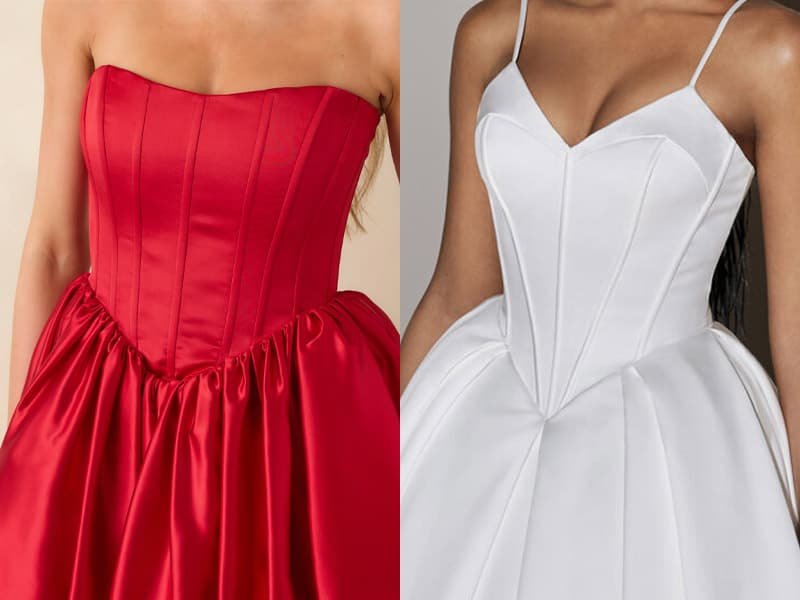
A corset waist and a Basque waist can look almost interchangeable in a front-view product photo. Both can create a sharply defined middle, both are common in fitted occasion and party dresses, and both may appear with cups, boning, shaped seams, or a close body fit. The similarity is visual, but the construction logic is different. That difference matters when a style moves from inspiration image to pattern, fitting, grading, and bulk production.
A corset waist is mainly about how the bodice shapes and supports the torso, while a Basque waist is about where the waist seam sits and how it is shaped. Corset construction may use boning, cups, lining, interfacing, or shaped panels. A Basque waist normally extends below the natural waist at center front, often forming a V or soft U-shaped point. One dress can use both features at the same time.
The distinction becomes easier to understand when a sample goes wrong. A pointed-waist dress can look perfect on a mannequin but lift at the center front when the wearer sits, twist toward one hip, or collapse above the waist after a few minutes of movement. Those defects are not solved by calling the style “more corseted.” They come from the relationship between pattern balance, body proportion, support, fabric behavior, skirt tension, and production execution. Once those relationships are clear, the terminology stops being confusing and becomes genuinely useful for design and development decisions.
What Is a Corset Waist?
A corset waist is a structured bodice treatment that shapes and supports the bust, rib cage, waist, and upper torso. Its effect comes from pattern contouring plus components such as boning, cups, lining, interfacing, power mesh, or firm closures. It does not define one fixed waistline position. A corset bodice can finish at the natural waist, extend below it, or continue into a Basque waist.
How Corset Shaping Works
Good corset shaping is not created by simply reducing the waist measurement. The pattern has to control several three-dimensional volumes at once: bust projection, under-bust circumference, rib-cage width, waist suppression, center-front length, side length, and back tension. If the bust is too flat, the wearer may experience spillage or the whole bodice may be pulled upward. If the waist is aggressively reduced without enough space through the ribs, the garment can ride up until it finds a narrower part of the body. If the front is strongly shaped while the back is too loose, side seams can rotate and the neckline can lose contact with the body.
Modern fast-fashion corsetry is usually lighter and more wearable than historical corsetry. A party mini dress may use flexible plastic boning, molded cups, stretch lining, or localized interfacing rather than rigid steel support. A woven occasion dress may rely more heavily on panel shaping, a stable lining, and a firm zipper. The right construction depends on what the garment must do. Bust lift, neckline security, vertical stability, waist definition, and smoothness through the torso are different technical problems, so they should not automatically receive the same solution.
Which Components Create Support?
Boning is the most recognizable element, but it should be treated as part of a system rather than as a cure-all. Boning can resist vertical collapse and help keep panel seams smooth, yet it cannot fix a cup that is too small, an apex that is too high, or a waist that is fundamentally too tight. Cups create localized bust volume, lining stabilizes the inside of the garment, interfacing reinforces areas that would otherwise stretch, and a waist stay can help anchor a strapless or longline bodice. The closure also carries load, so zipper strength, lacing position, hook-and-eye placement, and seam reinforcement matter more than they may appear on the sketch.
Fabric behavior changes the amount of support required. A dense stretch knit may contribute useful recovery around the waist, while a soft stretch satin can look smooth but continue growing during wear. A stable woven crepe has less stretch forgiveness, so the pattern must be more exact. A mesh overlay may add almost no structural support even though it visually covers the same area. During development, it is more useful to ask which zone needs control – bust, waist, neckline, side seam, or center front – and then choose the lightest structure that solves that problem without making the dress unnecessarily rigid.
Corset Waist or Corset Bodice?
In retail language, “corset waist” is often used broadly for a dress with visible seaming, cups, or a visibly cinched middle. In technical development, “corset bodice” is usually more precise because it separates the upper-body support system from the waistline shape. A corset bodice may end at the natural waist, create a longline body, flow into a Basque point, or continue into a fitted skirt without a visible horizontal waist seam. Two garments can therefore both be sold as corset dresses while using very different pattern structures underneath.
This distinction improves tech packs and sample comments. “Make the corset waist deeper” leaves the pattern room guessing whether the change concerns center-front length, Basque point depth, cup height, waist suppression, boning length, or skirt attachment. A measurable comment is much easier to execute: lower the center-front waist point by a stated amount, retain the current side-waist height, move the cup apex, or reduce the waist circumference while protecting the under-bust measurement. Clear language reduces unnecessary revisions because it isolates the variable that actually needs to change.
What Is a Basque Waist?
A Basque waist is a shaped waistline that extends below the natural waist, most often dropping into a V-shaped, pointed, or softly curved center front. Its strongest effect is visual proportion rather than compression: the lowered center can lengthen the appearance of the torso and emphasize the transition into the skirt. A Basque waist can be lightly constructed or combined with a fully structured corset bodice.

How a Basque Waist Is Shaped
The defining feature of a Basque waist is not simply a low waist. What matters is the relationship between the side waist and center front. In a classic interpretation, the side seam remains close to the natural waist while the front descends into a controlled point. That geometry creates the elongated look. A conventional drop waist, by comparison, lowers a larger portion of the waistline more evenly toward the upper hip. Understanding the difference matters because the two constructions require different bodice lengths, skirt seam shapes, and grading decisions.
The center-front depth should not be selected only because a deeper point looks dramatic in a sketch. It has to work with torso length, bust position, hip height, skirt volume, closure placement, and normal movement. A point that is too deep can push into the lower abdomen when the wearer sits. A point that is too shallow may disappear visually, especially on a long torso. During development, useful measurements include the natural-waist-to-point distance, side-waist level, center-back waist level, and total front bodice length. Once those relationships are recorded, the shape can be repeated rather than recreated by eye.
Where the Basque Point Should Sit
There is no universal number that makes a Basque waist correct. The same center-front drop can look elegant on one body and crowded on another because available vertical space changes with bust height and torso length. A shorter torso may need a shallower point to preserve comfort and leg proportion. A longer torso may carry a deeper extension without making the waist look excessively low. This is one reason fashion fit should be judged through body relationships rather than by applying a fixed measurement borrowed from another style.
A useful fitting review checks the dress while the wearer stands, turns, sits, bends slightly, and walks. If the point flips upward when seated, pushes firmly into the body, or causes the side waist to climb, the issue may be point depth or total bodice balance. If the point looks centered from the front but shifts toward one side in motion, the cause may be uneven skirt tension, rotated side seams, or asymmetric seam lengths. Front photography is valuable, but side and three-quarter views often reveal the actual reason the waistline is moving.
Which Silhouettes Use It Well?
Basque waists are especially effective when the waist transition is intended to become a visible design feature. Structured party dresses, occasion dresses, fitted minis, corset-inspired midis, fit-and-flare shapes, and full-skirt silhouettes can all use the line successfully. A fuller skirt increases the contrast below the point and can make the waist appear narrower. A fitted skirt extends the body line and gives a longer torso-to-hip transition. A soft satin or fluid lower section can create an attractive contrast with a structured upper body, although it places more responsibility on seam stabilization because the softer fabric can distort around the point.
The shape also has value at collection level. A brand can repeat a recognizable Basque proportion across several dresses while changing neckline, sleeve, skirt length, color, fabric, or embellishment. That creates a family resemblance without making every style identical. The strongest result usually comes from proportion rather than extremity. A sharper V or deeper point is not automatically more flattering. The waistline needs to cooperate with bust shape, neckline width, skirt volume, and the intended customer so that the dress reads as balanced rather than visually overloaded.
Is a Corset Waist the Same as a Basque Waist?
No. A corset waist and a Basque waist describe different design dimensions. Corset construction is mainly about shaping and supporting the torso, while a Basque waist describes the placement and geometry of the waist seam. They often appear together, which is why the terms are confused, but neither automatically requires the other. A corset bodice can have a natural waist, and a Basque waist can use relatively light internal support.
What Is the Main Difference?
The easiest way to separate the terms is to ask two different questions. First: how is the upper body being supported and shaped? That question identifies corset construction. Second: where does the bodice-to-skirt transition sit, and what shape does it make? That question identifies the waistline. Separating function from geometry is especially useful when a sample does not match the reference, because it prevents teams from changing the wrong part of the pattern.
For example, if the center-front point is too shallow, changing boning stiffness may have no meaningful effect. If the point is correct but the bodice collapses around the bust, redrawing the waist seam may create a new proportion problem without solving the original one. The comparison below shows why the two terms can coexist but should not be treated as interchangeable during design, fitting, or production.
Development factor | Corset bodice / corset waist | Basque waist |
Primary purpose | Shape and support the torso | Define waistline geometry and proportion |
Main visual cue | Sculpted, structured upper body | Lowered V, point, or curved center front |
Typical components | Boning, cups, lining, interfacing, shaped panels | Shaped waist seam and extended center-front bodice |
Requires boning | No, although common | No |
Must sit below natural waist | No | Usually at center front |
Common fit risk | Bust imbalance, riding, collapse, gaping | Point distortion, pulling, uncomfortable depth |
Can both appear together | Yes | Yes |
Can a Dress Use Both?
Many current fitted occasion and party dresses combine a corset bodice with a Basque waist. Imagine a satin mini dress with molded cups, six shaped bodice panels, flexible boning, a center-back zipper, and a front waist seam that extends into a V several centimeters below the side waist. The cups, panels, boning, and stable inner layer create the corset function. The front drop creates the Basque effect. Remove the point and the garment can still be a corset dress; remove most of the support and the dress may still retain a Basque-shaped waistline.
This way of breaking a reference image into separate features is useful for original product development. Instead of asking a supplier to “copy that corset waist,” a brand can define the cup shape, neckline, visible or concealed boning, front-point depth, side-waist height, skirt volume, outer fabric, lining behavior, and closure separately. That gives the design team more control over the result and makes it easier to create a brand-specific interpretation rather than reproducing another garment feature for feature.
Basque, Drop, and Natural Waist
A natural waist usually follows the narrowest part of the torso. A conventional drop waist lowers the bodice-to-skirt transition more evenly toward the upper hip. A Basque waist generally keeps the side seam higher while the center front extends farther downward. These positions affect the silhouette differently: a natural waist creates a familiar upper-to-lower-body break, a drop waist lengthens the torso more uniformly, and a Basque waist creates a directional line that draws the eye inward and downward.
When identifying a dress from a photo, inspect the side seam rather than relying only on the center front. If the waistline is lowered by a similar amount around much of the garment, the style is closer to a drop waist. If the side remains around natural-waist level while the front plunges into a distinct point, it is more likely Basque. The distinction also changes patternmaking. A drop waist needs controlled circumference through an extended torso section, while a Basque waist needs careful point depth, seam geometry, and skirt attachment in addition to circumference control.
Which Waist Creates the Better Silhouette?
Neither creates a universally better silhouette. Corset construction defines the body through structural shaping, while a Basque waist changes visual proportion through seam placement. The better choice depends on torso length, bust shape, skirt silhouette, fabric behavior, comfort, and the intended mood of the dress. In many fitted occasion styles, moderate corset support combined with a well-proportioned Basque line gives strong definition without relying on extreme compression.

Which Defines the Waist More?
A corset bodice can create stronger physical waist control because the pattern and internal structure actively manage circumference and body contour. A Basque waist may create equally strong visual definition without the same degree of compression because the V-shaped seam directs the eye toward the center and creates contrast between the narrow middle and the skirt below. These are different mechanisms: one changes how the garment holds the body, while the other changes how the body proportion is perceived.
This difference is important in commercial fit. Making a waist smaller is not always the best route to making it look smaller. Excessive suppression can create horizontal stress lines above the waist, pull the bodice upward, make the zipper difficult to close, or open the neckline because tension is being redistributed. A controlled Basque line can carry some of the visual work, allowing the waist to look more sculpted without forcing the body into an unnecessarily aggressive reduction. For dresses sold across several sizes, shared structural and visual shaping is often easier to grade consistently than a silhouette that depends on extreme compression in one base-size fit.
How Torso Length Changes the Result
Torso length changes both the comfort and appearance of a Basque waist. The point needs enough space between the bust and upper hip to look intentional. On a long torso, a deeper extension may still sit comfortably above the hip crease. On a short torso, the same absolute depth can visually crowd the bust-to-waist area or press into the body when seated. Bust height also changes the available space, so two people with similar overall height may need different vertical proportions through the same style.
Corset components have similar constraints. Boning that is too long can push into the hip or underarm, while boning that is too short may not stabilize the intended lower-bodice area. Cup placement, under-bust level, and strap position also relate to torso proportion rather than to total bust circumference alone. During grading, the aim is therefore not to scale every vertical measurement by the same percentage. The aim is to preserve the same relationship among bust, waist, point, and hip so that the design continues to read as the same silhouette across the range.
Which Works for Fitted Dresses?
Both constructions can work very well in fitted dresses, but the skirt and fabric determine how stable the result will be. A high-stretch bodycon fabric with strong recovery may contribute useful circumference control, allowing the internal structure to focus on bust support and vertical stability. A woven satin or crepe has less stretch tolerance, so pattern balance must be more exact. Mesh overlays add another complication because the decorative layer may react differently from the support layer underneath.
The Basque seam is particularly sensitive when the skirt is fitted. If the skirt is too tight directly below the point, upward tension can flatten the V or flip the tip outward. If the skirt is heavy, downward drag can make the center point appear longer after hanging. If bias-oriented skirt sections meet a stable bodice seam, differential stretch can create left-to-right distortion. For that reason, the waist should be evaluated as part of a complete dress rather than as an isolated bodice detail. Skirt ease, seam length, grain direction, lining, and waist stabilization all influence whether the intended shape survives real movement.
How Do Fabric and Structure Affect the Fit?
Fabric and internal structure determine whether a corset or Basque waist keeps its intended shape after the dress leaves the mannequin. Stretch, recovery, weight, drape, lining stability, cup shape, boning stiffness, seam direction, and skirt load all influence the final fit. Even a well-balanced pattern can behave differently after a material substitution, so fabric approval and structural approval should be treated as connected development decisions.
Which Fabrics Need More Support?
Support requirements are better judged by measurable behavior than by fabric name. Two satins can have very different weight, stretch, and drape. Mesh can have strong recovery or almost none. Jersey can range from a soft lightweight knit to dense compression fabric. A stable woven may hold seam definition beautifully but give almost no forgiveness if the body measurements or pattern balance are wrong. A stretchy shell may feel easier to fit while gradually losing waist definition if recovery is weak.
The following ranges are practical development bands rather than universal standards. They help teams discuss fabric behavior consistently before sampling. Actual test methods, tolerances, and acceptance criteria should always follow the brand specification, fabric supplier data, and intended end use.
Fabric behavior | Practical stretch band | Typical development implication |
Stable woven | Under about 5% | Pattern accuracy and internal shaping carry most of the fit |
Low stretch | About 5-15% | Limited forgiveness; support and seam control remain important |
Moderate stretch | About 15-30% | Can assist contouring when recovery is strong |
High stretch | Above about 30% | Recovery must be checked to avoid progressive loss of shape |
Bias-cut woven | Varies by grain direction | Requires careful seam, waist, and hanging control |
Stretch percentage alone should never be the only decision point. Recovery is equally important because a fabric that stretches easily but does not return close to its original dimension can grow during wear. Weight matters as well. Dense velvet, sequins, layered skirts, and heavy trims can pull on a pointed waist. Very light shells can collapse unless an inner layer carries the structure. The outer fabric, lining, interfacing, and support system should therefore be reviewed together rather than as separate sourcing choices.
Boning, Cups, and Lining
Boning works best when it follows an already balanced seam or structural line. Flexible boning is often enough to prevent folding in fashion corsets, while longer strapless or longline bodices may require firmer reinforcement. More stiffness is not automatically better. Excessively rigid boning can create visible ridges, reduce comfort, and push against the hip or rib cage when the wearer sits. The correct stiffness depends on the fabric, bodice length, support expectation, and where the load is carried.
Cup placement is even more sensitive because it coordinates with bust apex, under-bust seam, neckline shape, and outer-panel volume. A cup can be the expected nominal size and still fit poorly if it sits too high, too low, or too far apart for the garment pattern. Lining acts as the internal platform in many structured dresses: it can stabilize seams, carry boning channels, improve opacity, and reduce shell stretching. However, lining and shell need compatible stretch behavior. If the shell stretches much more than the lining, the inner layer can restrict the garment and create wrinkles; if the lining stretches more, the shell may carry too much load. Any meaningful change to cup, lining, boning, or closure after fit approval deserves another fit check.
What Distorts a Basque Point?
A distorted Basque point is usually a tension imbalance rather than a simple cutting error. The point can flip upward when the skirt immediately below it is too tight, grow longer when a heavy skirt pulls downward, twist when the left and right skirt panels have different tension, or become asymmetric when bias areas stretch during sewing and pressing. The lining can also pull the shell out of position if the two layers are not the same effective length around the waist seam.
A useful diagnostic method is to inspect the point at several construction stages. Check the bodice before the skirt is attached. If the point is already uneven, look first at panel balance, grain direction, cutting accuracy, and left-to-right seam lengths. If the bodice is symmetrical until skirt attachment, then inspect skirt seam length, ease distribution, fabric weight, and seam stabilization. Pressing is another common source of change, especially with soft satin and bias areas that can grow under heat and steam. For shape-sensitive styles, a first-piece or short pilot check can identify these interactions before the same defect is repeated across a full production run.
How Are Corset and Basque Waists Developed for Production?
Production-ready development turns a visual waist idea into measurable controls. Bust shape, rib cage, waist circumference, center-front length, side-waist height, Basque depth, skirt attachment, support components, and grading must work as one system. After sample approval, those relationships need to be converted into locked pattern versions, material specifications, construction checkpoints, and fit references that can be reproduced across sizes, colorways, production lines, and repeat orders.

How the Pattern Is Balanced
Pattern balance begins by separating structural lines from visual lines. In a corset bodice, princess seams, darts, side-front panels, or multi-panel divisions usually control bust and waist volume. In a Basque design, the shaped waist seam creates the visual extension. When those functions are mixed together in the fitting comments, one correction can easily create a second defect. A patternmaker needs to know whether a line is being moved to improve body fit, to change appearance, or to solve a production issue.
A practical development record can track the control points below. These are not universal size specifications; they are checkpoints that help the team understand what changed between versions and whether the intended relationships are still intact.
Control point | What it helps verify |
Bust apex position | Cup and shaping alignment with the body |
Under-bust level | Support height and lower-bust seam position |
Center-front bodice length | Front torso balance and neckline-to-waist proportion |
Side-waist length | Balance between front, side, and back |
Basque point drop | Intended depth of the center-front extension |
Waist circumference | Comfort, shaping, and closure tension |
Center-back length | Back balance and closure position |
Skirt attachment length | Tension and ease around the shaped waist seam |
These measurements make visual comments more repeatable. If the Basque point appears deeper after a bust correction, the point may not have changed at all; the center-front bodice may have gained length to relieve tension. Without tracking both variables, a team can shorten the point unnecessarily and create a new proportion problem. Measurements do not replace fitting, but they help explain what the eye is seeing and provide a record that the sample room and production team can follow.
Bust-to-Waist Control
Bust-to-waist fit is one of the most demanding parts of a structured dress because body volume changes quickly over a short vertical distance. If there is not enough bust projection, fabric can be pulled upward and outward, making the waist appear too high even when the waist measurement is technically correct. If the under-bust area is too loose, the bust may drop and make the front bodice look longer. If the waist is too tight, the garment can migrate upward until it reaches a more comfortable position.
A disciplined fit review separates comments rather than treating the entire front body as one problem. The most useful sequence is to confirm bust volume and apex position, check neckline contact, check under-bust level, confirm center-front and side lengths, review waist circumference, evaluate back closure tension, and only then finalize Basque point depth. That order helps reveal cause and effect. A development team that can explain which issue is driving the visible defect will usually reach a decision-ready sample faster than a team that makes several small, unrelated alterations in the same round.
Grading Across Sizes
Grading a structured corset or Basque dress is not simply a matter of adding circumference to bust, waist, and hip. The visual relationship among cup position, under-bust level, point depth, torso length, boning length, strap position, and skirt attachment must still feel intentional. A base-size sample can look excellent while the same grading rule produces a point that feels too shallow in larger sizes or too long in smaller sizes. The goal is consistent design language, not identical geometric growth in every feature.
Where the size range and development budget allow it, reviewing at least three representative size positions is a useful practice: the approved base size, one smaller size, and one larger size. The exact sizes depend on the brand range, but the comparison can expose whether bust position, side-waist height, point depth, and skirt balance are scaling convincingly. Boning should remain long enough to support the intended zone without pressing into the underarm or hip. Any grading tolerance, measurement allowance, or fit acceptance standard should follow the brand’s approved specification rather than an assumed industry-wide number.
Sampling and Bulk Repeatability
Sample approval should create a manufacturing reference, not simply mark the end of the design stage. Before production, the team should lock the approved pattern version, shell fabric, lining, cups, boning type and length, zipper or closure, point depth, seam construction, pressing method, and visual reference. If one of those items changes, the effect on fit should be reviewed rather than assumed to be minor. A different lining stretch or boning stiffness can alter the same outer pattern enough to change neckline contact, waist tension, or point behavior.
For a complex corset or Basque style, first-piece verification can prevent expensive repetition. The first completed production garment can be checked against the approved sample for bust position, center-front length, point symmetry, side-waist balance, skirt drag, closure tension, and overall silhouette before the full run is released. The same discipline matters for repeats because fabric lots can change slightly in weight, stretch, recovery, or hand feel. Brands developing a new structured dress program can also use the pre-sampling stage more effectively by sharing the tech pack or reference, target fabric, size range, support expectation, and launch timing with a dress-focused development team such as Duolan. The most useful response at that stage is not a simple “yes, we can make it,” but a clear explanation of which fit and construction points should be validated before bulk production.
The strongest manufacturing process protects the approved sample through every later decision. When the pattern, material, support system, grading logic, sewing sequence, and finishing method remain aligned, the final dress looks effortless even though the construction behind it is carefully controlled. That is the real difference between a style that only photographs well once and a style that can be developed into a repeatable commercial product.
Corset and Basque waists are easy to confuse because they often appear in the same dress, but they solve different problems. Corset construction is primarily responsible for shaping and support; the Basque waist is primarily responsible for the geometry and visual position of the waistline. One can exist without the other, and combining them successfully requires more than adding boning to a pointed seam. The pattern has to balance bust, ribs, waist, torso length, skirt tension, and movement as a connected system.
For designers and product teams, this distinction makes references easier to communicate and samples easier to diagnose. Instead of asking whether one waist is universally “better,” decide what the dress should do: create physical support, visually lengthen the torso, define the waist, support a full skirt, maintain a fitted mini silhouette, or combine several of those effects. Once the design intention is specific, fabric selection, internal structure, grading, and production controls become much easier to evaluate. A well-developed structured dress should not only look convincing in the approved sample; it should keep the same proportion and character when worn, graded, produced, and reordered.

Frequently Asked Questions
Is a Basque waist the same as a corset?
No. A Basque waist describes the shape and position of the waistline, usually with a center-front point extending below the natural waist. A corset describes the shaping and support system of the bodice. The two are frequently combined in modern party and occasion dresses, so product descriptions sometimes blur the terminology. A dress can have a Basque waist without heavy corset structure, and a corset bodice can finish at a straight natural waist without any Basque point.
Can a corset dress have a natural waist?
Yes. Corset construction does not require a lowered waistline. A corset bodice can finish at the natural waist, above it, below it, or continue seamlessly into a fitted skirt. The defining issue is how the bodice controls bust, waist, and torso shape through paneling and support rather than the exact location of the waist seam. For development purposes, separating “corset bodice” from “waistline type” makes the design easier to specify, fit, and grade across a commercial size range.
Does a Basque waist need boning?
Not necessarily. Boning can help a Basque waist stay smooth when the bodice is fitted or when the center-front point is long, but the waistline itself is defined by seam geometry rather than by boning. A softer Basque style can use stable fabric, lining, interfacing, or carefully balanced panels instead. The decision depends on the intended silhouette, fabric, bust support requirement, point depth, and skirt weight. Adding boning without correcting the underlying pattern will not automatically prevent a point from twisting or lifting.
What is the difference between a Basque waist and a drop waist?
A drop waist generally lowers the bodice-to-skirt transition more evenly around the body toward the upper hip. A Basque waist usually keeps the side waist higher while extending the center front downward into a V, point, or curved shape. That geometric difference changes the visual effect and the pattern. A drop waist lengthens the torso more uniformly, while a Basque waist creates a directional line that emphasizes the center front and can make the waist appear more sculpted.
Which waist is more flattering for a short torso?
There is no single rule, but very deep Basque points can crowd a short torso because the available distance between bust and hip is limited. A shallower Basque, a natural-waist corset, or a carefully proportioned hybrid may preserve more leg length and sitting comfort. The best choice depends on bust height, natural-waist position, skirt volume, and neckline as well as total height. Fitting the actual vertical relationships is more reliable than choosing a waist style solely from a body-type label.
Why does a Basque waist point flip up or look uneven?
The point often flips or twists because tension is unbalanced around the waist seam. A fitted skirt can pull upward, a heavy skirt can drag the point downward, bias-cut sections can stretch, or the lining can be shorter than the shell. Uneven pressing can also distort soft satin around the tip. A useful troubleshooting method is to inspect the bodice before skirt attachment, again after attachment, and again after pressing. The stage where the distortion first appears usually reveals the real source of the problem.
Share:
Our Services
Categories
Table of Contents
Here, developing fashion collections is more than manufacturing garments — it’s a collaborative process focused on transforming ideas into well-executed, market-ready products. From fabric sourcing and sample development to scalable production and delivery coordination, every stage is built to support quality, consistency, and efficient collection launches across global markets.