Skip to content

Draped Dress Pattern Development: How Does a Design Become a Production-Ready Pattern?
Your trusted Women’s Apparel Development & Manufacturing Partner from China
- Jerry
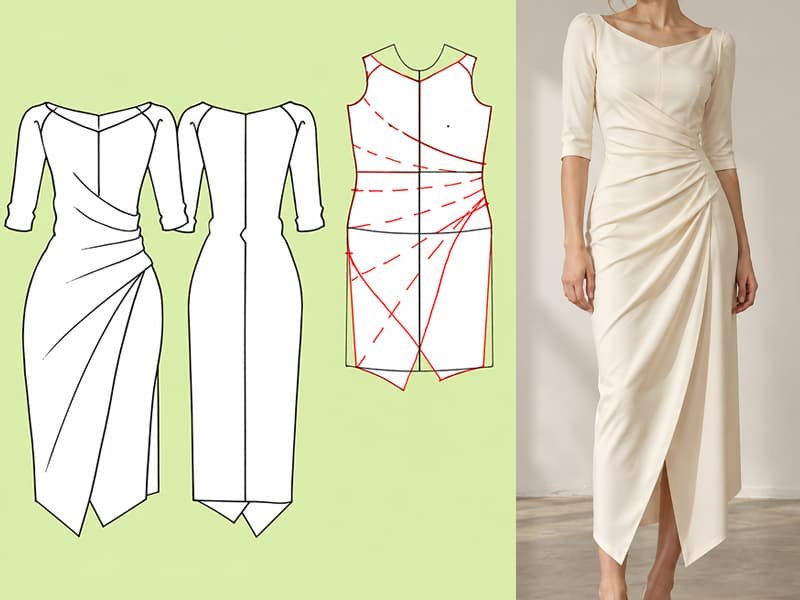
A draped dress often looks as though the fabric simply found the right place on the body. A soft fold falls from the shoulder, several gathers disappear into the side waist, or a twisted panel creates movement without visible structure. Behind a successful style, however, there is usually far more control than the finished garment suggests. Grain direction, fabric weight, stretch, anchor placement, seam balance, body proportions, and construction order all influence where the fabric finally settles. A dress can look impressive on a mannequin and still fail when the same design is sampled in another fabric, graded into additional sizes, or sewn repeatedly on a production line.
Draped dress pattern development converts a three-dimensional draped concept into accurate, repeatable pattern pieces while preserving the intended folds, fit, balance, and fabric movement. The process combines dress-form draping, flat-pattern correction, grain control, fabric testing, fit refinement, grading, and production instructions so the design can move from an attractive sample to a garment that can be manufactured consistently.
This difference becomes obvious when two samples are placed side by side. The first may have been arranged manually until every fold looked perfect for photography. The second must achieve almost the same appearance without the original patternmaker standing beside the machinist. If the pattern itself cannot explain where the folds begin, how the fullness is distributed, and what keeps the garment balanced, the design is still a sample-room solution rather than a fully developed product. The real craft lies in making something that looks spontaneous behave predictably.
What Is Draped Dress Pattern Development?
Draped dress pattern development is the process of turning controlled three-dimensional fabric shapes into two-dimensional pattern pieces that can be fitted, sewn, graded, and repeated. Unlike a conventional fitted dress pattern, it must control body shape and intentionally released volume at the same time. The pattern defines where folds originate, how they travel, which areas remain stable, and how fabric behavior contributes to the finished silhouette.
Draping Is More Than Adding Fullness
A draped pattern is not simply a normal dress pattern with extra fabric added somewhere. The additional volume has to perform a specific job. It may create a cowl at the neckline, diagonal movement across the torso, soft fullness around the hip, or controlled gathers that disappear into a side seam. Two patterns can contain the same additional 20 centimeters of fabric and still produce completely different garments because the release points, grain direction, and anchor positions are different.
Experienced patternmakers therefore separate the garment into stable zones and released zones. Stable zones include areas such as the shoulder, bust support point, waist seam, side seam, or fitted back panel. These areas keep the dress positioned on the body. Released zones contain the fabric that is intended to fall, fold, twist, or gather. The visual softness of a draped dress depends on the relationship between those two systems. If too much of the garment is allowed to move, the neckline may drop, the side seam may rotate, or the waist may lose its intended position. If too much is restrained, the drape can look flat and forced.
This balance matters particularly in fitted party and occasion dresses. A dramatic front may need to look relaxed while the internal fit remains precise. The wearer should see movement; the patternmaker should see control.
Draping and Flat Patternmaking Work Together
Draping is especially useful when the designer needs to understand how fabric behaves around a three-dimensional body. Cowls, sculptural waist folds, asymmetric necklines, twisted bodices, and complex side drapes are often easier to evaluate directly on a form because the patternmaker can immediately see how gravity changes the design. Fabric can be pinned, released, rotated, or redistributed until the intended visual line appears.
Flat patternmaking becomes valuable once those visual decisions need to become measurable. The draped muslin is marked, removed, flattened, trued, and converted into paper or CAD pieces. Seam lengths are checked, grainlines are confirmed, curves are cleaned, and the relationship between the creative front and the more conventional parts of the dress is restored. A style might therefore use direct draping for the front bodice while retaining a controlled fitted block for the back.
Commercial development often works best when these two methods are treated as complementary tools. Draping answers the question, “How should this fabric behave on the body?” Flat patternmaking answers, “How can we reproduce that behavior accurately?” The strongest patterns usually come from moving between the two rather than insisting that every design must begin and end with one technique.
Pattern Development Starts With Design Intent
A reference image can show an attractive silhouette, but it rarely contains enough information to create a reliable production pattern. The development team still needs to understand the intended bust fit, waist position, neckline coverage, stretch level, support requirement, lining method, and final use of the sample. A low draped neckline developed for a campaign photograph may require different control from a style expected to remain secure through several hours of normal movement.
Before pattern work starts, the most important questions usually concern silhouette, fit priority, fabric behavior, support, coverage, and the final production objective. Is the sample intended mainly for visual approval, fit approval, presentation, or preparation for manufacturing? Each answer changes what should be solved first. A fit sample may prioritize balance and measurements, while a visual sample may initially focus more heavily on the fold direction and overall shape.
Professional development teams increasingly formalize this early stage because it reduces unnecessary sample rounds. Duolan’s documented development process, for example, distinguishes between fit confirmation, visual approval, and production preparation while treating silhouette, drape, support, coverage, fit, and fabric handfeel as key development priorities. Defining those priorities early makes later corrections far more meaningful.
How Do You Turn a Drape Into a Pattern?
A drape becomes a usable pattern by recording critical reference points while the fabric is still positioned on the form, removing it carefully, flattening it, truing the pattern lines, and adding construction information. Grain direction, anchor locations, fold positions, seamlines, balance marks, and controlled fullness must survive the transition from three dimensions to two dimensions without losing the original visual intention.

Mark Before Removing the Fabric
The most valuable information exists while the fabric is still sitting correctly on the dress form. Once the pins are removed and the piece is laid flat, many relationships that seemed obvious can disappear. A fold that clearly traveled from the bust toward the waist may become an unfamiliar curved edge. A side gather may look like an irregular extension of the pattern. Without clear markings, the patternmaker is forced to reconstruct the drape from memory.
Center front, center back, waist level, bust level, hip level, seamlines, grainlines, and major style lines should therefore be recorded before removing the muslin. Fold origins and release points also need references. Gathered areas are more reliable when the start and finish are defined by notches rather than a general instruction such as “gather side seam.” If 300 mm of fabric is intended to be condensed into a 200 mm section, that relationship can later become controlled production information instead of a visual guess.
The same principle applies to tack points and asymmetric features. A fold attached 45 mm below the waist may look only slightly different if it moves by 10 mm, but across repeated garments that variation becomes visible. The pattern should capture the position that creates the intended result.
Pattern Control | What Should Be Recorded | Typical Risk if Missed |
Grainline | Straight, cross, or bias direction | Twisting, uneven hanging, shifted folds |
Gather zone | Start and end notches | Fullness spreads inconsistently |
Anchor point | Measured position from a fixed seam | Drape moves during wear |
Seamline | True stitching line | Joining lengths do not match |
Fold direction | Orientation or folding sequence | Visual result changes between garments |
Balance mark | Matching reference between pieces | Panels rotate during sewing |
Hem reference | Finished level after relaxation | Uneven final length |
Flatten Without Destroying the Shape
Removing a draped piece from the form requires restraint. The fabric may already have stretched around curves, particularly where it has been positioned close to the bias. Pulling it flat aggressively can introduce a second distortion before the actual pattern is even traced. The goal is to open the piece enough to understand its underlying geometry without erasing the behavior that created the original drape.
The patternmaker then separates intentional irregularities from accidental ones. Hand-drawn seamlines may be slightly uneven because they were marked while the fabric was pinned. A neckline may have been stretched by handling. One side seam may appear a few millimeters longer because the fabric shifted while the design was being shaped. Simply copying every mark reproduces those errors. Pattern development requires interpretation rather than tracing.
Grain direction deserves particular attention at this stage. True bias lies approximately 45 degrees to the warp and weft, giving many woven fabrics more flexibility than they have on straight grain. If part of the design depends on this behavior, the grainline should be reconstructed accurately from the original drape. A small grain change can alter how the panel falls once the garment is worn, especially in long satin or crepe sections.
True the Pattern Before Sampling
Truing is where an experimental pattern begins to behave like a professional one. Matching seams are walked against each other to confirm that the true stitching lengths are compatible. Curves are smoothed, corners are corrected, notches are positioned, and the relationship between adjacent pieces is checked. If one seam is longer because gathering or easing is intentional, the difference should be measurable. If the difference appeared only because the muslin stretched, it should be removed.
This stage also prevents visual effects from hiding structural problems. A neckline may look attractively loose while the shoulder seam has actually rotated forward. Preserving that apparent shape without correcting the shoulder would build a fitting error into the final pattern. The structural balance should first be corrected, and then the intended neckline volume should be restored deliberately.
Seam allowance is most useful after the true stitching lines have been established. Adding it too early makes it harder to determine whether a mismatch belongs to the pattern or to the allowance. Pattern names, grainlines, cut quantities, left-and-right identification, and relevant matching references can then be added. A sound pattern should explain itself to someone who did not participate in the original draping session.
Convert Visual Information Into Instructions
Draped garments become difficult to reproduce when too much information remains visual rather than measurable. A sample maker may understand instinctively that the upper fold should cover part of the lower fold, but a production operator cannot be expected to interpret the same feature identically. The pattern and technical information need to translate that craftsmanship into clear reference points.
Gather lengths, tack positions, fold order, seam stabilization, lining attachment, pressing direction, and construction sequence may all need to be documented. This becomes even more important with twist dresses, asymmetric panels, and pieces that look similar when laid flat but behave differently once assembled. Left and right pieces should be unmistakable, and directional fabric surfaces should be accounted for at cutting.
The aim is not to remove craftsmanship from the garment. It is to make craftsmanship repeatable. When the pattern carries enough information, the sewing team can focus on executing the design rather than reconstructing it from photographs or memory.
Which Methods Create Draped Effects?
Draped effects are created by controlling where fabric volume is added, released, redirected, or anchored. Cowls use additional neckline volume, side drapes concentrate fullness toward selected seams, twists rotate fabric through the construction, and bias cuts use diagonal grain behavior. Similar-looking dresses can therefore rely on completely different pattern mechanisms, and the best method depends on fabric, fit, visual intention, and repeatability.

Cowl and Neckline Drapes
A cowl neckline usually begins with additional volume opened into the neckline. In flat patternmaking, this can be created with slash-and-spread techniques that release the existing bodice toward the opening. The patternmaker determines how much the sections should open and where the new volume should originate. Direct draping can achieve the same goal by allowing fabric to fall naturally on the form before the resulting shape is transferred back into the pattern.
More fullness does not automatically create a more luxurious cowl. Excessive volume can make the neckline collapse too deeply, move during wear, or become heavy enough to pull against the shoulders. Fabric weight changes the result significantly. A lightweight crepe may create several fine folds, while a heavier satin may create fewer, broader rolls. A jersey may stretch under its own weight and make the finished neckline lower than it appeared during the first fitting.
The shoulder and bust therefore remain part of neckline development. The patternmaker needs to check how much of the upper body is stabilizing the draped area, how the neckline behaves when the wearer moves, and whether coverage remains appropriate. A successful cowl is not simply a large opening; it is controlled excess fabric supported by the rest of the garment.
Side Drapes and Gathered Fullness
Side draping often begins with a fitted foundation pattern that is opened toward one seam. Slash lines allow the patternmaker to add length and sometimes width while leaving other parts of the garment relatively unchanged. The position of those slash lines strongly influences where the folds appear once the added edge is gathered or pleated back into a smaller area.
Gather ratios provide a useful language for describing the amount of fullness. A 1.5:1 ratio means that 300 mm of fabric is controlled into a 200 mm finished section, while a 2:1 example would reduce 400 mm into 200 mm. These figures are examples rather than universal rules because thickness and visual intention matter. Lightweight fabrics can often accommodate higher ratios without looking bulky, while thicker jersey or satin may become heavy long before the same ratio is reached.
The more important question is where the fullness travels after sewing. Concentrating too much around the abdomen may make the dress look bulky. Moving the release points upward can create diagonal movement toward the waist, while opening the pattern lower may emphasize the hip. Experienced patternmaking therefore treats fullness as directional volume rather than simply extra centimeters.
Twist and Knot Effects
Twist details change the orientation of the fabric before the garment is completed. A panel may rotate 90 degrees, turn 180 degrees, pass through an opening, or cross another panel before returning to its seam. This changes the relationship between its edges and frequently changes the grain direction as well. A piece that looks almost symmetrical on paper can become strongly directional once it has been twisted.
Thickness becomes one of the main practical limits. A twist that works well in lightweight jersey may become excessively bulky if converted into double-layer satin. Four or more fabric layers can collect in a small area, making the center difficult to turn, stitch, and press. The surrounding seams may also be pulled out of position because the twist creates concentrated tension.
Stretch adds another layer of risk. If the twisted panel elongates but does not recover effectively, a neckline or waist detail can gradually drop during wear. Testing should therefore include dressing, movement, and recovery rather than only a static mannequin review. The best-looking twist at the first fitting is not always the most stable twist after several hours of use.
Bias Draping
Bias-cut fabric behaves differently because it sits diagonally to the main yarn directions. Around 45 degrees to the warp and weft, many woven fabrics gain enough flexibility to follow the body more closely and create fluid movement with fewer conventional shaping seams. This is why satin, crepe, and similar materials can produce particularly elegant bias dresses.
That flexibility creates several development challenges. Large bias panels may lengthen under their own weight. Side seams can rotate if the two sides are cut, handled, or sewn differently. A hem that appears level immediately after sewing may become uneven after the garment has been hanging. Long skirts and heavier fabrics usually make those effects more noticeable.
Bias styles therefore benefit from time as part of the development process. The garment should be allowed to relax before the hem and final balance are approved. There is no single waiting period that applies to every fabric because panel length, construction, and weight all influence the result. The important principle is that the pattern should be evaluated after gravity has had enough time to reveal how the material actually wants to behave.
How Does Fabric Affect Draped Patterns?
Fabric determines whether a draped pattern looks fluid, heavy, sharp, soft, or unstable. Weight, stretch, recovery, thickness, surface friction, opacity, and grain behavior can all change the appearance of identical pattern pieces. For this reason, pattern and fabric development should happen together. A material substitution that significantly changes these properties often requires corresponding pattern adjustments rather than simply using the original pattern unchanged.

Weight Changes Fold Size
Fabric weight is one of the easiest specifications to measure and one of the most important to interpret correctly. Lightweight materials generally form smaller, more numerous folds because they offer less resistance to gravity. Heavier materials often form broader folds and exert more downward pull on the points that support them. That difference can change not only appearance but also neckline height, waist placement, and overall garment length.
Weight is normally expressed in grams per square meter, but the same weight does not guarantee the same drape. Two 130 g/m² satins can behave differently because weave density, yarn, finishing, and surface treatment change how easily the fabric bends and slides over itself. Weight therefore provides a useful starting point rather than a complete prediction.
Fabric Type | Indicative Commercial Weight Range* | Typical Draping Behavior |
Lightweight chiffon | 40–90 g/m² | Very fluid with low bulk |
Lightweight mesh | 60–120 g/m² | Fluid but may need stabilization |
Dress crepe | 90–180 g/m² | Fluid with moderate control |
Stretch jersey | 140–240 g/m² | Body-following and stretch dependent |
Dress satin | 80–200 g/m² | Smooth with widely varying fold size |
Structured satin | 180–300+ g/m² | Larger folds and stronger shape |
*Ranges are indicative working references rather than universal specifications. Physical swatches and sample yardage should always be checked because fabrics within the same category can behave very differently.
Stretch Changes Fit and Drape Position
Stretch changes the way a dress distributes tension around the body. A pattern developed in a stable woven fabric can sit noticeably lower when remade in a stretch jersey, even when the flat pattern dimensions have not changed. The draped area creates weight, and the material may extend under that weight. If recovery is weak, the garment may also become progressively longer or looser while it is being worn.
Stretch should therefore be considered together with recovery. A fabric that can extend 30% but does not return close to its starting measurement behaves very differently from one that extends the same amount and quickly recovers. Crosswise and lengthwise stretch should also be checked separately because many materials have substantially different behavior in the two directions.
For fitted draped garments, a practical test should look at initial extension, recovery after extension, behavior under garment weight, and any change after steaming or the intended care process. The purpose is not to turn every development into laboratory research. It is to identify whether the pattern is relying on a level of support or recovery that the selected fabric cannot reliably provide.
Surface and Thickness Affect Gather Quality
Thickness becomes critical wherever several layers meet. A generous gather in chiffon may remain relatively flat because each layer is extremely thin. The same amount of fullness in a double-knit can create a thick seam that pushes outward from the body. Twist designs can become even more sensitive because the fabric may fold back on itself several times before it is stitched.
Surface friction also changes how folds behave. Slippery satin allows layers to move freely and can produce elegant, smooth draping, but it may shift during cutting and sewing. Crepe usually has more surface grip, which can help folds remain in position. Fine mesh can stretch differently from its lining, and two layers may gradually move against one another if their recovery does not match.
These differences explain why some apparent pattern problems are actually construction problems. Changing seam stabilization, pressing, lining choice, or the order in which layers are assembled may improve the result without changing the outer pattern. Experienced development therefore evaluates pattern, material, and sewing method as a connected system rather than treating each problem independently.
Fabric Changes May Require Pattern Changes
Developing one silhouette in multiple fabric stories can be commercially useful, but the master pattern should not automatically be assumed to work without adjustment. Satin, jersey, mesh, chiffon, and crepe can produce different neckline positions, waist tension, side seam locations, drape depths, and finished lengths even when cut from identical pattern pieces.
A sensible comparison focuses on what the wearer and brand will actually notice. Check neckline level, bust coverage, waist placement, side seam balance, fold position, and overall length in each material. If those areas remain consistent, one pattern may be adequate. If they change materially, the new fabric should be treated as a controlled variation rather than a simple color or sourcing change.
This approach reflects how professional dress development teams work with materials. Duolan’s documented product-development process specifically evaluates drape, structure, support, stretch, skin feel, and opacity and considers whether fabric choices may affect silhouette and fit. The practical lesson is straightforward: when the material behavior changes, the pattern assumptions should be checked again.
How Is Fit Controlled in Draped Dresses?
Fit in a draped dress is controlled by keeping key structural areas stable while allowing selected sections to move. Shoulder, bust, waist, hip, center lines, and major seams still need accurate balance even when part of the garment appears loose. Structural fit should usually be corrected before the visible drape is refined because folds can hide the real source of tension, rotation, or imbalance.

Check the Stable Points First
Dramed folds naturally attract the eye, which makes them capable of hiding underlying fit problems. A waist drape can cover a bodice that is too long. A large cowl can disguise one shoulder sitting lower than the other. A gathered front may make a side seam rotation look like part of the design. Experienced fit review therefore begins with the garment’s stable reference points rather than with the most visually dramatic fold.
Shoulder seams, center front, center back, bust level, waist level, side seams, hip balance, and hem position should be checked from several viewpoints. Front, side, and back photographs are particularly useful because a correction that looks successful from one angle can introduce a new imbalance elsewhere. If a side seam has moved 25 mm toward the front, for example, the problem may involve the relationship between front and back width rather than the side drape itself.
Measurements remain important, but a draped garment cannot be judged only on the table. A stretch or bias panel can measure correctly when relaxed and still shift once gravity and body movement are involved. Fit data and visual balance need to be read together.
Separate Fit Comments From Drape Comments
Sample comments become easier to manage when they are separated into structural corrections and visual corrections. Structural comments deal with bust circumference, waist circumference, shoulder position, body length, hip balance, or coverage. Visual comments deal with fold depth, gather location, cowl fullness, twist position, and the direction in which the fabric falls.
The categories often influence one another, but the distinction helps determine the order of work. Suppose a side-draped dress is 20 mm too loose at the waist while the outer folds already look attractive. Removing the entire 20 mm from the outer side seam might improve the circumference and destroy the visual design at the same time. A better solution may be to correct the fitted foundation, redistribute the underlying shape, or move an anchor while preserving the amount of outer drape.
This is one reason professional pattern development is more than changing measurements. Duolan’s documented pattern-development framework includes fit adjustment, contour, support, bust balance, waist fit, and skirt fall as related considerations rather than isolated numbers. The pattern needs to become more accurate without losing the reason the style was attractive in the first place.
Read Drag Lines as Evidence
Unwanted wrinkles often show where force is moving through the garment. Diagonal drag lines usually point toward tension. Horizontal wrinkles can indicate excess length or compression. Vertical folds can suggest excess width, although intentional draping means those signals must be interpreted carefully. The useful question is not simply where a wrinkle appears, but where the tension creating that wrinkle originates.
If several lines pull toward the waist, the waist may be too tight or positioned incorrectly. If the side seam moves forward, the back may need additional width or the front drape may be exerting excessive horizontal force. If one side of a cowl sits lower, check the shoulder balance before reducing the neckline volume. Local corrections made too early can hide a larger pattern imbalance and create new problems elsewhere.
Bias garments require additional patience because some movement develops gradually rather than during the first fitting. The patternmaker should distinguish between immediate fit errors and changes caused by hanging. Once the actual source is understood, the correction becomes much more predictable and later sample rounds become more efficient.
Grade the Visual Proportion, Not Just Measurements
Grading a draped dress cannot always be handled by applying the same incremental increase to every line. A fold that occupies roughly one-third of the waist area in a base size may appear visually too small in the largest size if its width barely changes. Increasing every fold proportionally, however, can produce too much bulk. The task is to preserve the relationship between the body and the design rather than simply enlarge the geometry.
Neckline coverage, drape anchors, gather density, twist size, waist position, hip balance, and hem fall deserve particular attention. For more complex designs, reviewing the smallest intended size, base size, and largest intended size before releasing the entire range can reveal whether the grading logic is working. The full range does not necessarily require separate development, but the visual behavior at the boundaries should be checked.
The goal is consistent appearance and wearable fit rather than perfect mathematical similarity. Larger sizes may require slightly different fullness distribution or support while still presenting the same design language. A well-graded draped dress should look as though the design was created for every size rather than enlarged from only one body.
How Do You Make Draped Patterns Production-Ready?
A draped pattern becomes production-ready when the approved appearance can be reproduced without depending on the original patternmaker’s memory. Pattern pieces, grain direction, folds, gathers, anchor points, seam relationships, fit standards, construction methods, and material requirements must be clear enough for repeated manufacturing. The pattern also needs to survive grading, fabric confirmation, and different production operators while maintaining the intended drape.

Evaluate the First Sample by Separate Criteria
A first sample should answer specific development questions rather than simply demonstrate that the dress can be sewn. Four useful review areas are fit accuracy, drape accuracy, visual direction, and construction feasibility. A sample may perform well in three areas and still require significant work in the fourth. The bust may fit correctly while the drape looks too flat, or the visual effect may be excellent while the internal construction is too difficult to repeat.
Separating these criteria helps the development team understand what each revision is supposed to solve. If the pattern is structurally correct, there may be no reason to reopen the entire fit simply because the folds need more volume. If the silhouette looks attractive but the side seam is rotating, visual approval should not prevent the underlying balance from being corrected.
This structured review also reflects Duolan’s documented sampling process, which considers fit accuracy, drape accuracy, visual styling, and construction testing before a style progresses further. A first sample is most valuable when it allows the next decision to be made with confidence rather than simply moving the project one step forward.
Standardize What Operators Must Repeat
Any feature that can vary noticeably between two trained operators should have a control method. An instruction such as “make the waist folds look nice” may work in a sample room where the original patternmaker can supervise every garment, but it becomes unreliable once production is distributed across several machinists. The fold needs a reference that the next person can understand.
That reference might be a notch defining the beginning of a gather, a measured tack position, a numbered fold order, or a finished seam length. Twist directions should be labeled clearly. Bias grainlines should appear on every relevant pattern piece. Stabilization requirements should be identified before an operator handles a section that is likely to stretch.
Production Variable | Practical Control Method | What It Helps Prevent |
Gather amount | Defined finished length between notches | Uneven fold density |
Fold position | Measured distance from seam or notch | Visible placement variation |
Twist direction | Left/right labels and numbered sequence | Reversed assembly |
Bias orientation | Grainline on each pattern piece | Uneven hanging and rotation |
Tack point | Measured location from a fixed seam | Drape migration |
Seam stabilization | Defined tape or stitch method | Stretch during sewing |
Final appearance | Approved sample and photo reference | Different visual interpretations |
These controls do not make the garment less handcrafted. They allow the intended craftsmanship to survive when more than one person is involved in making it.
Control Revisions by Version
Every meaningful pattern revision should be traceable. The team should know what changed, which pattern piece changed, the amount of the change, why the change was made, and which sample contains the correction. Without this discipline, a newer sample can easily be paired with an older pattern, especially when several styles and colorways are being developed at the same time.
Small changes can have larger visual consequences. Shortening the shoulder by 8 mm may raise the neckline, reduce the apparent cowl depth, alter the armhole, and move the upper drape. Moving a gather notch by 25 mm may change the entire direction of several folds even though the garment circumference has not changed. Each revision therefore needs to be evaluated in relation to the areas it affects rather than treated as an isolated number.
Professional development teams often categorize comments before revising the pattern so that fit changes, fabric or detail changes, visual preferences, and production concerns do not become one undifferentiated list. The cleaner the revision history becomes, the easier it is to identify the correct production standard when the style is eventually approved.
Lock Materials Before Bulk Production
Draped dresses are unusually sensitive to changes in fabric and supporting materials. Before bulk cutting begins, the approved standard should therefore be connected to confirmed fabric, lining, trims, measurements, workmanship, and critical construction points. A slightly heavier production fabric can lower a cowl. A stiffer lining can prevent an outer layer from falling freely. A different elastic tension can change the position of a gathered waist.
For this reason, production readiness involves more than approving the final paper pattern. Duolan’s documented bulk-readiness process calls for confirming fabric, lining, trims, color, measurements, workmanship points, and packaging requirements before production begins. Material and workmanship details are also intended to be locked before the production line starts so that the approved sample does not gradually change as the style moves into manufacturing.
For brands that need outside development support, this is often the stage where an experienced dress-focused manufacturing partner adds the most value. The relevant question is no longer simply whether a draped dress can be made once. It is whether the same design can survive fabric confirmation, pattern revisions, grading, repeated sewing, and later reorders without losing its original character. Duolan’s stated positioning centers on fashion and occasion dress development from product development and sampling through bulk production and delivery coordination.
Conclusion
The most convincing draped dresses make complicated engineering almost invisible. The wearer sees soft folds, movement, and an effortless silhouette, while the development team sees grain direction, anchor positions, controlled fullness, seam balance, material behavior, fit, and construction sequence. That combination is what turns fabric arranged beautifully on a dress form into a genuine commercial pattern.
Strong development also prevents the common divide between an impressive sample and disappointing production. The pattern needs to capture what made the original drape attractive, the fabric needs to behave within the assumptions used during development, and the construction method needs enough control to reproduce the result without constant manual correction. Fit revisions should preserve the visual intention, grading should preserve proportion, and production documentation should remove unnecessary interpretation.
For fashion brands developing cowl dresses, side-draped silhouettes, twisted bodices, asymmetric styles, or bias-cut dresses, the best time to solve these problems is before the product reaches bulk production. A few millimeters at an anchor point, a different grain direction, or a small change in fabric weight can affect an entire silhouette. When those relationships are understood early, the final dress can look spontaneous while being technically controlled—the combination that makes sophisticated draping commercially repeatable.
Frequently Asked Questions
What is the difference between draping and pattern making?
Draping creates or evaluates garment shape directly on a three-dimensional dress form, while pattern making converts garment geometry into two-dimensional pieces that can be measured, corrected, cut, and reproduced. Professional draped dress development commonly uses both methods. Draping helps the designer and patternmaker understand fabric movement, while flat pattern work establishes accurate seam lengths, grainlines, balance points, notches, sizing, and repeatable production information.
How do you transfer a draped dress from a mannequin to paper?
The fabric should first be marked on the form with seamlines, grainlines, center lines, balance points, fold positions, and important anchors. The muslin is then removed carefully and opened without unnecessarily stretching it. The marked pieces are flattened, traced, and trued so matching seams, curves, and grain directions are technically correct. The final pattern can then receive notches, cut quantities, seam allowances, and construction references before sampling.
What fabric is best for a draped dress?
There is no single best fabric because different draped effects need different material behavior. Chiffon can produce light mobile folds, crepe offers fluidity with more control, satin can create broad reflective drapes, and jersey combines drape with stretch. The more useful selection criteria are fabric weight, thickness, stretch, recovery, surface friction, opacity, and grain behavior. The chosen fabric should support the intended silhouette rather than simply resemble the reference image.
How much extra fabric is needed for draping?
The amount depends on the location and type of drape rather than a universal percentage. A shallow cowl may require relatively modest additional volume, while a deep cowl or heavily gathered side panel can require substantially more. Gather ratios such as 1.5:1 or 2:1 can describe fullness, but they are only starting references. Fabric thickness, fold direction, garment size, and visual intention should determine the final amount during sampling.
How do you stop a draped dress from twisting?
Unwanted twisting is usually controlled by checking grain direction, front-to-back balance, side seam position, fabric stretch, and the forces created by draped or gathered areas. Bias panels require particular care because they can lengthen and rotate under gravity. The cause should be identified before making local corrections. A twisted side seam, for example, may result from incorrect body balance rather than from the visible drape beside it.
How do you grade a draped dress pattern?
Grading should preserve both body fit and the visual proportion of the drape. Standard body increments can be applied to structural areas, but folds, gathers, cowls, and twist details may need additional judgment. Reviewing the smallest intended size, base size, and largest intended size can reveal whether coverage, fold position, gather density, and anchor locations remain balanced. The goal is consistent design expression rather than simply enlarging every detail proportionally.
What makes a draped dress pattern ready for production?
A draped pattern is ready for production when another trained team can reproduce the approved garment without depending on the original patternmaker’s memory. Grain direction, gather amounts, anchor positions, fold order, matching points, seam relationships, materials, construction methods, and fit standards should all be controlled. The approved pattern should also be validated with the intended fabric and size range so the visual result remains stable when production volume increases.
Share:
Our Services
Categories
Table of Contents
Here, developing fashion collections is more than manufacturing garments — it’s a collaborative process focused on transforming ideas into well-executed, market-ready products. From fabric sourcing and sample development to scalable production and delivery coordination, every stage is built to support quality, consistency, and efficient collection launches across global markets.