Skip to content

Ruched Dress Manufacturing
Controlled ruching development for fashion brands that need fitted silhouettes to look intentional in the sample room and remain repeatable in production.
- 6 key placement zones commonly reviewed: bust, waist, abdomen, hip, side seam, and center front.
- 3 core production controls: start and end placement, finished gathered length, and controlled tension or density.
- Full-size development links the approved sample to grading, PP standards, inline checks, and repeat production rather than treating gathering as a hand-shaped effect.
Built for Established Fashion Product and Sourcing Teams
Ruched dress programs move faster when design, technical fit, materials, sampling, and production standards are handled as one controlled development path rather than separate factory tasks.
Fashion Product Teams
Sourcing and Merchandising Teams
Sourcing and merchandising teams usually compare suppliers on development accuracy, material control, production consistency, schedule discipline, and the ability to manage several styles at once. Ruched dresses add extra variables because gather placement, fabric stretch, seam tension, lining, and grading all influence the finished appearance. Duolan organizes these variables into review points before bulk release, helping a seasonal program move from style selection to production without relying on individual sewing interpretation.
Established Fashion Brands
Ruched Dress Styles Developed Around Construction, Not Labels
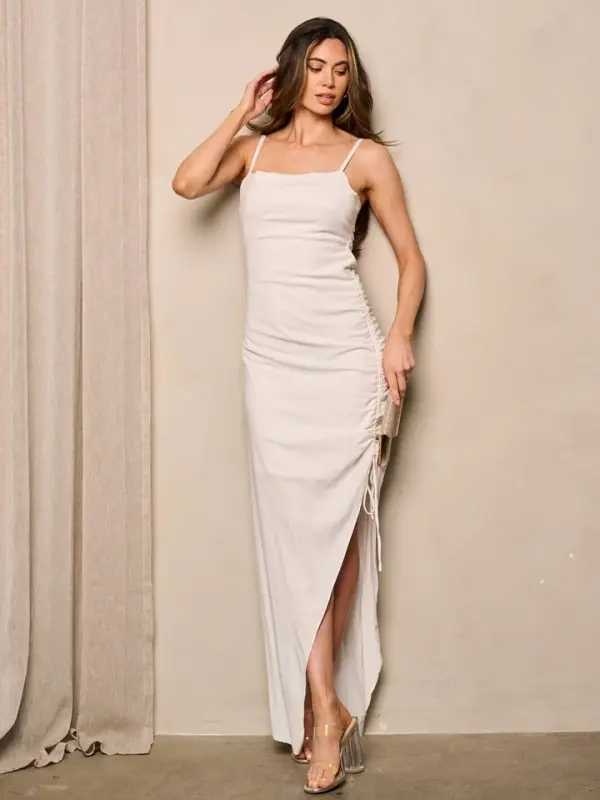
Side-Ruched Bodycon
- Best suited to stretch jersey, stretch mesh, and selected stretch crepes.
- Review waist-to-hip balance, seam direction, hem level, and recovery after fitting.
- Lock the PP reference before bulk so operators follow the same gathered section rather than arranging folds by eye.

Waist and Abdomen Ruching
Waist and abdomen ruching can create a softer fitted line and reduce the visual severity of a close bodycon silhouette. Placement must follow the intended waist position rather than simply gathering a rectangular area. Too little fullness can look flat; too much can create bulk and shorten the torso visually. Pattern development should establish where fullness enters the panel, how it is distributed, and whether the inner layer remains smooth.
- Check front and side appearance on the body, not only on a hanger.
- Match gather volume to fabric weight and recovery.
- Keep lining tension separate from the outer gathered layer when a smooth inner fit is required.

Bust and Center-Front Ruching
- Suitable for fitted mini, midi, corset-inspired, and occasion silhouettes.
- Review bust coverage and neckline stability through movement.
- Use pattern marks and sewing references so the production line does not redistribute fullness differently from the approved sample.

Asymmetric Ruched Dresses
- Confirm the designed high and low points against a mannequin or fit model.
- Check whether the skirt hem remains controlled after the body panel is gathered.
- Record asymmetric placement in the pattern and workmanship notes instead of relying on photographs alone.

Adjustable Drawstring Ruching
Drawstring ruching adds a functional adjustment system, not only a decorative gather. Channel width, cord diameter, exit position, end finishing, maximum adjustment, and fabric friction all affect performance. The gathered area should move smoothly without catching the lining or distorting the neighboring seam. For long side drawstrings, wear safety and final hanging length also need review.
- Test the shortest and longest intended settings.
- Reinforce channel openings and secure the construction against repeated adjustment.
- Confirm how product photography will present the recommended setting while keeping production instructions clear for all units.

Layered Mesh Ruching
Stretch mesh can create fine surface folds with less visual bulk than heavier jersey, making it useful for party, occasion, and fitted dresses. Mesh also amplifies construction errors. Uneven lining tension, mismatched stretch direction, seam waviness, or inconsistent gather density can show immediately. Development should treat the outer mesh and inner layer as a coordinated system rather than two fabrics sewn together at the end.
- Review transparency and coverage at bust, waist, hip, and upper thigh areas.
- Match outer and lining stretch behavior so one layer does not pull the other.
- Check gather distribution under normal lighting and camera lighting before PP approval.

Satin and Draped Ruching
Satin ruching depends more on controlled drape than elastic recovery. Surface shine makes fold direction, stitch marks, puckering, pressure marks, and uneven handling highly visible. The pattern must create enough fullness to form clean folds without making the area heavy. Pressing also requires restraint because excessive pressure can flatten the intended surface or leave gloss changes.
- Use the satin weight and surface finish approved for the sample.
- Keep needle, seam, and pressing methods consistent with the PP reference.
- Protect the ruched area during packing so finished folds are not crushed into random creases before delivery.

Mixed-Construction Ruched Styles
- Map critical seams before sampling and confirm which areas must remain smooth.
- Separate decorative fullness from structural support and closure points.
- Use a first-piece or pilot review when several risk-sensitive details meet in one construction.
Ruching Must Be Engineered Before It Reaches Production
A ruched dress becomes repeatable only when visual intent is translated into measurable pattern, sewing, and inspection references. Hand styling can support photography; it cannot replace a production standard.

Control Placement, Length, and Distribution Before Sewing
Ruching changes garment geometry. Once a panel is gathered, its finished length, seam direction, waist position, hip line, and hem balance can all move. Development should therefore begin by defining where the gather starts, where it finishes, and what the finished gathered section must achieve on the body. A sample-maker can create attractive folds by hand, but an operator handling hundreds of units needs unambiguous marks and a repeatable method.
For fixed ruching, the pattern can carry notches or control points that show the section to be reduced and the corresponding finished length. Elastic-backed construction needs an elastic specification, attachment position, and controlled extension. Drawstring ruching needs channel dimensions, cord route, adjustment range, and secured exit points. Layered mesh needs outer-to-lining relationship marks so the surface folds are not created by accidental lining tension.
Three measurements matter particularly during development: the ungathered panel length, the target finished gathered length, and the position of the gathered section relative to body landmarks such as waist and high hip. They should be read together rather than treated as isolated numbers. A 20 mm shift in placement can be more visible on a fitted mini dress than a similar change in a loose maxi skirt, while a small tension change can strongly affect stretch mesh or lightweight jersey.
The sample review should check front, side, and back views. Side seams must remain where the pattern intends them to sit. The hem should not lift unexpectedly on one side. Bust or center-front gathers should not pull the neckline out of position. Once visual approval is close, the accepted construction needs to move into pattern notes, workmanship instructions, and PP references so production does not rebuild the effect from memory.

Make Ruching Repeatable Across Sizes and Bulk Units
The approved sample is only one size. Production must reproduce the same design logic across the brand’s full size range and across multiple operators, bundles, and fabric rolls. Mechanical grading alone can fail because the body grows in several directions while the visual location of the gathers may need a different adjustment. The goal is not to put exactly the same number of folds on every size. The goal is to preserve the intended visual proportion and fit function.
For fitted styles, grading review should track bust, waist, high hip, low hip, side-seam length, body length, and hem opening together with the ruched zone. If the brand expands from a sample size into XS-XL or another established size system, the team should decide whether the gathered section grows proportionally, whether anchor points move, and whether elastic tension changes. Mesh and jersey may require different rules even when the two garments share the same silhouette because recovery and surface bulk are different.
Bulk repeatability also depends on production references. PP approval should record the accepted fabric, lining, elastic or cord, pattern version, finished gathered length, key placement, seam appearance, and visual reference. First-piece review can then verify whether the line is reproducing the same construction before full output builds. Inline inspection should sample the points most likely to drift, especially side-seam position, gather distribution, elastic tension, hem level, and symmetry where symmetry is intended.
Ruching is successful when the finished dress looks deliberately shaped without needing a stylist to rearrange every unit. That standard links design, technical development, sewing, and QC into one production method.
Match Each Ruching Method to the Intended Product Effect
Construction choice changes fit, adjustability, labor, visual texture, and bulk risk. The method should be selected from the target silhouette and fabric behavior, then confirmed during sampling before a production standard is released.
| Ruching Method | Best Use | Main Control Point | Common Production Risk | Bulk Standard |
|---|---|---|---|---|
| Fixed stitched gathering | Waist, bust, center-front, decorative panel shaping | Finished gathered length and distribution marks | Uneven density, flat zones, inconsistent folds | Pattern notches, finished length, visual PP reference |
| Elastic-backed ruching | Side seams, bodycon panels, stretch jersey | Elastic length, extension, attachment position | Excess tension, loose recovery, side-seam distortion | Elastic specification, stitch method, tension check |
| Drawstring ruching | Adjustable side or center panels | Channel width, cord route, adjustment range | Channel twisting, cord imbalance, weak exits | Channel spec, cord length, reinforced openings |
| Side-seam integrated ruching | Waist-to-hip shaping in fitted dresses | Seam balance and front-to-back panel relationship | Side seam pulled forward or backward | Seam position, gathered section length, fit reference |
| Layered mesh ruching | Sheer party and occasion styles | Outer-to-lining stretch and coverage | Lining drag, mesh waviness, transparency drift | Layer relationship, stretch direction, opacity review |
| Draped gathered panel | Satin, crepe, occasion silhouettes | Grain, fullness, fold direction, seam handling | Puckering, random folds, excessive bulk | Pattern fullness, seam finish, pressing and packing reference |
Fabric Behavior Determines How Ruching Looks and Recovers
Jersey for Fitted and Repeatable Ruching
Jersey is often chosen for bodycon and commercial ruched dresses because stretch allows the garment to fit close to the body while gathered sections add visual softness. The development question is not whether the fabric stretches; the important question is how consistently it recovers after wear, fitting, sewing, and washing. A soft low-weight jersey can create fine folds, yet it may also become too transparent, expose body lines, or lose shape around the waist and hip. A heavier jersey may provide coverage and cleaner support but can make dense gathering bulky.
Fabric review should record weight, stretch direction, stretch ratio, recovery, handfeel, opacity, shrinkage behavior, and surface stability. For a side-ruched bodycon dress, horizontal recovery influences circumference and seam position, while vertical stretch can affect body length and hem level. When elastic is added, the elastic tension must work with the fabric rather than overpower it. The inner layer, if used, should have compatible stretch so the garment does not form hidden drag lines.
During sampling, the team should fit the garment after the fabric has been handled and stretched, not only immediately after sewing. A recovery problem may appear after sitting, pulling the dress over the hips, or repeated fitting. The approved material direction then needs to be locked for PP and bulk, including any relevant color or batch considerations. For repeat styles, a fabric replacement should not be approved solely because composition looks similar on a supplier sheet; the new material should reproduce the required recovery, coverage, and gather response on the garment.

Mesh for Fine Surface Ruching and Controlled Transparency
Stretch mesh creates a lighter gathered surface and can build depth without the same bulk as jersey. It is especially useful for partywear, going-out styles, fitted occasion dresses, asymmetric panels, and designs where a visible layered effect matters. Mesh also exposes small inconsistencies quickly. A difference in stretch direction, lining tension, or seam handling can create rippling, twisting, or uneven transparency across the body.
Development should distinguish sheer stretch mesh, power mesh, printed mesh, embroidered mesh, and decorative mesh because each behaves differently. A soft sheer mesh can gather easily but may need a supportive lining. Power mesh can provide more control but may look too firm for delicate surface folds. Printed mesh adds another variable: the print can distort when stretched, and gather density changes how much of the motif remains visible. Lining color and coverage must be reviewed under the lighting conditions relevant to the finished product.
For layered ruching, outer and inner patterns should be coordinated rather than cut as identical shapes by default. The outer layer may carry extra length for gathering while the inner layer remains cleaner and more fitted. Seam allowances, zipper areas, armholes, necklines, and hems need enough stability to stop the mesh from rolling or waving. PP review should include transparency, fold distribution, seam appearance, and body coverage together because a visually attractive mesh sample can still fail wearability if the inner layer shifts during movement.

Satin, Crepe, and Woven Fabrics Need Drape Control
Ruching in satin, crepe, chiffon, and other woven fabrics relies more heavily on controlled fullness, fold direction, grain, and seam handling than on stretch recovery. Satin is particularly unforgiving because light reflects from the surface and magnifies puckering, needle marks, random fold direction, pressure marks, and handling damage. The pattern must create enough fullness to form intentional folds without producing a thick bundle at the seam or zipper.
For satin, the team should review fabric weight, surface shine, drape, grain direction, slip, seam response, and pressing behavior before the style is released. The same design can move from polished to inexpensive-looking if the fabric is too thin, the seam allowance becomes visible through the face, or pressing flattens the folds. Stretch satin can add fit flexibility, but recovery still needs review because the gathered section may relax differently from the smooth areas.
Crepe can offer more surface grip and may hold folds with less visible shine, while chiffon often needs additional layers or lining to control transparency and edge stability. In all woven options, the gathered panel should be engineered into the pattern rather than created by pulling excess fabric until it looks acceptable. Production notes should specify the approved fold direction, seam finish, pressing approach, and packing protection. Material choice is therefore part of the ruching standard, not a separate sourcing decision made after the silhouette is approved.

Pattern, Fit, and Grading Keep Ruching in Position
Build the Pattern Around Body Balance and Fabric Behavior
A ruched dress pattern cannot be developed as a smooth fitted block with gathering added at the end. The extra fullness changes seam lengths, panel relationships, waist position, hip curve, and sometimes neckline or hem balance. Pattern work should begin from the brand’s intended fit direction – body-hugging, shaped, softly fitted, draped, or structured – and then identify which part of the garment carries the visual fullness and which part must remain stable.
For side-ruching, the front and back panels must meet the side seam without pulling the seam around the body. For center-front or bust ruching, the pattern needs to preserve neckline coverage and center-front length. For asymmetric designs, diagonal tension must be controlled so one hip or shoulder does not rotate the garment. In layered mesh styles, the outer pattern may include additional length while the lining pattern stays smoother, requiring separate control rather than mirrored pieces.
Fit review should connect pattern measurements with real body landmarks. Bust, waist, high hip, low hip, body length, side seam, hem opening, neckline, and strap or sleeve positions all influence how the gathered zone reads on the body. A ruched section that starts too high can shorten the torso; one that finishes too low can pull the skirt line. The same location can also behave differently when fabric recovery changes, so pattern correction and fabric approval should move together.
Duolan’s development process uses tech packs, reference images, original samples, size specifications, fitting feedback, and pattern revisions as linked inputs. Fit comments are not treated as surface styling notes. When the issue comes from pattern balance, the correction should return to the pattern and then be carried into the next sample, PP reference, measurement standard, and production file. That creates a repeatable basis rather than a one-sample fix.
Grade the Visual Effect, Not Only the Measurements
Grading is where many ruched styles lose their original design language. Increasing bust, waist, and hip measurements by a standard rule does not automatically preserve the same gathered proportion. A brand may want the XS sample to show a compact side gather and the XL to maintain the same visual waist emphasis, but the larger size may require a longer gathered zone, adjusted anchor positions, different elastic extension, or a revised balance between smooth and gathered areas.
The grading review should define which dimensions follow the brand’s normal size rule and which construction values need style-specific control. Critical points often include bust, waist, high hip, low hip, body length, side-seam length, gathered start and end points, finished gathered length, hem opening, slit height, and lining length. When a style uses stretch jersey or mesh, negative ease and recovery must be considered alongside the numerical grade. When it uses satin or woven draping, added fullness and vertical balance become more important.
A full-size range does not need identical fold counts. It needs a consistent design effect. The sample size establishes the visual target; graded patterns translate that target into each size. Fit samples or size-set review can then identify whether the side seam remains vertical, the waist still sits at the intended point, the hem is level, the gathered zone covers the same body area proportionally, and the fabric is not over-stretched in larger sizes.
Once approved, grading rules should connect to the spec sheet, PP sample, measurement tolerance, and QC checkpoints. Repeat orders should reuse the same pattern version and recorded standards unless a controlled change is approved. That continuity helps keep a proven ruched style recognizable across seasons instead of slowly drifting in fit or gather placement from one production run to the next.
Sampling Turns Visual Ruching Into a Production-Ready Standard
Development Basis
Before cutting the first sample, the team should define what is being approved: silhouette, fabric direction, fit, visual gathering, construction, or production readiness. Inputs can include a tech pack, reference image, original garment, brand size chart, material direction, and launch timing. For a ruched style, the brief should also identify the intended gather location, whether the effect is fixed or adjustable, the priority body areas, and any smooth zones that must remain free from drag or bulk.
- Confirm sample purpose before work begins.
- Identify missing measurements, material information, and closure or lining details.
- Flag risk-sensitive points before the sample is sewn.
First Prototype
- Review front, side, and back views.
- Separate fit issues from surface styling issues.
- Record pattern changes before the next version.
Fit and Ruching Review
- Track body landmarks and seam position.
- Check stretch recovery after fitting.
- Confirm the target finished gathered length where applicable.
Revised Sample
- Carry accepted comments into the pattern and workmanship file.
- Compare the revision with the previous version.
- Identify any remaining items that must be reviewed before PP.
Photo or Sales Sample
- Check camera-visible seam lines, transparency, and fold direction.
- Confirm color and surface finish under relevant lighting.
- Keep production-sensitive details aligned with the developing PP standard.
PP and Bulk Basis
- Use PP approval for first-piece and inline comparison.
- Keep the approved pattern, spec, BOM, and workmanship points aligned.
- Record later approved changes before full production continues.
Workmanship Controls the Shape Behind Every Visible Gather

Control Elastic, Stitching, Channels, and Seam Transitions
Fixed gathering, elastic-backed ruching, and drawstring systems require different sewing controls. Fixed gathering depends on even distribution between marked points and a secure final seam that does not allow fullness to migrate. Elastic-backed ruching requires the correct elastic length, extension, stitch method, and attachment position. Too much tension can shorten the panel, distort the side seam, or create harsh ridges; too little can flatten the effect and reduce recovery. Drawstring systems add channel width, cord movement, exit reinforcement, and end finishing to the standard.
The transition between gathered and smooth areas is equally important. A side-ruched panel beside a concealed zipper can become bulky if seam allowance, elastic, lining, and zipper tape stack in the same zone. Mesh over a smooth lining can wave if the two layers are joined under different tension. Satin can show every needle mark or seam pucker where fullness is secured. Workmanship planning should therefore define where bulk is allowed, where seam allowance should be reduced, how layers are stabilized, and how the ruched section ends cleanly.
Operators need reference points that can be checked during production. Pattern notches, elastic marks, channel dimensions, seam specifications, finished gathered length, and PP images can all support repeatability. The goal is not to force every fold into the exact same shape. The goal is to control the construction variables that determine the overall silhouette, density, and placement. A finished unit should still look correct after normal handling without requiring a specialist to restyle the garment at the end of the line.

Finish the Inside, Closure, Hem, and Pressing for Wear
Ruched dresses are frequently close-fitting, so inner construction affects comfort as much as appearance. Lining should provide coverage and support without fighting the outer fabric. Elastic ends and gathering stitches should not create hard points against the skin. Zipper seams need enough stability to remain flat beside gathered panels. Armholes, necklines, slits, and hems should be finished according to fabric weight and stretch rather than using one standard method for every style.
Pressing requires special control. Jersey and mesh can be stretched out of shape by excessive handling, while satin can develop gloss changes, pressure marks, or flattened folds. Final pressing should clean seams and restore the intended silhouette without erasing the texture created by ruching. Packing also matters: dense side gathers or satin folds can be crushed if the garment is folded directly through the most dimensional area. The approved packing method should protect the visual zone rather than treating the dress as a flat basic garment.
Workmanship review should include the outside and the inside. Useful checks include seam security, elastic anchoring, thread tension, lining attachment, zipper flatness, channel opening strength, drawcord symmetry, hem level, pressing marks, and loose threads around heavily gathered areas. For stretch styles, a gentle extension check can reveal seam stress before the problem appears during wear. For satin and lightweight woven styles, visual inspection under angled light can reveal puckering or needle damage that may not be obvious under flat factory lighting.
Verify Risk-Sensitive Ruched Styles Before Full Production Release
New fabrics, new constructions, high-volume launches, and complex combinations benefit from first-piece or pilot verification. The goal is to catch repeatability problems while corrections are still controlled and traceable.
First-Piece Fit Check
- Compare key dimensions and visual body balance with PP.
- Confirm side-seam and gathered placement before larger quantities build.
- Record any line adjustment before release.
Ruching Repeatability Check
Ruching should be checked as a production feature, not only as a final styling detail. A short pilot can compare several pieces for finished gathered length, density, elastic tension, left-right balance, or drawstring operation. The objective is to see whether different operators and bundles create the same overall effect. If one unit is dense and compact while another is loose and flat, the problem should be corrected in the operation method or reference standard before the difference becomes a large inspection issue.
- Compare multiple units rather than selecting the best-looking one.
- Check anchor points, elastic marks, and seam balance.
- Confirm whether PP photos and written standards are clear enough for the line.
Fabric and Lining Check
- Review weight, stretch, recovery, opacity, and surface appearance where relevant.
- Check matching of lining, elastic, cord, zipper, and other functional components.
- Escalate material differences before the line compensates for them with inconsistent sewing.
Workmanship and Finish Check
The pilot stage also verifies whether the planned sewing sequence is efficient and stable. Excess bulk beside a zipper, weak drawstring exits, uneven elastic extension, mesh waviness, satin puckering, or pressing damage can all become systematic defects when the operation is repeated. A first-piece note should capture what was accepted, what was adjusted, and which points need extra inline attention.
The record becomes a production tool rather than an audit document created after problems have already spread.
- Confirm critical seam and finishing methods.
- Identify additional inline checkpoints for risk-sensitive operations.
- Release full production only after the accepted method is clear.
Move Approved Ruched Samples Into Controlled Bulk Production

PP Standard Lock

Material Preparation

Cutting and Marking

First-Piece Release
A first production piece or controlled pilot is reviewed against the PP standard before full output. Fit, gathered placement, seam balance, elastic tension, lining behavior, closure areas, and finish can be checked while corrective action remains contained and easy to communicate.
The accepted first-piece result should be recorded so operators, line supervision, and QC work from the same confirmed method before volume increases.

Inline Production Control

Final and Packing Review
Final inspection confirms measurements, appearance, workmanship, function, labels, packing, and order requirements before shipment. Ruched areas are reviewed after final pressing and handling, because an acceptable sewing result can still lose its intended appearance through poor finishing or packing pressure. Packed units should recover to the approved silhouette after unpacking, with adjustable cords, gathered panels, lining, and closures remaining secure and presentation-ready.
Ruched Dress Quality Control Focuses on Repeatable Visual Standards
QC is most effective when each visible problem is connected to a likely cause and an earlier control point. Ruched styles need measurements, material checks, and visual comparison working together from PP through final inspection.
| Risk | Likely Cause | Pre-Production Control | Inline Check | Final Acceptance Focus |
|---|---|---|---|---|
| Uneven gathering | Unclear distribution marks or inconsistent sewing | Lock placement, finished length, and method in PP file | Compare density and start/end points across units | Balanced visual distribution within approved style intent |
| Side-seam twisting | Panel imbalance, stretch direction, or uneven gather tension | Review pattern and grain/stretch direction | Check seam position on flat garment and body form | Side seam remains in intended line without torque |
| Flat ruched zones | Insufficient fullness or weak elastic recovery | Confirm pattern fullness and elastic specification | Check gathered length and recovery | Surface retains approved texture after handling |
| Excessive bulk | Too much fullness, heavy fabric, or stacked seam allowances | Review fabric weight and seam construction | Inspect transition points and closure areas | Gathered area remains shaped without hard lumps |
| Elastic tension variation | Inconsistent elastic length or extension | Mark elastic length and attachment method | Compare several units and size groups | Fit pressure and gather density remain consistent |
| Size-to-size visual drift | Mechanical grading without style-specific adjustment | Review anchor points and gathered zone by size | Compare size set or graded production samples | Design effect remains proportionally consistent |
| Mesh distortion | Outer and lining stretch mismatch or sewing drag | Approve layer relationship and stretch direction | Check waviness, transparency, and seam alignment | Mesh lies cleanly with intended coverage and folds |
| Satin puckering | Needle, seam tension, grain, handling, or pressing | Confirm sewing and pressing method on PP | Inspect seams under angled light | Smooth surrounding surface with controlled folds |
| Drawstring imbalance | Unequal cord length, channel friction, or weak exits | Lock channel and cord specifications | Test adjustment range and end security | Both sides function evenly and remain securely finished |
| Packing flattening | Folding through dimensional gathered areas | Approve folding and protection method | Review packed sample if needed | Garment recovers to intended appearance after unpacking |
Production Evidence Shows How Ruched Standards Are Controlled
The strongest manufacturing proof is process evidence connected to a specific decision. Each image should show what was checked, corrected, or locked rather than functioning as a generic factory photograph.
Pattern Control Evidence
- Best visual: pattern close-up plus marked control points.
- Proof value: design intent becomes a repeatable cutting reference.
Fabric Behavior Evidence
- Best visual: stretch/recovery sequence or drape comparison.
- Proof value: material decisions are linked to fit and gathering.
Sample Review Evidence
- Best visual: before/revised comparison with one technical note.
- Proof value: comments are translated into development actions.
First-Piece Evidence
Show the first production piece being measured or compared with the PP reference at the ruched area. The most useful photographs focus on finished gathered length, side-seam position, elastic marks, zipper transition, or size balance rather than a wide production-floor view. A short first-piece record can support the image by showing which points were accepted and which operation was adjusted before full release.
- Best visual: PP reference beside first production piece.
- Proof value: sample standards are checked before volume builds.
Inline QC Evidence
- Best visual: measurement or visual comparison on several units.
- Proof value: variation is detected during production, not only at final inspection.
Packing and Repeat Evidence
- Best visual: finished garment, packing method, and masked repeat record.
- Proof value: visual standards continue through delivery and future orders.
Anonymous Ruched Collection Case From Sample Correction to Bulk

Development Problem, Review, and Correction
The collection was planned around close-fitting mini and midi silhouettes where the visual result depended on clean waist definition and controlled hip shaping. Initial development showed three recurring risks. First, side-ruching on stretch jersey was pulling selected side seams forward after fitting. Second, a mesh-overlay style showed acceptable surface folds on the mannequin but developed drag lines because the inner layer recovered faster than the outer mesh. Third, one satin-blend style carried too much fullness into the zipper area, creating visible bulk and irregular fold direction.
The development team separated each issue by root cause rather than treating every comment as a sewing adjustment. The jersey style required pattern rebalance and a revised finished gathered length. The mesh style required different outer-to-lining length and stretch handling. The satin-blend style needed reduced fullness near the closure, a cleaner transition point, and revised pressing instructions. Each correction was carried into the pattern or workmanship basis before the next sample round.
The program used 2 structured sample review rounds for the risk-sensitive styles before PP approval. Review focused on front, side, and back fit; waist and hip balance; gathered start and end points; fabric recovery; lining behavior; zipper transition; hem level; and camera-visible surface finish. The objective was not to force every style through the same construction. Each style received a standard matched to its fabric and silhouette while the collection retained a consistent fitted visual language.

PP Lock, Production Control, and Collection Delivery
Before bulk release, each of the 16 styles had its own PP basis linked to the approved pattern, material direction, measurement priorities, workmanship points, and visual references. Production planning grouped styles by construction family so stretch jersey, mesh-layered, and woven ruched styles could follow the most suitable sewing and inspection path. The production team used first-piece review for the higher-risk constructions rather than allowing early line output to become the de facto standard.
Inline control emphasized the areas most likely to create visible differences across units: side-seam position, finished gathered section, elastic tension, mesh-to-lining relationship, zipper flatness, hem balance, and size-to-size proportion. The XS-XL range was not checked only by total garment measurements. Inspectors also compared the location and visual scale of the ruched zones so larger sizes did not become either unusually flat or excessively dense relative to the approved design.
Packing methods were adjusted by material group. Stretch jersey styles were folded to avoid hard pressure through the densest side gathers. Mesh styles were handled to prevent snagging and layer distortion. Satin-blend styles received more attention around pressing and fold placement to reduce surface marks before packing. The project record retained pattern versions, PP references, material details, and risk notes for future repeat production or color extensions.
The commercial value of the process was straightforward: a ruched collection was treated as a group of controlled fit and construction standards, not as 16 visually similar garments. That approach allowed style-specific corrections to remain traceable from sample review into production while keeping the collection coherent across materials, sizes, and color families.
Manufacturing Capacity for Multi-Style Ruched Dress Programs
Manufacturing Network
- 16 self-owned womenswear fashion factories.
- 20+ long-term satellite factories.
- Coordinated manufacturing resources in several production regions.
Production and Development Density
- 300 garment sewing lines across the manufacturing system.
- 50+ quick-response and flexible lines.
- 15,000-35,000 monthly sample development capacity across the group.
Compliance and Brand Requirements
- SMETA / SMETA 2-Pillar audit record within the manufacturing system.
- Support for project-specific testing, quality, labeling, and documentation requirements.
- Factory visits, video communication, and ongoing project coordination are available for qualified programs.









Ruched Dress Manufacturing Frequently Asked Questions
Jersey and stretch mesh are common for fitted ruching because they combine stretch with surface shaping, while satin, crepe, chiffon, and selected woven fabrics can create softer draped gathers. The best choice depends on silhouette, weight, recovery, opacity, lining, fold scale, target finish, and production method. A fabric should be evaluated on the garment rather than selected from composition alone.
Side-seam twisting is reviewed through pattern balance, grain or stretch direction, front-to-back panel relationship, gather placement, and sewing tension. During fit and first-piece review, the seam is checked against the intended body line. If ruching pulls the seam forward or backward, correction should return to the pattern, gathered length, or tension standard rather than being hidden by final styling.
Grading starts from the brand’s size specification and approved sample effect. Bust, waist, high hip, low hip, body length, side seam, gathered start and end points, and fabric recovery may all influence the rule. Larger sizes do not automatically receive identical fold counts or identical gathered lengths. The objective is to preserve proportional visual placement and fit across the full size range.
Yes. Development can begin from reference images, tech packs, original samples, size charts, fabric directions, or mixed project information. A review first identifies the intended silhouette, ruching construction, fit priorities, missing measurements, material risks, and sample purpose. Reference images are treated as development input, not as a substitute for pattern, material, and production specifications.
Sample lead time is confirmed after style complexity, fabric availability, trim requirements, pattern work, ruching method, and sample purpose are reviewed. A simple fixed time is not applied to every style. The sample proposal should identify the development path, expected timing, material or construction dependencies, revision needs, and the approval points required before the project can move toward PP and bulk production.
The PP basis can lock the approved pattern version, fabric and lining, measurements, ruching placement, finished gathered length where relevant, elastic or drawcord specifications, closures, workmanship, seam appearance, pressing, labels, packing, and key visual references. The production line, first-piece review, and inline QC should compare against the same approved basis rather than different earlier samples.
Inspection combines measurement and visual checks. Common focus points include gather start and end placement, finished gathered length, density, side-seam position, elastic tension, drawstring function, mesh and lining alignment, zipper flatness, hem balance, size-to-size proportion, pressing, and packing appearance. Risk-sensitive points are checked during production as well as at final inspection.
The company’s general bulk production reference is about 15-20 days for simple styles, 20-30 days for regular styles, and 30-45 days for complex styles. Final timing depends on fabric and trim readiness, colorways, order volume, ruching construction, special processes, approval status, and production allocation. A confirmed production timeline should follow PP and material readiness rather than a headline lead-time promise.
MOQ is reviewed according to fabric and trim minimums, color count, size range, construction, special processes, order structure, and the broader production plan. Ruched jersey, mesh, satin, and drawstring styles can have different material and operation constraints. The most useful quotation therefore starts from the actual style list, quantities, colorways, material direction, and launch plan rather than one generic MOQ number.
Yes, when the previous production basis remains valid. Pattern version, BOM, material direction, size specification, PP or golden reference, workmanship notes, QC focus points, packing requirements, and previous approved changes can be retained for repeat production. Any new fabric batch, color, size extension, trim substitution, or construction change should be reviewed before the prior standard is assumed to apply unchanged.

Send Your Ruched Dress Program for Development Review
Send the information already available for your next ruched dress program, and our team can review the development path before sampling or bulk planning begins. Useful inputs include a tech pack, reference images, original sample photos, brand size chart, target fabric, colorways, estimated quantities, launch timing, and any fit or workmanship concerns. The review focuses on the points that can change the finished result: ruching placement, fabric behavior, body balance, lining, stretch recovery, grading, construction method, sample stage, and production repeatability.
For an established style, include the current approved sample details or previous production standard so changes can be identified clearly. For a new development, provide the visual direction and commercial requirements already decided by your team. A complete brief helps separate pattern, material, sample, and production questions early, while distinguishing visual preferences from measurable production requirements before quotation, sampling, or line planning is finalized for the intended launch and production route.
Please include where available:
- Tech pack, reference image, original sample photos, and brand size chart.
- Fabric and lining direction, ruching position, construction method, and key fit concerns.
- Colorways, estimated quantity, target launch date, delivery market, and sample purpose.
- Label, packing, inspection, testing, or compliance requirements relevant to the program.