Skip to content
Scalable Womenswear Manufacturer
Scalable womenswear manufacturing for established fashion brands growing across styles, volume, repeat orders and delivery channels.
Duolan helps fashion brands move from approved samples and planned bulk orders into larger, repeatable womenswear programs. Our manufacturing system supports multi-style development, PP-controlled bulk production, repeat order reuse, QC consistency, packing accuracy and long-term supply growth.
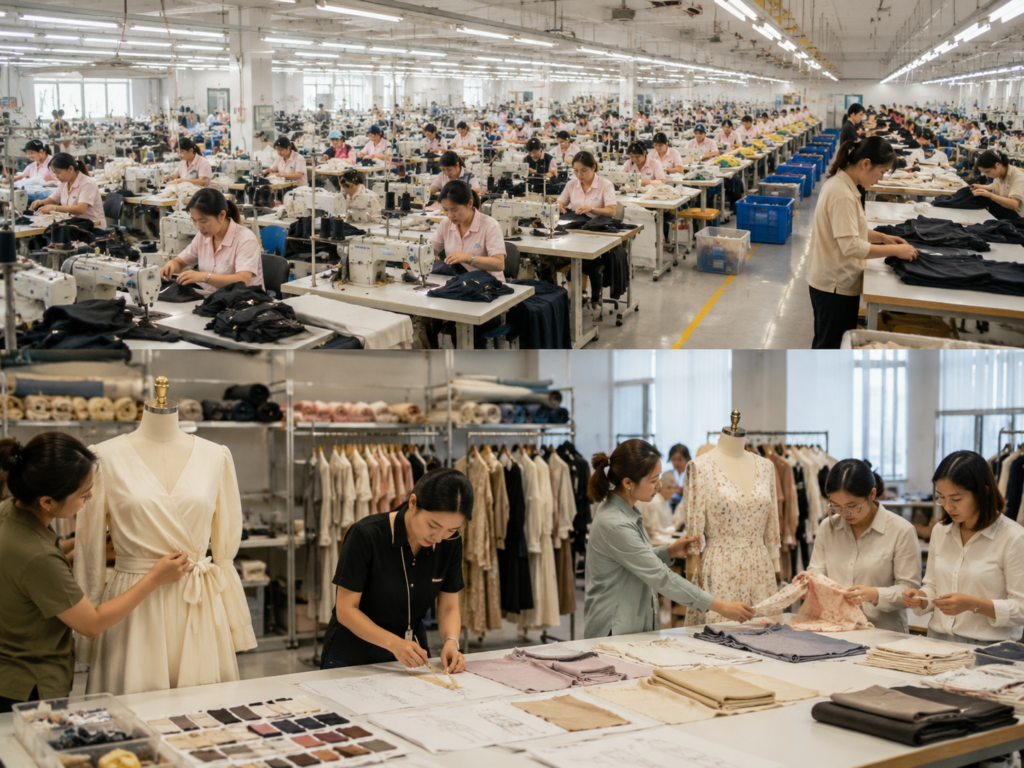
- 16 owned womenswear factories support direct control for key styles and PP-standard production.
- 20+ satellite factories support capacity extension, repeat orders and multi-style allocation.
- 300 sewing lines support parallel production across dresses, sets, tops and structured womenswear.
- 50+ quick-response lines support sampling, test production and launch preparation.
- 15,000–35,000 monthly samples support frequent development and revision cycles.
- 3,000–8,000 monthly style development flows support multiple programs in parallel.
- 6,500,000 stable monthly capacity supports planned bulk and repeat production.
- SMETA 2-Pillar audit record supports supplier evaluation for established fashion brands.







Scalable Manufacturing Means More Than Larger Volume
Scalable womenswear manufacturing is not only larger order quantity. Growth creates pressure across every part of production: sample standards, fabric sourcing, production routing, QC, packing, delivery waves and repeat order records. A supplier with capacity alone may still lose control when style count, colors, sizes and shipment requirements increase.
For Duolan, scalable manufacturing means a brand can grow without rebuilding the supply chain from zero for every order. Approved samples become PP standards. BOM records become reorder tools. Fabric records protect color and handfeel. Style-level QC points guide production. Packing standards support warehouse receiving. Repeat programs become more stable with every cycle.
Growth in womenswear creates specific risks. Fit drift, fabric batch variation, lining inconsistency, surface damage, SKU confusion and packing errors can become larger when order size increases. Duolan’s role is to keep standards visible while production volume, style count and delivery complexity expand.
Built for Established Womenswear Growth
Duolan supports brands with existing product direction, launch rhythm, order planning and repeat potential. Strong scalable projects usually involve confirmed styles, approved samples, multi-style production needs, larger quantity planning or repeat order programs.
Global Fashion Brands
- Need manufacturing systems able to support multi-market launches, seasonal drops and repeat production.
- Require stable standards across styles, colors, sizes, labels, packing formats and delivery waves.
- Duolan helps keep development, production, QC and packing aligned as order volume grows.
Regional Fashion Leaders
- Often grow through frequent launches, bestsellers, replenishment and stronger seasonal planning.
- Need suppliers able to respond faster while keeping fit, fabric, finishing and packing consistent.
- Duolan supports regional growth through sample capacity, quick-response lines, bulk production and repeat records.
Dress-focused Womenswear Brands
- Dress programs carry higher sensitivity around fit, drape, lining, zipper, hem, pressing and packing.
- Scaling dress production requires more than sewing capacity; approved standards must remain stable across volume.
- Duolan supports fashion dresses, occasion dresses, party dresses, fitted dresses and resort styles.
Product Development Teams
- Need approved samples, BOM records, size specs and PP standards able to move into bulk without confusion.
- Multi-style development requires sample priority, shared fabric review and style-level risk control.
- Duolan connects sample decisions with production records for stronger scaling.
Sourcing and Procurement Teams
- Evaluate suppliers by capacity, compliance, quality process, delivery control and repeat order stability.
- Scaling projects need clear answers on factory routing, QC, packing, shipment and documentation.
- Duolan provides structured production evaluation for growing womenswear programs.
Multi-brand Groups
- Need different product standards, price levels, launch windows and packing requirements managed separately.
- One group may run occasionwear, partywear, resort styles and commercial RTW at the same time.
- Duolan’s owned factory and satellite factory structure supports controlled multi-line manufacturing.
Scalable vs Bulk vs Standard Production
Scalable womenswear manufacturing should be separated from ordinary production and one-time bulk orders. The goal is long-term production control as a brand grows.
| Manufacturing Type | Main Focus | Brand Question | Duolan Role |
|---|---|---|---|
| Standard Production | Complete one confirmed order | Can the factory make the approved style? | Execute approved product standards |
| Bulk Manufacturing | Produce larger confirmed quantities | Can the factory deliver current volume? | Manage bulk output, QC and shipment |
| Scalable Manufacturing | Support growth across styles, seasons and repeat orders | Can the supplier grow with us without losing control? | Build repeatable production, QC and delivery system |
| Quick-response Production | Support urgent launches or replenishment | Can the supplier react faster? | Support samples, test orders and selected replenishment |
| Long-term Supply Partnership | Support brand growth over time | Can the supplier improve with each order? | Reuse BOM, PP samples, QC notes and packing standards |
When a Brand Needs Scalable Womenswear Manufacturing
A brand usually needs scalable manufacturing when orders become larger, styles increase, repeat programs become frequent, and delivery channels become more demanding. At this stage, production must depend on records and systems, not only personal follow-up.
Orders Are Getting Larger
Larger orders create more pressure on fabric control, production routing, QC and packing. A supplier must keep approved sample standards visible while quantity grows from launch order to repeat or seasonal bulk.
- Brand orders may move toward 20,000–80,000 pieces per program.
- Style count may increase from several garments to 10–30 styles.
- More colors, sizes, labels and packing combinations create more operational risk.
- PP samples, BOM records, size specs and QC points must be clear before volume increases.
Style Count Is Increasing
Multi-style production is harder than single-style volume. Different fabrics, structures, trims and finishing methods require separate handling, even under one launch plan.
- Satin dresses, mesh partywear, fashion sets and refined tops need different production rhythms.
- Sampling, PP approval, fabric booking, cutting, sewing, QC and packing should be managed by style group.
- Shared material styles need early fabric and shade confirmation.
- Strong style grouping reduces confusion before production pressure begins.
Orders Are Getting Larger
Larger orders create more pressure on fabric control, production routing, QC and packing. A supplier must keep approved sample standards visible while quantity grows from launch order to repeat or seasonal bulk.
- Brand orders may move toward 20,000–80,000 pieces per program.
- Style count may increase from several garments to 10–30 styles.
- More colors, sizes, labels and packing combinations create more operational risk.
- PP samples, BOM records, size specs and QC points must be clear before volume increases.
Style Count Is Increasing
Multi-style production is harder than single-style volume. Different fabrics, structures, trims and finishing methods require separate handling, even under one launch plan.
- Satin dresses, mesh partywear, fashion sets and refined tops need different production rhythms.
- Sampling, PP approval, fabric booking, cutting, sewing, QC and packing should be managed by style group.
- Shared material styles need early fabric and shade confirmation.
- Strong style grouping reduces confusion before production pressure begins.
Repeat Orders Are Becoming More Frequent
Repeat orders are a sign of product growth, but also a test of production memory. A strong supplier should make the second and third order more stable than the first.
- BOM, patterns, PP samples, lab dips and QC notes should remain usable after shipment.
- Reorders should not restart from visual memory or scattered messages.
- Fabric batch, shade band, handfeel and stretch need comparison against original standards.
- Repeat programs improve when previous defects become production reminders.
Delivery Channels Are More Complex
As brands expand into ecommerce, retail, wholesale, marketplace or multiple warehouses, packing accuracy becomes part of manufacturing quality.
- Barcode, polybag, hangtag, carton mark and packing ratio must match channel requirements.
- Multi-style, multi-color and multi-size orders need clean SKU separation.
- Split shipments should align with launch windows and warehouse receiving plans.
- Packing errors become operational cost after goods arrive.
Scalable Womenswear Product Range
Duolan’s scalable womenswear capability focuses on fashion-led products where development quality, fit control, material stability and repeat order records protect brand growth.

Dress Collections
Dress collections often carry the strongest visual and commercial identity in a womenswear line. Scaling dress production requires fit control, fabric consistency, hem balance, pressing and packing discipline across sizes and repeat batches.
- Suitable for fashion dresses, mini dresses, midi dresses, maxi dresses and occasion styles.
- Scaling focus includes PP sample reuse, size tolerance, fabric batch control and repeat records.
- Main risk appears when fit, lining, zipper and finishing standards are not locked before bulk.
- Strong records help repeat colors, extend lengths and protect bestseller continuity.

Occasionwear Lines
Occasionwear has higher expectations for polish, movement, support and final presentation. Scaling event-driven dresses means production cannot sacrifice finish when volume increases.
- Suitable for cocktail, graduation, wedding guest, semi-formal and formal-inspired pieces.
- Scaling focus includes lining, support, zipper strength, drape, pressing, stain control and packing.
- Event-season pressure requires clearer sample, material and shipment timing.
- Quality drift can damage brand trust quickly in eventwear categories.

Partywear Programs
Partywear scales differently because visual impact often comes from risky fabrics and details. Mesh, sequins, cut-outs, halter structures and shine fabrics need stronger production control.
- Suitable for mesh, sequin, cut-out, halter, backless and bodycon party styles.
- Scaling focus includes stretch recovery, opacity, edge finishing, lining comfort and surface protection.
- High-impact products may create higher defect and return pressure when volume grows.
- Style-level QC points are needed before final inspection.

Fashion Sets
Fashion sets create outfit value, but scaling requires stronger SKU and color control because two garments sell as one product unit.
- Suitable for skirt sets, fitted sets, resort sets and coordinated drops.
- Scaling focus includes color matching, size pairing, waistband control and top-bottom proportion.
- Packing ratio and SKU accuracy must be confirmed before shipment preparation.
- Main risk includes top-bottom mismatch, color shade difference or packing error.

Refined Tops
Refined tops help extend a womenswear line beyond dresses while keeping collection identity. These products require stronger fit and finish than basic tops.
- Suitable for satin tops, corset tops, mesh tops, halter tops and blouse-led extensions.
- Scaling focus includes neckline stability, strap position, label placement and surface finish.
- Fit-sensitive tops should not follow basic apparel production logic.
- Repeatability depends on pattern, fabric and size records.

Resort and Vacation Styles
Resort and vacation styles often use print, color, lightweight fabrics and relaxed silhouettes. Casual appearance does not remove production risk.
- Suitable for printed maxis, vacation dresses, lightweight sets and seasonal capsules.
- Scaling focus includes print placement, shrinkage, opacity, wrinkle behavior and packing protection.
- Main risks include shade variation, print imbalance, uneven hem and packing creases.
- Fabric and print records support future resort repeats.
Scaling Risk Points in Womenswear Manufacturing
Scaling risk is not solved by capacity alone. Duolan reviews growth pressure by style count, fabric stability, fit consistency, repeat order records, factory routing and packing control.
| Scaling Area | What Can Go Wrong | Duolan Control Focus |
|---|---|---|
| Multi-style Orders | Styles compete for sampling, materials and production slots | Style grouping, sample priority, production routing |
| Fabric Batches | Color, shrinkage, handfeel or stretch changes across batches | Fabric records, shade bands, bulk inspection |
| Fit Consistency | Larger volume exposes size and grading problems | PP sample, tolerance control, measurement checkpoints |
| Complex Fabrics | Satin, mesh, sequin, lace or stretch fabrics create more QC risk | Fabric-specific production notes and inspection points |
| Repeat Orders | Reorders restart from zero without usable records | BOM, pattern, PP sample and QC note reuse |
| Multi-factory Production | Standards drift between lines or factories | Unified PP sample, process notes and QC checklist |
| Packing and SKU Control | Barcode, size, color or carton errors affect receiving | Packing standard, carton mark, ratio and SKU checks |
Capacity Structure for Scalable Orders
Duolan’s scalable structure combines owned factory control, satellite capacity, sewing lines, quick-response lines, sampling depth and stable bulk production. The value comes from coordinated layers rather than one production site.
| Capacity Layer | Duolan Data | Scaling Value |
|---|---|---|
| Owned womenswear factories | 16 | Core styles, sensitive products and PP-controlled production can stay under stronger direct control |
| Satellite factories | 20+ | Repeat orders, capacity expansion and multi-style allocation can be coordinated flexibly |
| Sewing lines | 300 | Supports parallel womenswear production across dresses, sets, tops and structured styles |
| Quick-response lines | 50+ | Supports sampling, test orders, selected replenishment and launch preparation |
| Monthly sample capacity | 15,000–35,000 pcs/style-times | Supports frequent development and revision across multiple programs |
| Monthly style development flows | 3,000–8,000 | Supports multiple collections, drops and product lines in parallel |
| Stable monthly capacity | 6,500,000 pcs | Supports planned bulk and repeat production for established fashion brands |
Development-to-scale Handover
A scalable order begins before cutting. Sample decisions must become production standards, material records must become reorder tools, and QC points must match garment risk.
Sample Standards Become Production Standards
- First sample, fit sample and PP sample must not be treated as the same standard.
- Scaling begins after PP sample, BOM, size spec, tolerance, process notes and packing requirements are clear.
- Every sample revision should leave a written record before production starts.
- Larger volume magnifies any unclear sample decision.
BOM and Material Records Stay Reusable
- Main fabric, lining, zipper, trims, labels and packing materials need clear records.
- Reorders should not require every material decision to restart.
- Lab dips, shade bands, fabric batches, supplier references and approved substitutes support repeat production.
- Strong records make replenishment faster and more stable.
Production Notes Travel With Each Style
- Special cutting, reinforcement, seam control, pressing care and packing protection must be written into style notes.
- Satin, mesh, sequin, bodycon, corset and printed garments require different production details.
- Key information should not remain only in messages or sales communication.
- Production notes make multi-line execution more consistent.
QC Points Match Product Risk
- Each product type needs its own inspection focus.
- Satin needs surface and pressing checks; mesh needs opacity and edge checks; bodycon needs recovery and measurement checks.
- Scaling should not depend only on final inspection.
- Style-level QC notes help prevent repeated bulk issues.
Multi-style Production Coordination
Multi-style coordination is one of the strongest signals of scalable manufacturing. A growing brand may run 10–30 styles in one order, with different fabrics, colors, sizes, trims, delivery windows and channel requirements.
Style Grouping
Multi-style orders should be organized by fabric, construction, process risk and delivery priority. Duolan groups styles before production planning so commercial core styles, visual hero styles, repeat styles and complex products receive different handling.
- Commercial core styles can follow stable production routes with stronger efficiency.
- Satin, mesh, sequin, corset and structured products need stronger PP and first-piece confirmation.
- Shared-fabric styles should align color and batch approval before bulk.
- Style grouping improves sampling, costing, factory routing and QC communication.
Material Timing
Material timing often decides the real production calendar. In scalable womenswear programs, fabric approval, lab dips, trims, printing, embroidery, labels and packing materials may all move on different timelines.
- Critical fabrics should be locked before lower-risk materials.
- Shared fabrics must be managed carefully because one change can affect multiple styles.
- Printing, embroidery, dyeing and washing trials need earlier review.
- Material bottlenecks should be identified before bulk production slots are committed.
Production Routing
One production route cannot suit every womenswear product. Duolan matches styles to owned factories, satellite capacity, quick-response lines or familiar process routes based on risk and volume.
- Commercial styles can move through stable lines after PP confirmation.
- Complex dresses and embellished styles should use lines familiar with their construction.
- Repeat styles can reuse proven production paths.
- Satellite factories can support volume once PP sample and process standards are locked.
Packing and Delivery Waves
Scaling continues after sewing. Packing and shipment planning must handle SKU accuracy, channel needs and launch timing.
- Barcode, polybag, carton mark and packing ratio should be confirmed before final packing.
- Ecommerce, retail and wholesale packing requirements may differ.
- Split shipments should align with launch windows and warehouse receiving capacity.
- Packing errors can slow sales even when production quality is correct.
Repeat Order System
Scalable manufacturing proves its value through repeat orders. A strong repeat system makes the next production cycle faster, cleaner and more stable.

BOM Reuse
- Repeat efficiency depends on BOM quality from the first order.
- Fabric, lining, trims, labels, hangtags, polybags and carton materials should remain traceable.
- Approved substitutes need records, not informal replacement decisions.
- Clear BOM records reduce material confusion in future orders.

Pattern and PP Sample Reuse
- Approved patterns and PP samples form the base for repeated styles.
- New colors, length updates or fabric changes should be reviewed against original records.
- Reorders should not require the production team to reinterpret the garment.
- Reusing technical records shortens preparation time and reduces variation.

Color and Fabric Continuity
- Color drift, handfeel variation, shrinkage and stretch change often appear during repeat production.
- Lab dips, shade bands, fabric batch records and supplier references help protect continuity.
- New fabric batches should be compared with prior approved standards.
- Satin, jersey, mesh, lace and printed styles need stronger continuity checks.

Defect Memory
- Every inspection and claim record should improve the next production run.
- Prior defects should become warnings in style-level QC notes.
- Inline issues, final inspection findings and post-shipment feedback all create useful production memory.
- A scalable supplier should make repeat production more stable over time.
Fabric and Trim Scaling Control
Complex dresses are not difficult because they look special. They are difficult because fabric, structure, workmanship and wearing pressure must work together. Duolan reviews production-sensitive styles before sampling and bulk production so risks are controlled early.

Core Fabric Continuity
- Core fabrics decide bulk consistency and repeat order stability.
- Color, shrinkage, weight, handfeel, stretch and opacity should remain within approved standards.
- Fabric records should support future replenishment, not only current production.
- Unstable fabrics are weak foundations for high-volume core styles.

Seasonal Fabric Risk
- Velvet, sequins, lace, mesh and printed fabrics can create stronger visual value.
- These fabrics also increase inspection, cutting, sewing and packing pressure when volume grows.
- Seasonal fabric feasibility should be reviewed during development, not after PP approval.
- Visual hero products should not slow an entire production program.

Trim and Accessory Control
- Zippers, lining, elastic, boning, hardware, labels and hangtags must be confirmed early.
- One delayed trim can block multiple styles.
- Key trims should have approved samples, references and supplier records.
- Corset, bodycon, halter and structured styles require stronger trim review.

Packaging Material Readiness
- Polybags, barcode stickers, hangtags, carton labels and shipping marks belong to production planning.
- Multi-channel orders cannot leave packing decisions until the end.
- Packing material delays can hold finished garments in the factory.
- A scalable program places packing into the timeline from the beginning.
QC System for Scalable Womenswear
Quality control must grow with order volume. Duolan uses layered checks to prevent material, cutting, sewing, measurement and packing risks from spreading across larger programs.
| QC Layer | What Gets Checked | Scaling Value |
|---|---|---|
| Material QC | Fabric, lining, trims, color, shrinkage, defects, opacity | Stops material issues before cutting and sewing multiply risk |
| Cutting QC | Direction, size accuracy, panel balance, print placement | Protects fit, symmetry and visual consistency across volume |
| First-piece QC | PP match, measurements, workmanship, trims, support | Confirms line understanding before bulk continues |
| Inline QC | Seam, measurement drift, trim position, construction risk | Finds repeated issues before final inspection |
| Final QC | Appearance, measurements, stains, labels, defects | Protects shipment quality and reduces claim risk |
| Packing QC | Barcode, hangtag, polybag, carton mark, ratio | Supports warehouse receiving and channel delivery |
Equipment and Operational Support for Scaling
Duolan’s equipment base supports scalable womenswear production from fabric inspection to development, sewing, decoration, finishing, QC and packing. Equipment matters only when linked to garment risk and delivery control.
Fabric Inspection and Cutting Preparation
Duolan’s broader system includes 1,100–2,000 sets related to fabric inspection, pre-treatment and cutting preparation.
- Supports shade checking, defect review, spreading and shrinkage control.
- Helps satin, print, mesh, lace and directional fabrics enter cutting with lower risk.
- Reduces problems such as panel mismatch, uneven hems and batch inconsistency.
- Supports multi-style orders where several fabrics move at the same time.
Pattern, Sample and Development Equipment
Duolan’s system includes 650–1,200 sets related to pattern, sample and development work.
- Supports CAD patterning, sample sewing, sample pressing and fit correction.
- Helps approved sample standards move toward PP preparation.
- Supports frequent revisions across 10–30 style development programs.
- Useful when dress, set and top products require different development paths.
Core Sewing Equipment
Duolan’s system includes 7,000–9,000 units of core sewing equipment.
- Supports lockstitch, overlock, bartack, buttonhole, stretch seams and special-machine work.
- Helps lined dresses, bodycon styles, structured garments, sets and refined tops move through bulk.
- Supports parallel production after PP standards are locked.
- Protects production capacity across multi-style programs.
Printing and Embroidery Support
Duolan’s broader system includes 150–400 sets related to printing support and 150–300 sets related to embroidery support.
- Supports printed resort styles, partywear details, embroidery accents and seasonal surface effects.
- Process selection is reviewed by fabric, cost, timeline, QC and packing needs.
- Helps visual products move from sample approval to controlled bulk execution.
- Supports seasonal programs where surface details carry product value.
Pressing, QC and Packing Support
Duolan’s system includes 1,000–1,800 sets related to pressing and finishing, plus 3,000–6,000 sets related to QC, packing and auxiliary operations.
- Supports garment shaping, final appearance, measurement, needle detection and packing preparation.
- Protects satin surfaces, sequins, hems, pleats and structured garment shapes.
- Supports barcode, bagging, carton sealing and shipment preparation.
- Helps multi-SKU orders maintain receiving accuracy.

Multi-factory Standard Control
Multi-factory capacity becomes valuable only when standards remain unified. Duolan uses PP samples, BOM records, process notes, QC checklists and central coordination to reduce standard drift between lines or production sites.
Unified PP Sample
- Every line or factory must follow the same approved PP sample.
- Fit, fabric, workmanship, trims, labels and packing should be locked before distribution.
- PP standards should not depend on photos or verbal explanation.
- Unified samples help protect product consistency across production routes.
Shared BOM and Process Notes
- BOM, fabric, trims, construction methods and packing materials must be shared across production teams.
- Process notes should explain high-risk steps such as mesh edges, sequin seams, corset support or satin pressing.
- Shared records reduce interpretation differences between factories.
- Reusable notes help future repeat orders.
Style-level QC Checklist
- Every style has different risk points.
- Satin, mesh, sequin, bodycon, sets and refined tops should not use one generic inspection list.
- Style-level checklists help QC teams focus on known risks.
- Multi-factory production becomes safer when defect points are visible from the start.
Central Project Coordination
- Development, sourcing, production, QC, packing and shipment must follow one project rhythm.
- Satellite factories extend capacity, while standards remain centrally managed.
- Key approvals should remain visible to all teams.
- Growth requires both flexibility and control.
Cost Logic When Orders Scale
Scaling can improve cost efficiency, but not every cost area decreases automatically. Fabric, labor, construction complexity, sample history, special processes and packing accuracy all shape final economics.
Fabric Cost Leverage
- Main fabric usually carries the largest cost share.
- Larger volume may improve sourcing leverage when fabric is stable and repeatable.
- Special fabrics such as lace, sequins, velvet, mesh and printed materials may not reduce sharply with volume.
- Core commercial styles are better suited for long-term material planning.
Labor and Complexity
- Complex womenswear does not become simple because quantity increases.
- Corset work, sequin handling, mesh placement, bodycon tension and cut-outs still require skilled labor.
- Commercial core products often scale more efficiently.
- A strong line balances visual hero styles with stable repeatable products.
Sampling and Development Amortization
- Development cost becomes healthier when styles repeat across colors, seasons or fabric updates.
- Pattern, PP sample and BOM reuse help reduce repeated preparation.
- One-season visual styles may carry higher development cost with weaker long-term value.
- Scalable programs identify products worth repeat investment.
Packing and Logistics Efficiency
- Combined shipping and standardized packing can improve operational efficiency.
- SKU, barcode, carton ratio or packing errors create hidden cost after shipment.
- Clear packing standards reduce warehouse friction.
- Cost control includes delivery accuracy, not only unit price.
Scalable Packing and Delivery System
Packing and delivery become more complex as brand channels grow. Duolan treats packing accuracy as part of production control.

SKU Separation
- Multi-style, multi-color and multi-size programs need clear SKU logic before packing starts.
- Barcode, size label, hangtag, polybag and carton mark should match style records.
- SKU mistakes affect receiving, storage, fulfillment and sales flow.
- Packing accuracy is part of scalable manufacturing.

Channel-ready Packing
- Ecommerce, retail, wholesale and marketplace channels may require different packing rules.
- Polybag size, hangtag position, barcode placement and carton structure should follow channel needs.
- Packing should protect garment presentation while supporting receiving operations.
- Channel requirements should be confirmed before bulk completion.

Split Shipment Planning
- Larger programs may need multiple shipment waves.
- Shipment waves should align with launch calendar, warehouse capacity and priority styles.
- Every wave should follow the same packing and labeling discipline.
- Split shipment planning reduces pressure at final delivery.

Receiving Accuracy
- Receiving teams need carton marks, packing lists and goods to match.
- Size, color, quantity and SKU accuracy reduce warehouse disputes.
- Packing QC helps prevent avoidable operational delays.
- Large fashion brands often include delivery accuracy in supplier evaluation.
Scalable Project Control Checklist
A scalable program needs confirmed style lists, PP standards, fabric records, QC focus, packing rules and delivery planning before production volume expands.
| Control Area | What Must Be Ready | Why It Matters |
|---|---|---|
| Style List | Confirmed styles, colors, sizes, quantities | Prevents scope confusion across development and production |
| PP Standards | Approved garment, measurements, workmanship, packing | Gives each line and factory the same benchmark |
| BOM Records | Fabric, lining, trims, labels, packing items | Supports purchasing, production and repeat orders |
| Fabric Records | Color, batch, supplier, shrinkage, shade reference | Protects bulk consistency and future replenishment |
| QC Checklist | Style-specific defect points | Prevents repeated issues at scale |
| Packing Standard | Barcode, polybag, carton mark, ratio | Supports channel-ready receiving |
| Delivery Plan | Batch schedule, shipment wave, warehouse requirement | Aligns production with launch calendar |
Compliance and Supplier Evaluation for Scaling
Established brands evaluate scalable suppliers by factory structure, social compliance, quality process, documentation and long-term reliability. Duolan supports supplier review with manufacturing facts and project records.
Social Compliance
- SMETA audit and SMETA 2-Pillar audit record support formal supplier evaluation.
- Compliance readiness matters when production moves into larger, longer programs.
- Audit records help sourcing teams assess supplier fit before long-term cooperation.
- Supplier evaluation becomes easier when compliance information is organized.
Quality Process Documentation
- Quality control should be visible across material, cutting, first-piece, inline, final and packing stages.
- QC flow should match product risk, not only factory routine.
- Style-level inspection notes help larger orders stay controlled.
- Documentation gives teams a shared reference during production.
Testing and Material Requirements
- AATCC, ASTM, EN, China GB, OEKO-TEX® and GOTS-related requirements can be discussed by project needs.
- Testing should connect to fabric type, target market and product category.
- Different products may require different testing focus.
- Material compliance should be reviewed before bulk sourcing begins.
Long-term Supplier Fit
- Scalable cooperation depends on records improving over time.
- BOM, fabric, PP sample, QC and packing records support future orders.
- Repeat programs should become more predictable after each production round.
- A strong supplier grows through better memory, not only larger capacity.
Anonymous Scalable Womenswear Project Evidence
Project examples use realistic anonymized order ranges aligned with Duolan’s current cooperation pattern: 10–30 styles and 20,000–80,000 pieces per brand order.
US Dress Brand Scaling Program

An established US dress brand scaled a mixed dress program covering mini dresses, satin midis and fitted occasion styles.
- Project scope: 22 styles, 64,000 pieces, 2 delivery batches.
- Sample-to-PP cycle: 36–48 days depending on fabric and structure.
- Bulk window: 68 days after material approval and PP confirmation.
- Quality result: final inspection pass rate around 98.2%; claim rate near 0.9%.
- Control actions: PP reuse, satin shade control, hem balance review, barcode packing and carton ratio control.
Australian Partywear Repeat Program

An Australian partywear brand scaled fitted, mesh, cut-out and sequin-influenced styles across repeat launches.
- Project scope: 18 styles, 52,000 pieces, 3 shipment waves.
- Development result: high-risk styles completed first sample review within 21–28 days.
- Production structure: shipment waves aligned with campaign and ecommerce release plan.
- Quality result: inline defect closure around 96%; post-shipment claim rate near 1.1%.
- Control actions: opacity mapping, lining adjustment, stretch recovery check and sequin packing protection.
European Resort and Vacation Line

A European contemporary brand scaled a resort line with printed maxis, vacation minis and lightweight sets.
- Project scope: 16 styles, 38,500 pieces, 5 color or print directions.
- Material timeline: print and fabric approval completed within 14–18 days.
- Bulk window: 55 days after PP approval.
- Quality result: measurement compliance around 97.5%; final inspection pass around 98%.
- Control actions: print placement, shrinkage review, packing wrinkle control and shade band records.
Repeat Fitted Dress Extension

A repeat program extended proven fitted silhouettes into new color and length variations.
- Project scope: 12 styles, 58,000 pieces across repeat rounds.
- Reorder result: preparation time reduced by 23% after BOM, PP sample and pattern records were reused.
- Production result: repeat orders stayed within confirmed packing calendar.
- Quality result: repeat defect rate reduced from 1.3% to 0.7%.
- Control actions: BOM reuse, shade band comparison, seam elasticity review, PP reference and packing continuity.
Scalable Womenswear Manufacturer FAQ
Scalable womenswear manufacturing means a supplier can support growth across more styles, larger orders, repeat programs, tighter launches and more complex packing needs while keeping product standards controlled. For Duolan, scalable manufacturing connects sample approval, PP standards, BOM records, QC, packing and repeat order management into one production system.
Bulk production focuses on completing one larger order. Scalable manufacturing focuses on long-term growth across multiple orders, styles, seasons and repeat programs. A scalable supplier should help a brand reuse PP samples, patterns, BOMs, QC notes and packing records so future orders become more stable instead of starting from zero.
Yes. Duolan’s current cooperation pattern often involves 10–30 styles per brand order, with total order volume commonly ranging from 20,000 to 80,000 pieces. Multi-style programs are organized by fabric, construction, risk level, sample status, production route, QC focus and packing needs.
Duolan is better suited for established fashion brands with planned bulk and repeat potential rather than sample-only or very small orders. Programs in the 20,000–80,000 piece range across multiple styles match Duolan’s development, production, QC and delivery structure well, especially for dress-heavy womenswear, sets, tops and seasonal lines.
Duolan uses layered quality control across material inspection, cutting checks, first-piece approval, inline QC, final QC and packing QC. Style-level QC points are used for different product risks such as satin, mesh, sequins, bodycon fit, printed fabrics or structured garments. Scaling requires risk-specific control, not only final inspection.
Repeat orders are supported through BOM records, pattern records, PP samples, fabric references, shade bands, QC notes and packing standards. Reorder preparation becomes faster and more stable when prior production data remains available. Strong repeat order management helps protect color, fit, workmanship and delivery consistency.
Yes. Duolan supports scalable womenswear programs across dress collections, occasionwear, partywear, fashion sets, refined tops and resort styles. Each product group receives different development, material, production and QC focus. Multi-category orders are grouped by fabric, structure, risk and delivery priority.
Core styles, sensitive products and PP-controlled orders can be managed through owned factory control, while satellite factories support capacity extension, repeat orders and multi-style allocation. Standards are coordinated through PP samples, BOM records, process notes, QC checklists and central project management.
Packing accuracy depends on confirmed style lists, size ranges, colorways, barcodes, polybags, hangtags, carton marks and packing ratios. Duolan reviews packing standards before shipment preparation and uses packing QC to reduce SKU, carton and warehouse receiving problems across multi-style programs.
A brand can send product categories, planned style count, target quantity, sample status, PP status, fabric direction, size range, colorways, launch calendar, packing requirements and repeat order plan. Duolan will review capacity fit, production route, QC focus, packing needs and scaling readiness.

Send Your Scalable Womenswear Program for Review
Duolan works with established fashion brands, product teams, sourcing offices and procurement teams needing scalable womenswear manufacturing. Send program information for review across style count, production volume, factory routing, QC control, packing accuracy and repeat order readiness.
Share Product Scope
- Product categories: dresses, sets, tops, occasionwear, partywear, resort styles or refined womenswear.
- Planned style count, target quantity, colorways and size range.
- Current stage: sample review, PP approval, bulk production, repeat order or scaling plan.
Share Production Needs
- Fabric direction, trim details, special process and material approval status.
- Launch calendar, delivery waves, channel requirements and shipment plan.
- Label, barcode, polybag, carton mark and packing ratio requirements.
Duolan Will Review
- Capacity fit, product risk and factory routing.
- PP standard, BOM record, QC focus and packing readiness.
- Repeat order preparation, delivery planning and long-term supply fit.