...

ASTM Apparel Testing Coordination

Third-party apparel testing coordination connected to dress development, material approval, corrective action, PP confirmation, and controlled bulk production.

Duolan supports established fashion brands that need apparel testing requirements translated into a workable manufacturing plan. The process begins with product, market, material, color, construction, and protocol review, then continues through correctly identified samples, laboratory follow-up, corrective action, retesting, and bulk production controls. Duolan does not issue laboratory reports or present itself as an ASTM-approved laboratory. Independent testing remains with the nominated or mutually confirmed third-party laboratory, while Duolan manages the production-side work needed to make the results useful.

  • 16 owned womenswear factories and 20+ coordinated satellite factories for multi-style development and scale-up production.
  • 300 sewing lines, including 50+ quick-response and flexible lines for controlled pilot, launch, and repeat-order pathways.
  • 15,000-35,000 sample development pieces or iterations per month across 3,000-8,000 style development workflows.
  • Client-specified ASTM, AATCC, market, retailer, and brand protocol coordination with third-party laboratories.
  • Material, colorway, sample-version, report, BOM, PP sample, and bulk-production references linked before release.
  • SMETA and SMETA 2-Pillar audit records supporting structured manufacturing and social compliance review.

What Duolan Coordinates and Laboratories Independently Test

Reliable testing starts with a clear division of responsibility. Duolan controls manufacturing information, sample preparation, material traceability, corrective action, and bulk implementation. The laboratory controls the test method, test conditions, measurement, result, and report. Keeping both roles separate protects report credibility while preventing laboratory findings from becoming disconnected from the garment being manufactured.

Duolan Manufacturing Coordination

Duolan receives the available tech pack, BOM, fabric composition, colorways, trim details, target market, brand manual, nominated laboratory information, and launch timing. The development and quality teams review which material or garment version should represent the final product, prepare the required samples, assign style and color references, and follow the submission through completion. When a result requires action, the finding is reviewed against the fabric, finish, construction, seam, trim, care instruction, and production route before a revised sample is prepared. Approved information is then connected to the PP basis and bulk controls.

Independent Laboratory Execution

The nominated or mutually confirmed laboratory verifies whether the requested method is within its capability and accreditation scope, confirms sample quantity and conditions, conducts testing, records data, and issues the report under its own procedures. Pass or fail decisions follow the method, client limit, retailer protocol, or applicable requirement stated in the request. Duolan does not alter laboratory data, guarantee a pass, or replace an independent compliance review. The manufacturing role is to submit the correct product reference and act on the result with controlled materials and production records.

Fashion Teams We Support

The coordination model is designed for established fashion brands, product development teams, quality and compliance teams, buying offices, sourcing offices, and multi-brand groups managing structured apparel programs. It is especially relevant when a seasonal collection contains multiple fabrics, colorways, decorative components, or fit-sensitive dresses, and when reports must remain connected to specific materials and production lots. Clear project ownership, documented sample identity, and a defined corrective-action path reduce the burden on internal teams and create a cleaner handover from development to bulk production. 

Where Apparel Testing Projects Commonly Lose Control

Testing delays rarely begin inside the laboratory. Most problems start earlier, when the wrong sample is selected, the test scope is incomplete, the material changes after submission, or a failed result has no production response. Six control failures below are especially costly in fast-moving dress programs because they can affect fit, color, construction, launch timing, and repeat production at the same time.

Wrong Test Scope

A generic request such as “ASTM testing required” is not enough to build a reliable plan. Product category, target market, fabric type, fiber content, colors, lining, trims, embellishments, care method, age group, and brand protocol all influence the scope. Duolan organizes the available information before submission and identifies missing decisions so the laboratory request can be confirmed against a real garment configuration rather than an undefined style.

Testing Too Late

Testing after bulk fabric purchase, cutting, or decoration leaves little room for correction. A shrinkage, colorfastness, seam, trim, or flammability issue may then affect thousands of garments instead of one controlled sample. Duolan places relevant testing before high-commitment production points whenever the program and client protocol allow, while reserving later verification for PP or finished-garment requirements that depend on final construction.

Wrong Sample Submitted

A report has limited value when the submitted sample does not match the approved color, final composition, production finish, lining, trim, wash, or garment structure. Style number alone is not sufficient. Duolan identifies samples by style, colorway, material source, batch or swatch reference, garment stage, and test purpose, then keeps the record available for PP and bulk comparison.

Unclear Report Ownership

Multi-style collections can generate dozens of swatches, garments, requests, invoices, and reports. Without a register, one report may be attached to the wrong color, reused beyond its intended scope, or separated from the production order. Duolan maintains a simple reference path linking product, material, color, sample version, laboratory request, report status, and follow-up action so the record remains usable after development.

Fail Without Action

Forwarding a failed report does not solve the manufacturing problem. A colorfastness failure may involve dyeing or finishing; seam failure may involve fabric strength, seam allowance, stitch type, thread, or stress distribution; dimensional change may affect pattern allowance and care instruction. Duolan reviews the reported item with the relevant material, pattern, sample, process, and quality teams before proposing a revision for client approval.

Test-to-Bulk Mismatch

Passing one sample does not protect a program if the production material later changes. New dye lots, replacement trims, different lining, altered wash, revised print, changed finish, or a new factory route may invalidate earlier assumptions. Before bulk release, Duolan checks the approved test reference against the BOM, PP sample, material records, workmanship points, labels, and packing requirements, and flags changes that may require confirmation or additional testing.

Our Apparel Testing Coordination Scope

A useful coordination service should create decisions, not more email traffic. Duolan organizes six connected workstreams from protocol review through bulk release. Each stage has a defined input, manufacturing action, and output so the brand team can see what has been received, what still needs confirmation, and what must be locked before production moves forward.

Protocol Review

Review available test manuals, retailer protocols, product specifications, prior reports, nominated laboratory instructions, and target-market information. The output is a list of applicable requests, missing decisions, product-specific risks, and samples that need to be prepared.

Risk and Scope Review

Compare the requested tests with the garment’s fabric, lining, trims, decoration, construction, colorways, care method, age group, and intended use. The aim is not to replace compliance advice, but to prevent an obviously incomplete or mismatched submission.

Sample Preparation

Prepare fabric, trim, component, or finished-garment samples in the correct development stage and quantity. Labels and records identify style, color, material, version, batch reference when available, and the purpose of the submission.

Laboratory Follow-up

Coordinate quotation questions, submission details, courier information, sample receipt, pending clarification, expected completion, and report collection with the nominated or agreed laboratory. Laboratory timing remains subject to its quotation and workload.
Fit Comment to Pattern Action​

Corrective Action

Translate a reported issue into manufacturing questions involving material, pattern, seam, process, trim, care, or packing. Options are reviewed for appearance, fit, commercial impact, lead time, and production feasibility before a revised sample is submitted.

Bulk Alignment

Connect approved materials and reported results to the BOM, PP basis, color approval, trim board, workmanship standard, incoming inspection, first-piece review, inline QC, and final inspection. Changes are recorded before production release.

Understand Each Requirement Before Samples Are Submitted

ASTM methods, AATCC methods, federal rules, retailer manuals, and internal brand standards do not serve the same purpose. A submission should identify the governing requirement, method, acceptance limit, sample stage, and responsible party. The map below helps teams separate method selection from market compliance, laboratory execution, and manufacturing follow-through.

Requirement TypeWhat It ControlsTypical OwnerDuolan Coordination Role
ASTM Test MethodDefines a test procedure, equipment, conditioning, calculation, or reporting method for a specific property.Brand, retailer, laboratory, protocol owner, or compliance team.Prepare the correct product reference, clarify the requested method, coordinate submission, and act on the result.
AATCC Test MethodOften addresses textile colorfastness, care, appearance, moisture, and other performance properties.Brand, retailer, laboratory, or internal quality manual.Align fabric, colorway, care route, sample stage, and manufacturing response with the request.
U.S. Federal RequirementSets mandatory obligations for specific product categories, labeling areas, or safety concerns.Importer, brand compliance team, legal counsel, and qualified laboratory.Provide accurate product and material information, coordinate required samples, and implement approved production controls.
Brand Test ManualCombines selected methods, limits, product groups, retest rules, report formats, and approval responsibilities.Brand quality or compliance team.Translate the manual into style-level actions, sample timing, document needs, and bulk checkpoints.
Retailer ProtocolDefines acceptance requirements for products supplied through a specific retail channel.Retailer technical or quality team.Coordinate the requested package and maintain style, color, material, and report references.
Laboratory ReportRecords the sample description, method, conditions, result, and stated assessment under laboratory procedures.Independent laboratory.Review manufacturing implications, coordinate approved corrective action, and preserve traceability to bulk production.

Information Needed Before We Coordinate Testing

Clear inputs reduce generic assumptions and repeated clarification. A complete file is helpful, but development can begin with the information already available. Duolan reviews the current package, identifies what is sufficient for a first coordination plan, and lists the missing items that may affect test scope, sample identity, cost, timing, or bulk implementation.

Market and Product

Sales country or region, adult or children’s category, product name, intended use, season, launch date, and any retailer destination. Special requirements can differ by market and product class.

Style and Construction

Tech pack, sketch, reference image, original sample, pattern comments, lining structure, closure, support components, seam details, decorative areas, and expected fit. Structure can change which sample form is meaningful.

Fabric and Composition

Main fabric, lining, interlining, mesh, lace, elastic, coating, finish, fiber content, weight, stretch direction, supplier, swatch reference, and production lot when available. Composition and finish must match the submitted sample.

Trims and Decoration

Zippers, buttons, hooks, eyelets, boning, cups, silicone tape, elastic, sequins, beads, stones, embroidery, print, heat transfer, labels, and packaging components that may affect performance or safety.

Colors and Care

All planned colorways, contrast combinations, dark-to-light contact areas, wash or dry-clean direction, ironing limitations, and proposed care labeling. Color and care routes can materially change test outcomes.

Protocol and Timing

Brand manual, retailer protocol, previous report, required methods, stated limits, nominated laboratory, report format, sample quantity instruction, target report date, PP date, bulk start, inspection date, and delivery window.

Build the Test Plan Around Product Risk

No single test list fits every dress. A satin slip, stretch bodycon, boned corset, sequined party dress, and printed mesh style may share a product category while carrying very different material and construction risks. The planning matrix below links commercial garment concerns to sample stages and manufacturing decisions without presenting any method as universally mandatory.

Product RiskPossible Test DirectionUseful Sample StageDecision SupportedBulk Control
Dimensional changeWash or care-related dimensional stability under the specified protocol.Development fabric, garment sample, or PP stage as required.Pattern allowance, finished measurement, care route, and label direction.Lock fabric finish, lot reference, pattern revision, and care instruction.
Color transferColorfastness to rubbing, washing, perspiration, water, or other specified exposure.Approved color, contrast combination, printed or dyed sample.Color approval, lining choice, contrast placement, and care method.Control dye lot, color approval, supplier, finish, and incoming comparison.
Fabric strengthBreaking, tearing, bursting, abrasion, pilling, or surface performance as relevant.Bulk-intent fabric or finished garment where construction matters.Material suitability, seam location, reinforcement, and expected wear.Verify incoming fabric, cut direction, reinforcement, and workmanship.
Seam performanceSeam strength, slippage, stretch-seam behavior, or construction durability.Garment sample, first piece, or pilot stage.Seam type, allowance, stitch density, thread, reinforcement, and fit stress.Maintain approved construction and inspect high-stress points inline.
Stretch and recoveryElongation, growth, recovery, or repeated stretch behavior.Bulk-intent fabric and fitted garment sample.Negative ease, size grading, opacity, comfort, and shape retention.Lock stretch direction, fabric lot, pattern spec, seam, and pressing.
Trim durabilityAttachment strength, operation, corrosion, finish, or repeated-use performance as specified.Component sample and finished garment.Trim selection, reinforcement, placement, and replacement need.Control approved trim source, finish, attachment, and incoming checks.
Flammability or safetyApplicable market, product, or protocol-based testing by a qualified laboratory.Representative fabric or garment required by the protocol.Material acceptance and market-release decision.Protect material identity, color/finish reference, and any required retest trigger.
Fiber and label accuracyFiber composition verification and review of label information where required.Production-intent material and final label stage.Composition statement, care label, origin and responsible-party information.Match BOM, supplier record, label artwork, and final production material.

Fabric Performance Testing Before Bulk Commitment
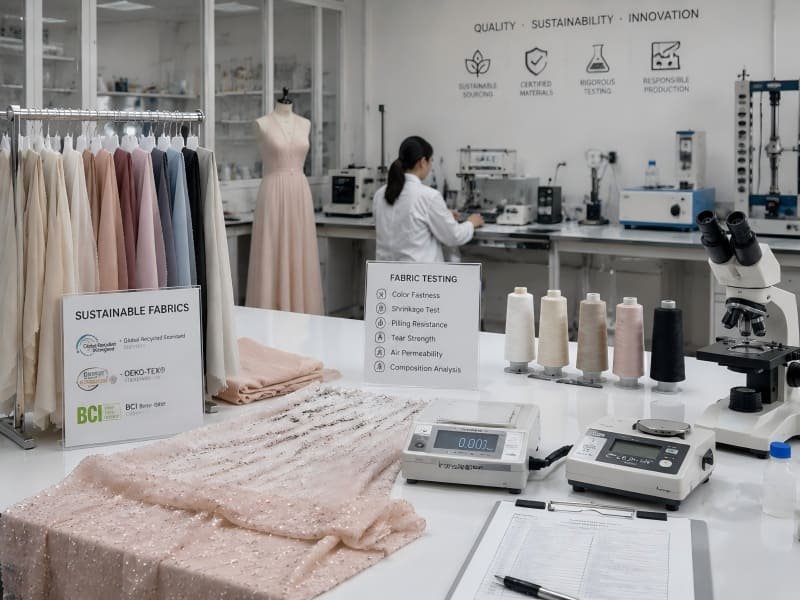
Fabric decisions influence silhouette, fit, seam behavior, color, care, comfort, and production yield. Testing becomes most useful when results are reviewed together with the intended garment, not as isolated numbers. Duolan combines development judgment, sample observation, supplier information, laboratory results, and bulk inspection controls to decide whether a fabric direction is ready to proceed.

Dimensional Stability and Pattern Allowance

Shrinkage and growth can alter bust placement, waist position, skirt length, hem balance, lining relationship, sleeve length, and finished measurement tolerance. Viscose blends, knitted fabrics, stretch wovens, washed materials, and heat-sensitive finishes require particular attention because the effect may differ by direction and care route. Duolan records the approved material reference and reviews whether the reported movement can be controlled through fabric finishing, relaxation, pre-treatment, pattern allowance, sewing sequence, pressing, or a revised care instruction. A pattern correction is not treated as a substitute for unstable material; both the material behavior and finished garment result must be considered before bulk release.
  • Check warp and weft, wale and course, or length and width directions separately where the protocol requires.
  • Compare main fabric, lining, fused areas, elastic sections, and mixed-material panels after the stated care route.
  • Confirm whether finished measurements are assessed before and after conditioning, washing, drying, or pressing.
  • Record any approved pattern allowance or care-label change against the production-ready sample version.

Colorfastness Across Real Garment Contact Areas

Dark shades, vivid colors, contrast panels, pale linings, mesh overlays, body-contact zones, and multi-material dresses can create risks that a single swatch does not fully explain. Duolan reviews the color combination and intended care route before samples are prepared. When a result indicates transfer, staining, or shade change, the manufacturing review may cover dyeing, fixation, washing, finishing, print process, lining selection, seam contact, packaging moisture, and storage conditions. Approved color references are kept with lab dips, swatches, trim boards, or garment samples so incoming production materials can be compared against the tested direction rather than against an unrecorded verbal approval.
  • Submit representative dark and light colors according to the brand or laboratory rule instead of assuming one color covers all.
  • Evaluate contrast areas where outer fabric, lining, elastic, tape, print, or decorative material touch each other.
  • Protect the approved color, finish, supplier, and lot reference from unrecorded replacement during bulk preparation.
  • Use incoming inspection and inline review to watch for shade, staining, crocking, or finish changes after approval.
Case 01|Australian Partywear Brand​

Strength, Surface, and Wear Performance

A fabric may look suitable on a hanger yet fail under seam stress, abrasion, pilling, snagging, or repeated wear. Lightweight satin can show seam stress or abrasion; open mesh and lace can snag; brushed or soft surfaces may pill; heavy decoration can pull on a weak base; fitted silhouettes can concentrate stress at the waist, hip, slit, armhole, or zipper. Duolan reviews laboratory findings with garment construction and fit observations, then considers fabric choice, cut direction, panel shape, seam allowance, stitch density, reinforcement, lining support, and placement of high-load details. Bulk inspection focuses on the same risk points so the approved performance is supported by consistent workmanship.
  • Map high-stress zones on the garment rather than treating strength as a fabric-only number.
  • Compare performance needs for loose silhouettes, fitted dresses, corset structures, slits, and heavy decorations.
  • Confirm surface sensitivity before selecting pressing, folding, hanger, polybag, and carton methods.
  • Use first-piece or pilot review when the construction creates risk beyond the laboratory swatch.

Stretch, Recovery, Opacity, and Shape Retention

Bodycon, bandage, fitted jersey, rib knit, power mesh, and stretch-lining garments depend on more than percentage stretch. Recovery, directional behavior, repeated extension, opacity under strain, seam compatibility, heat exposure, and pattern negative ease all affect fit and appearance. Duolan compares the fabric behavior with the target size chart and sample fit, then records stretch direction, pattern basis, seam construction, lining relationship, and pressing limits. A fabric that stretches sufficiently but does not recover can produce bagging at the seat, waist, elbow, or hem; a fabric with strong recovery can still feel restrictive if the pattern and seam path are not adjusted. Testing and fitting therefore remain connected throughout development.
  • Measure or review stretch in the directions used by the pattern and verify the production marker follows the approved orientation.
  • Check opacity and surface whitening at expected body extension, especially for light colors and printed stretch fabrics.
  • Evaluate seam extension, thread compatibility, elastic recovery, and heat-setting effects before production scale-up.
  • Preserve the approved fabric lot, composition, weight, stretch behavior, and finish in the production record.

Testing Beyond the Main Fabric

Final garment performance comes from the interaction of main fabric, lining, interlining, elastic, support materials, fasteners, decoration, labels, sewing, finishing, and packing. A passed fabric report cannot cover a zipper that fails, a stone that detaches, a boning edge that breaks through, a lining that shrinks differently, or a seam that opens under fit stress. Duolan reviews the finished structure as one product system.

Seams and High-Stress Construction

Seam performance depends on fabric structure, seam type, allowance, stitch density, thread, needle, edge finish, reinforcement, and garment fit. Fitted dresses place concentrated load at the bust, waist, hip, side seam, back seam, slit, armhole, strap, and zipper ends. Lightweight satin and loosely woven fabrics may show slippage; stretch fabrics may break stitches or create tunneling; mesh and lace may need binding, tape, or localized support. Duolan uses sample fitting, workmanship trials, first-piece review, and relevant laboratory findings to confirm how the construction should be built. Approved seam details are recorded in the tech pack, workmanship note, PP sample, or production file and checked at inline stages.

Closures, Support, and Functional Trims

Zippers, hooks, eyes, buttons, snaps, eyelets, lacing, elastic, silicone tape, bra cups, underwire, boning, and internal support components affect use, fit, durability, and wearer comfort. A corset dress may need reinforcement around eyelets and zipper ends; a strapless dress needs support without sharp edges; a halter style needs secure strap attachment; a bodycon dress needs elastic and seams that recover together. Duolan coordinates component samples and finished-garment submissions when required, then controls approved supplier, finish, dimensions, placement, attachment method, and reinforcement. Incoming trim inspection and first-piece testing help prevent a laboratory-approved design from being weakened by a substitute component or inconsistent application.

Sequins, Beads, Stones, Embroidery, and Print

Decorative garments carry risks beyond appearance. Sequins can crack, shed, abrade adjacent fabric, or create sharp contact; beads and stones can detach; dense embroidery can distort or shrink a panel; prints and foils can change after care or folding; heat application can affect stretch and shade. Duolan reviews decoration density, base fabric, backing, stitch or adhesive method, seam crossing, body-contact areas, weight, pressing, care, and packing. Development trials may include decorated panels, attachment checks, wash or care trials, first-piece review, and packaging simulation. The approved decorative process is then linked to the subcontractor or internal route, artwork, placement, materials, workmanship standard, and QC checkpoints.

Labels, Care, and Packaging Interaction

Fiber content, care instructions, size, origin, responsible-party information, and other label elements must reflect the final product and target market. Care wording also needs to match the tested material and decoration, not only the main fabric supplier recommendation. Packaging can influence results after approval: pressure marks on satin, moisture transfer, crushed boning, tangled fringe, abrasion from sequins, or dye transfer during long storage can appear even when sewing is correct. Duolan reviews label artwork against product records, confirms attachment and placement, and selects folding, tissue, protective covering, hanger, polybag, and carton arrangements suited to the garment construction and surface sensitivity.

Dress-Specific Testing Risks We Review

Different silhouettes create different evidence needs. Duolan reviews testing requirements together with fabric behavior, fit, support, workmanship, decoration, care, and bulk reproducibility. Six high-risk dress groups below illustrate how the same protocol can lead to different sample preparation and manufacturing controls.

Satin Dresses

Satin programs need control over shade, snagging, abrasion, seam impression, puckering, press marks, shrinkage, skew, and surface change after care. Slip shapes also depend on grain direction and drape. Duolan preserves the approved face, weight, finish, color, lining, cut direction, seam type, pressing method, hanger or folding plan, and protective packing. Testing results are reviewed with sample photos and workmanship because a fabric can meet a basic performance requirement while still showing unacceptable seam or pressing marks in the finished dress.

Bodycon Dresses

Bodycon and fitted stretch dresses require alignment between elongation, recovery, opacity, negative ease, grading, seam extension, thread, lining, and wearer movement. Duolan checks the fabric direction used by the pattern, compares stretch behavior with the size chart, and reviews high-load seams during fitting and pilot work. Light colors are checked for transparency under extension; print and surface finish are observed for whitening or distortion. Bulk control focuses on fabric lot, cut direction, seam construction, measurement tolerance, pressing, and shape recovery.

Corset Dresses

Corset and bustier dresses combine fitted outer fabric, lining, cups, boning, underwire or support layers, closures, eyelets, straps, and concentrated stress. Testing and pilot work may need to consider seam strength, trim attachment, sharp edges, closure operation, support placement, and repeated use. Duolan maps bust balance, cup position, waist tension, zipper ends, eyelet reinforcement, boning termination, and lining coverage before production. Approved components and reinforcement details remain locked in the BOM and PP sample so structure does not weaken during scale-up.

Mesh and Lace

Mesh and lace dresses can snag, stretch, distort, shrink differently from lining, reveal seam allowance, or lose placement accuracy. Layered designs add transparency and color interaction risks, while lace motifs may need controlled placement across seams and sizes. Duolan reviews material direction, recovery, pattern placement, lining coverage, edge finish, seam method, reinforcement, care, and packing. Laboratory submissions use representative combinations where required, and bulk inspection checks motif position, transparency, seam appearance, tension, and damage rather than looking only at finished measurements.

Sequin Dresses

Sequin garments require control of attachment, backing, seam clearance, shedding, abrasion, sharp contact, weight, drape, lining, pressing, and packaging. Dense decoration can change seam behavior and fit, while sequins crossing seam allowances can damage needles or create hard edges. Duolan develops decorated panels and garment samples, clears critical seam zones, confirms lining and body-contact protection, and reviews packing against rubbing and compression. Approved artwork, sequin type, color, density, attachment route, placement, repair standard, and inspection zones are retained for bulk production.

Printed or Washed

Printed, foil, heat-transfer, garment-dyed, washed, or specially finished dresses can change shade, handle, stretch, measurements, and surface appearance. Duolan confirms the artwork, strike-off or lab dip, base fabric, process route, color, care method, and production supplier before submission. When testing or sample review reveals cracking, migration, staining, shrinkage, skew, or hand-feel change, corrective options are assessed before bulk commitment. Production controls include approved artwork, process parameters, batch comparison, placement, curing or washing confirmation, and final appearance review.

Match Testing to the Right Sample Stage

A test result is only as useful as the sample stage it represents. Development swatches can support early material decisions, while final construction, labels, and decoration may require a later garment sample. Duolan plans submissions around the decision being made, the client protocol, the laboratory instruction, and the point at which material or production commitment becomes difficult to reverse.

Development Material Review

Early fabric, lining, print, wash, or trim samples can identify risks before the final garment is complete. The purpose is to compare material directions and remove unsuitable options before extensive pattern work or bulk reservation. Early results do not automatically cover later colorways, finishes, suppliers, or construction changes, so each reference is recorded with its exact composition, color, finish, and source.

First Prototype and Fit Sample

The first garment reveals how the selected material behaves in the intended silhouette. Fit, seam stress, opacity, support, lining, decoration, and finishing can expose risks not visible in a swatch. When the protocol permits, the stage can guide which garment-level tests or construction trials are needed. Duolan also separates fit comments from test-related changes so one correction does not accidentally create another issue.

Revised and Sales Samples

Revised, photo, showroom, or salesman samples may use closer-to-final materials but can still include temporary components or limited color availability. Before using such a sample for formal testing, Duolan checks whether its fabric, lining, trim, decoration, care, and construction represent the intended production version. Any deviation is disclosed and recorded so the report is not later treated as broader evidence than the sample supports.

PP and Production-Ready Sample

The pre-production stage is often the strongest link to bulk because key materials, measurements, workmanship, labels, and packing are close to final. Duolan uses a Bulk Readiness Review to confirm the approval status, BOM, fabric, lining, trims, color, measurements, workmanship points, packaging, and outstanding testing actions. A PP sample is not considered production-ready while a material substitution, failed result, unresolved label, or critical construction change remains open.

From Requirement Review to Bulk Production Approval

The coordination path follows eight controlled steps. Each step has a clear handover so a report does not become an isolated file. Timelines depend on protocol complexity, sample availability, laboratory quotation, corrective work, and approval speed, but the sequence remains stable and can be fitted into the brand’s collection calendar.

1. Receive Brief

Collect product, market, protocol, materials, colorways, quantity, sample stage, report deadline, PP date, bulk date, and nominated laboratory details.

2. Review Scope

Map requested methods and limits against the garment configuration, identify missing decisions, and flag high-risk materials, colors, components, or structures.

3. Confirm Samples

Determine whether fabric, trim, component, garment, or multiple versions are required, then confirm quantity and preparation instructions with the laboratory when needed.

4. Prepare Records

Assign style, color, material, sample-version, batch, and test-purpose references. Complete the request form and supporting documents without overstating product identity.

5. Coordinate Submission

Arrange shipment, confirm laboratory receipt, answer technical clarification, follow status, and keep the internal development calendar updated.

6. Review Results

Check the sample description, method, result, stated assessment, and any mismatch between the report and the submitted product information.

7. Correct and Retest

Analyze material or manufacturing causes, prepare approved corrective options, make a controlled revision, and resubmit under a new traceable version.

8. Lock Bulk Controls

Connect the approved result to the BOM, PP basis, material lot, color, trims, workmanship, labels, incoming checks, first piece, inline QC, and final inspection.

For collection programs, steps can run in parallel by style group rather than waiting for every item to reach the same stage. Simple material confirmations can proceed while complex corset, sequin, or mesh styles receive additional trial work. Duolan breaks the collection down by risk, material route, construction, laboratory need, and launch priority, then keeps the common protocol and reporting structure consistent across the program.

Correct Samples Create More Useful Test Results

Sample identity is the foundation of traceability. A laboratory can only report on what it receives, so the submission record must be specific enough to connect the result to product development and later production. Duolan prepares a concise evidence package designed to prevent mixed colorways, unrecorded substitutions, incomplete descriptions, and reports that cannot be matched to a bulk order.

Sample Identification

Each submitted item is assigned the available project references: brand or project name, style number, product description, colorway, material description, fiber composition, supplier or swatch reference, lot or batch reference when available, sample stage, version date, and test purpose. Finished garments are also linked to the corresponding tech pack or BOM version. When the sample is not fully representative, the deviation is stated rather than hidden, allowing the brand team and laboratory to decide whether the submission remains acceptable.
Manufacturing Must Support Brand Continuity​

Request and Supporting Files

The package can include the laboratory request form, brand protocol excerpt, method and limit reference, tech pack, BOM, fabric sheet, trim board, care proposal, label artwork, prior report, failure summary, corrective-action note, and photographs of the submitted item. Only relevant information is included; oversized files and conflicting versions make review harder. Duolan uses one current document version for the submission and records later changes separately so the laboratory report can be traced back to the exact product basis.

Quantity, Color, and Sample Condition

Sample quantity and preparation follow the nominated laboratory’s instruction because requirements vary by method, product, color, size, and retest status. Duolan checks whether multiple colors, contrast combinations, finished garments, unwashed materials, conditioned samples, or reserve pieces are required. Samples are protected from moisture, contamination, crushing, abrasion, or decorative damage during shipment. Where a destructive test may consume the only approved sample, reserve material or duplicate garments are planned in advance to protect the development calendar.
6. Material Status Communication (1)

Submission Register and Status

A submission register records style, color, material, sample version, laboratory, request date, courier reference, receipt confirmation, quoted completion, pending questions, report number, result, required action, retest version, and closure status. The register does not replace the laboratory system; it connects external progress with internal development and production decisions. For multi-style collections, one shared format prevents different teams from naming the same garment in different ways and reduces the risk of a report being attached to the wrong order.

When a Test Fails, the Next Action Matters

A failed result is not solved by requesting an immediate retest of the same unchanged sample. Effective correction begins with the reported property, the submitted version, and the production mechanism behind the result. Duolan separates laboratory facts from manufacturing hypotheses, then develops options that protect appearance, fit, cost, lead time, and bulk consistency as far as the project allows.

Verify the Reported Failure

The first review checks the report number, style, color, material, sample stage, method, conditions, limit, result, and laboratory comment. Any mismatch in sample description, composition, or requested protocol is clarified before manufacturing changes begin. A reported fail can only guide correction when the tested item and acceptance requirement are understood. The result is then classified by likely area: raw material, dyeing or finishing, print or decoration, pattern and fit, seam or attachment, care instruction, label, or packaging interaction.

Analyze Manufacturing Causes

Duolan brings the relevant teams into the review rather than leaving the report with one coordinator. Fabric development may review composition, weight, yarn, dyeing, fixation, coating, wash, or finish. Pattern and sample teams may review negative ease, stress concentration, seam allowance, support, lining, or panel direction. Process teams may review needle, thread, stitch, adhesive, heat, embroidery, sequin, print, or pressing. Quality teams check whether the issue appears in reserve samples or incoming materials. The objective is a reasoned cause map, not an unsupported promise that a new sample will pass.

Develop Corrective Options

Corrective action may involve a supplier adjustment, new dye or finish, alternative fabric, revised lining, changed trim, stronger attachment, seam reinforcement, pattern revision, adjusted care route, updated label, or different packing method. Each option is evaluated for visual effect, fit, hand feel, color, construction, cost, timing, minimum material requirement, and production scalability. The brand team receives a focused recommendation with any trade-offs. No material or design change is treated as automatically approved simply because it may improve a test result.

Retest and Close the Loop

The revised sample receives a new version reference and is submitted with the applicable corrective-action note. The retest result is linked only to the corrected material, color, construction, or process it represents. After acceptance, Duolan updates the BOM, PP basis, material approval, workmanship standard, care information, or packing instruction and identifies any earlier sample or stock that must not be used. The issue is considered closed only when the approved correction has been translated into production documents and inspection checkpoints.

Keep Approved Results Connected to Bulk Production

The report is one part of the production evidence chain. Bulk protection comes from keeping the tested reference aligned with the material, color, BOM, PP sample, workmanship, labels, and actual production lot. Duolan performs a production-readiness review before release and records changes that may require brand or laboratory confirmation.

Material and Color Locking

Approved fabric and lining references are stored with supplier, composition, weight, finish, color, swatch or lot information, and the relevant report number. Lab dips, strike-offs, printed panels, washed samples, or decorated materials remain linked to their specific route. Incoming production material is compared with the approved direction for shade, handle, width, weight, stretch, surface, and visible defects. A new supplier, dye lot, finish, print route, or material composition is treated as a change requiring evaluation rather than as an interchangeable replacement.

BOM, PP Sample, and Workmanship Alignment

The PP basis shows how the approved materials are assembled into the final garment. Duolan checks main fabric, lining, interlining, elastic, closures, support components, decoration, labels, and packaging against the current BOM. Critical workmanship points such as seam type, allowance, stitch density, reinforcement, boning end, eyelet backing, zipper finish, lining coverage, trim attachment, and pressing method are confirmed. When a test result triggered a correction, the revised detail is highlighted so the production line and QC team understand which earlier method is no longer acceptable.

Change Control Before Release

A change can be commercially reasonable and still affect prior evidence. Color additions, new fabric lots, substitute trims, revised print, altered wash, different decoration supplier, modified support, new care instruction, or a different production route are reviewed before bulk release. The project team decides whether the change can be accepted through internal comparison, requires brand approval, or should return to the nominated laboratory. The decision and supporting reference are recorded so production does not proceed on informal messages alone.

Reorder and Scale-Up Continuity

Repeat orders can introduce new lots, suppliers, factories, seasons, or quantities even when the style number remains the same. Duolan retrieves the prior approved sample, report, BOM, material and trim references, workmanship points, corrective-action history, and inspection findings before planning the new production route. Any changed item is reviewed against the previous evidence. This approach supports repeatability while recognizing that an old report cannot automatically cover a materially different reorder.

Testing Does Not Replace Production Quality Control

Laboratory testing evaluates defined samples under defined methods. Production quality control evaluates whether thousands of garments follow the approved product basis. Duolan uses both systems together: test results inform material and workmanship risk, while incoming, first-piece, inline, final, and packing controls verify the actual order. One cannot replace the other.

BOM and Material Reuse

Incoming Material Review

Before cutting, production-intent fabrics and trims are checked against the approved references. Typical controls include supplier and lot identity, color and shade grouping, width, weight, stretch direction, handle, surface, defects, print or embroidery appearance, trim dimensions, finish, operation, and visible damage. Required laboratory actions are checked for closure. Materials with unapproved substitution, unresolved report status, or significant mismatch are held for review rather than released automatically to cutting.
Fit areas checked before bulk​

First-Piece and Pilot Verification

Fit-sensitive or workmanship-sensitive styles are verified before the full production run. Corset, bodycon, satin, mesh, sequin, halter, backless, and structured occasion dresses can receive first-piece confirmation, critical-operation trials, or a small pilot quantity. The review checks measurements, fit balance, stress areas, seam appearance, lining, support, closure, decoration, pressing, and any point linked to testing or corrective action. Complex production is not released merely because the development sample looked acceptable.
Inline Correction​

Inline Quality Control

Inline checks focus on the risks identified during development and testing. QC teams verify material identity, panel direction, seam construction, high-stress reinforcement, stretch-seam quality, trim attachment, decoration placement, lining coverage, measurements, shade, and workmanship consistency. Findings are addressed while production is still running, when correction is more controlled. For multi-line or multi-factory programs, the approved sample, workmanship note, and risk points are distributed in a consistent format so each route follows the same product basis.

Final, Packing, and Third-Party Inspection

Final review covers appearance, measurements, function, labels, barcodes, packing, assortment, carton information, and the client’s agreed inspection criteria. Surface-sensitive or structured dresses receive packing checks to reduce abrasion, pressure marks, distortion, and trim damage. When an independent final inspection is required, Duolan coordinates the inspection date, production availability, sampling access, approved references, packing information, and corrective follow-up. The inspection report remains separate from laboratory testing while both are connected to the same order record.

Reference bulk production lead times are planned after PP, BOM, materials, order details, and commercial start conditions are locked: approximately 15-20 days for simple styles, 20-30 days for regular fashion styles, and 30-45 days for complex structures or decoration. Laboratory timing, corrective work, third-party inspection, and shipping are planned separately and can extend the overall calendar.

Manufacturing Infrastructure Behind Testing Coordination

Testing coordination becomes valuable only when the manufacturing organization can act on the findings. Duolan’s dress-focused network combines development density, specialist process resources, production scale, and controlled factory allocation. The figures below are used to explain project capacity rather than to replace product-level review.

16 Owned Factories

Core development, priority styles, complex construction, and key production programs can be managed through owned womenswear factories where sample, workmanship, and bulk controls remain closely connected.

20+ Satellite Factories

Long-term coordinated factories provide capacity flexibility for repeat orders, seasonal peaks, and style groups matched to suitable manufacturing routes while Duolan retains project planning and quality coordination.

300 Sewing Lines

The group can divide multi-style programs by fabric, complexity, process, quantity, and timing rather than forcing every dress through one production block. Line allocation is planned after sample and bulk-readiness review.

50+ Flexible Lines

Quick-response and flexible lines support development, pilot, launch, replenishment, and selected urgent pathways without presenting speed as a reason to skip material confirmation, first-piece review, testing, or QC.

6.5M Monthly Capacity

Stable monthly capacity of approximately 6.5 million garments, with peak capability reaching about 10 million, provides room for larger programs and scale-up after launch while maintaining planned production routes.

15,000-35,000 Samples

Monthly sample development capacity of approximately 15,000-35,000 pieces or iterations across 3,000-8,000 style workflows supports parallel collection development, revision, PP preparation, and controlled test-sample needs.

Duolan’s factory system has SMETA and SMETA 2-Pillar audit records. Product and testing requirements referencing ASTM, AATCC, EN, GB, OEKO-TEX, GOTS, retailer manuals, or specific brand protocols are coordinated according to the actual project and third-party requirements. Such references describe the standards or programs a project may need to follow; they are not presented as universal certifications held by every garment, factory, material, or production order.

Representative Multi-Style Testing Coordination Program

The following scenario reflects the order structure commonly handled by Duolan and is presented as a representative program rather than a named-client claim. It shows how testing coordination can be organized for a meaningful collection with multiple materials, risk levels, and production routes.

Program Profile

A U.S. fashion brand prepared an 18-style party and occasionwear program totaling 42,000 garments. The collection included six satin and woven dresses, five stretch bodycon styles, three mesh or lace layered dresses, two corset dresses, and two sequined statement styles.
Quantities ranged from 1,200 to 3,600 pieces per style across core and seasonal colors. The program involved multiple main fabrics, linings, zippers, boning, cups, elastic, mesh, lace, sequins, labels, and two packing formats, creating different test and production risks within one launch calendar.

Coordination Plan

Duolan grouped the 18 styles into four risk paths rather than processing them as one undifferentiated order. Core woven styles followed a material-and-garment verification path; stretch styles added recovery, opacity, negative-ease, and seam review; corset styles added support, closure, reinforcement, and first-piece confirmation; sequined styles added decoration, lining, abrasion, repair, and packing controls. The brand manual and nominated laboratory instructions were converted into a style-level register showing sample type, color, version, due date, report status, open question, and bulk impact.

Corrective Action Example

One dark stretch color required additional review after a color-transfer result, while one satin style showed greater dimensional movement than the development pattern had allowed. The stretch material route was reviewed with the fabric supplier, dyeing and finishing information, lining contact area, care method, and production lot plan. The satin style was assessed through material confirmation, revised pattern allowance, garment measurement, pressing, and care review. New samples received separate version references and were resubmitted only after the proposed corrections were approved. The earlier versions were marked as non-production references to prevent accidental use.

Bulk Release and Delivery Path

After accepted results and product approvals were aligned, Duolan completed a bulk-readiness review for each style group. Fabric, lining, trims, color, measurements, workmanship, labels, packing, and relevant report references were checked against the PP basis. Corset and sequin styles received first-piece or pilot verification before full release; stretch styles received fabric direction, seam, opacity, and measurement controls; satin styles received surface, pressing, and packing controls. Production was allocated across suitable lines, while one common reporting and QC structure kept the 42,000-piece program aligned through inline review, final inspection preparation, and shipment planning.

Program Outcomes

  • 18 styles grouped by product risk, material route, construction complexity, and launch priority.
  • 42,000 garments managed through style-level sample, report, corrective-action, PP, and production references.
  • High-risk corset and sequin styles verified before full production release instead of waiting for bulk defects.
  • Material and pattern corrections recorded as new versions so earlier samples could not be reused as production standards.
  • Laboratory reports remained independent while manufacturing actions were connected to BOM, PP sample, line instructions, and QC.

Frequently Asked Questions About ASTM Apparel Testing

No. Duolan is a women’s apparel development and manufacturing company. Independent testing is performed by the brand’s nominated or a mutually confirmed third-party laboratory. Duolan coordinates product information, sample preparation, submission follow-up, manufacturing-side corrective action, retesting support, and bulk implementation.
No. ASTM develops standards and test methods; Duolan does not issue an “ASTM certificate.” A third-party laboratory issues its own report for the tested sample and requested method. Acceptance depends on the applicable rule, brand limit, retailer protocol, and the organization responsible for approval.
The applicable plan depends on product category, target market, age group, fabric, fiber content, colors, lining, trims, decoration, construction, care route, intended use, and the brand or retailer protocol. Duolan can organize those inputs and coordinate confirmation with the nominated laboratory or compliance team.
Yes. Duolan can coordinate sample preparation, request documents, shipment, clarification, status, report collection, corrective action, and retest with a nominated laboratory, provided the laboratory accepts the project and the commercial arrangement is confirmed by the responsible parties.
The required sample form depends on the method and decision. Fabric samples can support early material review, while finished garments may be needed when construction, seams, trims, decoration, labels, or final care influence performance. Some programs require both stages. The laboratory instruction and brand protocol take priority.
Not automatically. Color, dye, print, finish, composition, supplier, and protocol rules can change the required coverage. Duolan identifies colorways and contrast combinations so the brand or laboratory can determine representative sampling. Reports are linked only to the samples and scope they support.
Samples can be identified by project, style, product, colorway, material description, composition, supplier or swatch reference, lot or batch when available, sample stage, version date, and test purpose. The request form, photographs, tech pack, BOM, and prior report can be attached where relevant.
Duolan first verifies the tested sample, method, limit, and reported result, then reviews possible material, dyeing, finishing, pattern, seam, trim, care, or packing causes. Corrective options are submitted for approval, a revised version is prepared, and retesting is coordinated. A pass is never guaranteed.
Approved references are linked to the BOM, PP sample, fabric or trim approval, colorway, workmanship standard, label, packing instruction, incoming inspection, first-piece review, inline QC, and final inspection. Changes are reviewed before release and may require additional confirmation or testing.
Yes, when the responsible teams provide the applicable manuals and approval rules. Duolan can organize the requests into one style-level plan while keeping each method, limit, laboratory report, and approval responsibility distinct. Conflicting or unclear requirements are raised before samples are submitted.
Initial review time depends on the number of styles, protocol length, completeness of product information, and whether laboratory clarification is needed. Sample preparation depends on material and garment stage. Laboratory turnaround follows its quotation. Corrective action and retesting add time, so testing should be placed into the launch calendar before bulk commitment.
No. Laboratory testing evaluates defined sample properties under defined methods. Final inspection evaluates the actual production order against approved appearance, measurements, workmanship, function, labels, packing, and agreed inspection criteria. Both systems address different risks and should remain connected.

Share Your Apparel Testing Requirements

Send the information currently available, even when the development package is not complete. Duolan will review the product category, target market, material and construction risks, current sample stage, nominated laboratory, report deadline, PP timing, bulk quantity, and delivery plan. The first response will focus on the coordination path, missing decisions, samples likely to be required, and the points that must remain connected to bulk production. Clear project information allows a more accurate review and avoids a generic testing answer that cannot support the collection calendar.

  • Company or brand name, sales market, product category, and intended launch window.
  • Tech pack, reference images, size chart, BOM, fabric composition, colorways, trims, decoration, and care direction.
  • Brand manual, retailer protocol, requested methods, previous reports, or laboratory quotation when available.
  • Current sample stage: development swatch, first sample, revised sample, sales sample, PP sample, or bulk material.
  • Target quantity by style and color, with the expected range of 10-30 styles and 20,000-80,000 total pieces where relevant.
  • Required report date, PP approval date, bulk start, third-party inspection date, delivery window, and any fixed selling event.
  • Upload fields: tech pack, test manual, prior report, material sheet, trim board, label artwork, and product photographs.


Start Your Apparel Development Project

OEM/ODM Manufacturing Support for Fashion Brands

Share your collection details, estimated quantities, target market, development timeline, and technical requirements. The production team will review your request and provide a tailored manufacturing solution based on your product category, fabric selection, construction needs, and delivery schedule.

Fashion Manufacturing Support with Scalable Production Capacity

From sample development to bulk production, Duolan supports fashion brands with confidential OEM/ODM manufacturing, stable quality management, flexible production planning, and coordinated multi-factory execution for seasonal and capsule collections.

Need Direct Assistance?

Seraphinite AcceleratorOptimized by Seraphinite Accelerator
Turns on site high speed to be attractive for people and search engines.