Skip to content

Backless Dress Manufacturing for Fashion Brands
Develop backless dresses around the structure that keeps the garment secure, balanced and repeatable from approved sample to bulk production.
- 6 structural zones reviewed: bust, neckline, side seam, shoulder or neck support, waist stability and back closure.
- 5 development stages: feasibility review, pattern development, first sample, fit or revision review and PP standard confirmation.
- Critical bulk points controlled: back opening depth, strap length, bust coverage, lining, left-right symmetry, closures and exposed-edge workmanship.
- Development can begin from a tech pack, sketch, reference images, an original sample or an established collection direction.
What Strong Backless Dress Manufacturing Requires
A polished open back depends on more than sewing accuracy. Product teams need a manufacturing partner capable of reading structural risk before sampling, translating fit comments correctly and protecting the approved look when production moves across sizes, colors and larger quantities.
| Evaluation Point | What Must Be Controlled | Why It Matters |
|---|---|---|
| Back Opening | Depth, width, curve and symmetry | Controls exposure, proportion and stability |
| Bust Security | Coverage, cup position and side support | Reduces gaping and movement risk |
| Strap System | Length, angle, width and attachment | Affects neckline height and garment balance |
| Fabric Behavior | Stretch, recovery, drape and surface stability | Changes fit even with the same paper pattern |
| Lining & Support | Coverage, power mesh, cups and internal layers | Keeps support hidden without changing the exterior |
| Size Grading | Back depth, bust coverage, strap and waist relationships | Maintains design intent across the size range |
| Sample Standard | Fit comments, materials, pattern and workmanship | Creates a usable reference for production |
| Bulk Control | Measurements, symmetry, tension and workmanship | Prevents approved details drifting during scaling |
Backless Dress Directions Developed for Brand Collections
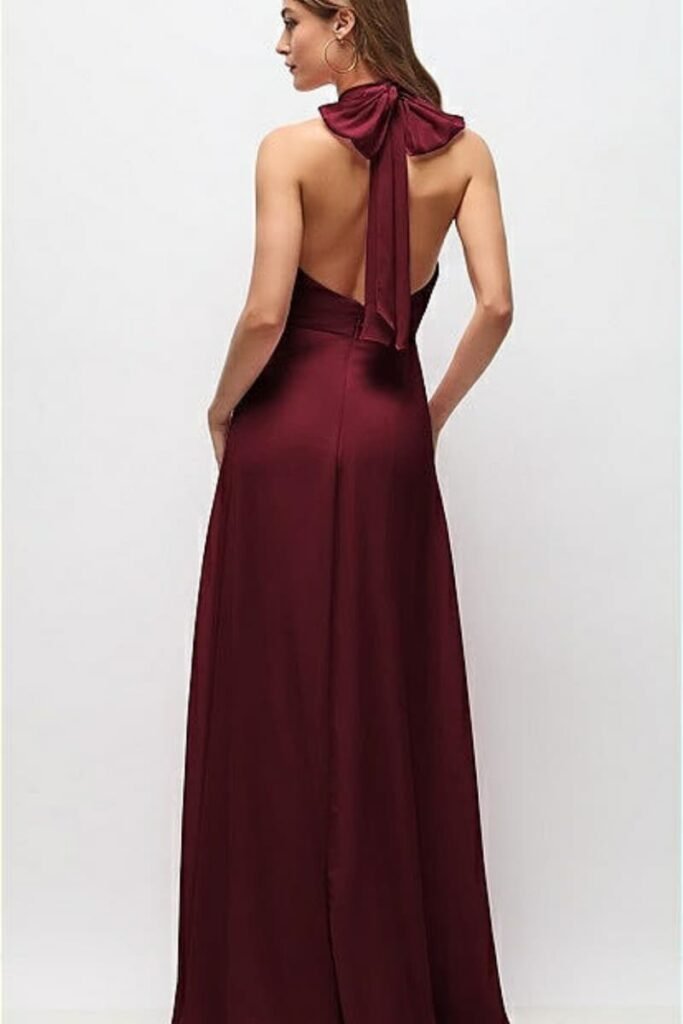
Halter Backless Dresses

Low Open-Back Dresses

Lace-Up Back Dresses

Corset Backless Dresses

Cut-Out Backless Dresses
Cut-out and backless construction must consider exposed skin as part of the pattern geometry. Placement around the side waist, lower back, under-bust area or upper back affects coverage differently across body shapes and sizes. Edge behavior is also critical: stretch fabrics may roll or wave, while woven satin can pucker if the curve and facing are not balanced correctly. Movement review should cover standing, walking, sitting, turning and raising the arms. Duolan assesses whether openings remain in the intended position, whether surrounding seams pull toward the cut-out and whether lining or hidden mesh is needed to improve stability without changing the visible design.

Fitted Backless Dresses
Fitted backless dresses depend heavily on controlled negative ease, fabric recovery and balanced tension through the bust, waist, hip and back. A garment can measure correctly when flat but still twist, gape or pull once stretched over the body. Development therefore connects material behavior with paper pattern balance instead of treating fit and fabric as separate decisions. Side-seam position is especially important because insufficient rear structure can pull the seam toward the back. Duolan reviews stretch direction, recovery, opacity, lining requirement, strap support and graded fit before a fitted backless block moves into repeat production or color extensions.
Engineering Stability Into an Open-Back Dress
Back Opening Geometry Controls More Than Exposure
- Opening depth: A deeper back removes more supporting area. The pattern may need stronger side control, a different strap angle or additional internal support to keep the front neckline stable.
- Opening width: A wide opening can pull remaining panels toward the side body. Narrowing or reshaping the opening can improve stability without noticeably changing the visual direction.
- Waist relationship: The lowest point of the opening affects perceived torso length and waist position. A low point that drops below the intended waist can change the entire proportion of a mini, midi or maxi style.
- Curve control: Curved edges must follow the body without standing away from the skin. Facing, binding, lining and seam allowance behavior all affect whether the finished edge sits flat.
- Left-right symmetry: Open-back geometry is visually exposed, so small differences between both sides become obvious. Pattern notches, controlled sewing references and PP measurements are required for repeatability.
- Movement clearance: The approved shape must still work when the body rotates or bends. A visually clean mannequin sample is not enough if the opening distorts during real movement.
Bust and Side Stability Protect the Front View
Backless development often fails at the front rather than the back. Removing rear structure changes tension through the bust, neckline and side seams, creating problems such as gaping, neckline drop, side-bust exposure or seam migration.
- Bust coverage: Coverage is reviewed against the intended neckline and target fit rather than judged only from garment width. Cup position, darts, lining and side-panel shape can all influence security.
- Side seam balance: The side seam should remain visually positioned on the side body. If rear tension is insufficient, the seam can rotate backward; excessive front tension can pull it forward.
- Neckline stability: A low or shaped front neckline needs enough remaining structure to hold its approved position. Strap length, shoulder or neck support and internal stabilization may be used depending on the silhouette.
- Underarm relationship: Armhole or side-edge shape should protect side coverage without becoming visually bulky. Small pattern corrections can prevent both gaping and cutting into the body.
- Fabric stretch: Stretch allowance cannot be selected by composition alone. Recovery, fabric weight, stretch direction and lining change how much tension remains after the garment has been worn for several hours.
Fit comments are translated back into the pattern instead of being handled as surface alterations. The aim is to keep front presentation and back exposure working together across the approved size system.
Straps Closures and Internal Support Carry the Load
A backless dress may look minimal on the outside while relying on several hidden components. Structural choices are made according to where the garment needs tension, adjustment or reinforcement.
- Straps: Width, length, angle and attachment position influence bust height, neckline shape and back opening. Adjustable straps can improve fitting flexibility, but adjusters and rings must match strap width and remain stable under tension.
- Halter ties: Neck ties carry more load than decorative ties. Tie width, attachment reinforcement and knot placement affect both security and comfort.
- Closures: Invisible zippers, hook-and-eye closures, buttons, ties or lace-up systems are selected according to opening geometry and dressing access. Closure placement must not distort the intended back line.
- Power mesh: Hidden power mesh can support areas where visual exposure limits the amount of shell fabric available. Opacity, recovery and edge treatment need to remain compatible with the outer material.
- Cups and support layers: Cups can improve shaping but cannot correct an unbalanced pattern by themselves. Cup height, spacing, lining connection and side support must align with the shell.
- Internal elastic: Elastic can help control an upper edge or waist position. Stretch force, recovery and finished length should be confirmed rather than adjusted casually on the line.
All selected components are recorded through the approved material and production standard so support does not change between sample and bulk.

Fabrics Matched to Backless Structure and Fit

Satin and Silky Wovens

Stretch Jersey

Mesh and Power Mesh

Lace Backless Construction

Sequin and Embellished Fabrics

Crepe and Stretch Wovens
Hidden Components That Keep Backless Dresses Secure
Cups and Bust Support
Power Mesh Layers
Power mesh can create hidden support where an exposed back leaves too little shell fabric to stabilize the garment. Application may be limited to side panels, bust support zones or internal sections rather than covering the full dress. Recovery is more important than stretch alone because the layer must return to its intended shape after movement. The mesh also needs appropriate color, softness and edge treatment so it does not become visible or uncomfortable during wear.
Elastic and Anti-Slip
Strap Adjusters and Rings
Zippers Hooks and Closures
Eyelets Ties and Lace-Up
Lace-up backs can provide both fit adjustment and product identity. Eyelets need consistent spacing, left-right alignment and reinforcement behind the shell. Tie materials may include self-fabric straps, satin ties, cord or other approved constructions, with width selected according to both appearance and load. During fitting, the team checks how the back opening changes across the usable adjustment range. A decorative lace-up detail and a tension-bearing lace-up system require different construction standards and should be defined clearly before PP approval.
Pattern Fit and Grading for Backless Dresses
Fit Is Controlled Through Connected Measurement Points
Back Openings Should Not Scale at One Fixed Ratio
- whether bust coverage remains sufficient;
- whether side seams stay in the intended position;
- whether strap length creates the same neckline relationship;
- whether the lowest back point still sits at the intended visual level;
- whether waist shaping changes the opening curve;
- whether the remaining shoulder, neck or side structure can still carry the required tension.
Fit Comments Must Return to the Pattern
Temporary sample alterations can make a fitting look correct without solving the underlying pattern problem. Duolan treats fit comments as inputs to pattern correction.
A gaping back edge may require a curve adjustment, tension redistribution or fabric-support change rather than simply removing width at one point. A neckline that drops may relate to strap length, side seam or bust shaping. Twisting can originate from pattern balance, grain direction or uneven seam tension. Back exposure that looks correct on a mannequin may change once the waist or hip is occupied by the body.
Revision records therefore identify the problem, likely source and corresponding pattern action. Relevant measurements, lining structure, trims or workmanship notes are updated when the correction changes more than the shell pattern.
A confirmed version becomes useful only when pattern, measurements and construction tell the same story. The resulting standard can then support PP confirmation, bulk inspection and future repeat production without relying on verbal memory.

Feasibility Review Before Backless Dress Sampling
What We Review From Your Development Files
Development can begin from a tech pack, sketch, reference images, original sample, collection moodboard or an established style direction. The first review separates visible design information from specifications that still need confirmation.
From a reference image, the team can read silhouette, length, neckline, waist position, strap direction, approximate back depth, closure location, drape direction and surface detail. A photo cannot reliably show fabric composition, stretch recovery, internal support, lining construction, exact measurements or hidden closure methods, so those points are confirmed separately.
For a tech-pack project, the review focuses on whether front, back and detail drawings agree with measurement specifications and construction notes. Open-back styles receive extra attention around back depth, side coverage, strap attachment, lining, closures and key points of tension.
The team also checks whether the intended material can support the requested structure. A highly fluid woven cannot be assumed to behave like stretch jersey, and changing from one to the other may require pattern and construction changes rather than a simple material substitution.
Sample timing is confirmed after structure, materials and special processes are reviewed, allowing the development schedule to reflect actual complexity instead of using one generic lead-time promise.
Risk Points Are Defined Before Pattern Release
Once the inputs are clear, development risks are grouped into fit, material, construction and production categories.
Fit risk may include inadequate bust coverage, excessive back exposure, side-seam rotation, strap pressure or unstable neckline position.
Material risk covers insufficient recovery, excessive transparency, weak edge stability, satin puckering, heavy embellishment or mismatch between lining and shell.
Construction risk includes unsupported eyelets, insufficient strap reinforcement, bulky back edges, closure placement or internal components showing through the exterior.
Production risk considers whether approved details can be positioned, sewn, measured and inspected consistently in larger quantities.
The output is not intended to redesign the brand direction. Its purpose is to identify what must remain, what needs technical confirmation and which points should be proven through sampling before production assumptions are made.For complex open-back projects, the team may recommend a specific support trial, construction sample or graded-size review before moving directly toward PP approval. A clear risk map gives designers, product developers and manufacturing teams the same priorities from the beginning.
Backless Dress Sampling Built for Production Decisions
First Sample Establishes the Structural Direction
Fit and Revision Rounds Convert Comments Into Actions
PP Confirmation Creates the Bridge Into Bulk
A visually approved sample is not automatically a complete production standard. Before bulk release, the confirmed version should be connected to the pattern, measurements, fabric, lining, trims, workmanship points and packaging requirements that production will actually use. For a backless style, PP review may lock:
- approved back opening shape and critical dimensions;
- strap length, attachment and hardware;
- bust and side coverage;
- closure specification;
- lining and hidden support;
- edge finishing and reinforcement;
- key measurement tolerance;
- presentation and pressing standard.
Duolan’s manufacturing process uses PP confirmation as the point where development information is translated into production instructions and QC checkpoints. Bulk production references vary with product complexity. Company production planning uses approximately 15-20 days for simple styles, 20-30 days for regular styles and 30-45 days for complex styles after required approvals and materials are ready. A structured backless style may fall into the regular or complex route depending on fabric, construction, quantity and special processes.

Workmanship at Every Exposed Back Detail
Exposed Edges Must Stay Clean and Flat
Load Points Require Reinforcement Without Bulk
A minimal back can concentrate force into a few small points. Strap attachments, eyelets, zipper ends, halter ties and side-back intersections must carry tension while remaining visually clean.
Reinforcement may come from backing fabric, lining, interfacing, secure stitch formation or a structural layer selected for the specific material. Heavy reinforcement is not automatically better. A rigid patch behind a lightweight satin shell can print through to the exterior; inadequate support around an eyelet can allow the hole to distort.
For straps, stitch length, seam allowance, fold method and reinforcement area are reviewed together. Hardware connections need enough structure to resist repeated pulling while keeping the intended strap width and visual scale.Lace-up systems require consistent eyelet spacing and support behind every attachment point. Corset-inspired designs may add boning or panel structure around the opening, requiring clean termination and alignment.Workmanship standards therefore define both the visible finish and the hidden construction carrying the load.
Pressing Presentation and Symmetry Finish the Garment
Backless styles often use clean, uninterrupted surfaces where pressing marks, seam distortion or left-right imbalance become highly visible.
Final presentation checks include back opening symmetry, strap position, side-seam balance, hem level, zipper smoothness, lining exposure and the relationship between front and back neckline heights.
Satin and other sensitive surfaces require controlled pressing to avoid shine, crushing or hard edge marks. Mesh and lace require handling that protects delicate surfaces. Embellished fabrics need finishing and packing methods that reduce pressure on beads, sequins or raised details.
Garments are also reviewed on a hanger or form because some issues are difficult to identify flat. Twisting, an uneven open-back curve or one strap sitting differently can become immediately visible once the garment hangs naturally.
Workmanship inspection therefore goes beyond loose threads. The objective is a garment that looks finished from close range, remains secure in motion and presents consistently across the production run.

Complex Backless Constructions Need Different Control Methods
Backless Halter Structure
Backless Corset Structure
Backless Satin Structure
Backless Mesh Cut-Out
Turning an Approved Sample Into Bulk Standards
Seven Elements Are Locked Before Production Release
- Pattern version: The approved front, back, lining and support pieces must correspond to the final sample.
- Main fabric: Composition direction, handfeel, stretch behavior, color and approved material reference are confirmed.
- Lining and support: Lining, power mesh, cups, elastic and structural layers are recorded where required.
- Trims: Zippers, hooks, adjusters, rings, eyelets, ties and related components follow approved specifications.
- Measurements: Critical points include bust, waist, strap, neckline, back opening and other style-specific dimensions.
- Workmanship: Edge finishing, reinforcement, seam treatment, closure installation and pressing expectations are defined.
- Packing: Folding and protection methods must preserve exposed edges, smooth satin surfaces and embellishments where relevant.
Production Instructions Translate Visual Approval Into Actions
A sample can show what the garment should look like, but production teams also need to know how the result is achieved.
For backless styles, process instructions may cover fabric direction, order of assembly, edge finishing, strap construction, reinforcement locations, closure installation, lining connection and points requiring intermediate inspection.
Critical operations are identified before full line output. A lace-up panel may require an eyelet-placement reference. A satin back edge may need controlled handling before pressing. A stretch backless dress may require consistent stretch direction during cutting. An internal support layer may need to be secured before the shell closes access to the area.
Production standards can connect the PP sample with BOM, spec sheet, workmanship notes and QC checklist. The goal is not more paperwork; the goal is fewer interpretation gaps between development, cutting, sewing and inspection.
Any Change After Approval Requires Reassessment
Material or construction substitutions can change fit even when the silhouette appears unchanged on paper.
Replacing stretch jersey with a firmer fabric may alter ease and back tension. Changing an adjuster can affect strap movement. Replacing lining can change support and opacity. A different elastic can create more or less tension at the upper edge.
For that reason, changes to fabric, lining, trims, measurements or significant workmanship after PP approval should be reviewed before production continues.
Revision control is especially important for repeat orders. A successful style should retain the approved pattern version, BOM direction, fit standard, critical workmanship points and QC references rather than being reconstructed from old photographs or memory.
Production continuity gives established styles a stronger base for new colors, adjusted lengths or later replenishment without losing the structure that made the original version successful.

Pilot Verification Before Scaling Risk-Sensitive Styles
When a Pilot or First Piece Is Worth Using
Pilot verification is most valuable when several risk variables are present at the same time.Typical triggers include a first production order, new back construction, unfamiliar fabric, new lace-up system, structured cup support, stretch-sensitive fit, heavy embellishment or a large launch quantity where one repeated issue could affect many garments.
A pilot stage is not used to change the brand design casually. It verifies whether the confirmed design can move through real cutting, sewing, pressing and inspection conditions.For a backless style, the first pieces can be checked against:
- back opening depth and left-right symmetry;
- strap length and attachment;
- neckline and bust stability;
- side-seam position;
- lining and hidden support;
- closure operation;
- exposed-edge finish;
- critical measurements and presentation.
Pilot Results Decide Whether Full Production Is Released
After the first-piece or pilot stage, the team compares garments with the approved PP reference and production standards.
If the style performs correctly, full output can proceed using the confirmed method and QC checkpoints. If a repeated issue appears, the production route can be adjusted before scale increases.
For example, a back edge beginning to wave across several first pieces may indicate handling tension rather than an isolated sewing defect. Strap length variation may require a clearer cutting or attachment reference. Eyelet distortion may point to insufficient backing. Satin puckering may require a construction or pressing adjustment.
The result should be an identifiable decision: release, correct and recheck, or return selected points for technical confirmation.
Duolan uses risk review, first-piece confirmation and inline inspection to protect sample-to-bulk continuity. The same approach supports structured dresses where fit, support, transparency and visible workmanship have limited tolerance for drift.
Backless Dress Quality Control Checkpoints
Inspection follows the approved style rather than a generic finished-garment checklist. Backless products require additional attention around exposure, structural tension, symmetry and hidden support because small deviations can change both appearance and wear security.
| QC Area | Main Inspection Points | Reference Stage |
|---|---|---|
| Back Opening | Depth, width, curve, lowest point, symmetry | PP / Inline / Final |
| Bust Coverage | Neckline position, side coverage, cup relationship | Fit / PP / Final |
| Straps | Length, angle, width, adjuster, attachment | PP / Inline |
| Side Seams | Position, twisting, pulling, balance | Fit / Inline / Final |
| Closures | Zipper, hook, tie or lace-up operation and security | Inline / Final |
| Lining & Support | Coverage, exposure, cups, power mesh, elastic | PP / Inline / Final |
| Exposed Edges | Flatness, binding, facing, puckering, comfort | Inline / Final |
| Measurements | Approved critical points and agreed tolerance | Inline / Final |
| Presentation | Symmetry, pressing, hanging balance and visible defects | Final |
Manufacturing Capacity Behind Complex Dress Programs
16 Owned Womenswear Factories
20+ Satellite Factories
300 Sewing Lines
The wider manufacturing system includes approximately 300 garment sewing lines. For fashion-dress programs, line quantity is useful only when production can be matched to style difficulty and timing. Backless jersey, structured corset-backless, satin open-back and embellished party dresses can require different methods, skill sets and inspection emphasis. Production planning considers construction and materials before assigning the most suitable route.
50+ Flexible Lines
15,000-35,000 Sample Capacity
6.5 Million Monthly Production
Regular stable monthly production capacity across the group is approximately 6.5 million garments, with peak capacity reaching around 10 million pieces depending on planning and allocation. Duolan does not use group volume to suggest every backless project belongs on a high-volume line. Capacity provides room to allocate different dress programs according to risk, construction and timing while supporting later replenishment or scale-up when an approved product performs strongly.
Compliance Discipline and Brand File Protection
SMETA Audit Foundation
Project-Specific Standards
Confidential Development Files
Tech packs, patterns, original samples, fit comments, unreleased collection plans, labels, packaging artwork and brand files are treated as project materials. They are used for development, sourcing, production and QC rather than automatically becoming marketing content. Public capability evidence can rely on anonymized process images, approved materials or non-confidential development examples. Brands can also identify NDA requirements or specific restrictions before files are distributed to the relevant project team.
An Anonymous Backless Partywear Production Program
16 Styles and 38,400 Pieces Across One Program
A North American partywear program involved 16 dress styles and 38,400 pieces, developed across mini, midi and fitted occasion directions. Five styles used prominent open-back or backless structures, while related styles shared halter, corset-inspired, cut-out and fitted construction language.
The collection used four main material directions: stretch jersey, satin, mesh combinations and structured woven fabrics. The size range ran from XS to XL, making grading especially important on open-back styles because back exposure, bust coverage and strap relationships could not simply be enlarged at one ratio.
The project required style-level development rather than one common solution. Stretch fitted styles needed recovery and side-seam control. Satin styles required smooth back edges and controlled pressing. Structured styles placed more emphasis on cups, lining and support. Mesh combinations needed transparent areas balanced against secure coverage.
Development was organized so shared lessons could be transferred between related silhouettes without forcing different garments into one construction standard.

Sample Review Focused on Back Stability Before Visual Polish
One fitted style showed correct flat measurements but the side seam moved backward during wear. Pattern balance and rear tension were reviewed rather than simply reducing the side width. A satin open-back style showed minor rippling around the curved edge, leading to adjustment of the pattern curve, internal finishing and sewing method. A halter-backless style needed a revised strap relationship so front neckline position remained stable without increasing neck pressure.
Revision comments were grouped into fit, structural, material and workmanship actions. Back opening dimensions, strap lengths and lining coverage were added to critical review points for the affected styles.
Each style moved through the sample path required by its risk level rather than receiving identical numbers of revisions. Before bulk release, confirmed styles were connected to PP samples, patterns, material directions, measurements and workmanship references.
The result was a clearer production standard for every open-back variation, rather than treating the collection as one generic backless category.

Bulk Planning Protected 38,400-Piece Repeatability
Production planning separated styles according to construction complexity and material behavior. More regular fitted styles and higher-control satin or structured styles were not assumed to require identical line conditions.
For complex styles, the group’s standard production reference is approximately 30-45 days after required approvals and material readiness, so scheduling was built around confirmed PP standards and actual style requirements rather than the shortest advertised lead time.
First-piece checks focused on back opening shape, strap attachment, bust stability, side seams, lining, closures and exposed-edge workmanship. Inline measurements used approved specifications, while final presentation review checked symmetry, pressing and visible back balance.
The program demonstrates the operating principle applied to branded dress manufacturing: sample approval should create a production asset. Once pattern version, material direction, fit, workmanship and QC priorities are documented, later colors, replenishment or related silhouettes can be developed with a stronger technical baseline instead of restarting from zero.

Evidence Behind Backless Dress Development and Production
Pattern Development Evidence
Fabric Review Evidence
Sample Revision Evidence
Structural Detail Evidence
Production Evidence
QC Evidence
QC evidence can include measurement checks, back-opening symmetry review, strap-length measurement, lining inspection, closure testing, workmanship close-ups and final presentation review. Photographs are more useful when the inspection point and reference are visible. A caption such as “Back opening checked against approved PP dimensions during inline inspection” communicates more than “Strict QC.” Issue-and-correction records can also show how deviations are identified, corrected and rechecked before final release.
Backless Dress Manufacturing Frequently Asked Questions

Send Your Backless Dress Program for Evaluation
Backless dress development works best when product direction, structure, fabric and commercial requirements are reviewed together. Send your project information to Duolan for an initial assessment of development requirements, sample direction and manufacturing feasibility. Our team can review a single structured style or a multi-style dress program and identify the points that should be confirmed before sampling or production planning.
For a more accurate review, include:
- Style information: tech pack, sketches, front/back references or original sample photos.
- Back construction: target opening depth, halter, lace-up, cut-out, corset or other support direction.
- Materials: main fabric, lining, stretch requirement, trims and color references.
- Fit information: size chart, base size, target market and existing fit comments where available.
- Order planning: estimated quantity by style or color and expected launch or delivery window.
- Brand requirements: labels, packaging, inspection standard, compliance files or NDA requirements.
- Files: BOM, artwork, detail photos or development notes can be uploaded with the inquiry.
Project information is reviewed before a development path, sampling requirement, quotation direction and production timeline are confirmed.