Skip to content
Common Fabric Tests for Fashion Dresses: What Should Brands Test Before Production?
Your trusted Women’s Apparel Development & Manufacturing Partner from China
- Jerry
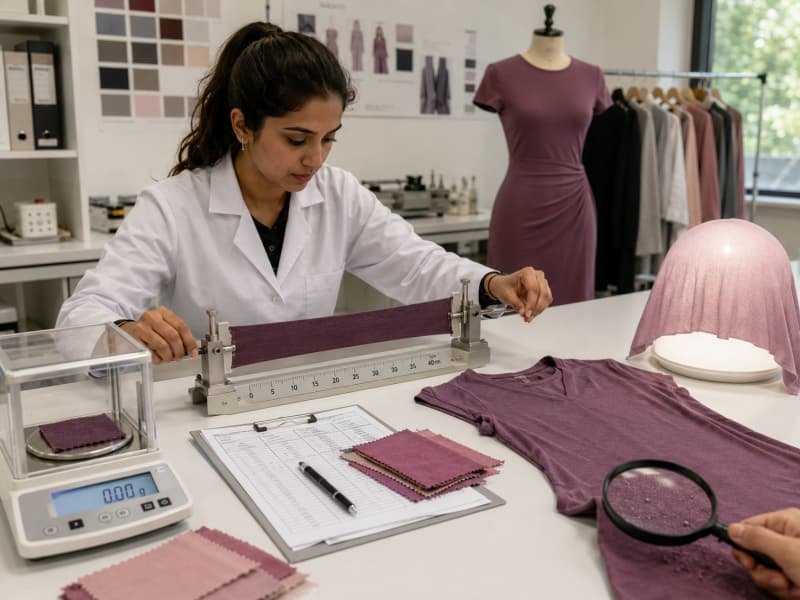
A fashion dress can look convincing on a hanger and still become a commercial problem after one wash, one evening of wear, or one production batch. A satin midi dress may twist after laundering. A black bodycon style may transfer color to a pale handbag. A lightweight woven dress may open at the hip seam even though the sewing thread remains intact. These failures often begin in the fabric, long before the first bulk garment reaches the sewing line.
Fashion dresses should be tested for dimensional stability, colorfastness, pilling, strength, seam performance, stretch recovery, fabric weight, fibre composition, and appearance after care. The final test plan must also reflect the silhouette, color, lining, embellishment, care label, destination market, and the amount of stress placed on the finished garment.
Testing is not about collecting a thick laboratory file that nobody uses. It is about making an informed decision while there is still time to change the fabric, revise the pattern, strengthen a seam, alter the pressing process, or select a more realistic care instruction. One failed test during development can feel inconvenient; the same weakness discovered after thousands of dresses have shipped is a very different story.
What Are Fabric Tests for Fashion Dresses?
Fabric tests are controlled checks that show whether a material can retain its size, color, surface, strength, stretch, and appearance during manufacturing, wearing, cleaning, and storage. For fashion dresses, the plan should reflect the fabric construction, silhouette, care method, color, lining, decoration, market, and stress placed on the finished garment.
What Fabric Testing Measures
Fabric testing turns physical behavior into measurable information. Instead of approving a material because it feels “stable” or looks “high quality,” the team records dimensional change, staining, breaking force, seam opening, pilling, stretch, recovery, fabric mass, or fibre content under controlled conditions. The result gives design, technical, sourcing, and production teams a common basis for making decisions.
Two fabrics can look almost identical on a hanger but behave very differently in production. One stretch satin may return cleanly after extension, while another develops permanent growth around the hip. Two chiffon qualities may share the same weight, but the more open construction can pull apart at the side seam. A black jersey may retain its shade after washing yet still transfer dye during wet rubbing.
- Fabric code, colorway, lot, supplier, and mill reference
- Fibre content, construction, fabric width, and mass
- Test method, care conditions, specimen direction, and number of cycles
- Individual readings, average result, requirement, and visible observations
Direction matters. Woven fabrics can behave differently along the warp and weft. Knits can show different extension and recovery across the course and wale. Reporting one average may hide a weakness that becomes obvious when the material is placed around a fitted bust, waist, hip, zipper, or slit opening.
Why Dresses Need Testing
Fashion dresses are unusually sensitive to small material changes because fit, drape, movement, and appearance are closely linked. A two-percent dimensional change may sound minor, but it can lift a midi hem, loosen a bodycon waist, move a bust seam, shorten a strap, or expose a lining. The commercial effect depends on where the change appears, not only on the percentage.
- Bias-cut panels that may lengthen during hanging or care
- Close-fitting silhouettes that depend on controlled stretch and recovery
- Lightweight woven fabrics with limited seam resistance
- Deep colors that may stain pale linings, underwear, bags, or seating
- Pleats, coatings, sequins, beads, foil, or flocking affected by heat and cleaning
- Shell, lining, fusible, elastic, and trims with different shrinkage behavior
A material does not need to tear completely to fail. Seam yarns can move away from the stitch line. A satin surface can become shiny under pressing. A lining can shrink faster than the shell and pull the hem upward. A stretch fabric can bag after sitting even though it looked perfect during a five-minute fitting. These are exactly the defects that generate returns, negative reviews, repair claims, delayed launches, and cautious repeat orders.
Fabric Tests and Garment Checks
Fabric testing and garment inspection answer different questions. Testing measures performance under defined conditions. Inspection checks whether the produced dresses match the approved sample, measurements, workmanship, colors, labels, quantities, and packing requirements. Neither process can replace the other.
An inspector may find puckering, incorrect measurements, broken stitches, mixed shades, missing trims, poor pressing, or packing errors. The same inspection may not reveal excessive shrinkage after care, weak wet-rubbing fastness, poor recovery, pilling after friction, low seam-slippage resistance, or delamination after cleaning. Conversely, a fabric may pass every laboratory test and still be damaged by the wrong needle, feed setting, pressing temperature, or cutting direction.
- Verify material performance before cutting.
- Verify construction performance during sampling and pre-production.
- Verify garment consistency through inline and final inspection.
The strongest quality system connects all three levels. A passing swatch is only the beginning; the approved properties must survive pattern development, sewing, pressing, finishing, packing, and repeated production.
How Testing Reduces Risk
Testing reduces risk only when the result leads to a recorded action. A report stored in a folder does not prevent defects. The team must decide whether the result changes the material, pattern, seam, lining, process, care label, or release decision.
A failed shrinkage result may lead to pre-shrinking, relaxation, pattern compensation, a different drying method, or rejection. Weak seam performance may require a wider allowance, another seam type, different stitch density, reinforcement tape, backing, lining, or a tighter fabric construction. Poor recovery may require less negative ease or a replacement fabric with stronger holding power.
- Identify the failure most likely to harm fit, appearance, safety, or durability.
- Choose a method that reproduces or predicts that failure.
- Set the method and acceptance requirement before testing.
- Test material representative of the intended production lot.
- Correct the cause, retest the correction, and confirm it on a finished garment.
- Carry the approved control into bulk production and repeat orders.
Timing is critical. Before cutting, the team can still change fabric. After cutting, options become narrower and more expensive. After shipment, the same defect becomes a customer-service, return, chargeback, or brand-reputation problem.

Which Fabric Tests Are Most Common?
The most common tests for fashion-dress fabrics cover dimensional change, colorfastness, pilling, strength, abrasion, seam performance, stretch recovery, fabric weight, and fibre composition. Extra tests may be required for prints, coatings, pleats, bonded layers, embellishments, delicate surfaces, deep colors, special care methods, or regulated markets.
Dimensional Stability
Dimensional-stability testing measures how much a fabric or garment shrinks, grows, twists, or changes shape after washing, drying, steaming, dry cleaning, relaxation, or hanging. The basic calculation is: dimensional change (%) = (final measurement – original measurement) / original measurement x 100. A negative result normally indicates shrinkage; a positive result indicates growth.
Both directions must be reviewed. A woven fabric may shrink in length but grow in width. A knit may remain close to its original dimensions yet twist because of spirality or skew. A bias-cut skirt may lengthen after hanging even when it has not been washed. The practical effect may appear in body length, waist position, strap length, sleeve length, hem balance, lining alignment, or panel matching.
The report should record the wash or cleaning method, temperature, detergent, drying method, number of cycles, conditioning time, and measurement direction. Results from line drying cannot be compared directly with tumble drying unless the specification allows both. Early screening may use one cycle, while brand protocols often use repeated cycles to identify progressive change.
Fabric results should be followed by garment testing. Shell, lining, fusible, zipper tape, elastic, thread, cups, and decoration may react differently. A shell that changes by two percent and a lining that changes by four percent can create bubbling, twisting, or an exposed lining hem even when each material looked acceptable alone.
Color and Surface Performance
Colorfastness checks whether the original shade changes and whether dye stains another material. Tests commonly cover laundering, dry and wet rubbing, perspiration, water, light, pressing, and dry cleaning. Results are often graded on a grey scale from 1 to 5, where 5 indicates little or no visible change and 1 indicates severe change. The brand still needs to define its own pass requirement.
Dark and saturated shades deserve extra attention. Black, navy, red, burgundy, purple, and some bright fashion colors may retain their visual depth while transferring dye to pale underwear, white linings, handbags, jackets, seating, or skin. Color change and staining should therefore be reviewed separately.
Surface testing covers pilling, fuzzing, matting, abrasion, snagging, print loss, coating damage, pile crushing, or shine. A laboratory grade should be interpreted together with color and texture. Moderate fuzz may be hard to see on a textured mélange but very obvious on smooth black jersey or satin.
Strength and Seam Performance
Strength testing measures the force required to break, tear, or burst a material. Woven fabrics are commonly evaluated for tensile and tear strength. Knitted and highly extensible fabrics may be better represented by bursting methods because the pressure is applied in several directions. The method should match the material, and the result should match the stress created by the dress design.
High-risk areas include fitted side seams, centre-back zippers, bust and waist joins, strap attachments, slit openings, boning channels, hook-and-eye positions, and narrow seam allowances. A delicate chiffon does not need the strength of workwear, but it must withstand the actual load created by the silhouette and construction.
Seam slippage occurs when fabric yarns move away from the stitch line under tension, leaving a visible opening even though the sewing thread has not broken. Results may be expressed as the opening at a specified load, the load needed to create a defined opening, or the force at failure. A number has little meaning unless the seam construction, specimen direction, load, and method are recorded.
Corrective action may involve seam type, allowance, stitch density, needle, thread, reinforcement, grain direction, or fabric selection. More stitches are not always safer; excessive stitch density can perforate a delicate fabric and lower its strength.
Stretch, Weight, and Composition
Stretch and recovery are separate properties. Stretch shows how far a material extends under load. Recovery shows how closely it returns after the load is removed. A fabric may stretch comfortably but recover poorly, leaving bagging around the seat, hip, waist, elbows, or knees. Another fabric may recover strongly but feel restrictive because the force needed to stretch it is too high.
- Original and extended specimen length
- Extension percentage under the specified load
- Immediate and delayed recovery
- Residual growth after one or more extension cycles
- Performance after washing, heat setting, or pressing where relevant
Fabric weight, often reported in grams per square metre, affects drape, opacity, support, sewing behavior, yield, and cost. GSM alone does not define quality. Two 180 GSM fabrics may differ in yarn, density, thickness, finish, recovery, and coverage. Bulk fabric should be controlled against the approved range rather than accepted because it feels similar.
Fibre composition matters when it influences care, heat sensitivity, stretch, dyeing, recycled-content claims, legal labeling, hand feel, and price. Even a small change in elastane percentage or yarn system can alter the fit of a bodycon dress.
Test area | Common result format | Dress problem revealed | Production decision |
Dimensional change | Length/width change (%) | Shortened hem, loose waist, twisting | Relax, pre-treat, adjust pattern, revise care, or replace |
Crocking | Dry and wet grade (1-5) | Dye transfer to skin, lining, bags, or seating | Improve fixation, change color, add care control, or reject |
Wash colorfastness | Color-change and staining grades | Fading, bleeding, contrast staining | Review dyeing, print fixation, and care method |
Pilling | Visual grade, commonly 1-5 | Pills at underarm, hip, seat, or side body | Change yarn, finish, fabric, or intended use |
Tensile/tear/burst | Force at break or failure | Splitting near seams, straps, or openings | Reinforce construction or select stronger material |
Seam performance | Opening (mm) or failure force | Visible seam gaps at hip, bust, waist, or zipper | Change seam, allowance, stitch, backing, or fabric |
Stretch/recovery | Extension and residual growth (%) | Bagging, poor support, fit change | Revise pattern ease or choose another stretch system |
Fabric mass/composition | GSM and fibre percentages | Changed drape, opacity, care, or legal label | Control bulk lot or correct sourcing and labeling |

Which Tests Suit Each Dress Fabric?
Each dress fabric needs a test package based on construction, fibre content, finish, silhouette, care method, and its role in the garment. Satin and chiffon need seam and surface control; knits need stretch and recovery checks; mesh and lace need structural testing; velvet, sequins, bonded layers, and structured fabrics need process-specific evaluation.
Satin and Chiffon
Satin is a surface and weave effect, not one fixed material. Polyester satin, acetate satin, silk satin, viscose satin, and stretch satin can react differently to heat, water, rubbing, seams, and pressing. Priority checks often include seam slippage, dry and wet rubbing, snagging, tensile or tear strength, pressing sensitivity, water marking, shade consistency, care appearance, and stretch recovery where elastane is present.
The material should also be viewed from different directions under controlled lighting. Satin panels cut off-grain or reversed can appear like different colors even when they come from the same dye lot. Pressing trials should establish safe temperature, pressure, steam, and contact time because an otherwise acceptable fabric may develop irreversible shine or edge marks during manufacturing.
Chiffon presents risks linked to low mass and open construction: tearing, seam grin, puckering, feed distortion, edge instability, and needle damage. Sewing trials are therefore as important as laboratory strength results. Needle size, stitch length, seam type, differential feed, and edge finish should be tested using the intended production fabric.
Bias-cut satin and chiffon garments should be hung before final hemming. Depending on length, cut, weight, and decoration, panels may continue to drop for 24 to 72 hours. The production process must allow the garment to settle before the hem is leveled.
Mesh, Lace, and Sheers
Mesh and lace should be evaluated for strength, hole growth, snagging, recovery, edge behavior, and attachment stability. The correct method depends on whether the material is knitted, woven, embroidered, bonded, or constructed as an open net. A loose decorative mesh sleeve and a power-mesh body lining carry very different loads and should not share the same acceptance level.
For stretch mesh, review extension in both directions, immediate and delayed recovery, bursting resistance, growth after care, edge curling, shade, and opacity under the actual extension used in the dress. A fabric that looks opaque when relaxed may become visibly sheer when stretched 20 or 30 percent over the hip or bust.
Lace requires attention to motif stability, embroidery security, scallop shape, tear propagation, shrinkage, and sewing damage. Needle penetration through a dense motif can cut embroidery yarns or create weak points. The test panel should include the real seam allowance and the densest motif areas rather than only the easiest open section.
Sheer materials must be reviewed with the intended lining, cups, boning, zipper tape, labels, seam allowances, and undergarment scenario. Shell and lining should be cleaned together and compared for shrinkage, static, recovery, color migration, and hanging behavior.
Jersey and Bodycon Fabrics
Jersey and bodycon fabrics depend on a controlled balance of stretch, recovery, opacity, weight, compression, and surface durability. Priority checks usually include dimensional stability, spirality or skew, stretch, recovery, residual growth, pilling, bursting strength, GSM, elastane content, opacity under extension, and appearance after repeated care.
High stretch does not automatically produce a good fit. A soft fabric may extend easily but lack holding power, so it feels comfortable during the first fitting and then grows around the seat. Another fabric may recover strongly but require excessive force to stretch, creating pressure points and restricted movement. Both extension and stretch force should be considered during material selection.
Opacity must be assessed at the extension level used in the garment. Flat swatch inspection is not enough. The pattern team should know the stable width, stretch curve, recovery, thickness, and compression before setting negative ease. Differences between “similar” four-way stretch fabrics can change bust fit, waist suppression, hip shaping, hem width, neckline stability, strap length, and zipper need.
The production fabric should be used for final fit approval. Substitution after sampling requires renewed testing and often renewed pattern confirmation because stretch percentage alone does not describe recovery, force, surface friction, or growth during wear.
Velvet, Sequins, and Structure
Velvet should be checked for pile direction, rubbing, crushing, shading, seam impression, cleaning, and pressing response. Reversed pile changes how light is reflected, so panels cut in different directions can appear to be different shades. Pressing trials should define safe temperature, steam, pressure, contact time, and the use of a soft support or velvet board.
Even when the fibres are not permanently damaged, seam allowances and folds can leave visible impressions on the face. Folding, stacking, vacuum packing, or long transport may crush the pile. A packing simulation helps reveal whether the garment can recover through hanging or steaming.
Sequin and bead materials require testing of both the base fabric and the decoration system. Check attachment strength, thread security, decoration loss after care, abrasion between panels, sharp edges, snagging, heat sensitivity, color loss, base-fabric distortion, and hanging growth. Heavy decoration can lengthen a bodice, pull down a neckline, or distort shoulder and waist seams over time.
Structured and bonded fabrics need shape-retention, fusible-adhesion, delamination, cracking, seam, pressing, and care tests. A stable shell can still fail when combined with the wrong interfacing, cup, boning, or adhesive. The assembled panel is the true product and should be tested as a system.
Fabric or construction | Priority tests | Common failure | Useful production check |
Satin | Seam slippage, rubbing, snagging, pressing, shade | Open seams, pulls, shine marks, panel shading | Test hip, zipper, waist seams and safe pressing window |
Chiffon | Tear, slippage, shrinkage, snagging, hanging | Tearing, puckering, seam grin, dropped hem | Trial needle, feed, edge finish, and 24-72 h hanging |
Stretch mesh | Recovery, bursting, growth, opacity | Holes, bagging, transparency | Test at intended garment extension |
Lace | Tear, motif stability, shrinkage, sewing damage | Distorted motifs, broken embroidery | Sew through dense motifs and scalloped edges |
Jersey/bodycon | Shrinkage, spirality, pilling, recovery, opacity | Twisting, growth, surface wear, show-through | Wash and wear-test the finished garment |
Velvet | Pile crushing, rubbing, pressing, cleaning | Pressure marks, shading, flattened pile | Review cutting direction and packing recovery |
Sequins/beads | Attachment, abrasion, heat, care, hanging | Decoration loss, snagging, garment growth | Hang-test full finished garment |
Bonded/structured | Adhesion, pressing, care, shape retention | Bubbling, cracking, delamination | Test fused and supported panels as assembled |

How Are Test Standards Selected?
Test standards are selected by matching the sales market, fabric construction, care method, dress type, known risk, and brand protocol. The standard defines how a property is measured; the performance specification defines what result is acceptable. Both the method and the acceptance requirement should be agreed before fabric approval or bulk production.
Method and Acceptance Limit
A test method and a pass requirement are not the same. The method controls specimen size, conditioning, equipment, applied load, temperature, wash procedure, number of cycles, and evaluation scale. The brand specification states what result the particular dress must achieve. Confusing these two creates disputes because a laboratory can follow the correct method and still produce a result that is unacceptable for the product.
A loose vacation maxi dress may tolerate a dimensional change that would visibly distort a fitted bustier mini dress. A black-and-white design may require stronger staining control than a single-color garment. A premium smooth jersey may need a better pilling appearance than a textured limited-wear fabric. The acceptance limit must reflect the consequence of failure in the finished style.
- Method and edition, including any customer modification
- Specimen direction, conditioning, exposure, and number of cycles
- Required result, treatment of individual failures, and retest rule
- Applicable colorways, sizes, lots, and garment components
Terms such as “good recovery,” “minimal shrinkage,” or “no obvious staining” should be translated into measurable requirements. Clear specifications shorten approval time and prevent different teams from interpreting the same result in different ways.
AATCC, ASTM, and ISO
AATCC, ASTM, and ISO methods are widely used in textile and apparel testing, but their procedures are not automatically interchangeable. The customer’s approved method should be used rather than whichever option is easiest for the supplier or laboratory. Common method families address dimensional change, rubbing, washing, perspiration, pilling, tensile or bursting strength, tear, seam performance, stretch and recovery, and appearance after care.
The selected method must suit the material. A procedure designed for stable woven fabric may not describe a highly extensible knit. A seam test using one standard seam construction may not represent a dress made with a different stitch, allowance, thread, or reinforcement. Brands should confirm the method scope, current edition, conditioning, units, reporting format, and laboratory accreditation where formal documentation is required.
Reports from different suppliers can be compared only when methods and conditions match. Two shrinkage percentages are not directly comparable if one used one wash and line drying while the other used three washes and tumble drying. The same caution applies to load, specimen direction, recovery time, and visual rating conditions.
Care and Market Requirements
The proposed care label strongly affects test selection. Machine washing, hand washing, tumble drying, line drying, flat drying, ironing, steaming, and dry cleaning expose the dress to different combinations of heat, moisture, agitation, pressure, and solvents. Testing should reproduce the realistic consumer-care method rather than an unusually gentle procedure selected only to obtain a passing result.
The complete garment should be considered. Linings can shrink differently from shells, fusibles can bubble, elastic can lose recovery, sequins can cloud, printed surfaces can crack, cups can deform, metal trims can discolor, and heat-set pleats can relax. Care testing on a flat fabric specimen cannot reveal all of these interactions.
Destination markets may add legal, chemical, labeling, flammability, retailer, or restricted-substance requirements. The correct package depends on the exact materials and selling channel. Coatings, prints, adhesives, metal components, recycled-content claims, and special finishes may require additional documentation or analysis. Requirements should be reviewed whenever the market, retailer, or material system changes.
Brand-Level Specifications
Brand standards are often stricter than minimum legal requirements because they protect fit, appearance, consistency, customer expectations, retailer obligations, and return rates. A mature specification is built from product positioning, complaints, return data, wear trials, test history, supplier performance, and the realistic capability of the material.
Stricter is not automatically better. An unrealistic limit can remove suitable fabrics, increase cost, extend development, and create disputes without producing a noticeable customer benefit. The standard should be demanding where failure is commercially serious and proportionate where the risk is low.
For example, seam opening at the hip of a fitted satin dress deserves close control. A loose decorative overlay may tolerate more movement. Wet rubbing matters greatly for a dark dress worn against pale accessories. A light single-color garment may present a different risk. The best specifications are specific to the product rather than copied from an unrelated category.
Requirement area | The method defines | The brand specification defines | Common mistake |
Dimensional change | Care cycle, drying, measurement, conditioning | Maximum change by direction and cycle count | Quoting a percentage without stating care conditions |
Colorfastness | Exposure and grey-scale evaluation | Minimum color-change and staining grades | Reviewing shade change while ignoring staining |
Pilling | Rubbing or tumbling procedure and duration | Minimum visual grade for the fabric and product use | Using one threshold for every surface and price point |
Seam performance | Seam construction, load, and measurement process | Maximum opening or minimum failure force | Ignoring the seam used in the real dress |
Stretch/recovery | Load, extension, hold time, and recovery interval | Required extension and maximum residual growth | Reporting stretch without recovery or stretch force |
Strength | Specimen, direction, and force application | Minimum value for the proposed construction | Applying a woven method to an unsuitable knit |
Appearance after care | Cleaning and visual-assessment procedure | Allowed twisting, puckering, bubbling, or trim damage | Testing fabric but not the assembled garment |

When Should Fabric Tests Be Done?
Fabric testing should begin during material selection and continue before sampling, cutting, bulk production, shipment, and relevant repeat orders. Early checks compare materials, pre-production tests approve the intended construction, and bulk controls confirm that the approved lot, shade, weight, performance, and process remain consistent through manufacturing.
Before Sampling
Before sampling, the team needs enough information to decide whether the proposed material can create the intended silhouette. Early checks often include fibre content, mass, usable width, stretch, recovery, drape, opacity, surface marking, basic shrinkage, seam behavior, pressing response, and lining compatibility. These checks can eliminate unsuitable fabrics before pattern and sample-room time are invested.
Not every early check requires a formal third-party report. Controlled internal screening is often more efficient for comparing several options. Formal testing can follow once the material direction is selected. The key is to use repeatable procedures and to keep the test specimen linked to the exact swatch used for development.
For a fitted style, stable stretch and recovery should be known before the pattern is finalized. For satin, seam and pressing trials should be completed before assuming that a narrow side seam will work. For a sheer dress, opacity should be examined under tension and with the intended lining. Early testing reduces sample revisions because a pattern cannot fully correct a fabric that continues to grow, slip, pucker, stain, or lose surface quality.
Before Cutting
Before cutting, bulk fabric must be confirmed against the approved material. This is one of the most important control points because cutting converts a roll-level issue into hundreds or thousands of garment components. The release decision should be based on the actual bulk lot, not only on an earlier development swatch.
- Roll identity, quantity, lot number, usable width, and fabric mass
- Shade grouping, visual defects, bow, skew, face, back, nap, and print direction
- Relaxation, shrinkage status, and critical test-report approval
- Consistency between shell, lining, trims, and approved sample
Stretch fabrics may need controlled relaxation before spreading. Velvet, brushed surfaces, directional prints, and one-way shine fabrics require marker planning that keeps panels aligned. Shade-sensitive materials should be cut by shade band so that visibly different rolls are not mixed within one garment.
Test reports must be traceable to the lot being cut. A passing result from a previous dye batch, mill, finish, or season does not automatically approve new bulk material, even when the supplier uses the same commercial fabric name.
Before Bulk Production
Before bulk production, the assembled dress should be tested using production-intent shell, lining, zipper, cups, boning, elastic, thread, labels, decoration, fusible, pressing, and care method. The objective is to confirm that the approved materials and construction work together, not simply that each component passed separately.
- Garment dimensional stability and appearance after care
- Seam, zipper, lining, fusible, and decoration performance
- Stretch, recovery, measurement stability, and fit after care
- Pressing marks, shade transfer, hanging balance, and packing recovery
The result must be translated into production instructions. When seam slippage is the risk, the technical file should specify allowance, stitch density, thread, reinforcement, and inspection position. When heat creates shine or migration, pressing temperature, pressure, steam, and contact time should be controlled. Some fabrics pass consumer-care testing but are damaged during fusing, steaming, folding, or packing, so manufacturing trials are part of approval.
Repeat Orders and Failures
Repeat orders need renewed testing when a variable affecting performance changes. Common triggers include a new mill, yarn source, fibre blend, GSM, dye lot, color depth, finish, print method, coating, embellishment supplier, factory, care label, or customer requirement. Incoming lots should still be checked for identity, shade, width, weight, and defects even when the specification appears unchanged.
When a test fails, the team should investigate the cause rather than repeatedly submitting the same sample until a passing result appears. The cause may be fibre, yarn, construction, dye fixation, finishing, heat setting, sewing damage, pressing, care conditions, or an unsuitable acceptance limit.
Corrective action may involve material replacement, reprocessing, pattern revision, seam reinforcement, altered pressing, revised care, or another colorway. The correction must be retested, and the material used for the retest must match the corrected bulk production. A mill statement that the problem has been solved is not a substitute for verification.
Stage | Main purpose | Useful checks | Release decision |
Material selection | Eliminate unsuitable options | Drape, weight, opacity, stretch, recovery, basic shrinkage | Select, revise, or replace material |
Sample development | Confirm design feasibility | Seam, pressing, fit, lining, surface, hanging | Revise fabric, pattern, or construction |
Bulk receipt | Confirm the production lot | Width, GSM, shade, defects, lot identity, reports | Approve, segregate, rework, or reject rolls |
Pre-cutting | Protect irreversible production | Relaxation, shrinkage, direction, shade grouping | Release controlled rolls for cutting |
Pre-production | Confirm assembled performance | Garment care, seams, trims, zipper, fusible, fit | Approve production method and control points |
Repeat order | Confirm continued consistency | Changed-risk tests and incoming-lot controls | Approve, retest, or adjust before cutting |

How Should Brands Use Test Results?
Brands should use test results to approve or reject materials, revise patterns and construction, set care instructions, control bulk production, compare suppliers, and prevent recurring defects. Every important result should be linked to a decision, responsible person, corrective action, retest, and production checkpoint rather than stored as an isolated laboratory report.
From Result to Action
The first question after receiving a report should be: what does this result change in the dress? Shrinkage may change pattern allowance or care instructions. Fabric growth may change negative ease. Seam opening may change the construction. Poor rubbing fastness may rule out a dark shell with a pale lining. Pilling may change material selection or the intended frequency of wear. Pressing sensitivity may change equipment settings and operator instructions.
A borderline result should be reviewed at product level. A lightweight satin with limited seam resistance may work in a loose draped maxi dress but not in a fitted zip-back mini. A soft jersey with moderate recovery may suit a relaxed day dress but not a compressive bodycon style. Testing should guide the most appropriate use, not simply label the fabric “good” or “bad.”
Corrective actions should be recorded with the report. Without documentation, another team may approve the same weak material, or a repeat order may return to the original seam, care process, or pressing condition. The value of testing grows when the result becomes part of the technical package and pre-production meeting.
Fabric and Pattern Decisions
Fabric properties directly affect pattern dimensions, ease, grain direction, seam allowance, support, lining, and reinforcement. A pattern approved in one material should not be transferred blindly to another fabric with different shrinkage, stretch force, recovery, thickness, drape, or bias behavior. Two garments can measure the same on a table while fitting very differently on the body.
- Negative ease, bust and waist shaping, and hip allowance
- Strap length, neckline stability, and hem depth
- Bias compensation, grain direction, and panel balance
- Lining dimensions, zipper reinforcement, boning, and interfacing
- Needle, thread, seam type, stitch density, tape, and stay stitching
When a fit issue appears, the paper pattern is not always the cause. The fabric may have relaxed, grown, twisted, or failed to recover. Test records help the technical team correct the real source instead of repeatedly changing measurements and creating a new problem elsewhere in the garment.
Reports and Traceability
A useful test report makes the material identifiable and the result reproducible. It should include report number, date, test location, fabric code, color, lot or batch, fibre content, sample description, method and edition, conditioning, care or exposure procedure, individual and average results, units or grades, requirement, conclusion, photographs where useful, and any deviation from the method.
A description such as “black polyester fabric” is not sufficient when several black polyester qualities are under development. The report should be stored with the test request, submitted specimen reference, supplier and mill details, styles using the fabric, corrective action, approval decision, repeat-order history, and relevant complaint data.
Over time, these records become a material-performance library. Product teams can identify stable mills, finishes, constructions, color systems, and suppliers instead of restarting from zero each season. Traceability also prevents the common mistake of assuming that “the fabric passed last year” when the mill, dye lot, mass, finish, or care instruction has changed.
Assessing a Manufacturer
A capable dress manufacturer should understand how fabric performance affects the complete product, not merely know where to send a swatch. The team should be able to identify the tests relevant to the silhouette, explain the highest-risk areas, separate internal screening from formal third-party work, and show how a failed result changes material, pattern, seam, or process decisions.
- Fabric inspection, shade grouping, shrinkage, and lot-traceability records
- Seam, pressing, wash, attachment, and lining-compatibility trials
- Pre-production checklists and technical-package updates
- Documented corrective actions and repeat-order controls
- Clear ownership across fabric, pattern, sample, production, and quality teams
The strongest teams connect fabric sourcing, testing, pattern development, fitting, sewing engineering, pre-production approval, inline control, and final inspection. Most dress failures are not caused by one department alone. A marginal fabric becomes a serious defect when it is combined with a tight silhouette, narrow seam, rigid lining, high pressing temperature, or heavy decoration.
A reliable process looks at the entire system before bulk cutting. That approach protects the approved design while improving repeatability from sample to launch quantity, repeat order, and scaled production.
Turn Fabric Data Into a Production-Ready Dress
A useful test plan begins with the dress, not a generic laboratory checklist. Duolan Apparel can review your tech pack, reference sample, target silhouette, proposed fabric, lining, colorways, care method, destination market, order volume, and launch schedule. The development team can then identify the material risks most likely to affect fit, drape, opacity, seam stability, appearance, or repeat-production consistency before bulk cutting begins.
Share:
Our Services
Categories
Table of Contents
Here, developing fashion collections is more than manufacturing garments — it’s a collaborative process focused on transforming ideas into well-executed, market-ready products. From fabric sourcing and sample development to scalable production and delivery coordination, every stage is built to support quality, consistency, and efficient collection launches across global markets.