Skip to content

Corset Dress Manufacturing Solutions
Structured corset development and manufacturing for fashion brands that need the bodice to fit, support, photograph, and repeat correctly in bulk.
- 10 structure checkpoints reviewed across cup position, boning, lining, waist shaping, back adjustment, and bulk consistency.
- 6 corset-specific QC points can be tracked during production: cup position, waist, boning, back panel, closure security, and symmetry.
- Sample development can move through first, fit, revised, photo-ready, salesman/approval, and PP stages according to project needs.
- Complex dress production commonly runs on a 30-45 day reference cycle after approvals and material readiness, with timing confirmed against style complexity and launch requirements.
Corset Manufacturing Built Around Established Fashion Brand Workflows
Established Dress Brands
Product Development Teams
Sourcing And Buying Teams
Six Manufacturing Risks Behind A Strong Corset Dress
Cup Position Drift
Boning Placement Error
Upper Edge Instability
Waist Shape Distortion
Back Structure Failure
Lace-up backs, eyelets, invisible zippers, hook-and-eye closures, and mixed closure systems carry different loads. Thin fabric can tear around eyelets; weak reinforcement can stretch; zipper areas can ripple or separate from the body; a back panel that is too wide or too narrow can shift the entire bodice. Back construction needs planned reinforcement, symmetrical placement, correct spacing, compatible trims, and a pattern that balances front support with rear adjustability.
Sample To Bulk Drift
Corset dresses are sensitive to small changes. A few millimeters at the cup, a slightly different boning length, a new lining lot, changed seam allowance, or inconsistent pressing can alter the finished fit. Bulk control therefore depends on locked references: approved pattern, BOM, fabric and trim standards, critical measurements, workmanship instructions, PP sample, and product-specific QC points. The goal is not visual similarity alone, but repeatable structure across sizes and production quantities.
Development Paths For Different Corset Project Starting Points
Complete Tech Pack
Reference Image
Original Garment Sample
Existing Bestseller
Collection Brief
Revised Supplier Program
Corset Dress Styles With Different Engineering Priorities
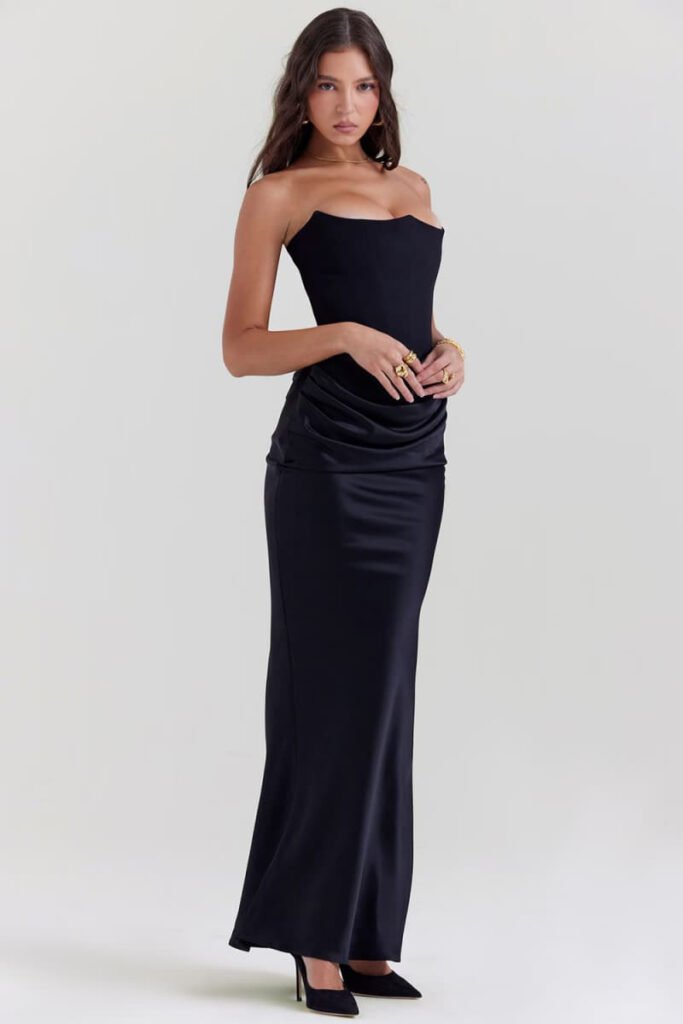
Strapless Corset Dresses
Strapless corset dresses rely on the bodice to carry the garment without shoulder support. Development should control cup position, upper-edge grip, bust coverage, boning length, waist tension, side-seam balance, back width, zipper or lace-up load, and lining stability. Anti-slip tape or internal elastic may help in selected designs, but those components cannot correct a weak pattern. Fit review should include standing, sitting, arm movement, and repeated wear movement so the neckline remains stable without excessive compression.
- Key focus: upper-edge stability and bust support.
- Main risk: gaping, slipping, or over-compression.
- Best evidence: front/side/back fit views and internal bodice close-ups.

Bustier Corset Dresses
- Key focus: cup architecture and neckline symmetry.
- Main risk: cup collapse, overflow, or visible seam distortion.
- Best evidence: cup pattern, foam/lining layers, and fit photographs.

Lace-Up Corset Dresses
A lace-up back can combine adjustability with a strong visual cue, but load must be transferred through reinforced structure. Eyelet spacing, hole diameter, backing layers, boning near the lacing area, back-panel width, lace material, tie length, and edge finishing all influence durability and fit.
Bulk checks should verify spacing, left-right symmetry, eyelet security, reinforcement coverage, and the relationship between the laced opening and approved fit.
- Key focus: reinforced adjustability.
- Main risk: eyelet pull-out, stretched back edges, or uneven lacing.
- Best evidence: inside reinforcement and pull-area close-ups.

Corset Mini Dresses
- Key focus: torso-to-mini proportion.
- Main risk: skirt lift, length imbalance, or distorted waist placement.
- Best evidence: standing/sitting views and critical length measurements.

Bodycon Corset Dresses
- Key focus: rigid-to-stretch balance.
- Main risk: waist seam distortion, transparency, or inconsistent compression.
- Best evidence: recovery tests, waist seam close-ups, and fit movement views.

Satin Corset Dresses
- Key focus: structure without surface damage.
- Main risk: puckering, ridging, shine marks, or visible internal edges.
- Best evidence: close lighting photos and inside/outside construction comparison.

Mesh Or Lace Corsets
- Key focus: transparent appearance with concealed reinforcement.
- Main risk: weak load areas, exposed seam allowance, or inconsistent lace placement.
- Best evidence: layered material samples and internal reinforcement views.

Party Occasion Corsets
- Key focus: visual impact plus production repeatability.
- Main risk: decoration interfering with support, fit, or workmanship.
- Best evidence: sample revision, inside construction, and bulk control records.
Inside The Structure Of A Production-Ready Corset Dress
Bust And Cup Architecture
The sample review should verify more than bust circumference. Cup depth, cup width, bridge or center-front spacing, underbust anchoring, side-cup containment, neckline edge tension, and the transition into the waist all affect wearing stability. When foam or molded components are used, thickness can change the internal volume available to the body. When the outer layer is satin, lace, mesh, or embellished fabric, surface tension can make a technically correct cup look distorted if the layer is not controlled.
Across size grading, cup position should not simply move outward by a fixed amount. Larger sizes may need adjusted cup width, depth, side support, back width, and boning relationships to retain the intended silhouette. The development record should therefore identify critical bust points, accepted sample photographs, measurement references, and material layers so the approved cup is reproducible rather than dependent on one sample maker’s hand. The same reference also supports later fit review, size grading, PP confirmation, and inline inspection.
Boning And Waist Support
Placement matters as much as material. Boning may follow princess seams, side seams, center-front structure, cup boundaries, or dedicated channels. Each bone needs enough length to support the area without finishing at a pressure point. The lower end must avoid digging into the waist or hip when sitting. The upper end should support the neckline without pushing visibly through the outer layer. Channels also need consistent width and seam control so bones do not twist or migrate.
Waist shaping is distributed through panel geometry, seam curvature, fabric stability, closure tension, and support rather than created by boning alone. Duolan therefore reviews the relationship between waist circumference, torso length, side seam, back opening, and bust support before finalizing the sample. Bulk production can then control boning length, channel position, left-right symmetry, and the approved waist measurement against the PP reference.
Lining And Interlining System
Material decisions should be localized. Cup areas may need different support from side panels. An eyelet section may require reinforcement not needed across the full bodice. A satin upper body may need a stable internal layer to prevent rippling, while mesh may require power mesh or shaped lining to provide strength without losing transparency. Light-colored corsets also need opacity review under strong lighting because cup foam, seam allowance, boning, or interlining can become visible through the outer material.
A production-ready specification should identify each internal layer, color, weight direction where relevant, attachment position, edge treatment, and relation to the outer pattern. During PP review and inline inspection, lining attachment and internal support are checked as construction elements, not hidden areas that can vary because they are not visible on a hanger.
Back And Closure Engineering
The back of a corset dress determines adjustability, entry, support distribution, and much of the tension carried by the bodice. An invisible zipper can create a clean fashion finish, but zipper tape, seam allowance, interlining, and pressing must be strong enough to hold the bodice without rippling. A lace-up back offers adjustability, but eyelets concentrate force into small areas and therefore require reinforced backing and consistent placement. Hook-and-eye or mixed closure systems introduce their own alignment and pressure requirements.
Back width is a fit-critical measurement. A panel that is too wide can reduce useful lacing range or cause loose fit at the upper body. A panel that is too narrow can overload the lacing area and make the front cup position shift. For zip-back corsets, center-back length, zipper top position, waist alignment, and seam balance affect whether the bodice sits straight. For lace-up styles, eyelet spacing and the intended gap must be defined in the sample rather than left to operator judgment.
During development, closure selection should be made with the outer fabric and support level already understood. During bulk, reinforcement layers, eyelet placement, zipper length, stitching, back-panel width, and left-right symmetry can be checked against the approved PP sample and construction record.
Corset Materials And Components Compared By Manufacturing Role
Material selection should follow the garment result rather than fabric name alone. Corset construction combines visible fashion materials with hidden support components. The strongest option is the combination that delivers the required shape, comfort, finish, price position, and repeatable production behavior.
| Material / Component | Structural Role | Best Use | Main Risk | Production Consideration |
|---|---|---|---|---|
| Main Fabric | Creates the visible surface and contributes stretch, drape, stiffness, texture, and recovery. | Satin, crepe, stretch woven, mesh, lace, velvet, sequin, or fashion blends selected by style. | Too soft can collapse; too rigid can distort fit; delicate surfaces can show internal ridges. | Confirm weight, stretch direction, opacity, surface sensitivity, lot consistency, and compatibility with internal support. |
| Lining | Controls skin feel, opacity, inside finish, movement, and protection from seams or boning. | Fitted, sheer, embellished, satin, and occasion corsets. | Wrong stretch or length can pull the shell, create twisting, or reduce comfort. | Lock lining composition, stretch, color, hand feel, pattern, and attachment points in BOM and PP standard. |
| Interlining | Adds local or full-body stability behind the outer fabric. | Strapless, sculpted, satin, eyelet, structured bodices. | Excess stiffness creates bulk and visible edges; weak support allows collapse. | Apply by zone according to neckline, cup, eyelet, zipper, and waist requirements rather than using one blanket solution. |
| Cups / Foam | Defines bust volume and contributes coverage and support. | Bustier, sweetheart, molded, padded, and strapless corsets. | Incorrect depth, thickness, or placement causes compression, gaping, or asymmetry. | Confirm size, thickness, shape, left-right matching, attachment, and grading relationship before bulk release. |
| Boning | Maintains panel shape, supports waist and neckline, and reduces collapse. | Corset-inspired and structured dress bodies requiring light to stronger support. | Wrong stiffness, length, or position can dig, twist, ridge, or fail to support. | Specify type, length, channel width, position, end treatment, and size-grade changes. |
| Zipper | Provides entry while carrying back or side tension. | Clean fashion corsets and styles without adjustable lacing. | Rippling, seam failure, difficult closing, or distortion under load. | Match zipper quality, length, tape strength, seam reinforcement, placement, and pressing method to bodice tension. |
| Eyelets | Transfer lace-up load through reinforced back or side panels. | Adjustable corset backs and visible lace-up details. | Pull-out, edge tearing, uneven spacing, sharp finish, or color inconsistency. | Confirm diameter, finish, spacing, reinforcement, setting method, pull area, and left-right symmetry. |
| Lace-Up Tape / Cord | Controls adjustable closure range and visual finish. | Back or side lace-up corsets. | Stretching, fraying, slipping, pressure, or mismatch with eyelet size. | Select material, width, length, end treatment, friction, color, and knot behavior against the approved sample. |
Pattern Fit And Grading Engineering For Corset Programs
Pattern Architecture Before Sampling
Pattern development begins by translating visible design lines into load-bearing and fit-bearing panels. Neckline shape, bust point, underbust, waist height, center front, side seam, princess seams, cup seams, back width, zipper line, lace-up opening, and skirt connection all influence the finished structure. A drawing can show the silhouette but does not automatically define how tension should move through the garment.
The outer fabric also changes the pattern decision. A rigid woven can hold a sharp panel line but needs enough ease and accurate shaping. Stretch satin may need negative ease in selected areas but can expose seam distortion. Mesh and lace can require stable underlayers. Sequin or embellished fabrics may not tolerate the same dart, seam, or channel arrangement as a clean satin. Pattern decisions therefore need to be reviewed with material direction before a sample is treated as a true fit reference.
For corset development, Duolan can work from a brand pattern, size specification, tech pack, physical sample, or reference direction. The goal is not to overwrite a brand fit block, but to make the supplied fit direction executable in the chosen structure. Pattern versions and comments should remain traceable so later sample rounds and bulk use the correct basis rather than an outdated file.
Fit Engineering On The Body
A corset can match flat measurements and still fit poorly. Human fit review tests how the garment distributes pressure across bust, underbust, waist, side body, back, and upper edge while the wearer stands, sits, turns, raises the arms, and breathes normally. Movement reveals problems that a table measurement cannot show: neckline lift, side seam migration, cup overflow, gaping, waist digging, zipper stress, lacing imbalance, skirt lift, or boning pressure.
Fit comments should therefore identify both the visible problem and the probable cause. A low cup may require a pattern shift, not simply a shorter strap. Gaping at the neckline may involve cup volume, upper-edge tension, side seam balance, or back width. A waist wrinkle may come from torso length, seam shaping, boning, or lining tension. Diagnosing the mechanism prevents repeated modifications that solve one area while creating another.
Approved fit points can be recorded through measurements, annotated front/side/back photographs, pattern revision notes, and sample comments. For structured styles, critical points commonly include cup position, underbust, waist, back-panel width, center-front length, boning position, neckline security, and the relationship between bodice and skirt. Clear records allow later sample rounds to preserve earlier approvals instead of reopening already settled fit decisions.
Grading Beyond The Sample Size
A good sample size is only the starting point for a commercial size range. Corset grading must preserve the intended bust shape, waist emphasis, back adjustability, neckline exposure, torso proportion, and support level as body dimensions change. Simply increasing every measurement by a fixed increment can move cup position incorrectly, make boning miss the body curve, widen a neckline too much, or reduce the useful lacing range.
Grading rules should distinguish horizontal growth from vertical and structural change. Cup width and depth may need different progression. Waist and high-hip relationships affect how the bodice anchors. Back panels may need controlled width increases so closure geometry remains usable. Boning lengths and positions may need size-specific adjustment. For mini or bodycon corset dresses, skirt length, hip ease, and hem opening also need to grow without losing the intended visual proportion.
Before bulk, the size specification, grading rule, critical POMs, tolerance logic, and approved PP reference should align. Brands with an established size chart can keep their standard as the basis. When information is incomplete, development can identify where additional grading decisions are needed before the range is released. Size-set review can also be used when a style has unusual cup, torso, or back proportions that cannot be confirmed reliably from the sample size alone.

Design Details That Directly Change Corset Performance

Strapless Upper Edge
A strapless upper edge controls both visual exposure and wearing security. Neckline curve, cup height, side height, back height, internal stabilization, boning, elastic or anti-slip treatment, and closure tension all interact. Making the top edge tighter is not a reliable correction for gaping because excessive tension can compress the bust or create rolling.
Development should test the edge while standing and moving, then record accepted neckline position, cup coverage, and internal support in the PP reference.
- Check: neckline symmetry, gaping, roll, grip, side height.
- Risk: solving instability with excessive tightness.
- Evidence: front/side fit photos plus internal edge construction.

Sculpted Neckline Shape
Sweetheart, square, peaked, curved, or asymmetric corset necklines depend on precise pattern geometry and stable internal layers. A dramatic curve can collapse when the outer fabric is soft, while heavy interlining can make the edge look thick. Cup seams and boning may also become visible if they terminate too close to the neckline.
Sample development should evaluate the neckline in relation to bust volume, fabric tension, edge finishing, topstitching where used, and camera appearance under directional light.
- Check: curve smoothness, left-right balance, edge thickness.
- Risk: waviness, cup distortion, or visible internal ridges.
- Evidence: close-up lighting images and pattern-to-sample comparison.

Lace-Up Back
- Check: spacing, reinforcement, gap, tape length, symmetry.
- Risk: eyelet pull-out, stretched edges, uneven closure.
- Evidence: inside backing photos and load-area close-ups.

Invisible Zipper Structure
- Check: zipper straightness, smooth travel, waist alignment, tape support.
- Risk: rippling, opening stress, or bulky seam intersections.
- Evidence: closed/open views and inside zipper reinforcement.

Mesh Lace Panels
Mesh or lace inserts can create a lighter corset visual while introducing structural discontinuity. Sheer fabric may not be strong enough to carry boning, cup seams, side tension, or eyelets. Reinforcement may need to sit behind selected zones while remaining visually discreet. Lace motif placement also affects symmetry and perceived quality. Development should map which areas are decorative, which carry load, where lining ends, how seams are hidden, and how transparency changes across sizes and body stretch.
- Check: coverage, reinforcement, motif balance, seam visibility.
- Risk: tearing, distortion, exposed internal structure.
- Evidence: layered swatches and inside/outside panel views.

Cut-Out Back Integration
- Check: opening shape, edge stability, remaining support path.
- Risk: gaping, twisting, or loss of bodice anchoring.
- Evidence: movement fit views and internal support mapping.
Corset Dress Sampling With Clear Approval Purposes
First Structure Sample
- Review: silhouette, structure, fabric behavior, major proportions.
- Output: first-sample photos, measurements, risk notes, revision priorities.
Fit Sample
- Review: support, comfort, movement, pressure, critical POMs.
- Output: annotated fit photos, comments, measurement and pattern actions.
Revised Sample
- Review: requested corrections plus secondary effects.
- Output: revision summary, before/after evidence, next-stage recommendation.
Photo-Ready Sample
- Review: camera silhouette, surface, detail, color, pressing.
- Output: controlled front/side/back images and detail close-ups.
Salesman Approval Sample
- Review: commercial presentation and range consistency.
- Output: approved styling direction plus outstanding production notes.
PP Sample
- Review: complete bulk standard and remaining production risk.
- Output: PP approval basis linked to BOM, spec, workmanship, and QC records.
Turning Fit Comments Into Controlled Technical Revisions
When The Cup Sits Too Low
A comment such as “raise the cup” may sound straightforward, but the cause can sit in several places. The bust point may be positioned too low in the pattern. Cup depth may be excessive, allowing the body to settle downward. The side cup may lack containment. The neckline may be cut too open, visually lowering the bust. Back width or closure tension may pull the front bodice away from the intended position. Foam thickness and lining stretch can also change how the body fills the cup. Revision begins by comparing the approved body or size basis with front, side, and internal sample evidence. The team checks bust point, underbust seam, cup height, center-front relationship, side seam, back tension, and any movement of the garment during wear. A correction can then be targeted: move the cup pattern, adjust cup volume, change side support, alter neckline, rebalance the back, or revise internal material.
The revised sample should confirm whether bust position improved without introducing compression, overflow, gaping, or a changed waist line. The revision record should show what changed and why. A technically controlled process prevents several sample rounds from making random millimeter changes without understanding the fit mechanism. The next approval stage can then judge whether the correction is stable enough for grading and production preparation.
When The Upper Edge Gapes
When Waist And Back Balance Fails
Waist wrinkles, a twisting bodice, uneven lacing gap, zipper strain, or side seams that rotate can all indicate a balance problem rather than a simple waist-size problem. The front and back torso lengths may not match the intended body. Waist suppression may be distributed incorrectly through the panels. Boning could be forcing the garment into the wrong line. The back panel may be too wide or narrow, changing tension across the front. Lining or outer fabric stretch can create additional distortion. Diagnosis compares center-front length, center-back length, side seam, waist position, back opening, bust support, and skirt hang.
For lace-up styles, the team also reviews whether the approved lacing gap remains consistent from top to bottom. For zipper styles, center back should stay straight without excessive pulling around the waist seam. Correction can involve redistribution of seam shaping, torso-length adjustment, back-width revision, boning position change, material stabilization, or closure alignment. The revised sample should be checked while standing and sitting because torso compression and waist pressure change with movement. Once accepted, measurements and construction references become critical bulk checkpoints rather than relying on visual judgement alone. Those references also help separate a true production deviation from normal visual variation caused by fabric handling or pressing.

Workmanship Standards For Structured Corset Dress Construction
Internal Structure Workmanship
External Finish And Symmetry
Load Areas And Closures
Closures and reinforcement zones experience repeated mechanical stress. Eyelets should be set through suitable reinforcement and checked for sharp edges, loose setting, uneven spacing, or damage to the surrounding fabric. Lace-up tape or cord should move through the eyelets without cutting, excessive friction, or rapid fraying. Zippers need straight installation, stable seam support, smooth movement, and clean transitions where waist seams or boning meet the closure.
Strapless upper edges, cut-out corners, narrow straps, hooks, and side openings may also carry concentrated force. Stitch density, backing, seam allowance, bartacks where appropriate, and internal support should be selected according to the material and expected load. Decorative fabrics cannot be assumed to carry structural tension simply because they look substantial.
During production, load areas benefit from staged inspection before final lining closure. Once the garment is finished, internal reinforcement can be difficult to verify without opening the product. Process photographs, first-piece review, and inline checkpoints provide a more reliable basis for confirming construction consistency across bulk quantities. Load-area checks can also be repeated after finishing when the closure is operating under the final garment tension. If a closure or reinforcement method changes, the revised method should be approved and recorded before the full quantity continues.
Pressing And Final Presentation
Pressing is part of corset workmanship because heat, pressure, and shaping can change the appearance of cups, seams, satin surfaces, lace, boning channels, and waist lines. Excessive pressure can flatten cup volume, create shine marks, expose seam allowance, or imprint internal support. Insufficient pressing can leave seam puckering, rolling edges, or distorted panel lines. The method should therefore match the outer fabric and internal construction rather than follow one general ironing routine.
Structured areas often need controlled shaping instead of heavy flattening. Satin and velvet require surface protection. Mesh and lace need temperature care. Sequin or embellished corsets may require localized steaming rather than direct pressure. Final pressing should preserve the three-dimensional bodice shape while cleaning seam presentation and skirt fall.
The approved PP sample provides a visual benchmark for finish. Final inspection can compare cup shape, neckline, waist line, zipper area, surface marks, and overall symmetry after pressing.
Packaging should then protect the structure so the dress does not arrive with crushed cups, bent boning, severe wrinkles, or snagged embellishment. Packing method, fold position, cup protection, and carton pressure therefore belong within the workmanship and delivery standard for structured dresses. Trial packing can be useful for highly shaped or embellished corsets before the full order is packed.
Six Critical Corset Construction Points We Control

Cup Setting Accuracy
- Control: left/right matching, bust point, seam smoothness.
- Evidence: cup close-up and measurement reference.

Boning Channel Control
- Control: position, width, length, end treatment.
- Evidence: open bodice and boning map comparison.

Waist Seam Alignment
- Control: height, side-seam match, smooth join, circumference.
- Evidence: flat and worn waist-line comparison.

Eyelet Reinforcement
- Control: backing, hole position, spacing, setting security.
- Evidence: front/back eyelet close-up before lacing.

Zipper Load Area
A zipper in a fitted corset can be under significant tension at bust and waist. Tape support, seam allowance, interlining, stitch control, seam intersection thickness, and top/bottom stops all influence reliability. The zipper should close without forcing the body out of shape and remain straight under normal wear.
During bulk, zipper length and placement can be checked together with waist alignment and back width to prevent a correct zipper from being installed into an incorrect fit geometry.
- Control: straightness, reinforcement, movement, seam load.
- Evidence: inside zipper construction and closed fit view.

Lining Attachment
Lining should support comfort and internal cleanliness without changing the fit of the shell. Attachment points around neckline, cups, zipper, waist, boning, slit, or skirt can create pulling when lengths or stretch properties are mismatched. A lining that is too short can distort the dress; one that is too loose can twist or show.
Bulk control therefore compares lining pattern, material, attachment, and finished length with the approved standard rather than treating lining as a generic internal layer.
- Control: tension, length, attachment, coverage.
- Evidence: inside garment plus shell/lining alignment view.
PP Sample Locking Before Corset Bulk Production Starts
What The PP Standard Locks
Fit-critical points need a clear approval basis. Cup position, underbust, waist, center-front length, back-panel width, neckline, boning placement, closure position, skirt length, and any cut-out or slit can be recorded through the size specification and PP photographs. Workmanship points should show the expected finish rather than leaving production teams to interpret general phrases such as “clean sewing.” Detailed close-ups can define acceptable cup seams, boning channels, eyelet areas, zipper installation, lining attachment, and pressing finish before line release. For style groups using different fabrics, the standard can also identify where the same construction method needs a different surface-handling rule.
When a PP sample is approved, supporting records should align with it: BOM, spec sheet, workmanship notes, brand comment history, trim card, material swatches, QC checklist, and packing instruction. If a major component changes afterward, the team can review whether cost, fit, schedule, or quality control needs to be updated before the full run continues.
Pre-Production Alignment
Corset risk points should be called out explicitly. The production team needs to know which cup position is correct, where boning begins and ends, how eyelets are reinforced, which lining layer is used, what back opening or zipper alignment is acceptable, how waist and neckline are measured, and which surface defects are unacceptable for satin, lace, mesh, or embellishment. These are not generic dress instructions; they are the details most likely to change fit or visual quality if misunderstood.
The output can be a concise production standard sheet or risk checklist used during first-piece confirmation and inline inspection. Clear alignment makes it easier to identify whether a later issue comes from cutting, sewing, materials, pressing, or an unapproved change. Responsibility for each open point can also be assigned before production begins, reducing delays caused by unclear internal handoffs. The same review helps teams decide whether a first-piece, pilot quantity, or extra inline checkpoint is appropriate for the specific corset style.
Change Control After Approval
Fashion calendars sometimes require late changes, but a structured garment cannot absorb every change without consequence. Replacing the outer fabric can alter stretch, support, seam appearance, and pressing. Changing lining can affect fit. Switching boning can change stiffness. A new eyelet or zipper can require different reinforcement. A measurement change can alter grading or closure tension. Packaging changes can affect how a shaped bodice arrives at the warehouse.
Once the PP basis is locked, changes should therefore be reviewed for technical and timeline impact before release. The decision does not need to become bureaucratic; it needs to be traceable. The team records what is changing, why, which sample or test is required, whether the BOM or spec must be updated, and whether production already completed is affected.
A controlled change process protects the brand from mixed standards within one order. Production and QC can then work from one current set of documents and one approved physical reference rather than several versions of comments with different dates. The same change record becomes useful later if the style is reordered, recolored, or extended into another related silhouette. Clear version control also prevents mixed construction within one order when a late revision reaches only part of the production team.

Controlled Bulk Production For Structure-Sensitive Corset Dresses

Production Readiness Review
Before line release, Duolan reviews whether fit, visual direction, materials, trims, critical measurements, workmanship, packaging, and PP status are sufficiently clear for manufacturing. Corset styles receive special attention around cup, boning, lining, closure, waist, and back structure. Any open item that can change fit or construction is separated from minor commercial details so the team knows which issues must be closed before full production begins.
- Output: bulk-start confirmation or readiness note.
- Focus: approved standard, material status, critical risk points.

First Piece Verification
The first production piece checks whether the manufacturing line can reproduce the approved sample using bulk materials and line methods. It is useful for corset styles because small changes in seam allowance, cup setting, boning channel, zipper installation, or pressing can alter the structure. The first piece can be compared with the PP sample, critical measurements, and internal construction points before a larger quantity is released.
- Output: first-piece review with correction notes where needed.
- Focus: structure transfer from sample room to production line.

Controlled Line Release
Once the first-piece basis is accepted, production can be released according to style complexity, materials, quantity, and timing. Complex corset styles may need additional monitoring during early sewing stages, especially before lining closure hides internal work.
Multi-style programs can also be sequenced by shared fabrics, fit blocks, trims, or special processes to reduce confusion while protecting launch priorities.
- Output: style and production path alignment.
- Focus: correct line, correct standard, correct release timing.

Inline Structure Checks
Inline inspection is scheduled where a corset risk can still be corrected. Cup setting, boning channels, eyelet reinforcement, zipper areas, waist seams, lining attachment, and critical measurements may be checked during construction rather than waiting until final inspection. Early inspection helps separate isolated workmanship errors from pattern, material, or process problems that could affect a larger portion of the run.
- Output: inline records, issue marking, recheck result.
- Focus: prevention before defects spread.

Finishing And Presentation
- Output: finished garment and packing status review.
- Focus: presentation without damaging the approved structure.

Production Cycle Planning
- Reference: complex styles 30-45 days.
- Planning basis: material status, construction, quantity, and delivery date.
Corset-Specific Quality Control Across Bulk Production
Cup Position Control
Cup position is checked against the approved pattern, sample, and measurement basis rather than judged by eye alone. The team reviews left-right symmetry, underbust line, cup height, center-front relationship, neckline, and surface smoothness. On fitted styles, a shifted cup can also change waist and side-seam balance, so inspection should consider the complete bodice.
Early detection is important because cup errors become harder to correct after lining, trim, or embellishment is completed.
- Critical points: bust point, underbust, cup height, symmetry.
- Bulk risk: repeated fit deviation across one size or line.
Waist Measurement Control
Waist is a structural anchor in many corset dresses, but the measurement method must be consistent. Flat measurement, stretched measurement, and post-press measurement can produce different results, especially when the dress combines structured and stretch materials. Tolerance should follow the approved spec, garment construction, and target fit rather than a generic number. The team also checks waist position and side-seam balance because a correct circumference at the wrong vertical location still changes the silhouette.
- Critical points: circumference, waist height, seam balance.
- Bulk risk: inconsistent compression or twisted fit.
Boning Placement Control
- Critical points: type, length, channel, termination, symmetry.
- Bulk risk: variable support and visible structure distortion.
Back Panel Control
Back-panel width, zipper position, lacing gap, eyelet spacing, and upper/back height affect how the front bodice sits. A back that drifts wider can make the front loose; a narrower back can overload closure tension. Lace-up styles should keep the intended opening geometry within the approved range, while zipper styles should remain straight through waist and upper body. Measurements and visual alignment are therefore reviewed together. Lace-up gap and zipper line are also compared with the approved PP reference under normal closure tension.
- Critical points: back width, closure line, opening range, symmetry.
- Bulk risk: front fit changes caused by rear-structure variation.
Closure Security Control
Zippers, eyelets, hooks, and lacing systems are functional components under repeated load. Inspection covers secure setting, reinforcement, smooth movement, straight placement, sharp edges, tape or cord condition, and surrounding fabric damage. Decorative material alone should not carry concentrated force without suitable backing. Closure checks are linked to actual bodice tension rather than tested as loose trims before they are assembled into the garment.
Any damage, pull-out, sharp edge, or alignment problem is isolated for correction before packing.
- Critical points: setting, reinforcement, function, load area.
- Bulk risk: failure during dressing or wear.
Finished Symmetry Control
- Critical points: neckline, cups, waist, side seams, back, hem.
- Bulk risk: inconsistent ecommerce and rack presentation.
Sample-To-Bulk Consistency Matrix For Corset Dress Production
Corset consistency becomes easier to manage when each risk has a defined cause, locked standard, production checkpoint, and proof record. The matrix below converts a visual product into measurable and reviewable controls that can be shared across development, production, and quality teams.
| Bulk Risk | Common Cause | Locked Standard | Production Control | Evidence |
|---|---|---|---|---|
| Cup position | Pattern drift, setting variation, foam difference, lining tension | Approved pattern, cup spec, PP sample, critical POMs | First-piece comparison and inline cup review | Front/side photos, measurement record, cup close-up |
| Boning | Wrong type, length, channel, or placement | BOM, boning map, PP internal reference | Pre-lining check, length and position verification | Open-bodice photo, boning record, QC note |
| Main fabric | Lot variation, stretch change, surface sensitivity | Approved swatch, fabric spec, color reference | Fabric lot control, cutting separation, handling standard | Swatch/lot record, inspection photos |
| Back closure | Eyelet spacing, reinforcement, zipper alignment, back-width drift | Trim card, pattern, PP sample, back POMs | First-piece load-area review and inline closure checks | Inside reinforcement, closure function photos |
| Fit | Measurement variation, seam allowance, pressing, material behavior | Pattern version, spec sheet, tolerance, PP sample | Critical measurement checks by size and stage | Measurement report, fit photos, issue/recheck log |
| Workmanship | Operator variation, unclear construction method, finishing differences | Workmanship standard, approved sample, process notes | Inline sewing review plus final appearance inspection | Detail photos, QC record, repair/recheck evidence |
Anonymous Corset Programs Showing Development To Bulk Control
US Partywear Brand - 18 Styles, 42,600 Pieces
A US fashion brand planned an 18-style corset-led party program totaling 42,600 pieces across XS-XL, with satin, stretch woven, mesh overlay, and lace directions. The range combined strapless minis, bustier bodycon dresses, lace-up backs, and several embellished hero styles. The main development risk was not the visual concept; it was keeping cup position, upper-edge stability, waist shaping, and back tension consistent while material behavior changed across the assortment.
Development was divided into common and style-specific decisions. Shared fit references were used where silhouettes were related. Cup height, underbust position, waist level, back width, and boning logic were reviewed before decorative details were finalized. Satin styles received additional seam and pressing review. Mesh styles used localized reinforcement around load areas. Lace-up backs were checked for eyelet spacing, internal backing, and the intended lacing gap.
Three sample rounds were used where needed: first structure sample, fit/revision sample, and PP basis. Not every style required the same number of revisions; stable blocks moved faster while new necklines or back structures received additional review. Each bulk style was released against an approved material basis, pattern version, critical measurements, workmanship notes, and PP reference. Inline checks concentrated on cup setting, boning channels, waist seams, closure areas, and left-right symmetry.
The program moved into bulk by style and production readiness rather than releasing all 18 styles at once. Production records kept material, fit, and construction differences separated while preserving common standards across the collection. The result was a controlled route from a visually varied party range to repeatable corset manufacturing without forcing every style into one identical internal construction.

UK Occasion Brand - 12 Styles, 28,800 Pieces
A UK occasionwear program covered 12 structured corset styles totaling 28,800 pieces across six sizes. The group included satin midi dresses, sculpted strapless styles, lace-panel corsets, and two lace-up back designs. The main challenge was balancing a refined surface with enough internal support for occasion wear. Heavy stabilization would have reduced the premium drape, while a light internal build created neckline and waist instability in early development.
Material review therefore separated visible fabric decisions from internal support decisions. Selected satin styles used localized stabilization rather than a uniformly rigid bodice. Lace panels were backed only where the structure required load support. Cup and boning relationships were adjusted according to neckline and torso length, while back widths were reviewed together with zipper or lacing tension. Fit comments were classified by pattern, material, structure, and visual finish so corrections did not become a chain of unrelated alterations.
The size range required particular attention to cup and waist grading. Rather than scaling the sample size mechanically, grading rules preserved bust position, waist emphasis, back opening, and neckline exposure across the six sizes. PP approval linked the final sample to BOM, material swatches, critical POMs, boning notes, workmanship, and QC checkpoints. Satin pressing and packing were included because surface marks and crushed structure could undo otherwise correct sewing.
Bulk production used first-piece comparison and inline structure checks before final inspection. The focus remained on stable cup position, smooth satin surfaces, correct boning, back closure, measurement consistency, and finished symmetry. The project structure illustrates how a premium corset range can keep a refined visual identity while production controls remain specific enough for large-order execution.

Evidence Behind Duolan Corset Manufacturing Capability
Pattern And Sample Evidence
Corset capability should be visible in pattern pieces, sample versions, fit notes, front/side/back images, and approved structure rather than only finished campaign photography. Duolan can document development through pattern review, critical POMs, sample comments, revision summaries, fit evidence, and PP references.
These records help product teams see how a design moved from visual direction into a measurable garment and make later bulk or repeat-order discussions more precise.
Internal Structure Evidence
Inside-bodice photographs can show cup attachment, boning channels, interlining, lining, zipper reinforcement, eyelet backing, and seam construction before hidden areas are closed. For corset programs, internal evidence is often more meaningful than a full-length model image because it demonstrates how support is actually created. Sensitive brand designs can be photographed selectively or anonymized so structural methods are visible without exposing logos, labels, or unreleased styling.
Material And Trim Evidence
Fabric swatches, interlining, cups, boning, eyelets, zippers, lacing, color approvals, and trim boards create a clear material trail from development into production. Duolan’s South China supply environment supports access to dress fabrics, trims, accessories, and specialized processing resources. Material evidence should identify the approved direction and production relevance, helping teams understand which component controls drape, opacity, support, comfort, closure strength, or visual finish. Approved swatches and trim references also support later repeat orders.
Fit Review Evidence
Fit quality is easier to assess through annotated front, side, and back views combined with measurement points and revision notes.
Corset reviews can focus on cup position, neckline, underbust, waist, back width, lacing gap, zipper alignment, boning pressure, and movement.
Evidence from standing, sitting, or arm movement can reveal problems that flat measurements miss. The final fit basis then becomes useful for grading, PP approval, bulk measurements, and repeat styles.
PP And QC Evidence
An approved PP sample, BOM, spec sheet, workmanship notes, material standards, and QC checklist connect development to manufacturing. Production evidence can include first-piece comparison, inline measurement, cup or boning checks, closure review, final inspection, packing confirmation, and issue/recheck records.
The objective is not to show paperwork for appearance; records should demonstrate how the approved corset standard remains visible to production and quality teams during the run. Each record should connect to a real decision or inspection point.
Scalable Manufacturing Network
Compliance And Inspection Support
Delivery And Repeat Support
Bulk execution continues through final inspection, packing, shipment coordination, and repeat-order records. Reference production cycles are 15-20 days for simple styles, 20-30 days for regular styles, and 30-45 days for complex styles after approvals and material readiness. Express delivery commonly references 3-7 days, air 5-8 days, and sea 20-35 days. FOB, CIF, DDP, split shipments, and nominated forwarder coordination can be arranged according to the commercial plan. Shipment timing is aligned with packing readiness and the agreed delivery structure.
Corset Dress Manufacturing Frequently Asked Questions

Send Your Corset Dress Project For Technical Evaluation
Share enough information for the team to evaluate structure, sampling path, material direction, fit risk, production readiness, and timing with useful accuracy. A strong project brief does not need to be perfect, but it should show the intended product, market, size range, quantity, and launch objective. Duolan can review existing tech packs, reference images, physical-sample details, revised supplier projects, repeat styles, and multi-style corset collections. Files and product information can be handled as project material and discussed through email, WhatsApp, voice, video, or online meetings according to the working process.
Please include where available:
- Company or brand name and website
- Product type and number of corset styles
- Tech pack, sketch, reference images, or sample photos
- Target fabric, lining, cup, boning, and closure direction
- Size range and existing size specification
- Expected quantity by style or program
- Target launch date and required delivery window
- Current stage: development, revision, PP, bulk, reorder, or supplier evaluation
- Main concerns around fit, support, structure, workmanship, or consistency
- Label, packaging, testing, compliance, or third-party inspection requirements