Skip to content
Dress Manufacturing Glossary: What Terms Do Fashion Brands Need to Know?
Your trusted Women’s Apparel Development & Manufacturing Partner from China
- Jerry
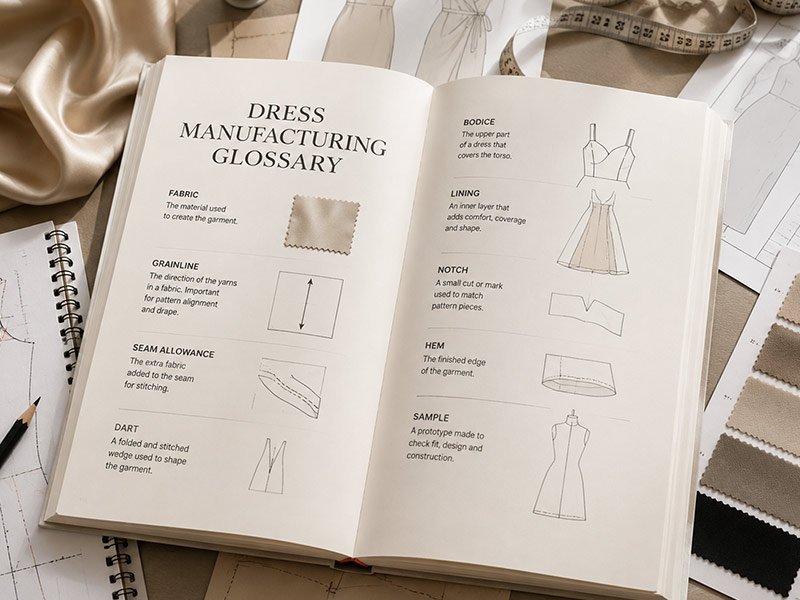
A dress can look effortless on a product page while hiding hundreds of technical decisions behind the final photograph. The neckline may depend on millimeters of pattern balance. The drape may come from a particular fabric construction, weight, and finish. A clean fitted waist may require hidden boning, stay tape, lining, controlled seam allowance, and an approved fit sample. When a designer, product developer, pattern technician, merchandiser, and factory use the same words differently, a small misunderstanding can quickly become an expensive revision or an unstable bulk order.
A dress manufacturing glossary explains the documents, materials, pattern terms, construction methods, sample stages, quality controls, and commercial language used to turn a design idea into a production-ready garment. Fashion brands need these terms to communicate specifications accurately, approve samples confidently, compare quotations fairly, control fit, and reproduce an approved dress consistently in bulk.
The most useful glossary is not simply a list of definitions. It explains where each term appears, who uses it, what decision it controls, and what can go wrong when it is misunderstood. Consider a satin halter dress that appears simple in a sketch. The first sample twists at the side seams, the neckline gaps, the lining shows below the hem, and the zipper ripples. None of these problems is solved by saying, “Please improve the fit.” They are solved through precise language: grainline, fabric relaxation, neckline stabilization, garment balance, seam tension, lining turn-up, zipper application, and measurement tolerance. That is where manufacturing vocabulary becomes commercial control rather than industry jargon.

What Documents Start Dress Development?
Dress development usually begins with a current tech pack, technical flats, a measurement specification, a bill of materials, construction notes, color references, and a revision log. Together, these documents convert a creative idea into measurable instructions that pattern makers, sample technicians, sourcing teams, cost engineers, production planners, and quality inspectors can follow without relying on assumptions.
A strong development file does more than show what the dress should look like. It defines how the product will be interpreted. This distinction matters because a fashion sketch communicates mood, proportion, and design direction, while a manufacturing document communicates measurable requirements.
The most common mistake is treating the tech pack as a one-time handover. In practice, it should function as a controlled record that develops with the product. Measurements change after fittings. Fabric details change after sourcing. Internal construction may change after the first prototype. A decorative treatment may be simplified after a production-risk review. Every approved change should enter the current document version.
Brands should also distinguish between visual approval and technical approval. A sample can look attractive in a photograph while still containing production risks. The zipper may be difficult to repeat consistently. A fitted waist may be achieved through temporary sample-room adjustments not reflected in the pattern. A neckline may sit correctly only because it was pinned during fitting. A proper document trail converts those temporary fixes into repeatable instructions.
For medium and large fashion programs, document quality also affects project speed. Clear files allow fabric sourcing, costing, pattern development, trim matching, and risk assessment to run in parallel. Incomplete information forces these teams to wait for clarification or make assumptions. Those assumptions may later appear as quotation differences, delayed samples, or inconsistent bulk workmanship.
Document | Main Function | Practical Detail | Risk if Missing |
Tech pack | Central product instruction | Construction, materials, measurements, labels | Teams work from different assumptions |
Technical flat | Shows garment structure | Seams, darts, closures, panels | Styling images are misread as technical drawings |
Spec sheet | Defines measurements | POM method, base size, tolerance | Fit cannot be checked consistently |
BOM | Lists all materials | Shell, lining, zipper, cups, labels | Costing and sourcing remain incomplete |
Construction sheet | Defines workmanship | Seam type, stitch density, pressing, finishing | Sample and bulk quality may differ |
Revision log | Records approved changes | Version, date, owner, status | Obsolete comments reappear |
The Tech Pack as the Control File
A tech pack is not simply a drawing attached to an email. It is the main control file for the product. A complete version normally includes front and back technical flats, style numbers, fabric and trim details, measurement points, seam instructions, artwork placement, labeling requirements, packaging notes, and an approval history.
The most effective tech packs separate visual information from measurable information. A fashion sketch may communicate attitude, proportion, or styling, but it rarely explains seam type, zipper length, lining coverage, boning placement, or tolerance. Those details need their own callouts and specifications.
For a fitted satin dress, for example, the file should state whether the fabric is cut on grain or bias, whether the bodice is fully lined, whether the zipper seam is stabilized, and whether the waist is measured straight across or along a curved seam. Without those instructions, different teams may interpret the same design differently.
A tech pack should remain active throughout development. When the neckline changes, the pattern changes. When the pattern changes, measurements and material consumption may change. If those updates are discussed in messages but not added to the document, old information can easily return during bulk production.
Measurements, POMs, and Tolerances
A specification sheet gives measurable shape to the design. It usually includes the base size, points of measurement, target dimensions, tolerances, and sometimes the full graded size range.
POM means Point of Measurement. Each POM should explain not only what to measure but how to measure it. A waist can be measured straight across, along a shaped seam, or around the full garment. A neckline can be measured edge to edge, along the seam, or as a drop from high-point shoulder. These methods can produce different numbers.
Tolerance is the permitted deviation from the specification. It should reflect product sensitivity. A loose maxi skirt sweep may allow more variation than the waist of a fitted mini dress. Common garment tolerances may fall around +/-0.5 cm for smaller or highly visible measurements and +/-1.0 cm or more for larger, less critical areas, but the correct tolerance depends on fabric, construction, size, and brand standards.
Tolerance should never be used to hide poor workmanship. A garment can sit inside measurement limits and still fit badly because of poor balance, twisted seams, incorrect dart position, or unstable stretch.
BOMs, Colorways, and Material Codes
The Bill of Materials lists every item required to produce the dress. A useful BOM includes the material description, composition, weight or specification, supplier reference, color, consumption, placement, unit, and approval status.
For a corset-style dress, the BOM may include shell fabric, lining, fusible support, bra cups, boning, boning channels, underwire, stay tape, zipper, hooks and eyes, labels, hangtags, thread, polybags, size stickers, and cartons. Omitting a hidden component can affect both costing and production readiness.
Colorways should be controlled as complete material combinations. A black dress with black lining and silver hardware is not technically identical to the same dress with nude lining and gold hardware. Each variation may require separate approvals for color, trims, labels, and packaging.
Material codes help prevent informal substitutions. Names such as “soft satin” or “fine mesh” are too vague for repeat production. A supplier code, construction detail, approved swatch, or test report gives the team a more reliable reference.
Revision and Approval Discipline
Version control is one of the least glamorous but most important parts of product development. Every update should have a revision number, date, summary of changes, and clear status.
The file name should make the current version obvious. A development team working from “final,” “final-new,” and “final-latest” files is already at risk. A structured format such as StyleNumber_TechPack_Rev04_2026-07-03 is far easier to manage.
Approval language should be specific. “Looks good” is not the same as “approved for bulk.” A style may be fit-approved but still waiting for a lab dip, zipper confirmation, wash test, or packaging approval.
- Design approved
- Fit approved
- Fabric approved
- Trim approved
- Color approved
- Artwork approved
- Grading approved
- PP sample approved
- Approved for bulk
Separating approvals into categories prevents one positive comment from being treated as authorization for the entire order.

Which Fabric and Trim Terms Matter?
The most important fabric and trim terms describe composition, construction, weight, drape, stretch, recovery, shrinkage, opacity, color performance, lining, closures, support components, and embellishments. These terms matter because a dress silhouette is controlled as much by material behavior as by the pattern itself.
Choosing fabric by appearance alone is one of the fastest ways to weaken a dress. Two fabrics may have the same fiber content but perform very differently because of yarn type, knit or weave construction, density, finishing, and weight. One polyester satin may fall softly around the body; another may feel stiff, reflect light harshly, and show every seam impression.
Material decisions should be linked to silhouette. A bias-cut slip dress needs controlled drape, stable grain, and careful seam behavior. A corset mini dress needs structure, support, and resistance to distortion. A ruched mesh dress needs predictable stretch and recovery. A sequin dress needs a base fabric capable of carrying decoration without sagging.
Trim selection works the same way. A zipper is not simply “a zipper.” Its tape, teeth, slider, length, color, weight, and application method can influence appearance and fit. Boning must be selected according to garment structure, channel width, comfort, curvature, and care requirements. Cups should match the neckline, target bust shape, and intended size range.
Bulk consistency adds another layer. Sample yardage may behave differently from bulk fabric because it comes from another dye lot or finishing batch. Material approval should not end with a small swatch. Brands may need lab dips, strike-offs, sample yardage, performance tests, and bulk-lot review.
Property | Practical Meaning | How It Is Checked | Typical Dress Risk |
GSM | Weight per square meter | Cut and weigh a known area | Too light may become transparent; too heavy may distort drape |
Drape | How fabric falls and moves | Drape sample or full garment trial | Wrong drape changes the silhouette |
Stretch | How far fabric extends | Measure original and extended length | Incorrect pattern reduction affects fit |
Recovery | Return after stretching | Rest and remeasure after extension | Poor recovery causes bagging |
Shrinkage | Dimensional change | Wash, steam, press, or relaxation test | Finished measurements move outside tolerance |
Opacity | Resistance to showing through | Body, light, and stretch evaluation | Lining or coverage may be inadequate |
Crocking | Color transfer by rubbing | Dry and wet rubbing test | Dark fabric stains lining or packaging |
Torque | Twisting after treatment | Relaxation or wash comparison | Side seams and hems rotate |
Fiber, Construction, and Weight
Fiber content identifies what the fabric is made from, but it does not fully explain how it will perform. Two fabrics containing 95% polyester and 5% elastane may have completely different thickness, stretch, surface, recovery, and drape.
Construction explains how the yarns are organized. Woven fabrics use warp and weft yarns, while knits are formed through loops. Wovens are generally more dimensionally stable, although special weaves can create mechanical stretch. Knits usually provide more stretch and body movement, but they may also grow, curl, or distort.
GSM means grams per square meter. It is a practical way to compare fabric weight, but it should be read together with thickness, density, and finish. A lightweight satin may sit around 80-130 GSM, while a more structured stretch knit may range from roughly 220-350 GSM. These are broad commercial ranges rather than fixed rules.
Weight affects opacity, drape, seam pressure, pressing response, and garment support. A fabric that is too light may show every seam allowance. One that is too heavy may collapse gathers, pull straps downward, or distort a bias-cut silhouette.
Drape, Stretch, and Recovery
Drape is the way fabric hangs and folds under its own weight. It influences whether a dress feels fluid, sharp, sculpted, soft, or stiff. It is especially important in satin slip dresses, bias-cut skirts, draped necklines, gathered maxis, and cowl-front styles.
Stretch describes extension. It should be measured in both width and length because many fabrics behave differently in each direction. A fabric may have 40% crosswise stretch but only 10% lengthwise stretch.
A simple stretch calculation is: extended length minus original length, divided by original length, multiplied by 100. If a 10 cm fabric sample stretches to 14 cm, the stretch is 40%.
Recovery describes whether the fabric returns close to its original dimension after being stretched. Good stretch with poor recovery creates a misleading first impression. The dress may fit well during the first try-on but grow around the waist, seat, bust, or neckline after an hour of wear.
Negative ease should be based on tested stretch and recovery. A bodycon dress with 8 cm of reduction at the hip may work in a stable compression knit but fail in a soft jersey. The pattern must follow the actual fabric rather than a generic stretch label.
Opacity, Shrinkage, and Color
Opacity often changes when the fabric is stretched. A white knit may look acceptable on the cutting table and become transparent across the bust or hip. A pale satin can reveal lining edges, seam allowances, cups, or internal support.
Opacity should be evaluated under realistic conditions: on the body, under bright light, and at the intended stretch level. For selected styles, a double layer, underlining, or tonal lining may be more effective than a full separate lining.
Shrinkage can result from washing, steaming, pressing, relaxation, or finishing. Even a 2% length change can alter a 120 cm dress by 2.4 cm. That difference is highly visible in a fitted midi or floor-length style.
Colorfastness describes resistance to fading, bleeding, or transfer. Dark red, black, navy, and strongly saturated colors often need careful testing for rubbing and perspiration. Color migration is especially relevant when dark shell fabrics are combined with light linings, labels, elastics, or prints.
Testing should follow the care method and target market. A dry-clean-only occasion dress does not require the same washing assessment as a machine-wash jersey dress, but rubbing, perspiration, pressing, and storage risks may still apply.
Trims and Support Components
Dress trims include visible components such as zippers, buttons, rhinestones, pearls, and sequins, as well as hidden components such as cups, boning, underwire, elastic, stay tape, interfacing, and hook-and-eye tape.
Trim specifications should include size, material, color, finish, supplier reference, placement, and attachment method. “Invisible zipper” is not enough. The zipper length, tape color, chain size, slider, puller, and top-stop position may all affect appearance and function.
Support components should be selected as a system. Boning cannot compensate for an incorrect bust pattern. A cup cannot create stable support if the neckline, underbust, lining, closure, and strap placement are not coordinated.
Decorative trims also change production risk. Heavy beadwork can stretch mesh. Sequins can damage needles or scratch the wearer. Heat-applied stones depend on adhesive performance, pressure, and temperature. Embellishment should therefore be tested for attachment strength, abrasion, appearance after pressing, and cleaning compatibility.

How Do Pattern and Fit Terms Work?
Pattern and fit terms describe how flat pattern pieces are shaped, positioned, graded, and corrected to create a dress that fits the body properly. Key terms include block, production pattern, grainline, seam allowance, ease, balance, grading, measurement points, and fit correction.
Pattern making is often mistaken for tracing a sketch. In reality, it is an engineering process shaped by body dimensions, fabric behavior, construction method, and design intention. A pattern that works in stable woven crepe may fail in stretch jersey because the material behaves differently. Changing fabric can require changing the pattern.
Fit should also be separated from size. A garment can meet its measurement specification and still fit poorly. The neckline may gap, the waist seam may tilt, the side seam may swing forward, or the skirt may twist. These problems relate to balance, shaping, grain, distribution, and body contour rather than one measurement.
The fitting process should combine objective measurements with visual and movement assessment. The wearer should stand, sit, walk, raise the arms when relevant, and test the closure. Occasion and party dresses may need special checks for security, support, coverage, and movement.
Brands should identify critical fit points before sampling. A loose maxi dress may tolerate greater variation in the sweep, while a corset dress may require close control of bust placement, underbust shaping, waist, cup position, neckline stability, and zipper length.
Blocks, Patterns, and Grading
A block, also called a sloper, is a basic pattern foundation developed around a defined fit standard. It usually contains essential shaping but not the full fashion styling of a finished design.
Different dress categories often need different blocks. A woven fitted dress, stretch bodycon dress, relaxed shift dress, corset bodice, and bias slip dress should not all start from the same foundation.
The production pattern is the final set of pieces used for cutting. It includes seam allowances, grainlines, notches, drill points, size information, and construction references.
Grading creates additional sizes from an approved base pattern. It is not simple enlargement. Bust, waist, hip, armhole, shoulder, strap position, cup shape, length, and decorative placement may all grow at different rates.
A design that looks balanced in a base size can become distorted if grading is too mechanical. Larger sizes may need changes to bust shaping, neckline coverage, strap position, waist length, and support placement. Size-set review is therefore essential for fitted and structured dresses.
Grainlines, Notches, and Allowances
The grainline controls how each pattern piece sits on the fabric. Incorrect grain placement can cause twisting, uneven drape, poor stretch, and unstable seams.
Bias-cut pieces are placed diagonally to the main grain. This creates fluidity but also increases movement during cutting and sewing. Bias garments often need relaxation or hanging time before final hemming because the fabric can grow unevenly.
Notches are matching points that help sewing operators align seams, panels, pleats, darts, and openings. They are especially important on curved princess seams, corset panels, gathered sections, and asymmetrical designs.
Seam allowance is the distance between the cut edge and stitching line. Common allowances may range from around 0.6 cm on narrow internal work to 1.0-1.5 cm on general seams, with wider allowances used where alteration or special finishing is needed. These are not universal standards.
More allowance is not always better. Wide allowances can create bulk in cups, curves, straps, and boning channels. Narrow allowances can fray or slip. The correct amount depends on fabric stability, seam type, machinery, and whether the edge will be overlocked, bound, enclosed, or pressed open.
Ease and Garment Balance
Ease is the difference between body size and garment size. Wearing ease allows movement. Design ease creates the intended silhouette. Negative ease means the garment is smaller than the body and stretches to fit.
A fitted woven dress may have very little positive ease at the waist, while a stretch bodycon dress may use negative ease. The correct amount depends on fabric extension, recovery, lining, construction, and the target fit.
Garment balance describes how the front, back, and side sections hang around the body. A dress can meet the stated bust, waist, and hip measurements and still look wrong because the balance is incorrect.
- Side seams swinging toward the front or back
- Waist seams rising at the front
- Hems dropping unevenly
- Necklines pulling backward
- Armholes opening away from the body
- Skirts twisting around the legs
These problems are often related to pattern length distribution, bust shaping, shoulder angle, grain, or fabric behavior. Adding width may not solve them.
Fit Correction in Practice
A fit correction should describe the problem and the technical action. “Improve the neckline” is too vague. “Remove 0.7 cm from each side of the back neckline and blend to zero at the shoulder” is measurable and easier to verify.
Fit review should consider standing appearance, sitting, walking, arm movement, closure operation, and coverage. A party dress may look perfect while standing but ride up or expose too much when the wearer sits.
For structured dresses, fit should be checked at the bust apex, underbust, center front, waist, and zipper. For halter or backless styles, strap tension and neckline security are especially important. For mini dresses, movement and hem position should be reviewed, not only static length.
Fit comments should be added to the current document version and reflected in the pattern. Temporary sample-room adjustments, such as pinning or hand-tacking, should never become the hidden reason a sample looks correct.

Which Dress Construction Terms Matter?
Dress construction terms explain how the garment is shaped, supported, lined, closed, and decorated. Darts, seams, panels, boning, cups, interfacing, lining, ruching, pleating, and embellishment methods all influence fit, comfort, durability, cost, and production consistency.
Two dresses can look nearly identical from the outside while having completely different internal structures. One may use a simple lined bodice. Another may require underlining, cups, boning, stay tape, a waist stay, shaped panels, and controlled seam pressing. The second dress involves more materials, operations, skill, time, and quality risk.
Construction decisions should begin during development rather than after the visual design is approved. A dramatic neckline may need stabilization. A heavy embellished skirt may need stronger internal support. A close-fitting satin dress may need carefully positioned seams to avoid rippling. An open-back dress may need alternative support because conventional straps cannot be used.
Manufacturability is not the same as simplifying every design. The objective is to preserve the intended visual effect while selecting methods that can be repeated consistently. A beautiful one-off sample is not a successful product if bulk operators cannot reproduce it within the planned cost and timeline.
Construction review should also account for the wearer. Hard boning ends, rough sequins, exposed seam allowances, unstable necklines, weak straps, and poorly placed closures can create discomfort or failure even when the garment photographs well.
Darts, Seams, and Panels
Darts remove excess fabric and shape a flat textile around the body. Bust darts, waist darts, shoulder darts, and contour darts each control fullness in different areas.
Princess seams create shaping through curved seams that usually pass over or near the bust. They offer more control than a single dart and are commonly used in fitted dresses, corset bodices, and structured occasionwear.
Panels divide the garment for fit, design, color blocking, or material combination. Gores are shaped panels that add controlled flare. Godets are inserted pieces that add volume or movement to a skirt.
Seam placement affects both appearance and engineering. A well-placed seam can support the bust, carry boning, control drape, hide a pocket, or break up a print. A poorly placed seam can create bulk, distortion, or an unnecessary cost increase.
The seam type must also match the fabric. A lightweight satin may require fine needles, controlled tension, and careful pressing to avoid puckering. A stretch mesh may need a seam that stretches without breaking. A heavy sequin fabric may require decoration to be removed from the seam allowance before sewing.
Corsetry and Internal Support
Corsetry is not one component but a coordinated structure. A corset-inspired dress may use shaped panels, boning, cups, underwire, fusible reinforcement, waist stay, lining, and a stable closure.
Boning supports vertical shape and reduces collapsing or rolling. Plastic boning is flexible and widely used, while steel options provide stronger support but require more careful handling. The correct choice depends on silhouette, comfort, care, curvature, and target price.
Boning channels should be wide enough for insertion but not so loose that the boning shifts. Ends should be finished to avoid sharp pressure points. Placement should follow the pattern structure rather than being added randomly.
Cups need to match the neckline and target bust shape. The cup size, thickness, projection, spacing, and attachment method all matter. A single cup cannot always serve a broad size range without modification.
Support should also be tested in motion. A dress may look stable in a fitting room but fail during walking, sitting, or dancing. Strap tension, neckline security, zipper strength, and internal anchoring are part of the same system.
Lining and Stabilization
Lining improves comfort, hides internal seams, supports opacity, and helps the dress move over the body. It may cover the full garment or only selected areas.
Underlining is attached directly to the shell and treated as one layer during sewing. It can add body, opacity, or stability while preserving the outer appearance.
Interfacing reinforces specific areas such as necklines, waistbands, facings, closures, and button positions. It should be tested for adhesion, stiffness, shrinkage, and show-through.
Stay tape stabilizes edges that may stretch during sewing or wear. Common locations include necklines, shoulder seams, waist seams, zipper openings, and bias edges.
The support material should never overpower the shell. A stiff interfacing under lightweight satin can create visible ridges. A non-stretch lining inside a stretch dress can restrict movement and change fit. A heavy lining can alter drape and increase seam pressure.
Internal construction should be reviewed on both the body and the hanger. A dress may look smooth while worn but collapse or distort during storage if the internal support is poorly distributed.
Ruching, Pleats, and Embellishment
Ruching gathers fabric in a controlled area. The specification should define the gathering ratio, direction, anchor points, finished length, and visual distribution. Without a standard, one garment may look softly draped while another appears heavily bunched.
Pleats also need precise definitions. Knife pleats fold in one direction, box pleats open outward, and sunray pleats radiate from a narrow point. Heat-set pleats may require specialist processing and may be sensitive to high pressing temperatures.
Bias cutting, ruching, and pleating often increase fabric consumption. A finished 30 cm ruched panel may require 45-60 cm of fabric depending on the desired fullness. Directional prints and embellishments may further reduce marker efficiency.
Decorative applications need control samples. The team should define motif placement, density, spacing, scale, color, attachment method, and edge treatment.
- Attachment strength
- Missing-decoration tolerance
- Rough edges against the skin
- Weight distribution
- Seam interference
- Zipper clearance
- Lining protection
- Cleaning performance
A decorative effect is successful only when it remains attractive, wearable, and repeatable in bulk.
What Do Sampling and Approval Terms Mean?
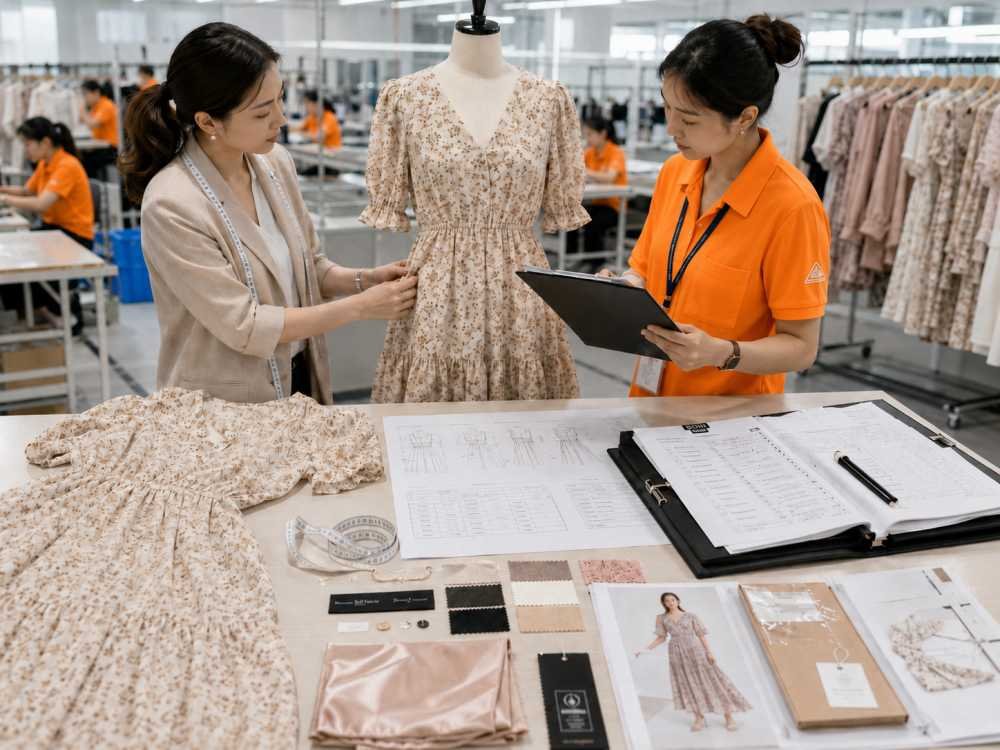
Sampling terms identify why each pre-production garment is made and what decision it supports. A prototype tests the concept, a fit sample checks shape, a size set checks grading, a salesman or photo sample supports commercial work, and a PP or sealed sample establishes the production reference.
Calling every sample simply “the sample” creates confusion. The team may believe a garment has been approved for production when only its visual direction was accepted. A marketing team may request photo samples before the fabric has passed bulk testing. A factory may prepare a PP sample from production materials while the brand still expects another fit revision.
Each sample should have a clearly defined objective. The submission should state what is being reviewed, what remains pending, and what approval will allow the project to do next. Fit approval may authorize grading but not bulk cutting. Color approval may allow fabric dyeing but not garment production.
Comments should be prioritized. Critical fit, safety, material, and construction issues should be resolved before minor styling preferences. Trying to change every element in every round can make development slower and less controlled.
Approval language also matters. “Looks good” may not equal “approved for bulk.” Formal approval should identify the sample version, color, size, date, outstanding conditions, and approved next step. A disciplined sample path reduces risk because each stage closes specific questions.
Sample Stage | Main Purpose | Typical Approval Outcome | Common Risk |
First proto | Test concept and construction | Revise or continue development | Wrong assumptions are treated as final |
Fit sample | Confirm shape and measurements | Fit approved or revised | Fabric behavior differs from final material |
Size set | Check graded sizes | Grade approved or corrected | Base-size proportions are copied mechanically |
Salesman sample | Support sales review | Commercial presentation approved | Not fully production-ready |
Photo sample | Support marketing content | Approved for photography | Manual sample fixes are not documented |
PP sample | Confirm bulk method and materials | Approved for production | Materials are not from intended bulk supply |
Sealed sample | Create physical bulk reference | Used for line and inspection control | Accepted deviations are not recorded |
Prototype and Development Samples
The first prototype tests whether the design can be turned into a workable garment. It is used to review silhouette, proportion, basic construction, material direction, and major risks.
Substitute fabric may be used when the final material is unavailable, but the substitution should be clearly identified. A prototype made in stable cotton cannot fully predict the fit of a soft stretch satin.
A development sample follows with revised pattern, material, trim, or workmanship. Complex dresses may require several rounds, particularly when they include corsetry, draping, cut-outs, bias sections, heavy embellishment, or unusual fabric combinations.
The aim is not to eliminate every revision. The aim is to make each round answer a defined question.
- What changed
- What remains provisional
- What requires approval
- What cannot yet be judged
- What the next stage will confirm
This prevents teams from commenting repeatedly on areas that are already scheduled for correction.
Fit and Size-Set Samples
A fit sample verifies measurements, balance, shaping, comfort, and movement on the approved model or form. It should use the intended fabric or a material with closely comparable stretch, weight, and drape.
Fit comments should be specific and linked to the current pattern. A revised sample should include a response showing which comments were applied and whether any alternative solution was used.
A size set checks whether the grading works across selected sizes. Some brands review all sizes, while others review representative sizes such as the smallest, base, and largest.
Structured and fitted dresses deserve extra attention because grading can shift cup placement, strap position, neckline coverage, waist level, slit height, and internal support. Measurement compliance alone does not prove that grading is visually balanced.
Salesman and Photo Samples
Salesman samples are used for showroom meetings, sales presentations, wholesale reviews, or internal line selection. They need to represent the intended product closely enough for commercial decisions.
Photo samples are used for e-commerce, campaigns, social content, and lookbooks. Their timing may be critical because a late sample can delay product photography, online setup, and launch planning.
However, a photo sample is not automatically a production standard. Sample technicians may have manually improved the garment for the shoot by pinning, pressing, reshaping ruching, or adjusting straps.
Any visible appearance that the brand expects in bulk should be translated into technical instructions. If the photographed neckline sits close to the body, the pattern and stabilization method should produce that result without hidden adjustments.
Marketing and manufacturing teams should also communicate about color. Studio lighting and image editing can make a garment look different from the approved physical standard. The bulk reference should remain the approved material or color standard, not an edited photograph.
PP, Sealed, and Approval Status
PP means pre-production. A PP sample is normally made using intended bulk materials, approved pattern, trims, labels, construction, and workmanship. It demonstrates that the approved design can be reproduced under production conditions.
A sealed sample is the approved physical reference used during manufacturing and inspection. In many systems, the approved PP sample becomes the sealed sample. The terms are related but not identical: PP describes the stage, while sealed describes the control status.
Approval should identify the exact sample version, size, color, date, and any accepted deviations. Conditional approval should state the condition clearly, such as “approved for bulk after zipper color confirmation.”
- Garment measurements
- Fit and balance
- Fabric and lining
- Trims and hardware
- Construction and internal support
- Embellishment
- Labels and care information
- Packaging
- Testing status
- Final comments
Production should not begin from an unrecorded verbal approval. Good comments are visual, measurable, and prioritized, and a comment-response sheet can record the original request, interpretation, action, responsible person, status, and completion evidence.

How Are Production, Quality, and Delivery Terms Used?
Production, quality, and delivery terms explain how an approved dress becomes a commercial order. They cover minimum quantities, purchase orders, material readiness, time-and-action planning, cutting, sewing, inspection, packing, shipping, and repeat production.
A low unit price can be misleading when it excludes fabric minimum surcharges, testing, special packaging, inspection, freight, duty, or development costs. In the same way, a short stated lead time may not include material production, color approval, artwork confirmation, or final sample approval.
Brands should evaluate the complete critical path. The manufacturing clock does not begin simply when a purchase order is discussed. Bulk timelines depend on payment or deposit terms, material readiness, approval status, production allocation, special processes, inspection, and shipping arrangements.
Production control also relies on checkpoints. Fabric may be reviewed before cutting. A pilot or pre-production meeting may confirm construction. Initial output may be checked before the line continues. Inline inspection can identify repeated defects while correction is still possible. Final inspection evaluates completed and packed goods against the agreed standard.
Scale adds another challenge. Moving from a sample to 500, 5,000, or 50,000 garments is not just repeating the same action more times. Material lots become larger, more operators are involved, line balancing matters, process variation increases, and documentation becomes more important.
MOQ, PO, and Commercial Terms
MOQ means minimum order quantity. It may apply per style, color, size, fabric, print, trim, or total order. The practical MOQ is often controlled by the least flexible material or process. A sewing line may be able to produce 500 garments, but a custom-dyed fabric mill may require 1,000 meters. A special buckle, zipper pull, print screen, embroidery program, or branded packaging item may have its own minimum.
PO means purchase order. It confirms style numbers, quantities, color and size breakdowns, prices, delivery terms, and commercial conditions. The PO should match the approved tech pack and material records.
CMT means Cut, Make, and Trim. Under this model, the manufacturer mainly provides cutting and sewing, while the customer may supply major materials. Responsibility for loss allowance, material quality, delays, and replacements should be agreed in advance.
FOB, EXW, CIF, and DDP are trade terms with different responsibilities. They should not be treated as interchangeable price labels. The correct comparison should include freight, insurance, duty, customs handling, destination charges, and delivery risk.
Lead Time and Critical Path
Lead time should be divided into stages. Sample lead time, material lead time, bulk production time, testing time, inspection time, and shipping time are different. A T&A calendar, or Time and Action calendar, maps tasks, owners, deadlines, and dependencies. The critical path contains the activities that directly affect the delivery date.
Stage | Broad Planning Range | Key Dependency | Main Delay Risk |
Tech pack review and quotation | 2-7 working days | Complete product information | Missing construction or quantity details |
Fabric and trim sourcing | 5-20 working days | Stock versus custom material | Supplier MOQ or unavailable color |
Lab dip or strike-off | 5-12 working days | Color or artwork approval | Repeated color correction |
First sample | 5-15 working days | Pattern and material readiness | Complex fit or special process |
Fit revision | 4-10 working days per round | Clear comments | Late or conflicting feedback |
PP sample | 5-12 working days | Bulk materials available | Unapproved component substitution |
Bulk manufacturing | 20-45 working days | Complexity, volume, capacity | Material delay or line congestion |
Final inspection and packing | 2-7 working days | Production completion | Rework or packaging mismatch |
These are broad industry planning ranges, not guaranteed timelines. A beaded corset dress cannot be scheduled like a simple jersey slip dress. Late approvals often compress the production window without reducing the actual work. Brands should therefore track their own decision dates as carefully as factory dates.
Cutting, Sewing, and Line Control
A marker is the planned arrangement of pattern pieces on fabric. Marker efficiency shows how much of the fabric area is used. Directional prints, nap, velvet, sequins, large motifs, bias pieces, and size ratios can reduce efficiency.
Fabric relaxation allows rolled or finished fabric to settle before cutting. This is particularly important for knits and stretch fabrics. Insufficient relaxation may cause shrinkage, twisting, or measurement changes after sewing.
A lay is the stack of fabric plies prepared for cutting. Numbering and bundling help keep garment parts in the correct size, color, and shade group.
WIP means work in progress. Too much WIP between operations can hide bottlenecks and defects. Balanced lines make quality problems easier to identify and reduce unnecessary handling.
An operation bulletin breaks the garment into sewing steps. Complex styles may include separate operations for cups, boning channels, lining, draping, embellishment, closures, and hand finishing.
Early line output should be checked before full production continues. A first-piece or pilot review can reveal seam puckering, wrong stitch density, inaccurate placement, pressing marks, or internal construction problems while correction is still manageable.
AQL, Inspection, and Delivery
AQL means Acceptable Quality Limit. It is used with statistical sampling plans to determine how many units are inspected and what defect levels may lead to acceptance or rejection. A final inspection is the actual inspection event. It may use AQL, but AQL and final inspection are not the same thing.
Defects are commonly classified as critical, major, or minor. Critical defects can create safety, legal, or serious compliance problems. Major defects can make the garment unsellable, unwearable, or substantially different from the approved sample. Minor defects reduce appearance or workmanship quality without preventing normal use.
- Measurement outside tolerance
- Twisted side seams
- Neckline gaping
- Zipper rippling
- Uneven hem
- Visible lining
- Poor cup placement
- Missing embellishment
- Shade variation
- Seam puckering
- Loose threads
- Label or barcode errors
AQL is not a substitute for process control. Fabric inspection, inline checks, operator training, measurement audits, and corrective action are needed before final inspection.
Packing instructions define folding, hangers, tissue, polybags, size stickers, barcodes, assortment, carton dimensions, carton marks, and maximum weight. Structured or heavily decorated dresses may need protective inserts, hanging packs, or special folding methods because compression can affect cups, boning, pleats, and embellishments.
A repeat order is not automatically identical to the first order. Material dye lots may change, a trim supplier may revise a component, another sewing line may be allocated, or the pattern file may contain approved updates. Before repeat production, the current pattern, materials, measurements, construction, packaging, labels, testing requirements, previous quality issues, and delivery date should be reconfirmed.
Turn Manufacturing Language into a Production-Ready Dress Program
A manufacturing glossary is valuable because it gives brand teams a shared operating language. The real advantage comes from applying each term at the right point: defining POMs before fitting, confirming stretch before reducing a pattern, reviewing the BOM before quotation, approving bulk materials before cutting, and sealing a production standard before the line begins.
Duolan Apparel supports established fashion brands, regional fashion leaders, product-development teams, sourcing offices, designer-led labels, and occasion-focused dress businesses that need structured development and reliable production coordination. Core categories include fashion dresses, party dresses, occasion dresses, vacation dresses, fitted and bodycon dresses, corset and bustier styles, halter dresses, backless dresses, satin dresses, mesh dresses, velvet dresses, sequin dresses, and related fashion collections.
To request a quotation, send your tech pack, technical drawing, reference sample, fabric direction, size specification, target quantity, color plan, delivery market, and expected launch date. The development team can then evaluate material suitability, pattern and fit requirements, construction risk, sampling needs, bulk readiness, and production planning.
Share:
Our Services
Categories
Table of Contents
Here, developing fashion collections is more than manufacturing garments — it’s a collaborative process focused on transforming ideas into well-executed, market-ready products. From fabric sourcing and sample development to scalable production and delivery coordination, every stage is built to support quality, consistency, and efficient collection launches across global markets.