 Skip to content
What Is Bandage Knit Fabric? Composition, Stretch, Fit, and Dress Manufacturing Explained
Your trusted Women’s Apparel Development & Manufacturing Partner from China
- Jerry
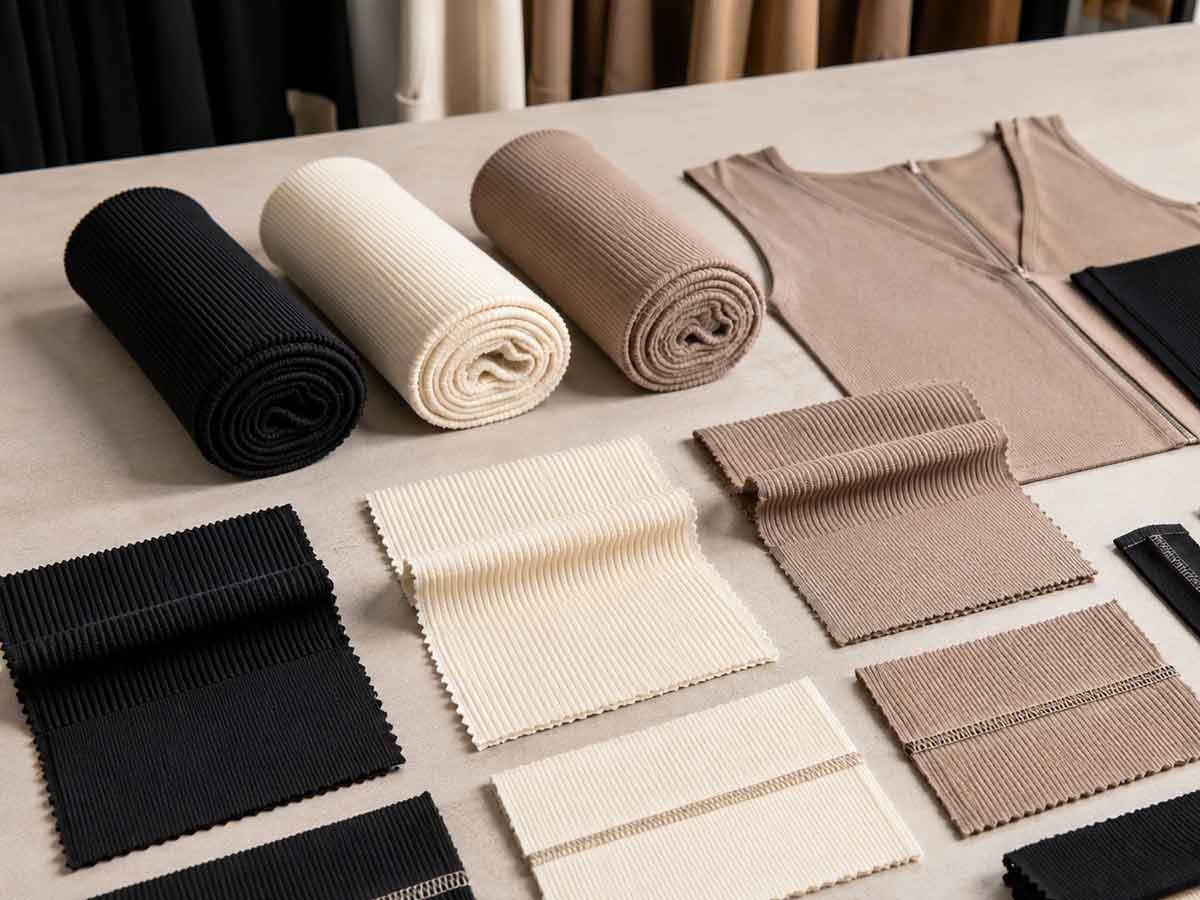
A bandage dress can look simple on a hanger: a close-fitting silhouette, a clean surface, and a few strategically placed panels. Once it is worn, however, the fabric must do several jobs at the same time. It has to extend over body curves, return without becoming baggy, remain opaque, support the waist and bust, and still let the wearer sit, walk, breathe, and move through an event comfortably. That combination is why choosing bandage knit by appearance or elastane percentage alone often leads to disappointing samples.
Bandage knit fabric is a dense, elastic knitted material engineered for close-fitting garments. Its shaping performance comes from fiber blend, yarn structure, knit density, GSM, stretch direction, recovery, pattern reduction, and seam construction working together. It is widely used for bandage dresses, bodycon styles, fitted tops, skirts, jumpsuits, and other contour-focused fashion products.
The important point is that bandage knit is not one universally standardized recipe. Two fabrics can carry the same commercial name and still behave very differently after cutting, sewing, pressing, and wear. A development team may approve a fabric because it feels firm in the hand, then discover that the finished dress rolls at the hem, exposes seam lines, grows at the seat, or restricts movement. The sewing line may not be the real problem. More often, the fabric, pattern, and construction were never engineered as one system. The rest of this guide shows how experienced product teams separate a convincing bandage dress from a garment that is merely tight.

What Is Bandage Knit Fabric?
Bandage knit fabric is a compact stretch textile developed to provide contouring, recovery, opacity, and structural support in fitted garments. The term describes a performance category rather than one fixed composition or knitting method. A successful fabric balances compression, comfort, surface quality, and dimensional stability after repeated stretching and wear.
Is It Fabric or Sewn Bands?
The answer can be either, depending on the design. Some bandage dresses are cut from full-width knitted fabric in much the same way as other fitted dresses. The front, back, sleeve, and skirt pieces are conventional patterns, while the shaping effect comes from the fabric resistance, recovery, and controlled negative ease.
Other garments are assembled from narrow horizontal, diagonal, vertical, or curved bands. These sections may be cut from a wider fabric, knitted to a controlled width, or developed as engineered panels. Their joining seams are not merely decorative. They help distribute tension, define the waist, support the bust, and guide the eye along the body.
A third approach combines a full knitted base with applied bands, double layers, contrast panels, or zoned support. This method is useful when one area needs firmness while another needs greater extension. The tech pack should therefore clarify whether each visible line is an actual seam, a knitted effect, or a surface application. It should also specify band direction, finished width, alignment points, stretch direction, and whether the seam is structural, decorative, or both.
Two dresses can look almost identical in a campaign image but require different patterns, machine settings, labor time, and inspection points. A segmented dress may require millimeter-level matching at side seams and zipper lines. A smooth-panel dress may rely more heavily on fabric recovery and accurate contour shaping. Treating both as the same product is a common source of costing errors and failed samples.
What Makes It Bandage Knit?
Stretch alone does not make a fabric suitable for bandage garments. A lightweight jersey can stretch 80 percent and still provide almost no shaping support. A dense knit can feel powerful in the hand yet become uncomfortable if it does not extend enough during movement. The bandage effect appears when density, elastic resistance, recovery, thickness, and pattern tension are balanced.
- Knit density: a compact construction improves opacity and creates a smoother surface under tension.
- Elastic resistance: the fabric should push back enough to contour the body without becoming restrictive.
- Recovery: the material should return close to its original dimensions after extension.
- Fabric body: adequate thickness helps hide minor lines and supports clean panel shapes.
- Pattern tension: garment measurements must be reduced in a controlled way for each body zone.
The strongest compression is not automatically the best result. Too much pressure can flatten bust shaping, pull side seams forward, create neckline gaping, restrict breathing, or make the garment difficult to put on. The objective is controlled contouring: a dress that looks smooth and secure while still allowing normal movement and comfortable wear through a dinner, party, or formal event.
Where Is It Commonly Used?
Bandage knit is most closely associated with fitted dresses, but the same performance family is used across several fashion categories. Typical applications include mini, midi, and maxi bandage dresses; bodycon party dresses; fitted occasion styles; corset-inspired knit dresses; crop tops; pencil skirts; stretch jumpsuits; matching skirt-and-top sets; structured bodysuits; and contour panels in mixed-material garments.
The fabric requirement changes with the product. A strapless mini needs strong recovery around the upper edge. A midi dress needs seat recovery and walking ease. A maxi dress needs vertical stability because its own weight can pull the fabric downward. A pencil skirt must recover at the knees and seat, while a fitted top needs enough shoulder and arm mobility to prevent the neckline from shifting.
The term bandage should therefore describe the expected wearing performance, not only the visual style. Before sourcing begins, a product team should define whether the garment is intended to feel softly fitted, firmly supportive, or strongly compressive. That decision affects fabric weight, pattern reduction, lining, zipper choice, internal support, and the comfort standard used during fitting.

Which Fibers and Knits Are Used?
Bandage knit fabrics commonly combine viscose or rayon, nylon, polyester, and elastane. Fiber content influences hand feel, durability, moisture behavior, color, and care, while knit structure controls support, stretch, opacity, and recovery. No single blend guarantees quality, so buyers should evaluate the full fabric specification and finished garment performance.
Common Fiber Blends
Viscose and rayon are often used when the target is a smooth, soft, and substantial hand. They can give darker colors a rich appearance and reduce the dry synthetic feel found in some lower-grade stretch knits. Viscose-rich constructions must still be checked for wet stability, shrinkage, and recovery because softness does not guarantee dimensional control.
Nylon, also called polyamide, contributes strength, abrasion resistance, and resilient recovery. It is widely used in close-fitting garments because it can create a clean surface and maintain performance under repeated extension. Nylon-rich fabrics may feel firmer or more technical than viscose-rich options, which can be an advantage for strong contouring but a disadvantage when a softer hand is required.
Polyester can improve durability, color consistency, availability, and care performance. Its quality varies widely. A well-developed polyester knit can feel controlled and smooth, while a low-grade version may feel hot, shiny, or harsh against the skin. Elastane supplies extension and recovery, but its effect depends on how it is integrated into the yarn and structure.
Commercial Blend Family | Illustrative Composition Range | Typical Strengths | Points to Check |
Viscose-rich compact knit | 60-75% viscose, 20-35% nylon, 3-8% elastane | Smooth hand, dense feel, refined surface | Shrinkage, wet stability, recovery |
Nylon-rich support knit | 75-92% nylon, 8-25% elastane | Strong stretch, clean recovery, durable face | Heat sensitivity, compression, comfort |
Polyester-based bandage knit | 65-90% polyester, 5-25% nylon, 3-10% elastane | Color stability, durability, broad availability | Breathability, shine, skin feel |
Mixed synthetic-viscose knit | 30-60% viscose plus polyester, nylon, and elastane | Balanced softness, structure, and cost | Lot consistency, pilling, dimensional stability |
These ranges are practical screening references, not universal formulas. Two fabrics with the same percentages can behave differently because yarn count, twist, stitch density, elastane insertion, finishing, and heat setting all change the final result. Composition should begin the evaluation, not end it.
How Do Knit Structures Differ?
The knitted structure often has more influence on garment behavior than the fiber label suggests. Rib knit has visible columns or ridges and usually stretches strongly across the ribs. It can create the recognizable banded appearance, but rib direction and texture matching must be controlled carefully during cutting. Even a small mismatch is obvious on a fitted garment.
Interlock and other double knits provide a smoother face, better opacity, and greater edge stability than lightweight single jersey. They are common choices when the design needs a clean, continuous surface rather than visible rib texture. Compact jersey can work for softer bodycon styles, but it must be assessed for edge curling, seam stability, and residual growth.
Engineered bands or panels can be knitted to controlled widths and tension zones. A development team may place stronger density around the waist and greater extension around the bust or hip. This gives more control than using one uniform fabric across the entire garment, although it also increases the need for precise panel mapping and consistent production settings.
Structure affects manufacturing as well as fit. Dense knits may create bulky seam intersections. Loose constructions may distort during spreading. Rib fabrics may grow unevenly if cut before relaxation. Textured surfaces need direction control. A small swatch cannot reveal all these issues, so serious approval should include a full-width cutting and a garment trial in the intended silhouette.
Does Elastane Content Define Quality?
No. Elastane percentage is one variable, not a complete quality score. A fabric containing 10 percent elastane may still recover poorly if the base yarns, stitch density, or heat setting are unstable. Another fabric containing 4 percent may recover cleanly because the structure distributes tension efficiently.
Higher elastane can also create practical risks. The fabric may be difficult to spread without tension, shrink more after heat exposure, show needle cutting, or create uncomfortable pressure. It may also be more sensitive to storage temperature, chlorine, body oils, and unsuitable finishing processes.
- Stretch percentage in both directions
- Immediate and relaxed recovery
- Residual growth after repeated extension
- GSM, thickness, and opacity under target stretch
- Shrinkage after the intended care cycle
- Pilling, abrasion, colorfastness, and crocking
- Needle, pressing, and seam response
- Performance consistency between fabric lots
The useful question is not, How much spandex does it contain? It is, Does this material deliver the stretch, recovery, support, comfort, appearance, and production consistency required by this specific dress?

How Does Bandage Knit Shape the Body?
Bandage knit shapes the body through elastic resistance and controlled negative ease. The garment is smaller than the corresponding body measurements, so the fabric stretches during wear and creates distributed pressure. Stretch, recovery, density, panel direction, seam placement, and body-zone reduction determine whether the result feels supportive, weak, uneven, or restrictive.
How Do Stretch and Recovery Work?
Stretch measures how far a fabric can extend. Recovery measures how closely it returns after the force is removed. The two properties are connected but not interchangeable. A material can have high stretch and weak recovery, which often causes bagging at the waist, seat, elbows, or hem after wear.
A basic stretch calculation is: Stretch % = (Extended length – Original length) / Original length x 100. If a 100 mm specimen extends to 160 mm, the fabric has 60 percent stretch in that direction. Residual growth can be calculated after relaxation: Growth % = (Relaxed length – Original length) / Original length x 100. If the specimen measures 104 mm after recovery, residual growth is 4 percent.
Hand stretching is useful for a quick comparison, but it is not reliable enough for final approval. Results change with force, hold time, specimen size, and operator technique. A controlled internal method should use the same sample dimensions, extension target, tension period, and recovery time for every fabric. Laboratory testing should follow the buyer standard or agreed test method when contractual limits are required.
Screening Item | Practical Measurement | What It Reveals |
Crosswise stretch | Extension across usable width | Fit around bust, waist, and hips |
Lengthwise stretch | Extension along fabric length | Vertical movement and garment growth |
Immediate recovery | Measurement shortly after release | Short-term return |
Relaxed recovery | Measurement after 30-60 minutes | Residual growth |
Repeated-cycle recovery | Result after multiple extensions | Wear durability |
Opacity at target stretch | Visual or instrument check under extension | Transparency risk |
Dimensional change | Length and width change after care | Finished measurement stability |
The fabric should also be tested after sewing. A panel may recover well on its own but behave differently once seams, lining, elastic, zippers, or reinforcement limit its movement.
What Creates Compression and Support?
Compression is created when stretched fabric tries to return to its original size. That return force presses against the body and produces the close, supportive feeling associated with bandage garments. The pressure should not be identical everywhere. The bust needs shape and projection, the waist can accept controlled contouring, the hip needs support plus movement, and the neckline needs stability without cutting into the skin.
Compression is influenced by yarn elasticity, stitch density, fabric thickness, pattern reduction, panel orientation, seam placement, lining, internal support, zipper structure, wearer proportions, and duration of wear. A change in any one of these can alter the balance of the garment.
Panel direction can redistribute tension. Horizontal bands emphasize circumference and waist definition. Diagonal sections can guide pressure across the torso and create a more dynamic visual line. Vertical panels can help control lengthwise growth and shape the side body. Curved seams can support the bust or define the hip, but only when the pattern and fabric resistance are coordinated.
Excessive compression is not evidence of better quality. It can create side-seam rotation, bust flattening, restricted breathing, neckline distortion, hem rolling, or difficulty dressing. A successful bandage garment should feel secure during movement and remain wearable for the intended occasion, not only for a two-minute fitting.
How Do GSM and Density Matter?
GSM means grams per square meter. It indicates fabric mass, but it does not directly reveal thickness, support, or quality. Two fabrics with the same GSM may use different yarns, structures, and finishes and therefore feel completely different.
For many fitted fashion applications, development teams may begin screening dense stretch knits in an approximate 280-450 GSM range. Lighter options can suit tops, layered garments, or softer bodycon styles. Heavier options may provide stronger support, better opacity, and a more substantial hand. These are not universal limits; they are a practical starting range that must be validated against the style.
High GSM can create a premium feeling, but too much weight may make a midi or maxi dress grow vertically. It can pull on narrow straps, distort a neckline, increase seam bulk, and add shipping weight. Low GSM can improve comfort and drape, but may expose underwear lines, become transparent over the hips, or lose the sculpted effect.
A useful review combines GSM with thickness, stitch density, stretch in both directions, recovery after repeated extension, opacity at target stretch, seam bulk, air permeability, and finished garment weight. The correct weight is the one that supports the silhouette without creating new fit or comfort problems.
How Is Pattern Tension Controlled?
The same fabric can produce either a weak fit or an uncomfortable fit depending on the pattern. Pattern reduction should be based on elastic resistance and recovery, not only maximum stretch. A fabric may extend 80 percent, but using most of that capacity in the garment would normally leave too little reserve for breathing, sitting, walking, and dressing.
The body is not a cylinder, so reduction should not be applied uniformly. The bust, waist, high hip, full hip, thigh, and hem perform different functions. Bust projection may require shaping rather than simple circumference reduction. The waist can usually carry more contouring. The hip needs recovery and movement. The hem needs enough stability to avoid rolling or riding upward.
Fit evaluation should include standing, walking, sitting, arm movement, bending, and repeated wear. A dress that appears smooth in a static photograph may become unstable after ten minutes. Recording the reduction logic by body zone makes size grading, fabric substitution, and repeat production far more predictable than repeatedly adjusting by eye.

How Is It Different From Other Fabrics?
Bandage knit differs from ordinary bodycon jersey, Ponte, and scuba through its balance of density, elastic resistance, opacity, and recovery. Bodycon describes a silhouette, not a textile. Ponte is usually more stable and tailored, scuba is thicker and springier, and lightweight jersey is softer and more fluid. None automatically provides bandage-style contouring.
Is It the Same as Bodycon Fabric?
No. Bodycon means body-conscious and describes a close-fitting silhouette. A bodycon dress can be made from lightweight jersey, rib knit, velvet, mesh with lining, Ponte, scuba, compact double knit, or bandage knit.
A lightweight jersey bodycon dress follows the body but may not shape it. It often relies on softness and drape rather than elastic resistance. Depending on weight and color, it may reveal underwear lines, seam allowances, or localized tension around the bust and hips. A bandage dress is generally expected to provide more support, smoother contouring, and stronger fit retention.
Product teams should define the intended wearing experience before sourcing. Is the target a soft body-following fit, a firm contouring fit, shapewear-inspired support, a sculptural fashion shape, a textured ribbed surface, or visible segmented construction? Without this definition, a supplier may provide a fabric that stretches enough but delivers the wrong hand, pressure, drape, or appearance.
The product name should follow the actual performance. Calling a thin jersey dress bandage may create an expectation the fabric cannot meet. Conversely, using a strong compression knit for a casual bodycon style can make the garment unnecessarily difficult to wear.
How Does It Compare With Ponte?
Ponte is generally a stable double-knit fabric with a smooth face, good opacity, and a tailored appearance. It is widely used for fitted dresses, skirts, trousers, and jackets. It usually provides moderate stretch with less compression than a dedicated bandage knit.
Bandage knit tends to feel more elastic and resistant. It is chosen when close contouring, visible panel shaping, or stronger recovery is required. Ponte may be easier to sew and more forgiving for everyday wear, while bandage knit needs tighter control of negative ease, seam tension, and pressing.
Patterns cannot always be transferred directly between the two. A Ponte pattern made in a stronger bandage knit may feel too small and flatten the body. A bandage pattern made in soft Ponte may appear loose at the waist or seat. Substitution should therefore trigger a fit review, measurement check, and often a new prototype.
How Does It Compare With Scuba and Jersey?
Scuba is usually a synthetic double knit with a smooth surface, visible thickness, and springy body. It can create sculptural shapes, flared skirts, and clean edges. Thickness should not be confused with compression. Some scuba fabrics stretch easily but recover weakly; others feel stiff rather than supportive.
Lightweight jersey sits at the opposite end. It is comfortable, flexible, and suitable for soft bodycon silhouettes, but it tends to cling rather than shape. It may show seam allowances and undergarment lines, become transparent at high stretch, or grow at stress points if recovery is weak.
Performance Area | Bandage Knit | Ponte Knit | Scuba Knit | Lightweight Jersey |
Main fit effect | Controlled contouring | Stable tailored fit | Sculptural shape | Soft body-following fit |
Support level | Medium to high | Low to medium | Low to medium | Usually low |
Typical drape | Controlled | Structured | Springy | Fluid |
Opacity | Usually high if correctly specified | Generally high | Generally high | Highly variable |
Recovery demand | Critical | Important | Variable | Highly variable |
Common risk | Over-compression, growth, rolling | Bagging at stress points | Heat, bulk, limited breathability | Transparency, weak recovery |
Typical use | Bandage dresses, fitted sets | Workwear, dresses, skirts | Fashion shapes, flared styles | Casual bodycon, soft tops |
Material substitution should always trigger a pattern and construction review. Replacing bandage knit with jersey without changing the pattern usually weakens the fit. Replacing jersey with dense bandage knit can make the same style restrictive and difficult to put on.
Can Commercial Names Be Misleading?
Yes. Commercial fabric names are not always standardized. One supplier may call a dense rib bandage knit, while another uses the same term for a smooth double knit. Online descriptions may use bandage, bodycon, compression knit, and Ponte interchangeably.
Reliable sourcing should therefore rely on measurable information: exact composition, GSM, usable width, stretch in both directions, recovery or residual growth, shrinkage, surface structure, opacity under extension, care requirements, and lot-to-lot tolerance. A reference garment or approved fabric cutting is also valuable because it gives the mill and manufacturer a physical standard for hand, resistance, thickness, texture, and recovery.
When buyers and suppliers use different names for the same behavior, the risk is manageable if the specification is clear. When both sides rely on the name alone, even a technically good fabric can be the wrong fabric for the product.

Which Bandage Knit Suits Each Dress?
The right bandage knit depends on silhouette, garment length, support level, openings, lining, and expected movement. A fabric that works in a sleeved mini may fail in a strapless midi. Selection should combine measurable specifications, a prototype in the actual style, and realistic wear testing rather than swatch appearance alone.
Which Specifications Should Brands Confirm?
A detailed fabric specification gives the brand, mill, and garment manufacturer the same reference point. This is especially important when the approved sample and bulk production are separated by several weeks or sourced from different dye lots.
- Fiber composition and yarn description
- GSM, thickness, and usable width
- Crosswise and lengthwise stretch
- Immediate recovery and residual growth
- Shrinkage after the intended care process
- Opacity at relaxed and target extension
- Colorfastness to washing, perspiration, and rubbing
- Pilling and abrasion performance
- Surface direction, bowing, skew, and relaxation time
- Shade and performance tolerance between lots
- Recommended needle, seam, and pressing limits
Stretch should be recorded with a test method or controlled internal procedure. Very stretchy, heavy, soft, and strong recovery are not technical specifications. A full-width cutting should be reviewed because small swatches can hide edge variation, width inconsistency, bowing, skew, and texture changes across the roll.
How Should Fabric Match Silhouette?
Different dress structures create different stress points. A fitted mini experiences strong horizontal extension at the bust and hip but less vertical load than a midi or maxi. A strapless design needs firm upper-edge recovery. A halter concentrates force at the neck and underarm. A backless style has less fabric supporting the body. A cutout requires edges that do not wave, curl, or spread.
Dress Style | Main Fabric Requirement | Important Construction Check | Common Failure Risk |
Strapless mini | Strong upper-edge recovery and crosswise support | Bust support, grip elastic, zipper area | Neckline slipping, bust flattening |
Halter dress | Balanced stretch and comfortable recovery | Neck seam, underarm shape, bust position | Neck pressure, armhole distortion |
Backless dress | Stable side body and lower-back recovery | Side seams, back opening, internal support | Side gaping, back edge rolling |
Cutout dress | Edge stability and clean recovery | Opening reinforcement, seam allowance control | Wavy edges, spreading cutouts |
Long-sleeve mini | High elbow and shoulder recovery | Sleeve cap, mobility, cuff finish | Elbow bagging, neckline pull |
Midi dress | Seat recovery and vertical stability | Walking ease, hem control, zipper length | Seat growth, riding up |
Maxi dress | Lengthwise stability with manageable weight | Strap load, hem weight, vertical seams | Lengthening, shoulder drag |
Panelled dress | Consistent stretch and surface direction | Band alignment, seam bulk, symmetry | Twisting, uneven bands |
The fabric must be tested in the actual silhouette. A material approved in a simple sleeveless sample may behave differently in a long-sleeve, cutout, or strapless version. Even within one collection, the same roll may require different pattern reduction, support, and construction across six styles.
Do Lining and Opacity Matter?
Yes, but lining should solve a defined problem. A dense bandage knit may appear opaque while relaxed and become translucent over the hip or bust. Opacity should therefore be checked at the expected garment extension, not only by holding an unstretched swatch to the light.
Lining can improve coverage, smooth the internal surface, support cups or boning, stabilize openings, protect the shell, or conceal seam allowances. The lining must have compatible stretch and recovery. A rigid lining inside an elastic shell restricts movement and creates drag lines. A lining that stretches too freely may fail to support the garment.
A full lining is not always the best solution. Depending on the design, the team may use bust lining, partial skirt lining, power mesh, clean facings, localized reinforcement, double self-fabric panels, or internal elastic. The correct choice depends on whether the goal is concealment, smoothing, support, protection, or finishing.
Light colors need extra care. White, cream, pale pink, and bright shades can reveal seam allowances or lining edges even when the fabric is relatively dense. The lining color and construction should be checked under normal room light, strong retail light, and photography lighting.
How Should Comfort Be Evaluated?
Comfort cannot be judged from a standing fit photograph. A practical wear test should include sitting for 10-15 minutes, walking, climbing a step, raising both arms, bending slightly, taking deep breaths, and putting on and removing the garment more than once. The fit should be checked again after 30-60 minutes.
The team should observe whether the dress rolls, rides upward, rotates, opens at the neckline, cuts into the underarm, or creates excessive pressure at the waist. Comments should be specific. Reduce waist pressure by 2 cm while keeping the high hip unchanged is more useful than simply saying the dress feels uncomfortable.
Comfort should be reviewed across more than one size. A fixed percentage reduction may work in the base size and become too strong in larger sizes if grading does not account for body distribution and fabric tension. The ideal bandage dress feels secure and controlled, not punishing. A customer may tolerate discomfort for a fitting, but she is less likely to keep or reorder a dress she cannot wear through an event.

How Are Bandage Dresses Developed and Tested?
Bandage dresses are developed by matching fabric behavior with negative ease, seam engineering, fit correction, and production controls. A reliable process includes fabric relaxation, stretch and recovery measurement, prototype fitting, movement testing, construction trials, pre-production approval, inline inspection, and comparison of bulk garments against an approved standard.
How Is Negative Ease Controlled?
Negative ease means the finished garment is smaller than the corresponding body measurement. The basic calculation is: Negative ease % = (Body measurement – Garment measurement) / Body measurement x 100. If the body waist is 72 cm and the finished garment waist is 64.8 cm, the negative ease is 10 percent.
That does not mean 10 percent is correct for every fabric or body area. The required reduction depends on elastic resistance, recovery, thickness, panel direction, lining, internal support, garment length, intended compression, and the target customer comfort level. A soft fabric may need more reduction to look fitted. A firm fabric may need less to avoid excessive pressure.
Negative ease should be distributed by body zone. The bust needs projection and support, not only reduction. The waist can usually accept more contouring. The hip requires enough movement for sitting and walking. The hem needs stability to resist rolling and riding upward. Recording the reduction logic during development makes size grading, fabric replacement, and repeat orders easier to manage.
A pattern repeatedly adjusted by eye may eventually produce one successful sample, but it is difficult to reproduce. A measured approach creates a reliable link between body measurements, finished garment measurements, fabric resistance, and the intended wearing pressure.
Which Seams and Constructions Work?
Bandage knit needs seams that extend with the garment without breaking, tunneling, or becoming bulky. Overlock seams are common for joining stretch panels. Coverstitch may be used for selected hems or decorative finishes. Some areas require lockstitch with suitable reinforcement. The correct method depends on fabric weight, seam position, and the amount of extension during wear.
- Needle type and size appropriate to the knit density
- Thread elongation and seam extension
- Stitch density and differential feed
- Presser-foot pressure and seam allowance width
- Seam direction and panel matching
- Pressing temperature and dwell time
- Reinforcement at straps, cutouts, zipper ends, and intersections
Needle damage may appear as small holes beside the seam. Excessive thread tension can cause puckering. Low stitch extensibility can lead to breakage when the garment is pulled over the body. Panel alignment deserves special attention because a mismatch of only a few millimeters can make horizontal bands appear twisted or uneven.
Zipper construction is another common risk. A rigid zipper placed into a highly elastic center-back seam may buckle. Heavy band intersections can prevent smooth closing. Reinforcement is often needed at the zipper base, neckline, straps, and cutout corners. Seam testing should include extension to the intended garment stretch and a check that the seam returns flat after release.
How Are Fabrics and Samples Tested?
Testing should reflect the way the garment will be worn, not only the fabric in a relaxed state. A practical program may include GSM, usable width, dimensional stability, stretch and recovery in both directions, repeated-cycle growth, seam strength, seam extension, colorfastness, pilling, abrasion, spirality, opacity at target stretch, pressing response, trim attachment strength, zipper performance, and wear testing.
The sample should be checked against agreed points of measure such as bust, waist, high hip, full hip, total length, strap length, neckline opening, armhole, sleeve, and hem. Fit photographs are useful, but comments should be supported by measurements and movement observations. Add 1.5 cm to the half-hip while keeping the waist unchanged is more actionable than saying the hip is too tight.
The first sample is both a garment trial and a material trial. Pattern, seam method, lining, support, pressing, and zipper application may all need adjustment after the full garment is worn. The development team should keep these variables open until it understands how the complete system behaves.
When a new fabric is introduced into an existing style, a new fitting is still advisable. Matching composition or GSM does not guarantee matching pressure, growth, or drape. The actual performance of the fabric in the garment is the final reference.
How Is Bulk Consistency Controlled?
Bulk quality begins before cutting. The approved sample, fabric lot, color, trims, measurements, workmanship, labels, and packaging should be confirmed through a pre-production review. Fabric should be checked for shade, width, GSM, defects, shrinkage, and relaxation behavior. Cutting direction and panel numbering must be controlled when texture or band placement is visible.
- Confirm the approved sample and final development comments.
- Approve bulk fabric, lining, trims, color, and testing requirements.
- Complete and sign off the pre-production sample.
- Review pattern, construction, measurements, and critical risks before line start.
- Inspect first production output before full-line continuation.
- Monitor measurements, band alignment, seam tension, zipper behavior, and shade inline.
- Compare finished garments with the approved standard.
- Complete final inspection and packing verification.
- Retain fabric, measurement, and workmanship records for repeat orders.
Bandage garments are sensitive to lot variation. A small change in weight, recovery, or heat setting can alter the fit even when the composition is unchanged. Critical risks include waist or hip tension shifting between lots, side seams rotating, band misalignment, zipper buckling, hem rolling, inconsistent recovery between sizes, shade variation, and lining that restricts the shell.
For brands developing bandage dresses, bodycon collections, and fitted knit programs, manufacturing capability is most valuable when fabric development, pattern work, sample fitting, sewing engineering, and bulk controls are connected. Duolan Apparel focuses on fashion dresses, party dresses, body-conscious and fitted dresses, fashion sets, refined tops, and bandage dresses. Its documented manufacturing network includes 16 self-owned garment factories, more than 20 long-term satellite factories, 300 sewing lines, and over 50 flexible quick-response lines, supported by fabric, pattern, sample, and quality teams.
The strongest sample is only the first checkpoint. The real test is whether the approved fit, pressure, appearance, and workmanship can be repeated across colors, sizes, production lines, and later orders.
Develop Your Bandage Dress With Duolan Apparel
A bandage dress project should begin with more than a color reference and target price. The development team needs to understand the intended silhouette, compression level, customer size range, fabric hand, opacity, support structure, and wearing occasion. These decisions affect material sourcing, negative ease, seam construction, lining, zipper selection, fit testing, and bulk consistency.
To receive a useful development review, prepare your tech pack, reference sample or design images, target market, size range, expected order quantity, preferred fabric performance, and delivery schedule. Duolan Apparel can evaluate fabric behavior, pattern reduction, internal support, construction risks, and production readiness before the style moves too far in the wrong direction.
For custom bandage dresses, bodycon collections, fitted knit dresses, fashion sets, or related product development, contact Duolan Apparel.
Share:
Our Services
Categories
Table of Contents
Here, developing fashion collections is more than manufacturing garments — it’s a collaborative process focused on transforming ideas into well-executed, market-ready products. From fabric sourcing and sample development to scalable production and delivery coordination, every stage is built to support quality, consistency, and efficient collection launches across global markets.

