Skip to content
Custom Blazer Dress Manufacturer
Structured blazer dress development and manufacturing for established fashion brands, product teams, buying offices and multi-style collection programs.
- 12 critical structure and fit zones reviewed across the shoulder, lapel, bust, waist, sleeve, closure, lining and hem.
- A 6-stage development route connects project review, material selection, pattern development, fit approval, PP confirmation and controlled bulk production.
- Collection programs commonly include 10–30 coordinated styles rather than isolated single-style development.
- Complex structured styles are generally planned within a 30–45-day production window after the PP sample, BOM, materials, order details and payment milestone are confirmed.
Blazer Dress Manufacturing for Established Fashion Teams
Established Fashion Brands
Blazer dresses often sit between tailored apparel and occasion-driven fashion. Brand teams need a manufacturing partner capable of protecting a recognizable silhouette while adapting lapel width, shoulder shape, waist definition, length, surface finish and styling details across seasonal collections.
Duolan supports development from a tech pack, design sketch, reference garment, original sample or coordinated collection brief. Product direction is evaluated together with fabric behavior, internal construction, target fit, retail positioning and planned order scale.
The goal is not merely to create a visually similar sample. The goal is to develop a blazer dress that looks correct on the body, performs consistently across sizes and can be reproduced through repeat production.
Product Development Teams
Product teams normally work through several versions before a structured dress becomes production-ready. A deep neckline may affect front balance. A wider shoulder may require a different pad, sleeve head and armhole. A sharper waist may change dart intake, button placement and hip ease.
Duolan organizes comments around measurable development actions rather than vague visual instructions. Pattern, fabric, lining, interlining, closures and workmanship are reviewed as connected parts of one garment system.
Development files can include measurement specifications, BOM details, fitting comments, construction references, material standards, colorways and packaging instructions. Each approved decision creates a clearer basis for the next sample or production stage.
Buying and Sourcing Offices
Buying offices require clear documentation, stable communication and traceable approval points. Style lists, color breakdowns, size ratios, delivery windows, inspection standards and packing manuals must remain aligned across development and production.
Duolan can coordinate multi-style projects by separating regular styles, complex structured styles, urgent styles and higher-risk workmanship. The order is then matched with an appropriate development and production route.
Project communication may be supported through email, WhatsApp, online meetings, annotated documents, images, videos and stage-based updates. Factory visits, sample-room visits, line inspections and project discussions can also be arranged for qualified programs.
What Fashion Brands Expect From a Blazer Dress Supplier
Structured Product Knowledge
A blazer dress combines tailored shoulder construction, lapel behavior, front closure, waist shaping and dress-length proportion. Each part influences the next. Extending a blazer pattern downward rarely produces a well-balanced dress. Duolan reviews:
- Shoulder width and slope
- Lapel shape and roll
- Bust and front balance
- Waist placement
- Hip ease
- Sleeve position
- Closure stability
- Dress length and vent position
Material Compatibility
- Weight and thickness
- Drape and stiffness
- Stretch and recovery
- Heat sensitivity
- Surface marking
- Shrinkage
- Color behavior
- Bulk availability
Production-Ready Sampling
- First prototype
- Fit sample
- Revised sample
- Photo sample
- Salesman sample
- Pre-production sample
Bulk Quality Consistency
- Approved sample status
- Confirmed BOM
- Locked materials and colors
- Agreed measurements and tolerances
- Workmanship instructions
- First-piece confirmation
- Inline inspection points
- Final packing requirements
Pattern and Fit Control
Multi-Style Coordination
Blazer dress programs often contain several silhouettes, colors, lengths and construction levels. A 10–30-style collection may include sharp mini dresses, softened longline styles, tuxedo details, belted shapes and embellished statement pieces.
Duolan separates styles by structural risk, material readiness, workmanship complexity and required delivery date. Development priorities, sampling waves, production allocation and inspection points can then be organized without treating every style as an identical order.
Blazer Dress Risks and Duolan Control Actions
Structured dresses can fail even when the garment appears acceptable on a hanger. Risk control must connect every visible defect with a measurable development, construction or production action.
| Common Risk | Likely Cause | Duolan Control Action | Approval Evidence |
|---|---|---|---|
| Shoulder collapses or looks uneven | Incorrect shoulder slope, pad thickness or sleeve balance | Review shoulder angle, pad specification, armhole and sleeve-head relationship | Front, side and back fit photos |
| Lapel rolls poorly | Pattern shape, interlining or pressing mismatch | Check lapel break line, collar balance, fusible behavior and pressing method | Lapel close-up and symmetry check |
| Front opening pulls | Bust balance, closure position or insufficient ease | Adjust front pattern, button position, dart intake and chest allowance | Closed-front fit review |
| Waist lacks definition | Incorrect dart distribution or side-seam shape | Correct waist position, dart intake, panel shaping and belt placement | Waist measurement and profile view |
| Garment feels excessively stiff | Main fabric and interlining are incompatible | Test lighter, softer or sectional interlining | Material trial and hand-feel review |
| Lining twists or drags | Lining pattern, ease or attachment points are incorrect | Adjust lining volume, hem allowance, sleeve lining and vent attachment | Interior inspection and movement test |
| Bulk differs from approved sample | Unlocked materials or unclear production standards | Lock BOM, materials, measurements, workmanship and PP basis | Bulk Start Confirmation |
| Grading changes the silhouette | Uniform grade rules applied to sensitive points | Review shoulder, lapel, waist, button and length grading separately | Multi-size measurement review |
Custom Blazer Dress Styles for Fashion Collections

Structured Mini Dresses
- Single- or double-breasted fronts
- Notch or peak lapels
- Defined or softened shoulders
- Fitted, straight or slightly flared hems
- Full lining
- Welt, flap or decorative pockets
- Center-back or side vents

Double-Breasted Dresses
Double-breasted blazer dresses create strong visual structure but require accurate button spacing and front overlap. Small deviations can shift the center line, distort the waist or create diagonal pulling across the bust.
Development focuses on:
- Button diameter and weight
- Horizontal and vertical spacing
- Internal security button
- Front overlap
- Lapel symmetry
- Bust allowance
- Waist suppression
- Hem opening
The front pattern must remain stable when worn open and closed. Button reinforcement and interlining placement are reviewed together.

Tuxedo Blazer Dresses
Tuxedo styles often use contrast satin, covered buttons, shawl collars or sharp peak lapels. Surface contrast increases the visibility of alignment, pressing and stitching quality.
Key controls include:
- Satin-lapel grain direction
- Collar joining accuracy
- Edge rolling
- Contrast shine consistency
- Button covering quality
- Pocket welt alignment
- Internal facing construction
- Clean pressing without glazing
Black-on-black combinations require careful shade review because minor differences between shell, lapel, lining and trim become visible under studio lighting.

Belted Blazer Dresses
A belt can define the waist without relying entirely on darts or tight body shaping. Belt position, width and material must match the torso proportion and fabric weight.
Customization may include:
- Self-fabric belts
- Buckled belts
- Tie belts
- Detachable belts
- Belt loops or hidden anchors
- Metal eyelets
- Covered buckles
- Contrast waist panels
The waistline is confirmed on the fit model rather than assumed from the flat measurement. Belt placement must remain consistent across graded sizes.

Sleeveless Blazer Dresses
- Shoulder width
- Armhole depth
- Armhole shape
- Underarm coverage
- Facing width
- Lining attachment
- Pad edge concealment
- Bust balance

Longline Blazer Dresses
Longline designs create a stronger vertical line and may be developed as mini, above-knee, midi or coat-dress proportions. Extra length increases the importance of hip ease, walking allowance and vent construction. Options include:
- Straight longline silhouettes
- Waisted coat-dress shapes
- Front or back vents
- Side slits
- Full-length sleeves
- Belted fronts
- Hidden closures
- Extended peak lapels
The garment must hang cleanly without the lower front crossing, spreading or twisting during movement.

Asymmetric Blazer Dresses
Asymmetric closures, diagonal hems and one-sided lapels create visual impact but increase pattern and balance risk. The garment still needs a stable center of gravity despite an intentionally uneven design. Development evaluates:
- Closure tension
- Uneven front overlap
- Neckline stability
- Hem balance
- Lining shape
- Internal fastening
- Pocket placement
- Weight distribution
Drape and fit must be reviewed in motion because asymmetry may appear controlled on a mannequin but shift during wear.

Embellished Blazer Dresses
Crystal, pearl, sequin, chain, metal button and embroidery details can transform a tailored style into an event-led product. Decoration must be planned around garment structure rather than added after construction.
Duolan reviews:
- Decoration weight
- Placement templates
- Reinforcement requirements
- Abrasion against lining
- Lapel and pocket interference
- Stitch or adhesive method
- Spare-part planning
- Packing protection
Decorative density should preserve lapel roll, front balance and wearer comfort.
Blazer Dresses Across Fashion and Occasion Programs
Office-to-Evening
Cocktail Collections
Cocktail blazer dresses can use deeper necklines, stronger waist shaping, satin lapels, velvet surfaces or decorative closures. Fit security must be reviewed around the bust, front opening and hem.
A cocktail style often needs more internal support than the outer appearance suggests. Stay tape, hidden snaps, internal buttons or selective interlining may help maintain neckline and front-edge control during movement.
Holiday Party
Holiday programs may include velvet, sequins, crystals, metallic trims, pearl details and rich seasonal colors. Decoration, surface marking and packing protection require early planning. The garment structure must remain readable after embellishment.
Heavy components should not pull the lapel, pocket or front edge. Material tests should be completed before the full style set moves into production.
Premium Going-Out
Going-out collections often favor sharper mini lengths, defined waists, padded shoulders and striking necklines. Visual impact must be supported by fit security. Key review points include bust coverage, closure strength, body movement, sleeve mobility, hem position and sitting coverage.
Strong photography appeal should not come at the expense of wearability or bulk consistency.
Contemporary Occasionwear
Seasonal Fashion Drops
Seasonal drops may combine several blazer dress directions in one program: core black styles, color-led statement pieces, occasion designs and repeatable commercial shapes.
Duolan can help organize style priority, material grouping, sample sequence, color approvals and production waves. Shared components or fabric families may also improve collection consistency and material planning.
Blazer Dress Design Details Available for Customization

Lapel Shape
Development controls:
- Break-line position
- Gorge height
- Collar stand
- Roll behavior
- Interlining zone
- Edge thickness
- Symmetry
- Pressing method

Shoulder Profile
Controls include:
- Shoulder extension
- Pad thickness
- Pad density
- Sleeve-head support
- Shoulder slope
- Seam position
- Sleeve mobility
- Size grading

Sleeve Construction
Technical review covers:
- Sleeve pitch
- Bicep allowance
- Elbow shape
- Sleeve-head height
- Vent construction
- Button quantity
- Lining ease
- Arm movement

Front Closure
Single-breasted, double-breasted, concealed, wrap, zipper and mixed-closure designs can be developed. Closure choice influences front balance and fitting security.
Review points include:
- Button stance
- Overlap width
- Internal button
- Hidden snap
- Hook-and-eye
- Zipper position
- Bust tension
- Opening stability
Closures are tested while standing, sitting and moving.

Waist Shaping
Technical decisions include:
- Natural waist location
- Dart intake
- Side-seam curve
- Front and back balance
- Belt level
- Hip transition
- Ease distribution
- Grade rules

Pocket Design
Pocket development considers:
- Position relative to waist
- Opening length
- Bag depth
- Reinforcement
- Lapel relationship
- Decorative alignment
- Functional use
- Bulk pressing

Hem and Vent
Review points include:
- Walking allowance
- Sitting coverage
- Vent height
- Overlap
- Lining connection
- Hem depth
- Edge weight
- Grade consistency
Decorative Finish
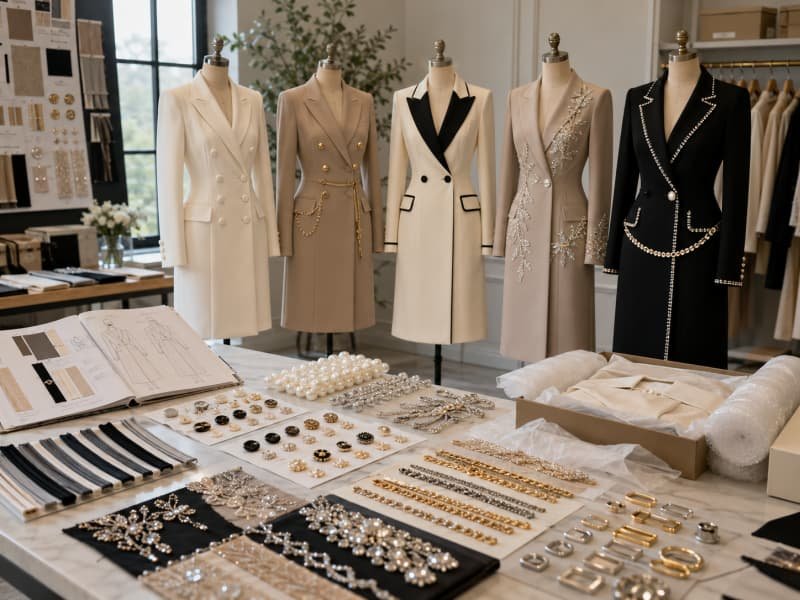
Custom finishes can include covered buttons, metal buttons, contrast lapels, piping, crystals, pearls, sequins, embroidery, chains and branded hardware.
Each element is evaluated for:
- Weight
- Surface durability
- Skin contact
- Placement repeatability
- Color consistency
- Replacement parts
- Packing protection
- Reorder availability
Structural Engineering Behind a Balanced Blazer Dress
Shoulder Balance, Sleeve Position and Upper-Body Control
- Shoulder width: The seam should support the intended profile without dropping unintentionally or cutting into the arm.
- Shoulder slope: Pattern angle must correspond with pad thickness and the target body posture.
- Pad placement: The pad should extend smoothly toward the sleeve without creating a ridge or hollow area.
- Sleeve-head support: Additional support may be used to maintain a clean transition from shoulder to sleeve.
- Armhole balance: Excessive depth can create drag lines; insufficient depth restricts movement.
- Sleeve pitch: The sleeve must follow the natural arm position expected for the garment.
- Back width: Adequate movement is needed without losing the structured back shape.
Lapel Roll, Collar Balance and Front Neckline
Lapel quality is affected by pattern geometry, interlining, seam allowance, edge construction and pressing. A lapel may look acceptable when flattened but fail to roll naturally on the body.
Key control areas include:
- Gorge position: The meeting point between collar and lapel affects visual height and neck proportion.
- Break line: The roll line must support the intended open or closed front.
- Lapel width: Width should match shoulder strength, neckline depth and garment length.
- Collar balance: The collar must sit close to the back neck without standing away or pulling downward.
- Front-edge stability: Facing, fusible and stay tape help control stretching and waving.
- Symmetry: Left and right lapels must mirror one another after sewing and pressing.
- Thickness control: Multiple layers at the notch, collar point or shawl edge must be trimmed and graded carefully.
Deep blazer necklines may also require hidden support such as snaps, internal buttons or stay tape. The aim is a clean open neckline that remains stable during normal movement.
Bust, Waist and Front-Closure Engineering
- Bust point position
- Chest width
- Front length
- Dart direction
- Princess-seam shape
- Waist level
- Button stance
- Front overlap
- Internal closure
- Hip transition
Hip Ease, Hem Balance and Wearability
The lower section must preserve the tailored line while allowing walking, sitting and normal movement. Mini lengths have limited space to absorb fit errors, while longline designs may twist or spread if the hip and vent are not balanced. Review points include:
- Hip ease: Enough room for movement without losing the intended shape.
- Front and back length: Both must remain level when the garment is worn.
- Side-seam position: Side seams should remain vertical rather than shifting forward or backward.
- Vent height: The vent must support movement without opening excessively.
- Lining length: Lining should not pull the shell upward or show below the hem.
- Hem depth: A suitable hem helps the lower edge hang cleanly.
- Sitting coverage: Essential for mini and fitted lengths.
- Garment weight: Buttons, hardware and decoration can affect lower-body balance.
Wearability is reviewed alongside visual appearance. A blazer dress should retain structure while allowing the wearer to move without constant adjustment.
Fabrics Selected for Structure, Drape and Wearability

Structured Suiting
- Surface smoothness
- Drape versus body
- Crease recovery
- Fusible compatibility
- Needle marking
- Color consistency
- Shrinkage
- Pressing response

Crepe Suiting
Crepe suiting, often around 180–280 gsm, offers a refined surface and softer movement while retaining enough body for tailored silhouettes.
Suitable directions include:
- Office-to-evening dresses
- Contemporary occasion styles
- Softly structured shoulders
- Belted shapes
- Single-breasted fronts
- Minimalist longline designs
Interlining may be applied selectively rather than across the entire front, preserving drape while controlling the lapel, closure and pocket areas.

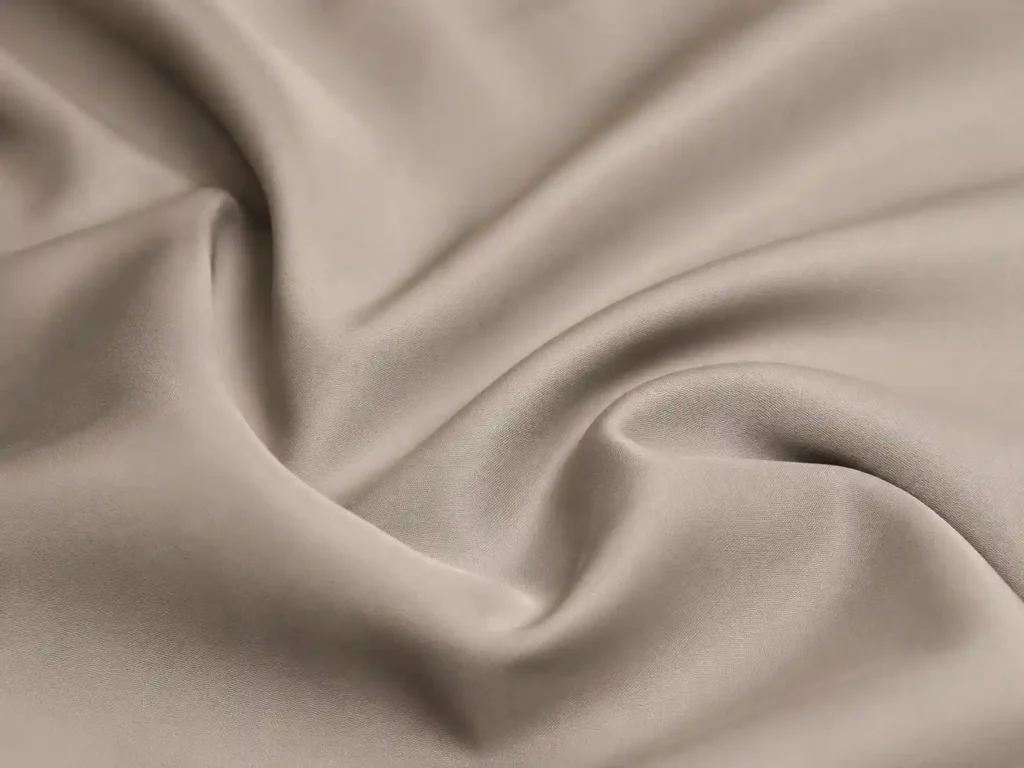
Tailored Twill
Twill fabrics around 200–300 gsm can offer durability, shape and a slightly more relaxed visual character. Stretch twill may improve comfort in fitted mini styles.
Key review points include:
- Twill-line direction
- Surface shine
- Stretch recovery
- Seam impression
- Fraying
- Shrinkage
- Color migration
- Pressing temperature
Pattern ease should reflect the fabric’s actual stretch and recovery rather than the fiber label alone.
Compact Ponte
- Two-way or four-way stretch
- Recovery after extension
- Edge stability
- Pilling
- Heat response
- Needle selection
- Seam stretch
- Hem support

Velvet
Velvet often falls around 240–360 gsm, although pile density and backing construction strongly influence weight. Velvet supports holiday and evening programs but requires careful handling.
Development focuses on:
- Nap direction
- Shade appearance
- Seam crushing
- Pressing marks
- Lapel surface
- Pocket construction
- Lining friction
- Packing method
Panels must be cut in a consistent direction, and pressing should avoid flattening or glazing the pile.

Satin-Faced Fabrics
Satin-faced suiting and heavier satin blends around 160–260 gsm may be used for full garments or contrast lapels. Shine makes needle marks, seam impressions and pressing errors more visible.
Key controls include:
- Grain alignment
- Surface snagging
- Seam puckering
- Needle size
- Pressing protection
- Shade variation
- Fusible show-through
- Lining compatibility
For tuxedo designs, shell and satin-lapel contrast should be assessed under studio lighting as well as normal room light.

Textured Wovens
Bouclé, basket weave, jacquard and other textured wovens may range from 250–400 gsm or more. They create visual depth but may fray, distort or build excessive seam thickness.
Development may require:
- Edge stabilization
- Wider seam allowance
- Partial interlining
- Seam grading
- Pocket reinforcement
- Matching of visible texture
- Lining coverage
- Bulk pressing trials
Buttons and decorative trims should suit the surface scale without overpowering the garment.

Stretch Woven Blends
- Stretch percentage
- Recovery after repeated extension
- Growth during wear
- Heat sensitivity
- Fusing behavior
- Seam extension
- Size tolerance
- Relaxation before cutting
Lining and Interlining Systems for Tailored Dresses
Lining for Comfort, Movement and Interior Quality
Lining review covers:
- Fiber and hand feel: Polyester, recycled polyester, acetate-like or other options may be evaluated according to project requirements.
- Weight: Lining should support the shell without adding unnecessary bulk.
- Static control: Important for fitted and longer styles.
- Color: Tone-on-tone, contrast or printed lining must remain compatible with shell color and opacity.
- Ease: Extra movement is required around the back, sleeve and hip.
- Hem connection: Full attachment, swing lining or partial attachment may be selected according to the silhouette.
- Vent construction: Lining must open cleanly with the vent and return to position.
- Durability: Seam strength and abrasion should support repeated wear.
Interlining for Lapel, Front Edge and Shape Retention
Interlining can be woven, nonwoven, knit, stretch or sectional. Selection depends on main-fabric weight, stretch, surface sensitivity and required structure.
Common support zones include:
- Lapel and collar
- Front panel
- Front edge
- Shoulder area
- Pocket opening
- Button and buttonhole positions
- Vent
- Hem or cuff
Before bulk use, fusible compatibility may be reviewed for adhesion, hand feel, shrinkage, bubbling, strike-through and surface change. A strong adhesive bond is not enough if the result becomes too rigid or leaves visible marks.
Sectional interlining may preserve softness across the body while reinforcing only the areas that need control. More structure is not automatically better; the correct result depends on silhouette and wearing purpose.
Shoulder and Chest Support Components
Strong shoulder lines may use pads, sleeve-head rolls, chest pieces or reinforcement tapes. Each component must remain concealed and stable.
Control points include:
- Pad size and thickness
- Pad density
- Position relative to shoulder seam
- Front and back extension
- Sleeve-head support
- Attachment method
- Edge visibility
- Graded-size consistency
Support components are checked after pressing because heat and pressure can change their shape. The garment is also reviewed from front, side and back to confirm a smooth transition.
Internal Reinforcement Around Closures and Pockets
Buttons, buttonholes, hooks, snaps and pocket openings place repeated stress on the garment. Reinforcement helps prevent distortion and tearing.
Potential reinforcement includes:
- Stay tape along front edges
- Extra fusible at button positions
- Pocket-opening support
- Neckline stabilization
- Vent reinforcement
- Belt-loop backing
- Hidden snap support
- Hardware backing patches
Reinforcement dimensions and placement should be recorded before production. Excessive reinforcement can become visible from the outside, while insufficient reinforcement can fail during wear.
Buttons, Closures and Branded Trim Development
Single-Breasted Buttons
Double-Breasted Buttons
Double-breasted styles require an accurate grid. Horizontal spacing must support the torso width, while vertical spacing must preserve lapel and waist proportion. Duolan checks visible buttons, functional buttons and internal anchor buttons. Button templates and placement measurements help maintain consistency across sizes and production batches.
Hidden Security Closures
Deep necklines or overlapping fronts may require hidden snaps, hooks, internal buttons or stay tape. Security closures should stabilize the garment without changing the intended exterior.
Placement is reviewed on the body because a closure that appears correct on a flat garment may still allow gaping or pulling during movement.
Zippers and Mixed Closures
Decorative Hardware
Metal buttons, chains, buckles, eyelets and logo hardware must be evaluated for weight, coating, edge smoothness and color consistency. Hardware approval may include finish samples, color comparison, attachment tests and packing protection. Spare components may be planned for selected high-value programs.
Labels and Brand Trims
Pattern, Fit and Measurement Control for Blazer Dresses
Critical Upper-Body Measurements and Balance
Upper-body accuracy determines whether the blazer dress sits cleanly around the neck, shoulder, bust and sleeve.
Important points include:
- Shoulder width
- Shoulder slope
- Across chest
- Across back
- Bust width
- Front chest width
- Armhole depth
- Sleeve length
- Bicep width
- Cuff opening
- Neckline depth
- Collar length
Measurements are interpreted together. Increasing bust width without correcting front length may leave the front hem uneven. Extending the shoulder without changing sleeve pitch may create twisting. Changing pad thickness may require adjustment to shoulder slope and armhole shape.
Duolan follows the brand’s point-of-measure method where provided. Measuring position, garment state and preparation method should remain consistent.
Waist, Hip, Length and Closure Measurements
The lower body must combine shape with movement.
Important points include:
- Waist width and position
- High-hip and full-hip width
- Front and back body length
- Side length
- Dress length
- Hem opening
- Vent height
- Front overlap
- Button placement
- Pocket position
- Belt position
- Lining length
Critical measurements depend on the silhouette. A fitted mini style gives greater priority to waist, hip, length and opening security. A longline style gives greater priority to side-seam balance, vent height and lower-front alignment.
Button position is treated as a measurement point because an incorrect stance can change both visual proportion and front tension.
Fit Review on the Body
The review may examine:
- Collar contact at the back neck
- Lapel roll
- Shoulder symmetry
- Sleeve hang
- Bust drag lines
- Front closure
- Waist position
- Side-seam direction
- Hip movement
- Sitting coverage
- Vent opening
- Hem level
Grading Across the Size Range
Blazer dress grading must preserve design proportion rather than enlarge every point at one fixed rate.
Sensitive areas include:
- Lapel width
- Gorge position
- Shoulder extension
- Button grid
- Pocket placement
- Waist level
- Vent height
- Dress length
- Sleeve proportion
- Belt location
The brand’s size chart and fit model provide the starting basis. Selected sizes may require additional review when a style has deep necklines, strong shoulder extension, close body fit or complex front overlap.
Tech Pack Review Before Blazer Dress Sampling

Design and Measurement Review
The review begins with sketches, reference images, measurements and fit intention. Duolan checks whether the visual direction agrees with the numerical specification. Common conflicts include:
- Shoulder width inconsistent with the sketch
- Lapel width missing
- Front length incompatible with button stance
- Waist position not defined
- Sleeve opening unclear
- Vent height absent
- Lining length unspecified
- Finished garment length measured differently across files
Questions are organized before pattern development begins, giving the product team a cleaner approval basis.

BOM and Material Review
- Material description
- Composition
- Weight or construction
- Color reference
- Supplier status
- Required tests
- Placement
- Consumption basis
- Alternative options
- Bulk availability

Construction Detail Review
Construction notes should clarify:
- lapel type
- collar structure,
- pocket method
- front edge
- lining
- sleeve vent
- hem
- back vent
- closure
Missing details can affect cost and appearance. For example, a true welt pocket requires different labor and reinforcement from a mock welt. A lined vent requires different construction from an unlined slit.Duolan can identify areas requiring an enlarged detail drawing, original sample reference or workmanship trial.

Production Feasibility Review
A beautiful development idea must also remain repeatable.
Before sampling, Duolan considers:
- Fabric behavior
- Pattern complexity
- Interlining requirements
- Decoration placement
- Sewing sequence
- Pressing sensitivity
- Material sourcing
- Size grading
- Inspection access
- Packing protection
Potential risks are raised with suggested development routes rather than ignored until bulk production.
Six Stages of Blazer Dress Sample Development
Project Review
Material Preparation
Main fabric, lining, interlining, shoulder components, buttons and trims are reviewed before cutting. Where exact materials are unavailable, alternatives may be proposed according to weight, drape, stretch, structure, surface finish and bulk feasibility. Color swatches, lab dips or trim options may be prepared where required.
Pattern Development
First Sample
Fit and Revision
PP and Bulk Readiness
Sample Review, Comments and Revision Control
Visual Evidence Before Shipment
- Front, side and back views
- Open and closed front
- Lapel and collar close-ups
- Shoulder profile
- Sleeve hang
- Waist and side seam
- Pocket details
- Interior lining
- Button placement
- Hem and vent
Measurement and Fit Notes
A sample review note may identify:
- Confirmed measurements
- Measurements requiring review
- Visual concerns
- Fit concerns
- Material observations
- Workmanship observations
- Suggested revisions
- Items awaiting brand approval
Comment Translation
Possible actions may include:
- Redistribute dart intake
- Adjust side-seam shape
- Raise waist position
- Reduce interlining weight
- Shorten lapel
- Change break line
- Move button stance
- Reduce edge thickness
Revision Summary
Each revision round should preserve approved decisions and identify remaining open points. A revision summary can include:
- Original concern
- Agreed action
- Pattern change
- Material change
- Construction change
- Measurement change
- Visual result
- Next approval point
Clear records improve PP approval and reduce the risk of old comments returning during bulk production.
Blazer Dress Workmanship Details Under Close Control

Collar and Lapel
- Left-right symmetry
- Smooth roll
- Collar contact
- Edge shape
- Corner sharpness
- Interlining visibility
- Topstitch consistency
- Pressing marks
Shoulder Construction
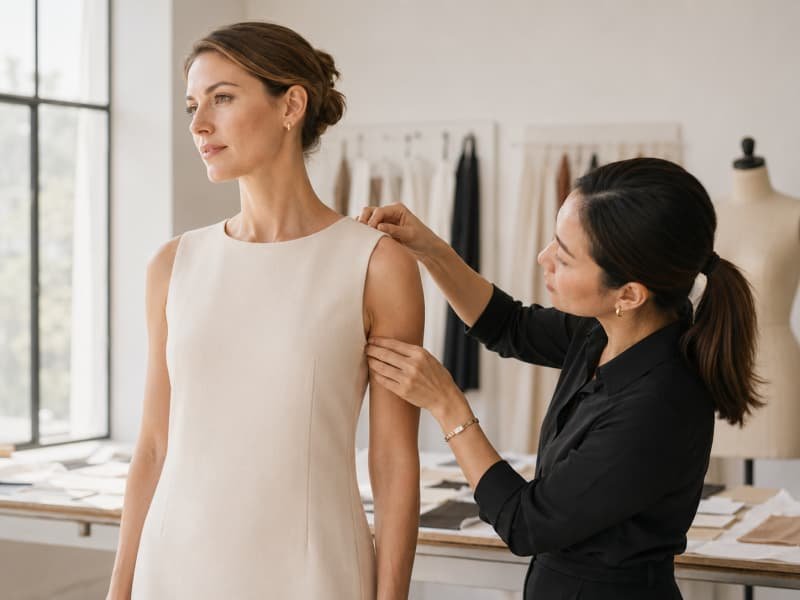
Shoulder quality depends on seam shape, pad position, sleeve-head support and pressing.
Control points include:
- Shoulder seam location
- Pad centering
- Smooth pad edge
- Sleeve-head transition
- No hollows or ridges
- Equal left-right height
- Back shoulder balance
- Stable shape after packing
Strong shoulders should remain smooth rather than appear bulky.

Sleeve Setting
Sleeves are checked for pitch, hang, mobility and even sleeve-head distribution. Excess ease can create puckering, while insufficient shaping may pull the front or back armhole.
Duolan reviews:
- Sleeve rotation
- Cap height
- Bicep allowance
- Elbow shape
- Cuff opening
- Vent alignment
- Lining ease
- Left-right length
Sleeve quality is assessed while the garment is worn.

Darts and Panels
Darts, princess seams and side panels create bust and waist shape. Their endpoints and curves must blend smoothly without dimples or sharp protrusions.
Control includes:
- Dart length
- Dart direction
- Pressing direction
- Panel symmetry
- Seam smoothness
- Waist continuity
- Bust shaping
- Grade consistency
Shape lines should support the body without creating visible tension.

Front Edge and Facing
- Edge stretching
- Waving
- Thickness
- Facing roll-out
- Button reinforcement
- Hem transition
- Front length
- Closed-front balance

Welt and Flap Pockets
Pocket openings should be equal in length, level and accurately positioned. Welt thickness and flap shape must remain consistent.
Checks include:
- Pocket height
- Angle
- Opening length
- Corner security
- Reinforcement
- Bag attachment
- Flap symmetry
- Pressing

Buttonholes and Buttons
Buttonholes are evaluated for:
- length
- density
- cutting cleanliness
- reinforcement.
Buttons are checked for placement, attachment strength and orientation.
Double-breasted styles use placement templates to protect the button grid. Internal anchor buttons and backing support may be added according to garment weight and closure stress.
Lining and Vent Finish
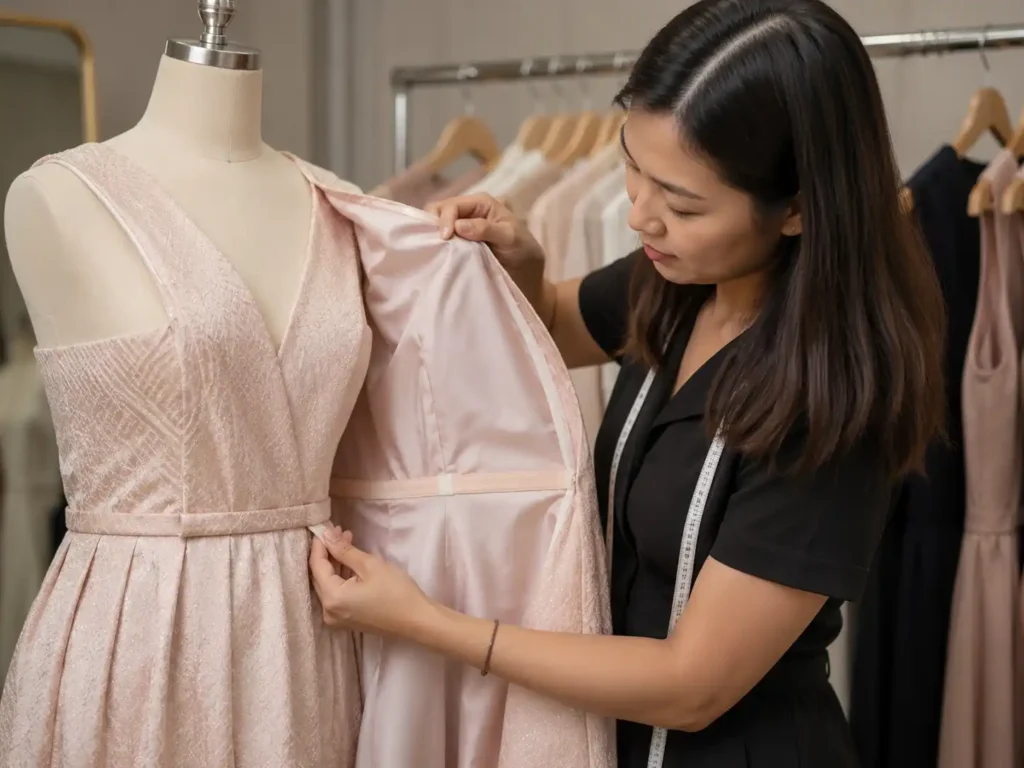
Lining should remain smooth, concealed and free from twisting. Vents should open cleanly and return to position.
Interior inspection covers:
- Back pleat
- Sleeve lining
- Armhole attachment
- Hem allowance
- Vent connection
- Loose threads
- Interlining concealment
- Label placement
Pressing and Finishing for a Sharp Tailored Silhouette
Lapel Roll Setting
Collar Shaping
The collar should follow the neckline and sit close to the back neck. Pressing helps shape the collar stand and remove excess fullness.
Checks include collar balance, left-right equality, gorge alignment and seam thickness. Collar points or shawl edges must remain clean without visible impressions.
Shoulder and Sleeve
Waist and Panel Shaping
Final Appearance
Packing Shape Protection
Quality Control for Custom Blazer Dress Production
Fabric and Shade
Interlining Compatibility
Interlining is checked for adhesion, bubbling, stiffness, shrinkage, strike-through and surface change.
Selected combinations may be tested before full cutting, especially for satin-faced, stretch, velvet, light-colored or textured fabrics.
Cut Panel Accuracy
Cut panels must follow the approved pattern, grain direction, nap direction and matching requirements. Critical components include collars, lapels, facings, pocket parts, front panels and lining. Accurate notches and numbering support correct sewing assembly.
First-Piece Review
Inline Measurement
Structural Symmetry
Final Appearance
Packing and Labels
Packing inspection confirms size labels, care labels, hangtags, barcode stickers, polybags, folding, carton quantity and carton marks. Structural protection is checked to reduce lapel crushing, shoulder folding and hardware abrasion during transit.
From Approved Sample to Stable Bulk Production
Approved Sample Status
- Fit approved
- Visual approved
- Material approved
- PP basis
- Partially approved
- Pending refinement
Material and BOM Locking
Main fabric, lining, interlining, pads, buttons, zippers, labels and packaging are reviewed against the approved BOM.
Color references, supplier status, substitute restrictions and special handling instructions are confirmed.
Material changes after approval require controlled review because even visually similar replacements can alter fit and structure.
Bulk Readiness Review
Before production release, Duolan reviews:
- Approved sample status
- Style, color and size breakdown
- Material readiness
- Inspection requirements
- Packing requirements
- Delivery window
The review supports a controlled production start rather than an immediate release after order confirmation.
Measurement and Workmanship Locking
The production basis includes the approved size specification, measuring method, tolerance, construction details and workmanship references. Critical areas may be recorded through close-up images or workmanship cards covering lapel, shoulder, pocket, closure, lining and vent.
First-Piece Confirmation
For complex styles, the first piece or pilot run is checked before full volume proceeds. The review confirms whether production materials, production patterns, sewing methods, pressing and measurements reproduce the approved standard. Any deviation is corrected before the same issue appears across a larger quantity.
Inline and Final Control
Inline inspection monitors measurement trends, structural symmetry and workmanship. Final inspection confirms overall quality, labeling and packing. Production records can be retained for repeat orders, supporting more consistent future runs and faster preparation for approved repeat styles.
Sampling, Production, MOQ and Delivery Planning
Commercial planning depends on confirmed design, materials, quantity and approval status. The following ranges provide a project framework; final quotation and timing are reviewed against the actual style program.
| Project Area | Reference Planning Basis |
|---|---|
| Development input | Tech pack, reference image, original sample, design sketch or collection brief |
| Sample purpose | First prototype, fit sample, revised sample, photo sample, salesman sample or PP sample |
| Sample timeline | Confirmed after design basis, material direction, fit priority and sample purpose are reviewed |
| MOQ evaluation | Assessed by style, color, fabric, trims, workmanship, size breakdown and total program quantity |
| Simple bulk styles | Approximately 15–20 production days after all bulk-start conditions are confirmed |
| Regular bulk styles | Approximately 20–30 production days after all bulk-start conditions are confirmed |
| Complex structured styles | Approximately 30–45 production days after all bulk-start conditions are confirmed |
| Bulk-start conditions | PP basis, BOM, materials, color, order breakdown, packaging, payment milestone and production plan |
| Express delivery | Commonly 3–7 days, subject to route and customs |
| Air delivery | Commonly 5–8 days, subject to route and customs |
| Sea delivery | Commonly 20–35 days, subject to destination and sailing schedule |
| Delivery terms | FOB, CIF, DDP and staged shipment can be evaluated |
| Standard payment reference | 30% deposit and 70% before shipment; ongoing programs may be coordinated according to cooperation history |
Packaging Protection for Structured Blazer Dresses

Garment Folding
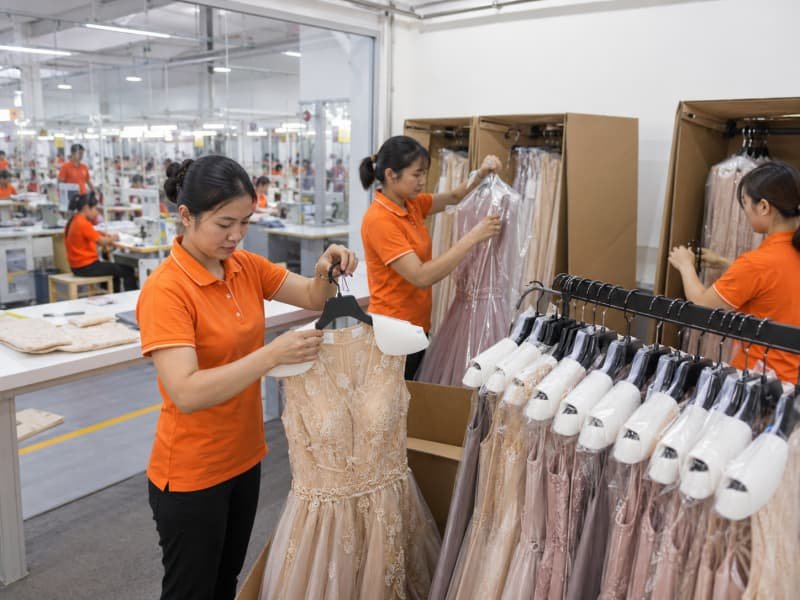
Hanger Packing

Lapel Protection

Hardware Protection

Labels and Barcodes

Carton Planning
Why Duolan Supports Brand-Level Blazer Dress Programs
Nearly 30 Years
Dress-Focused Development
Duolan’s core direction centers on fashion dresses, occasion dresses, party dresses, fitted dresses, coordinated fashion sets and refined tops.Blazer dress development benefits from both tailored structure and dress-specific understanding of waist fit, body proportion, skirt fall, event styling and visual impact.
16 Owned Factories
Sixteen owned womenswear factories provide direct control for core styles, development-sensitive products and important production programs.
Factory allocation is based on product complexity, workmanship, quantity and timing rather than sending every style through one undifferentiated production route.
20+ Satellite Factories
More than 20 long-term satellite factories provide additional flexibility for repeat orders, seasonal volume, production balancing and scaled programs.
The wider network supports controlled expansion when a style moves from initial launch to repeat or higher-volume production.
High Development Capacity
The manufacturing system supports approximately 15,000–35,000 sample developments or sample units per month and 3,000–8,000 style development processes, depending on project complexity and scheduling. The value lies in handling multiple projects and style groups in parallel while maintaining defined development stages.
Audit Readiness
The supporting factory system has completed SMETA and SMETA 2-Pillar audit requirements and maintains a SMETA social audit record. Duolan can also coordinate brand-specific requirements involving quality manuals, testing, labeling, packing, restricted-substance instructions, inspection and shipment documentation.
Blazer Dress Project Case Studies
United States Going-Out Program
Region: United States
Program: Premium going-out and occasion collection
Style count: 18 blazer dress styles
Total quantity: 46,800 pieces
Size range: XS–XL
Colorways: 2–4 per style
The initial references used extended shoulders, deep V necklines, double-breasted closures and short fitted lengths. Early development showed inconsistent lapel opening, front pulling at the bust and waistlines shifting between styles.
Duolan separated the collection into three structure groups. Shoulder slope, pad thickness, front length, interlining map and button stance were reviewed for each group. Shared black suiting and lining standards were locked, while velvet and satin-lapel styles followed separate handling routes.
Fit approval was completed through two main development rounds. Production was released in three coordinated waves to match campaign and warehouse dates. Six core styles moved into repeat production after the first sales cycle.

United Kingdom Occasionwear Program
Region: United Kingdom
Program: Holiday and cocktail occasionwear
Style count: 12 blazer dress styles
Total quantity: 28,800 pieces
Size range: UK 6–16
Main materials: Velvet, crepe and contrast satin
Delivery structure: Two shipment windows
The main development risk came from velvet crushing, satin-lapel marking and visible differences between black shell, satin and lining. Several styles also used metal buttons and crystal decoration, increasing front weight.
Duolan established one-way nap cutting, protected pressing, separate satin-lapel construction trials and reinforcement maps for heavy closures. Decoration was moved away from the lapel roll and pocket openings where necessary. Packing methods were adjusted to avoid pressure on velvet and metal components.
The 12 styles entered production after PP confirmation and first-piece review. Two shipment windows supported the brand’s holiday launch sequence, while common trims and labels were coordinated across the program.

European Contemporary Program
Region: European Union
Program: Contemporary office-to-evening collection
Style count: 24 structured dress styles
Total quantity: 72,000 pieces
Size range: EU 32–46
Main focus: Clean tailoring, longline silhouettes and repeatable fit
The brand required a consistent shoulder language and waist position across mini, above-knee and longline shapes. Initial files used one grade rule for lapels, buttons and pockets, creating visual imbalance in the larger sizes.
Duolan reviewed grade-sensitive design points separately. Lapel width, button spacing, pocket position, waist level, vent height and sleeve proportion were adjusted by style group. A shared measurement method and critical-point list were prepared for inline QC.
Production was divided according to complexity and material group. Core black and navy styles formed the commercial base, while seasonal colors followed separate shade-control plans. Project records were retained for repeat colors and future collection extensions.

Custom Blazer Dress Frequently Asked Questions

Start Your Custom Blazer Dress Development Project
Send Duolan your tech pack, design sketch, reference images, original sample photos or collection brief. Our team will review the design basis, structural requirements, fabric and interlining direction, target fit, order quantity and launch schedule before confirming the most suitable development path.
For a more accurate review, include:
- Product type and intended wearing occasion
- Tech pack or design reference
- Main fabric and lining direction
- Lapel, shoulder and closure requirements
- Target size range and fit standard
- Quantity by style, color and size
- Required sample stage
- Target launch or delivery date
- Label, packaging and warehouse instructions
- Quality, testing or inspection requirements
- Current project stage: development, sampling, supplier evaluation, PP approval or bulk production
After receiving the files, Duolan can evaluate sample requirements, material readiness, key structural risks, MOQ conditions, quotation basis and production timing.