 Skip to content
What Is the Best Lining for Bodycon Dresses : A Complete Fabric Guide
Your trusted Women’s Apparel Development & Manufacturing Partner from China
- Jerry
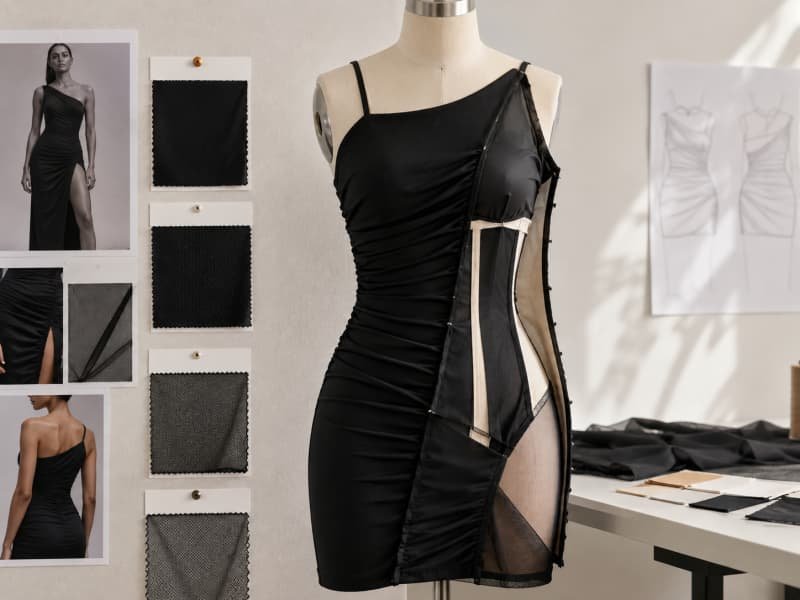
A bodycon dress can look uncomplicated on a hanger, yet the lining often decides whether it feels polished or frustrating once it is worn. The wrong inner layer may restrict movement, turn transparent across the hip, trap heat, twist around the body, or create ridges that show through the shell. The right lining does the opposite: it follows the silhouette, improves coverage, protects the skin, and moves quietly with the wearer. That is why experienced product teams treat lining as part of fit engineering rather than as a late-stage trim decision.
The best lining for most bodycon dresses is a lightweight nylon-spandex or polyester-spandex knit with a smooth surface, dependable recovery, and stretch that matches the shell in every movement-critical direction. The final choice should also reflect opacity, compression, garment weight, care method, climate, and retail positioning rather than fiber composition alone.
A lining can pass a quick hand-stretch test and still fail during a real fitting. One fitted sample may look clean on a mannequin, then pull sharply across the seat when the wearer sits down because the inner layer stops extending before the shell. Another may feel comfortable for five minutes but grow after several hours and collect around the hip. The practical questions are therefore not simply “Is it stretchy?” but “How far does it stretch, how much force does it require, and how well does it return?”
What Is the Best Bodycon Dress Lining?
The best bodycon lining is a smooth stretch knit that reaches the dress’s working extension without restricting the shell, recovers after wear, provides the planned coverage, and remains comfortable against the skin. Nylon-spandex tricot is often the strongest all-round option, while polyester-spandex, lightweight jersey, self-fabric, and power mesh suit different silhouettes and support levels.
The Best Overall Choice
For many fitted dresses, nylon-spandex tricot provides the most balanced combination of stretch, recovery, low bulk, and surface smoothness. Its fine knit structure allows it to sit close to the body without adding the thickness of a conventional jersey, while its smooth face helps the shell move independently instead of catching against the lining. This makes it especially useful beneath stretch mesh, lace, lightweight rib knits, ruched shells, and close-fitting occasion dresses.
The word “best,” however, should never be treated as a universal fabric code. A lightly fitted midi dress requires a different inner layer from a structured mini dress with strong negative ease. A lining that performs beautifully beneath mesh may feel too cool or synthetic under a soft cotton-blend shell. The right decision begins by defining the main job: modesty, skin comfort, support, seam coverage, shape control, or a deliberate balance of several functions.
Those goals can conflict. Greater density usually improves opacity, but it can also increase heat and reduce flexibility. Firmer recovery can clean up the silhouette, yet too much resistance may make the garment feel smaller than its size label suggests. Experienced development teams therefore approve lining by complete performance rather than composition alone. A label such as “90% nylon, 10% spandex” does not reveal modulus, growth, edge rolling, shine under tension, or sewing stability.
Stretch and Recovery
Bodycon garments depend on controlled extension, but stretch distance is only half the question. Recovery is equally important because the lining must return after repeated sitting, walking, and bending. The most revealing areas are usually the seat, hip, waist, underarm, and elbow. If the lining grows more than the shell, it can form loose folds inside the garment. If it resists more than the shell, it can produce drag lines, shorten the hem in motion, or overload the seams.
Stretch force matters as much as maximum extension. Two fabrics may both reach 50% extension, yet one may require substantially more force to get there. The firmer quality will feel more compressive and may change the intended fit even though the percentage looks acceptable on paper. During development, compare equal swatches under the same load, then confirm the result through a complete-garment wear test that includes sitting, stair climbing, arm movement, and at least thirty minutes of continuous wear.
The lining only needs to meet the garment’s working extension, not necessarily the shell’s maximum laboratory stretch. A shell may stretch 90%, while the pattern uses only 25% extension around the hip. The lining should comfortably reach that working range and return without permanent growth. Methods such as ASTM D2594/D2594M can provide a repeatable framework for evaluating knit stretch and growth, but the final decision still belongs to the finished dress on the intended body shape.
Comfort Against the Skin
A bodycon lining remains close to the wearer for long periods, so surface feel, moisture behavior, seam placement, and heat retention directly affect satisfaction. A technically strong fabric can still fail commercially if it feels sticky, scratchy, overly warm, or unexpectedly compressive. Nylon-spandex tricot often feels smooth and cool at first touch, while polyester-spandex qualities vary from silky and light to dense and heat-retaining depending on yarn, construction, and finish.
Viscose-elastane and modal-elastane blends can offer a softer, more absorbent hand for premium casual styles, but they require closer control of shrinkage, relaxation, and growth. The lining should also be assessed with the thread, care label, zipper tape, elastic, boning, bra cups, and seam allowances because a soft fabric does not guarantee a comfortable garment when hard components sit directly against the skin. For warm-weather or long-event wear, partial lining may deliver better comfort than a full second layer.
Production Repeatability
A lining is not truly suitable until it can be repeated in bulk. Sample rooms can sometimes make unstable materials look acceptable through careful hand cutting, slow sewing, or extra pressing, while production exposes whether the fabric rolls, distorts, shades unevenly, or changes under higher machine speed. The approved specification should therefore record supplier, construction, composition, finished width, weight, color, stretch direction, finish, and a sealed reference swatch rather than relying on a fiber percentage alone.
Color continuity deserves special attention in pale dresses and mesh-over-lining designs. A small variation in the inner layer can visibly alter the finished shade even when the shell dye lot is correct. Nude effects should be approved as a combination of shell and lining, not as separate materials. The most reliable “best” lining is the one that protects the intended silhouette, remains comfortable through real movement, and can be reproduced from approved sample to repeat order without quiet changes in hand, shade, or recovery.
Which Lining Fabrics Work Best?
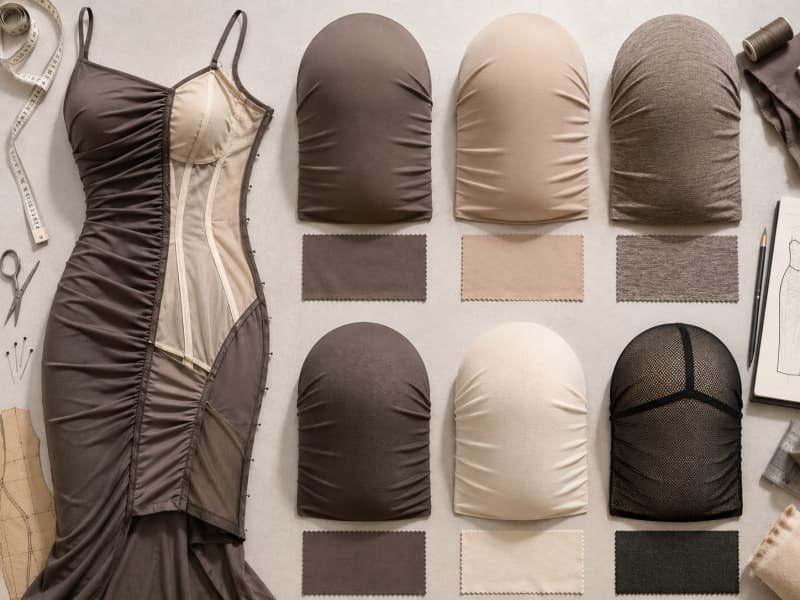
Nylon-spandex tricot works best for many lightweight and high-stretch bodycon dresses. Polyester-spandex lining offers broad color availability and practical cost control. Stretch jersey suits soft double-layer styles, power mesh supplies targeted shaping, and self-fabric lining gives the closest match in color and stretch. Viscose blends can improve skin feel but need careful stability testing.
Nylon-Spandex Tricot
Nylon-spandex tricot is widely used because it can combine high extension, clean recovery, and low weight in one smooth layer. Its fine surface reduces friction under mesh, lace, stretch velvet, and embellished fabrics, which helps the inner and outer layers move without catching. For many fitted dresses, a development weight of roughly 70 to 120 GSM is a useful starting range. The lighter end suits transparent overlays, while denser qualities offer more coverage and a slightly firmer hand.
GSM alone cannot predict performance. Yarn size, stitch density, heat setting, dyeing, and finishing can make two fabrics with the same weight and composition behave very differently. Nylon-spandex is particularly effective when the design needs a second-skin inner dress without visible thickness. It also works well beneath ruching because the lining can remain relatively flat while the shell creates controlled volume. Its main limitations are exact-color availability, dye-lot consistency in pale shades, and a higher cost than basic polyester qualities.
Polyester-Spandex Lining
Polyester-spandex is often the most practical option for large color programs, trend-led collections, and dresses that need disciplined material cost. The supply base is broad, and mills commonly offer stock colors, multiple weights, and different finishes. A development range around 75 to 140 GSM is common, although construction matters more than the number alone. A light warp-knit polyester can feel smoother and cooler than a denser weft-knit jersey even when both have similar composition.
A good polyester-spandex lining should recover cleanly, remain stable during sewing, and avoid becoming excessively shiny when stretched. Lower-grade qualities may feel hot, build static, or retain growth around the seat. Dark shades should be checked for dry and damp rubbing transfer, especially when the dress contains pale labels, contrast trims, or light underwear. Polyester is not automatically a lower-quality compromise; a well-finished quality that matches the shell can outperform a premium fiber selected without regard to recovery, care, and construction.
Jersey and Self-Fabric
Lightweight stretch jersey suits dresses where softness and a substantial double-layer feel are part of the product. It is common in casual fitted styles, long-sleeve jersey dresses, and products positioned around comfort rather than sharp control. Self-fabric lining can be useful when exact color, stretch, and surface compatibility are priorities. It often creates a clean appearance in pale jersey dresses because the two layers behave similarly under tension and photograph as one coordinated material system.
The trade-off is bulk. Two similar knit layers can increase heat, slow drying, raise material consumption, and change drape. Jersey also tends to roll at cut edges and can grow if it is not relaxed before cutting. A lighter related quality is often more practical than duplicating a heavy shell. When self-fabric is used, the development team should test the complete double layer rather than assuming the original pattern will fit correctly, because added resistance may require changes to seam allowance, neckline stabilization, and negative ease.
Power Mesh and Viscose Blends
Power mesh is designed for support rather than simple coverage. It works well as a targeted abdominal panel, waist stabilizer, side-body reinforcement, or internal bodice layer. Typical development weights may fall between 120 and 220 GSM, but modulus is more important than weight because it determines how much force the wearer feels. Using firm power mesh from neckline to hem can unintentionally turn a fashion dress into compression wear and alter the size specification.
Viscose-elastane and modal-elastane jersey offer a softer, more absorbent feel for premium casual dresses, but they need careful relaxation, laundering, and growth testing. These fabrics may change more after moisture and heat than synthetic tricot. Cotton-elastane can also be suitable in selected products, although its higher surface friction may cause the lining and shell to move together. The correct specialist option is chosen by function: support, softness, moisture comfort, or exact shell matching, not by a generic hierarchy of fibers.
Lining fabric | Typical development weight | Best applications | Main advantage | Main caution |
Nylon-spandex tricot | 70-120 GSM | Mesh, lace, ruched and lightweight bodycon dresses | Smooth, light and resilient | Cost and exact-color availability |
Polyester-spandex knit | 75-140 GSM | Commercial programs and multiple colorways | Broad sourcing and cost control | Heat, static and variable recovery |
Lightweight jersey | 100-170 GSM | Soft casual and double-layer dresses | Comfortable hand and familiar feel | Bulk, edge rolling and growth |
Self-fabric | Same as shell | Pale jersey and premium double-layer construction | Closest color and stretch match | Added weight and consumption |
Viscose-elastane | 120-180 GSM | Premium casual fitted dresses | Soft and absorbent skin feel | Shrinkage and dimensional change |
Power mesh | 120-220 GSM | Shaping panels and support zones | Controlled smoothing and support | Excess compression if overused |
How Should Lining Match the Shell?
Direct answer: A bodycon lining should match the shell’s usable stretch, recovery, stretch direction, opacity needs, and care behavior rather than merely sharing its fiber composition. The lining must reach every movement required by the pattern without becoming the tighter layer. It should also remain light and stable enough to preserve the intended silhouette, drape, hem position, and comfort.

Match Working Stretch
A lining should be matched to the extension actually used by the garment pattern, not only to the shell’s advertised maximum stretch. Supplier descriptions such as 50%, 80%, or 100% stretch can vary because the test load and method may differ. The development team should first identify the high-stress zones. A sleeveless midi may need most of its extension around the bust, waist, and hip, while a fitted mini with sleeves also needs meaningful vertical movement through the torso and armhole.
Equal-size swatches of shell and lining can be marked and extended under the same controlled load. The lining should reach the garment’s working range without requiring noticeably more force. If it stops earlier, it may create strain and drag lines. If it stretches farther but recovers poorly, it may collect inside the dress. The pattern’s negative ease must be considered because a soft jersey bodycon and a firm sculpting style may use very different relationships between garment and body measurements.
Match Stretch Direction
Stretch direction can be as important as total extension. Most fitted patterns are positioned so the greatest stretch runs around the body. If the lining is cut with its strongest stretch running vertically while the shell stretches horizontally, the layers will resist movement differently and the wearer may feel restriction at the hip even though both fabrics look flexible during manual handling.
Four-way stretch is particularly useful for mini dresses, long sleeves, fitted armholes, dance-oriented styles, and garments that must move through sitting and stair climbing. Two-way stretch can still work in simpler sleeveless or strapless designs when the pattern provides enough vertical length. Cutting orientation should be marked on the approved swatch and controlled in the marker because some fine tricot fabrics look almost identical in both directions, making production mistakes difficult to spot before fitting.
Match Weight and Opacity
The lining is usually lighter than the shell, but this is a guideline rather than a rule. A compact 90 GSM tricot may provide better coverage than an open 130 GSM jersey. Opacity depends on yarn, stitch density, finish, color, and how far the fabric is stretched. For light mesh or lace dresses, 70 to 120 GSM is a useful development starting point, while medium jersey shells may use 100 to 160 GSM inner layers.
Opacity must be checked under realistic tension because a fabric that looks solid on the cutting table can become sheer over the bust or seat. Layer the actual shell and lining over dark, light, and skin-tone backgrounds, then inspect them in daylight, warm indoor light, retail light, and camera flash. Color matching also requires judgment. A tonal lining may deepen the shell shade, while a slightly lighter or carefully selected nude can preserve brightness and provide more natural coverage beneath pale fabrics.
Match Care Behavior
The shell and lining should respond similarly to the care method printed on the garment label. They do not need identical shrinkage results, but a large difference can distort the dress. If the lining shrinks more, it may pull the hem upward or tighten the armhole. If it shrinks less, it may form excess folds or hang below the shell. Differences in heat response can also create twisting after pressing or laundering.
As a cautious working target, many teams try to keep the difference in dimensional change between shell and lining within about one to two percentage points after the agreed care cycles, although the brand’s own quality specification must take priority. The complete garment should be tested as well as separate swatches because thread, elastic, zipper tape, seam construction, and pressing can change the result. Machine-wash jersey and dry-clean occasionwear require different evaluation routes, so care compatibility should be settled before final sample approval.
Shell fabric | Suitable lining direction | Typical starting range | Key approval concern |
Lightweight stretch mesh | Nylon-spandex tricot or light stretch jersey | 70-120 GSM | Opacity under tension and color interaction |
Polyester-elastane jersey | Lighter polyester-spandex or nylon-spandex | 80-140 GSM | Recovery and heat retention |
Cotton-elastane jersey | Lightweight jersey or smooth tricot | 100-160 GSM | Shrinkage and surface friction |
Stretch velvet | Smooth stretch tricot | 70-120 GSM | Restricted movement and seam bulk |
Ponte or double knit | Partial lining, light tricot, or unlined | 70-120 GSM | Unnecessary weight and reduced breathability |
Stretch satin | Light tricot or partial lining | 70-110 GSM | Seam visibility and shell distortion |
Lace or sequin stretch | Smooth stretch lining | 80-140 GSM | Skin protection and embellishment weight |
Bandage-style knit | Selective support or no lining | Project-specific | Excess compression and size change |
Do All Bodycon Dresses Need Lining?
Direct answer: No. A bodycon dress can remain unlined when the shell is opaque under stretch, comfortable against the skin, stable in wear, and cleanly constructed. Full lining is more useful for sheer mesh, lace, pale lightweight jersey, abrasive embellishments, and structured styles. Partial lining is often preferable when only the bodice, skirt, waist, or transparent areas need coverage.

When Unlined Works Better
An unlined construction can be appropriate for dense ponte, compact double knit, heavy rib knit, and some bandage-style fabrics because these shells may already provide sufficient opacity, support, and recovery. Adding another layer can make the garment hotter, heavier, or more restrictive without producing a visible improvement. Removing the lining may also preserve the shell’s intended stretch and reduce drying time, material consumption, and internal friction.
The decision should never rely on relaxed opacity alone. Stretch the shell to the expected wearing extension and inspect it over the bust, hip, and seat because pale knits often become more transparent as the structure opens. An unlined bodycon dress also exposes more of its internal construction, so thread softness, seam allowance, labels, zipper tape, and hem finishing must be controlled. In some cases, a premium unlined garment requires more precise workmanship because there is no inner layer to hide shortcuts.
When Full Lining Is Necessary
Full lining is commonly used beneath transparent mesh, lace, pale lightweight jersey, sequins, rough embroidery, and open-knit constructions. It gives continuous coverage and can protect the wearer from scratchy thread ends, embellishment backing, and seam allowances. In a mesh bodycon dress, the opaque inner dress is often a major design component rather than a hidden technical layer because its neckline, hem, and leg opening determine the final modesty and visual balance.
Sequin and embellished dresses usually benefit from a smooth full lining, but the inner layer should not be so loose that it twists separately beneath the heavier shell. Pale fitted dresses may also need full coverage to control underwear visibility. This should be assessed across the full intended size range because larger sizes may place more tension on both materials. The correct lining gives coverage without replacing the original silhouette with unnecessary bulk or compression.
When Partial Lining Is Smarter
Partial lining often solves the actual problem without adding material to the whole dress. A structured bodice may need full support while the skirt only requires a short opacity panel. A cut-out design may need lining around the bust and waist while remaining intentionally open at the back or side. Power mesh is particularly effective when used selectively to support the lower abdomen, stabilize a seam, or reinforce an internal bodice.
The ending point must be planned carefully. A horizontal lining edge across the fullest hip can show through the shell as a ridge, especially in pale or satin-faced fabrics. Safer positions include existing seam lines, under ruching, near a waist seam, or in a lower-pressure zone. Partial lining needs its own pattern; simply shortening a full lining can create rolling, riding, or visible edges. Hem width, elastic tension, and attachment method should all be tested on the complete dress.
Mesh, Nude Effects, and Ride-Up
Skin-tone lining is often used beneath mesh to create the appearance of exposed skin while preserving coverage. The shade must be reviewed under the actual shell because black, red, and jewel-toned mesh can make a neutral lining appear warmer, greyer, or pinker. A single generic “nude” is rarely suitable for every market, so brands with diverse customers may benefit from several skin-tone families tested in daylight, retail lighting, and flash photography.
Lining can sometimes reduce ride-up by creating a smoother internal surface, but it is not a complete cure. Ride-up may come from excessive negative ease, insufficient garment length, poor hip shaping, high-friction fabric, an unstable hem, or incorrect seam tension. Adding another layer without correcting the pattern may make the dress hotter while leaving the problem unchanged. The fitting should identify whether the movement begins at the lining, shell, hem, or pattern before any material solution is approved.
Dress condition | Likely lining decision | Technical reason |
Dense opaque ponte | Unlined or partially lined | Full lining may add bulk without improving coverage |
Pale lightweight jersey | Full lining or self-fabric double layer | Opacity often drops under stretch |
Transparent mesh | Full inner dress or targeted opaque panels | Coverage is part of the design |
Sequin bodycon dress | Full smooth lining | Protects skin and covers internal work |
Structured bustier dress | Bodice lining with selective skirt lining | Support requirements vary by zone |
Heavy bandage knit | Often unlined | Shell already supplies compression and structure |
Ruched mesh shell | Opaque stretch inner dress | Inner layer controls coverage and base fit |
Cut-out fitted dress | Partial or engineered lining | Preserves intentional exposure while supporting key areas |
How Do You Test Lining Before Production?
Direct answer: Test the lining as part of the complete dress, not only as a loose swatch. Approval should cover stretch, recovery, opacity under tension, seam extension, dimensional stability, color transfer, skin comfort, and extended wear. The final material should then be locked by supplier, construction, weight, color, finish, and approved reference before bulk cutting begins.

Stretch and Recovery Tests
Begin with a controlled comparison of shell and lining extension. Mark a measured distance on both fabrics in the course and wale directions, then apply the same load. Record extension and observe how closely each fabric returns after release. Immediate recovery is not the whole story, so readings can also be taken after a resting period. Some materials appear stable at first but retain growth after sustained tension, especially around the seat and hip.
The complete garment should then be worn through realistic movement. The fit model should sit, walk, climb steps, bend, raise her arms, and remain seated long enough to expose gradual restriction or growth. The lining should not pull the hem upward, drag at the armhole, twist around the torso, or collect at the seat. Use the same sample size, fit model, movement sequence, and resting time when comparing alternative materials so the decision is based on repeatable observation rather than a quick impression.
Opacity and Appearance Tests
Opacity should be evaluated with the shell and lining stretched to the expected wearing level. Layer the actual materials over dark, light, and skin-tone backgrounds and inspect them under daylight, warm interior light, cool retail lighting, and camera flash. The fullest body zones deserve special attention because tension is not distributed evenly. The bust, seat, hip, and upper thigh may become more transparent than the waist even when the relaxed swatch looks completely solid.
Seams, darts, and overlaps should also be reviewed because multiple layers can create darker lines under a translucent shell. For mesh and lace dresses, a half or full garment gives more reliable information than a small swatch because ruching, body contours, and overlapping seam allowances change the visual result. The test should include e-commerce photography when the product will be sold online, since a lining that looks acceptable in person may behave differently under direct studio lighting.
Seam and Construction Tests
A lining can perform well as a fabric and still fail after sewing. Seams must extend with the garment without thread breakage, tunneling, puckering, or permanent waviness. Stitch type, thread, needle size, differential feed, seam allowance, and elastic application all influence the result. Four-way stretch lining may need different machine settings from stable two-way tricot, while lightweight qualities are especially sensitive to needle damage and feed distortion.
Test seams should be loaded in the same directions they experience in the garment. Side seams, waist joins, armholes, skirt hems, and lining attachment points deserve particular attention. Hem behavior also matters because raw edges may curl, narrow hems may rope, and coverstitching can create ridges under a thin shell. Bonded or laser-cut finishes can reduce bulk in selected products, but they require wash, peel, and heat-resistance testing before they are accepted for production.
Bulk Approval Controls
Once the lining passes sample and wear testing, the approved quality should be controlled in production. The technical record should identify supplier, mill reference, construction, composition, finished width, weight tolerance, stretch direction, approved color, finish, and reference swatch. Where performance is critical, the acceptable stretch, recovery, and shrinkage range should also be stated. Fiber content and a color name alone are not enough to protect repeatability.
Incoming bulk fabric should be compared with the sealed standard before cutting. Check weight, shade, width, hand feel, visible defects, and extension by lot. Pale and nude linings need close shade control because small differences may alter the complete dress. A pilot run should be reviewed after final pressing because spreading tension, cutting relaxation, production sewing speed, and heat can reveal problems that never appeared in the sample room. Bulk approval is complete only when the first finished units reproduce the intended fit, comfort, and appearance.
Test area | Practical method | What to record | Common failure sign |
Extension | Measure marked swatches under equal controlled load | Stretch in both directions | Lining stops before shell working range |
Recovery | Measure immediately after release and after rest | Residual growth | Bagging at hip or seat |
Opacity | Inspect relaxed and at wearing extension | Visibility under several lighting conditions | Sheerness across bust or seat |
Dimensional stability | Apply intended wash or cleaning cycle | Length and width change | Hem mismatch or internal twisting |
Seam performance | Stretch sewn panels repeatedly | Breakage, puckering, and recovery | Popped stitches or wavy seams |
Color transfer | Conduct dry and damp rubbing checks | Staining on light test cloth | Dye transfer to labels or underwear |
Wear comfort | Perform movement and extended-wear fitting | Heat, pressure, friction, and ride-up | Restriction or irritation |
Pilot production | Review first bulk units after pressing | Fit and appearance against sealed sample | Sample-to-bulk inconsistency |
Develop the Lining Before It Becomes a Fit Problem
The lining of a bodycon dress is easy to overlook because customers rarely see it in a product image, yet it influences many of the issues they notice immediately: transparency, heat, movement, ride-up, seam visibility, and whether the dress still feels comfortable after an evening of wear. The most reliable development process chooses the shell and lining together, measures their interaction, tests the complete garment, and locks the approved material before bulk production rather than treating the inner layer as an interchangeable substitute.
Duolan Apparel focuses on body-conscious, occasion, party, and fashion-led dresses and supports fabric sourcing, lining selection, pattern development, fit correction, sample review, and scalable production. Brands and product teams can send a tech pack, reference sample, shell-fabric specification, target fit, size chart, and intended care method for a practical material and construction review.
Share:
Our Services
Categories
Table of Contents
Here, developing fashion collections is more than manufacturing garments — it’s a collaborative process focused on transforming ideas into well-executed, market-ready products. From fabric sourcing and sample development to scalable production and delivery coordination, every stage is built to support quality, consistency, and efficient collection launches across global markets.

