Skip to content
Bodycon Dress vs Bandage Dress Construction: What Is the Difference?
Your trusted Women’s Apparel Development & Manufacturing Partner from China
- Jerry
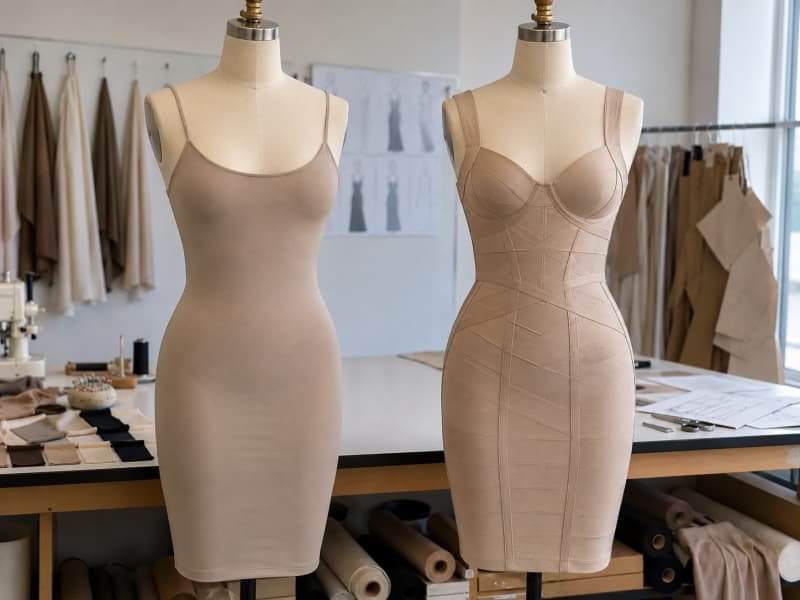
Two fitted dresses can look almost identical in a campaign image and behave completely differently once a customer walks, sits, or wears them for an evening. A lightweight bodycon dress may follow every natural curve, while a structured bandage dress can redistribute tension around the waist, bust, and hips. The difference is not created by a few horizontal lines. It starts with yarn selection, knit density, stretch recovery, pattern reduction, panel direction, seam construction, and the way the garment is fitted across several sizes.
A bodycon dress is a close-fitting garment designed mainly to follow the wearer’s existing shape. A bandage dress is a more structured type of fitted dress that uses dense, high-recovery material, controlled negative ease, and strategically arranged panels to create stronger compression and contouring. Every bandage dress is body-conscious, but not every bodycon dress has true bandage construction.
That distinction can decide whether a style earns repeat orders or becomes a costly fit problem. A product team may approve a polished sketch, choose a fabric that feels good in the hand, and still receive a sample that turns sheer over the hips, rolls at the waist, or feels unbearable after twenty minutes. One vague term in a tech pack can send development in the wrong direction. The practical comparisons below turn those vague expectations into construction choices that designers, sourcing teams, and manufacturers can measure, test, and reproduce.
What Defines Each Construction?
A bodycon dress follows the wearer’s shape through a close-fitting pattern and stretch fabric. A bandage dress adds greater fabric density, stronger recovery, controlled pattern reduction, and strategically placed panels. The clearest distinction is not the presence of horizontal lines; it is whether the garment creates deliberate compression, support, and contour control.
Is Every Bandage Dress Bodycon?
Every bandage dress is body-conscious because it fits closely around the bust, waist, and hips. The reverse is not true. “Bodycon” mainly describes a silhouette, while “bandage” describes a more specific relationship between material, pattern, and compression. A simple bodycon style may be cut from jersey, rib knit, ponte, or stretch interlock using a front panel, back panel, and conventional side seams. Its main purpose is to follow the body while preserving comfortable movement.
A true bandage dress usually uses denser material, stronger elastic recovery, and more deliberate tension placement. The waist may be reduced more than the hip, while bust panels may provide shape instead of uniform pressure. This is why simply making a regular bodycon pattern several centimeters smaller rarely creates a convincing bandage fit. The result often feels tight without looking sculpted.
Warning signs include side seams pulling forward, the skirt climbing during walking, a flattened bust, rolling necklines, difficult zipper closure, and strong horizontal drag lines. A well-engineered bandage garment controls selected zones and releases others. It should feel firm and secure, but it must still allow breathing, sitting, and normal movement.
Are the Bands Knitted or Sewn?
The visible bands can be produced in several ways. Some fabrics are knitted with raised channels, directional ribs, or structured zones before the garment is cut. This approach can reduce seam bulk, but it requires stable knitting specifications and careful control of width, density, and recovery from one fabric lot to the next.
Other dresses are assembled from separate strips or shaped panels. These pieces may run horizontally, diagonally, or around curved body zones. Cut-and-sew construction gives designers greater control over color blocking and contour placement, but it increases cutting time, sewing operations, matching points, and the risk of wavy seams. A high-panel-count style also needs disciplined bundling because a single rotated piece can alter stretch direction.
A third method uses wider panels with decorative coverstitching, piping, topstitching, or printed lines. It creates a bandage-inspired appearance without the same level of structural compression. A useful tech pack identifies every line as a functional seam, separate strip, knitted channel, color boundary, stabilizing edge, or decorative feature. That one distinction prevents a sample room from copying the look while missing the intended performance.
What Makes a Dress Bandage-Inspired?
A bandage-inspired dress borrows the visual language of a bandage garment without necessarily delivering strong compression. It may use horizontal seams, contrast inserts, binding, piping, or broad contour panels, while the base fabric remains a conventional stretch jersey or ponte. The result can look structured in photography yet feel lighter and more flexible on the body.
This approach is often commercially sensible. True compression fabric can be heavy, warm, and expensive to sew. A summer partywear program may want the recognizable panelled look without the pressure or heat of a dense bandage construction. A faster fashion calendar may also favor fewer seams and a more forgiving fit across sizes.
The problem begins when product language promises sculpting performance that the garment cannot provide. Marketing, fit comments, and technical specifications should describe the same construction level. Terms such as lightweight bodycon, structured bodycon, bandage-inspired, and compression-focused bandage are more useful than using “bandage” for every fitted dress with horizontal lines.
Where Misclassification Happens
Misclassification often begins with product photography. A black fitted dress with several horizontal seams may look like a bandage dress in a front-facing image, even when the fabric is soft and the panels provide almost no support. The difference becomes obvious during wear: the bodycon version stretches easily over the body, while a structured bandage dress may require a zipper and more controlled dressing.
The garment can also be assessed by hand. Compression-oriented material normally feels denser, firmer, and more resistant when stretched. After release, it should return close to its original dimension rather than remain elongated. The seams should sit flat under tension, and the panel layout should affect shaping rather than serve only as decoration.
Brands should classify a style after reviewing fabric behavior, negative ease, panel construction, and wear performance—not from appearance alone. Accurate classification improves costing, product descriptions, fitting expectations, and customer satisfaction.
Construction factor | Bodycon dress | Bandage-inspired dress | Structured bandage dress |
Main function | Follow natural curves | Create a panelled visual effect | Shape and compress selected zones |
Typical panel count | Low to moderate | Moderate | Moderate to high |
Fabric density | Light to medium | Medium | Medium to heavy |
Compression level | Low to moderate | Moderate | Moderate to high |
Sewing complexity | Lower | Medium | Higher |
Main development risk | Poor recovery or transparency | Decorative lines distorting | Uneven pressure and seam bulk |
Practical construction comparison for early product classification.

Which Fabrics Work Best?
Bodycon dresses perform well in flexible fabrics that provide comfort, drape, opacity, and reliable recovery. Bandage dresses require denser materials with stronger resistance and better shape retention. Fiber content is useful, but knit structure, weight, stretch direction, recovery, and finishing usually predict garment performance more accurately than the composition label alone.
Which Fibers and Knits Are Common?
Polyester-elastane jersey is widely used for commercial bodycon dresses because it offers stable color, straightforward care, and broad availability. Performance varies greatly by yarn quality and knit density. A loose quality may turn shiny or transparent when stretched, while a denser version can provide a smooth, controlled surface.
Viscose or rayon blends feel soft and often drape more naturally. They work well for comfortable fitted dresses, but low-density qualities may grow at the seat, waist, or hem after several hours of wear. Nylon-elastane knits are commonly selected when smoother recovery and a more technical hand are required. They can suit fitted partywear and compression-oriented styles, although heat retention and snagging should be checked.
Ponte and other double knits provide more structure than single jersey and can smooth the silhouette without numerous narrow panels. Rib knits stretch easily in width but may expand significantly across the bust and hip. The composition label alone cannot confirm performance: two fabrics marked 95% polyester and 5% elastane can behave very differently because of yarn count, machine gauge, knit density, elastane quality, finishing, and heat setting.
How Much Stretch and Recovery Are Needed?
Stretch measures how far a material can extend. Recovery measures whether it returns close to its original dimension after the force is removed. A fabric can have high stretch and poor recovery, which makes it unsuitable for a fitted dress expected to retain its shape through an evening of sitting, walking, and movement.
A basic development test uses a relaxed 10-centimeter section. If it extends to 15 centimeters, the fabric has approximately 50% stretch: (15 – 10) ÷ 10 × 100. After release, measure it again. If it remains at 10.4 centimeters, it has retained 4% growth. In a finished dress, that growth may appear as a loose seat, stretched waist, or rippled hem.
Record widthwise and lengthwise stretch, recovery after 30 seconds and 30 minutes, surface whitening, transparency, repeated-cycle performance, and dimensional change after washing or steaming. There is no universal ideal percentage. A pull-on bodycon style may need more extension than a zipped dress, while a compression bandage design may use moderate stretch with much stronger resistance and recovery.
How Do Weight and Opacity Affect Fit?
A heavier fabric often provides more coverage, but weight must not be judged alone. A dense 300 gsm double knit may control the body more effectively than a loose 400 gsm knit that stretches without returning. Fabric construction and recovery determine whether weight translates into useful support or simply makes the garment hot and bulky.
Opacity should be checked under realistic extension. A swatch may look fully opaque when relaxed and become visibly sheer at 30% or 40% stretch. The issue is especially noticeable in white, nude, pale pink, bright red, and other lighter colors. Test the actual color over the intended lining under daylight, retail lighting, and camera flash. Also check whether seam allowances, cups, and lining edges show through.
Weight changes seam behavior as well. Dense fabrics can create ridges at horizontal panel joins. When many seams cross the front of a dress, even a small difference in seam thickness affects the silhouette. A flatter seam may be more valuable than adding another layer of heavy lining.
Which Fabric Risks Are Often Missed?
A common mistake is approving fabric based only on hand feel. A soft swatch can feel premium and still lose shape after an hour of wear. Another is testing only black. Dark shades hide transparency, surface whitening, and seam impressions that become obvious in lighter colorways.
Shrinkage deserves special attention because small changes matter more in a close-fitting garment. A 2% width reduction on an 80-centimeter waist equals 1.6 centimeters, enough to change comfort, zipper strain, and measurement compliance. Steam relaxation can also alter dimensions before the first wash.
Fabric approval should cover behavior as well as appearance. The right material is not simply the one that looks best on a hanger. It is the one that maintains the intended fit after cutting, sewing, pressing, wearing, and cleaning.
Development category | Indicative fabric weight | Common widthwise stretch | Main performance check |
Lightweight bodycon | 180-240 gsm | 30-60% | Opacity and growth |
Structured bodycon | 240-330 gsm | 25-50% | Recovery and seam bulk |
Bandage-inspired | 280-380 gsm | 30-55% | Panel distortion |
Compression-focused bandage | 320-500+ gsm | 25-50% | Pressure and heat retention |

How Are Patterns Engineered?
Fitted-dress patterns are developed around body measurements, fabric stretch, recovery, support requirements, and intended pressure. Bodycon styles usually use moderate negative ease, while bandage styles may use stronger reduction distributed differently across the bust, waist, hips, and skirt. Applying one reduction percentage to the entire garment rarely creates a balanced fit.
How Is Negative Ease Set?
Negative ease means the finished garment is smaller than the corresponding body measurement. For an 80-centimeter waist with 10% negative ease, the starting garment circumference is approximately 72 centimeters: 80 × 0.90. That figure is not an automatic cutting measurement. Seam construction, lining, zipper placement, fabric recovery, and the desired pressure still affect the final pattern.
Common development starting points may be around 5-10% reduction for soft bodycon jersey and 8-15% for structured bodycon. Compression-focused zones may use more, but only after testing the actual fabric. A material with 50% extension and weak recovery may need less reduction than a fabric with 35% extension and strong resistance.
Negative ease should also vary by body zone. The waist can often accept more reduction than the bust. The hip needs room for projection, and the lower skirt may need added sweep for walking. In a good pattern, pressure is distributed deliberately rather than created by shrinking every circumference equally.
How Do Panels Control Compression?
Panel direction changes both visual shape and physical tension. Horizontal panels wrap around the body and can create circumferential control. Diagonal panels can draw the eye toward the waist and distribute stretch in more than one direction. Vertical panels can lengthen the silhouette and shape the body through curved seam lines.
The greatest stretch direction of every panel should be marked on the pattern. Rotating one piece by 90 degrees can significantly change how it behaves, even when all pieces come from the same fabric roll. A practical panel plan may use firmer sections at the waist, more flexible shaping around the bust, greater extension over the hip, stable zipper zones, reinforced necklines, and lower-pressure sections near the hem.
More panels are not automatically better. Every additional seam adds cutting time, sewing time, bulk, alignment points, and inspection risk. Product teams should separate seams that genuinely improve shape from lines that are only decorative.
How Are Bust, Waist, and Hip Balanced?
A fitted dress must work around a three-dimensional body. Matching bust, waist, and hip circumferences is not enough. Bust projection, torso length, hip depth, posture, and the location of the visual waist all affect how the garment hangs and moves.
At the bust, excessive reduction can flatten the shape, pull the neckline outward, or create radiating drag lines. Strapless, halter, and low-cut styles may need curved panels, cups, clear elastic, or internal support. At the waist, the design line may sit above or below the anatomical waist, so the pattern must separate visual proportion from actual fit balance.
At the hip, vertical depth matters as much as circumference. A hip line positioned too high can make the skirt ride upward. A short back length can pull side seams backward and lift the hem. Fit approval should therefore include front, side, back, sitting, and walking views rather than a single static photograph.
Why Size Grading Needs Separate Review
A fitted style that works in the base sample size may not grade correctly into smaller and larger sizes. Uniform grading can create too much bust reduction, insufficient hip depth, or excessive armhole pressure. Compression should not increase automatically as sizes increase.
A practical size-set review compares at least three points in the range: a smaller size, the base size, and a larger size. Review neckline position, bust coverage, waist placement, side-seam balance, hip strain, hem movement, and the effort required to close the zipper. Larger sizes may need more careful ease distribution and stronger support placement rather than simply larger increments.
The purpose of grading is to preserve design intent across bodies, not to force every size into the same proportional reduction. A dress can remain visibly fitted while using different internal balance and pressure distribution at different size points.
Use these checkpoints during fit review to identify where pattern balance is failing before changing overall circumference.
Fit checkpoint | What to review | Common warning sign |
Bust point | Position, projection, and shaping balance | Flattening or radiating drag lines |
Waistline | Level and placement around the body | Rolling or side-seam pull |
Hip line | Circumference and vertical depth | Horizontal strain lines |
Side seam | Front-to-back balance | Seam shifting forward or backward |
Neckline | Security during movement | Gaping or cutting into the body |
Hem | Position after walking and sitting | Riding up or twisting |

How Are the Dresses Sewn?
Stretch dresses require seams that extend with the fabric, recover after movement, and remain flat against the body. Overlock, coverstitch, stretch lockstitch, reinforcement, and specialized finishes can all work when matched to the material. Seam choice should be confirmed through extension testing, appearance checks, and wear trials rather than selected only by routine.
Which Seams Handle High Stretch?
A four-thread overlock seam is widely used because it provides stretch, strength, and edge finishing in one operation. It works well for many bodycon jerseys, but machine settings must be adjusted to the actual fabric. If differential feed is too low, the seam may wave. If thread tension is too tight, the seam can resist extension and break during wear.
Coverstitch is common for hems and decorative lines. It provides useful extension, but heavy fabrics can create bulky folded edges. Binding, facing, or a clean bonded finish may produce a flatter result on dense material. Stretch lockstitch is useful around zippers, stabilized seams, and precise panel joins. Very short stitches can damage elastic knits by cutting into the yarn structure.
Test the finished seam, not only the fabric. A material with 50% stretch may be restricted to 20% by the seam. Review extension before thread breakage, seam opening under pressure, needle damage, recovery after repeated movement, puckering after steaming, and the visibility of seam ridges through the garment.
Do They Need Linings or Zippers?
A lightweight pull-on bodycon dress may not need a zipper or full lining. Removing unnecessary layers can improve comfort, reduce heat, and preserve stretch. A lining becomes useful when the shell is sheer, rough against the skin, or likely to expose seam allowances and internal components.
The lining must stretch in compatible directions and at a compatible rate. A low-stretch lining inside a high-stretch shell restricts movement and causes wrinkling, while a weak lining can grow and twist. Bandage dresses often use a center-back zipper because the reduced waist and firm fabric make pull-on dressing difficult. The zipper creates a stable vertical area, so the surrounding panels may need reinforcement to prevent rippling.
Possible internal components include power mesh, clear elastic, silicone tape, cups, flexible boning, stable facings, zipper guards, and shoulder reinforcement. Every component should solve a specific support or coverage problem. Structure added without a clear purpose can create pressure points, bulk, and visible ridges.
How Are Wavy Seams Prevented?
Wavy seams usually appear when the material stretches during feeding but the seam does not recover evenly. Common causes include excessive presser-foot pressure, incorrect differential feed, operator pulling, tight thread tension, unstable narrow panels, insufficient fabric relaxation, and aggressive steam pressing.
Control begins before sewing. The fabric should be relaxed, directional panels should be numbered, and narrow strips should be supported during handling. Operators should guide rather than stretch the fabric. Machine trials need to use production material, thread, needle, and seam allowance because a setting that works on a lightweight jersey may fail on dense compression knit.
After sewing, steam the sample using controlled heat and pressure, let it rest, then reassess flatness and measurement. Some rippling disappears after finishing, while heat can make other distortion worse. Final approval should follow resting, not the immediate appearance at the machine.
How Should Panel Alignment Be Controlled?
Panelled dresses can look poorly made even when every seam is strong. Misalignment of only a few millimeters becomes obvious when multiple horizontal or diagonal lines travel around the body. Match points should be placed at side seams, center seams, and key contour positions.
On curved panels, notches should show where shape is distributed rather than encouraging an operator to stretch one edge into another. Cut components need clear numbering and directional control. A first assembled garment should be checked for seam continuity, panel height, side-seam matching, zipper alignment, and symmetry before full production begins.
For complex styles, a small pilot run gives a more reliable view than one perfect sample made by a senior technician. It reveals whether the method can be repeated by production operators at normal speed. Correcting a panel-matching problem before bulk sewing is far less costly than reworking hundreds of completed garments.

Which Construction Performs Better?
Neither construction is better in every situation. Bodycon dresses usually perform better when comfort, lighter weight, movement, and accessible pricing matter most. Bandage dresses perform better when stronger shaping, support, and a sculpted appearance are central to the product. The right choice depends on the intended customer, occasion, climate, and retail position.
Which Dress Shapes the Body More?
A conventional bodycon dress follows the wearer’s existing shape. Dense jersey or ponte can provide light smoothing, but the garment usually does not change the silhouette dramatically. A bandage dress creates more visible contouring through fabric resistance, panel direction, and stronger negative ease.
The waist may appear narrower because surrounding panels pull toward it. Dense material can smooth surface variation, while diagonal or curved panels guide the eye and redistribute tension. However, more pressure does not always produce a better result. Excessive compression can flatten the bust, create ridges at the neckline or armholes, strain the zipper, and push the skirt upward.
The intended result should be described in functional language: light body following, moderate smoothing, waist emphasis, bust support, hip contouring, or strong overall compression. “Make it tighter” is not a controlled development instruction because it does not identify the body zone, pressure level, or acceptable effect on movement.
Which Is More Comfortable?
Comfort depends on more than tightness. Fabric weight, breathability, seam placement, skin feel, garment length, and wear duration all matter. Lightweight bodycon dresses generally allow easier movement and feel cooler. They work well for casual, vacation, and warm-weather collections, although thin fabrics can expose underwear lines and require careful opacity control.
Bandage dresses can feel secure and supportive. Some wearers prefer that sensation because the garment stays in place and provides smoothing. Others find the same pressure hot or restrictive, especially while sitting, dancing, or eating. A static fitting cannot predict that experience.
A realistic wear trial should last 30-60 minutes and include walking, sitting for at least ten minutes, raising the arms, climbing steps, bending, turning the torso, and checking the hem after movement. After removal, inspect pressure marks and fabric recovery. A dress that photographs well for two minutes may not perform through an actual event.
How Do Durability and Cost Compare?
Bodycon dresses usually use fewer panels and sewing operations, so they are faster to cut, assemble, and inspect. Their cost still varies with fabric quality, lining, trims, finishing, and fit difficulty. A low-quality fabric can create expensive returns if the dress grows, pills, or becomes transparent.
Bandage dresses tend to cost more because they may require heavier fabric, directional cutting, numerous panels, more matching points, longer sewing time, extra fitting rounds, and additional quality checkpoints. Durability depends strongly on recovery. A well-made bandage dress can retain shape over repeated wear, while a cheaper version may loosen quickly despite feeling firm at first.
Evaluate cost across material, cutting, sewing, and production risk. The lowest unit quote may not be the lowest commercial cost if the style requires rework, misses the intended fit, or cannot be reproduced consistently across sizes and color lots.
Which Style Suits Different Markets?
Light bodycon styles suit casual fashion, vacationwear, and trend-led programs where comfort, speed, and price sensitivity are important. Structured bodycon works well for partywear, going-out dresses, and occasion styles that need better coverage and shape without full compression.
Bandage-inspired construction suits collections that want strong visual paneling while keeping weight and sewing complexity under control. Compression-focused bandage dresses are more suitable when sculpting is part of the product promise and the retail price can support denser material and higher workmanship requirements.
Climate matters as much as occasion. A dense multi-layer dress may work well for evening events in cooler markets but feel uncomfortable in hot, humid conditions. Product teams should consider wear time, customer expectations, returns risk, care requirements, and the level of fit education that the product page can realistically communicate.

How Should Brands Develop Each Style?
Successful development begins by converting visual intent into measurable standards. The tech pack should define fabric performance, stretch direction, negative ease, panel layout, seam construction, and fit expectations. Samples must then be tested for appearance, movement, recovery, and repeatability before the approved standard is transferred into bulk production.
What Should the Tech Pack Specify?
A flat sketch and measurement chart are not enough for a fitted dress. The tech pack should identify whether the target is lightweight bodycon, structured bodycon, bandage-inspired, or compression-focused bandage. That classification sets expectations for fabric, pressure, seam count, comfort, and cost.
Record fabric composition, target weight, usable width, stretch in both directions, recovery requirement, panel grain, negative ease by body zone, seam type, lining performance, zipper specification, internal support, finished measurements, tolerances, fit-model measurements, opacity, and the intended pressure level. Every visible line should be identified as structural or decorative.
When a precise numerical standard is not yet available, combine written intent with an approved reference garment and clear fit photographs. The supplier needs to know not only how the dress should look on a mannequin, but how it should feel after movement and which body areas must be supported, followed, or released.
Which Samples and Tests Are Needed?
A practical development sequence may include a first prototype, fit sample, revised sample, size set, and pre-production sample. A simple jersey bodycon style may not need every stage. A high-compression style with multiple directional panels should not move from one attractive first sample directly into full production.
Recommended checks include stretch percentage, repeated-cycle recovery, wash or steam shrinkage, seam extension, seam strength, zipper endurance, colorfastness, pilling or abrasion, opacity under tension, movement testing, and size-set fitting. Laboratory values should be connected to garment behavior. Strong seams do not solve a rolling neckline, and excellent fabric recovery does not correct an unbalanced pattern.
Allow the sample to rest before final measurement because steam, handling, and compression can temporarily change dimensions. Fit comments should identify the exact location and effect of each problem instead of using general instructions such as “too tight” or “not flattering.”
How Is Bulk Consistency Controlled?
Bulk consistency starts before sewing. The approved shell fabric, lining, trims, color, measurements, workmanship, and packaging method should be reviewed before cutting. The pre-production sample must use the actual bulk materials and production construction, not a substitute fabric prepared only for presentation.
Key controls include fabric-lot approval, shade grouping, stretch and weight checks, first-piece confirmation, panel-direction verification, inline measurement, seam-flatness inspection, zipper-function testing, resting before final measurement, and sample-to-bulk comparison. Stretch garments should be measured after a defined resting period because heavy steaming and handling can temporarily distort results.
A small pilot run is particularly valuable for complex bandage styles. It tests whether cutting, bundling, sewing, pressing, and inspection can reproduce the approved sample under normal production conditions. It also exposes problems that one highly skilled sample maker may have corrected manually.
Which Construction Fits the Collection?
The final choice should begin with the product promise. Select lightweight bodycon when customers expect softness, movement, warm-weather comfort, and an accessible price. Select structured bodycon when the style needs better opacity and smoothing without the heaviness of a true bandage garment.
Use bandage-inspired construction when visual paneling is important but strong compression is unnecessary. Use compression-focused bandage construction when shaping, support, and a firm secure fit are central to the product’s value. A collection may include more than one approach, but each product name, tech pack, sample standard, and marketing claim should describe the same performance level.
Before approval, ask four practical questions: How should the wearer feel after 30 minutes? Which areas should be followed, supported, or compressed? Can the retail price support the material and sewing complexity? Can the approved fit be reproduced across sizes, colorways, and fabric lots? Those questions usually reveal whether the chosen construction belongs in the collection.
A production-ready control plan connects each approval stage to evidence that can be checked again during bulk manufacturing.
Stage | Control point | Evidence or record |
Material approval | Fabric lot, shade, weight, stretch, recovery | Approved swatch and test record |
Pre-production | Measurements, seams, lining, internal support | Approved pre-production sample |
Pilot stage | First-piece fit, alignment, workmanship | First-piece or pilot confirmation |
Inline production | Panel direction, seam quality, dimensions | Inline inspection record |
Finishing | Pressing, resting, recovery, appearance | Finished-garment review |
Final inspection | Measurement, workmanship, packing | Final inspection report |
Control points for transferring an approved fitted-dress sample into repeatable bulk production.
Bodycon and bandage dresses are not separated by one seam, one fiber percentage, or one visual detail. Their difference comes from a connected system of material performance, negative ease, panel engineering, seam behavior, fit evaluation, and bulk control. When those elements are defined early, product teams can reduce repeated sampling, improve size consistency, and make more accurate claims about comfort and shaping.
Duolan Apparel supports fashion brands developing bodycon, bandage, party, occasion, and other fitted dress collections. The Guangdong-based development and manufacturing team can review tech packs, reference samples, sketches, fabrics, compression targets, seam requirements, and likely bulk-production risks before quotation and sampling.
For a construction review or custom quotation, send your tech pack, reference garment, measurement chart, or collection brief to duolan apparel.
Share:
Our Services
Categories
Table of Contents
Here, developing fashion collections is more than manufacturing garments — it’s a collaborative process focused on transforming ideas into well-executed, market-ready products. From fabric sourcing and sample development to scalable production and delivery coordination, every stage is built to support quality, consistency, and efficient collection launches across global markets.