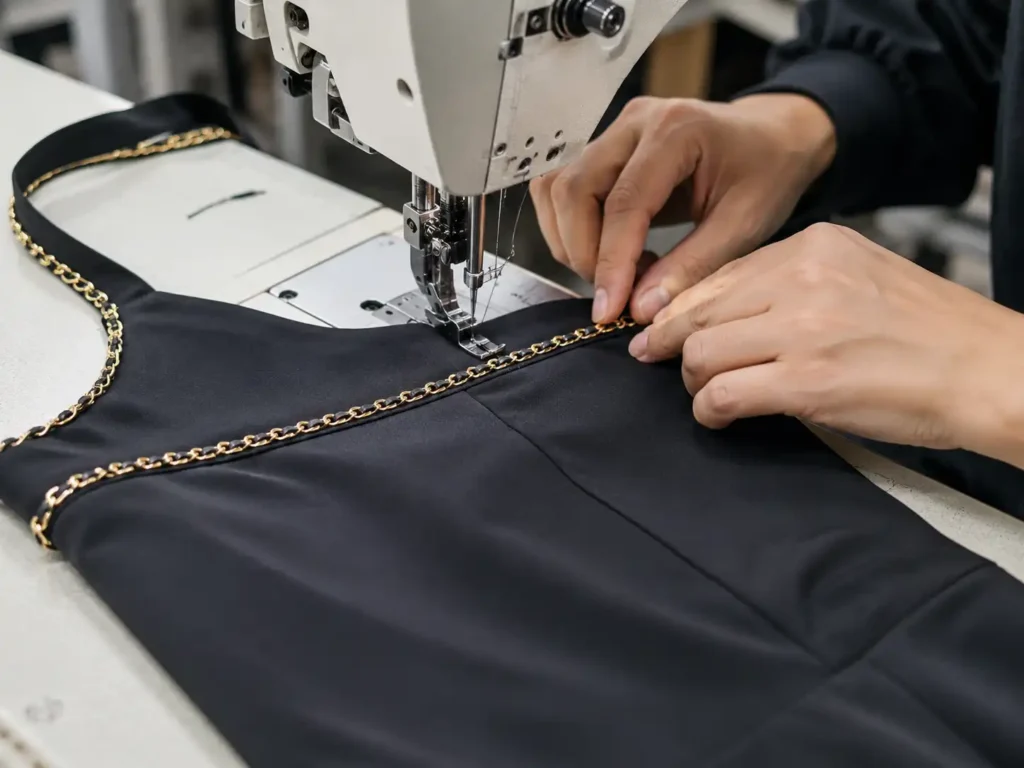
...

Custom Chain Detail Dress Manufacturer

Chain-integrated fashion dress development for brands requiring controlled hardware, accurate fit, refined workmanship and repeatable bulk production.

  • 5 hardware parameters locked before bulk: chain code, link size, finish, total length and attachment position.
  • 4 development checkpoints available for complex styles: first sample, revised sample, PP sample and first-piece verification.
  • 10 chain-specific inspection points cover specification, placement, strength, symmetry, surface condition, comfort and packing.
  • Complex dress production commonly requires 30–45 days after materials, PP basis and production requirements are confirmed.

Built for Dress-focused Fashion Brand Teams

Chain detail dresses require coordinated decisions across design, materials, fit, metal components and manufacturing. Duolan supports established fashion businesses with defined product direction, collection calendars, development files and production plans.

Fashion Dress Brands

For brands developing party, occasion, going-out, fitted and contemporary dress collections. Duolan helps translate a design direction into a controlled sample and a production-ready specification, with close attention to chain placement, garment balance, visual finish and repeat-order consistency.

Product Development Teams

For teams managing silhouettes, fit comments, materials, trims and seasonal deadlines. Development work can begin from a tech pack, sketch, reference image, original sample, chain concept or collection brief, followed by structured review and sample planning.

Buying Teams

For teams evaluating manufacturing accuracy, costing logic, material reliability, approval stages and delivery control. Duolan provides a clear path from initial feasibility review to PP confirmation, production release, inline checks, packing control and shipment preparation.

Sourcing Offices

For sourcing teams coordinating several styles, suppliers, deadlines and inspection requirements. Duolan can support multi-style programs through centralized project coordination, manufacturing path planning, material confirmation and recorded production standards.

A Chain Detail Is a Structural Decision

A metal chain may appear decorative, yet its weight, movement and attachment method can change the way a dress hangs, fits and performs. Successful development begins by treating hardware, fabric, pattern and reinforcement as one connected system.

Decorative Use Still Creates Load

A short chain applied at the neckline may weigh only a small amount, but the load is concentrated around limited attachment points. On satin, mesh, stretch jersey or lightweight woven fabric, concentrated weight can distort the neckline, pull a shoulder seam forward or create visible tension marks.

Duolan reviews the chain as part of the garment structure rather than as a final decoration. Evaluation normally considers:

  • Total chain weight and weight per attachment point
  • Fabric stretch, recovery, thickness and surface sensitivity
  • Distance between the attachment and the nearest seam
  • Whether the chain moves freely during walking or dressing
  • Whether a backing layer, woven tape or reinforcement patch is needed
  • Whether the chain should remain fixed, draped or detachable

A visual reference alone cannot define enough production information. A controlled specification should include chain length, link dimensions, finish, fixing method and placement measurements.

Structural Chains Need More Control

Some designs use a chain as a shoulder strap, cut-out connector, side opening link or back support element. In those constructions, the chain influences fit and wearing stability. A small length difference can change neckline depth, bust coverage, shoulder balance or cut-out opening.

Development therefore needs to answer several questions before sampling:

  • Does the chain carry real garment load?

  • Can the wearer move without opening or shifting the dress?

  • Is the chain comfortable against the shoulder or skin?

  • Will the connector remain closed during repeated movement?

  • Can every size preserve the intended visual proportion?

  • Can the chosen attachment method be repeated consistently in production?

Duolan uses sample review, fit correction, reinforcement planning and first-piece verification to reduce the risk of a good-looking sample becoming an unstable bulk style.

What Brand Teams Expect From Development

A strong chain detail program must deliver more than visual similarity. Each style needs to support wearing comfort, repeatable workmanship, accurate placement and a stable transition from approved sample to production.

Design Translation

Chain scale, placement and movement should match the intended fashion direction. Development must protect the original silhouette rather than allowing hardware weight to reshape the garment unintentionally.

Placement Accuracy

Chain start points, end points, drop depth and distance from seams need measurable references. Visual estimation alone creates variation between samples, sizes and production operators.

Secure Attachment

The connection must suit the fabric and expected load. Reinforced loops, fabric tabs, rings, hidden tape anchors or detachable hooks may require different backing and stitching methods.

Wearing Comfort

The chain should not create sharp contact, hair catching, skin pinching, shoulder pressure or excessive movement. Comfort review is especially important for chain straps and back details.

Bulk Consistency

Approved length, color, finish, placement and attachment construction must be transferred into BOM records, workmanship instructions, PP approval and inspection checkpoints.

Reorder Readiness

Pattern versions, chain references, connector codes, measurements, approved samples and QC notes should remain available for repeat production and color extensions.

Chain Detail Dress Styles We Develop

Duolan develops chain details across fitted, draped and structured dress categories. Every product direction requires a different relationship between chain weight, fabric behavior, garment construction and movement.

Chain Strap Dresses

Chain straps can create a jewelry-led finish for mini, midi and evening dresses, but the strap also affects shoulder comfort, neckline depth and bust stability. Development normally covers chain weight, strap length, connector security, shoulder contact and hidden support options. For heavier chains, a partial fabric strap, internal support tape or dual attachment construction may be needed. Chain-only shoulder structures require careful fit review because a few millimeters of length difference can change the front neckline and armhole position.

Chain Neckline Dresses

A chain can frame a halter neckline, cowl neckline, V-neck or straight neckline. The design may be fixed close to the garment edge or suspended as a decorative drape. Important controls include neckline stabilization, chain curve, distance between attachment points, symmetrical placement and movement during wear. Satin and fine knits need special attention because local chain weight may create visible pull lines or surface marks.

Chain Waist Dresses

Waist chains can define the body line, connect cut-outs or create a detachable belt effect. The design should follow the waist position without twisting the dress or restricting movement. Development decisions include chain circumference, side opening, fastening method, adjustability, contact with the zipper and compatibility with the waist seam. For bodycon products, stretch recovery must be considered before final chain length is approved.

Chain Cut-out Dresses

Chain-linked cut-outs often appear at the waist, bust, side body or back. The chain may visually connect separate garment panels while also influencing opening size and stability. Pattern measurements, attachment angles and chain drop need to be reviewed together. If the chain is too long, the opening loses definition. If too short, the fabric becomes distorted and fit pressure increases.

Chain Back Dresses

Back chains can run across an open back, between shoulder points or from neckline to waist. Hair contact, skin comfort, fastening access and sitting movement should be considered during development. Back details often require fitting on a body or dress form rather than flat measurement alone. Chain position should remain controlled across sizes without reducing movement or changing back coverage.

Chain Slit Dresses

A chain may connect a side slit, front slit or thigh opening. Walking movement creates changing tension, so the chain cannot be assessed only while the garment is standing still. Duolan reviews slit height, chain drop, walking allowance, reinforcement and fabric recovery. The inspection standard should include the chain appearance both at rest and during movement.

One-shoulder Chain Dresses

One-shoulder designs already have asymmetric load and balance. Adding chain details increases the importance of neckline control, shoulder position and side-seam balance. Development may include an internal stay, support tape or hidden elastic to reduce dependence on the chain alone. The chain should contribute to the visual design without causing the dress to rotate on the body.

Detachable Chain Dresses

Detachable details provide styling flexibility and can simplify care, but connectors need to be secure, easy to operate and protected from accidental opening. Approval should define connector type, orientation, opening direction, replacement policy, packing position and care instructions. Loose chains may need separate protective packing to prevent fabric damage during shipment.

Chain Placement Shapes the Dress Identity

Placement determines whether a chain reads as subtle jewelry, structural hardware or a dominant visual feature. Every position creates different load, fit and construction requirements.

Shoulder Placement

Shoulder chains may replace straps or sit over fabric straps. Key decisions include shoulder pressure, chain movement, neckline stability and attachment reinforcement.

Neckline Placement

Neckline chains can frame or suspend from the edge. Curve, symmetry and distance from the body need measurable control, especially on cowl and V-neck constructions.

Bust Placement

Bust-level chains influence the visual center of the dress and may affect coverage. Cup position, neckline opening, chain drop and skin contact should be reviewed together.

Waist Placement

Waist chains may highlight body shaping or connect cut-outs.

Stretch, waist seam stability and zipper interaction determine whether the chain remains level during wear.

Side Cut-out Placement

Side chains often connect front and back panels. Chain length affects opening width, side coverage and tension around the waist and hip.

Back Placement

Back chains can create open-back structure or decorative drape. Hair catching, fastening access and movement while sitting require special review.

Slit Placement

Slit chains respond to walking movement. Placement should avoid pulling the slit closed, widening it excessively or creating repeated stress at the fixing points.

Draped Placement

Draped chains can cross the body, hip or neckline. Each drop should be measured from fixed reference points so the intended curve can be repeated in every garment.

Selecting Chains and Hardware for Fashion Dresses

Chain selection affects visual quality, garment balance, cost, production repeatability and consumer experience. Duolan reviews the entire hardware assembly rather than selecting a chain by color alone.

Chain Specification and Visual Direction

A chain should fit the brand’s intended price position and design language. Large polished links create a different effect from fine curb chains, flat chains or jewelry-like links. Several specification points need to be confirmed before a sample can become a production standard:

  • Base material: The chain may use iron, aluminum alloy, zinc alloy, brass or another nominated material. Material choice influences weight, strength, finish and cost.
  • Link geometry: Link length, width, thickness and opening direction affect both appearance and snagging risk.
  • Unit weight: A visually similar chain may differ significantly in weight. Weight becomes critical on straps, mesh, satin and stretch fabrics.
  • Surface finish: Gold, silver, gunmetal, antique, matte or polished finishes require a physical reference whenever color sensitivity is high.
  • Edge quality: Link joints, cut surfaces and connector edges should be reviewed for burrs or sharp points.
  • Batch consistency: Production orders should use an approved chain reference and controlled finish standard.

Photography can make gold tones appear warmer or cooler than the actual component. Physical chain samples, trim boards or approved components provide a stronger production basis than screen images.

Connectors, Rings and Detachable Components

The chain rarely works alone. Jump rings, lobster clasps, hooks, D-rings, end caps, eyelets or custom connectors determine how the chain joins the garment.

Connector development should consider:

  • Opening resistance and accidental release risk
  • Orientation during wear
  • Color consistency with the main chain
  • Contact with skin or delicate fabric
  • Ability to withstand garment movement
  • Ease of assembly during production
  • Replacement or spare-component requirements
  • Packaging position and protection

For a detachable design, the connector should be operable without weakening security. For a permanent design, the connection may need to be closed, stitched, crimped or anchored through reinforced fabric.

Duolan evaluates the connection as part of the full garment construction, then records the approved chain and connector combination in the BOM and workmanship standard.

Matching Chain Weight With Fabric Behavior

A suitable chain must work with the fabric’s stretch, recovery, thickness, surface and drape. Chain selection and fabric selection should be reviewed together before final pattern and construction decisions.
Fabric DirectionMain Development RiskChain DirectionRecommended Control
Stretch JerseyNeckline growth, local distortion and uneven recoveryLightweight or medium-light chainStabilized attachment, fit test and recovery review
SatinPull marks, snagging, pressure marks and visible stitchingSmooth links with controlled weightHidden backing, protected edges and careful packing
MeshTearing, transparency and weak fixing pointsLightweight chain or distributed attachmentStructural panel, backing layer or reinforced tab
VelvetSurface crushing, friction marks and chain imprintSmooth finish with limited movementControlled placement and protective packing
Woven CrepeLocal tension and uneven drapeMedium-weight chainLoad distribution and placement measurement
Rib KnitStretch growth and shifting attachment pointsFlexible lightweight chainRecovery test and reinforced fixing
ChiffonTearing, seam pull and unstable drapeVery light decorative chainAttach through stronger internal structure
Ponte or ScubaBulk at attachment points and reduced flexibilityMedium-weight structured chainClean reinforcement and movement testing

Stretch and Recovery

Stretch fabrics can change chain position when worn. A chain approved on a flat sample may sit differently once the garment expands across the bust, waist or hip. Duolan reviews chain placement on the intended sample size and checks whether the fabric returns after wear.

Surface Sensitivity

Satin, velvet and fine mesh may be damaged by rough links, moving connectors or concentrated packing pressure. Chain edges, internal wrapping and garment folding therefore become part of the product standard.

Load Distribution

A delicate fabric should not carry heavy hardware through one small fixing point. Backing patches, woven tape, lining panels or fabric tabs can spread the load over a wider area while keeping the front appearance clean.

Engineering Secure Chain Attachment Points

A chain connection must remain visually clean from the outside while distributing load safely inside the garment. Attachment construction varies according to fabric, chain weight, placement and expected movement.

Reinforcement Begins Behind the Visible Detail

A neat front view can hide a poorly supported attachment. The internal construction should be planned before the fixing point is stitched or fitted.

Common reinforcement directions include:

  • Fusible support: Suitable where the shell fabric can accept heat and added body without visible marking.
  • Woven tape: Helps stabilize neckline edges, straps and cut-out openings.
  • Backing patch: Spreads local stress across a larger fabric area.
  • Lining integration: Allows the chain load to connect with an internal structure rather than the shell fabric alone.
  • Fabric tab: Creates a controlled connection between metal hardware and delicate fabric.
  • Seam anchoring: Transfers load into a stable seam instead of relying on a single surface stitch.

The reinforcement should not create a hard bump, visible square, puckering or discomfort. Material thickness, color and edge finishing therefore matter.

Attachment Geometry Controls Stability

Strength is not determined only by stitch count. The direction of load, distance from the seam and angle of the connector all influence performance.

A shoulder chain pulls mostly downward. A cut-out chain may pull horizontally. A draped hip chain may swing and twist. Duolan reviews each direction separately and sets measurable references for:

  • Attachment point location
  • Distance from seam or edge
  • Tab width and finished length
  • Chain orientation
  • Ring direction
  • Stitching area
  • Reinforcement dimensions
  • Left-right symmetry

For high-risk styles, a first-piece or pilot-stage review confirms whether the approved construction can be repeated by the production line without changing the visual finish.

Chain Attachment Methods for Dress Construction

Different chains and fabrics require different methods. Duolan selects the attachment structure according to load direction, garment thickness, visual finish, maintenance and production repeatability.

Reinforced Fabric Loop

A narrow fabric loop provides a softer transition between the chain and garment. The loop can be anchored into a seam or reinforced internally. Suitable for delicate shells, detachable chains and designs requiring reduced metal-to-skin contact.

Hidden Tape Anchor

A woven tape or stable internal strip carries the chain load behind the visible fabric. Suitable for necklines, shoulders and cut-outs where the outer material needs protection from concentrated stress.

Metal Ring Connection

A D-ring, O-ring or custom ring can create a clear hardware-led appearance. Ring size, orientation, surface finish and fabric support must be confirmed to avoid twisting or local distortion.

Fabric Tab Connection

A shaped tab can connect a chain to the bodice, waist or slit. Tab width, turn-back construction, reinforcement and edge finish determine strength and visual refinement.

Detachable Hook System

Hooks or clasps allow the chain to be removed for styling or care. Opening resistance, direction, spare parts and packing position should be defined before production.

Multi-point Draped Chain

Longer chains may use two, three or more fixing points to control curve and reduce movement. Every point requires measured placement and balanced tension to keep the intended drape.

Controlling Comfort and Product Safety Risks

Metal details interact with skin, hair, fabric and movement. Comfort and safety review should be integrated into development, fit evaluation, quality checks and care communication.

Sharp Edge Control

Chain joints, cut ends, rings and clasps should be checked for burrs, open gaps and rough surfaces. A visually polished chain can still contain a sharp internal joint.

Skin Contact Review

Shoulder, neckline, waist and back chains may touch skin for extended periods. Weight distribution, edge smoothness and connector position affect comfort.

Hair Catching Risk

Back and shoulder chains can catch long hair when link openings are wide or joint gaps are exposed. Link style and chain position should be reviewed on-body.

Fabric Snagging Risk

Mesh, chiffon, lace, satin and loose yarn structures are vulnerable to snagging.
Chain edges, movement range and packing contact need control.

Movement Stability

Walking, sitting, arm movement and dressing can change chain tension.
Fit review should include movement rather than static appearance alone.

Surface and Care Risk

Plated finishes may react differently to moisture, friction and cleaning. Care labeling and removable-hardware instructions should follow the confirmed component and target-market requirements.

Reviewing Feasibility Before Chain Dress Sampling

A sample should begin with clear development decisions. Duolan reviews the design basis, hardware direction, fabric behavior, construction risk and future production path before confirming the sample plan.

What Your Team Can Provide

Development can begin from one or several sources:

  • Tech pack
  • Design sketch
  • Reference image
  • Original sample photographs
  • Existing garment
  • Chain or connector sample
  • Fabric swatch or composition direction
  • Size chart
  • Fit comments
  • Collection mood
  • Target quantity
  • Launch timing

A complete tech pack supports faster evaluation, but a well-organized reference package can also provide a useful starting point.

What Duolan Reviews

The review focuses on decisions that may affect sample accuracy or production stability:

  • Whether chain weight suits the selected fabric
  • Whether the attachment carries structural load
  • Whether the neckline, cut-out or slit needs pattern adjustment
  • Whether reinforcement will remain invisible
  • Whether the chain finish can be sourced consistently
  • Whether the design creates snagging or skin-contact risk
  • Whether the style requires a special PP or pilot-stage check
  • Whether the target production timing allows chain approval and material preparation

After review, the team can define the recommended sample purpose, material confirmation path and areas requiring early approval.

From Design Reference to Chain Dress Sample

A controlled sample path separates design evaluation, fit correction, hardware approval and production readiness. Each stage should answer a defined set of questions.

Brief Review

The team identifies the intended silhouette, chain function, target market, sample purpose, target quantity and launch schedule. Missing information is organized before pattern work begins.

Material Review

Fabric, lining, chain, connectors and reinforcement directions are compared. Physical components may be requested when finish, weight or feel cannot be judged reliably from images.

Pattern Development

The pattern is built around garment fit and chain placement. Neckline, shoulder, cut-out, waist, slit or back openings are measured using stable reference points.

First Sample

The first version tests silhouette, proportion, chain position and construction logic. It is evaluated as a development tool rather than treated as the final production basis.

Revision Sample

Fit comments, chain length, attachment method, reinforcement and visual balance are translated into controlled pattern, BOM and workmanship changes.

Production-ready Sample

The approved direction is prepared for PP or bulk readiness review. Chain code, finish, length, fixing method and critical measurements should be locked before release.

Locking Chains and Materials Before Bulk

Chain detail production becomes more predictable when every material and construction decision is recorded. Duolan uses approved references, BOM control and sample standards to reduce substitutions and interpretation gaps.

Chain and Connector Records

The material record should include more than “gold chain.” A production-ready reference may include:
  • Supplier or nominated source
  • Chain code
  • Base material
  • Link dimensions
  • Unit or total weight
  • Finish and approved color reference
  • Total length per garment
  • Number of chain sections
  • Connector code
  • Ring size
  • Detachable or permanent construction
  • Approved physical sample location
Any replacement should be evaluated for weight, color, movement, edge condition and compatibility with the existing construction.
4Trim Reuse Across Styles (1)

Garment Material and Construction Records

The chain must remain connected to the wider product specification:
  • Main fabric
  • Lining
  • Interlining or reinforcement
  • Tape or backing material
  • Thread
  • Zipper
  • Elastic or internal support
  • Labels
  • Care instructions
  • Protective packing materials
A trim board or sealed component reference allows the development team, production line and inspection team to work from the same physical standard. The BOM, approved sample and workmanship instructions should support one another rather than existing as separate documents.

Turning Comments Into Controlled Sample Revisions

Sample comments create value only when they are translated into measurable technical actions. Duolan organizes feedback by fit, hardware, material, construction and visual priority.

Fit and Measurement Comments

Comments such as “the neckline feels low” or “the side opening is too wide” are converted into pattern or measurement actions. The revision record identifies the affected points, required change and any impact on chain length.

Chain Position and Length

A request to raise, lower or tighten a chain is linked to specific reference measurements. Revised chain length and attachment coordinates should be updated together to avoid solving one point while creating another issue.

Material and Finish Comments

A chain that feels too heavy, bright, yellow or rigid may require a different specification. Changes should be reviewed for cost, availability, lead time and attachment compatibility before replacement.

Attachment Construction

If the first sample puckers, twists or feels unstable, the solution may involve reinforcement, tab direction, seam anchoring or ring orientation rather than simply adding more stitches.

Visual Preference

Some changes concern styling rather than fit. The revision summary should separate visual requests from technical corrections so approval remains clear.

Production Risk

A construction may look acceptable on one sample but remain difficult to repeat. Production feasibility comments should be resolved before PP approval or full release.

Converting Approved Samples Into Bulk Standards

Sample approval must be converted into documents, physical references and control points understood by material, production and quality teams.

Production Readiness Review

Before full production starts, Duolan reviews:

  • Sample approval status
  • Main fabric and lining
  • Chain and connector approval
  • Color and finish
  • Placement measurements
  • Chain length and drop
  • Reinforcement
  • Sewing and attachment method
  • Size specification
  • Labels and packaging
  • Required inspection points
  • Target completion and shipment timing

The review identifies details ready for production and any points still requiring confirmation.

Bulk Standard Package

A strong production basis combines several references:

  • Approved or PP sample
  • BOM
  • Measurement specification
  • Size grading
  • Chain placement map
  • Workmanship instructions
  • Hardware reference
  • Packing requirements
  • QC checklist
  • Approval records

Production cannot depend on a single garment alone. The physical sample shows the result, while supporting documents explain how the result should be repeated across sizes, colors, lines and reorder cycles.

Controlled Production From Inspection to Packing

Chain detail production requires clear handover between materials, cutting, sewing, hardware attachment, quality inspection and packing. Each stage should preserve the approved sample standard.

Chain Inspection

Incoming chains and connectors are checked against the approved reference for type, dimensions, finish, color, length and visible defects before line release.

Fabric Inspection

Fabric condition, shade, width, stretch, surface and defects are reviewed. Sensitive surfaces require protection from rough hardware during handling.

Cutting and Numbering

Panels are cut and organized to support shade consistency and size control. Attachment reference marks are transferred accurately where required.

Reinforcement Preparation

Backing patches, tapes, tabs or lining supports are prepared before assembly. Shape and dimensions should follow the approved construction.

Sewing and Assembly

The garment is assembled with attention to fit, seam balance, neckline stability, cut-out shape and zipper interaction before chain installation.

Chain Attachment

Approved chains are installed using measured positions and defined methods. Orientation, connector closure and chain drop are checked during the operation.

Inline Inspection

Production checks focus on placement, strength, fabric distortion, symmetry, surface condition and workmanship before defects move further through the line.

Final Packing

Chains are protected, secured or wrapped according to fabric sensitivity. Labels, accessories, folding, polybags, cartons and shipping marks are checked before release.

Quality Checks for Chain Detail Dress Production

Chain-specific inspection points should be added to normal garment measurement, workmanship, labeling and packing checks. A generic final inspection cannot fully control hardware-related risks.
QC PointWhat Is CheckedRisk Controlled
Chain SpecificationLink type, dimensions, finish and approved codeWrong component
Chain LengthTotal length and section lengthIncorrect drop or fit
PlacementDistance from defined garment referencesVisual inconsistency
AttachmentStitching, tabs, rings, hooks and reinforcementDetachment or distortion
SymmetryLeft-right position and matching curvesUneven appearance
Edge ConditionBurrs, open links and sharp pointsSkin or fabric damage
Surface FinishColor, plating consistency and visible defectsBatch variation
Movement CheckChain behavior while walking, sitting and stretchingFit instability
Fabric ContactSnagging, pull marks and pressure pointsGarment damage
Packing ProtectionWrapping, securing and garment separationTransit damage

Measurement Plus Visual Control

Chain placement often needs both numerical tolerances and visual comparison. A chain can measure correctly yet still hang unevenly if attachment angles differ. Inspectors should compare measurement, symmetry and drape against the approved reference.

Recorded Inspection Basis

Inspection criteria should be linked to the approved sample, workmanship sheet and chain specification. Repeat orders can then use the same control points while reviewing any material batch or finish changes.

Keeping Chain Placement Consistent Across Sizes

Size grading affects chain position, garment tension and visual proportion. Duolan defines which measurements stay fixed, which grow and which require separate size-specific values.

Start Point Control

The start point is measured from a stable reference such as shoulder point, center front, neckline seam, waistline or side seam.

End Point Control

End points should follow the intended construction and remain balanced with the opposite side or connecting panel.

Chain Length Control

Length may remain fixed or change by size depending on whether the chain is decorative, structural or movement-related.

Drop Depth Control

Draped chains need a defined vertical drop so the curve remains consistent across production and sizes.

Opening Control

Cut-out and slit chains are linked to opening dimensions. Chain length cannot be approved without checking the garment opening.

Reorder Control

Approved grading rules, chain values and pattern versions are preserved so future orders do not restart from estimation.

Protecting Metal Details During Packing and Shipping

Packing must prevent chains from marking, snagging, crushing or staining the garment. Protection methods vary with chain weight, fabric sensitivity, folding and shipment duration.

Chain Isolation and Securing

A loose chain can move repeatedly during transport and damage satin, velvet, chiffon, mesh or embellishment.

Depending on the design, the chain may be:

  • Wrapped in tissue or a protective sleeve
  • Fixed temporarily to a controlled position
  • Placed inside a separate small bag
  • Detached and packed with installation instructions
  • Protected from zipper teeth and other metal parts
  • Separated from adjacent garments

Folding and Carton Pressure

Heavy chain sections should not sit directly under high carton pressure. Folding direction should avoid placing metal hardware against visible garment areas.Packing review may consider:

  • Chain position inside the fold
  • Shoulder and neckline support
  • Tissue placement
  • Polybag size
  • Garment quantity per carton
  • Carton compression
  • Hanging or flat-pack requirements
  • Reopening appearance
  • Label and accessory accuracy

Express delivery commonly takes 3–7 days, air shipment 5–8 days and sea shipment approximately 20–35 days, subject to destination, route, customs and logistics arrangements.

A Manufacturing System for Dress Programs

Duolan combines dress development, sample coordination, material resources, production planning, quality control and delivery support for multi-style fashion programs.

16 Owned Factories

Core factories support controlled development, key styles, complex workmanship and stable production standards.

20+ Satellite Factories

Long-term manufacturing partners provide production flexibility for repeat orders, capacity peaks and differentiated production paths.

12,000+ Supporting Workers

A coordinated workforce supports multi-style projects, parallel production and large seasonal programs across several manufacturing bases.

300 Sewing Lines

Production lines can be matched according to garment complexity, construction, quantity, schedule and quality requirements.

50+ Flexible Lines

Flexible lines support testing, priority styles, replenishment and production programs requiring faster internal response.

SMETA 2-Pillar Audit

The manufacturing system maintains a social audit foundation suitable for formal supplier evaluation and brand compliance coordination.

Duolan’s wider capability is built on more than 30 years of fashion dress development experience, with product focus across party, occasion, fitted, vacation, going-out and detail-driven dresses.

Chain Detail Dress Development Case Studies

The following anonymized programs show how chain design, fabric behavior, pattern engineering and production control can be managed across multi-style brand orders.

Chain Strap Bodycon Program

Market: United States

Program: 18 styles

Total order: 42,600 pieces

Main products: Chain strap minis, fitted midi dresses and asymmetric party dresses

The collection used stretch jersey, double-layer mesh and structured knit fabrics with gold and gunmetal chain directions. Early samples revealed three issues: heavy chains lowered the front neckline, attachment points created local stretch distortion, and shoulder pressure varied between styles.

Duolan separated the collection into lightweight decorative chains, medium-weight supported chains and structural shoulder chains. Internal support tapes were introduced for selected bodices, chain lengths were reviewed on-body, and attachment positions were transferred into measurable references.

A first-piece check was added for seven higher-risk styles. Chain length, neckline depth and shoulder balance were reviewed together before production release. Packing instructions also isolated chain sections from mesh and smooth knit surfaces.

Result: The 18-style program entered production with separate chain standards, fit rules and attachment constructions suited to each product group. The preserved BOM and placement records supported later color extensions.

Chain Cut-out Party Collection

Market: United Kingdom

Program: 12 styles

Total order: 28,800 pieces

Main products: Side cut-out minis, chain-linked waist dresses and slit-detail midi dresses

The first development round showed inconsistent cut-out openings because the chain length had been selected from visual references rather than linked to pattern measurements. Several styles also changed shape when the wearer moved.

Duolan defined fixed measurement points for each chain start and end position. Cut-out width, chain length and fabric stretch were reviewed as one system. Reinforced fabric tabs replaced direct chain attachment on sensitive areas, while selected slit styles received multi-point fixing to control chain movement.

The production standard included chain code, total length, attachment map, tab construction, size rule and movement check. A PP review confirmed the visual curve and opening balance before full release.

Result: The collection maintained more consistent cut-out proportions across sizes and reduced visual variation between sewing lines.

Chain Cut-out Party Collection (1)

Multi-style Hardware Collection

Market: Europe and North America

Program: 24 styles

Total order: 63,200 pieces

Main products: Chain neckline, waist-chain, detachable-chain and back-detail dresses

The collection used several chain scales and three metal finishes across satin, ponte, crepe and velvet. Major risks included finish variation, material confusion between styles and pressure marks during packing.

Duolan created style-specific trim boards and grouped the order by chain family, fabric sensitivity and attachment complexity. Gold, silver and gunmetal references were approved physically. Chain and connector records were linked to the BOM, while velvet and satin styles received separate packing methods.

Production paths were assigned according to construction risk. Eight complex styles used first-piece confirmation, and inline inspection focused on placement, symmetry, edge condition and fabric contact.

Result: The 24-style program moved through production with clearer material control, fewer trim interpretation gaps and stronger repeat-order records for future seasonal development.

Frequently Asked Questions About Chain Detail Dresses

Yes. A reference image can support initial review when paired with available information such as target fabric, chain direction, sample size, quantity and launch timing. A tech pack, original sample or detailed sketch helps define measurements and construction more accurately.
Yes. Brand-nominated chains can be evaluated for weight, finish, dimensions, edge condition, availability and compatibility with the proposed attachment structure. Physical samples are recommended before final approval.
Color matching can be reviewed against an approved physical component, plating reference or nominated trim. Screen images alone are not reliable enough for sensitive gold, silver or gunmetal tones.
The method depends on chain function and fabric. Review may include reinforcement inspection, manual pulling, movement checks, first-piece confirmation and any additional testing required by the brand or target market.
Yes. Detachable constructions can use hooks, clasps, rings or custom connectors. Approval should cover security, ease of use, spare components, care instructions and packing protection.
Simple styles commonly require 15–20 days, regular styles 20–30 days and complex styles 30–45 days after materials, approvals and production requirements are ready. Chain availability and custom hardware can affect timing.
It may remain fixed, change proportionally or follow a functional size rule. The correct method depends on whether the chain is decorative, structural or connected to a cut-out, neckline or slit.
Chain edges, link gaps, movement range and contact with delicate fabric are reviewed. Smooth components, controlled placement, backing and protective packing may be used according to the design.
Approved chain references, BOM records, placement measurements, PP samples, first-piece checks and chain-specific QC points provide the production basis.
Send a tech pack, sketch, reference image, sample photos, chain direction, fabric idea, size chart, target quantity, launch date and any fit or quality priorities available.

Start Your Chain Detail Dress Development Project

Send Duolan a clear development basis so our team can review chain selection, fabric compatibility, fit, reinforcement, sample path and production feasibility. Useful files include tech packs, reference images, sketches, original sample photographs, size charts, chain samples, trim references, fabric directions and previous fit comments.

For a production review, also include the number of styles, quantity by style, color and size plan, target market, launch timing, packaging requirements and current approval stage. Our team will organize the information, identify major technical risks and confirm the most suitable next step for sample development, PP review, bulk quotation or production planning.

Duolan supports fashion dress programs requiring controlled product development, multi-style coordination, sample-to-bulk continuity and repeat production records.


Start Your Apparel Development Project

OEM/ODM Manufacturing Support for Fashion Brands

Share your collection details, estimated quantities, target market, development timeline, and technical requirements. The production team will review your request and provide a tailored manufacturing solution based on your product category, fabric selection, construction needs, and delivery schedule.

Fashion Manufacturing Support with Scalable Production Capacity

From sample development to bulk production, Duolan supports fashion brands with confidential OEM/ODM manufacturing, stable quality management, flexible production planning, and coordinated multi-factory execution for seasonal and capsule collections.

Need Direct Assistance?

Seraphinite AcceleratorOptimized by Seraphinite Accelerator
Turns on site high speed to be attractive for people and search engines.