 Skip to content
How to Develop Cocktail Dresses from Concept to Bulk Production
Your trusted Women’s Apparel Development & Manufacturing Partner from China
- Jerry

A cocktail dress can look effortless on a product page while being surprisingly difficult to develop. A clean satin mini may require more technical control than a visually complex casual dress because every wrinkle, seam, balance problem and lining edge remains visible. A fitted mesh style can photograph beautifully on one model yet fail commercially when support, stretch recovery or grading is not properly engineered.
To develop a cocktail dress successfully, define the customer, occasion, silhouette and target price first. Then match the design with suitable fabrics, create a complete tech pack, engineer the pattern, fit and revise samples, approve materials and workmanship, and verify a pre-production sample before bulk manufacturing. Each decision must protect both the intended appearance and production repeatability.
The key is to stop treating product development as a sequence of isolated tasks. Fabric affects pattern shape. Pattern shape affects fit. Fit affects construction. Construction affects cost, lead time and quality risk. A change that appears minor on a sketch – such as lowering a back neckline or adding dense embellishment – can alter support, sewing sequence, lining structure and packaging.
Many failed cocktail-dress projects begin with a striking reference image and a rushed instruction: “Make something similar.” Successful projects begin with a more useful question: “What must be true for this design to look right on the customer, remain wearable and be reproduced consistently in every unit?”
What Defines a Cocktail Dress?
A cocktail dress is a polished semi-formal dress designed for social events where the wearer needs more refinement than everyday clothing but less ceremony than black-tie eveningwear. Its identity comes from the combined effect of occasion, silhouette, length, fabric, fit and construction. No single hemline, neckline or decorative feature defines the category on its own.
Occasion and Formality
The first question is not whether the dress is mini or midi. It is where the customer will wear it and how formal that environment will be. Cocktail dresses commonly serve wedding receptions, engagement parties, company events, graduation dinners, holiday celebrations, birthday dinners and evening social functions.
A dress for a corporate reception needs controlled exposure, reliable movement and enough comfort for several hours of standing and sitting. A dress for a holiday party may allow a stronger shine, shorter hem or more visible embellishment. A wedding-guest cocktail dress usually needs an elegant silhouette that photographs well without appearing bridal or overly ceremonial.
The category therefore sits between casual partywear and formal eveningwear. It should look intentional in a social setting, but it should not require the structure, train, volume or dressing assistance often associated with a full evening gown.
The product brief should define:
- Primary occasion
- Day or evening use
- Expected dress code
- Climate and season
- Typical wearing duration
- Required movement
- Acceptable exposure
- Target retail position
When these points remain vague, development decisions become subjective. One person may imagine a refined dinner dress, while another imagines a club-focused mini. The result is often a sample that is technically acceptable but commercially misplaced.
Category | Typical Use | Common Lengths | Usual Construction Level | Main Development Priority |
Casual dress | Daily wear, travel, daytime activity | Mini to maxi | Light to moderate | Comfort and easy care |
Party dress | Birthdays, clubs, celebrations | Mini to midi | Moderate | Visual impact |
Cocktail dress | Receptions, dinners, semi-formal events | Mini, knee, midi | Moderate to structured | Balance of polish and wearability |
Evening dress | Galas, formal ceremonies, black-tie events | Midi to floor length | Structured to highly detailed | Formal presence and finish |
Length and Proportion
Cocktail dresses are not restricted to one length. Mini, knee-length and midi styles can all work when the overall proportion fits the occasion and customer.
Mini cocktail dresses are common in fashion-led and younger markets. They suit bodycon, corset, halter, asymmetric and embellished designs. Their development risks include insufficient coverage, riding up, lining exposure and hem distortion after grading.
Knee-length styles often feel more traditional and can work well for work-related events, mature customers and semi-formal daytime occasions. The exact hem position matters. A length that ends at the widest point of the knee can shorten the appearance of the leg, while a small adjustment may improve the silhouette noticeably.
Midi dresses often communicate greater refinement and suit draped, fitted, column, slip and softly flared designs. Their technical risks include restricted walking, poorly placed slits, lining drag and unflattering calf placement.
Length should be checked on a fit model wearing the footwear expected for the final styling. Flat measurements alone cannot confirm whether the hem looks balanced on the body.
For graded sizes, the team should decide whether length increases evenly, remains fixed or follows a more selective grade rule. Automatic length increases can make larger sizes unexpectedly long, while a completely fixed length may reduce coverage for some customers.
Silhouette and Fit
A cocktail dress should create a clear silhouette without looking accidental or unfinished. Common directions include fitted column dresses, bodycon minis, corset shapes, draped midis, one-shoulder dresses, halter styles, fit-and-flare shapes and asymmetric designs.
The most important issue is not whether a silhouette is fashionable. It is whether the fabric, internal support and pattern can produce that silhouette consistently.
A corset-inspired dress needs coordinated control of the bust, under-bust, waist, neckline and closure. A bodycon dress needs reliable stretch recovery and carefully distributed negative ease. A draped satin dress needs stable anchoring points and control of bias movement. A backless dress needs another source of support because the back panel can no longer provide it.
The dress should be reviewed from the front, side and back. Many fit problems remain hidden in front-view product photography. Side-view checks reveal bust projection, waist position, seat balance and hem tilt. Back-view checks reveal strap spacing, zip distortion, excess fabric and uneven tension.
A strong silhouette usually depends on several small decisions working together rather than one dramatic construction feature.
Fabric and Visual Language
Fabric often determines whether a dress reads as cocktailwear, casualwear or eveningwear. Satin, crepe, velvet, mesh, lace, stretch woven fabrics, sequined textiles and selected jerseys can all support the category, but they communicate different levels of formality.
A simple black midi in a dense stretch crepe can look polished because the surface is controlled and the silhouette is clean. The same pattern in a thin casual jersey may lose its occasion identity. A sequin mini can look sophisticated or inexpensive depending on sequin density, lining, edge finish, motif direction and fit.
The fabric must support the intended visual language:
- Soft drape for fluid elegance
- Firm stretch for sculpted fit
- Controlled shine for evening impact
- Texture for seasonal depth
- Transparency for layered or illusion effects
- Surface embellishment for statement products
The best material is not necessarily the most expensive one. It is the material that produces the right silhouette, survives the manufacturing process and remains commercially viable in bulk.
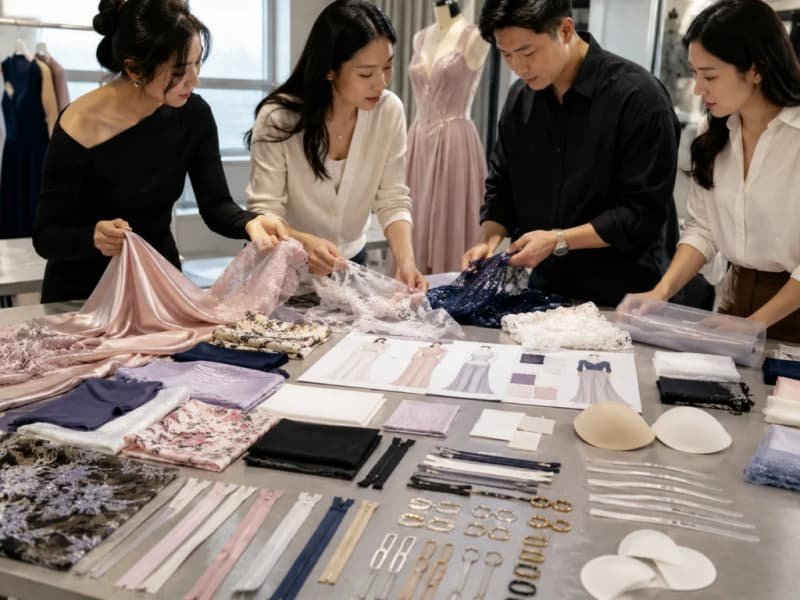
How Do You Choose Fabrics and Trims?
Fabrics and trims should be selected according to silhouette, drape, support, stretch, recovery, opacity, skin feel, care, sewing behaviour and bulk consistency. A material is suitable only when it delivers the intended appearance and remains stable through cutting, sewing, pressing, wearing, cleaning and repeat production.
Fabric Performance
Fabric names alone are not enough. Two satins with similar fibre content can behave very differently because of yarn type, weave, weight, finish and stretch.
The team should evaluate:
- Weight in grams per square metre
- Usable width
- Stretch in warp and weft directions
- Recovery after extension
- Drape and surface movement
- Opacity under tension
- Shrinkage or relaxation
- Snagging and abrasion risk
- Pressing response
- Shade consistency
- Skin feel
The following ranges are common starting references rather than fixed rules. Actual suitability must be confirmed through swatches, wash tests and samples.
Material | Common Working Weight | Typical Use | Critical Check |
Lightweight satin | 90-140 gsm | Slip and draped dresses | Seam puckering and opacity |
Midweight satin | 140-220 gsm | Structured and corset styles | Bulk at seams and pressing marks |
Stretch crepe | 180-280 gsm | Fitted and column dresses | Recovery and surface bagging |
Power mesh | 120-220 gsm | Internal support and shaping | Stretch direction and comfort |
Fashion mesh | 50-120 gsm | Overlays and illusion sections | Transparency and seam strength |
Velvet | 180-320 gsm | Cold-season cocktail dresses | Nap direction and pressure marks |
Sequin fabric | Varies widely | Statement styles | Finished weight and skin contact |
The supplier should provide production-representative material for the final fit sample. Early prototypes can use substitutes, but final approval should not rely on a fabric with different stretch or drape.
Lining and Support
Lining influences opacity, comfort, support and movement. It should be selected as carefully as the outer fabric.
A stretch bodycon dress usually needs a lining with compatible stretch and recovery. A non-stretch lining inside a high-stretch shell can restrict movement and create pulling. A soft lining inside a structured corset bodice may fail to support cups and boning.
Important checks include:
- Does the lining alter the outer colour?
- Does it remain hidden while walking?
- Does it ride upward?
- Does it cling to hosiery or skin?
- Does it stretch at the same rate as the shell?
- Does it make the dress too warm?
- Is it opaque under flash photography?
- Does it create visible seam impressions?
Support components should be purposeful. Cups provide shape and coverage, but their width, projection and spacing must suit the intended fit. Boning stabilises specific areas, but incorrect placement can create pressure points. Power mesh distributes support, but excessive tension may distort the neckline or side seams.
A support package should be reviewed as one system. Cups, boning, lining, elastic and closure strength must work together.
Trims and Closures
Trims should match the garment’s tension, weight and wearing conditions. A trim that looks suitable on a sample card may fail after repeated opening, movement or cleaning.
For zippers, define:
- Zip type
- Tape width
- Length
- Colour
- Slider finish
- Top stop position
- Bottom stop position
- Reinforcement method
- Hook-and-eye requirement
Invisible zippers are common but can be unsuitable for very heavy or highly tensioned garments. A fitted dress with strong horizontal tension may need reinforcement or a different closure system. Corset-inspired dresses may use exposed zips, hooks, lacing or mixed closures.
Elastic should be specified by width, stretch ratio and recovery. Clear elastic can stabilise necklines and armholes, but it may become uncomfortable if too tight or poorly enclosed.
Boning should be selected by rigidity and finished edge. Metal, plastic and spiral types behave differently. The choice depends on curve, support level, cost and construction method.
Trims should be tested after pressing and washing or cleaning where applicable.
Embellishment Control
Sequins, stones, beads, pearls and embroidery affect more than appearance. They change garment weight, flexibility, sewing sequence, packing and quality risk.
Before approval, define:
- Motif size
- Repeat and direction
- Placement coordinates
- Density
- Edge clearance
- Seam allowance treatment
- Replacement method
- Colour tolerance
- Finished garment weight
- Skin-contact areas
Embellishment should not extend blindly into seam allowances. Bulk at seams can cause broken needles, weak stitching and uneven joining. Clear edge zones are often needed around zippers, darts, side seams and hems.
Weight should be assessed on a complete garment, not only on a small panel. Dense embellishment can pull down a neckline, stretch straps or change the skirt hang. A dress that appears balanced on the table may shift after twenty minutes on the body.
Wear testing should check scratching, noise, catching and pressure. Packing tests should confirm that stones or sequins do not mark adjacent surfaces.
Which Cocktail Dress Direction Should You Develop?
The right cocktail-dress direction comes from the intersection of customer needs, occasion, brand identity, sales history, market timing and production feasibility. A commercially strong design should feel distinctive enough to attract attention, familiar enough to understand quickly and realistic enough to manufacture at the required cost, quality and delivery schedule.
Customer and Use Case
Development becomes more accurate when the customer is defined by behaviour rather than age alone. Two women in the same age group may have completely different expectations for support, length, styling and price.
A useful customer profile should answer:
- Where does she wear the dress?
- How long does she wear it?
- Does she need bra compatibility?
- Does she prefer shaping or relaxed movement?
- Which areas does she want to emphasise?
- Which areas does she expect to cover?
- What type of outerwear or footwear will she use?
- What price does she consider acceptable?
- What causes her to return fitted dresses?
Customer reviews can reveal more than trend reports. Repeated comments such as “the straps were too long,” “the lining rode up,” “the bust had no support” or “the fabric looked cheaper than the photos” identify practical development failures.
The primary occasion should also be narrow enough to guide decisions. “Partywear” is often too broad. “Winter cocktail dress for evening receptions” gives clearer direction for sleeve coverage, fabric weight, shine, comfort and styling.
The development team should describe the wearer and occasion in a few precise sentences before selecting silhouette or fabric.
Collection Balance
A cocktail collection needs range, but range does not mean random variety. The products should share a recognisable design language while serving different customer needs and commercial roles.
A balanced range may include:
- One or two high-impact image styles
- Several dependable commercial shapes
- A mix of mini and midi lengths
- Both fitted and less restrictive options
- Clean-surface and embellished products
- Different neckline and bra-compatibility levels
- Colour options with clear seasonal logic
Ten dresses with different colours but the same bodycon silhouette do not create a strong collection. At the same time, ten unrelated concepts can weaken brand recognition and complicate production.
A practical collection structure may assign each design a role:
Product Role | Approximate Share of a 12-Style Capsule | Purpose | Typical Risk Level |
Core commercial styles | 5-6 styles | Reliable sales and repeat potential | Low to moderate |
Trend-led styles | 3-4 styles | Seasonal relevance and newness | Moderate |
Image styles | 1-2 styles | Campaign, social and brand impact | High |
Entry-price styles | 1-2 styles | Accessible price point and volume | Low to moderate |
These numbers are not fixed rules. They are a useful starting point for teams that need to balance creativity, cost and repeatability.
Trend and Brand Identity
Trends should be filtered through the brand rather than copied directly. The same trend can be translated in several ways.
For example, sheer dressing could become:
- Illusion mesh panels in a fitted mini
- Sheer sleeves over a fully lined bodice
- Layered mesh in a draped midi
- Tonal embroidery over transparent sections
- A controlled sheer back with front coverage
Each version responds to the same market direction but serves a different customer and price point.
Before approving a trend, ask four questions:
- Does it fit the brand’s existing visual language?
- Does it solve a real customer desire?
- Can it be manufactured consistently?
- Will it still feel relevant at launch?
The timing question matters. A trend seen online today may not reach stores for several months, especially when custom fabric, embellishment or multiple sampling rounds are involved.
Trend density should also be controlled. A dress combining extreme cut-outs, corsetry, asymmetry, ruching and heavy embellishment may look exciting in a sketch but become difficult to fit, expensive to produce and visually confusing.
A useful rule is to choose one lead feature, one supporting feature and one commercial foundation.
Price and Feasibility
The target retail price should be discussed before detailed sampling. Otherwise, the design may be developed beautifully and then stripped back under cost pressure.
The main cost drivers in cocktail dresses usually include:
- Main fabric and lining consumption
- Fabric usable width
- Pattern efficiency
- Number of panels
- Sewing operation count
- Cups, boning and internal support
- Embellishment density
- Special cutting requirements
- Custom dyeing or colour development
- Testing and packaging
- Order quantity and colour split
A high-impact feature should justify its cost through visible customer value. If the key selling point is a sculpted corset bodice, reducing internal structure may damage the product more than simplifying an invisible finishing operation. If the key selling point is luxury satin drape, replacing the fabric with a flatter low-cost option may remove the reason customers noticed the dress.
Feasibility also includes production consistency. A handmade detail may be attractive on one sample but unsuitable for a multi-style, multi-colour order with a tight launch calendar.
Good development protects the core visual effect while simplifying areas the customer is unlikely to notice.

How Are Tech Packs and Patterns Built?
A cocktail-dress tech pack should translate the design into measurable, testable instructions, while the pattern should convert those instructions into a three-dimensional garment suited to the approved fabric. The two must stay connected: every fit correction should update the pattern, measurement chart, construction notes and revision history.
Tech Pack Essentials
A useful tech pack gives design, pattern, sourcing, sampling, costing, quality and production teams one shared product definition.
It should include:
- Front and back technical drawings
- Interior views where needed
- Bill of materials
- Main fabric and lining specifications
- Trim details
- Colourways
- Base-size measurements
- Measurement methods
- Construction notes
- Seam and stitch requirements
- Placement dimensions
- Label information
- Packaging instructions
- Revision history
- Approval status
Complex areas need enlarged callouts. “Add support” is not a workable instruction. The file should explain whether support comes from cups, boning, power mesh, elastic, lining or a combination.
Every measurement should have a clear method. “Front length” can mean shoulder to hem, high point shoulder to hem or centre-front length. Conflicting methods create false measurement failures.
The tech pack should distinguish critical design features from adjustable technical details. This allows the manufacturer to suggest a more stable construction without changing the product’s visual identity.
Revision control is essential. The physical sample, pattern and digital file should all show the same revision status.
Pattern and Fabric Interaction
The pattern must respond to fabric behaviour. A pattern developed for stretch crepe cannot be transferred directly to non-stretch satin without reconsidering ease, seams, closure and movement.
Key fabric factors include:
- Stretch percentage
- Recovery
- Thickness
- Drape
- Shrinkage
- Friction
- Bias movement
- Surface sensitivity
- Directional nap
- Motif placement
A high-stretch material may use negative ease, but negative ease should be distributed carefully. Too much reduction across the hip can make a dress ride up. Too much tension at the neckline can pull it open or distort the armhole.
Bias-cut satin needs time to relax before the hem is finalised because parts of the garment may lengthen differently. Velvet requires directional cutting. Sequined textiles may need manual clearing around seams.
Pattern approval should use treated, production-representative material whenever possible. If the fabric changes after fitting, the pattern should be reviewed again.
The most expensive fit problems often come from treating material choice and pattern shape as separate decisions.
Structured Silhouettes
Bodycon, corset, bustier, halter and backless styles need engineered support. They cannot be produced reliably by making a basic dress smaller or adding boning at the end.
For a corset-inspired bodice, review:
- Bust cup width and projection
- Under-bust position
- Waist suppression
- Panel curve
- Boning placement
- Neckline tension
- Back support
- Closure strength
- Lining stability
For bodycon dresses, review:
- Negative ease
- Stretch recovery
- Seam strength
- Transparency
- Lining compatibility
- Hem movement
- Upward migration during wear
Halter dresses need control of neck pressure, strap stretch, armhole gaping and bust coverage. Backless dresses need support transferred to the waist, side seams, internal elastic, cups or power mesh.
Fit should be tested through movement. Raising the arms, sitting, walking and bending often expose problems that do not appear during a static fitting.
A structured silhouette should feel secure, not merely tight.
Grading and Size Range
Grading should preserve proportion, support and coverage across the full size range. Mechanical increases alone often fail in highly shaped cocktail dresses.
Areas that may need selective grading include:
- Bust cup shape
- Apex position
- Strap spacing
- Neckline depth
- Armhole coverage
- Cut-out size
- Back opening
- Slit height
- Skirt length
- Embellishment placement
A fixed cut-out may appear proportionally larger on a smaller size and too small on a larger size. Strap positions can become too wide if graded automatically. Cup shapes may need size-group changes rather than simple enlargement.
For fitted or revealing styles, review at least one size above and one size below the base size. Broader size ranges may require additional fit models or split pattern blocks.
Grade rules should reflect the brand’s actual fit standard and customer body data. Copying another brand’s size chart without its blocks, model measurements and ease philosophy can produce inconsistent results.
The approved grade should be documented before marker making and bulk cutting.

How Do You Develop and Fit Samples?
Samples should be developed in stages that answer specific questions: first shape and construction, then fit, material performance, workmanship and production repeatability. A good sampling process does not aim to create the largest number of versions. It aims to remove uncertainty efficiently and preserve every approved correction in the final production documents.
Sample Stages
The first sample should address the greatest technical risk. A corset mini may need early confirmation of bust support. A draped satin midi may need early confirmation of drape placement. An embellished mesh dress may need confirmation of weight, opacity and lining.
Common sample stages include:
- Development prototype
- First fit sample
- Revised fit sample
- Sales or showroom sample
- Size-set sample
- Pre-production sample
Not every style requires every stage. A repeat style using an approved pattern and unchanged fabric may follow a shorter route. A new high-risk structure should not.
The development request should state what the sample is intended to prove. Without that clarity, teams often comment on styling, fit, material and production details all at once, creating confusion.
Substitute fabric may be used for an early shape prototype, but it cannot confirm final fit when the approved fabric has different stretch, recovery or drape.
Each sample should carry a clear identification label with style number, size, date and revision.
Fit Review
A proper fitting combines measurement, visual balance, comfort and movement.
The model should:
- Stand naturally
- Walk
- Sit
- Raise the arms
- Bend
- Turn
- Enter and remove the garment
- Wear it long enough to observe relaxation
The reviewer should check:
- Neckline stability
- Strap pressure
- Bust position
- Waist level
- Side-seam balance
- Hip tension
- Lining movement
- Slit function
- Hem level
- Zip behaviour
Fit should be reviewed from all directions. A dress may appear correct from the front but show a tilted waist, collapsed bust or raised back hem from the side.
The intended bra, shapewear and shoe height should be used when relevant. These can change posture and garment balance.
Measurements should confirm the approved specification, but a garment can meet measurements and still look wrong. The location and distribution of shape matter as much as total circumference.
Corrections and Comments
Comments should be measurable and easy to trace.
“Make the waist tighter” is incomplete. A useful comment states how much to reduce, where to remove it and whether the change affects the front, back or side seam.
A controlled correction process should:
- Identify the problem.
- Pin, release or mark the sample.
- Check whether the change improves balance.
- Measure the adjustment.
- Update the pattern.
- Update the specification.
- Recheck connected areas.
Bust corrections may involve cup volume, apex position, neckline tension or under-bust level rather than total chest width. Waist problems may be vertical as well as horizontal. Hip tension may pull side seams forward and raise the hem.
Comments from different team members should be consolidated before being sent to the manufacturer. Conflicting instructions create unnecessary rounds and increase the risk of one correction reversing another.
Approved visual changes should be marked on photographs as well as written into the file.
Production Readiness
A sample is ready for production when its appearance, fit, measurements, materials, construction and workmanship can be repeated without guesswork.
Before approval, confirm:
- Base-size fit is accepted.
- Graded-size risks have been reviewed.
- Main fabric and lining are approved.
- Trims are approved.
- Colour standards are locked.
- Measurements and tolerances are final.
- Construction details are complete.
- Embellishment placement is measurable.
- Labels and packaging are defined.
- The correct pattern and file revision are linked.
- Cost and lead time remain acceptable.
A sample can look correct but still be unsuitable for production if it contains hand corrections that were never transferred to the pattern.
The approved sample should be stored carefully as a physical reference. Photographs are useful, but they cannot fully show fabric hand, support, seam construction or internal finishing.
For a sensitive style, the pre-production sample should use bulk or bulk-representative materials and the intended production method.

How Do You Prepare for Bulk Production?
Bulk preparation requires the approved sample, pattern, materials, measurements, workmanship, colour and packaging to be locked before cutting begins. The production team should then verify material quality, review technical risks, approve the first piece, monitor critical operations and complete final inspection. The purpose is to reproduce the approved dress consistently, not redesign it during manufacturing.
Material and PP Approval
Bulk materials should be compared with approved physical standards. A supplier reference or colour name is not enough because lots can vary in shade, stretch, hand and surface appearance.
Approval may include:
- Main-fabric cutting
- Lining cutting
- Colour standard
- Lab dip
- Print strike-off
- Embroidery sample
- Sequin or stone panel
- Zip and trim card
- Cup and boning specification
- Test results where required
Stretch fabrics should be compared with the sample fabric for both extension and recovery. A small change in recovery can alter fit across the entire size range.
Satin, velvet and sequined fabrics should be checked under more than one lighting condition. Directional fabrics should be reviewed for nap or shine consistency.
The pre-production sample should represent the final manufacturing standard. It should use approved materials, construction, labels and finishing. It is especially important for first-time corset, backless, satin, layered-mesh or embellished styles.
Major design changes should not normally begin at the PP stage because materials and production planning may already be committed.
First Piece and In-Line Control
The first production piece confirms whether operators, machines, materials and methods can reproduce the approved sample.
It should be checked before the same operation is repeated across the full order. This is particularly important for:
- Bustier and corset bodices
- Fitted stretch dresses
- Halter necklines
- Backless structures
- Satin seams
- Sequin placement
- Layered mesh
- Asymmetric drape
- Slits and shaped hems
The first-piece review should cover measurements, balance, seam appearance, internal support, closure, lining, pressing and surface quality.
In-line inspection should focus on operations that are difficult to correct later. A poorly set cup or uneven neckline should be caught before the bodice is fully closed. A twisting side seam should be corrected before finishing. Sequin loss around seam lines should be identified before packaging.
Quality staff should work from approved samples, measurements and critical-point instructions rather than general workmanship expectations.
Quality Checkpoints
Cocktail dresses need product-specific controls because their failures are often visual, structural and fit-related at the same time.
Stage | Checkpoint | Practical Control |
Fabric receipt | Shade, width, weight, defects | Compare lots and separate visible shade groups |
Before cutting | Shrinkage, relaxation, direction | Confirm test result and marker direction |
First piece | Fit, balance, measurements | Compare with approved sample and pattern |
In line | Neckline, cups, boning, seams | Check high-risk operations before closure |
Finishing | Pressing, hem, symmetry | Use fabric-specific temperature and handling |
Final inspection | Appearance, measurements, labels | Sample across sizes, colours and cartons |
Repeat order | Batch consistency | Compare with retained standard and prior order |
Common cocktail-dress risks include:
- Satin seam puckering
- Uneven bust shape
- Strap-length variation
- Neckline gaping
- Side-seam twisting
- Lining exposure
- Transparency under tension
- Zip distortion
- Sequin loss
- Uneven slit height
- Hem imbalance
- Shade variation
Tolerances should reflect the product and measurement point. A small variation at a strap or neckline may have a greater visual effect than the same variation at a less critical area.
Cost, Timing and Repeat Orders
Final cost should be based on the approved construction, actual material consumption, order quantity, colour split, size ratio, specialised processes and packaging.
Lead time depends on more than sewing. It can include:
- Fabric booking
- Colour approval
- Custom trim development
- Embellishment preparation
- Material testing
- PP approval
- Cutting
- Sewing
- Special processing
- Finishing
- Inspection
- Packing
A small order is not always faster. A low-volume style with custom-dyed satin, specialised cups and dense embellishment may require more preparation than a larger repeat order using approved materials.
Repeat orders should preserve:
- Final pattern
- Grade rules
- Approved tech pack
- Physical sample
- Material standards
- Colour records
- Trim specifications
- Construction notes
- Quality findings
- Packaging details
Before a repeat run, confirm whether the fabric lot, supplier, colour, size ratio, production line or process has changed. The new first piece should be compared with both the approved standard and, where available, a retained garment from the previous shipment.
Consistency is not automatic. It is created by keeping accurate standards and checking every change that could affect the finished dress.
Ready to Develop Your Next Cocktail Dress Collection?
Duolan Apparel supports established fashion brands, product teams and buying teams with cocktail, occasion, party and fitted-dress development. The company’s manufacturing system is built around fabric and trim development, pattern engineering, sampling, specialised dress workmanship, bulk planning and quality coordination.
Duolan is backed by more than 30 years of apparel development experience, 16 self-operated fashion factories, over 20 long-term satellite factories, 300 sewing lines and more than 50 flexible quick-response lines. Its supporting factory system has completed a SMETA 2-Pillar audit and can coordinate customer-specific testing, compliance and quality requirements.
For a project review, send your tech pack, reference images, original sample, fabric direction, target quantities, size range and launch schedule. The development team can then assess construction risks, material options, sampling needs and the route from first prototype to repeat production.
Share:
Our Services
Categories
Table of Contents
Here, developing fashion collections is more than manufacturing garments — it’s a collaborative process focused on transforming ideas into well-executed, market-ready products. From fabric sourcing and sample development to scalable production and delivery coordination, every stage is built to support quality, consistency, and efficient collection launches across global markets.

