 Skip to content
Which Boning Is Best for Fashion Corset Dresses : Plastic, Steel, and Synthetic Options Compared
Your trusted Women’s Apparel Development & Manufacturing Partner from China
- Jerry
A corset dress can look perfect in a campaign photograph and still disappoint the moment the wearer sits down. The waist may crease, a side bone may twist toward the bust, the neckline may begin to gape, or the entire bodice may move lower during an evening event. These failures are often blamed on weak boning, yet replacing plastic with steel rarely fixes a pattern, cup, lining or balance problem. Boning is only one part of a support system that must work with the complete dress.
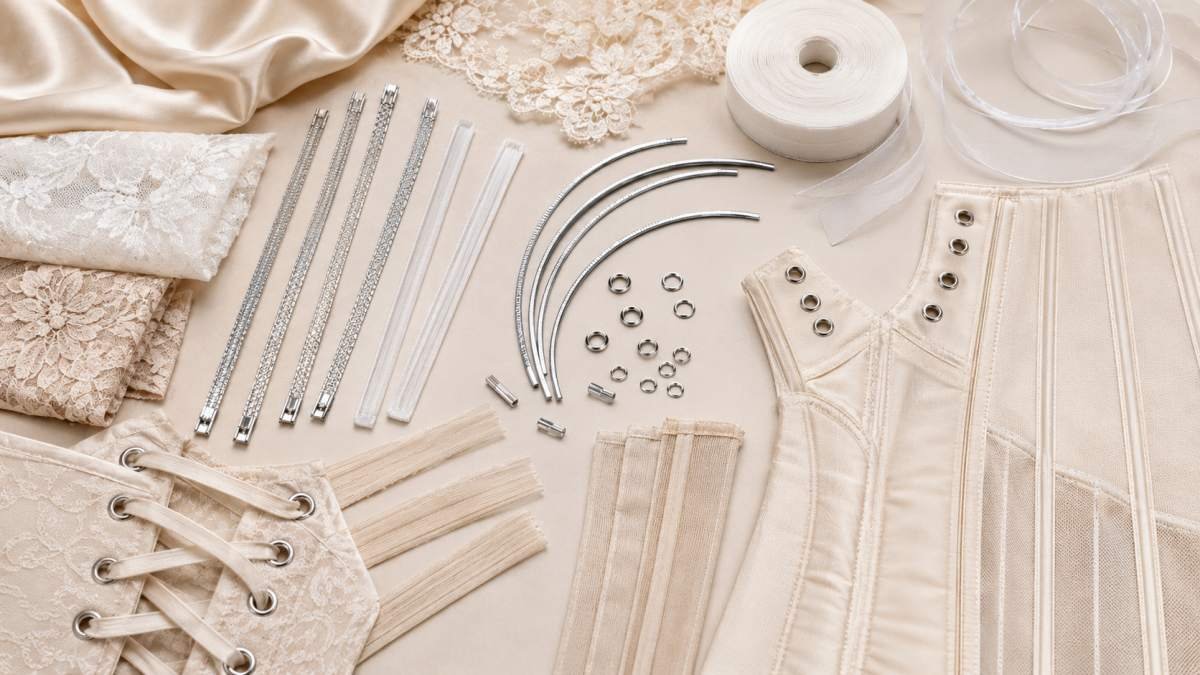
The best boning for a fashion corset dress depends on the load and location. Synthetic whalebone suits many lightweight and medium-structure styles, Rigilene provides economical light support, spiral steel follows curved seams, and flat steel stabilizes straight high-tension areas. Many reliable dresses use a mixed system instead of one material throughout the bodice during real-world wear.
The practical question is not which material sounds strongest, but which construction keeps the approved silhouette while the customer walks, sits, reaches, dances and wears the garment for several hours. A mesh corset mini, a satin strapless midi and a functional lace-up occasion dress place very different demands on their internal frames. The expensive surprise usually appears after an attractive first sample, when real movement exposes a weakness hidden by the mannequin. The following guide explains how to choose, place and test boning before that weakness reaches bulk production.
What Does Boning Do in a Corset Dress?
Boning keeps a corset bodice vertically stable, reduces folding and helps preserve the shape created by the pattern. It supports the structure but cannot correct poor bust fit, a loose waist or an unstable neckline. A dependable corset dress combines appropriate boning with accurate panel shaping, suitable cups, strong lining, secure closures and balanced tension across the body.
Shape Versus Support
Boning is often described as the component that shapes the body, but the pattern creates most of the three-dimensional form. Curved seams, cup volume, waist suppression, panel angles and fabric recovery determine how the bodice fits around the bust, waist and upper hip. Boning mainly prevents those already-shaped panels from folding or rolling once the garment is under tension. This is why a dress can contain firm steel and still fit poorly: the steel may hold an incorrect shape with impressive determination.
Each strip should have a defined job. A center-front bone may keep the neckline and waistline smooth. A flexible bone along a princess seam can preserve the bust-to-waist curve. A stronger strip beside functional back lacing helps keep the eyelet rows parallel. A lighter side bone may reduce fabric collapse without limiting movement. Counting the number of bones is less useful than mapping the failure each bone is expected to prevent, because an over-boned fashion dress can become heavy, visible under the shell and uncomfortable during normal wear.
Structural need | Primary solution | Boning contribution | What boning cannot fix |
Bust shaping | Cup volume, seams and cup placement | Keeps shaped panels upright | Incorrect cup size or spacing |
Strapless stability | Upper-bust fit and waist anchoring | Reduces vertical collapse | Loose neckline or waist |
Waist definition | Contoured pattern and stable foundation | Maintains the vertical waist line | Excess garment circumference |
Back-lacing control | Reinforced eyelet panels | Keeps lacing edges straighter | Weak eyelet reinforcement |
Smooth center front | Balanced pattern and stable fabric | Reduces buckling and rolling | Incorrect front length |
Curved side support | Shaped seams and suitable inner layer | Preserves the body curve | Poorly shaped side panels |
Fashion and Traditional Corsets
Fashion corset dresses and traditional waist-reducing corsets use some of the same construction language, but they are designed for different mechanical loads. A traditional corset may be expected to withstand sustained horizontal compression and therefore normally uses a strong foundation fabric, reinforced lacing sections and a carefully distributed steel system. A fashion dress usually aims to create a defined silhouette, shaped cups or visible corset lines while remaining suitable for dinners, parties, graduation events, weddings and other occasions where the wearer must move naturally for several hours.
This difference explains why synthetic or plastic boning can be entirely appropriate in a fashion product. A lightweight mesh mini does not automatically need the same structure as a waist-training garment. At the same time, a dress with functional lacing, a heavy embellished skirt or a sharply fitted satin bodice may need selected steel at specific load points. Before choosing the trim, the development team should confirm whether lacing is decorative or functional, whether waist reduction is intended, how long the dress will be worn and how much weight the bodice must carry.
Problems Boning Can Prevent
Correctly selected boning can reduce horizontal folding at the waist, rolling near the neckline, collapse between vertical seams and distortion beside a zipper or lacing panel. These problems become more visible when the wearer sits because the torso shortens and the front waist bends. A weak strip may take a permanent kink, while a strip that is too long may press into the lower bust or upper hip. A well-matched bone should flex within its intended range, remain controlled in the channel and recover when the wearer stands again.
Visible symptoms should be classified before the material is changed. Horizontal creasing may indicate insufficient vertical support, but it may also show that the bodice is too long. A bone twisting inside its channel can mean the channel is too wide or attached to an unstable stretch layer. A protruding end may result from inadequate clearance, weak casing fabric or poor finishing. Experienced sample teams separate fit, material, placement and workmanship problems rather than replacing every plastic strip with steel and hoping the next sample behaves better.
When Boning Is Unnecessary
Not every corset-inspired dress needs a full internal frame. Some styles use contrast topstitching, shaped seams or visible channels mainly as design details. Stable stretch fabric, bonded construction, a power-mesh foundation or a carefully fitted cup system may already provide enough control for the intended silhouette. In these garments, strategic placement can be more effective than filling every seam. Two side supports and two front supports may solve the actual problem while preserving comfort and reducing surface ridges.
The decision should be made through a physical sample rather than through cost reduction alone. Test the bodice without bones, observe where it collapses, and add support only where it produces a measurable improvement. Unnecessary boning adds cutting, tipping, casing, insertion and inspection operations, while also increasing the chance of visible lines or pressure points. The best commercial construction is not the one with the most internal parts; it is the lightest system that keeps the approved shape throughout realistic wearing conditions.

Which Boning Type Is Best?
There is no universal best boning for every fashion corset dress. Plastic and Rigilene suit lighter structures, synthetic whalebone provides stronger recovery, spiral steel follows curved seams, and flat steel controls straight high-tension areas. The most reliable option is often a mixed system in which each material is assigned to the position where its stiffness and flexibility are genuinely needed.
Plastic and Rigilene
Plastic boning is widely used because it is lightweight, easy to cut and compatible with efficient garment production. It works well in corset-inspired party dresses, stretch bustiers and lightly structured tops where the objective is to prevent folding rather than withstand strong lacing tension. Its weakness is inconsistency across grades. A thin featherweight strip may be appropriate for a neckline but too soft for a sharply fitted waist, while a denser polypropylene strip can provide noticeably better resistance and recovery.
Rigilene is a woven, sew-through synthetic support that can be stitched directly onto a seam allowance or internal foundation. This reduces the need for a separate casing and makes it attractive for decorative channels and light structures. However, it can twist when attached to an unstable stretch layer, and its cut ends may feel rough unless they are rounded and completely covered. It can also show through fine satin or sheer mesh. Rigilene should be chosen for moderate support and production convenience, not treated as a substitute for a stronger material in high-load areas.
Synthetic Whalebone
Synthetic whalebone is a solid engineered plastic used when a fashion corset needs more structure and better recovery than lightweight plastic can provide. Common apparel widths are approximately 6 to 12 millimetres, although the correct choice depends on the channel, seam allowance, fabric stack and required stiffness. Narrow strips are easier to conceal and can follow smaller curves, while wider or thicker strips resist bending more strongly but may become visible beneath lightweight shells.
Its main advantage is resilient flexibility. A suitable grade can bend during sitting and return closer to its original form than low-grade plastic, which makes it useful for premium party dresses, fitted satin bodices and garments designed for several hours of wear. Supplier consistency still matters. Two strips carrying the same nominal width can perform differently because of variations in resin, thickness or production tolerance. The approved bill of materials should therefore identify the supplier, grade, measured dimensions and reference sample rather than simply stating “plastic bone.”
Spiral and Flat Steel
Spiral steel bends in several directions and follows curved princess seams, side-body contours and shaped waist panels more naturally than flat steel. Common dressmaking widths are often around 5 to 7 millimetres, with the final gauge established through sampling. It is valuable when plastic collapses but a rigid straight strip would push the seam away from the body. Proper cutting and tipping are essential because an unfinished metal end can abrade the casing and eventually create a sharp point inside the garment.
Flat steel bends mainly forward and backward while strongly resisting sideways movement and twisting. This makes it effective beside functional eyelet rows, center-back lacing and straight center-front areas where concentrated horizontal tension must be controlled. The same directional stiffness makes flat steel unsuitable for many compound curves. When forced along a deeply shaped princess seam, it can stand away from the torso or create pressure. It should be specified by location rather than distributed throughout the bodice simply because it is the strongest option available.
Boning type | Typical width | Support level | Flex behavior | Best use | Main risk |
Light plastic | 6-12 mm | Light to medium | Mostly forward/backward | Soft bustiers and light dresses | Permanent kinking |
Rigilene | 6-12 mm | Light | Flexible and sew-through | Decorative channels | Twisting or rough ends |
Synthetic whalebone | 6-12 mm | Medium | Smooth resilient bending | Premium fashion corsets | Grade variation |
Spiral steel | 5-7 mm | Medium to high | Multidirectional | Curved seams and panels | Poor end finishing |
Flat steel | 5-13 mm | High | Directional resistance | Lacing edges and straight areas | Excess rigidity |
Mixed Boning Systems
Using more than one type of boning is often the most technically balanced choice because different panels carry different loads. A functional lace-up satin dress may use flat steel beside the eyelets, spiral steel along curved side panels and synthetic whalebone at the front princess seams. A lightweight mesh corset mini may use narrow synthetic strips through visible channels and a firmer support beside the zipper. The goal is not complexity for its own sake, but controlled stiffness where the dress needs it and flexibility where the body moves.
Mixed systems require precise documentation. Each channel should be identified on the pattern or placement map, and the trim sheet should state the material, width and finished length. Operators should not be expected to identify similar-looking strips after they are covered. Transitions also require testing because a rigid bone beside a soft strip can create a hard contour change or pressure point. The complete bodice must be evaluated on the body, with realistic closure tension, rather than approving each material separately on the worktable.

How Do You Match Boning to the Dress?
Match boning to the complete dress structure rather than the outer fabric alone. Review fabric weight, stretch, recovery, transparency, seam curvature, closure tension, skirt weight and expected wear time. Lightweight styles usually need low-profile support, while heavy satin or functional lacing may require selected steel. Cups, lining, underlining and waist anchoring must be developed with the boning as one connected system.
Fabric Weight and Stretch
Fabric weight is a useful starting point, but stretch, recovery, drape and surface sensitivity can be equally important. A heavy non-stretch satin may provide substantial body, yet an attached full skirt can pull downward on the bodice. A lightweight stretch mesh may weigh very little but allow channels to rotate if boning is sewn directly to it. A sequin layer adds weight while hiding small ridges better than plain satin. These differences explain why the same strip can perform well in one dress and fail in another with a similar silhouette.
The complete material stack should be assessed: shell, fusible, underlining, power mesh, cups, channel tape and lining. A bone that behaves well between stable woven layers may become visible or unstable beneath a thin fashion fabric. Stretch shells generally need an internal controlled-stretch or non-stretch foundation. Increasing stiffness without stabilizing the base layer may make the bone feel stronger while the garment continues to move around it, creating twisting, channel distortion and uneven surface tension.
Mesh and Satin Dresses
Mesh makes the internal construction part of the visual product. Every seam allowance, channel edge and bone termination can remain visible, especially in pale colors. Narrow synthetic boning often provides a clean line without excessive bulk, while a matching stable mesh or internal facing can help conceal channels that are not intended as design features. Rigilene can be useful, but the woven edge and cut end must be fully enclosed so they do not scratch the skin or appear as uneven texture through the shell.
Satin creates the opposite challenge because it hides the internal structure while magnifying small ridges, puckering and pressing marks. A wide bone, bulky casing or thick tipped end may become obvious under side lighting used for campaign photography. Samples should be reviewed on the body under directional light, not only on a hanger under flat factory illumination. A mechanically strong bodice is not commercially successful if it creates unattractive vertical shadows, gloss marks or hard transitions across the front of a smooth satin dress.
Dress construction | Practical starting option | Supporting layer | Priority test |
Sheer mesh corset mini | Narrow synthetic whalebone | Stable mesh or light underlining | Show-through and twisting |
Stretch bodycon bustier | Flexible plastic | Power mesh or stable lining | Recovery after sitting |
Satin strapless midi | Synthetic whalebone or spiral steel | Underlining and waist support | Ridges and downward movement |
Lace-up occasion dress | Flat steel at lacing; flexible bones elsewhere | Reinforced back panel | Eyelet alignment under tension |
Curved princess bodice | Spiral steel | Strong channel casing | Curve following and comfort |
Decorative corset style | Rigilene or limited plastic | Light internal foundation | Whether full boning is needed |
Cups, Lining and Closures
Cups and lining change the work assigned to the bones. Molded cups create fixed volume and can reduce the shaping demanded from front boning, but their lower edges must connect securely to the bodice. Soft cups depend more heavily on seam shaping, underlining and internal support. Power mesh can distribute tension and improve body control, while a stable woven lining can hold channels in position. A slippery lightweight lining may feel comfortable but contribute little mechanical strength.
Closure type changes the load pattern. A zipper mainly needs local stability and smooth alignment. Hook-and-eye tape introduces repeated pulling at several points. Functional back lacing creates horizontal tension across the whole bodice and concentrated stress beside the eyelets. The dress should be fitted at the realistic lacing tension, with the gap remaining reasonably parallel and the upper and lower edges staying balanced. Flat steel or another firm straight support may be appropriate beside the lacing, while the curved body seams remain more flexible.
Occasion and Party Wear
Party and occasion dresses must preserve a polished silhouette for several hours while allowing sitting, dining, dancing and arm movement. Synthetic whalebone suits many commercial styles because it offers moderate structure without the full weight of steel. Spiral steel becomes useful when the design has strong curves or a fitted waist that repeatedly collapses under plastic. Flat steel is generally reserved for straight high-tension positions rather than installed throughout the bodice, where it can make the garment feel unnecessarily restrictive.
The skirt should be attached before final approval. A bodice that remains secure during an isolated fitting may begin to move once heavy satin, sequins, layered mesh or a long skirt is added. Cost decisions should include more than trim price because a cheaper strip may require extra reinforcement, create rework or increase the risk of returns. The most economical construction is the one that achieves the approved fit, remains comfortable through realistic movement and can be reproduced consistently across the planned size range.

How Should Boning Be Placed?
Boning should follow stable seam lines and real load paths while avoiding sensitive pressure points. Firmer strips belong beside closures or lacing, flexible bones suit curved panels, and lighter support can control lower-load areas. Finished length, channel width, end clearance, symmetry and grade rules must be confirmed on a worn sample before the pattern and production instructions are released.
Channel Position
Common positions include the center front, princess seams, side-front seams, side seams, side-back seams and both sides of a closure. However, every seam does not require a bone. Placement should reflect the structure rather than copy a decorative panel layout automatically. A center-front support may keep the neckline and waist smooth, while princess-seam bones preserve the bust-to-waist curve. Side bones control folding and underarm shape, and stronger strips beside a back opening prevent the closure from bowing under tension.
Curved channels need materials that can follow body contours. Spiral steel or resilient synthetic boning usually behaves more naturally than flat steel along a compound princess seam. Straight lacing edges benefit from firmer directional support. Decorative visible channels can align with functional needs, but the two are not always identical. A visually balanced design may require additional hidden support at a load point, while a dress with many decorative lines may need bones in only a few of them to avoid excess weight and stiffness.
Length and Clearance
A bone should be shorter than its finished channel so the ends do not push directly against seam lines. Sample rooms often begin with several millimetres of clearance at each end, then adjust after fitting because the correct allowance depends on the channel fabric, end treatment and garment location. Too little clearance can cause the strip to press through the casing or create a hard bump. Too much clearance allows the bone to migrate, rotate or collect at one end during wear.
Termination height deserves special attention under the bust, under the arm and near the hip. A side bone finishing too high can dig into the underarm when the wearer lowers her arms. A front bone finishing too low may press into the abdomen or thigh when she sits. A strip ending directly at the natural waist crease can kink repeatedly. Finished lengths should be approved on the body after top and lower-edge finishes are complete, because bindings and seam constructions reduce the actual internal channel length.
Channel Construction
The channel should hold the bone securely without excessive friction. If it is too narrow, insertion becomes difficult, seams may pucker and the strip cannot flex naturally. If it is too wide, the bone can rotate or move sideways. The required allowance changes with the material and end treatment; tipped spiral steel generally needs more clearance than a thin plastic strip. The correct channel allows smooth insertion and controlled movement without obvious looseness when the bodice is handled.
Channel fabric must also resist abrasion. A hard or poorly finished end can gradually wear through lightweight lining, especially where the garment bends repeatedly. Stable woven tape, reinforced seam allowances or engineered casings are safer than placing hard boning against delicate mesh. Sew-through Rigilene requires its own method: the stitching should control the strip without splitting its woven edge, while both ends are rounded, covered or enclosed. A square-cut end left between soft lining layers can quickly become a customer comfort complaint.
Symmetry and Grading
Boning placement should remain symmetrical unless the design is intentionally asymmetric. Small left-to-right differences become visible in fitted satin and sheer mesh because garment tension highlights uneven spacing. The pattern should carry clear channel lines, notches, material codes and finished lengths, and the first cut pairs should be compared before sewing. This simple production check prevents a surprising number of defects that are difficult to repair once the shell and lining are closed.
Grading should not scale the base-size arrangement mechanically. As bust volume, torso length and panel curvature change, bone positions and finished lengths may need adjustment even when the number of strips remains the same. Fuller-bust sizes often need more careful cup connection, side support and underbust anchoring, but stronger boning cannot compensate for insufficient cup volume. Size-set fitting should confirm that each support line remains aligned with the body and does not move into the underarm, bust apex or hip crease as the garment is graded.

How Do You Test Boning for Production?
Boning should be tested inside the complete dress rather than judged only by hand. A production-ready sample must pass standing, sitting, bending, arm movement, torso rotation, closure-tension and recovery checks, followed by the approved care process. Bulk controls should verify the exact material grade, width, finished length, placement, channel security and end protection before the lining closes the structure.
Wear and Movement Tests
A dress form reveals general shape but cannot reproduce body heat, movement and pressure. The garment should be worn by a fit model who matches the intended size specification. A practical test includes repeated sitting and standing, walking, bending forward, raising both arms and rotating the torso. Party styles should also be checked through light dancing movements. The model should remain in the dress long enough for the materials to warm and settle, because some weaknesses appear only after continued pressure.
The team should observe whether bones kink, twist, migrate or create pressure points. The neckline should remain controlled, the waist should recover after sitting and the back opening should stay aligned. The complete dress must be tested with the actual skirt, embellishment, cups, lining and closure because each changes the load. Approving an isolated bodice and attaching a heavy skirt later can produce a false result. After the garment is removed, the channels and strips should be examined for permanent deformation rather than judging appearance alone.
Test | Suggested action | Pass indicator | Common failure |
Sitting recovery | Sit for 15-20 minutes, then stand | Bodice returns without a permanent fold | Kink at front waist |
Arm movement | Raise and lower arms repeatedly | Underarm stays comfortable | Bone presses into skin |
Torso rotation | Rotate left and right | Channels remain aligned | Bone twists in casing |
Closure tension | Tighten to intended wearing level | Back edges remain stable | Lacing panels bow inward |
Extended wear | Wear for 1-2 hours during development | No increasing pressure points | Progressive discomfort |
Care test | Apply the approved care process | Shape and finish remain acceptable | Warping, rust or delamination |
Heat and Care Performance
Plastic materials can respond to heat from pressing, drying, transport or storage. Some grades soften or retain a new curve, while steel presents different risks such as corrosion if coatings or end finishes are damaged. The actual care label should determine the test. A garment intended for gentle washing should pass that process, and a dry-clean-only style should use materials compatible with the expected treatment. Synthetic composition alone does not prove that a strip is washable or suitable for commercial pressing temperatures.
Pressing is a common hidden failure point. Excessive temperature or pressure can distort plastic or leave channel impressions on satin. Production instructions should define the pressing method, protective cloth and whether direct pressure over the channels is permitted. Post-care inspection should include shape, casing abrasion, seam opening and internal condition. When necessary, a strip should be removed from a test garment and examined for cracking, coating damage or permanent curvature, because the outer dress can look acceptable while the internal support has already weakened.
Sample Approval Data
A reliable approval record should identify the material precisely rather than using a vague phrase such as “plastic boning.” Record the supplier, composition, width, thickness or gauge, color, batch reference and approved sample date. Finished bone lengths should be listed by channel and size, while a placement map identifies which material belongs in each location. This level of detail is essential in mixed systems because narrow synthetic and steel strips can look similar after they are enclosed.
The record should also preserve the surrounding construction. Changing shell fabric, underlining, channel tape or lining can alter performance even when the bone remains unchanged. A trim approval without fabric context is incomplete. The pre-production sample should use intended bulk materials and methods, and any temporary substitution should be disclosed and assessed. A sample approved with a resilient premium synthetic strip does not validate bulk production made with a cheaper alternative that matches only the nominal width.
Bulk Quality Control
Incoming inspection should confirm that delivered boning matches the sealed reference. Width and thickness can be measured, while flexibility and recovery are compared with the approved strip. Rolls should be checked for uneven curvature, cracking, inconsistent edges, contamination and damaged coatings. During sewing, inspectors verify channel position, symmetry, finished length and end coverage. A material should not be stitched through unless it is specifically designed for that construction, and tipped metal ends must remain secure and fully enclosed.
Inline inspection is more effective than waiting for final inspection because incorrect strips and misplaced channels become expensive to repair after the shell and lining are closed. The first completed garments from each line or operator should be checked before production continues. Final inspection should include a hands-on review of every boned area for sharp ends, missing strips, twisting and uneven termination. Measurement control remains important, but correct dimensions alone do not prove that the internal frame is balanced or comfortable.

Develop the Boning System Before Bulk Production
The best boning decision is rarely a choice between “cheap plastic” and “premium steel.” It is a construction decision that connects pattern shape, fabric behavior, cup structure, lining, closure tension, wearing comfort and production control. A reliable fashion corset dress uses enough support to preserve the intended silhouette without turning the garment into rigid armor. That balance can only be confirmed through complete samples, realistic movement testing and clear bulk specifications.
For a new corset, bustier, satin, mesh, party or occasion dress project, prepare the tech pack or reference sample together with the intended fabric, size specification, closure type, target quantity and launch date. Duolan Apparel can review the structure, suggest a practical boning system, develop the sample and carry the approved construction into production.
Share:
Our Services
Categories
Table of Contents
Here, developing fashion collections is more than manufacturing garments — it’s a collaborative process focused on transforming ideas into well-executed, market-ready products. From fabric sourcing and sample development to scalable production and delivery coordination, every stage is built to support quality, consistency, and efficient collection launches across global markets.

