Skip to content
What Is the Best Lining for Corset Dresses : A Practical Fabric Guide
Your trusted Women’s Apparel Development & Manufacturing Partner from China
- Jerry
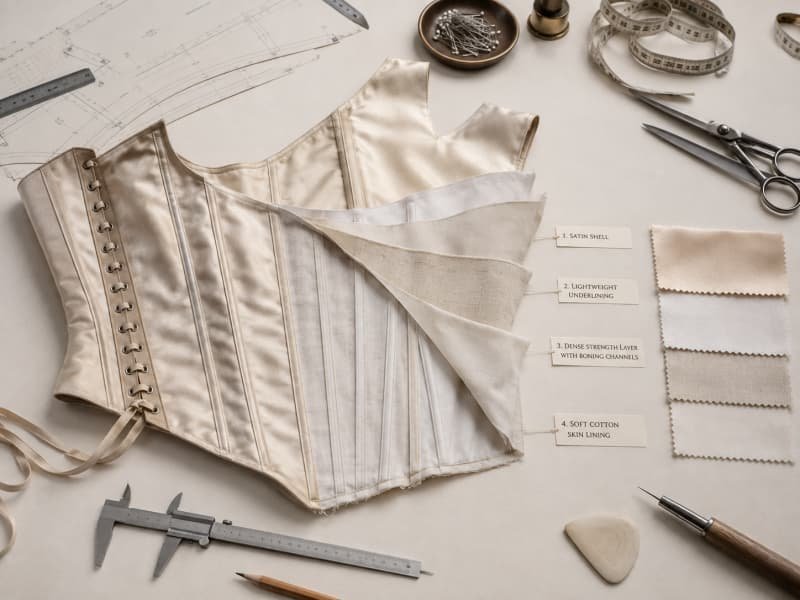
The lining inside a corset dress is rarely visible in campaign photography, yet it often decides whether the garment feels refined or disappointing. A smooth satin exterior can still wrinkle over poorly graded channels. A dramatic mesh bodice can lose its shape when the hidden support stretches too far. A dress may look perfect during a five-minute fitting and become hot, restrictive or painful after an evening of sitting, walking and dancing. These problems are usually blamed on boning or patternmaking, but the real cause is often a lining package that was selected as an afterthought rather than developed as part of the complete structure.
The best lining for a corset dress is a smooth, breathable and dimensionally stable fabric chosen separately from the layer that carries structural tension. Cotton poplin, cotton lawn or fine cotton twill work well against the skin in many woven styles, while coutil, firm twill, stable tricot or power mesh may provide support. The correct combination depends on the shell, stretch, boning, cups, silhouette and intended wear.
A useful way to think about corset construction is to stop asking one fabric to perform every job. The layer touching the body should manage comfort, friction and moisture. The strength layer should control boning and body tension. Underlining should stabilize delicate shell fabrics and soften visible ridges. Once those roles are separated, material decisions become clearer, sample corrections become faster and bulk production becomes more repeatable. The following guide explains how experienced dress-development teams evaluate those layers before a beautiful design turns into an expensive production problem.
What Is the Best Lining for Corset Dresses?
The best lining is a smooth, breathable and stable fabric that protects the wearer without weakening the bodice. Cotton poplin, cotton lawn and fine twill suit many woven corset dresses, while stretch tricot suits flexible bodycon styles. Strong boning tension should normally be carried by a separate structural layer rather than by the skin lining alone.
What Should the Lining Do?
A lining should make the corset dress comfortable, cleanly finished and easier to wear. It separates the body from seam allowances, boning channels, cup edges, interfacing, zipper tapes and reinforcement. The wearer should feel controlled support rather than sharp pressure, rubbing or a rough transition between components. This sounds simple, but it requires the lining to remain smooth while the bodice bends, compresses and changes shape with the body.
Comfort cannot be judged from a swatch alone. A fabric that feels soft in the hand may become abrasive when pulled tightly across the waist or pressed over a boning channel. For party, occasion and wedding guest dresses, the sample should be assessed while the wearer sits, walks, raises her arms and remains in the garment long enough for heat and pressure points to develop. Six-hour event wear places very different demands on a lining than a short showroom fitting.
The lining also contributes to opacity, moisture management and dressing ease. Cotton-rich fabrics tend to absorb moisture better than tightly woven polyester, while smooth synthetic linings can help the garment slide over the body and reduce catching on underwear. Neither is automatically superior. The decision depends on climate, expected wear time, skirt movement, color transparency and the number of additional layers already present in the bodice.
Is Lining the Strength Layer?
The lining and strength layer do not have to be the same fabric because their responsibilities are different. The lining primarily provides comfort, coverage and a clean interior. The strength layer carries tension from boning, fitted waist shaping, cups, lacing and closures. Lightweight cotton lawn may feel excellent against the skin but is rarely suitable for carrying heavily loaded boning. Dense coutil may control tension very well but can feel too firm as the only layer next to the body.
Some lightly structured fashion dresses can use one firm cotton twill for both roles. That approach may work when the corset effect is visual, the waist is not significantly compressed and flexible plastic boning is used. The compromise becomes less attractive as structure increases. A single fabric may be heavier than necessary for comfort while still offering less control than a dedicated support layer, especially near eyelets, cups and long boning channels.
For more demanding styles, separating the layers gives the development team greater control. The strength layer can be selected for stability and seam performance, while the lining is selected for softness, breathability and low bulk. This arrangement also makes later material adjustments more manageable. A comfort problem can be solved without rebuilding the complete support system, and a stronger structural material can be introduced without placing a coarse surface directly against the skin.
How Many Layers Are Needed?
Most corset dresses contain two to four functional layers, although not every style needs the maximum number. A simple fashion corset dress may use an outer shell, reinforced inner structure and lining. A fitted satin occasion dress may need an additional underlining to prevent boning, seam allowances and cup edges from showing through. A sheer mesh style may use localized reinforcement instead of a full opaque strength layer so the design remains intentionally transparent.
More layers do not automatically mean better quality. Excessive layering can make the waist stiff, increase heat, create bulky seam intersections and cause the neckline to roll outward. It may also reduce the natural drape of the skirt when a heavy bodice construction is extended too far below the waist. The best construction is the lightest package that can reliably hold the intended shape through movement, cleaning and repeat production.
Every layer should have a defined purpose. When two layers perform the same job without a measurable benefit, one may be unnecessary. During development, experienced teams compare full samples with reduced-layer test panels and examine support, surface smoothness, breathing comfort, sewing consistency and pressing response. A lighter solution that performs equally well is usually more commercially useful because it reduces material cost, seam bulk and production handling without weakening the garment.
Layer | Primary Function | Common Materials | Typical Development Range |
Outer shell | Appearance, color and fashion surface | Satin, crepe, velvet, mesh, jersey | Varies by design |
Underlining | Stabilizes shell and hides internal ridges | Organza, tricot, lightweight woven support | About 30-100 gsm |
Strength layer | Carries boning and body tension | Coutil, firm twill, drill, power mesh | About 140-300 gsm |
Skin lining | Comfort, opacity and clean finish | Poplin, lawn, fine twill, stretch tricot | About 60-130 gsm |
What Makes a Lining Suitable?
A suitable lining balances softness with control. It should not be abrasive, excessively slippery, loosely woven or unstable after steaming. In a close-fitting bodice, it must tolerate constant contact with the skin while resisting stress around the zipper, waist seam and boning ends. The fabric should also sew cleanly without tunneling, puckering or fraying so aggressively that seam allowances become bulky after binding or overlocking.
Dimensional stability is one of the most important checks because lining and shell can react differently to heat, moisture and care. Many fashion-development teams use approximately 2% to 3% dimensional change as a cautious internal reference for stable dress fabrics, but the final limit should follow the product, fiber, care method and customer protocol. The difference between layers matters as much as the isolated result; mismatched shrinkage can pull a neckline or create ripples even when each fabric appears acceptable by itself.
Color and finish also affect suitability. A pale lining can change the tone of mesh, lace or lightweight satin, while a dark lining may transfer color during perspiration or pressing. The final decision should include dry and wet rubbing checks, a realistic steam test and a wear trial. A lining is successful only when it supports comfort, fit and visual quality at the same time rather than excelling in one area while creating a new problem elsewhere.
Which Lining Fabrics Work Best?
Cotton poplin and cotton lawn are dependable skin linings for many woven corset dresses, while fine cotton twill adds body and durability. Coutil is better used as a structural layer when strong control is required. Polyester suits smooth occasionwear, and stretch tricot or power mesh is more appropriate when the dress depends on controlled stretch and recovery.

Is Coutil Always the Best?
Coutil is one of the strongest traditional choices for structured corsetry because its dense weave limits distortion under tension. It is particularly useful in bodices with steel boning, back lacing, firm waist shaping or long corset panels that must remain stable during repeated wear. When the support system is carrying real load, a dedicated corsetry fabric can reduce twisting, seam growth and stress around channels and eyelets.
However, coutil is not automatically the best choice for every corset dress. Many contemporary dresses borrow the visual language of corsetry without applying traditional waist-reduction pressure. In those cases, full coutil may make the garment warmer, heavier and more rigid than the design requires. A lightly boned mini dress or bustier-inspired party style may perform better with firm twill or localized reinforcement around cups, center front and closure areas.
The correct decision is based on load rather than reputation. Developers should consider boning type, panel length, closure, waist tension, fabric weight and intended wear time. Coutil is valuable when its stability solves a clear structural problem. When it does not, a lighter material can produce a more wearable garment with cleaner curved seams, lower bulk and better commercial appeal while still maintaining the desired silhouette.
Is Cotton Twill a Practical Alternative?
Cotton twill is often a practical alternative for fashion corset dresses because it is widely available, familiar to sewing teams and offered in many weights. A closely woven twill can provide useful resistance for moderate boning while remaining softer and less rigid than heavy coutil. It is particularly suitable for structured fashion dresses that need shape retention but are not designed for aggressive compression or traditional tight lacing.
The name cotton twill covers a broad range of performance. A soft, garment-washed twill may stretch significantly on the bias and relax around the waist after steaming. A compact, firmly finished twill may behave much more like a dedicated support material. Approval therefore needs more than fiber content and weight. Warp and weft extension, bias distortion, seam slippage, recovery after tension and shrinkage under production pressing all need to be checked.
A fine twill can sometimes act as both a light support layer and a lining when the surface is smooth and the design uses moderate shaping. That approach saves bulk, but it is not ideal for every wearer or event. In close-fitting, long-wear dresses, a separate softer lining often improves comfort. When replacing coutil with twill, the pattern and boning layout should also be reviewed because the material may distribute tension differently across the bodice.
Are Poplin and Lawn Suitable?
Cotton poplin is one of the most versatile skin linings for non-stretch corset dresses. It is usually smooth, tightly woven and light enough to finish shaped bodices without adding unnecessary thickness. It also absorbs moisture more effectively than many standard synthetic linings. Poplin works especially well when a separate strength layer already carries boning and body tension, allowing the inner surface to focus on comfort and clean finishing.
Cotton lawn is lighter and softer, making it useful for summer occasionwear or dresses that already contain several structural layers. Very fine lawn, however, may need reinforcement around zippers, hook-and-eye closures, waist seams or areas exposed to boning friction. Poplin generally offers more durability and opacity, while lawn provides a lighter skin feel. Neither should be expected to hold strong boning tension by itself in a firmly shaped corset bodice.
Shrinkage and color are the main development concerns. Cotton linings can react differently from polyester satin, stretch mesh or bonded shells during steaming and cleaning. The fabric should be relaxed or preconditioned before cutting, then tested using production pressing settings. A white or nude lining may change the shade of a semi-transparent shell, while a dark lining can transfer color when exposed to moisture. The approved color must therefore be checked inside the actual garment, not only on a swatch card.
When Does Polyester Work Better?
Polyester lining works well when a dress needs a smooth interior, low bulk, crease resistance and easy dressing. It is common in occasionwear because it allows a fitted bodice and skirt to move over the body without catching on underwear. It also tends to offer stable color and dimensions when sourced consistently. These advantages are useful in complex styles where multiple internal seams already create friction and the lining must remain thin.
Its main disadvantages are heat, moisture management and static. These issues become more noticeable when the bodice also contains foam cups, fusible support, boning and several shell layers. A polyester lining that feels pleasant during a short fitting can become warm during a long event. Lower-quality constructions may also cling to hosiery, build static in the skirt or feel plasticky against the skin, especially in humid climates.
Quality varies greatly, so fiber content alone should not determine approval. A lightweight, breathable polyester can outperform a loose cotton fabric with uncontrolled shrinkage. Some dresses also benefit from different linings in different zones: a cotton-rich lining inside the bodice for comfort and a smooth polyester lining in the skirt for movement. Treating the bodice and skirt as separate functional areas often produces a better wearing experience than forcing one fabric throughout the entire garment.
Fabric | Best Application | Common Weight | Main Advantage | Main Caution |
Cotton coutil | Firm structural bodices | 200-300 gsm | High dimensional stability | Can feel stiff and warm |
Firm cotton twill | Moderate support | 140-240 gsm | Practical and widely available | Performance varies by weave |
Cotton poplin | Skin-contact lining | 80-130 gsm | Smooth and breathable | Shrinkage must be controlled |
Cotton lawn | Lightweight lining | 60-100 gsm | Soft and low bulk | May need local reinforcement |
Polyester lining | Occasionwear and skirts | 55-100 gsm | Smooth and crease resistant | Heat and static |
Stretch tricot | Stretch corset dresses | 70-140 gsm | Moves with fitted shells | Recovery must match shell |
Power mesh | Stretch support zones | 120-250 gsm | Strong flexible control | Can feel firm against skin |
How Do Lining and Structure Work Together?
The lining must be developed together with boning, cups, seams, stretch and the outer shell. Boning should be anchored to a stable layer, while the lining protects the wearer. Cups change internal volume, stretch differences change fit, and underlining controls surface appearance. Treating these parts as one system prevents pressure points, visible ridges and inconsistent production results.

How Does Boning Affect the Lining?
Boning concentrates pressure along narrow vertical lines, so the fabric supporting each channel must resist tearing, twisting and repeated flexing. A soft lining can cover the channel, but it should not be the only layer carrying the load when firm shaping is required. The structural layer must remain stable enough to hold the bone in position while the lining follows the bodice without becoming stretched or punctured.
Flexible plastic boning, often used in fashion corset dresses, places less stress on the structure than spiral or flat steel. Plastic is generally suitable for visual shaping and light support, while steel is more appropriate when the bodice must resist stronger tension. Common fashion boning widths are roughly 4 to 12 millimetres, but channel width should be based on the actual bone and casing. A channel that is too narrow can twist the bone; one that is too wide can allow movement and noise.
The lining should cover boning with controlled ease. If it is cut too tightly, it may compress the bodice, pull the neckline or flatten cups. If it is too loose, it may wrinkle between channels or catch during dressing. Boning ends also need adequate clearance from seams and should be rounded or capped to reduce abrasion. Boning length, channel placement, lining pattern and seam allowance must therefore be tested as one construction rather than approved independently.
How Do Cups Change the Construction?
Built-in cups add volume, seam intersections and localized pressure. A lining pattern that works for an unpadded corset may flatten the cup or distort the neckline once foam, underwire or support panels are inserted. The lining must follow the cup volume without tension, and the seam allowances around curved joins need careful grading because even a few millimetres of extra thickness can produce visible ridges under satin.
Cup systems vary widely. Molded foam cups offer consistent shape and coverage but may feel warm. Cut-and-sew fabric cups provide greater control over fit but require accurate seaming and balanced tension. Underwired cups need secure channels and sufficient clearance at the center front and underarm. Soft internal slings or power-mesh panels can improve support, especially in larger sizes, but they also change the pressure distribution and must be integrated into the lining pattern.
Grading must account for more than cup width. Bust projection, cup height, bridge position and underarm coverage all change across the size range. Simply enlarging the original cup can move the bust point and reduce support. The lining, cup, frame and neckline should therefore be graded as a system. Fit testing should confirm that the cup edge remains smooth, the wearer can breathe comfortably and no seam or underwire channel presses sharply against the body.
How Should Stretch Be Controlled?
Stretch corset dresses must balance movement with recovery. Maximum extension alone does not predict performance because a fabric may stretch easily during fitting and fail to return to its original dimensions after several hours. The shell and lining do not need identical stretch, but their relationship must be understood. A slightly firmer lining can provide control; a dramatically firmer lining can restrict dressing and force the outer shell to wrinkle.
Recovery should be checked through repeated extension rather than one pull. Many internal development teams use approximately 3% to 5% residual growth as a cautious reference after cycling and rest, but the acceptable result depends on the product, fabric and customer protocol. Measurements should be recorded in both principal directions because some knits stretch mainly across the body while others stretch in two directions and can change length as well as circumference.
Support can also be zoned. The center front and cup frame may need firm control, while the side and back panels need more flexibility. Combining stable tricot, power mesh and localized woven reinforcement can produce a better fit than using one material across the entire bodice. The pattern must be based on the approved production fabric, since two materials described as four-way stretch can have very different extension, modulus and recovery, leading to visibly different waist and bust fit.
How Do You Keep the Outer Surface Smooth?
Boning marks, cup edges and seam ridges become especially visible under satin, lightweight crepe and other smooth surfaces. Adding a thicker shell is not always the right solution. The cause may be uneven seam allowances, twisted channels, abrupt foam edges, excessive body tension or an underlining that is too stiff. A successful correction begins by identifying which internal transition is creating the visible line.
Underlining can spread pressure and stabilize the shell. Lightweight organza, tricot or fine woven support may be suitable depending on the outer fabric. The underlining should be tested on a full panel because it can alter drape, color and shine. Seam allowances need consistent grading so adjacent panels do not alternate between thick and thin areas. Foam cup edges may require tapering, and boning ends should avoid finishing directly beneath a prominent neckline edge.
Lighting is an important inspection tool. A sample may appear smooth under flat factory lighting and show every internal ridge under directional light or flash photography. The bodice should be examined on a body rather than only on a hanger because wearing tension reveals problems that disappear when the garment is relaxed. A clean surface is achieved by balancing fit, structure, seam handling and fabric support, not by hiding every issue beneath another layer.
Construction Issue | Likely Cause | Practical Correction |
Boning visible through satin | Thin shell, narrow channel or excessive tension | Test underlining, grade seams and review fit |
Lining wrinkles between bones | Too much lining ease or poor attachment | Rebalance lining pattern and secure key points |
Neckline rolls outward | Inner layers are too thick or too small | Reduce bulk and correct turn-of-cloth |
Cup edge shows through | Foam or seam allowance ends abruptly | Taper foam and grade cup seams |
Bodice twists | Shell and inner layers cut off-grain | Recheck grain direction and panel alignment |
Zipper area waves | Uneven shrinkage or weak stabilization | Stabilize opening and retest pressing |
Waist feels sharp | Thick seam intersection or short bone clearance | Grade layers and revise boning length |
Which Lining Suits Each Corset Dress?
The right lining depends on the shell, silhouette and wearing conditions. Satin dresses need low-bulk support and careful surface control. Mesh styles need visually compatible reinforcement. Stretch bodycon dresses need coordinated extension and recovery. Firm occasion dresses require stronger support, while summer and long-wear styles place greater emphasis on breathability, moisture management and pressure distribution.

Which Lining Suits Satin Dresses?
Satin exposes construction mistakes more clearly than most dress fabrics because its smooth, reflective surface highlights puckering, boning ridges, cup edges and abrupt changes in thickness. For many satin corset dresses, cotton poplin or a fine polyester lining works well against the skin, while a separate firm twill or coutil layer carries structural tension. Lightweight underlining may be required when the satin is too soft to hide the internal construction.
The satin type changes the decision. Duchess satin has more body and may require less support beneath the surface than lightweight charmeuse. Stretch satin needs a compatible stretch system; placing it over a fully rigid inner bodice can create drag lines or prevent even recovery. The development team should examine the exact shell weight, weave, stretch and finish rather than approving one standard lining package for every satin style.
Pressing trials are essential because heat, steam and pressure can flatten shine or leave permanent marks. Fusible reinforcement should be tested on full-size panels, since small swatches may not reveal bubbling or adhesive strike-through. The approved sample should be reviewed in daylight, directional lighting and flash photography. Satin can also exaggerate fit tension, so horizontal lines around the bust or waist should be investigated through pattern balance and cup volume rather than blamed automatically on the lining.
What Works for Mesh Styles?
Mesh corset dresses require structural planning and visual planning at the same time because the internal construction may remain visible. A conventional opaque lining can remove the intended sheer effect, while unsupported mesh may stretch, tear or reveal unattractive seam allowances. The development team should decide which zones remain transparent, which require coverage and which structural components can become intentional visual lines in the finished design.
Stable mesh, soft stretch mesh, transparent organza and power mesh can be combined by zone. A sheer center panel may use narrow seam tape and transparent reinforcement, while the cups, side body and zipper areas use stronger support. The lining does not need to cover the entire garment uniformly. Partial lining often preserves the concept more effectively, but every exposed seam and channel must still be durable enough for wear and repeat production.
Color matching is critical because nude mesh, cup fabric, binding, thread and elastic can change appearance when stretched over the body. Two materials that look similar on a table may separate visibly once tension makes one fabric lighter or more transparent. Fit tests should include the intended skin-tone range whenever possible. In sheer corsetry, internal construction is part of the design, so clean channel spacing, narrow allowances and intentional line placement matter as much as hidden comfort.
Which Lining Suits Stretch Bodycon Dresses?
Stretch bodycon corset dresses need a lining that moves with the shell while controlling the bust and waist. Stable tricot, stretch mesh and power mesh are common choices, selected according to stretch direction, recovery, opacity and pressure. A slightly firmer lining can improve contour, but a rigid inner layer inside a highly elastic shell may restrict dressing, create seam stress and produce wrinkles where the shell wants to extend but the lining does not.
Negative ease should be based on the approved fabric rather than a generic stretch label. Two fabrics described as four-way stretch may differ significantly in extension and recovery. A substitution can change bust support, waist compression, hip fit and skirt ride-up even when the pattern is unchanged. The development record should therefore include measured stretch in both directions and recovery after repeated cycling, not only composition and weight.
Movement testing should include walking, sitting, dancing, raising the arms and wearing the sample for an extended period. The bodice should be remeasured afterward to identify permanent growth, twisting or loose folds inside the garment. Ride-up also depends on lining friction, hip shaping and skirt length, so it should not be treated as a lining-only problem. The goal is controlled contouring that moves with the wearer and returns close to its intended shape after use.
Which Option Suits Occasion Dresses?
Occasion dresses often need stronger support than casual styles, but they must remain comfortable for several hours. A firm twill or coutil strength layer can be combined with cotton poplin, lawn or a smooth performance lining against the skin. The bodice and skirt may use different linings because the bodice needs stability and pressure management, while the skirt benefits from movement, low friction and reduced weight.
Climate and event type should influence the specification. A winter velvet dress can tolerate more internal weight than a summer destination-party style. A dress intended for dancing needs greater movement than a highly structured presentation piece. Long-wear testing is therefore valuable. A ten-minute fitting may not reveal heat buildup, underarm rubbing or concentrated waist pressure that becomes obvious after one or two hours.
Commercially, comfort affects returns, reviews and repeat purchase as much as the first visual impression. A striking dress that becomes painful during an event is unlikely to build loyalty. Development teams should review body temperature, sitting comfort, ease of dressing and pressure distribution alongside appearance. The most successful occasionwear lining package maintains a clean silhouette while allowing the wearer to remain comfortable through the real situations in which the dress will be used.
How Do You Test Lining Before Production?
Test the lining as part of the complete corset system. Review fiber content, weight, stretch, recovery, shrinkage, seam performance, colorfastness and pressing response before sampling. Then test the finished garment for movement, pressure, surface smoothness and dimensional change. Any lining substitution should trigger a compatibility review before bulk cutting because small material differences can change fit and construction behavior.

What Material Tests Are Needed?
Begin by confirming fiber composition, construction, usable width, weight, color, finish and supplier article number. These details should match the approved bill of materials. A description such as black cotton lining is too vague for repeat production because fabrics with the same composition can vary in weave density, shrinkage, hand feel and seam performance. The test record should connect the approved physical swatch to a precise material reference.
Weight should be checked because a lighter lot may reduce opacity or strength, while a heavier lot may increase bulk and alter fit. Stretch fabrics require measurements in both directions, including extension and recovery after repeated cycles. Woven fabrics should be examined for seam slippage, fraying and bias distortion. Dimensional stability should be tested under the intended pressing and care conditions, with particular attention to differences between the lining, shell and structural layer.
Colorfastness is important for dark linings, pale shells and direct skin contact. Dry and wet rubbing, perspiration exposure and pressing migration should be considered according to the target market and customer protocol. Heat response also matters when fusing, molding or high-temperature pressing is used. The purpose of testing is not to build a decorative certificate file; it is to identify material behavior that could become a fit failure, appearance defect, color complaint or return after production.
How Should the Fit Sample Be Checked?
The lining should be evaluated separately from the outer appearance during fitting. Check whether it pulls across the bust, wrinkles around the waist, rolls at the neckline or gathers near the zipper. The inner layer should follow the structure without changing the intended garment measurements. The wearer should then sit, bend, walk and raise her arms so pressure from boning ends, cup edges, underwire channels and waist seams becomes visible.
After the movement test, turn the garment inside out and inspect stress points. Look for stretched stitch lines, fraying, seam opening, boning abrasion and permanent fabric growth. Compare key measurements before and after wear where appropriate. A sample can pass flat measurement inspection and still fail on the body because comfort and pressure distribution are dynamic. Feedback from the wearer should be recorded rather than relying only on visual judgment from the technician.
External appearance should be assessed at the same time. When horizontal drag lines, puckering or neckline distortion appear, the lining may be involved but is not always the sole cause. Cup volume, shell stretch, waist suppression, boning position and pattern balance can create similar symptoms. Effective correction requires identifying the true source. Simply loosening the lining may hide one problem while reducing support or introducing wrinkles elsewhere in the bodice.
Do Material Changes Affect the Pattern?
A lining substitution can change fit even when the pattern remains identical. A heavier fabric reduces internal space, a rigid fabric restricts movement and a stretch fabric may allow the bodice to grow. Different shrinkage can pull the shell after pressing. Turn-of-cloth also matters around cups, necklines and folded edges because the inner layer follows a shorter path than the outer shell and may need a slightly different pattern shape.
Seam allowances may need revision when the material changes. A heavily fraying fabric may require wider allowances or binding, while a thick twill may need more aggressive grading at cup joins and waist seams. If the support layer changes, boning-channel width, seam placement and reinforcement may also need review. A replacement that looks similar on a swatch can behave very differently once stitched into curved, highly fitted panels.
Every substitution should be documented as a controlled change. High-risk styles should receive a revised fit sample using the new material. Lower-risk changes may be evaluated through a full-scale bodice section or targeted test panel, provided the test reproduces actual seams, boning and pressing. Bulk cutting should not begin until the updated material package has been checked, approved and reflected in the bill of materials and construction instructions.
What Must Be Approved Before Bulk?
Bulk approval should identify the exact lining and explain its function. The specification should record composition, construction, weight, usable width, color reference, stretch direction, extension, recovery, shrinkage, finish and care compatibility. Placement must also be clear, including whether the material is used in the full bodice, cups, skirt, side panels or selected support zones and whether it acts as lining, underlining or strength layer.
The pre-production sample should use actual bulk materials wherever possible. Before cutting, the production lot should be compared with the approved swatch for color, weight, hand feel, stretch and surface finish. Heat-sensitive shells such as satin, velvet or bonded fabrics should receive a production pressing trial. During sewing, inline inspection should monitor lining alignment, channel width, cup positioning, seam puckering and attachment at key points rather than waiting for final inspection.
Final approval should include external appearance and internal comfort. A corset dress is not ready for shipment simply because the outside looks clean on a hanger. The garment must maintain its shape on the body, allow intended movement, avoid sharp pressure and reproduce the approved sample across the production run. A clear approval record also improves repeat orders because future teams can identify exactly which material and construction package produced the accepted result.
Approval Item | What to Record | Practical Development Reference |
Fabric identity | Supplier, article, composition and construction | Exact match to approved BOM |
Weight | GSM of approved and bulk fabric | Within agreed supplier tolerance |
Shrinkage | Length and width change after care or pressing | Often targeted below 3%, subject to product standard |
Stretch | Extension in both principal directions | Must match approved fit assumptions |
Recovery | Residual growth after repeated extension | Common internal reference below 3%-5% |
Seam performance | Slippage, tearing and fraying | No opening under expected garment tension |
Colorfastness | Dry rub, wet rub and perspiration | Meet target-market requirement |
Pressing response | Shine, bubbling, shrinkage and distortion | No unacceptable appearance change |
Wear comfort | Sitting, walking and extended wear | No sharp pressure or severe heat buildup |
Surface quality | Boning marks, cup edges and puckering | Acceptable in daylight and photography |
Bulk confirmation | Pre-production sample with actual materials | Approved before full cutting |
Build the Lining Around the Dress, Not Around a Habit
Choosing the best lining for a corset dress is not about selecting the most expensive fabric or repeating one traditional corsetry formula. It is about building a material system that produces the intended silhouette, supports the wearer, survives pressing and manufacturing, and remains comfortable in the real setting where the garment will be worn. A lightweight party mini dress, a stretch bodycon corset and a structured satin occasion dress should not automatically share the same internal construction.
The strongest development process begins with the design intent and works inward. The team defines support level, stretch, cup construction, boning, closure and wearing conditions, then assigns a clear job to the shell, underlining, strength layer and skin lining. Materials are tested together, not in isolation, and any substitution is reviewed against the approved fit and surface appearance. This approach reduces repeated samples, prevents hidden bulk and creates a clearer route from the first prototype to stable repeat production.
Duolan Apparel supports custom development for fashion dresses, corset and bustier styles, party dresses, occasion dresses, bodycon silhouettes, satin constructions and mesh designs. Brands can submit a tech pack, reference sample, size specification, target fabric, color plan, estimated quantity and delivery window for a material and production-feasibility review. The development discussion can cover lining architecture, strength layers, boning, cups, fit risks, test requirements and the adjustments needed before a design is released for sampling or bulk production.
Share:
Our Services
Categories
Table of Contents
Here, developing fashion collections is more than manufacturing garments — it’s a collaborative process focused on transforming ideas into well-executed, market-ready products. From fabric sourcing and sample development to scalable production and delivery coordination, every stage is built to support quality, consistency, and efficient collection launches across global markets.