Skip to content
How Does Boning Support Corset Dresses? A Guide to Structure, Fit, and Comfort
Your trusted Women’s Apparel Development & Manufacturing Partner from China
- Jerry
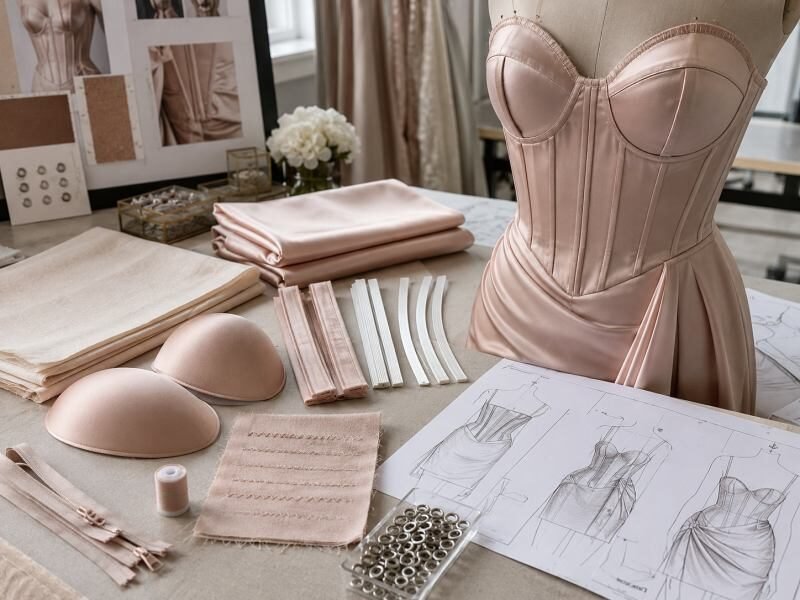
A corset dress can look perfectly smooth on a hanger and still fail within minutes of being worn. The neckline may move away from the body, the waist may crease, one side may sit lower than the other, or a bone may press into the wearer whenever she sits. These problems are often blamed on “weak boning,” but boning is only one part of a larger support system.
Boning supports a corset dress by reinforcing the bodice vertically, controlling fabric collapse, and helping the garment retain the three-dimensional shape created by its pattern. Reliable support comes from the combined action of the bones, fitted panels, strength layer, cups, waist anchoring, closures, and suitable fabric. Boning preserves shape; it cannot replace accurate fit or sound construction.
For fashion brands, the practical question is not simply whether a dress contains bones. Product teams need to know which material is used, where each bone is positioned, how it is enclosed, and whether the complete bodice remains stable across sizes and through normal movement. Two dresses can use the same plastic boning and produce completely different results. One stays smooth through an evening of sitting, walking, and dancing; the other wrinkles at the waist before the wearer reaches the door. The difference is usually hidden inside the bodice—and that hidden construction is where successful corset-dress development begins.

What Does Boning Do in a Corset Dress?
Boning gives a corset dress vertical stability. It helps the bodice resist folding, rolling, and collapsing under bust pressure, waist tension, body movement, and skirt weight. Boning does not create fit by itself; it preserves the shape already built through the pattern, cups, inner layers, seams, closure, and waist anchoring.
Vertical Stability
A fitted bodice is under pressure from several directions. The bust pushes outward, the waist pulls inward, the skirt may pull downward, and ordinary movement compresses the torso whenever the wearer sits, turns, or bends. Without internal support, soft panels can shorten vertically and form horizontal wrinkles around the waist or lower bust.
Boning keeps selected areas of the bodice extended. It acts like a narrow structural rail inside the garment, reducing the amount of fabric that can fold between the neckline and waist. The result is a cleaner front, straighter seam lines, and better control around the sides and back.
The effect is most noticeable in strapless corset dresses, bustier dresses, fitted satin styles, mesh-panel party dresses, bodycon dresses with structured upper sections, and occasion dresses carrying heavier skirts. A bone must bend enough to follow the torso but resist collapsing across its width. If it is too soft, it can buckle at the waist; if it is too rigid, it can force the garment away from the body or create pressure at the underarm and hip.
Fabric Control
Boning does not stop fabric from stretching in every direction. Its main job is to limit uncontrolled vertical compression. That distinction is especially important in stretch fabrics and lightweight outer layers.
Stretch mesh can still expand around the body even when the panel is boned. If its recovery is weak, the dress may become looser during wear. Boning may keep the panel upright, but it cannot restore lost recovery. Satin can remain vertically stable yet still show rippling when the seams, interlining, pressing method, or zipper area are poorly controlled.
A strong corset dress divides responsibility correctly. Boning maintains vertical extension; the pattern creates shape; the strength layer carries tension; cups position the bust; the waist anchors the bodice; and the closure maintains circumference. When one element is asked to perform another element’s job, the dress usually feels stiff without becoming more secure.
Component | Main role | Common problem when incorrect |
Boning | Maintains vertical extension | Buckling, rolling, or collapsed panels |
Pattern | Creates bust, waist, and torso shape | Gaping, pulling, or incorrect balance |
Strength layer | Carries and distributes tension | Distortion, weak channels, or stretched seams |
Cups | Shape and position the bust | Empty cup areas, compression, or poor lift |
Waist fit | Anchors the bodice | Dress slides, rotates, or drops |
Closure | Maintains circumference | Zipper rippling, back gaping, or uneven tension |
What Boning Cannot Fix
Adding stronger or additional bones is often the first reaction when a sample looks weak. In many cases, however, the underlying problem is insufficient bust volume, an incorrectly positioned cup, excessive torso length, weak fabric recovery, poor zipper stabilization, or an unbalanced side seam.
When a bodice slides downward, loose waist anchoring is often more important than bone stiffness. When the neckline gaps, the upper-chest pattern may be too long. When the waist wrinkles, the torso may be overlength or the panel may be trapped between two rigid points.
The direction of the wrinkle is useful evidence. Horizontal creases usually point to vertical collapse or excess length. Diagonal drag lines often indicate balance or circumference problems. Local pressure marks near the ends of the bones suggest that length or placement needs correction. Reading these signals is more effective than simply adding rigidity.
Support Versus Stiffness
Support and stiffness are not the same. A dress can feel extremely rigid and still provide poor support when the pattern does not fit the body. A more flexible bodice can remain secure when the waist, cups, panels, and inner foundation share the load correctly.
Fashion corset dresses usually need controlled support rather than traditional waist reduction. The garment should hold a clean silhouette through several hours of standing, sitting, walking, and dancing without feeling like a rigid shell.
A lightly structured party bodice may begin with four to eight support positions. A medium corset construction may use eight to twelve. More complex structures can require additional channels, particularly when the bodice contains many narrow panels or supports a heavier skirt. These are development ranges rather than fixed standards. Bone count must follow the silhouette, size range, fabric, and panel layout.

How Does Boning Shape the Bodice?
Boning supports the three-dimensional shape created by the bodice pattern. It keeps bust panels extended, helps the waist remain defined, controls side seams, and stabilizes the transition between the upper body and skirt. The visible silhouette comes from pattern engineering; boning helps that silhouette survive movement and repeated wear.
Bust Support
Boning does not lift the bust by pushing directly upward. Bust support comes from the way forces are distributed through cups, underbust seams, shaped panels, side support, waist anchoring, and the closure. Bones keep those components from folding or shifting under load.
A front princess bone can stabilize the area beside the bust. A side bone can reduce outward collapse. Center-front reinforcement can maintain neckline height and prevent the front panel from shortening. None of these positions can compensate for a cup that is too shallow or a bust apex that sits in the wrong place.
For fuller-bust sizes, stronger support often requires changes to cup depth and width, underbust shaping, side-front panel geometry, upper-bust coverage, bust-to-waist length, waist circumference, and inner-layer firmness. Simply using a harder bone can increase pressure without improving lift. Side-view fitting is essential because a front view may look acceptable while the side view reveals low bust placement or forward compression.
Waist Definition
The waist shape of a corset dress is created by the pattern. The panels narrow through the waist and expand toward the bust and hip. Boning keeps these shaped panels from folding where the circumference is smallest.
A secure waist also provides an anchor. In a strapless design, the garment should rest partly on the waist and lower rib area rather than hanging from the bust. If the waist is too loose, the dress can slide downward even when the bones are strong. If it is too tight, pressure can cause wrinkling above and below the waistline.
The required shaping depends on the product concept. A fashion corset mini may need light contouring and easy movement. A structured occasion dress may need firmer definition to support a heavier skirt. Product specifications should distinguish decorative corset styling, light internal shaping, medium structural support, and stronger corset construction.
Silhouette Control
Boning improves the silhouette by keeping structural lines visually stable. Princess seams appear straighter, side panels remain controlled, and the neckline is less likely to collapse or twist. The transition from bust to waist also looks more deliberate.
Five zones should be reviewed together: neckline contact, bust position, underbust control, waist definition, and the bodice-to-skirt transition. A weakness in one zone can affect the entire garment. A heavy gathered skirt may pull the waist seam downward, while a rigid front panel may push the neckline away from the chest.
Photography often exposes structural issues that are less obvious during a quick fitting. E-commerce images reveal uneven neckline height, different cup positions, zipper waviness, or small folds at the waist. A balanced internal structure reduces styling adjustments and helps the dress present consistently from front, side, and back views.
Bone Count and Panel Design
More bones do not automatically produce a better shape. The distance between support positions, the direction of the seams, and the width of each panel matter more than the total count.
Wide panels can wrinkle between bones because too much fabric remains unsupported. Narrow panels often hold their shape more effectively, especially when their seam lines follow the body contour. Extra channels, however, increase bulk and can show through smooth fabrics.
Every added bone should solve a defined structural problem. Wrinkles between two support points may call for closer spacing or a firmer strength layer. A twisting side panel may need a different bone material. A collapsing neckline may need edge stabilization instead of more waist boning. A buckled lower bodice may need corrected torso length or shorter bones.

Which Boning Types Work Best?
The best boning depends on the required support, body curvature, dress weight, fabric, wearing time, care method, and target price. Plastic boning suits many fashion corset dresses, spiral steel follows curved areas well, and flat steel gives stronger resistance in straighter, high-tension zones. No material is ideal for every panel.
Plastic Boning
Plastic boning is common in commercial fashion dresses because it is lightweight, easy to cut, and compatible with many industrial sewing methods. It can perform well in party dresses, strapless minis, bodycon styles, and bustier dresses that need moderate structure rather than strong waist reduction.
Common development widths often fall between 6 and 12 millimetres, although thinner and wider products are available. Width alone does not determine performance. Thickness, material density, flex direction, edge finish, heat response, and recovery after bending are equally important.
Plastic should be tested for permanent bending, twisting inside curved channels, visibility beneath the outer fabric, and compatibility with the care method. A lightweight strip may work perfectly in a short party dress yet struggle under a long, heavy occasion skirt. The same material can also behave differently across sizes because body curvature and panel length change the forces applied to it.
Spiral Steel
Spiral steel bends in several directions, allowing it to follow curved seams and body movement more naturally than a rigid flat strip. It is often useful along princess seams, side-front panels, side-back panels, and longer corset sections that require support with lateral flexibility.
Common fashion and corsetry widths are roughly 5 to 10 millimetres, with the final choice depending on garment scale and required strength. Steel thickness and coil quality affect recovery as much as width does.
Spiral steel resists permanent kinking better than many soft plastics, but it requires controlled cutting, safe end finishing, and accurately sized channels. Poorly capped ends can damage the casing or become a safety risk. Metal also adds weight and may affect care instructions. It is not automatically a premium solution: a poorly fitted steel-boned dress can be less comfortable than a well-engineered plastic-boned one.
Flat Steel
Flat steel bends strongly in one main direction and resists lateral flexing. It is useful in selected areas that need a firm, straight support line, such as a center-front panel, a straight back opening, a lacing edge, or a high-tension closure zone.
Common widths often range from about 5 to 12 millimetres. Metal thickness changes the feel significantly, so two strips with the same width may provide very different resistance.
Flat steel is less suitable for highly curved seams because it can press away from the body or create hard contact points. Using it at every seam can make a fashion bodice unnecessarily rigid. Its value comes from targeted use where a particular line must remain straighter than the surrounding panels.
Material Selection
Boning should be selected inside the actual dress rather than judged only as a loose trim. Once enclosed between outer fabric, interlining, lining, seam allowances, and body tension, its behaviour can change significantly.
Mixed systems often produce the best balance. A dress may use firmer reinforcement at the center front or beside the back closure and more flexible materials along curved side panels. The material must also match the expected wear duration, garment weight, pressing process, shipping conditions, and target price.
The ranges in the table below are practical starting points, not universal rules. Supplier construction, fabric thickness, size range, channel method, and support level must be tested in a complete sample before production approval.
Dress construction | Practical boning direction | Common width range | Main development risk |
Lightweight party mini | Flexible plastic | 6-10 mm | Permanent bending or visible ends |
Stretch bodycon corset | Flexible plastic or spiral steel | 6-10 mm | Twisting and poor fabric recovery |
Structured satin midi | Firm plastic or mixed system | 8-12 mm | Channel ridges showing through satin |
Heavy occasion dress | Spiral steel or mixed reinforcement | 6-10 mm | Skirt weight pulling the bodice down |
Straight center front | Flat steel may be suitable | 5-12 mm | Excessive rigidity |
Curved princess seam | Spiral steel or flexible plastic | 5-10 mm | Pressure where the seam changes direction |

How Should Boning Be Positioned?
Boning should follow the areas where the bodice needs vertical control. Princess seams, side seams, center panels, and closure edges are common positions, but placement must respond to bust shape, panel width, waist location, fabric behaviour, and wearer movement. Incorrect placement can create pressure, twisting, gaping, or visible ridges.
Support Lines
Princess seams are common boning positions because they shape both the bust and waist. Side seams help control the torso and reduce outward folding. Center-front reinforcement can stabilize a low neckline or long front panel. Back bones can support zipper or lacing tension.
Boning does not have to sit directly on a seam. A wide panel may need an independent internal channel when the distance between seam lines leaves too much unsupported fabric.
A useful support map records each bone position, material, width, upper and lower stopping points, relationship to cups and waistline, relationship to the closure, channel construction, and end-finishing method. Pattern, sample, sewing, and quality teams should work from the same map rather than relying on memory or an internal detail that is difficult to see.
Length and End Position
Bone length is as important as placement. A strip that finishes too high can press into the underarm, breast tissue, or neckline edge. A lower end that extends too far can dig into the waist, hip, or lap when the wearer sits.
Bones are generally shorter than the full channel so the ends can be safely enclosed without pressing against seam intersections. The exact clearance depends on the casing, cap, fabric thickness, and construction method. Too much free space, however, can allow the bone to migrate or twist.
Length must be graded across sizes. Using one length for every size ignores changes in torso length, bust depth, and hip relationship. During fitting, the wearer should sit upright, lean forward slightly, rotate, raise both arms, take a deep breath, and walk. These movements reveal pressure and migration that are invisible during a static standing check.
Panel Spacing
The space between bones determines how much unsupported fabric can collapse. A firm non-stretch foundation can usually span a wider distance than lightweight mesh or stretch satin. Smooth outer fabrics also reveal internal channels more easily, so adding support may improve stability while reducing surface quality.
A wrinkle should be diagnosed before a new channel is added. Horizontal folding between two support points may indicate excessive spacing. Diagonal wrinkles often come from pattern balance. A fold directly above the waist may result from excess torso length, while rippling near a zipper may point to uneven tension or insufficient stabilization.
Bone spacing should follow the stress map of the garment rather than a fixed distance rule. The bust side, waist, closure edge, and long front panel can need different levels of support even when they appear similar in width.
Bodice zone | Common support position | Main purpose | Placement risk |
Center front | Front panel or front seam | Maintain neckline and front length | Excessive stiffness |
Side front | Princess seam or independent channel | Support bust-side transition | Flattening or pressing the bust |
Side seam | Seam channel | Control torso and lateral collapse | Underarm pressure |
Side back | Curved panel or seam | Smooth the back contour | Twisting on curved seams |
Center back | Beside zipper or lacing | Stabilize closure tension | Visible zipper ridging |
Wide panel | Independent internal channel | Reduce unsupported folding | Surface show-through |
Channel Construction
A boning channel holds the strip in position and protects the wearer from direct contact. It can be formed from seam allowances, separate casing tape, a stitched inner foundation, or a dedicated structural layer.
The channel should be wide enough for the bone to flex without twisting. A practical starting clearance is often about 1 to 2 millimetres wider than the finished bone, depending on bone thickness, casing material, and sewing method. This must be confirmed through sampling because a soft tape and a thick seam allowance behave differently.
A channel that is too narrow can grip the bone, create surface ridges, restrict flexing, or distort a curved seam. A channel that is too wide can allow twisting, migration, clicking, and uneven support. Ends must be rounded, capped, or otherwise finished so they cannot cut through the casing, and the upper and lower closures must withstand wear and cleaning.

How Do Fabric and Fit Affect Support?
Boning works only when the fabric and fit allow it to work. The outer fabric controls appearance, the inner foundation carries tension, the pattern creates body shape, and the waist, cups, and closure hold the dress in position. A weak material or inaccurate fit can make even strong boning ineffective or uncomfortable.
Fabric Behaviour
Every fabric creates a different structural risk. Satin can reveal seam puckering and internal ridges. Mesh looks light but may not carry concentrated tension. Stretch jersey can grow and lose recovery. Velvet adds weight and shifts during sewing. Sequin fabric can be heavy, abrasive, and difficult to press.
Six properties should be reviewed before approving a corset dress: drape, firmness, stretch percentage, stretch recovery, opacity, and surface sensitivity. Stretch percentage alone is not enough. Two fabrics may both stretch by 20 percent, yet one returns immediately while the other remains extended after wear.
The sample material and bulk material should be compared for weight, elastane content, finish, knitting or weaving tension, and recovery. Structured dresses are less forgiving of small material changes because the internal components hold fixed positions while the fabric around them changes.
Inner Foundation
The inner foundation carries much of the tension that appears to come from the outer fabric. It supports boning channels, stabilizes seams, holds cups, and prevents the face fabric from carrying loads it was not designed to carry.
Possible foundation materials include stable woven interlining, non-stretch mesh, firm lining, fused reinforcement, separate corset panels, and local reinforcement around closures and cups. The structural layer and comfort lining may be different materials: one provides strength, while the other creates a smooth surface against the skin.
A weak foundation can cause channel stitching to pull, zipper areas to stretch, cup positions to move, bones to show through the outer fabric, and seam allowances to separate. The full material stack should be approved together because outer fabric, reinforcement, cups, seam tape, boning, and lining must behave as one system.
Pattern and Fit
The pattern controls where every structural component sits on the body. Even a perfectly sewn channel will feel wrong when torso length, bust point, waist position, or circumference is inaccurate.
Five measurements have a direct effect on support: bust circumference, underbust circumference, waist circumference, bust-point position, and neckline-to-waist or shoulder-to-waist length. A small length error can create a major defect. An overlong bodice can buckle at the waist, while a short bodice can pull the neckline down or press the bones into the ribs.
Fit must also be reviewed across the size range. Corset grading is more complex than adding equal amounts at every seam. Bust volume, cup spacing, waist suppression, panel curvature, and bone length may require different growth rules. For high-risk fitted styles, checking the base size plus at least one smaller and one larger size is a practical minimum.
Comfort and Movement
A corset dress can feel secure without feeling restrictive. Comfort depends on pressure distribution rather than simple softness.
Frequent causes of discomfort include bones ending near the underarm or hip crease, cups that are too shallow, excessive waist reduction, thick seam intersections, twisted channels, rough end finishing, non-breathable lining, and closures that concentrate tension at the back.
A five-minute standing fitting is not enough for a party or occasion dress that may be worn for several hours. The wearer should sit, dine, walk, turn, and raise her arms. Useful comments identify the exact location and action—for example, “lower front bone presses into the lap while seated” or “neckline moves away after walking.” Specific comments lead to specific corrections; “too stiff” does not reveal whether the problem is material, length, fit, or layer thickness.
How Is Boning Controlled in Production?
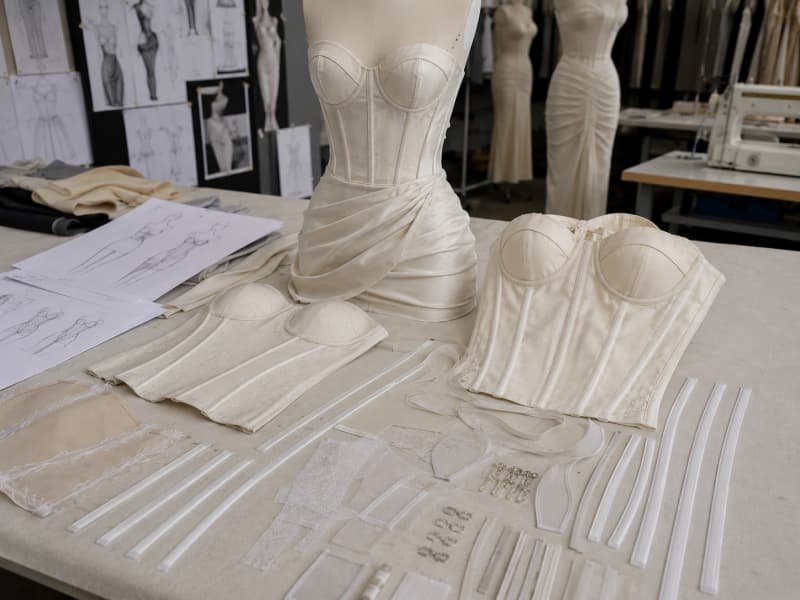
Boning is controlled through approved specifications, locked materials, fit-approved samples, first-piece checks, clear sewing instructions, and repeated inspections. Production control must cover material, width, length, placement, channel construction, end finishing, symmetry, surface appearance, comfort, and consistency across sizes and batches.
Sample Approval
The sample stage must prove that the complete support system works. Visual similarity to a sketch is not enough. The garment should remain stable during movement and maintain the intended silhouette from front, side, and back.
The review should confirm bone material and stiffness, width and thickness, position against the pattern, left-right symmetry, upper and lower length, channel width, end finishing, cup relationship, neckline contact, waist anchoring, closure behaviour, and surface visibility.
Changes should be made in a controlled sequence. Altering the pattern, cups, bones, and lining in the same revision can hide the true cause of a problem. Comments should be measurable: “move the side-front bone 8 mm toward the princess seam” is more useful than “add support.” A good revision records both what changed and why the correction must be carried into bulk.
Pre-Production Control
Before cutting bulk fabric, the structural components must be locked. Production teams need exact supplier references, composition, finished width, thickness or grade, length by position and size, channel method, cup reference, lining and interlining reference, closure specification, seam allowance, critical measurement tolerance, and end-finishing method.
A first production piece should be checked against the approved sample in three dimensions. Flat measurements cannot confirm bust projection, neckline contact, or seated comfort. The first piece should also verify that production machines, operator methods, pressing, and seam handling reproduce the sample construction.
For complex corset dresses, a short pilot run can reveal repeated problems before the full quantity moves through the line. Channel twisting, inconsistent bone lengths, zipper distortion, or visible ridges are far less expensive to correct in a pilot than after hundreds of garments have been lined and closed.
Inspection Points
Boning-related checks should be placed at several stages rather than left for final inspection. Incoming material must match the approved reference. Cut lengths should be controlled by position and size. Channel width and straightness should be checked on first pieces from each operator. Insertion must follow the support map, and channel ends must be secured.
Inline inspection is particularly important for satin, mesh, and other surface-sensitive materials because internal defects become difficult to repair after the lining and outer layer are fully closed. Measurements must be taken from defined points; otherwise two inspectors may record different lengths from the same garment.
Selected pieces should be reviewed on a mannequin or fit model after operator changes, material-batch changes, or line transfers. A garment can pass a flat table check and still fail through neckline movement, bust compression, or underarm pressure.
Stage | Main checks | Practical control |
Incoming materials | Width, stiffness, surface, recovery | Compare with approved trim reference |
Cutting preparation | Length by position and size | Use labelled bundles or cutting templates |
Channel sewing | Width, straightness, symmetry | Check first pieces from each operator |
Bone insertion | Correct position and direction | Match bundle code to support map |
Channel closure | Secure ends and no sharp contact | Use hand-feel and visual inspection |
First-piece review | Fit, neckline, waist, movement | Compare with approved sample |
Inline inspection | Missing, twisted, or uneven bones | Run random checks during sewing |
Final inspection | Shape, comfort, surface, symmetry | Table check plus mannequin or fit review |
Common Defects and Bulk Consistency
High-risk defects include missing bones, the wrong material, incorrect lengths, left-right asymmetry, twisted strips, sharp ends, open channel ends, incorrect placement, visible ridges, waist buckling, underarm pressure, closure distortion, cup misalignment, and migration after care.
Bulk consistency depends on controlling the material batch, cutting length, channel width, operator method, pressing temperature, seam allowance, cup attachment, closure stabilization, grading rules, and final finishing. A substitute bone with similar dimensions may still have different recovery or heat behaviour, while a new lining batch may stretch more than the approved one.
The real quality standard is not that boning is present. It is that every garment reproduces the approved support level, fit, comfort, and visual balance. A well-made corset dress feels secure while keeping its internal engineering out of sight. The wearer notices the silhouette, not the bones.
Corset-dress support is not created by stiffness alone. It comes from the way pattern shape, cups, strength layers, boning, closures, fabric, and production control work together. When those elements are balanced, the dress holds its silhouette without constantly reminding the wearer that a support structure is inside it.
Duolan Apparel develops fashion-driven corset, bustier, party, occasion, and fitted dresses for established fashion brands and product teams. Based in Shenzhen, Guangdong, the company’s dress-focused development process covers fabric and trim matching, pattern engineering, fit correction, sample development, pre-production locking, first-piece verification, and bulk quality control. The wider manufacturing system supporting Duolan includes dedicated pattern, sample, sourcing, production, and quality teams, with experience in structure-sensitive dress categories.
For a corset-dress development review, send the tech pack or reference images, size chart, target fabric, intended level of support, expected order plan, and any known fit concerns. These materials allow the development team to assess the structure, identify likely risks, and prepare a clearer sample-to-bulk route before production decisions are made.
Share:
Our Services
Categories
Table of Contents
Here, developing fashion collections is more than manufacturing garments — it’s a collaborative process focused on transforming ideas into well-executed, market-ready products. From fabric sourcing and sample development to scalable production and delivery coordination, every stage is built to support quality, consistency, and efficient collection launches across global markets.