Skip to content
Sew-through Boning vs Boning Channels: Which Is Better for Structured Dresses?
Your trusted Women’s Apparel Development & Manufacturing Partner from China
- Jerry
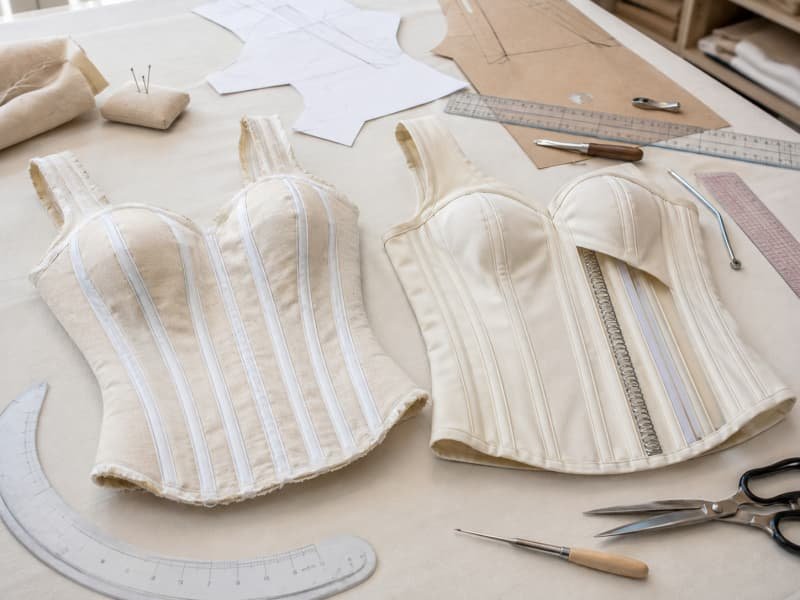
Boning is one of those details that looks simple on a technical sketch and becomes surprisingly complicated once a fitted dress reaches the sample room. A soft strip hidden inside a bodice can determine whether a neckline stays level, whether a waist seam collapses after sitting, and whether a smooth satin panel still looks clean under studio lighting. The real decision is not merely whether a garment contains boning. It is whether the support method matches the silhouette, fabric, body pressure, wearing time, and production process.
Sew-through boning is usually the better option for lightweight shaping, flexible support, and fewer sewing operations. Boning channels are generally better when a garment needs stronger support, protected or replaceable bones, curved steel components, or a cleaner internal foundation. The correct choice depends on the required function, bone material, fabric behavior, fit pressure, target price, and repeat-production standard.
A common development mistake is to treat these methods as a simple budget choice. In practice, the cheaper-looking construction can become expensive if it creates puckering, permanent waist kinks, uncomfortable pressure points, or high rework rates. The opposite is also true: adding steel bones and heavy channels to a soft fashion bodice may increase cost and stiffness without improving the customer experience. The most reliable decision starts with one question: what must the structure actually do when the wearer stands, sits, breathes, dances, and moves through a full evening?
What Is the Difference Between Sew-through Boning and Boning Channels?
Sew-through boning is stitched directly onto an internal garment layer, while a boning channel is a fabric casing that holds a separate bone. Direct attachment is usually lighter and faster. Channels accept more bone types, separate the support from delicate fabrics, offer greater structural control, and make adjustment or replacement easier during development.
Direct Attachment
Sew-through boning usually refers to flexible polyester filaments woven into a narrow strip that a sewing-machine needle can penetrate. It may be attached to a seam allowance, underlining, lining, or dedicated internal foundation. Depending on the product, the operator may sew along both edges, through marked sewing zones, or down a central band. The supplier specification matters because products that appear similar can respond very differently to needle penetration, heat, bending, and repeated wear.
This method is most effective when the bone is controlling the garment rather than trying to reshape the body. It can keep a side seam upright, support a softly fitted bustier panel, reduce vertical collapse, and help a strapless neckline remain smooth. These are common needs in fashion corset tops, party dresses, costumes, dance garments, and selected occasion styles where the visual effect is structured but the garment is not intended to create strong waist compression.
The production advantage is straightforward: there is no separate casing to cut, apply, measure, load, and close. Fewer operations can shorten sewing time and reduce component handling. The limitation is that the bone becomes part of the stitched structure. Once the lining is closed, removing it may require opening the garment and unpicking several rows. Direct attachment can also transfer ridges or stitch lines through pale satin, thin crepe, or other fabrics that reveal internal pressure easily.
Channel Construction
A boning channel is a narrow fabric passage designed to hold a separate bone without stitching through the bone itself. The channel may be formed from seam allowances, twill tape, bias binding, coutil, lining fabric, corset mesh, or specialist casing. It can remain visible as part of the design or sit between the outer fabric and lining, where the structure is completely hidden from the finished surface.
Channels support a much broader material range. Flexible plastic, synthetic whalebone, spiral steel, flat steel, and spring steel are normally installed this way. The bone can move slightly inside the casing as the wearer bends, provided the channel is correctly sized. During sampling, the bone can also be removed or changed before the opening is permanently closed, which is useful when the team is comparing stiffness, length, or placement.
The additional control comes with additional operations. Channel width, seam direction, curve, end clearance, fabric strength, and stitching accuracy all have to be managed. A channel that narrows by only a small amount can block insertion halfway through a long panel. A channel that is too loose can let a flat bone rotate or create an uneven ridge. The method is not inherently superior; it is simply capable of handling stronger and more varied support systems when executed correctly.
Key Differences
The most useful comparison begins with function. A soft corset-inspired top and a structured strapless occasion dress may appear similar in campaign photography, but they create very different internal pressures. The first may need only enough support to stop fabric collapse. The second may need to stabilize the bust, maintain neckline height, resist tension from a zipper or lace-up closure, and remain comfortable through several hours of sitting and movement.
The table below presents practical differences rather than absolute rules. Actual performance changes with bone width, thickness, length, fabric layers, seam position, and body shape. A carefully selected sew-through system can outperform a poorly made steel channel, while a correctly engineered channel can provide support that lightweight woven boning cannot deliver. The decision should therefore be based on the approved garment result, not on the perceived status of the construction method.
Comparison Point | Sew-through Boning | Boning Channels |
Basic construction | Bone stitched directly to a support layer | Separate bone inserted into a fabric casing |
Typical support range | Light to medium | Light to strong, depending on bone |
Common materials | Sewable polyester or woven plastic | Plastic, synthetic whalebone, spiral steel, flat steel |
Sewing operations | Fewer operations | More preparation, insertion, and inspection |
Replacement | Difficult after the lining is closed | More practical during sampling and repair |
Curved seams | Works on gentle curves | Spiral steel can follow complex curves |
Main visual risk | Ridges or stitch lines through thin fabrics | Channel bulk or uneven channel spacing |
Typical use | Fashion bodices and soft bustiers | Corset dresses and structured occasionwear |
Not Always an Either-or Choice
Sewable boning can also be placed inside a channel. This is useful when a brand wants lightweight support but prefers to keep stitching away from a delicate outer fabric. It can also make sample changes easier because the bone remains removable until the channel is closed. The term sew-through describes what the material permits; it does not require the development team to stitch directly through it in every garment.
Mixed structures are common in well-developed fitted dresses. A style may use firmer bones near the center-back closure, flexible bones along curved princess seams, and no boning at the center front because cups, interfacing, and shaped seams already provide sufficient control. This approach places support where the garment experiences pressure instead of adding equal stiffness to every panel, which can make the dress lighter and easier to wear.
Boning must also be evaluated as part of the complete internal architecture. It cannot correct an inaccurate bust shape, an overly long torso, a weak neckline edge, unstable seam allowances, or stretch fabric with poor recovery. The best results come when the pattern, bone, cups, lining, waist stay, closure, elastic, and outer fabric are tested as one system rather than approved as unrelated components.
Which Method Gives Better Support and Fit?
Boning channels offer the wider support range because they can contain rigid and multidirectional bones. Sew-through boning works well for flexible shaping and light stabilization. Neither method guarantees good fit by itself; placement, torso length, bust balance, fabric recovery, seam direction, closure strength, and the amount of pressure created during wear remain equally important.

Light Support
Light support is appropriate when the garment needs to hold its visual shape rather than compress the torso. A corset-inspired top, softly fitted party dress, or strapless style may already receive most of its stability from molded cups, elastic, interfacing, a waist stay, and the pattern itself. In these cases, sew-through boning can keep long seams upright, limit rolling, and reduce vertical collapse without making the bodice feel heavy or rigid.
The support level should be judged on the finished garment rather than by bending a loose strip on the worktable. A material that feels firm at room temperature can soften against body heat and fold sharply at the natural waist. During development, the sample should be worn while standing, walking, sitting, raising the arms, and turning the torso. A practical wear trial of at least 20 to 30 minutes often exposes problems that a brief mirror fitting does not reveal.
After the trial, the team should inspect the bone and the fabric around it. Permanent kinks, diagonal drag lines, a neckline that drops, or a side seam that shifts forward indicate that the support system is underperforming or incorrectly positioned. These symptoms do not always require a stronger bone. The real cause may be an inaccurate waistline, poor fabric recovery, or a panel that is transferring too much tension to one narrow support point.
Corset Support
A true corset dress places greater demand on its internal structure than a dress with corset-style topstitching. The garment may need to stabilize the bust, maintain a strapless neckline, control the waist, resist pressure from a center-back zipper or lace-up closure, and remain comfortable during a long social event. Channels are generally more suitable because they permit stronger bone materials and more precise control over where different kinds of resistance are used.
Spiral steel bends forward, backward, and sideways, so it performs well along curved princess seams and shaped torso panels. Flat steel offers stronger resistance to side bending and is often used near center-back closures or other straighter areas. Synthetic whalebone can provide a lighter alternative in selected structures, but its suitability still depends on width, thickness, length, heat response, and the amount of force created by the pattern and closure.
More stiffness is not automatically better. An overly rigid bone can dig into the hip, push the neckline away from the body, or make an incorrect torso length more uncomfortable. If the bust balance is wrong, stronger steel will not correct the cup shape; it may simply make the fault harder to ignore. The intended function should be defined clearly as decorative corset styling, light smoothing, bust stabilization, strapless support, moderate waist shaping, or strong body control.
Garment Function | Typical Support Direction | Likely Starting Method | Development Check |
Reduce seam collapse | Light vertical control | Sew-through boning | Sit test and inspect waist kinking |
Stabilize strapless neckline | Medium vertical and bust support | Channels or mixed structure | Raise arms and check neckline drop |
Support curved corset panels | Strong multidirectional control | Spiral steel in channels | Check curve, pressure, and symmetry |
Control center-back closure | Strong straight resistance | Flat steel in channels | Cycle closure and inspect distortion |
Create moderate waist shaping | Distributed torso resistance | Mixed channel system | Long wear trial and breathing comfort |
Decorative corset appearance | Visual structure only | Light sew-through or empty channels | Confirm weight and surface appearance |
Comfort and Movement
Comfort depends on how the support behaves when the body changes position. The torso shortens while sitting, the waist expands during breathing and eating, and the rib cage moves continuously. A bone that appears perfectly placed while the wearer stands can become uncomfortable in a car, at a dinner table, or on a dance floor. Fit approval therefore needs movement, not just a front-and-back visual check on a static model.
Channels can improve comfort by creating a barrier between the bone and the lining and by allowing a small amount of controlled movement. They also make it easier to round, cap, or protect the bone ends. A thick casing placed directly beneath a thin lining, however, may create a hard ridge. An oversized channel can let a flat bone twist, producing a sharper pressure point than a correctly installed sew-through strip.
The most sensitive locations are usually the underarm, lower rib, waist crease, and upper hip. Boning should not finish directly where the body folds. Depending on the construction, sample teams often begin with approximately 8 to 15 millimeters of clearance from a finished seam or turning edge, then adjust after fitting. This range is not a universal specification; torso length, bone stiffness, seam shape, and garment use can require a different result.
Durability and Recovery
Durability is determined largely by whether the selected bone is working within its intended pressure range. Flexible sew-through boning can perform reliably in lightly structured garments. Problems develop when repeated sitting forces it into a sharp waist fold, when the bone is too long for the wearer’s torso, or when dense rows of stitching weaken the woven material. Permanent deformation is a warning that the support is being asked to perform beyond its capability.
Channels usually offer better serviceability because the bone can sometimes be removed and replaced before the garment is permanently closed. They can also contain materials with stronger recovery, including spiral steel and selected synthetic bones. The casing still needs to match the component. A light lining channel may work with flexible plastic but wear quickly against a poorly finished steel edge or a bone that repeatedly strikes the same stopping point.
Testing should reflect the customer’s likely use. A party dress should be assessed through repeated sitting, walking, dancing, and upper-body movement. A structured occasion dress may need to remain stable for six to eight hours. Care testing should follow the proposed label claim because washing, dry cleaning, pressing, and heat can change plastic stiffness, shrink casing materials, expose ridges, or weaken adhesives used in the internal foundation.
How Do Fabric and Boning Type Affect the Choice?
The correct construction depends on how the bone, outer fabric, lining, and support layer behave together. Satin reveals ridges, mesh exposes internal engineering, stretch jersey can grow around rigid supports, and velvet may shift during sewing. Flexible sew-through boning suits lighter systems, while steel and firmer plastic bones usually require stable channels and stronger foundations.

Bone Materials
Only materials specifically designed for needle penetration should be treated as sew-through boning. Woven polyester is the most familiar option, but its behavior varies with width, thickness, filament density, and supplier construction. A machine needle passing through a sample once does not prove that the material is suitable for repeat production. The team should confirm needle wear, skipped stitches, fraying, heat response, and the effect of repeated perforation along the approved stitch line.
Spiral steel is formed from flattened metal wire and bends in more than one direction, which makes it useful on curved seams. Flat steel, sometimes called spring steel, resists sideways bending and provides stronger control along straight areas. Synthetic whalebone can create smooth shaping with less weight than steel in some garments. Standard plastic boning varies widely; two pieces with the same nominal width can have very different recovery after heat and bending.
Material descriptions such as plastic bone or metal bone are too vague for a production technical pack. The approved specification should include the supplier reference, nominal width, measured thickness, color, finish, and intended position. Length also changes behavior. A 10-centimeter sample may feel firm in the hand, while the same material at 35 centimeters can appear much more flexible inside a longline bodice.
Fabric Behavior
Reflective satin exposes small construction faults because light travels across the surface. A channel that is only slightly uneven may create a visible ridge, while a directly attached bone can produce parallel stitch lines or pressure marks. Pale colors and tightly fitted panels make these effects more noticeable. A stable underlining often helps distribute pressure, but it must be tested because excessive stiffness can change the drape and make the garment feel board-like.
Mesh creates the opposite challenge: the support system is visible. Channel width, thread quality, color matching, seam allowances, bone position, and end finishing become part of the design. Transparent corset dresses often require cleaner internal engineering than opaque styles because there is nowhere to hide irregular tape application or bulky reinforcement. The technical team should approve both the structural performance and the visual rhythm of the channels across the body.
Stretch jersey can grow around a stable internal foundation, causing bubbling, twisting, or uneven tension. Stretch percentage and recovery should be measured in both directions, and the pattern should account for the difference between the elastic outer fabric and the controlled layer beneath it. Velvet may shift during narrow channel sewing and show pile damage after pressing. Sequin fabric normally needs a separate foundation because dense embellishment creates bulk and can interfere with accurate channel stitching.
Material or Fabric | Typical Behavior | Main Risk | Practical Starting Direction |
Sewable polyester boning | Flexible and lightweight | Permanent waist kinking | Use for light shaping; complete a seated wear test |
Spiral steel | Strong multidirectional recovery | Weak or narrow casing | Use stable channels on curved seams |
Flat steel | Strong straight resistance | Pressure on curved body areas | Use near closures and straighter support zones |
Satin | Reflective and surface-sensitive | Ridges and puckering | Use a tested underlining and hidden channels |
Mesh | Transparent and visually exposed | Untidy internal construction | Treat channel placement as part of the design |
Stretch jersey | Elastic with variable recovery | Growth around rigid support | Measure stretch and control with a stable foundation |
Velvet or sequins | Bulky or difficult to feed | Channel distortion and surface damage | Carry boning on a separate internal layer |
Channel Dimensions
The finished internal channel width should allow smooth insertion while preventing excessive twisting. A practical development starting point is often approximately 1 to 2 millimeters wider than the nominal bone, but this is not a universal rule. Bone thickness, edge shape, end caps, casing compression, seam curve, and operator variation all affect the amount of usable internal space after sewing.
An 8-millimeter bone may initially be tested in a channel with a finished internal width of around 9 to 10 millimeters. A thick tipped steel bone may need more clearance, while a thin flexible plastic bone may rotate in the same space. Long channels are especially sensitive because a narrowing of only 1 millimeter can block insertion halfway through the panel, even when the opening appears correct at the top.
The team should measure several sewn channels rather than relying only on the paper pattern. Fabric compresses under stitching, applied tape can stretch, and curved seams can close the internal space. The final technical file should record the bone reference and the approved channel dimension together. Keeping only one of these values allows a repeat order to use the correct bone inside an incorrect casing, changing fit, comfort, and visual appearance.
Layering and Support
Boning rarely performs best when it sits directly against the fashion fabric. Structured dresses commonly use a stable layer to distribute pressure, such as cotton underlining, woven fusible, non-stretch lining, corset mesh, coutil, or another foundation selected for the product’s weight and price level. The support layer should be strong enough to hold the channel stitches without becoming so heavy that it changes the intended hand of the dress.
The outer fabric and foundation do not need to behave identically, but the relationship must be controlled. Stretch satin placed over a rigid foundation may require carefully calculated ease. Too little ease creates strain, seam shine, and pulled openings; too much creates bubbling. A non-stretch satin may need underlining to prevent channels from showing through, while a transparent mesh style may use the channel tape itself as a deliberate visual feature.
The lining also affects comfort and appearance. A very light lining may reveal every bone edge, seam allowance, and cap. A heavy lining adds warmth and bulk. The complete stack should be assessed together: outer fabric, underlining, foundation, boning or channels, cups, support tapes, lining, and seam finishes. Testing only a loose bone against one fabric swatch gives little information about how the finished dress will behave on the body.
How Are Both Methods Sewn into Dresses?
Sew-through boning is attached to a stable internal layer without stretching the bone or panel. Boning channels are stitched first, measured, and then loaded with prepared bones. Both methods require accurate placement, matched left and right lengths, protected ends, and enough clearance from seam lines. Most failures come from poor tension control, incorrect length, or inconsistent channel width.

Sewing Sew-through Boning
The first step is to establish the approved position on the paper pattern and transfer it accurately to the internal garment layer. Boning should not be placed by eye during production. A deviation of several millimeters can change bust balance, side-seam direction, or the symmetry of a fitted neckline. Mirrored left and right bones should be prepared as matched pairs before the operator begins sewing.
A stable sequence is to prepare the panel, mark the top and bottom stopping points, cut and finish the bone ends, secure the bone without stretching it, stitch through the designated sewing zones, and compare the finished panel with the pattern. The panel should be inspected before the lining is closed. If the piece curls after attachment, either the bone, fabric, or stitch line has been tensioned and should be corrected before assembly continues.
Machine settings must be confirmed on the actual material stack. A needle in the approximate 80/12 to 90/14 range and a stitch length around 2.5 to 3.0 millimeters may be useful starting trials for certain sewable polyester products, but they are not universal specifications. Thread size, boning density, underlining, and outer fabric all affect the correct setup. Excessively short stitches can create unnecessary perforation and weaken some woven boning structures.
Making Channels
Channels may be formed from seam allowances, applied tape, flat-felled seams, or internal lining layers. A seam-allowance channel is efficient because it uses material already present in the garment, but it requires enough width and can create uneven bulk. Applied twill tape provides more freedom because the support can be placed between panel seams. Internal channels create a clean exterior, which is useful for satin and polished occasion dresses.
Every channel should be measured after sewing and before the bone is inserted. The operator or inspector should look for narrow points, skipped stitches, folds, twisted tape, and curved areas that block the passage. A bone should slide in with controlled hand pressure. Forcing it with a hard tool can damage the casing or create hidden abrasion that later develops into end breakthrough during wear.
Construction order matters. Some channels are easier to sew while the bodice panels remain flat, while others must be completed after selected seams are joined. The sample method should be converted into a clear production sequence that controls access, pressing, and inspection. A skilled sample machinist may improvise successfully, but a production line needs a method that several operators can repeat without relying on undocumented personal technique.
Bone Length and Ends
Bone length affects support, comfort, and sewing access. A bone that is too short can allow the neckline or waist to fold. A bone that is too long may enter a seam allowance, prevent a clean turned edge, or press into the underarm and hip. The specification should define the finished length or exact stopping points rather than using vague instructions such as stop before the seam.
Plastic and synthetic bones should be cut cleanly and rounded or smoothed according to the supplier’s guidance. Steel bones require appropriate cutting equipment and protective finishing, such as caps, tips, coating, or another approved method. Rough metal edges should never sit directly against a light fabric channel. Adding extra stitches over an unfinished end is not a reliable substitute because concentrated pressure can still abrade the casing.
Left and right components should be measured as pairs. For complex bulk production, pre-cut bone sets, simple cutting templates, or controlled component kits can reduce variation. Top and bottom clearances should be checked before the channel is permanently closed. Transparent and close-fitting styles may require tighter visual tolerances than opaque garments because even a small difference in bone length can change the visible line of the bodice.
Preventing Failures
Waist folding is one of the most common failures. It may result from a bone that is too flexible, too short, incorrectly placed, or unsupported by the pattern. Replacing the component with a stronger material can help, but the team should first confirm the natural waist position, torso length, and distribution of tension. A stronger bone placed in the wrong location can make the garment less comfortable without correcting the real problem.
Puckering is often caused by uneven feeding, excessive thread tension, casing shrinkage, or a channel attached to an unstable layer. Satin makes these faults especially visible. The solution may involve changing the internal foundation, adjusting the sewing direction, reducing pressure from the channel, or moving the support farther from the fashion fabric. Pressing should be controlled carefully because heat can also change plastic boning and leave marks on sensitive surfaces.
Twisting occurs when a channel is too wide for the bone or when a flat component is forced along a curve that does not match its bending direction. End breakthrough usually combines sharp finishing, weak casing, insufficient clearance, and concentrated pressure. A proper wear test should be followed by internal inspection, because the outside of the garment may still look acceptable while abrasion, channel stress, or permanent deformation has already begun inside.
Which Method Is Better for Bulk Production?
Sew-through boning is usually faster because it removes separate channel preparation and insertion. Boning channels add labor but support a wider range of structures and can be more reliable in demanding garments. For bulk production, the better method is the one that meets the approved fit, appearance, durability, and cost target through repeatable operations and measurable tolerances.
Production Efficiency
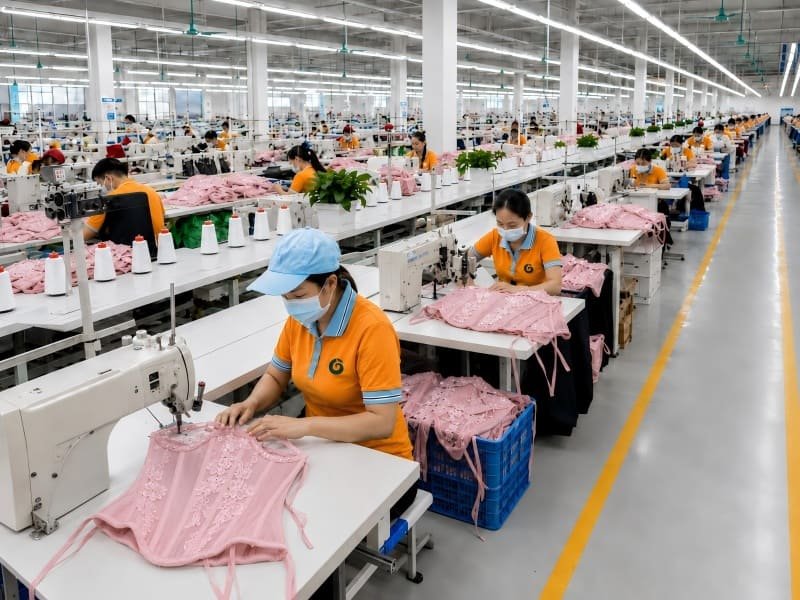
Direct attachment usually involves fewer operations. The operator positions the boning, stitches it to the panel, and continues with assembly. A channel system may require preparing the casing, sewing it, measuring the finished width, cutting and finishing the bone, inserting it, closing the opening, and completing an additional inspection. The time difference becomes meaningful when a dress contains several bones and the order includes many repeated units.
Fewer operations do not always produce lower total cost. When sew-through boning stretches a panel, shows through the surface, or folds during wear, operators slow down and rework increases. A slightly longer channel method can deliver more acceptable garments per hour if it is easier to control. Production efficiency should therefore be measured as approved garments produced within the target time, not simply the number of sewing minutes recorded for one operation.
A pilot batch should be completed by production operators rather than only by a highly skilled sample machinist. Sample rooms are designed for flexibility and problem solving, while production lines depend on repeatability. Simple tools can improve consistency: channel-position templates reduce marking variation, pre-cut bone sets control length, and narrow gauges allow inspectors to confirm internal width without measuring every point with a ruler.
Cost and Value
The price of the boning component is only one part of the calculation. Total cost includes casing material, underlining, lining reinforcement, end caps, cutting loss, labor, machine time, inspection, and likely rework. Development costs also matter. A low-priced plastic bone can become expensive if it folds during a wear trial and forces a new sample, a pattern correction, or a late material change close to the launch date.
A useful cost review separates material, labor, development, quality risk, and commercial risk. Material covers the bone, channel, lining, and reinforcement. Labor includes cutting, finishing, attachment, insertion, closure, and inspection. Commercial risk includes returns, negative reviews, missed launch dates, and difficulty repeating the same construction when a successful style is reordered several months later.
Cost engineering should protect the product promise rather than remove the structure that makes the design sellable. A premium strapless occasion dress that cannot hold its neckline has failed even if the sewing method was fast. A lightweight party dress that feels unnecessarily rigid has also failed despite using expensive steel. The best value comes from selecting the least complicated method that consistently achieves the approved fit, comfort, appearance, and expected wearing life.
Bulk Quality Control
Quality control begins before sewing. The approved bone and casing should be identified by supplier reference, width, thickness, material, finish, and intended location. Two 8-millimeter plastic bones can look almost identical and behave very differently after bending or exposure to heat. Substituting a visually similar component without a performance check can change neckline stability, waist recovery, and the feel of the entire bodice.
The first production piece should be opened and compared with the approved sample before the line continues. Channel construction, bone length, end finishing, seam clearance, reinforcement, and left-to-right symmetry should all be checked. Inline inspection is particularly important because internal defects become slow and expensive to correct once the lining is fully closed and the garment has reached final pressing or packing.
Final inspection should assess the garment in both flat and worn conditions. A channel may look straight on a table and twist when the bodice is under tension. A bone may appear symmetrical inside the garment yet create different pressure on the left and right sides. For structured styles, a short seated and movement check on pilot garments provides more useful evidence than an exterior visual inspection alone.
Control Point | Practical Starting Tolerance | Inspection Stage | Reason |
Individual bone length | Approved value, often +/- 3 mm | Before insertion | Prevents inconsistent support and seam interference |
Left/right pair difference | Maximum 2 mm | Component preparation | Maintains visual and fit symmetry |
Channel position | Often +/- 3 mm from approval | Before lining closure | Controls shaping and panel balance |
Internal channel width | Often +/- 1 mm | After channel sewing | Prevents blocking or bone twisting |
Top and bottom clearance | Follow approved sample | Before closure | Avoids pressure and sewing interference |
Visible puckering | Not acceptable from normal viewing distance | Inline and final | Protects surface quality |
Bone twisting or end breakthrough | Not permitted | Wear check and final inspection | Protects comfort and durability |
Brand Specifications
A technical pack should never state only add boning. That instruction leaves the most important decisions to the sample room and increases variation between suppliers, sample rounds, and repeat orders. A useful specification identifies the intended function, approved material, supplier reference, width, thickness, position, length, installation method, channel construction, end treatment, top and bottom clearances, stitch details, and expected visual result.
The function is especially important. The supplier needs to know whether the support is intended to reduce wrinkling, stabilize a neckline, support the bust, prevent rolling, or shape the waist. Without this information, a visually similar construction may fail during wear. The brand should approve the complete bodice made in the actual fabric and lining, because loose component samples cannot reproduce the pressure, movement, and surface appearance of a finished dress.
For complex corset, bustier, strapless, mesh, satin, and fitted occasion styles, a small production pilot can confirm whether the sample-room method remains stable under line conditions. Duolan Apparel can review a tech pack, reference garment, fabric direction, size specification, intended support effect, target quantity, and price position, then develop an appropriate sew-through, channel, or mixed structure for sampling and repeatable production. This approach keeps the inquiry practical: the support method is selected around the garment the brand wants to sell, not around a generic construction preference.
Share:
Our Services
Categories
Table of Contents
Here, developing fashion collections is more than manufacturing garments — it’s a collaborative process focused on transforming ideas into well-executed, market-ready products. From fabric sourcing and sample development to scalable production and delivery coordination, every stage is built to support quality, consistency, and efficient collection launches across global markets.