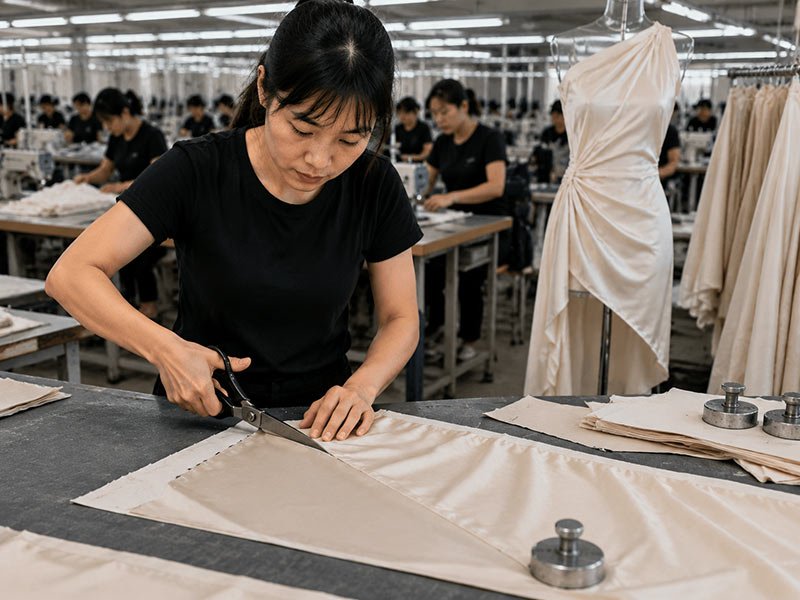
...

Custom Crepe Dress Manufacturer

Crepe dress development and manufacturing built around fabric behavior, accurate fit, controlled workmanship, and repeatable bulk production.

  • 8 crepe fabric families evaluated by drape, stretch, opacity, recovery, surface texture, and bulk availability
  • 10–30 styles can be structured within one coordinated dress collection
  • 20,000–80,000 pieces can be planned across launch orders, repeat programs, and scaled production
  • 10 crepe-specific control points cover fabric review, pattern balance, seams, lining, pressing, and final appearance
  • Reference bulk production periods range from 15–45 days after approvals and material readiness, depending on style complexity

Developed for Established Fashion and Product Teams

Duolan supports dress-focused organizations that require more than cut-and-sew execution. Each project is reviewed through its product direction, target market, fabric behavior, fit priorities, production scale, and launch schedule.

Fashion Dress Brands

Contemporary, occasionwear, workwear, partywear, and resort labels need crepe dresses that reflect a clear market position. Duolan works from established design direction rather than replacing it. Development support connects fabric selection, silhouette, price positioning, construction, color, and delivery requirements. The result is a dress program aligned with the brand’s visual language and suitable for sampling, internal review, launch orders, repeat orders, and future collection extensions.

Product Development Teams

Product teams need samples that answer specific questions. A first sample may need to confirm drape, fit, neckline balance, waist shaping, opacity, or workmanship feasibility. Duolan establishes the purpose of each sample before pattern work begins, helping comments move through structured revisions. Fabric direction, measurement priorities, open points, and production risks remain visible throughout development rather than becoming disconnected conversations.

Procurement and Sourcing Teams

Procurement teams evaluate manufacturing discipline, documentation, capacity, compliance, quality control, communication, and repeat-order stability. Duolan supports formal supplier evaluation with project reviews, sample records, production-readiness checks, material confirmation, staged production updates, inspection coordination, packing verification, and delivery documentation. Clear responsibility and traceable approvals help multi-style programs move through development and manufacturing with fewer avoidable surprises.

Control Crepe Dress Risks Before Bulk Production

Crepe can look refined and commercially versatile, yet small differences in weight, stretch, recovery, grain, pressing, and lining can change the finished garment. Duolan connects each major risk to a defined development or production action.

Fabric Name Mismatch

Two fabrics sold under the same crepe name may behave differently in a finished dress. Composition, yarn, weave, finish, weight, stretch, and surface texture all influence the result. Duolan reviews the physical swatch rather than relying on the trade name alone.
  • Check composition and weight
  • Compare drape and surface
  • Test stretch and recovery
  • Confirm width and availability
  • Review bulk material continuity

Incorrect Drape Direction

A soft crepe may collapse in a tailored sheath, while a firm double crepe may overpower a fluid cowl or gathered silhouette. Fabric direction is reviewed against pattern shape, seam placement, fullness, support, and the intended body line before the first sample.
  • Evaluate silhouette support
  • Review fold behavior
  • Check skirt fall
  • Confirm gathering volume
  • Compare sample references

Unstable Stretch Recovery

Stretch crepe can improve mobility and fit, but poor recovery may create seat growth, bagging, neckline distortion, or inconsistent measurements. The pattern cannot be developed from stretch percentage alone. Recovery, direction, lining, seam choice, and wearing tension also need review.
  • Measure stretch direction
  • Observe recovery speed
  • Test seam extension
  • Check body tension
  • Adjust ease accordingly

Visible Seam Puckering

Crepe surfaces often reveal uneven tension, feed imbalance, needle damage, or excessive pressing. Puckering is especially visible along princess seams, center-back zippers, waist joins, curved necklines, and long side seams. Trial stitching helps determine a cleaner production method.
  • Select suitable needles
  • Adjust stitch density
  • Balance thread tension
  • Control fabric feeding
  • Review pressed appearance

Lining Changes Silhouette

A lining may solve transparency or comfort concerns while changing the drape, stretch, weight, or movement of the outer shell. Duolan reviews shell and lining as one construction system. Lining type, attachment, ease, length, and hem relationship are confirmed during sampling.
  • Match stretch behavior
  • Check color coverage
  • Add movement ease
  • Control hem exposure
  • Review static tendency

Sample-to-Bulk Difference

An attractive sample has limited value when its fabric, trims, measurements, construction, or pressing method cannot be repeated. Duolan uses material locking, revision records, PP or approved production basis, first-piece confirmation, inline inspection, and final appearance checks to transfer approved standards into bulk.
  • Lock materials
  • Record measurements
  • Confirm workmanship
  • Verify first pieces
  • Preserve reorder standards

Crepe Dress Styles for Distinct Fashion Markets

Crepe supports tailored, fluid, fitted, minimalist, and occasion-led directions. Each silhouette requires a different combination of fabric weight, stretch, lining, pattern balance, seam control, and finishing.

Crepe Mini Dresses

Mini dresses require accurate length, seat coverage, hem balance, and stable side seams. Stretch crepe may support close silhouettes, while firmer woven crepe suits tailored A-line or structured shapes. Development checks include sitting movement, slit height, lining length, zipper stress, and hem behavior. For multi-size production, skirt proportion and coverage must be reviewed across more than the base size.

Crepe Midi Dresses

Midi lengths work well for workwear, cocktail, day-to-evening, and contemporary collections. The longer visual line makes side seam balance, waist placement, skirt fall, vent construction, and hem level especially important. Depending on the design, Duolan may recommend soft polyester crepe, viscose-rich crepe, stretch crepe, or double crepe to achieve the required movement and structure.

Crepe Maxi Dresses

Maxi silhouettes depend on controlled fabric consumption, grain direction, seam stability, and floor-length balance. Soft crepe can produce elegant movement, but bias sections, gathered skirts, long panels, and irregular hems require careful hanging and leveling. Lining weight must remain compatible with the outer fabric so the finished skirt does not twist, drag, or lose its intended flow.

Tailored Sheath Dresses

Tailored sheath dresses need shape without unwanted stiffness. Double crepe, medium-weight stretch crepe, or compact polyester crepe can support clean waist and hip lines. Pattern work focuses on bust shaping, dart position, waist balance, back contour, hip ease, vent function, and zipper behavior. Pressing must sharpen the silhouette without flattening or marking the textured surface.

Wrap Crepe Dresses

Wrap dresses rely on neckline security, overlap width, waist anchoring, tie strength, and skirt coverage. Fabric that is too fluid may open or collapse; fabric that is too firm may create bulky overlap points. Duolan evaluates wrap depth, modesty, internal fastening, tie placement, edge stabilization, and size grading so the wrap function remains reliable across the requested size range.

Draped Crepe Dresses

Draped styles require fabric-led development. Cowl necks, side drapes, twisted waists, asymmetric folds, and waterfall details cannot be judged only from flat measurements. The pattern must account for fabric fall, grain direction, fold depth, attachment points, and body movement. Sample review focuses on visual balance from front, side, and back rather than a single mannequin angle.

Ruched Fitted Dresses

Ruching can shape the body, add coverage, and create a strong visual feature, but uneven tension or excessive bulk quickly reduces quality. Stretch direction, gathering ratio, lining support, seam reinforcement, and left-right consistency require testing. Duolan establishes fixed ruching points and production references so the effect remains controlled across different operators, colors, and sizes.

Occasion Crepe Dresses

Cocktail, wedding guest, graduation, formal, and evening styles may combine crepe with mesh, satin, lace, embellishment, boning, or structured lining. Development must preserve elegance while protecting comfort and manufacturability. Key checks include neckline support, clean internal finishing, movement, opacity, weight distribution, trim compatibility, pressing, and packaging protection for refined surfaces.

Compare Crepe Fabrics by Finished Garment Behavior

Crepe should be selected through measurable and visual performance, not by fabric name alone. The ranges below are development references; final specifications depend on the chosen mill quality, composition, finish, target price, silhouette, and market requirements.

Crepe TypeCommon BehaviorStretch DirectionDrape LevelOpacitySuitable Dress ApplicationsMain Development Risk
Polyester CrepeStable, textured, commercially versatileNone or mechanicalMediumMedium to highMidi, work, wrap, occasion and day dressesHeat sensitivity, static, surface shine from pressing
Stretch CrepeCompact with body movement and recoveryUsually crosswiseMediumMedium to highBodycon, sheath, fitted mini and tailored stylesBagging, seam extension, recovery variation
Viscose CrepeSoft hand with fluid movementUsually limitedHighLow to mediumMaxi, draped, resort and relaxed midi dressesShrinkage, growth, crease response, color consistency
Crepe de ChineLightweight, smooth and fluidUsually noneHighLowBlouses, slips, layered occasion and soft dressesTransparency, snagging, seam show-through
Moss CrepePebbled texture with easy drapeVaries by qualityMedium to highMediumPrinted dresses, wrap dresses, casual occasion stylesQuality variation, width and bulk continuity
Bubble CrepePronounced surface and dimensional textureOften mechanicalMediumMediumCasual dresses, relaxed silhouettes, summer programsSurface inconsistency and limited tailored precision
Double CrepeFirm, dense and refinedNone or limitedLow to mediumHighTailored midi, structured sheath and premium occasion dressesWeight, pressing marks, bulky seam intersections
Crepe-Back SatinMatte crepe face and satin reverseUsually noneMedium to highMediumReversible details, occasion, draped and formal dressesFace selection, needle marks, shine and handling damage

How Crepe Selection Changes the Finished Silhouette

A single pattern can produce very different results when fabric weight, stretch, recovery, surface, and drape change. Duolan reviews the garment goal before confirming the fabric direction or using an alternative material.

Lightweight Crepe Versus Double Crepe Structure

Lightweight crepe creates movement, soft folds, and reduced visual weight. It works well for gathered skirts, loose sleeves, draped bodices, wrap shapes, and layered maxi dresses. The same fabric may lack the body required for a sharp sheath, sculpted waist, or unsupported neckline. Transparency and seam show-through may also require lining or altered seam construction.

Double crepe creates a cleaner body line and stronger silhouette. It can support tailored midi dresses, structured shoulders, fitted waist panels, clean vents, and premium minimalist shapes. Added weight changes the way darts, seams, facings, and hems behave. Thick intersections may need grading, reduced bulk, or adjusted construction.

Duolan evaluates:

  • Finished silhouette and body line
  • Fold depth and gathering volume
  • Seam thickness at intersections
  • Lining requirement
  • Pressing response
  • Fabric consumption and cost
  • Suitability for repeated bulk production

A fabric alternative is approved only after the visual effect, pattern relationship, workmanship, and commercial requirements remain aligned.

Non-Stretch Versus Stretch Crepe Fit

Non-stretch crepe depends more heavily on pattern ease, dart control, zipper opening, vent movement, and accurate grading. Close silhouettes need enough mobility for sitting, walking, and dressing without weakening the intended line. A pattern developed for rigid crepe cannot simply be transferred to a stretch fabric without review.

Stretch crepe can support closer body contours and greater movement. However, stretch percentage does not fully describe performance. Recovery, direction, repeated extension, fabric weight, seam elasticity, lining behavior, and wearing tension all affect the result. Excessive negative ease can distort necklines, strain zippers, and create measurement instability.

Duolan checks:

  • Stretch and recovery before pattern correction
  • Shell and lining compatibility
  • Bust, waist, hip, and seat tension
  • Seam extension and stitch selection
  • Zipper and vent stress
  • Size grading behavior
  • Appearance after hanging and wearing

Pattern decisions follow the actual approved fabric rather than an assumed crepe category.

Crepe Fabric Sourcing for Custom Dress Programs

Duolan coordinates fabric sourcing around garment performance, commercial positioning, color requirements, order scale, and repeat availability. Sourcing decisions remain connected to the approved dress rather than handled as a separate purchasing activity.

Existing Market Qualities

Available market fabrics can shorten development time when composition, weight, width, handfeel, stretch, color, and bulk stock meet the project requirements. Duolan compares physical swatches and checks whether the chosen quality can support sampling and planned production.

  • Review available colors
  • Confirm current stock
  • Check repeat availability
  • Compare lot consistency
  • Record fabric specifications

Mill-Sourced Crepe

Mill sourcing is suitable when a project requires more stable bulk continuity, defined specifications, larger quantities, or repeat-order planning. Communication may cover composition, construction, weight, finish, width, color development, testing, minimum production quantity, and mill lead time.
  • Define performance targets
  • Request representative swatches
  • Confirm production conditions
  • Review testing needs
  • Plan repeat material access

Custom Color Development

Color work connects Pantone direction, fabric base, dye method, surface texture, opacity, lighting, and final garment appearance.

A lab dip viewed alone may differ from the color on a lined, gathered, stretched, or layered dress.

  • Submit color reference
  • Review lab dips
  • Compare lighting conditions
  • Check shell and lining
  • Lock approved color basis

Alternative Material Review

When a specified fabric is unavailable, commercially unsuitable, or unstable for bulk, Duolan can review alternatives against the original garment objective. A lower price alone does not make an alternative suitable.

  • Compare composition
  • Match weight and drape
  • Review stretch and recovery
  • Check color potential
  • Evaluate bulk continuity

Printed Crepe Development

Printed crepe requires coordination among artwork, repeat size, color count, fabric texture, garment panels, gathers, seams, and grading. Strike-offs and sample garments help confirm whether the pattern remains clear after cutting and construction.
  • Review artwork files
  • Set repeat dimensions
  • Confirm print method
  • Check panel placement
  • Approve bulk print basis

Trim and Lining Matching

Zippers, hooks, buttons, thread, labels, interfacing, elastic, lining, and decorative trims influence both appearance and manufacturing stability. Matching decisions consider color, weight, flexibility, skin contact, seam bulk, and production availability.

  • Match functional trims
  • Coordinate lining behavior
  • Check color compatibility
  • Confirm order quantities
  • Record approved references

Fabric Checks Before Crepe Dress Sampling

Physical fabric review helps avoid developing a promising sample on unsuitable or non-repeatable material. The selected checks vary by fabric and market, while the core aim remains consistent: confirm how the cloth will behave as a dress.

Composition and Weight

Composition influences drape, shrinkage, heat response, moisture behavior, recovery, handfeel, and care requirements. Weight is reviewed together with construction and finish, since equal GSM values can still produce different body and movement. Specifications are recorded before pattern and sample decisions become dependent on the fabric.
Stretch and Recovery​

Stretch and Recovery

Stretch is checked by direction and compared with recovery after extension. Close-fitting dresses require stable recovery at the bust, waist, hip, seat, neckline, and zipper areas. Fabric that stretches easily but returns slowly may look acceptable during fitting and lose shape after wear or handling.

Drape and Support

Fabric is folded, hung, gathered, and placed over curved forms to evaluate fall and support. A drape test helps identify whether the material can form the intended folds, maintain the waist shape, support a neckline, or carry a long skirt without becoming heavy or visually flat.

Opacity and Coverage

Opacity is reviewed under relevant lighting and against different skin-tone backgrounds where needed. Stretching, gathering, seams, pockets, and lining can alter coverage. Pale colors often require separate assessment because a fabric appearing opaque in a folded swatch may become transparent across the body.

Shrinkage and Color

Wash, steam, pressing, or relaxation can change dimensions and appearance. Testing requirements depend on fiber content, care instruction, market, and construction. Color review may include lab dips, lot comparison, rubbing, lighting, shell-lining coordination, and special attention to dark or pale shades.

Width and Availability

Usable width affects consumption, marker efficiency, panel placement, bias cutting, print alignment, and cost. Availability is checked for sampling and planned bulk quantity. A sample fabric with no reliable bulk path should be treated as a temporary development material, not an approved production standard.

Custom Design Details for Crepe Dress Collections

Crepe can support clean minimalism or complex fashion detailing. Each feature is reviewed for visual effect, fabric compatibility, fit, workmanship, grading, and production repeatability.

Sculpted Necklines

Square, sweetheart, asymmetric, halter, boat, plunge, and off-shoulder necklines require different stabilization. Crepe weight, stretch, facing, lining, interfacing, stay tape, and closure placement influence whether the edge remains clean on the body.

Draped Cowls

Cowl depth depends on fabric softness, grain direction, pattern volume, neckline anchoring, and body position. Duolan reviews whether the fold should remain open, collapse softly, sit close to the chest, or continue into a shoulder or back drape.

Structured Shoulders

Shoulder shaping can come from pattern geometry, internal support, sleeve head treatment, interfacing, or shoulder pads. Firm crepe creates clean lines, while softer crepe may need controlled internal construction to avoid a weak or uneven silhouette.

Fitted Waist Panels

Waist panels define proportion and can improve support, but seam intersections may become bulky in double crepe. Grain, interfacing, lining, boning where required, zipper placement, and seam grading are planned to keep the waist smooth.

Controlled Ruching

Ruching ratio, anchor points, direction, and lining support determine whether gathering looks intentional. Production references mark start and finish positions so left-right balance and size consistency do not rely only on operator judgement.

Pleated Details

Knife pleats, tucks, sunray effects, soft folds, and asymmetric pleating respond differently to crepe texture and heat. Trial work determines whether folds remain crisp, softly released, or permanently set without damaging the surface.

Slits and Vents

Front, side, and back openings require reinforcement, clean corners, stable hem relationships, and suitable height. Fit movement and market expectations are checked across the requested size range, not only on the base sample.

Cut-Out Features

Cut-outs require stable edges, balanced tension, adequate coverage, and secure connection points. Stretch crepe can improve fit but may distort openings. Facing, binding, elastic, lining, tape, and pattern shaping are evaluated together.

Covered Buttons

Self-covered buttons must suit fabric thickness and texture. Button size, shank, spacing, reinforcement, loops, and opening tension are tested so the feature remains functional and visually even during repeated production.

Concealed Zippers

Invisible zippers are highly visible when crepe puckers or bows around the seam. Seam stabilization, zipper tape, stitch position, pressing, and waist intersections are controlled before bulk release.

Belted Shapes

Self-fabric belts, fixed ties, detachable belts, sash waists, and wrap ties require suitable width, reinforcement, turning method, and attachment points. Fabric thickness and stretch affect whether the belt lies flat or twists.

Mixed Fabric Panels

Crepe may be combined with mesh, satin, lace, chiffon, sequins, or jersey. Each combination changes stretch, seam thickness, transparency, pressing, and shrinkage. Junctions are tested before bulk standards are finalized.

Feasibility Review Before Pattern and Sample Development

Early review helps clarify what the sample must prove and which decisions should be resolved first. Duolan accepts tech packs, reference images, original samples, fabric swatches, sketches, collection briefs, and mixed development inputs.

Establish the Development Basis Before Sampling

A crepe dress project begins by defining the intended market, price position, silhouette, occasion, fit direction, fabric idea, size standard, target quantity, and launch window. The sample purpose is also clarified. A prototype used to explore shape is not managed in the same way as a fit sample, photo sample, salesman sample, or PP sample.

Duolan reviews:

  • Whether the target fabric can create the intended drape and structure
  • Which construction areas carry fit, support, or bulk-production risk
  • Whether the design requires lining, interfacing, boning, tape, elastic, or reinforcement
  • Which measurements or visual points should receive priority
  • Which details need trials before a complete sample
  • Whether the requested material and trims have a realistic bulk path
  • Whether the current information is sufficient for costing and pattern development

The resulting development direction may identify open questions, recommended trials, missing specifications, and decisions required before sampling. A clear starting basis reduces unnecessary revisions and helps the first sample become more useful for internal approval.

Review Production Feasibility Alongside Visual Intent

A sample can reproduce a reference image while remaining unsuitable for repeat manufacturing. Duolan therefore reviews how design choices affect cutting, sewing, pressing, quality control, size grading, material consumption, operator consistency, and production timing.

Typical concerns include:

  • Deep ruching that varies from garment to garment
  • Bias panels that grow after hanging
  • Narrow straps carrying excessive load
  • Heavy seam intersections in double crepe
  • Unsupported necklines in soft crepe
  • Pale fabrics requiring additional coverage
  • Complex draping without fixed control points
  • Trims that cannot be reordered consistently
  • Construction methods that create visible pressing marks
  • Decorative details that slow production beyond the launch plan

The aim is not to simplify every design. The aim is to preserve the intended fashion effect through a method that can be sampled, approved, costed, inspected, and repeated at the required scale.

Tech Pack Execution with Production Risk Review

A strong tech pack provides the foundation, while active review prevents conflicting instructions from becoming sample or bulk problems. Duolan follows approved specifications and raises points requiring clarification before making unauthorized assumptions.

Specification Alignment

Style sketches, measurement charts, construction callouts, BOM details, fabric notes, and artwork are reviewed as one development package. Conflicts between the drawing, measurements, and written notes are identified for confirmation. Approved changes remain visible in later sample versions rather than disappearing into informal messages.

Material and Trim Review

Fabric, lining, zipper, thread, interfacing, labels, closures, and decorative trims are checked against the garment structure and intended appearance. Material references should include color, composition, weight, width, finish, stretch, supplier status, and bulk availability where relevant.

Production Standard Transfer

The final approved sample is supported by confirmed measurements, workmanship points, BOM, color, labels, packing details, and tolerance requirements. Production teams receive an aligned basis rather than relying on the appearance of one sample alone. Deviations or pending points are resolved before bulk release.

Pattern and Fit Engineering for Crepe Dresses

Fit decisions are connected to the actual fabric, silhouette, construction, and wearing scenario. Crepe dresses require more than copying flat measurements because stretch, drape, support, lining, and body tension affect how the garment performs. Fit comments are separated into measurement, pattern, visual, fabric, and construction categories. The pattern is corrected against confirmed priorities rather than altered through unrelated changes.

Balance the Bust, Waist, Hip and Skirt Fall

Fitted and tailored crepe dresses depend on balanced distribution rather than isolated circumference measurements. Bust shaping influences neckline position and front length.

Waist shaping affects side seam direction, zipper behavior, and skirt fall. Hip and seat ease affect movement, vent function, and horizontal drag lines.

Duolan reviews:

  • Bust point and dart placement
  • Front and back length balance
  • Waist position and shaping
  • Side seam alignment
  • Hip and seat ease
  • Skirt sweep and hem level
  • Shoulder and armhole relationship
  • Zipper opening and dressing ease
  • Slit or vent movement
  • Lining ease and attachment

Grade the Approved Shape Across the Requested Sizes

A base-size sample can look correct while larger or smaller sizes lose neckline security, bust capacity, waist position, slit balance, or intended length. Grading rules should protect the original silhouette instead of applying uniform growth to every point. Review areas may include:
  • Bust and cup-related shaping
  • Shoulder and neckline scaling
  • Waist-to-hip progression
  • Armhole depth and sleeve width
  • Strap length and placement
  • Cut-out coverage
  • Slit height relative to garment length
  • Ruching distribution
  • Zipper length and opening
  • Lining and facing dimensions
For a program ranging from US 0–14, XS–XXL, UK 6–18, or a brand-specific size chart, grading follows the supplied specification and fit direction. Extended ranges are evaluated separately where structure or fabric behavior requires additional adjustment.

Construction Decisions Behind Stable Crepe Silhouettes

A clean crepe dress often hides a detailed internal structure. Pattern geometry, seam positions, support materials, lining, and reinforcement determine whether the silhouette remains stable through fitting, production, wearing, and repeat orders.

Darts and Princess Seams

Darts create controlled shaping with minimal visible construction, while princess seams distribute contour over longer lines. The choice depends on bust shape, fabric weight, seam visibility, fit level, and design direction. Curved seams require careful feeding and pressing to avoid rippling on textured crepe.

Waist Seam Structure

A waist seam can define proportion, support gathered skirts, connect different grain directions, or carry internal reinforcement. Double crepe may create bulk where multiple layers meet. Seam allowance grading, interfacing, lining attachment, and zipper crossing are planned before bulk methods are confirmed.

Bias and Draped Sections

Bias-cut sections can create fluid movement but may lengthen or distort after cutting and hanging. Panel direction, stabilization, seam method, hanging time, and hem leveling need control. Draped sections also require fixed attachment points so folds remain repeatable.

Ruching Support System

Ruching may be attached to lining, elastic, a stable internal panel, or marked shell positions. The chosen method affects comfort, thickness, stretch, and visual consistency. Production references establish gathering ratios and anchor locations for each size.

Neckline Stabilization

Stay tape, facing, lining, interfacing, elastic, under-stitching, and pattern shaping can help control necklines. The right solution depends on stretch, openness, body tension, closure type, and desired softness. Excessive reinforcement may make fluid crepe look stiff.

Slit and Hem Control

Slits require secure reinforcement and clean transition into the hem. Hem choice depends on weight, surface, skirt width, lining, and desired movement. Blind hems, narrow machine hems, faced hems, or hand-finished options are assessed against appearance and production scale.

Seam and Stitching Control for Clean Crepe Dresses

Crepe often exposes workmanship that textured prints or heavy embellishment might hide. Needle selection, stitch density, tension, feeding, seam preparation, pressing, and operator handling must work together.

Needle and Thread Match

Needle size and point are chosen according to fiber, density, finish, and fabric sensitivity. An unsuitable needle may leave visible holes, pull yarns, create skipped stitches, or damage a fine surface. Thread weight and finish should support strength without creating raised, rigid, or shiny seam lines.

Stitch Density Control

Stitches that are too short can perforate delicate crepe and create puckering. Stitches that are too long may reduce seam security or look irregular on curved areas. Trial stitching establishes a suitable balance for straight seams, curved seams, hems, topstitching, and zipper insertion.

Balanced Seam Feeding

Top and bottom layers can feed at different rates, especially along long side seams, curved princess lines, bias panels, or mixed-material joins. Handling method, presser pressure, machine settings, stabilization, and operator control help prevent twisting, rippling, or mismatched seam lengths.

Invisible Zipper Finish

Center-back and side zippers require a straight seam, clean waist intersection, smooth top edge, and flat pressed appearance. Zipper tape, seam stabilization, stitch position, fabric thickness, and garment tension are checked before the method is released to production.

Curved Seam Shaping

Princess seams, necklines, armholes, and shaped waist panels need accurate clipping, grading, easing, and pressing. Overworking can stretch the edge or flatten the fabric texture. Underworking can leave fullness, ridges, or uneven curves.

Hem and Pressing Finish

The hem must support the silhouette without creating a visible ridge, flare, twist, or heavy edge. Pressing temperature, moisture, pressure, protective cloth, and cooling time are adjusted to the crepe quality. Final appearance is reviewed after hanging, not only immediately after pressing.

Cutting, Pressing and Finishing for Crepe Dresses

Accurate sewing cannot correct fabric distorted during relaxation, spreading, cutting, handling, or pressing. Duolan treats preparation and final shaping as part of garment quality.

Prepare Fabric Before Cutting

Fabric condition is reviewed before the marker is released. Depending on the quality, crepe may need relaxation, shrinkage assessment, lot separation, face identification, direction control, flaw marking, or special handling. Rolls are checked for usable width, shade variation, surface defects, and quantity.

Cutting preparation considers:

  • Grain and nap direction where relevant
  • Face and reverse identification
  • Bias or asymmetric panel orientation
  • Print placement
  • Fabric relaxation
  • Shade and lot grouping
  • Marker efficiency
  • Panel numbering
  • Bundle control
  • Distortion during spreading

Long skirts, bias sections, matched panels, and fluid fabrics require additional attention because small cutting shifts become visible in the finished hem or drape.

Shape the Garment Without Surface Damage

Pressing should improve seam shape and silhouette without creating shine, flattening texture, stretching edges, leaving seam impressions, or marking dark and pale colors. Temperature alone is not enough; pressure, moisture, duration, protective materials, support tools, and cooling also affect results.

Finishing checks include:

  • Seam smoothness
  • Zipper flatness
  • Neckline and armhole shape
  • Dart and princess seam contour
  • Waist seam bulk
  • Ruching arrangement
  • Slit and vent corners
  • Hem level after hanging
  • Lining position
  • Surface cleanliness
  • Final garment measurements
  • Packing method suited to crease sensitivity

A completed crepe dress is assessed after construction, pressing, hanging, and packing preparation rather than at the sewing machine alone.

Fit Comments Translated into Controlled Sample Revisions

Comments create value only when they are interpreted, grouped, applied, checked, and carried into the next version. Duolan manages revision work as a development record rather than a collection of disconnected messages.

Separate Fit, Visual and Construction Comments

A request such as “make the waist cleaner” may refer to measurement, dart position, seam shaping, fabric tension, lining, pressing, or styling preference. Duolan clarifies the intended result before changing the pattern.

Revision categories commonly include:

  • Body measurements
  • Pattern balance
  • Silhouette proportion
  • Neckline and coverage
  • Fabric behavior
  • Lining relationship
  • Construction method
  • Ruching or draping
  • Trim and color
  • Workmanship appearance

Each category is checked against previously approved points.

Preserve the Approved Direction for Bulk

After comments are applied, the revised sample is reviewed against the agreed priorities. Confirmed changes are reflected in measurements, pattern, BOM, workmanship notes, and production references where required.

Useful outputs can include:

  • Revision summary
  • Updated measurement chart
  • Pattern correction note
  • Approved material reference
  • Close-up photographs
  • Pending decision list
  • Sample status
  • PP or production-readiness path

The final aim is not endless sample rounds. The aim is a version that allows the brand team to make a confident decision and gives production teams a clear, repeatable standard.

Controlled Crepe Dress Sample Development Process

Sampling converts design information into a decision-ready garment. Each stage has a defined purpose, required inputs, review priorities, and next action. Reference sampling window: many custom crepe styles can be scheduled within 7–15 working days after development inputs and suitable sample fabric are confirmed. Draped, bias-cut, structured, embellished, custom-dyed, or multi-material designs may require a separately planned period.

Project Brief Review

Development starts with product type, design source, sample purpose, target fabric, fit direction, size standard, quantity, colorways, launch date, and packaging requirements. Missing information is identified before unnecessary pattern or sourcing work begins.

Fabric Direction Confirmation

Available swatches, specified fabrics, or proposed alternatives are reviewed against drape, stretch, support, opacity, surface, price position, and bulk availability. Temporary sample material is clearly separated from a final production fabric basis.

Pattern Development

Pattern work translates measurements, silhouette, construction, fabric behavior, and visual references into a buildable garment. High-risk areas may be tested through partial trials, draping, toile work, or construction mock-ups before a full sample is completed.

First Sample Review

The first sample is reviewed according to its agreed purpose. Fit, drape, proportion, coverage, structure, workmanship, and visual direction are considered separately. Open points are recorded rather than hidden behind a simple “approved” or “not approved” status.

Controlled Revision

Comments are categorized into measurement, pattern, fabric, construction, color, trim, and visual adjustments. Confirmed changes are summarized before the revised sample starts, reducing the risk of one correction unintentionally reversing another approved point.

Production Readiness

Once the direction is accepted, the project moves toward PP basis, material locking, production costing, order breakdown, first-piece confirmation, and quality checkpoints. An attractive sample is not treated as bulk-ready until the manufacturing basis is aligned.

Material Locking Before Crepe Dress Bulk Production

Bulk production begins after the approved sample direction is converted into confirmed materials, measurements, workmanship, labels, packing requirements, and production checkpoints.

Main Fabric

The production fabric is confirmed by quality, composition, weight, width, surface, stretch, recovery, color, lot, finish, quantity, and approved reference. Sample fabric substitutions remain identified until replaced by an approved bulk basis.

Lining and Support

Lining, interfacing, tape, elastic, boning, cups, shoulder support, and internal reinforcement are locked according to the approved construction. Shell and support materials are checked together because a change inside the dress can alter the exterior silhouette.

Trims and Closures

Zippers, hooks, buttons, thread, labels, hangtags, and decorative trims are confirmed by specification and color. Availability and order quantity are reviewed early enough to avoid late substitutions that affect appearance or delivery.

Measurements and Fit

The approved measurement chart, tolerance, grading basis, and critical fit points are prepared for production control. Measurement standards remain connected to the correct sample version and fabric quality.

Workmanship Points

Seam type, stitch density, zipper method, neckline finish, lining attachment, ruching position, slit reinforcement, hem method, pressing, and appearance references are confirmed before the line produces volume.

Packing Requirements

Folding, hanging, tissue, polybags, labels, barcodes, cartons, assortment, carton marks, and shipment destination are aligned with the order. Crease-sensitive crepe styles may need adjusted folding or hanging protection.

Quality Control Focused on Crepe Dress Risk Points

Quality control follows the product from fabric arrival through packing. Crepe-specific appearance, measurement, seam, lining, pressing, and handling risks are checked at the stages where corrective action remains possible.

Fabric Arrival Inspection

Incoming fabric is reviewed for quantity, width, color lot, surface defects, shade variation, face direction, stretch, and visible inconsistency. Testing and relaxation requirements are confirmed according to the approved quality and project needs.

Cutting Control

Markers, grain direction, panel placement, lots, bundle numbering, notches, matching points, and critical dimensions are checked before cut components enter sewing. Bias, asymmetric, printed, or long-panel designs receive additional attention.
First-piece Confirmation​

First-Piece Confirmation

The first completed garment or controlled pilot verifies measurements, fit-related construction, zipper behavior, seam appearance, lining, ruching, slit, hem, pressing, labels, and packing direction before the full run is released.

Inline Measurement Checks

Measurements are checked during production so pattern, cutting, seam allowance, operator handling, and pressing deviations can be corrected early. Critical points are selected according to the style rather than using one generic measurement list.

Inline Workmanship Checks

Inspectors review seam smoothness, stitch security, zipper insertion, neckline finish, lining attachment, left-right balance, gathering, slit reinforcement, hem quality, thread trimming, and visible surface condition while garments remain in production.

Color and Lot Control

Fabric lots and garment groups are kept identifiable. Shade variation is reviewed under appropriate lighting, with attention to shell-lining coordination, replacement panels, mixed bundles, and colors that reveal variation more strongly.

Pressing Appearance Review

Pressing is checked for shine, flattening, seam impressions, stretching, uneven shape, water marks, and heat damage. Crepe texture and garment form should remain consistent after cooling and hanging.

Final Garment Inspection

Final inspection covers measurements, workmanship, appearance, function, labels, care information, cleanliness, assortment, and agreed quality level. Third-party inspection can be coordinated when required by the brand program.

Packing Verification

Polybag, hanger, fold method, tissue, barcode, hangtag, size sticker, assortment, carton quantity, carton marks, and destination instructions are checked before shipment. Crease-sensitive styles receive additional presentation review.

Compliance Support for Global Fashion Brand Programs

Duolan’s manufacturing system has completed SMETA and SMETA 2-Pillar auditing. Additional product, material, social, and quality requirements are coordinated according to the market, order, factory, and program.

Factory and Social Compliance

Formal sourcing programs may require factory profiles, audit records, corrective action information, production location confirmation, and social responsibility documentation. Duolan coordinates the relevant manufacturing entity and avoids presenting unrelated certificates as coverage for every project.

Testing and Quality Standards

Requirements may involve AATCC, ASTM, OEKO-TEX®, EN, China GB standards, GOTS-related material documentation, or specific brand protocols. Applicable tests depend on fiber content, market, product claim, care instruction, trim, color, and end use.

Brand-Specific Requirements

Brand manuals, restricted substance requirements, third-party inspection, label rules, barcode structure, packing standards, documentation, design confidentiality, and approved vendor procedures can be incorporated into the project plan after review.

Dress-Focused Manufacturing Capacity with Structured Control

Manufacturing scale creates value only when it supports development accuracy, multi-style coordination, repeat consistency, seasonal capacity, and accountable project management.

30+ Years

More than three decades of apparel development experience support decisions involving dress silhouettes, fabric behavior, commercial styling, workmanship, and manufacturing feasibility.

16 Owned Factories

Owned womenswear factories provide direct control for core styles, sensitive projects, sample-to-bulk transition, important repeat orders, and products requiring stronger development continuity.

20+ Satellite Factories

Long-term coordinated factories add planned flexibility for seasonal volume, repeat production, process matching, order distribution, and multi-style programs without depending on unstructured last-minute outsourcing.

12,000+ Workers

The wider coordinated manufacturing network provides labor depth across multiple production bases. Capacity allocation follows order structure, skill requirement, material readiness, timing, and quality risk.

50+ Flexible Lines

Quick-response and flexible lines support launch orders, test quantities, urgent replenishment, multi-style collections, and programs that need a path from controlled entry volume to larger repeat orders.

SMETA 2-Pillar

SMETA 2-Pillar auditing provides a social compliance foundation for formal supplier evaluation. Project-specific documentation, testing, inspection, and brand requirements remain subject to review.

Crepe Dress Development and Production Case Studies

The following anonymized project profiles reflect realistic multi-style order structures for established fashion brands. Brand names and identifying design information remain confidential.

United States Occasionwear Program

An established US occasionwear label planned an 18-style capsule covering fitted midi dresses, asymmetric necklines, draped maxi dresses, and structured cocktail silhouettes. The launch order totaled 38,400 pieces across six colors and a US 0–14 size range.

The main challenge involved using three stretch-crepe qualities across different body-contour levels without creating inconsistent fit. Pale colors also required stronger coverage, while deep shades revealed seam and pressing variation.

Duolan organized the program by fabric family and fit sensitivity. Stretch and recovery were checked before pattern corrections. Shell and lining combinations were reviewed by color. Ruching positions, invisible zippers, waist seams, and slit reinforcement were treated as critical control points. Each style moved through first sample, revision review, material confirmation, and bulk-readiness assessment.

All 18 styles entered production after two structured revision rounds. Production was divided by style complexity, and the first shipment prioritized campaign and showroom styles. The remaining quantity followed the confirmed retail launch sequence.

United Kingdom Workwear Collection

A UK contemporary workwear brand developed 12 double-crepe and compact stretch-crepe styles, including tailored sheath dresses, long-sleeve midis, belted dresses, and structured wrap silhouettes. Total order quantity reached 24,600 pieces across four commercial colors and UK sizes 6–18.

The project required clean tailoring without excessive stiffness. Major concerns included waist seam bulk, sitting comfort, vent movement, concealed zipper flatness, and consistent hem length across sizes.

Duolan reviewed the original tech packs against the selected fabrics and identified several construction points where double crepe created unnecessary thickness. Seam allowances were graded, waist intersections were revised, and lining ease was adjusted. Fit review covered seated movement as well as standing appearance. A first-piece check was completed before full production release.

The resulting collection maintained a consistent fabric and color story across all 12 styles. Shared approved materials simplified purchasing, while style-level workmanship references supported inspection and future repeat development.

Australia Resort Dress Program

An Australian resort label planned 22 styles using viscose crepe, printed moss crepe, and lightweight polyester crepe. The order totaled 51,800 pieces across printed maxis, wrap midis, relaxed minis, gathered dresses, and day-to-evening silhouettes in sizes XS–XXL.

The main risks involved viscose shrinkage, long-panel distortion, print placement, pale-color transparency, and launch timing across multiple delivery destinations. Several styles used asymmetric hems and bias sections requiring additional hanging and leveling control.

Duolan grouped styles by fabric and production risk. Printed qualities went through artwork, strike-off, color, and garment review. Viscose styles received shrinkage and relaxation attention before final pattern approval. Lining was added only where coverage required it, preserving movement in the remaining styles. Production and delivery were divided into two planned phases.

The first phase covered campaign and early-season products. The second phase carried the broader retail assortment. Approved patterns, print references, BOM data, and packing instructions were preserved for follow-up styles and repeat orders.

Plan Quantity, Cost, Production and Delivery Together

Commercial planning improves when fabric, style complexity, colorways, size structure, quantity, approvals, packing, and delivery are evaluated as one program rather than separate quotations.

Project Quantity Structure

Quantity is reviewed by style, color, size, fabric, and delivery phase. A 30,000-piece order spread across 25 styles and multiple colors has a different production structure from the same quantity across five styles. Material minimums, cutting efficiency, line changes, and quality control are considered.

Fabric and Color Minimums

Crepe fabric minimums may come from available stock, mill production, dyeing, custom color, print method, or finish. Combining styles around shared fabric qualities and coordinated colors can improve material use and repeat availability without forcing unrelated products into one structure.

Cost Drivers

Quotation depends on fabric consumption, lining, construction, pattern complexity, trims, special processes, sewing time, pressing, quantity, color split, size range, testing, labels, packaging, inspection, and delivery terms. An accurate tech pack or approved sample provides a stronger costing basis.

Sampling Schedule

A 7–15 working-day reference window can apply to many crepe samples after suitable development information and sample fabric are confirmed. Custom-dyed material, print development, complex draping, bias construction, heavy ruching, or extensive internal support may require additional time.

Bulk Production Schedule

Reference periods after approvals and material readiness are approximately 15–20 days for simple styles, 20–30 days for regular styles, and 30–45 days for complex styles. Multi-style programs may use staggered production and delivery plans.

Shipping Options

Delivery can be coordinated by express, air, sea, FOB, CIF, DDP, split shipment, nominated forwarder, or overseas warehouse arrangement. Reference transit periods are approximately 3–7 days by express, 5–8 days by air, and 20–35 days by sea, subject to route and customs conditions.

Private Label, Packaging and Delivery Execution

Brand presentation is carried through labels, garment preparation, packing, cartons, documentation, and shipment coordination. Requirements are reviewed before production to prevent late changes at the final stage.

Main Brand Labels

Woven, printed, heat-transfer, or other approved label formats can be coordinated according to placement, size, color, fold, attachment, skin contact, and market requirements. Label samples or artwork should be approved before bulk production.

Size and Care Labels

Size, fiber content, care instructions, country-of-origin information, language, and required symbols are prepared according to the supplied brand and market standards. Final legal responsibility and wording remain subject to the destination requirements and brand approval.

Hangtags and Barcodes

Hangtags, strings, seals, price tickets, UPC or EAN barcodes, SKU stickers, and retail information are checked against style, color, size, and destination. Scanning or data verification can be coordinated where required.

Garment Presentation

Crepe dresses may be folded, hung, supported with tissue, protected with polybags, or packed using brand-specific methods. Crease sensitivity, surface protection, embellishment, length, and warehouse requirements guide the packing direction.

Carton Assortment

Solid-size, ratio, pre-pack, store allocation, color assortment, and mixed-style carton plans can be followed according to the order. Carton quantity, weight, dimensions, marks, destination, and shipment phase are verified.

Delivery Coordination

Commercial invoices, packing lists, shipping marks, booking information, nominated forwarders, split shipments, and destination instructions are coordinated as part of the order. Production status and shipping priorities remain connected to the agreed launch plan.

Evaluate a Crepe Dress Manufacturer by Control Depth

A capable supplier should explain how fabric, pattern, sample, production, inspection, and repeat orders connect. Broad statements about quality provide less value than visible control points.

Evaluation AreaBasic Manufacturing ResponseDuolan Development and Production Approach
Crepe selectionChooses by fabric name or priceReviews composition, weight, drape, stretch, recovery, opacity, width, finish, and availability
Design reviewConfirms whether the dress can be madeIdentifies fit, fabric, structure, workmanship, cost, and bulk-production risks before sampling
Pattern developmentCopies dimensions or a reference sampleConnects measurements with fabric behavior, silhouette balance, movement, lining, and grading
Sample purposeProduces one general sampleDefines prototype, fit, visual, photo, salesman, PP, or production-readiness purpose
Revision controlApplies comments through messagesSeparates comments by measurement, pattern, visual, material, and construction category
Material confirmationUses available sample materialDistinguishes temporary development fabric from the locked bulk production basis
Bulk startBegins after sample approvalCompletes material, measurement, workmanship, label, packing, and readiness confirmation
Production controlRelies mainly on final inspectionUses first-piece, inline measurement, inline workmanship, pressing, final, and packing checks
Multi-style ordersSchedules by available capacityMatches styles to production paths by material, complexity, timing, and quality sensitivity
Repeat ordersRebuilds from previous garmentsPreserves approved pattern, BOM, measurements, workmanship, color, and packing standards

Custom Crepe Dress Manufacturing Frequently Asked Questions

Duolan can review polyester crepe, stretch crepe, viscose crepe, crepe de chine, moss crepe, bubble crepe, double crepe, crepe-back satin, and project-specific qualities. Availability depends on composition, weight, width, color, finish, quantity, mill conditions, and required delivery date. Physical swatches are evaluated against the intended dress rather than approved by fabric name alone.
Yes. A complete tech pack can provide sketches, measurements, BOM details, construction, artwork, labels, packaging, and tolerances. The team reviews conflicting or missing information before sampling. Development can also begin from reference images, original samples, sketches, fabric swatches, or a collection brief when the required decisions are clarified.
An original sample can be replicated, corrected, or developed into a new version according to the brand’s instructions and intellectual-property rights. Review may cover measurements, fit, fabric, lining, construction, workmanship, trims, color, grading, production feasibility, and target cost. Approved changes are documented before bulk production.
The garment goal is reviewed first. Fabric is then compared by composition, weight, surface, fold, movement, stretch, recovery, opacity, width, and pressing response. A tailored sheath may need stronger body, while a draped maxi requires greater fluidity. Sample evaluation confirms whether the selected fabric produces the intended silhouette.
Custom color development can be coordinated through available color selection, lab dips, mill dyeing, or print development. Color is reviewed on the actual fabric because texture, opacity, fiber, finish, lining, gathering, and lighting affect appearance. Minimums and lead times depend on the fabric source and dyeing conditions.
Control begins with fabric assessment and trial stitching. Needle size, point, thread, stitch density, tension, feeding, seam stabilization, zipper insertion, pressing temperature, pressure, and operator handling may be adjusted. First-piece and inline appearance checks help identify deviations before full-volume production.
Lining may be required for opacity, comfort, structure, internal finishing, or shape support. Pale colors, lightweight crepe, formal designs, fitted silhouettes, and structured bodices often need additional review. Lining is not added automatically because incorrect weight, stretch, ease, or attachment can damage drape and movement.
Duolan links the approved sample to confirmed fabric, lining, trims, measurements, grading, workmanship, labels, packing, and quality checkpoints. Bulk-readiness review, first-piece confirmation, inline inspection, pressing checks, final inspection, and preserved production records help transfer the approved direction into repeatable manufacturing.
Timing depends on information completeness, fabric availability, custom color or print, pattern complexity, number of styles, fit revisions, construction trials, trims, approvals, order quantity, packing, testing, and production schedule. Many samples use a 7–15 working-day reference window; bulk production commonly ranges from 15–45 days after approvals and material readiness.
Provide a tech pack or clear reference, target fabric, colorways, size range, quantity by style and color, construction details, lining, trims, labels, packaging, testing requirements, delivery destination, trade terms, and target launch date. Missing information may require a preliminary cost range rather than a final production quotation.

Start Your Custom Crepe Dress Development Project

Send Duolan the information available for your crepe dress program, including a tech pack, reference images, original sample photographs, fabric swatch, target crepe quality, colorways, size chart, quantity by style, launch date, label requirements, packaging standard, testing needs, and delivery destination. Our development team will review fabric suitability, pattern and fit priorities, key construction risks, sampling path, material availability, production structure, and the information required for a more accurate quotation.

Projects can begin from a single confirmed design, a 10–30 style collection brief, an existing bestseller requiring repeat production, or a new seasonal dress program. Design files and commercial information are handled as confidential project materials. For complex styles, a short online meeting can be arranged to align fabric, fit, workmanship, timing, and bulk-production expectations before sampling begins.

  • Name
  • Company / Brand Name
  • Company Website
  • Country
  • Tel / WhatsApp
  • Business Email
  • Project Type
  • Target Crepe Fabric
  • Number of Styles
  • Quantity by Style
  • Colorways
  • Size Range
  • Target Launch Date
  • Label and Packaging Requirements
  • Delivery Destination
  • Message
  • Upload Tech Pack
  • Upload Reference Images
  • Upload Original Sample Photos

Start Your Apparel Development Project

OEM/ODM Manufacturing Support for Fashion Brands

Share your collection details, estimated quantities, target market, development timeline, and technical requirements. The production team will review your request and provide a tailored manufacturing solution based on your product category, fabric selection, construction needs, and delivery schedule.

Fashion Manufacturing Support with Scalable Production Capacity

From sample development to bulk production, Duolan supports fashion brands with confidential OEM/ODM manufacturing, stable quality management, flexible production planning, and coordinated multi-factory execution for seasonal and capsule collections.

Need Direct Assistance?

Seraphinite AcceleratorOptimized by Seraphinite Accelerator
Turns on site high speed to be attractive for people and search engines.