Skip to content

Custom Dress Manufacturer for Australian Wedding Guest Dress Brands
Dress-focused development and manufacturing for Australian occasionwear teams planning polished, commercial and production-ready wedding guest collections.
- Collection programs commonly cover 10-30 styles across mini, midi, maxi, cocktail, formal and destination-wedding directions.
- Brand-level orders commonly total 20,000-80,000 pieces across styles, colours and size runs.
- Duolan coordinates 16 owned womenswear factories, 20+ long-term satellite factories and a 30+ year dress-development background.
- Development support covers fabric direction, pattern making, fit review, sample revision, PP approval, bulk production, quality control and packing.
Manufacturing Scale Built for Multi-Style Dress Programs
30+ Years Development
16 Owned Factories
20+ Satellite Factories
12,000+ Supporting Workers
Dress-Focused Supply Resources
Compliance Coordination
Built for Established Australian Occasionwear Teams
Established Fashion Brands
Established labels need a manufacturer able to understand brand language, not merely copy a reference image. Collection planning often covers a clear price structure, recognisable silhouette direction, commercial styles and reorder potential. Duolan supports teams that already know their market and require a manufacturing partner to convert design direction into fit-reviewed, material-confirmed and production-ready dresses while maintaining consistency across repeated seasonal programs.
Buying Teams
Product Development Teams
Sourcing Offices
Sourcing offices need transparent production routes, quality checkpoints, documentation support and reliable communication across a multi-style order. They also need to know where a product will be made and how risk-sensitive styles will be controlled.
Duolan can separate regular, complex, fast-response and special-process styles, then align each route with material confirmation, PP standards, inspection requirements and delivery planning.
Understanding Australian Wedding Guest Dress Demand
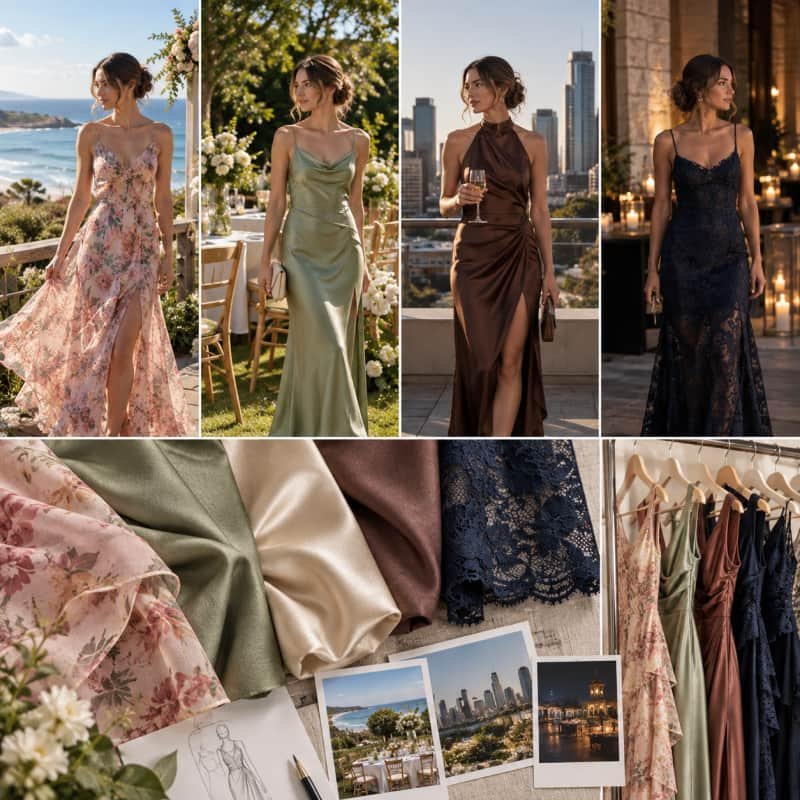
Australian wedding guest dressing sits between everyday fashion and formal occasionwear. Successful collections must feel polished enough for the event while remaining wearable, photographable and commercially relevant across climate, venue and dress-code differences.
Occasion Polish Without Bridal Language
Wedding guest dresses need visual impact without entering bridal territory. Brand teams often seek refined colour, controlled sheen, flattering movement, considered coverage and memorable details rather than heavy gown construction. Product direction may move from soft floral chiffon and printed crepe to satin draping, lace placement, corset-inspired bodices or evening sequins. The manufacturing challenge is to retain occasion value while avoiding weight, stiffness or excessive decoration that limits wearability. Necklines, slit height, back exposure, bust coverage and lining depth need to support movement, sitting, photography and long event hours.
Climate and Venue Shape Product Decisions
Australia spans warm coastal venues, garden ceremonies, city cocktail events, destination weddings and cooler evening receptions. Fabric and construction need to reflect the intended selling window. Lightweight woven dresses require opacity and seam stability; satin requires careful pressing and packing; formal styles need support without becoming uncomfortable; long dresses need movement and hem control for outdoor settings. A collection may also need colour stories suited to spring florals, summer resort tones, autumn depth or year-round occasion neutrals. Duolan reviews fabric weight, lining, sleeve coverage, length and structure against the intended event environment.
Commercial Collections Need More Than Hero Dresses
Campaign imagery may be led by a sculpted satin maxi or embellished evening style, yet sales volume often comes from approachable midis, adjustable straps, controlled draping, wearable florals and proven fit blocks. Strong collections combine visual leaders with lower-risk commercial options and repeatable styles. Manufacturing planning must support both ends of the range: complex pieces requiring longer development and stable commercial styles able to move into colour extensions, repeat orders or future capsules. Duolan helps organise the range around hero, support, volume and repeat roles rather than treating every design as equal.
What Australian Dress Brands Need from Manufacturing
Brand Direction Translation
Collection-Level Development
Accurate Fit Execution
Fabric-Silhouette Matching
Production-Ready Samples
Repeatable Bulk Quality
Development Risks and Duolan Control Points
A strong dress supplier identifies risk before fabric is cut in volume. The control matrix below connects common wedding guest dress problems with specific development and production actions.
| Risk Area | Possible Commercial Impact | Duolan Control Point | Evidence to Review |
|---|---|---|---|
| Fabric and silhouette mismatch | Flat drape, excess volume or poor body definition | Fabric behaviour review, drape test and silhouette matching | Swatches, test drape and sample comparison |
| Bust and waist imbalance | Gaping, compression or unstable neckline | Pattern correction, cup/boning review and fit session | Marked fit photos and revised measurements |
| Transparency or lining failure | Poor coverage under daylight or flash | Opacity check, lining depth review and seam placement control | Layered swatches and worn sample photos |
| Design-to-sample deviation | Lost brand character and repeated revisions | Reference analysis, construction interpretation and sample brief | Development notes and revision summary |
| Photo sample not production-ready | Campaign approval but unstable bulk construction | Workmanship feasibility review and PP conversion | Photo sample versus PP comparison |
| Sample-to-bulk material drift | Different colour, handle, stretch or sheen | Fabric lot, colour, lining and trim locking | Material confirmation record |
| Multi-style timeline confusion | Late samples, missed campaign dates and rushed bulk | Style priority map and approval calendar | Development tracker and production path plan |
| Complex workmanship variation | Uneven draping, lace placement or embellishment | First-piece confirmation and pilot verification | Approved first piece and inline records |
| Size grading distortion | Silhouette changes across the size range | Base-size approval, grading review and size-set check | Size-set measurements and fit comments |
| Reorder inconsistency | Repeat stock no longer matches the original | Pattern, BOM, workmanship and QC file preservation | Reorder confirmation pack |
Build a Balanced Wedding Guest Dress Collection
A commercially sound collection combines visual leadership, accessible fit, event relevance and repeat potential. Duolan helps organise products by role so development time and production attention are spent where they create the greatest range value.
Hero Styles Create Recognition
Hero dresses lead campaign imagery and set the visual tone. They may feature sculpted draping, corset structure, statement sleeves, asymmetric necklines, sequin surfaces, directional prints or strong back detail. Development should begin earlier because visual impact often depends on fabric behaviour, internal support, seam placement and workmanship precision. Hero styles also need a production feasibility boundary. Duolan reviews the intended effect, identifies the non-negotiable visual elements and suggests construction routes able to preserve them in bulk.
Commercial Styles Carry Volume
Commercial wedding guest styles need dependable fit, clear value and broad event relevance. Midi lengths, controlled ruching, adjustable straps, soft wrap effects, clean halters, lined mesh and fluid maxis often work across several wedding settings. The design still needs distinction, but complexity should support perceived value rather than create hidden risk. Shared fit blocks, repeated neckline logic or common fabric families can improve speed and consistency while allowing colour, print and detail variation.
Support Styles Complete the Range
Support styles connect the collection and help create outfit choice across different ages, body preferences and dress codes. One collection may include a sleeve option, a higher-coverage midi, a lighter destination style and a structured evening dress. Product teams can use common colour stories, coordinated trims and related silhouettes so the range looks deliberate. Duolan evaluates how shared materials, patterns or construction methods can reduce unnecessary development duplication while protecting variety.
Repeat Styles Build Continuity
Repeatable styles create long-term value when pattern, material, workmanship, grading and QC standards remain preserved. A proven satin slip can extend into new colours or lengths; a mature halter block can move from mini to midi; a reliable corset construction can support several neckline developments. Repeat potential should be considered during the first program, especially for styles expected to carry seasonal colour updates or post-launch replenishment. Duolan records production-critical information so future orders do not restart from incomplete memory.
Custom Dress Categories for Australian Wedding Guests

Satin Midi Dresses

Draped Maxi Dresses

Floral Chiffon Dresses

Lace Occasion Dresses

Structured Cocktail Dresses

Halter Backless Dresses
Halter and backless designs balance exposure with support. Neck pressure, strap angle, bust coverage, side opening, back tension and fastening method are evaluated as one system. Lightweight styles may need hidden elastic or controlled lining; structured styles may use internal cups, grip tape or boning. Size grading must preserve support without changing the intended open-back proportion.

Strapless Corset Dresses

Sequin Evening Dresses
Match Each Dress to the Wedding Occasion
Garden and Day Weddings
Coastal Destination Weddings
Cocktail Semi-Formal Events
Formal Evening Receptions
Black-Tie Premium Events
Match Fabric Behaviour with Dress Silhouette

Satin and Charmeuse
Satin creates a polished surface and fluid movement, yet it is highly sensitive to grain direction, needle size, thread tension, seam handling, pressing and packaging. Lightweight qualities can reveal every seam allowance and body line; heavier qualities may lose the intended drape. Bias-cut styles need controlled hanging and measurement review because fabric can lengthen after cutting. Lining must support opacity and movement without pulling the outer shell. For draped or cowl designs, sample review checks whether folds remain smooth from front, side and seated positions.

Chiffon and Georgette

Crepe and Fluid Wovens
Crepe offers a refined matte appearance and can support wrap, draped, tailored or softly structured dresses. Different crepes vary widely in stretch, recovery, thickness and grain stability. A fabric with excessive mechanical stretch can distort a neckline or side seam, while a dense quality may make gathered areas bulky. Development considers seam choice, pressing response, lining requirement and whether the fabric supports the intended waist and hip contour. Crepe is often suitable for repeatable commercial styles when the exact quality and colour can be maintained.

Lace and Embroidery

Mesh and Tulle

Stretch Jersey

Jacquard and Structured Wovens

Sequin and Embellished Materials
Sequined, beaded and embellished surfaces need a manufacturing plan before the pattern is final. Sequins may need to be cleared from seam allowances; beads can break during sewing; embroidery may scratch the wearer or damage adjacent panels. Lining, facing and edge treatments protect comfort. Duolan reviews motif direction, decoration replacement, seam reinforcement, closure strength, inspection method and packing protection so the visual surface remains consistent through production and delivery.
Measurement Discipline for Reliable Australian Brand Fit
| Measurement Zone | Development Focus | Common Risk | Bulk Control |
|---|---|---|---|
| Bust circumference | Ease, cup volume and neckline relation | Gaping or compression | Approved spec and size-set check |
| Underbust | Support level and bodice stability | Bodice movement | Pattern and internal support review |
| Waist | Position, shaping and seam alignment | Waist seam riding up | Balance check and tolerance priority |
| High hip | Transition from waist to hip | Drag lines | Pattern contour review |
| Low hip | Movement and body fit | Over-tight skirt | Fabric-specific ease confirmation |
| Front length | Neckline-to-waist balance | Bodice too long or short | Base-size fit and graded length review |
| Back length | Shoulder and waist balance | Back opening distortion | Side-view fitting and pattern correction |
| Strap length | Bust support and neckline position | Falling straps or neck pressure | Wear test and size grading rule |
| Armhole depth | Coverage and movement | Gaping or restriction | Movement test and seam review |
| Slit height | Event appropriateness and mobility | Excess exposure | Finished measurement checkpoint |
| Dress length | Occasion proportion and footwear | Uneven or uncommercial length | Measured from fixed reference point |
| Hem sweep | Movement and visual volume | Restricted walking or excess bulk | Pattern measurement and hanging check |
Base Size and Fit Priority
Every project should identify the base size used for first fit and the body profile behind the brand chart. Fit priority also needs to be explicit. A bodycon style may prioritise smooth contour and controlled compression; a satin slip may prioritise drape and movement; a corset dress may prioritise bust stability and waist definition. The same tolerance cannot carry equal importance across all points. Critical measurements receive tighter attention because small changes can alter neckline security, support or silhouette.
Grading Across the Range
Grading is more than adding a fixed amount to every seam. Strap angle, cup position, neckline depth, boning placement, back opening and slit proportion may need controlled rules so larger and smaller sizes retain the same visual intention. Stretch and rigid materials also grade differently. Size-set review helps identify where a mathematically enlarged pattern no longer wears correctly. Duolan records comments by size and measurement point so corrections remain traceable.
Control Support, Coverage and Wearing Stability

Bust Support and Cup Position

Boning and Internal Structure

Halter and Strap Engineering
Halter designs transfer support to the neck and upper back, so strap angle, width, stretch and closure matter. A narrow strap in a heavy fabric can create pressure; an overly elastic strap can lower the bust line; a fixed length may not grade correctly. Adjustable straps need secure hardware and enough range without disrupting the design. Duolan checks neckline position, side coverage, back tension and weight distribution during fitting.

Backless and Open-Side Control

Slits and Movement Security

Lining and Closure Systems
Turn Design Direction into a Feasible Dress Plan
Information Needed at Entry
Feasibility Before Pattern Cutting
Commercial Value Boundaries
Clear Sample Objectives
The first sample should have a defined purpose. A prototype checks construction and silhouette; a fit sample checks measurements and balance; a photo sample supports campaign use; a PP sample establishes bulk standards. Confusing these purposes leads to unnecessary revisions. Duolan confirms what the team must approve at each stage and records remaining action points before the next version begins.
Develop Samples Ready for Review and Production
Feasibility Review
First Prototype
Fit Sample
Revised Sample
Photo Sample
PP Sample
Workmanship Details That Define Occasion Dress Quality

Satin Seam Control

Chiffon Hem Finishing

Lace Motif Placement

Mesh Lining Joins

Invisible Zipper Setting

Sequin Edge Finishing

Keep Approved Samples Consistent in Bulk Production
Sample approval becomes commercially valuable only when the standard can be transferred to production. Duolan converts visual and technical decisions into locked materials, documented workmanship and measurable inspection points.
Lock Materials and Trims
Fabric lot, colour, weight, hand feel, stretch, lining, zipper, cups, boning, elastics, hooks, labels and decorative components are confirmed before production. Substitution is controlled because a small change in stretch, sheen or trim strength can alter fit and perceived value. Material records help maintain consistency across colours and future repeat orders.
Convert Sample into Standards
The approved sample is supported by the measurement chart, grading rules, BOM, workmanship notes, construction details, trim specifications, label placement and packing requirements. Visual approval alone is not enough. Production teams need a clear reference for every feature likely to change during cutting, sewing, pressing or finishing.
Confirm First Piece or Pilot Run
Risk-sensitive products can be checked through first-piece approval or a small pilot run before full quantity is released. Verification may cover size, bodice support, satin handling, lace placement, sequin seam treatment, lining, zipper, slit, pressing and packing. Any correction is made while the affected quantity remains limited.
Inspect During Production
Inline inspection identifies problems while correction is still possible. Checks can focus on critical measurements, seam quality, support placement, symmetry, embellishment, colour separation and construction consistency. Findings are linked to immediate production action instead of being left for final inspection, when rework becomes more costly and delivery risk increases.
Preserve Reorder Knowledge
Patterns, approved materials, workmanship references, measurement priorities, QC findings and packing standards are retained for repeat production. Reorder review still confirms material lot, trim availability and any requested change, but the project does not begin from an empty record. Preserved knowledge supports colour extensions, replenishment and future collection development.
Plan Multi-Style Wedding Guest Production at Scale
Classify Styles Before Scheduling
Coordinate Materials and Processes
One collection can involve printing, embroidery, lace, pleating, washing, embellishment, custom colours and multiple trim suppliers. Production planning links each external process to fabric approval, cutting, sewing and finishing dates. A delay in print strike-off or custom hardware can affect several styles, so shared materials and dependencies are mapped early. Material arrival is checked against the line plan before release.
Use the Manufacturing Network Deliberately
Manage 10-30 Styles as One Program
A collection containing 10-30 styles requires prioritisation. Photo samples, hero styles, long-lead materials and complex construction usually begin earlier. Commercial styles may follow shared fit blocks or fabrics and can move faster after the common standard is confirmed. Production planning also accounts for campaign dates, warehouse arrival and possible repeat demand. The aim is to keep the range coordinated without allowing one difficult style to hide risk in the rest of the order.

Quality Control from Fabric Inspection to Packing
Quality control follows the product through material, pre-production, sewing, finishing and shipment. Inspection priorities are adapted to each dress type so the process focuses on the faults most likely to affect fit, appearance, comfort or delivery condition.
Fabric and Colour Inspection
Fabric is checked for shade, width, visible defects, surface damage and relevant performance concerns before bulk cutting. Satin requires surface and shade consistency; stretch fabrics require recovery awareness; lace and mesh require defect and motif review; printed fabrics require colour and print alignment checks. Material concerns are isolated before they become repeated garment defects.
Pre-Production Alignment
The approved sample, measurements, construction, trims, special processes, labels and packing requirements are reviewed before line release. Critical points are highlighted for the production and QC teams. A strapless dress may prioritise cup, boning and anti-slip placement; a satin dress may prioritise seam smoothness and pressing; a lace dress may prioritise motif and underlayer alignment.
Inline Measurement and Workmanship
Inline checks confirm critical dimensions and construction during sewing. Early inspection can detect drifting waist position, uneven straps, incorrect slit height, zipper waves, lining pull, decoration damage or seam inconsistency. Corrective action is communicated while the line is active. Inspection coverage can be adjusted for new styles, complex details and high-volume products.
Final Garment Review
Final inspection reviews measurements, appearance, workmanship, symmetry, closure function, labels, cleanliness and order assortment. Occasion dresses are also checked for pressing quality, surface condition, drape, lining coverage, embellishment security and hanging or folding presentation. Approved sample comparison remains important for styles where visual balance cannot be captured by measurements alone.
Packing and Shipment Audit
Carton assortment, size-colour ratio, barcode, hangtag, polybag, garment bag, shipping marks and carton condition are checked against the order instructions. Surface-sensitive garments receive protection suited to satin, sequins, structured bodices or long hems. Final records support shipment release and provide a traceable reference for any later review.
Plan Backward from the Australian Launch Window
Build the Calendar from Launch
Allow Different Styles Different Time
Simple styles may use a bulk-production planning reference of about 15-20 days after all approvals and materials are ready. Regular wedding guest dresses often require about 20-30 days. Complex corset, sequin, engineered-lace or multi-process styles may require about 30-45 days. These ranges are planning references, not automatic promises; order quantity, material readiness, line inspection and packing can change the final schedule.
Protect Approval and QC Buffer
Prioritise the Collection
When several styles share one launch, hero and long-lead products should not automatically receive the same timeline as stable commercial styles. Duolan can identify which styles need earlier material booking, earlier sampling or pilot verification. Split production or shipment can be considered where the retail plan benefits from phased delivery. The decision should protect campaign readiness and stock flow without weakening quality control.

Protect Occasion Dresses Through International Delivery
Packing is part of garment quality. Wedding guest dresses can lose value through creasing, abrasion, crushed structure, tangled straps or damaged embellishment even after production has passed inspection.
Choose Hanging or Folded Packing
The decision depends on garment length, surface sensitivity, structure, destination handling and cost. Structured bodices, heavy embellishment and high-risk satin may benefit from additional support or controlled folding. Long dresses need a folding method that avoids sharp pressure lines at the front body. Hanging solutions can be evaluated where the logistics chain supports them.
Protect Surface and Structure
Tissue, protective film, inner support, garment bags and individual folding methods can reduce satin shine marks, sequin abrasion, lace snagging and bodice compression. Cups and boning should not be flattened by carton pressure. Straps, ties and belts are secured so they do not tangle or mark the surface. Final pressing is matched to the packing method.
Control Labels and Assortment
Size labels, care labels, hangtags, barcode stickers, polybag markings and carton assortments are checked against the brand’s order data. Multi-style programs need clear style, colour and size separation to prevent warehouse receiving errors. Carton marks and packing lists should support efficient Australian distribution and any required split shipment.
Plan Air, Sea or Split Delivery
Transport mode is selected according to launch date, quantity, carton volume and risk tolerance. Air can protect urgent campaign or initial stock; sea supports larger volume with more planning buffer; split delivery can release key styles earlier while the balance follows. Shipping readiness includes inspection clearance, documents, carton data and confirmed handover timing.
Wedding Guest Dress Programs Built for Brand Production
Satin Occasion Collection
An Australian occasionwear label planned an 18-style collection covering draped midis, bias maxis, asymmetric cocktail dresses and two structured satin minis. The total program reached 42,000 pieces across six colours and seven sizes. Main risks included shade variation across satin qualities, bias growth, zipper rippling, bust support in the structured styles and limited calendar space between photo samples and PP approval.
Duolan grouped the range into three fabric families and two core fit blocks. Draped styles were reviewed for grain, hanging length and lining tension, while structured styles followed separate cup, boning and zipper checks. Material lots were assigned by colour group, and hero styles entered sample review earlier than stable commercial midis. A first-piece check was used for the structured minis before full production release.
The program moved into bulk with approved fabric, measurements, workmanship notes and packing standards by style group. Shared material decisions reduced avoidable colour variation, and the fit-block approach allowed several styles to progress without repeating the same base correction. The brand retained the commercial midi block for later colour extensions and used the draped maxi pattern as a foundation for a future evening capsule.

Floral Lace Spring Edit
A regional fashion brand developed 24 wedding guest styles for a spring and early-summer launch. The 68,000-piece order included floral chiffon maxis, printed crepe midis, lace-panel dresses, soft sleeve styles and higher-coverage occasion options. The program used nine print or colour directions and required the campaign samples to be completed before the full bulk material schedule.
Duolan separated print-development dates from garment-development dates so strike-offs, lining shades and photo samples could be tracked clearly. Floral scale was reviewed against dress length and panel layout, while lace placement was controlled around neckline, sleeve and waist areas. Lightweight seam methods, rolled hems, lining opacity and print-to-lining colour were included in the style review. Commercial styles sharing fabric and fit logic were grouped for coordinated approval.
The brand received photo-sample priorities first, followed by PP samples aligned to bulk materials. Production was divided according to chiffon, crepe and lace workmanship. The final assortment maintained consistent colour stories across different fabric groups, and several commercial midis were preserved for repeat production after the first selling period.

Structured Evening Program
A multi-brand fashion group planned a 12-style premium wedding guest and evening program totalling 26,400 pieces. The collection included strapless corset dresses, halter midis, backless maxis, mesh-overlaid bodycon styles and two sequin evening dresses. Order quantity was lower than the other programs, but construction risk was significantly higher because nearly every style involved support, open areas or specialised surface handling.
Duolan reviewed each style for bust support, cup position, boning, strap angle, back tension, lining coverage, zipper route and wearing stability. Strapless and corset styles entered size-set review; mesh dresses were checked under daylight and flash; sequin styles used seam-clearance and lining-comfort standards. First-piece approval was applied before larger quantities were released, and special-process readiness was tracked separately from sewing-line readiness.
The program reached bulk with clearer construction standards and fewer unresolved fit questions. The group retained two approved bodice structures for later design extensions and used the halter block across a subsequent mini and midi development. Preserved pattern, BOM and QC records supported the next order without rebuilding the technical foundation.

Why Duolan Belongs on a Supplier Shortlist
Dress-Focused Knowledge
Australian Market Relevance
Production-Ready Sampling
Complex Fit Control
Scalable Manufacturing
Controlled Bulk Transfer
Frequently Asked Questions About Wedding Guest Dress Manufacturing

Start Your Australian Wedding Guest Dress Program
Send Duolan the information already available and the commercial result your team is working toward. A complete tech pack is helpful, but development can also begin from sketches, original samples, reference images, fabric swatches or a collection mood when the missing technical decisions are clearly identified. The first review focuses on product feasibility, fit-sensitive areas, material direction, sample stages, expected order structure and the launch calendar.
Please include:
- Brand name and website
- Wedding guest or occasionwear collection brief
- Tech packs, sketches, reference images or original sample details
- Target fabric, colour or Pantone direction
- Brand size chart and fit priorities
- Expected number of styles and total quantity
- Target launch date and delivery window
- Required labels, packing, testing or inspection standards
- Current stage: development, sampling, PP approval, bulk order or repeat production