 Skip to content
Custom Dress Manufacturer for Department Store Fashion Brands
Custom dress development and manufacturing for fashion brands serving department store and wholesale retail channels, with support across PP standards, bulk consistency, retail-level QC, UPC and barcode accuracy, ticketing control, packing rules, carton records, shipment handover and replenishment planning.
Duolan supports department store dress programs through structured sample review, material readiness, production execution, inspection records, label and barcode review, fabric-specific packing, carton accuracy and repeat order memory.
- 9 department store delivery touchpoints connect sample review, PP lock, bulk standard, QC, label file, barcode, packing, carton mark and shipment handover.
- 6 channel-ready records align PP sample, BOM, spec sheet, QC notes, packing rule and carton record.
- 5 retail risk zones focus on visible finish, measurement, surface, label / barcode and carton accuracy.
- 3,000–8,000 monthly style workflows support multi-style dress programs and wholesale range preparation.
- 15,000–35,000 monthly samples support fit, photo, salesman, PP, size set and color sample cycles.
- 300 sewing lines plus 50+ flexible lines support launch orders, replenishment and repeat programs.
- 16 owned factories plus 20+ coordinated satellite factories support core styles, volume styles, seasonal allocation and reorder continuity.








Department Store Fashion Brands Need More Than a Dress Factory
Department store fashion brands need more than sewing capacity. A wholesale retail dress program must move from sample approval into controlled bulk production, retail-level inspection, accurate labeling, correct barcode use, packing discipline, carton-level records and shipment handover prepared for warehouse receiving.
Duolan supports dress programs by linking PP samples, BOM records, spec sheets, measurement tolerance, QC notes, label files, UPC / barcode data, polybag rules, carton marks and packing lists before bulk delivery pressure builds. A dress manufacturer serving department store channels must protect garment quality and data accuracy at the same time.
- PP-to-bulk consistency: Fit, fabric handfeel, measurement, surface finish and construction must stay aligned with approved standards.
- Retail-level presentation: Garments should pass close-up review across pressing, zipper, lining, surface, hanger or folded presentation.
- Ticketing and barcode accuracy: Label, hangtag, UPC, barcode, SKU and polybag data need clean style-color-size matching.
- Carton and packing control: Carton marks, quantities, packing lists and SKU separation need accuracy before handover.
- Replenishment continuity: Repeat orders and new colors should use PP memory, fabric cards, shade records and packing files.

Department Store Channel Roles Duolan Supports
Department Store Fashion Brands
Fashion brands serving department store accounts need dresses prepared for wholesale retail expectations: stable fit, polished workmanship, barcode accuracy, packing consistency, carton records and repeat delivery discipline. Duolan connects product files with production and shipment preparation.
Wholesale Operations Teams
Wholesale operations teams need PO details, UPC records, packing lists, carton marks, shipment documents and receiving requirements aligned. Duolan supports these teams through SKU-level packing files, carton information and forwarder coordination.
Production Teams for Wholesale Channels
Vendor Compliance Coordinators
Vendor compliance coordinators need ticketing, barcode, carton label, packing rule and shipment data support. Duolan can prepare manufacturing-side records for brand teams managing vendor manual and channel compliance requirements.
Merchandising and Account Teams
Dress Category Teams Serving Retail Accounts
Department Store Delivery Risks Duolan Helps Reduce
PP-approved Style Fails in Bulk
- PP sample, BOM and spec sheet need alignment before production release.
- Fabric handfeel and shade should match approved records.
- Measurement points should protect fit-sensitive dress areas.
- QC notes should translate sample details into production checks.
Retail Finish Is Not Close-up Ready
Department store environments expose finishing details. Loose threads, zipper waves, lining exposure, pressing marks, satin pressure lines, sequin loss, lace frays, uneven hems or weak hangtag placement can reduce retail confidence even when the basic garment is wearable. Duolan reviews close-up finish across garment zones likely to be seen in fitting rooms, on racks, in ecommerce imagery or during wholesale inspection. Retail polish needs production, pressing and packing working together.
- Satin needs zipper and surface review.
- Mesh and lace need snag and edge control.
- Occasion dresses need lining, pressing and inside finish checks.
- Hangtag and label placement should support presentation.
UPC / Barcode and Ticketing Errors
- UPC / barcode data should match style, color and size.
- Hangtag and ticket files need approval before packing.
- Polybag stickers should match physical garments.
- Replenishment and color extensions need updated SKU records.
Carton and Packing List Mismatch
- Carton marks should match goods inside.
- Packing lists should match style-color-size quantities.
- Carton numbers and weights should be checked before handover.
- Split shipments need separate carton and packing records.
Vendor Manual Requirements Are Added Too Late
- Vendor manual details should be shared before bulk packing.
- Ticketing and barcode rules should enter the production file early.
- Carton label and packing rules should guide final packing.
- Shipment timing should account for inspection and documentation.
Replenishment Loses Previous Standard
Replenishment and color extension programs can drift when earlier PP samples, fabric cards, shade notes, QC notes and packing files are not retained. A proven department store style should not restart full clarification every season. Duolan supports replenishment through PP memory, fabric records, measurement notes, defect focus, label updates, barcode revisions and packing records. Repeat continuity helps reduce approval time and quality drift.
- PP memory supports fit and workmanship consistency.
- Fabric cards and shade notes guide repeat material review.
- Barcode and carton records support replenishment accuracy.
- QC notes help avoid repeated defects.
Department Store Dress Program Readiness Workflow
Wholesale Range and Channel Review
Tech Pack, BOM and Fabric Route
Tech packs, reference samples, fabric direction, lining, trims, special processes and price position are reviewed before sampling and bulk planning. Fabric choices influence cost, lead time, QC focus, packing route and replenishment potential.
Sample Review and PP Lock
Bulk Production and Retail QC
Label, Ticketing and Barcode Control
Packing, Carton and Shipment Records
Replenishment and Retail Account Continuity

Department Store Delivery Control Matrix
Department store delivery requires garment quality and data accuracy to move together. Duolan connects production, inspection, labels, barcodes, packing and carton records through channel-focused controls.
| Channel Area | Brand Concern | Duolan Control Direction |
|---|---|---|
| PP Sample | Approved sample does not transfer into bulk | PP lock, BOM, spec sheet, workmanship notes |
| Bulk Quality | Fit, finish, surface and measurements drift | Inline QC, measurement checks, final inspection |
| Retail Finish | Garments look weak in close-up retail view | Pressing, surface review, zipper and lining checks |
| Label Files | Care label, main label or hangtag errors | Label file review and sample approval |
| UPC / Barcode | Style-color-size data mismatch | Barcode file, SKU matching and polybag sticker check |
| Packing | Garment damage or poor presentation | Fabric-specific folding and polybag control |
| Carton Records | Carton marks and packing list mismatch | Carton mark, quantity and packing list review |
| Replenishment | Later batches lose approved standard | PP memory, fabric cards and reorder QC records |
Dress Categories That Need Department Store-level Control

Occasion Dresses

Cocktail Dresses

Satin Dresses

Sequin and Embellished Dresses

Mesh and Sheer Dresses

Corset and Bustier Dresses

Bodycon and Fitted Dresses

Resort and Printed Dresses
PP-to-Bulk Consistency for Department Store Dress Programs
PP Sample as Retail Standard
- PP sample should match final fabric, trims and construction.
- Workmanship notes should mark retail-sensitive areas.
- Label and packing rules should be attached before bulk release.
- PP records should remain available for replenishment.
Fabric and Shade Continuity
- Fabric card and bulk fabric should match approved sample.
- Shade variation should be reviewed before cutting.
- Color PP samples should support new shades.
- Reorder shade notes should guide later batches.
Measurement and Fit Stability
Fit-related returns can harm department store performance. Duolan reviews bust, waist, hip, length, strap, armhole, slit height, back opening, hem sweep and style-specific measurements according to fabric behavior and garment structure. Bodycon, corset, halter, backless, satin midi and cocktail dresses need careful measurement control because small deviations can change wearability, support or retail perception.
- Size set review should guide grading and tolerance.
- Stretch and recovery should be considered for fitted styles.
- Long dresses need length and hem balance review.
- Structured dresses need closure and support checks.
Workmanship and Finish Consistency
- Zipper and lining checks protect visible quality.
- Lace, sequin and mesh need fabric-specific workmanship review.
- Satin and crepe need pressing control.
- Inside finish should match brand level and channel position.
Reorder PP Memory
- PP records support repeated fit and finish.
- Fabric and trim records support material continuity.
- QC notes guide renewed inspection focus.
- Packing files protect carton and barcode accuracy.
Retail-level QC for Wholesale Dress Channels
Material Review Before Cutting
- Fabric card and bulk fabric should align.
- Surface defects should be caught before cutting.
- Stretch fabrics need recovery and opacity checks.
- Printed and lace fabrics need placement review.

First-piece and Inline QC
First-piece review confirms whether production understands the approved PP standard. Duolan checks early output before volume grows, then continues with inline QC across sewing, measurements, finishing and surface handling. Inline QC helps prevent repeated issues such as zipper waves, skipped stitches, lining exposure, uneven ruching, measurement drift, seam twisting, satin marks or mesh snags.
- First-piece review catches line interpretation errors.
- Inline QC tracks repeated defects while correction remains possible.
- Sewing and pressing notes can be adjusted before final inspection.
- Defect feedback supports future replenishment.

Measurement and Fit-sensitive Checks
- Bust, waist, hip and length need priority review.
- Strap and armhole points matter for support and comfort.
- Slit, back opening and hem points affect presentation.
- Size set learning should guide bulk measurement checks.

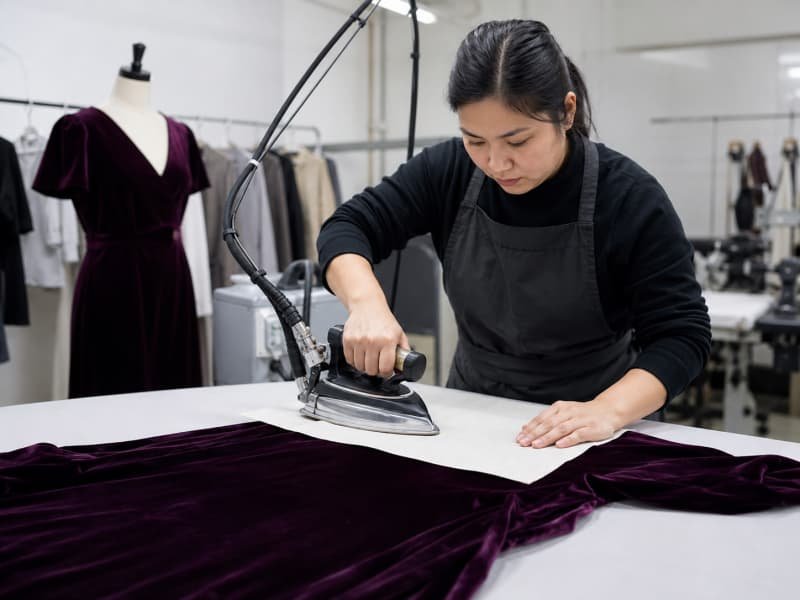
Surface and Pressing Review
Retail environments reveal surface issues. Duolan checks satin shine marks, pressure lines, mesh snags, lace frays, sequin loss, chiffon wrinkles, stains, oil marks, fold lines and pressing effects before packing. Pressing can improve or damage a garment. Satin, crepe, chiffon, lace and structured styles require different finishing care. Surface review should happen after sewing and again before final packing.
- Satin needs light and pressure review.
- Mesh and lace need snag and edge inspection.
- Sequin needs attachment and friction review.
- Chiffon and lightweight fabrics need wrinkle recovery checks.
Final Inspection and Packing QC
- Workmanship and measurement checks support garment approval.
- Label and barcode review supports account operations.
- Packing QC confirms SKU and carton accuracy.
- Final records support replenishment and future reviews.

Label, Ticketing, UPC and Barcode Accuracy
Main Label and Care Label
Main labels, care labels and size labels should match brand file, style, fabric content, lining, origin, size range and care instructions. Duolan reviews label files against BOM records and approved garment details. Care label errors can create compliance, consumer care or account processing issues. Label placement also matters for comfort, visibility and garment presentation.
- Main label should match brand and style file.
- Care label content should match fabric and lining records.
- Size label should match garment and polybag data.
- Label placement should suit fabric and structure.
Hangtag and Price Ticket
- Hangtag artwork and style information should match approved files.
- Ticket placement should follow account instructions.
- Attachment method should avoid fabric damage.
- Price ticket and size information should match SKU records.
UPC / Barcode Matching
- UPC / barcode files should match style-color-size matrix.
- Physical labels should match electronic records provided by the brand.
- Polybag stickers should match garments inside.
- Barcode updates should be reviewed for replenishment and new colors.
Polybag Sticker and SKU Separation
Multi-style, multi-color and multi-size orders often fail at polybag and SKU separation. Duolan reviews style code, color code, size code, PO, barcode and polybag sticker against packing records. SKU separation should happen before cartons are sealed, especially when one program includes several department store accounts, delivery dates or split shipments.
- Polybag sticker should match garment and hangtag.
- Style-color-size records should match packing list.
- SKU grouping should follow account or warehouse rules.
- Split shipments need separated SKU records.
Barcode Record for Replenishment
- New colors need updated SKU and barcode review.
- Reorders should use retained packing rules with updated data.
- Carton records should reflect current replenishment quantities.
- Barcode files should remain linked to style records.

Packing, Carton Mark and Warehouse Receiving Support
Fabric-specific Packing
- Satin should avoid heavy front-panel pressure.
- Mesh and lace should avoid friction with rough trims.
- Sequin garments may need protective separation.
- Corset and bustier styles need structure protection.
Polybag and Folding Rules
- Polybag size should suit garment volume and structure.
- Folding should protect visible panels.
- Stickers should follow style, size and barcode records.
- Packing method should support retail presentation.
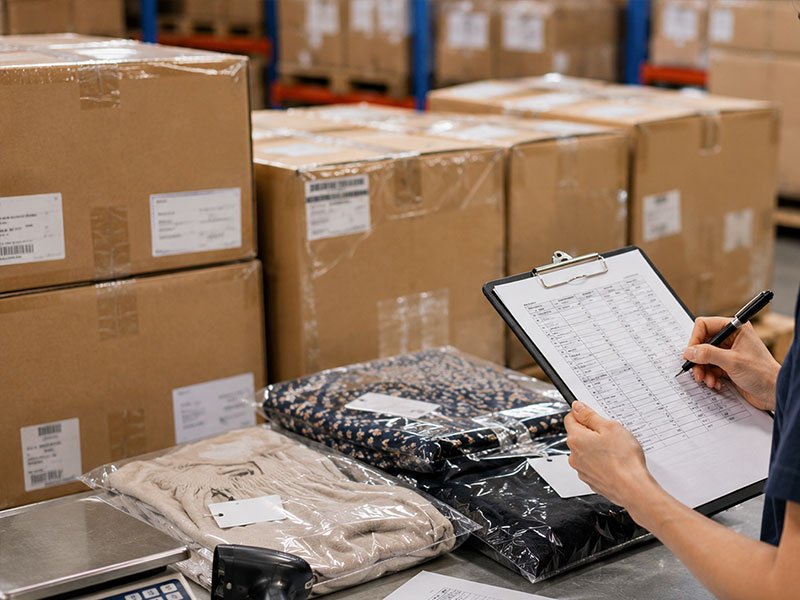
Carton Mark Accuracy
Carton marks should include PO, style, color, size, quantity, carton number, gross weight, net weight, destination and any account-required details. Duolan reviews carton marks against packing lists and physical goods. Carton accuracy supports warehouse receiving, inspection and allocation. Inaccurate carton data creates avoidable follow-up even when production is complete.
- Carton label should match goods inside.
- Carton count and sequence should be clear.
- Gross weight, net weight and CBM should be recorded.
- Destination and PO data should match brand files.
Packing List Matching
Packing list records need exact alignment with physical goods. Style-color-size quantities, carton numbers, PO details and shipment split must match the actual packed cartons. Duolan reviews packing lists before handover.A department store program may involve several styles, colors, sizes and shipment routes. Packing list accuracy helps account operations and receiving teams process goods without repeated clarification.
- Packing list should match carton marks and goods.
- Style-color-size totals should be checked before release.
- Split shipments require separate packing summaries.
- Replenishment should use updated quantity records.
Store / DC Allocation
Some wholesale programs require goods packed or marked according to destination, store group, distribution center or account allocation rules. Duolan can follow brand-provided allocation and packing instructions when shared before packing starts.Allocation rules should enter packing preparation early, because late changes can require carton reopening, relabeling or repacking.
- Destination rules should be confirmed before packing.
- Store or DC allocation should be reflected in carton records.
- Carton marks should follow account requirements.
- Shipment files should support receiving and allocation.
Vendor Manual, EDI / ASN and Channel Coordination
Vendor Manual Review Inputs
When a brand provides a department store vendor manual, Duolan can review relevant manufacturing and shipment requirements: labels, hangtags, barcode placement, polybag rules, carton marks, packing lists, inspection timing, delivery windows and appointed forwarder instructions. Vendor manual requirements should be shared before bulk packing. Early review reduces relabeling, repacking and shipment delays.
- Label and ticketing rules should enter packing files.
- Carton mark requirements should be confirmed before printing.
- Inspection and packing timing should align with shipment plans.
- Account-specific rules should stay linked to project files.
EDI / ASN Data Support
Brand teams may need carton count, SKU details, quantity, packing list, carton marks, gross weight, net weight, CBM and shipment timing for ASN or EDI preparation. Duolan can provide these manufacturing-side shipment records after packing data is confirmed. Accurate carton and SKU data helps brand teams prepare their own digital submissions and internal account documents.
- Carton count and quantity should match packed goods.
- SKU details should match barcode and packing records.
- Weight and CBM should be confirmed before handover.
- Shipment ready date should match packed goods status.
UPC / GTIN / EAN Alignment
UPC, GTIN or EAN data should match brand-provided files, hangtags, polybag stickers, carton records and packing lists. Duolan checks physical and document-level alignment before shipment handover. Barcode and identifier accuracy matters for receiving and fulfillment. The manufacturer’s role is to avoid manufacturing-side mismatch between garments, labels, bags and cartons.
- Identifier files should come from brand-approved records.
- Physical labels should match the style-color-size matrix.
- Polybag and carton data should match packing files.
- New colors or replenishment runs need updated records.
Chargeback Risk Reduction
Department store chargebacks or deductions may arise from avoidable manufacturing-side issues: wrong tickets, barcode mismatch, carton errors, poor packing, late corrections or shipment documentation problems. Duolan helps reduce these avoidable risks through file review, packing QC and carton-level checks. The goal is not to manage account systems for the brand, but to reduce errors caused by production, labeling, packing and handover.
- Label and barcode checks reduce ticketing errors.
- Packing QC reduces garment and data mismatch.
- Carton file review reduces receiving friction.
- Reorder files reduce repeat errors.
Appointed Forwarder and Shipment Terms
- Forwarder contact should be shared early.
- Shipment term should match quotation and document needs.
- Split shipments need separated carton records.
- Delivery timing should include inspection and packing review.
Department Store Channel Risk to Duolan Control Matrix
Department store risk often sits between garment quality, label accuracy, carton data and shipment records. Duolan connects retail channel risks with production, QC, packing and replenishment controls.
| Department Store Risk | What It Affects | Duolan Control Direction |
|---|---|---|
| PP standard unclear | Bulk quality and fit consistency | PP sample, BOM, spec sheet, QC notes |
| Retail finish weak | Floor presentation and return risk | Surface review, pressing check, close-up QC |
| Barcode mismatch | Warehouse receiving and fulfillment | UPC / barcode file, SKU matching, polybag sticker check |
| Ticketing error | Account compliance and store readiness | Hangtag, price ticket and label file review |
| Carton mark mismatch | DC receiving and shipment processing | Carton mark, packing list and quantity check |
| Packing damage | Arrival condition and channel presentation | Fabric-specific folding and protective packing |
| Inspection failure | Shipment window and account confidence | Inline QC, final inspection, correction follow-up |
| Reorder drift | Replenishment consistency | PP memory, fabric card, measurement and packing records |
Manufacturing System for Department Store Dress Programs
Department store dress programs need manufacturing resources able to support approved samples, bulk consistency, retail QC, ticketing, packing accuracy, carton files, replenishment and seasonal volume. Duolan connects owned factories, coordinated satellite capacity, sampling resources, QC workflow and central project coordination for wholesale retail programs.
Owned Factory Control for Key Wholesale Styles
Duolan’s 16 owned fashion factories support core styles, complex dresses, priority launches and programs requiring stronger PP standards. Satin, corset, mesh, sequin, bodycon, occasion and cocktail dresses often need close control from sample approval to final packing.
Owned factory control helps key styles retain clearer production records, QC notes and replenishment memory.
- Key wholesale styles can receive closer PP control.
- Complex dresses can carry stronger QC notes.
- Priority account programs can receive better milestone alignment.
- Repeat styles can retain approved production references.
Coordinated Satellite Capacity for Volume and Replenishment
Duolan’s 20+ coordinated satellite factories support volume styles, seasonal allocation, replenishment and repeat orders under Duolan’s PP, BOM, QC and packing standards. Coordinated capacity supports larger programs without losing record control.
Department store ranges often require several styles and colors at once. Allocation flexibility helps manage volume, while unified files protect consistency.
- Volume styles can be allocated with approved records.
- Replenishment can follow retained PP and BOM files.
- Packing rules stay connected across production routes.
- Seasonal programs can be planned with capacity support.
Sample Capacity for Showroom and PP Cycles
Duolan’s monthly sample capacity of 15,000–35,000 supports fit samples, photo samples, salesman samples, PP samples, size set samples, color samples and revision samples. Department store programs often need samples for showroom, line review, market week, photography and PP approval.
Clear sample purpose reduces confusion between commercial review samples and bulk approval samples.
- Fit samples support size and body review.
- Salesman samples support wholesale presentation.
- Photo samples support product imagery and account decks.
- PP samples support bulk and QC standards.
QC and Packing Coordination for Retail Accounts
Retail account delivery needs garment and packing control together. Duolan connects material review, inline QC, final inspection, label checks, barcode review, packing QC, carton marks and shipment records before handover.
A retail account program can fail through garment defects or data mistakes. QC and packing should never move as separate tracks.
- Material and inline QC protect garment quality.
- Label and barcode review protect account data.
- Packing QC protects SKU and carton accuracy.
- Shipment records support receiving and replenishment.
Reorder and Replenishment Memory
Replenishment planning depends on retained PP sample, fabric card, shade note, measurement record, QC notes, label file, barcode update and packing rule. Duolan keeps these records linked to repeat styles and new color programs.
A successful department store dress should be easier to replenish, not harder to repeat.
- PP memory supports garment consistency.
- Fabric cards support shade and handfeel control.
- QC notes guide repeated inspection.
- Packing records protect account delivery accuracy.
Anonymous Department Store Dress Project Case Studies

United States|Wholesale Party Dress Channel Program
- Channel Goal: Prepare a multi-style party dress range for wholesale retail delivery.
- Duolan Action: PP lock, satin and sequin QC, UPC matching, polybag review, carton records and shipment coordination were organized.
- Control Focus: Surface marks, sequin loss, fit-sensitive measurements, barcode accuracy and carton-level packing.
- Replenishment Direction: PP records and packing files supported later new color planning.

United Kingdom|Occasion Dress Retail Account Program
- Channel Goal: Build a retail account range requiring close-up finish and channel packing discipline.
- Duolan Action: Fabric routes, lining QC, zipper review, hangtag placement, final inspection and packing list support were prepared.
- Control Focus: Satin surface, lace trim, lining comfort, measurement tolerance and label accuracy.
- Replenishment Direction: Approved records supported later occasion range updates.

Australia|Department-store-ready Resort Dress Program
- Channel Goal: Support seasonal resort delivery with printed fabrics, lightweight silhouettes and staged shipment needs.
- Duolan Action: Print placement, shade review, hem balance, wrinkle recovery packing and split shipment records were coordinated.
- Control Focus: Print scale, opacity, hem recovery, carton pressure and shipment documentation.
- Replenishment Direction: Resort files supported future color extensions and carryover planning.

Europe|Replenishment and Color Extension Program
- Channel Goal: Replenish proven fitted dresses without losing approved fit, shade or packing standard.
- Duolan Action: PP memory, fabric cards, shade notes, measurement QC, barcode updates and reorder packing files were prepared.
- Control Focus: Fit continuity, shade matching, SKU accuracy, final inspection and carton record consistency.
- Replenishment Direction: Repeat records reduced approval work for later drops.
Department Store Fashion Brand FAQ

Send Your Department Store Retail Brief
A stronger department store dress program starts with clear channel rules, product files and packing expectations. Duolan can review your dress range, vendor manual requirements, PP sample needs, label files, barcode records, QC standard, packing instructions, shipment terms and replenishment plan before proposing a manufacturing route.
Share Your Channel Requirements
- Department store account or wholesale retail channel involved.
- Vendor manual, packing instructions, warehouse receiving rules and delivery window.
- Shipment terms, appointed forwarder details, split shipment needs and destination requirements.
Share Your Product and Sample Files
- Dress category, style count, target quantity, size range and colorways.
- Tech packs, reference samples, fabric direction, trim details and special process requirements.
- Fit sample, photo sample, salesman sample, size set sample, PP sample and color sample needs.
Share Your Label, Barcode and Packing Rules
- Main label, care label, size label, hangtag, price ticket, UPC / barcode and SKU rules.
- Polybag size, sticker placement, folding method, carton mark format and packing list structure.
- AQL or final inspection standard, previous quality concerns, replenishment goals and color extension plans.


