Skip to content
Custom Dress Manufacturer for Department Store Private Labels
Dress-focused development and manufacturing for retail groups building controlled, scalable, and commercially balanced private-label collections.
- Private-label programs commonly cover 10-30 styles and 20,000-80,000 total pieces across one brand order.
- Nearly 30 years of fashion-womenswear development experience supports silhouette, fabric, fit, workmanship, and commercial product decisions.
- Structured control connects design review, sample approval, production readiness, barcodes, carton details, delivery records, and repeat-order standards.
A Manufacturing System Built for Retail Dress Programs
16 Owned Factories
20+ Satellite Factories
300 Sewing Lines
50+ Flexible Lines
6.5M Monthly Base
High Development Density








Built for Department Store Private Label Teams
Category Management Teams
Womenswear Buying Teams
Product Development Teams
Technical Teams
Sourcing Offices
Retail Operations Teams
Private Label Manufacturing Goes Beyond Replacing Labels
A department-store label requires product identity, technical standards, retail execution, and repeatable manufacturing. The comparison below separates a controlled private-label program from a basic relabeling service.
| Program Area | Basic Relabeling Service | Department Store Private Label Program |
|---|---|---|
| Product Direction | Existing generic styles with limited change | Assortment built around target shopper, category role, channel, season, and retail price |
| Design Development | Minor color or logo changes | Silhouette, fabric, fit, construction, detail, color, and range development |
| Size System | Factory standard size chart | Brand or market-based size chart, grading rules, POM definitions, and tolerances |
| Sample Approval | Visual approval of one sample | Prototype, fit, revision, photo or salesman sample, PP standard, and production readiness |
| Material Control | Available stock materials | Approved fabric, lining, trims, color standards, BOM, and substitution rules |
| Bulk Control | End-line inspection | First-piece review, inline checks, final inspection, measurement control, and packing QC |
| Branding | Main label attachment | Main label, size label, care label, hangtag, price ticket, barcode, and placement rules |
| Delivery | Standard cartons | PO-based packing, size ratios, carton marks, shipment documents, and receiving requirements |
| Repeat Orders | Recreate from previous communication | Preserved pattern, BOM, color record, spec, workmanship, QC, and packing files |
Control Points for High-Risk Retail Dress Programs

Assortment Risk
- Define core, volume, statement, and replenishment styles.
- Separate commercial fabrics from high-cost feature materials.
- Flag styles whose construction may not support the target price.

Fabric Risk
- Confirm material direction before pattern finalization.
- Use lab dips, strike-offs, or swatches when needed.
- Lock approved bulk references and substitution rules.

Fit Risk
Fit errors often begin with unclear measurement methods, unsuitable ease, or pattern corrections that never reach the spec sheet.
Duolan translates fit comments into pattern, POM, tolerance, support, and construction updates.
- Identify critical measurements by style.
- Review sample size and grading basis.
- Connect revised measurements to PP and QC standards.

Bulk Deviation Risk
A beautiful sample can still fail in production when materials, workmanship, or production instructions remain open.Duolan uses approved samples, BOM control, material confirmation, first-piece review, inline inspection, and final checking to preserve the intended result.
- Confirm production-ready sample status.
- Lock fabric, lining, trims, color, and key operations.
- Verify high-risk styles before full production release.

Retail Data Risk
Wrong barcodes, ticket prices, size stickers, or carton marks can block receiving even when garments are acceptable.
Duolan requests approved artwork, data files, placement instructions, and packing ratios before the packing stage.
- Match style, color, size, SKU, and PO records.
- Check scan readability and placement.
- Reconcile packed quantities with carton and shipment files.

Timeline Risk
- Prioritize long-lead materials and complex styles.
- Separate approval deadlines from production dates.
- Preserve QC and shipping buffers instead of consuming them early.
What Retail Teams Evaluate Before Supplier Approval
Dress Category Depth
Collection Development
Sample Accuracy
Size Consistency
Production Discipline
Compliance Readiness
Supplier approval often requires social-audit records, labeling accuracy, inspection support, and shipment documentation. Duolan has completed SMETA 2-Pillar audit and can coordinate project-specific standards according to the selected materials, markets, and retail requirements.
Retail Packing Accuracy
Repeat-Order Stability
Developing Dresses Within Retail Price Architecture
Build Cost From Product Reality
Duolan reviews cost drivers before a quotation is treated as production-ready. Main factors include shell fabric, lining, trims, consumption, marker efficiency, construction operations, fit sensitivity, decoration, color count, size range, packaging, testing, and delivery timing. A preliminary cost direction can be discussed from a clear tech pack or sample basis, while the formal bulk quotation should follow confirmed materials, workmanship, quantity, labels, and packing requirements.
A corset mini dress with cups, boning, lining, shaped seams, and a concealed zipper cannot be costed like a loose day dress. A satin dress may appear simple but can require careful cutting, seam handling, pressing, and protective packing. A sequin style carries cutting loss, thread and needle considerations, lining protection, decoration stability, and slower operations.
Balance Range Roles
Not every style should carry the same cost structure. A department-store range may combine entry commercial dresses, reliable volume styles, fashion-led pieces, occasion statements, and online exclusives. Duolan can help separate product roles before costly details are spread across the entire range.
- Core volume styles: stable fabrics, repeatable operations, controlled color programs, and reliable replenishment potential.
- Fashion styles: stronger silhouette or detail direction with controlled development investment.
- Statement styles: higher visual impact, limited SKU depth, and more focused production planning.
- Retail anchors: recognizable shapes and materials designed to support the category’s regular selling rhythm.
Plan Production Backward From the Retail Launch
Build the Critical Path
The working sequence begins with the required warehouse or store date, then moves backward through transport, final inspection, packing completion, bulk completion, production start, PP approval, revised sample approval, first sample, material confirmation, and development review. Every stage receives an owner and a decision deadline.A useful planning chain is:
Retail launch -> warehouse receiving -> shipping -> final inspection -> packing -> bulk completion -> production -> first-piece approval -> material lock -> PP approval -> revised sample -> first sample -> development review.
Duolan’s reference bulk lead times are 15-20 days for simple styles, 20-30 days for standard styles, and 30-45 days for complex styles after production-critical approvals and materials are ready. Satin, corset, sequin, mesh-layered, heavily embellished, or highly fitted dresses may require added verification before full production release.
Protect Approval Buffers
The fastest calendar is not always the safest calendar. A schedule becomes fragile when sample comments arrive late, lab dips remain open, barcodes change after packing starts, or inspection time is reduced to recover an earlier delay.
Duolan identifies approval items that can stop the entire program and separates them from details that can progress in parallel.
- Long-lead items: custom fabric, special color, branded trims, printed materials, and retail tickets.
- Technical gates: fit approval, grading basis, PP sample, BOM, and critical workmanship.
- Retail gates: care-label content, barcode files, price tickets, packing ratios, and carton marks.
- Logistics gates: shipment term, forwarder booking, warehouse window, and document format.
Use Split Release When Needed
A 20-style program may contain twelve standard dresses, five fit-sensitive dresses, and three decoration-heavy styles. Releasing every style on one date can create unnecessary pressure.
Duolan can plan staged production or shipment where commercially ready styles move first while complex styles complete pilot verification or material confirmation.
Split release must still follow PO, packing, and warehouse instructions, but it can protect the launch when product complexity is uneven.

Dress Categories for Department Store Private Labels

Day Dresses
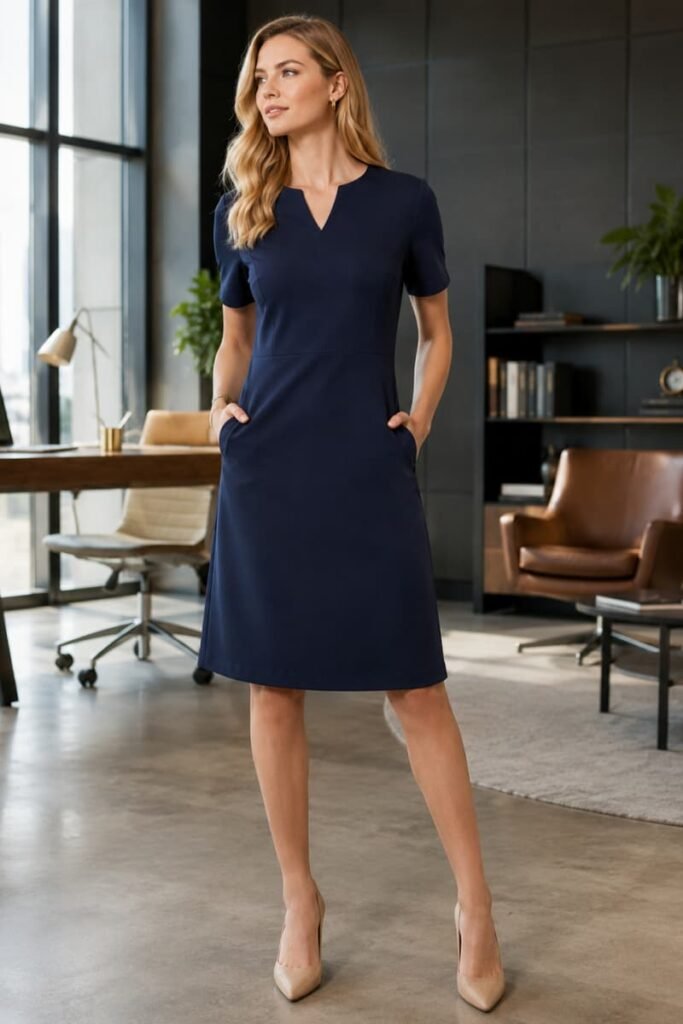
Office Dresses

Occasion Dresses

Party Dresses

Wedding Guest Dresses

Vacation Dresses

Going Out Dresses
Going-out dresses sit between party, evening, and social occasion.
Bodycon, corset, halter, asymmetric, ruched, mini, and mesh-layered styles often lead the range.
Fit must remain secure during movement, with careful attention to bust coverage, waist balance, hip shaping, strap angle, closure stress, slit height, and lining control.

Fashion Sets
From Individual Styles to a Balanced Dress Assortment
Define the Commercial Structure
The assortment should identify why each style exists. Entry styles establish accessible price points. Core styles carry dependable volume. Fashion styles create newness. Statement styles deliver visual authority. Replenishment styles deserve materials and construction routes that can be repeated. Online exclusives may carry stronger detail or narrower size depth, while store-wide styles may need broad size ratios and simpler receiving. For a 20-style dress program, a workable starting structure could include six core commercial styles, five fashion-led styles, four occasion or statement styles, three online-led styles, and two replenishment anchors. Duolan can help identify development priorities before every style enters sampling at the same intensity.
Build a Coherent Visual Rhythm
Collection unity does not require every dress to look similar. Coherence can come from a controlled color story, shared fabric families, related necklines, balanced lengths, repeated trim language, or a consistent fit direction. A mini bodycon, a satin midi, and a printed maxi can still belong to one range when palette, styling, proportion, and occasion are planned together. Fabric planning should avoid too many one-style materials unless the visual reason and margin justify them. Silhouette planning should cover different body preferences and occasions without crowding one shape. Duolan can review where shared fabric, lining, zipper, label, or packaging components may improve production efficiency while preserving product identity.
Sequence Sampling and Launch Priority
Not every style carries equal development risk. Standard woven or jersey dresses may move quickly, while corset, satin, mesh, sequin, or asymmetric styles need earlier technical review. Sample priority should reflect campaign needs, material lead time, fit sensitivity, production complexity, and commercial importance. A strong sample sequence may open high-risk hero styles first, then core commercial styles, followed by lower-risk supporting styles. Such sequencing exposes fit, fabric, and construction risks early while leaving enough calendar for correction. Duolan can track each style by sample stage, open comments, material status, target approval date, and bulk path.
Fabric Planning for Commercial Dress Collections

Satin and Charmeuse

Crepe and Wovens

Stretch Jersey

Mesh and Power Mesh

Lace

Chiffon and Georgette

Jacquard and Texture

Sequin and Embellishment
Trims, Labels, and Packaging Begin During Development
Linings and Coverage
Closures and Support
Main Brand Labels
Care and Size Labels
Hangtags and Tickets
Protective Packing
Turning Retail Product Briefs Into Development Standards
Information Needed at Project Entry
Tech Pack Review Before Sampling
Fit, Size, and Grading for Retail Dress Ranges
Establish the Size Basis
Critical measurements may include bust, underbust, waist, high hip, low hip, body length, strap length, armhole, across back, sleeve opening, slit height, hem width, zipper length, and neckline drop. Measurement methods must define where each point starts and ends, whether a half or full circumference is recorded, and whether adjustable components are measured at a fixed setting.
Correct the Pattern, Not Only the Sample
Duolan can translate comments into pattern updates, POM changes, construction adjustments, lining changes, and revised sample verification. Such linkage is especially important for corset, bodycon, halter, backless, strapless, satin, mesh, and slit dresses.
Grade Proportion, Not Only Numbers
Grading should preserve visual and functional relationships across the size range. Bust placement, waistline, skirt length, slit height, strap length, armhole depth, neckline coverage, support position, and hem opening do not always increase by the same amount. Stretch fabrics, non-stretch wovens, heavy embellishment, and layered constructions each need different grading consideration.
Use Measurement Data in QC
The approved spec sheet becomes a production and inspection tool. Duolan defines POM method, tolerance, critical points, sample approval status, and any special measuring condition such as garment relaxation or stretch recovery. Inline and final measurement checks then compare production against the same basis used during fit development.
A Controlled Sample Path for Multi-Style Programs
Development Review
First Prototype
Fit Sample
Revised Sample
Photo-Ready Sample
Salesman Sample
Size Set
Selected sizes may be sampled to verify grading, proportion, length, opening, support, and construction across the range.
Size-set depth depends on style risk, material, brand procedure, and order scale.
PP Sample
The pre-production sample should represent the approved fabric, lining, trims, color, construction, measurements, labels, and relevant packing basis. PP approval becomes the principal bridge between development and bulk production.
Workmanship Engineered for Dress-Specific Performance

Clean Seam Control

Bust Support Systems

Draping and Gathering

Zipper and Closure Finish

Slits and Openings
Slits, cut-outs, open backs, necklines, and armholes combine visual design with wearing security.
Reinforcement, lining, facing, edge control, grading, and measurement tolerances must protect movement and coverage across the size range.

Lining Integration
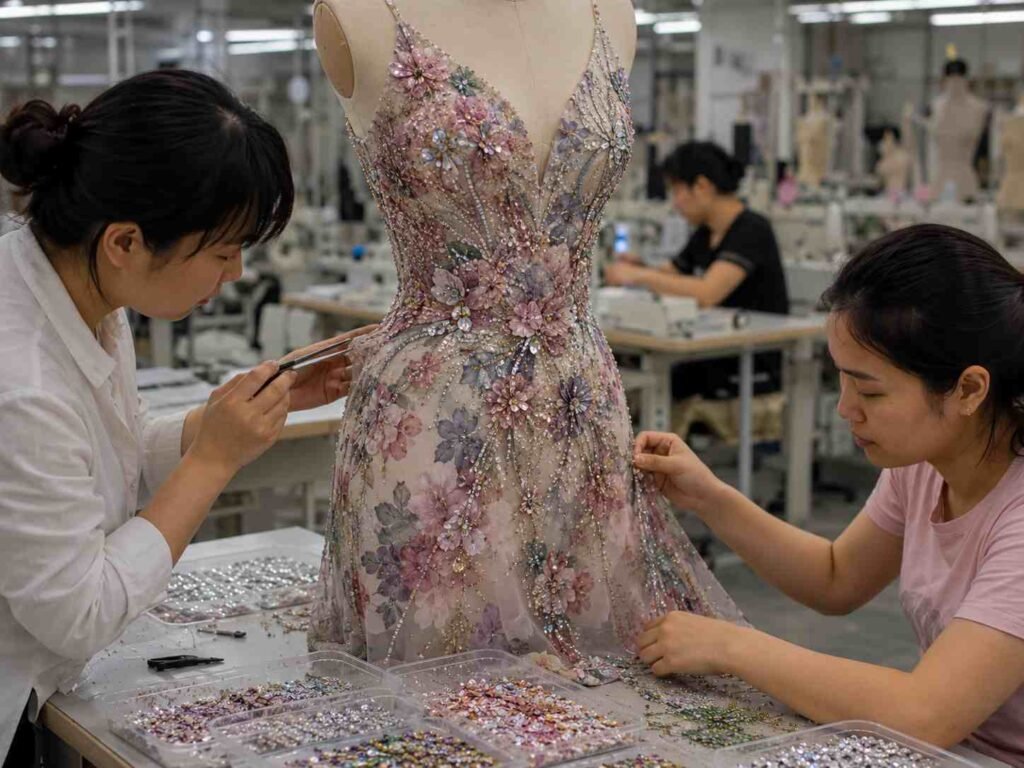
Embellishment Security

Pressing and Final Shape
How Multi-Style Private Label Orders Are Planned
Break the Order Into Controlled Units
Order breakdown begins by style, color, size, quantity, fabric, lining, key trims, decoration, and delivery requirement. Each style is classified as standard, complex, flexible-response, high-risk workmanship, or repeat production. The classification determines whether the style needs special material control, a dedicated line, a pilot run, first-piece approval, additional inline checks, or separate packing instructions.
A 24-style program may contain ten standard woven or jersey dresses, six satin or draped styles, four corset or highly fitted styles, and four embellished pieces. Running all styles through one line plan would ignore material handling, operation sequence, and quality risk. Duolan can match production resources to the real technical profile of each group.

Set Production Priority by Retail Need
Keep Comments and Files Separated by Style
Capacity for Launches, Reorders, and Scale-Ups
Core Factory Control
Flexible Line Response
Specialized Allocation
Parallel Style Scheduling
Replenishment Capacity
Scale-Up Planning
Quality Control From Development to Retail Packing

Development Feasibility

Material Inspection

PP Standard Approval

First-Piece Verification

Inline Inspection

Final Review

Packing QC

Shipment Release
Retail-Ready Labeling, Ticketing, and Packing Control
Retail execution begins before the packing line. Approved artwork, data, placement, assortment, and receiving instructions must be connected to style and PO records so finished dresses arrive ready for store, warehouse, or ecommerce handling.
| Retail Item | Required Input | Duolan Control Before Shipment |
|---|---|---|
| Main Label | Artwork, material, dimensions, fold, color, placement | Physical approval, orientation, position, stitch method, style compatibility |
| Size Label | Size range, market notation, placement | Match garment size, main label set, barcode data, and packing record |
| Care Label | Composition, care wording, symbols, origin, legal content | Verify against confirmed materials, approved file, placement, and print readability |
| Hangtag | Artwork, paper, finish, string, fastener, attachment point | Check print, color, attachment, style reference, and presentation |
| Price Ticket | Retail price, currency, promotion data, format | Confirm file version, style-color-size mapping, print quality, and attachment |
| UPC or Barcode | Approved code file and SKU mapping | Scan test, data match, label position, size and color accuracy |
| Polybag | Material, dimensions, warning text, vents, closure | Confirm garment protection, label visibility, sticker placement, and sealing |
| Size Sticker | Approved notation, color, placement | Match actual garment size, polybag, pack ratio, and carton record |
| Hanger | Hanger type, size marker, clips, anti-slip requirement | Check support, garment shape, size marker, and pack method |
| Carton Assortment | Units by style, color, size, PO, store or DC | Count verification, ratio control, separation, and packing-list reconciliation |
| Carton Mark | PO, style, color, size, destination, carton number | Print clarity, carton sequence, destination match, and document consistency |
| Shipment Files | Packing list, invoice, weight, CBM, shipping data | Reconcile physical cartons, quantities, marks, and handover information |
Prepared for Retail Compliance and Vendor Onboarding
Social Audit Readiness
Quality Standards Support
Textile Testing Coordination
Material Requirement Support
Labeling and Packing Rules
Inspection and Documents
Duolan can coordinate inline, final, or third-party inspection according to the agreed procedure. Shipment support may include packing list, commercial invoice, HS information, inspection record, test documents, carton details, and forwarder data as required.
Delivery and Reorders Managed as One Supply Cycle
Coordinate the Delivery Basis
Duolan can support FOB, CIF, DDP, split shipment, nominated forwarders, and different receiving arrangements according to the confirmed commercial terms. Delivery planning should state ready date, destination, forwarder, warehouse window, carton quantity, gross and net weight, CBM, PO references, document format, and any pallet or labeling requirement.Reference transport times are approximately 3-7 days by express, 5-8 days by air, and 20-35 days by sea, excluding project-specific booking, customs, consolidation, and destination variables. Logistics choice should be made from launch timing, cost, garment sensitivity, carton volume, and replenishment urgency rather than speed alone.
Preserve the Approved Product Standard
After delivery, Duolan records the pattern version, BOM, fabric and trim references, color record, size spec, workmanship notes, PP basis, QC findings, label and packing files, and issues found during production. A reorder therefore begins with a controlled history rather than memory.
Before a repeat order, material availability, shade, trim substitutions, size ratios, ticket data, packing requirements, and destination information are rechecked. A first-piece confirmation may be used when the production line, material batch, or construction detail changes.
Protecting Unreleased Private Label Collections
Protect Development Files
Control Brand Visibility
Separate Project Assets
Style codes, artwork, labels, packaging files, and sample records should be organized by project and version. Clear file separation reduces the risk of using the wrong label, ticket, artwork, or packing instruction across different retail programs.
Private Label Dress Programs Managed in Practice

US Department Store Seasonal Range
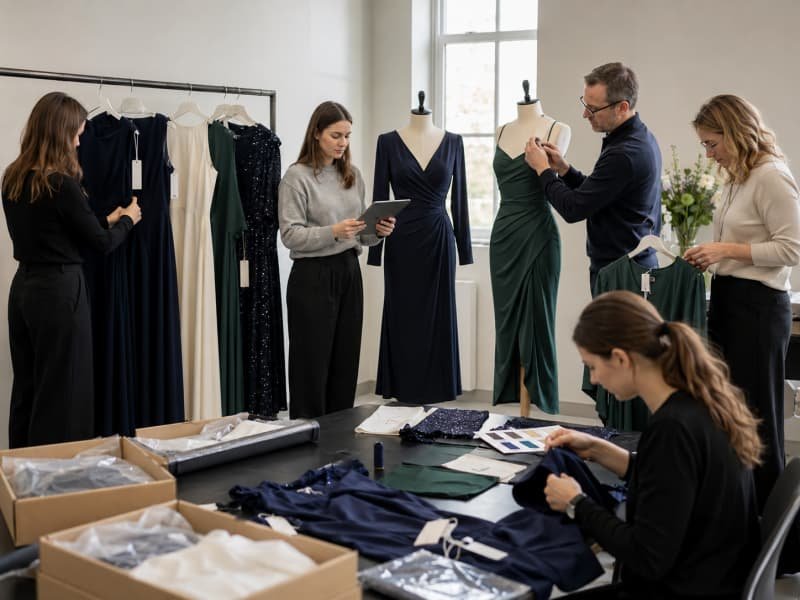
Occasionwear Multi-Style Program

Replenishment and Color Extension
A multi-store fashion group reordered 12 proven dress styles in three replenishment waves totaling 27,600 pieces. The program included core bodycon, going-out, satin, and occasion styles, with updated color demand and revised size ratios based on prior sales. The main risk was preserving fit and visual standards while introducing new fabric batches, colorways, and packing data. Duolan reopened the approved pattern, BOM, spec, workmanship, QC, and packing files, then checked current material availability and shade references. New colors received fabric and garment review before production release. Size ratios were adjusted by style rather than applying one distribution to the entire order. A first-piece review was used for styles with new material batches or line changes. Barcode, ticket, and carton files were updated by replenishment wave while the original product standard remained under version control.
Frequently Asked Questions for Private Label Dress Programs

Start Your Department Store Private Label Dress Program
Share the commercial and technical basis of the program so Duolan can evaluate product direction, development depth, manufacturing feasibility, production timing, retail packing, and the most suitable next step. A complete inquiry allows the team to separate immediate decisions from details that can remain open during early development.
Please include:
- Company or retail-group name, website, country, and selling channels.
- Collection purpose, season, target shopper, and planned retail launch date.
- Number of styles, estimated total quantity, colorways, and size range.
- Tech packs, reference images, sketches, moodboards, or original-sample photos.
- Fabric, lining, trim, fit, construction, and workmanship direction.
- Target FOB or cost framework when available.
- Main-label, care-label, hangtag, price-ticket, barcode, hanger, and packing requirements.
- Compliance manual, testing expectations, inspection procedure, and delivery destination.