 Skip to content
Custom Going-Out Top Manufacturer
Custom development and controlled manufacturing for fashion brands building body-conscious, occasion-led and statement women’s top collections.
- 12 core going-out top categories covering corset, bustier, halter, strapless, mesh, satin, lace, sequin and fitted structures
- Collection programs commonly planned across 10–30 coordinated styles
- Brand production programs commonly range from 20,000–80,000 pieces per order cycle
- Bulk production references range from 15–45 days according to construction, materials, workmanship and order planning
- Pattern, fit, fabric, lining, support and trim decisions are reviewed before production release
- Multi-factory coordination supports launch orders, repeat colors, rolling replenishment and larger production programs
Built for Established Fashion Brands and Product Teams
Established Fashion Brands
- Structured review of product direction and price positioning
- Multi-style planning across corset, mesh, satin, halter and fitted categories
- Pattern and fit records that support repeat colors and future extensions
- Material and trim coordination across related styles
- Controlled transition from approved samples into bulk production
- Production planning for launch orders, reorders and seasonal expansion
Buying and Sourcing Teams
Sourcing teams need clear records, traceable approvals and predictable production checkpoints. A visually strong sample carries limited value when measurements, materials, workmanship and packaging instructions are not properly transferred into bulk production.
Duolan works with sourcing teams on:
- Product feasibility and factory allocation
- Fabric, lining and trim approval records
- Sample status and revision summaries
- Pre-production confirmation
- Bulk production timelines
- Inline and final quality checkpoints
- Label, barcode and carton requirements
- Shipment documentation and delivery coordination
Complex going-out tops receive added attention around bust support, neckline stability, transparency, stretch recovery, hardware strength and sensitive surface finishes.
Product Development Teams
Product teams are responsible for turning a design direction into a garment that fits, photographs well, meets commercial cost targets and remains manufacturable at scale.
Duolan reviews:
- Silhouette and body proportion
- Bust, neckline, armhole and waist balance
- Fabric drape, stretch and opacity
- Support components and lining coverage
- Pattern construction and grading logic
- Sewing feasibility and finishing quality
- Revision priorities
- Sample-to-bulk readiness
Development discussions may begin from a tech pack, reference image, original garment, sketch, fabric idea or collection moodboard. Each route requires a different level of technical clarification before sampling begins.
What Defines a Production-Ready Going-Out Top?
More Than a Fashion Label
Going-out tops are designed for dinner dates, parties, birthdays, concerts, nightlife, holiday events, vacation evenings and social occasions. Commercially relevant categories include:
- Corset and bustier tops
- Halter and backless tops
- Strapless and tube tops
- One-shoulder tops
- Cowl-neck and draped tops
- Mesh and lace tops
- Satin camisoles
- Sequin and embellished tops
- Bodysuits
- Fitted long-sleeve tops
- Cut-out tops
- Coordinated top-and-skirt sets
Each category has a different pattern, material and fit risk. Treating every style as a basic crop top usually leads to unstable samples and inconsistent bulk results.
Original Cut-and-Sew Development
- Custom pattern creation
- Brand-specific measurements
- Fabric and lining sourcing
- Color development
- Custom neckline and body length
- Cup, boning and support construction
- Sleeve and strap development
- Hardware and closure selection
- Brand labels and hangtags
- Retail and ecommerce packaging
- Sample revision
- Controlled bulk manufacturing
Built for Repetition
A strong sample should become a usable production standard. Pattern files, measurement specifications, material references, workmanship notes, label positions and packaging instructions need to remain clear after sample approval.
Repeatability matters when a brand plans:
- Additional colors
- Extended size ranges
- Matching skirts or trousers
- Seasonal fabric updates
- Reorders
- Regional launches
- Higher-volume production
- Related styles using the same fit block
Production readiness begins when visual approval and manufacturing information are aligned.
Six Going-Out Top Risks Controlled Before Bulk
Design Sample Mismatch
- Break down the visual design into measurable components
- Confirm target body length and exposure
- Review fabric behavior before cutting
- Define internal construction
- Mark high-risk areas on the development note
- Separate visual preferences from structural requirements
Fabric Silhouette Mismatch
The same pattern can look completely different in satin, mesh, jersey, velvet or lace. Weight, stretch direction, recovery, friction and opacity influence the final shape. Control actions include:
- Compare drape and recovery
- Check fabric width and usable cutting direction
- Review transparency under light
- Confirm lining compatibility
- Test gathering, pleating or ruching behavior
- Evaluate whether the fabric can hold the intended neckline and bust shape
Unstable Bust Fit
Corset, strapless, halter and deep-neck styles may slide, gape, compress unevenly or expose more than intended. Bust fit depends on pattern shape, support placement, fabric tension and closure design. Control actions include:
- Confirm bust point and underbust position
- Review cup dimensions
- Plan boning channels
- Test elastic and gripper tape
- Check side coverage
- Review closure tension
- Evaluate the style on a mannequin and fit model
Transparency Lining Failure
Mesh, lace, light satin and pale stretch fabrics may appear acceptable on a cutting table but become overly transparent when stretched or photographed under strong lighting.
Control actions include:
- Map lined and unlined areas
- Check opacity under normal and studio lighting
- Review lining color
- Test edge visibility
- Control seam allowance exposure
- Confirm stretch compatibility between shell and lining
Sample Bulk Variation
An approved sample can lose its shape when the bulk fabric lot, pattern, seam method or support component changes. Small changes create visible differences in fitted garments.
Control actions include:
- Lock approved material references
- Preserve the approved pattern
- Define critical workmanship points
- Confirm the pre-production sample
- Review first-piece construction
- Run inline inspections
- Compare final garments against the approved standard
Missed Launch Timing
A style may be technically achievable but commercially late. Delays often come from unconfirmed fabric, repeated design changes, custom hardware, incomplete size charts or unclear packaging requirements. Control actions include:
- Work backward from the launch date
- Separate first sample, revision and PP stages
- Confirm material deadlines
- identify long-lead trims early
- Plan production by style complexity
- Reserve inspection and packing time
- Select shipping methods according to the sales window
Custom Going-Out Tops for Distinct Fashion Collections

Corset Tops
Corset tops require more than visible boning lines. A stable product depends on cup position, underbust shaping, waist contour, side-seam balance, back closure and controlled tension. Development options include:
- Overbust and underbust structures
- Straight, sweetheart and pointed necklines
- Internal or exposed boning
- Lace-up, hook-and-eye or zipper backs
- Molded, cut-and-sew or removable cups
- Satin, jacquard, mesh, lace and stretch woven shells
- Cropped, waist-length and longline bodies
Bulk control focuses on boning placement, cup symmetry, top-edge stability, seam smoothness and consistent closure tension.

Bustier Tops
- Cup depth and spacing
- Center-front height
- Side coverage
- Underbust support
- Strap width and placement
- Lining strength
- Hook, zipper or lace-up construction
- Smooth transition from bust to waist

Halter Tops
A halter top transfers part of the garment load toward the neck. Strap angle, width and length affect both comfort and bust stability.
Development reviews cover:
- Neck pressure distribution
- Tie, button, hook or fixed-back closures
- Front neckline depth
- Side-bust coverage
- Armhole shape
- Open-back balance
- Lining and support
- Strap extension across sizes
A strong visual shape should not create neck strain, excessive pulling or unstable side coverage.

Strapless Tops
- Straight bandeau shapes
- Curved corset necklines
- Folded satin constructions
- Ruched mesh overlays
- Grip tape support
- Underbust elastic
- Boned side seams
- Internal bra structures

One-Shoulder Tops
- Shoulder angle
- Neckline tension
- Armhole depth
- Side-seam balance
- Internal elastic
- Sleeve weight
- Draped panel direction
- Grain and stretch orientation

Backless Tops
Backless products place greater pressure on the front bodice, side seams, neck or waist. Secure wear depends on careful coverage and closure planning. Options include:
- Low scoop backs
- Cross-back straps
- Lace-up backs
- Tie-back construction
- Elasticized backs
- Hardware-connected straps
- Open-back bodysuits
- Halter-back combinations
Development checks front stability, side exposure, strap tension, closure strength and the effect of movement on coverage.

Cut-Out Tops
- Waist cut-outs
- Underbust openings
- Shoulder openings
- Center-front keyholes
- Side-body cut-outs
- Hardware-linked sections
- Twisted fabric sections
- Layered mesh openings

Cowl-Neck Tops
Cowl necklines rely on controlled fabric fall. Too little volume looks flat; too much fabric creates uncontrolled movement and poor bust coverage. Key decisions include:
- Straight or bias cutting
- Cowl depth
- Facing construction
- Shoulder or strap placement
- Bust coverage
- Back-neck stabilization
- Lining method
- Fabric weight
Satin, jersey and lightweight crepe each produce different folds. Pattern dimensions must match the selected material.

Mesh Lace Tops
Mesh and lace styles combine transparency with fit and edge control. Different materials may stretch at different rates, causing rippling, twisting or uneven coverage.
Development covers:
- Lined and unlined zones
- Appliqué placement
- Seam visibility
- Neckline stabilization
- Sleeve stretch
- Lace motif positioning
- Skin-contact softness
- Reinforcement around closures
Bulk cutting must also control lace direction, motif balance and mesh relaxation.

Ruched Draped Tops
Ruching and draping create shape through controlled fabric distribution. Inconsistent gathering can shift the waistline, distort the neckline or create uneven left-to-right volume.
Control points include:
- Gathering ratio
- Anchor points
- Elastic length
- Draping direction
- Side-seam matching
- Lining attachment
- Hem balance
- Pressing method
Approved samples should record finished gathering length and key visual positions for bulk reference.

Sequin Embellished Tops
Sequin, pearl, crystal and metallic surfaces require careful planning around weight, skin contact, seam construction and packing protection.
Development checks:
- Decoration density
- Base fabric strength
- Seam-line cleaning
- Underarm comfort
- Lining coverage
- Trim attachment
- Needle marks
- Replacement and repair method
- Pressing restrictions
- Packaging protection
Decorative placement should remain visually consistent across sizes without making the garment excessively heavy or rigid.

Bodysuits Fitted Tops
Bodysuits and fitted jersey tops require stable stretch, sufficient recovery and accurate torso proportion. A style can fit at the bust and waist while still pulling vertically or creating discomfort at the crotch.
Development reviews:
- Torso length
- Bust and waist ease
- Armhole and sleeve tension
- Neckline recovery
- Snap placement
- Gusset shape
- Lining or double-layer zones
- Fabric recovery after wear
Grading must protect both silhouette and mobility across the size range.
Build a Commercial Going-Out Top Collection
Dinner Date Collection
- Satin cowl tops
- Off-shoulder jersey tops
- Structured sweetheart tops
- Draped long-sleeve styles
- Lace-lined camisoles
- One-shoulder fitted tops
Party Birthday Collection
Birthday and party programs can carry stronger color, shine and body definition. Products often need to photograph well under artificial lighting.
Suitable directions include:
- Corset and bustier tops
- Crystal or sequin surfaces
- Metallic stretch fabrics
- Mesh-overlay tops
- Ruched fitted styles
- Hardware cut-outs
Development must control surface reflection, lining comfort, support and finishing around decorated seam lines.
Club Nightlife Collection
- Strapless tops
- Halter bodysuits
- Cut-out jersey styles
- Open-back tops
- Mesh panel tops
- Asymmetric necklines
Concert Festival Collection
Concert and festival products may combine stronger details with more movement and styling flexibility.
Suitable directions include:
- Lace-up corset tops
- Denim or coated bustiers
- Hardware-linked tops
- Printed mesh styles
- Cropped halter tops
- Coordinated mini-skirt sets
Material durability, metal trim strength, edge softness and packing recovery need additional review.
Holiday Event Collection
- Velvet corset tops
- Sequin camisoles
- Crystal mesh tops
- Satin bow styles
- Draped metallic tops
- Long-sleeve occasion tops
Vacation Evening Collection
Vacation evening styles need visual impact with lighter packing weight and comfortable wear in warm climates.
Suitable directions include:
- Printed halter tops
- Satin scarf tops
- Open-back camisoles
- Lightweight mesh styles
- Draped one-shoulder tops
- Coordinated maxi-skirt sets
Fabric wrinkling, colorfastness, transparency and post-packing recovery should be considered before approval.
Fabrics Selected for Shape, Drape and Wear

Satin
- Gloss level
- Drape
- Snag sensitivity
- Seam puckering risk
- Needle-mark visibility
- Pressing response
- Bias-cut movement
- Opacity
- Lining compatibility

Stretch Jersey
- Two-way or four-way stretch
- Recovery after extension
- Fabric weight
- Pilling risk
- Opacity when stretched
- Edge curling
- Seam growth
- Heat response
- Color consistency

Power Mesh
Power mesh provides controlled transparency and stretch support. Different grades range from soft decorative mesh to stronger compression mesh.
Development reviews include:
- Stretch direction
- Recovery
- Sheerness
- Surface softness
- Support level
- Layer interaction
- Seam visibility
- Edge finishing
- Color matching with lining
Power mesh can support bodysuits, corset panels and fitted long-sleeve tops. Layer tension must be balanced to prevent twisting and rippling.

Fashion Lace
Lace brings surface depth and occasion value, but motif scale, stretch, edge shape and softness affect development.
Development reviews include:
- Motif direction
- Border availability
- Stretch behavior
- Skin feel
- Transparency
- Appliqué potential
- Cutting loss
- Seam visibility
- Color consistency
Large motifs may need placement planning. Stretch lace may require stabilized necklines, while rigid lace often needs shaping seams or softer lining.

Crepe
- Weight
- Grain stability
- Drape
- Stretch
- Recovery
- Fraying
- Pressing response
- Opacity
- Seam smoothness

Velvet
- Pile direction
- Shade variation
- Crushing risk
- Stretch
- Bulk
- Seam impression
- Lining
- Pressing restrictions
- Packing recovery

Sequin Fabric
Sequin fabrics create strong visual impact while adding weight, abrasion and sewing complexity. Development reviews include:
- Sequin size
- Direction
- Attachment method
- Base fabric stretch
- Weight
- Edge comfort
- Seam-line cleaning
- Lining
- Repair method
Decoration may need removal from seam allowances before sewing. Underarm and neckline areas require particular attention to prevent scratching.

Double-Layer Knit
Double-layer stretch construction can improve opacity, support and surface smoothness without using a separate loose lining. Development reviews include:
- Shell and inner-layer recovery
- Layer tension
- Seam bulk
- Neckline turning
- Body compression
- Hem finishing
- Heat behavior
- Measurement change after relaxation
The two layers should work together. Unequal stretch can create twisting, bubbles or uneven hems after wear.
Linings, Support Components and Functional Trims
Bra Cups
Review points include:
- Cup width and depth
- Size allocation
- Foam thickness
- Edge smoothness
- Position inside the bodice
- Compatibility with underwire or boning
- Attachment method
- Visibility through the outer fabric
Boning
Boning helps control vertical shape, waist contour and upper-edge stability.
Options may include:
- Plastic boning
- Spiral steel for selected constructions
- Covered channels
- Exposed channel designs
- Side-seam reinforcement
- Center-front reinforcement
Length, flexibility and end finishing influence comfort. Boning should stop at safe positions and remain secure after repeated movement.
Underbust Elastic
Underbust elastic supports fitted and lingerie-inspired structures by distributing tension below the bust.
Review points include:
- Width
- Recovery
- Stretch force
- Skin feel
- Attachment tension
- Join position
- Compatibility with lining
- Effect across sizes
Elastic length should be recorded rather than estimated during bulk sewing.
Gripper Tape
Review points include:
- Width
- Silicone pattern
- Recovery
- Skin contact
- Sewing method
- Placement
- Heat sensitivity
- Bulk consistency
Mesh Lining
Mesh lining can improve support while preserving lightness and flexibility.
Review points include:
- Stretch direction
- Recovery
- Opacity
- Color matching
- Seam visibility
- Edge softness
- Layer tension
- Support level
Lining should follow the intended support zone and remain invisible from the garment exterior.
Invisible Zippers
Invisible zippers are widely used in structured and fitted tops. Installation quality affects seam smoothness and opening function.
Review points include:
- Zipper length
- Tape color
- Top-stop position
- Waist-seam matching
- Fabric reinforcement
- Seam allowance
- Puller style
- Opening durability
Satin and lightweight fabrics may need stabilization to avoid rippling.
Hook Eye Closures
Hook-and-eye closures support corset backs, internal bra sections and narrow openings.
Review points include:
- Hook spacing
- Tape width
- Closure strength
- Skin contact
- Row alignment
- Color
- Attachment density
- Size grading
Multiple hook rows may offer adjustment, while single rows create a cleaner external line.
Decorative Hardware
Review points include:
- Metal finish
- Edge smoothness
- Weight
- Pull strength
- Color consistency
- Attachment reinforcement
- Tarnish risk
- Skin-contact suitability
Fit Engineering for Body-Conscious Fashion Tops

Bust and Underbust Balance
- Bust point height and spacing
- Upper-bust contour
- Full-bust capacity
- Underbust tension
- Center-front length
- Side-bust coverage
- Cup seam shape
- Armhole relation
- Neckline gaping
- Support placement

Neckline and Armhole Control
Going-out tops often use low necklines, exposed shoulders or reduced armhole coverage. Small pattern differences can create gaping or excessive exposure.
Review focuses on:
- Neckline length
- Neckline curvature
- Strap position
- Armhole depth
- Front and back armhole balance
- Binding or facing tension
- Elastic application
- Movement during lifting and sitting
The intended styling should remain stable during normal movement, not only in a static photograph.

Body Length and Waist Placement
Cropped, longline and bodysuit styles depend on accurate vertical proportion. A top can match the bust measurement but still sit incorrectly if the torso length or waist placement is wrong.
Review focuses on:
- Shoulder-to-bust length
- Bust-to-waist length
- Center-front length
- Side length
- Back length
- Hem position
- Crop level
- Relation to matching bottoms
- Bodysuit torso extension
For coordinated sets, the top hem and bottom waistline should be assessed together to control the intended amount of exposed skin.

Grading Across the Range
Grading is not mechanical enlargement. Each size must preserve the visual relationship between bust, neckline, strap, waist and length. Sensitive grading points include:
- Cup size and spacing
- Boning length
- Strap length
- Neckline depth
- Underarm coverage
- Cut-out position
- Body length
- Hardware placement
- Lining coverage
- Bodysuit torso length
Grading rules can be aligned with the brand’s existing size chart, target market and fit block. Measurement tolerances should be assigned by point of measure and product risk rather than using one universal tolerance for every location.
Structure Control for High-Risk Top Silhouettes
Strapless and Corset Structures
- Accurate upper-bust circumference
- Defined bust point
- Cup and cradle position
- Boning direction
- Side-seam stability
- Grip tape
- Underbust elastic
- Back closure tension
- Top-edge symmetry
- Lining strength
Halter and Backless Structures
Halter and backless tops rely on fewer support points. Neck straps, side seams and waist closures may carry most of the garment tension. Key controls include:
- Neck strap width and angle
- Side-bust coverage
- Center-front support
- Back opening height
- Tie or hook security
- Strap extension
- Elastic support
- Lining connection
- Load distribution
- Skin comfort
A narrow neck strap may look refined but become uncomfortable when the front bodice is heavy. Decorative hardware also changes load distribution. Fit review should include extended wear and movement rather than a brief static check.
Mesh and Sheer Structures
Transparent products need a planned coverage map. Lining borders, seams and support components should appear intentional.
Key controls include:
- Transparent and covered zones
- Mesh stretch direction
- Lining color
- Cup visibility
- Seam allowance visibility
- Appliqué placement
- Edge finishing
- Neckline stabilization
- Sleeve recovery
- Light-test review
When mesh is layered over a structured base, both layers must share compatible stretch and shape. Uneven tension creates bubbles, drag lines or displaced motifs.
Satin and Draped Structures
- Bias or straight-grain cutting
- Cowl depth
- Gather ratio
- Draping anchor points
- Seam direction
- Needle size
- Pressing temperature
- Interfacing selection
- Lining attachment
- Packing recovery
Bodysuit and Stretch Structures
- Torso length
- Front and back rise
- Gusset width
- Snap position
- Neckline recovery
- Sleeve tension
- Leg opening
- Double-layer tension
- Seam stretch
- Recovery after wear

Review the Design Before Sampling Begins
What Your Team Can Submit
- Complete tech pack
- Measurement chart
- Construction sheet
- Reference image
- Original garment
- Hand sketch
- Digital design
- Fabric swatch
- Collection moodboard
- Target retail position
- Planned order quantity
- Required launch date
What Duolan Reviews
- Whether the selected fabric supports the silhouette
- Whether the neckline and exposed areas can remain stable
- Whether internal support is needed
- Whether lining coverage is sufficient
- Whether hardware creates strong load points
- Whether decoration can be sewn and repaired
- Whether the style can be graded
- Whether the workmanship is repeatable
- Whether materials match the target cost and timing
- Whether the design can move into bulk without major reconstruction
What Becomes Clear
A structured review helps define:
- Sample purpose
- Material direction
- Pattern route
- Required components
- High-risk fit areas
- Workmanship trials
- Information still needed
- Sample quotation basis
- Development timeline
- Bulk readiness path
Sample timing is confirmed after material availability, structure and required workmanship are reviewed.
A straightforward jersey top and a boned sequin corset should not share the same development schedule.
Pattern and Sample Development with Clear Control Points
Development Brief Review
The review records:
- Product category
- Target market
- Target wearing occasion
- Required sample type
- Main visual features
- Key fit priorities
- Fabric direction
- Lining and support requirements
- Trim and hardware
- Size basis
- Packaging needs
- Launch schedule
Pattern Development
Pattern work translates design intent into measurable garment geometry.
Pattern development considers:
- Bust and waist shaping
- Neckline curvature
- Strap angle
- Armhole balance
- Side coverage
- Body length
- Cut-out position
- Grain direction
- Seam placement
- Lining shape
- Support channels
- Closure allowance
Pattern decisions are matched to fabric behavior. A rigid corset top, stretch mesh bodysuit and bias satin cowl require different pattern logic.
First Sample Review
Internal review may cover:
- Front, side and back appearance
- Measurement against the specification
- Bust position
- Neckline stability
- Armhole shape
- Strap tension
- Waist balance
- Lining coverage
- Closure function
- Workmanship
- Material performance
- Bulk feasibility
Fit and Revision
Brand comments are converted into controlled technical actions.
A revision summary may separate:
- Measurement changes
- Pattern corrections
- Material changes
- Construction changes
- Visual preferences
- Workmanship improvements
- Points requiring confirmation
- Approved points that should remain unchanged
Separating comment categories helps prevent one change from creating an unintended problem elsewhere.
From Sample Comments to Bulk-Ready Standards
Comment Interpretation
Comments such as “tighter,” “lower,” “more fitted” or “less transparent” need measurable meaning.
The team converts comments into:
- Revised measurements
- Pattern movement
- Strap-length adjustment
- Neckline-position change
- Elastic-length change
- Lining-coverage change
- Fabric or color replacement
- Workmanship update
- Hardware-position update
- Grading consideration
Visual comments are checked against production feasibility so that a correction improves the product without creating a new risk.
Revision Control
Each sample round should show what changed and what remained approved.
Revision records may include:
- Version number
- Updated pattern date
- Updated specification
- Material change
- New trim reference
- Modified workmanship point
- Comment response
- Outstanding decision
- Sample purpose
- Next approval stage
Clear version control becomes especially important when 10–30 styles move through development at the same time.
Pre-Production Approval
Before bulk production, the approved direction is translated into a production basis.Key items include:
- Approved pattern
- Approved measurements
- Approved fabric and color
- Approved lining
- Approved trims
- Approved workmanship
- Approved label positions
- Approved packaging
- Critical quality points
- Inspection reference
Complex styles may require first-piece or pilot verification before full production release.
Repeat-Order Foundation
A well-documented development process supports:
- Repeat colors
- Repeat production
- Size-range extensions
- Matching set development
- Related silhouettes
- Material substitutions
- Regional packaging changes
- Faster future review
Repeat production still requires material-lot and production-condition review, but an organized standard reduces the need to rebuild the product from the beginning.
Workmanship Details That Protect Fit and Appearance
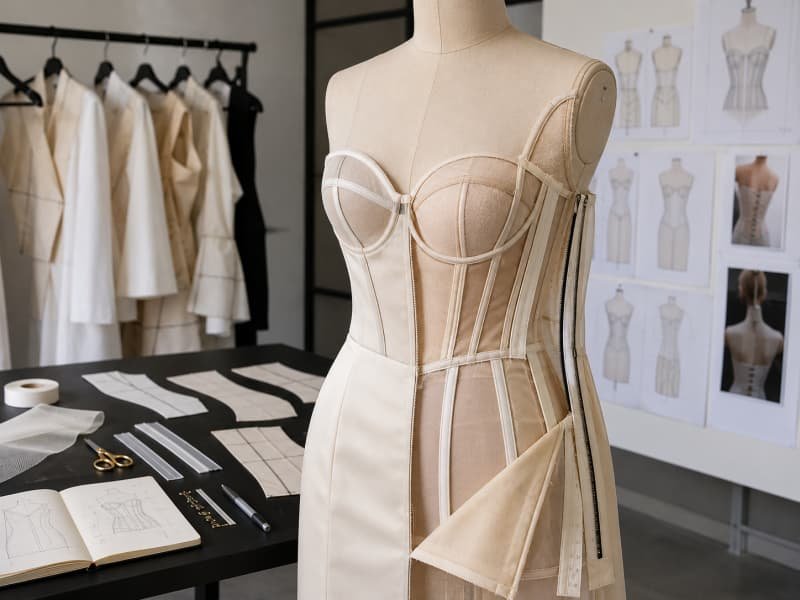
Boning Channels
Boning channels should remain straight, secure and comfortable. Control points include:
- Channel width
- Boning length
- End protection
- Stitching alignment
- Position symmetry
- Relation to cup and waist
- Lining attachment
- Edge smoothness
Curved or twisted channels distort the bodice. Bulk operators need a clear reference for each channel position.

Cup Setting
Cups must sit at the intended bust position without visible edges or internal shifting. Control points include:
- Cup size
- Cup spacing
- Upper-edge position
- Underbust alignment
- Attachment security
- Lining coverage
- Foam compression
- Symmetry
Cup placement should be verified against the pattern and fit sample rather than centered visually on the garment alone.

Mesh Joining
Mesh seams need strength without excessive bulk or waviness.
Control points include:
- Needle and thread suitability
- Seam elasticity
- Seam allowance width
- Reinforcement
- Stretch direction
- Layer matching
- Edge softness
- Transparency
Seam testing is especially important around underarms, side seams and bodysuit closures.

Clean Binding
Binding finishes necklines, armholes and cut-outs while controlling stretch. Control points include:
- Binding width
- Cut direction
- Tension
- Join location
- Stitch consistency
- Edge coverage
- Bulk
- Recovery
Too much tension creates puckering; too little produces gaping. Approved finished measurements should be recorded.

Ruched Seam Control
Ruching must remain visually balanced and stable across production. Control points include:
- Gathering ratio
- Elastic length
- Anchor marks
- Left-right balance
- Finished length
- Seam security
- Fabric distribution
- Lining connection
Bulk inspection should compare visual position as well as measurements.

Draped Construction
Draped panels require controlled anchor points and fabric direction. Control points include:
- Grain direction
- Drape depth
- Pleat placement
- Tack position
- Seam concealment
- Lining support
- Hem balance
- Pressing
The approved garment should be photographed from multiple angles for production reference.

Invisible Zipper Setting
A well-installed zipper should open smoothly while keeping the seam flat.
Control points include:
- Zipper length
- Seam stabilization
- Waist or panel matching
- Top-stop finish
- Bottom reinforcement
- Puller function
- Tape concealment
- Seam puckering
Sensitive satin and mesh structures may need additional reinforcement.

Sequin Edge Cleaning
- Removal width
- Loose-thread security
- Replacement method
- Underarm comfort
- Neckline comfort
- Seam bulk
- Lining coverage
- Repair record
Custom Branding and Packaging for Retail Programs
Main Labels
Main labels communicate brand identity and must be positioned without affecting comfort.
Options include:
- Woven labels
- Printed labels
- Heat-transfer labels
- Metal brand plates
- Custom logo patches
Position, size, color, folding method and attachment should be approved before production.
Size Labels
Size labels must match the garment, polybag, barcode and carton assortment.
Control includes:
- Size naming system
- Regional size conversion
- Label position
- Label color
- Printed clarity
- Assortment accuracy
- Polybag match
- Carton match
Care Labels
- Fiber composition
- Washing method
- Drying instructions
- Ironing limitations
- Bleaching guidance
- Country of origin
- Responsible party information
- Required language versions
Hangtags
Hangtags can carry branding, product information, pricing and campaign details. Control includes:
- Artwork version
- Material
- Size
- Hole position
- String or fastener
- Barcode
- Retail price
- Attachment location
Fasteners should not damage satin, mesh, lace or embellished surfaces.
Barcodes Stickers
Barcode and size stickers support warehouse and inventory handling.
Control includes:
- SKU match
- Color code
- Size code
- Barcode readability
- Sticker position
- Polybag adhesion
- Carton relationship
- Regional warehouse format
A barcode verification step should occur before final packing.
Protective Polybags
- Bag dimensions
- Vent holes
- Warning text
- Recycled material request
- Adhesive position
- Fold size
- Surface protection
- Size sticker position
Ecommerce Packing
- Folding method
- Tissue placement
- Cup protection
- Strap organization
- Decoration protection
- Polybag size
- Barcode visibility
- Warehouse label
Carton Marking
- Purchase order
- Style number
- Color
- Size assortment
- Quantity
- Carton sequence
- Destination
- Gross and net weight
- Dimensions
- Handling marks
A Controlled Path from Brief to Shipment
Project Review
The team reviews product direction, target quantity, launch timing, reference materials and required services. Missing information and key risks are identified before development begins.
Material Development
Fabric, lining, elastic, cups, boning, zippers, hardware and decoration are selected according to silhouette, support, skin contact, cost and delivery requirements.
Pattern Making
Patterns are developed or adjusted around the approved measurements, material behavior, body proportion and construction method.
Sample Development
The first sample is produced and internally reviewed for measurements, fit direction, appearance, workmanship and manufacturing feasibility.
Sample Revision
Comments are organized into measurement, pattern, material, structure and finishing changes. Updated versions remain traceable.
PP Approval
The pre-production basis confirms fabric, color, trims, pattern, measurements, workmanship, labeling, packing and quality checkpoints.
Cutting Sewing
Bulk cutting and sewing follow the approved production basis. Complex operations may receive pilot or first-piece confirmation before full release.
Quality Inspection
Material, measurements, fit-sensitive points, seams, support components, decoration, labels and packing are checked at relevant production stages.
Packing Shipment
Garments are packed according to the approved guide. Cartons, documentation, shipping method and destination requirements are coordinated before dispatch.
How Sample Standards Transfer into Bulk Production
Sample approval only becomes valuable when every important decision is translated into material, pattern, workmanship and inspection records. The following control map shows how Duolan reduces variation between the approved sample and production garments.
| Bulk Risk | Control Action | Production Evidence |
|---|---|---|
| Fabric appearance changes | Confirm approved fabric reference, composition, weight, stretch, color and lot conditions | Approved swatch, lab dip or material record |
| Pattern shape shifts | Preserve approved pattern and revision version | Approved pattern file and pattern date |
| Fit measurements drift | Set point-of-measure specifications and tolerances | Measurement specification and QC record |
| Cup or boning positions vary | Mark component positions and operation requirements | Construction note and approved sample |
| Neckline or binding stretches | Record finished length and application method | Workmanship standard and first-piece check |
| Lining coverage changes | Define shell-to-lining relationship | Lining pattern and coverage reference |
| Sequin or trim placement varies | Approve placement map and attachment method | Artwork, placement guide and sample |
| Sewing quality changes | Confirm critical seams and finishing | Operation note and PP sample |
| Label or barcode errors occur | Match style, color, size and SKU records | Packing instruction and barcode check |
| Bulk starts before full approval | Run production-readiness and first-piece review | Bulk start confirmation and first-piece record |
| Mid-production variation appears | Inspect at controlled stages | Inline QC report |
| Final packing differs | Verify folding, polybag and carton execution | Final inspection and packing record |
Quality Control for Fit-Sensitive Going-Out Tops

Fabric Color
Inspection covers:
- Fabric identity
- Color agreement
- Surface defects
- Shade variation
- Grain or nap direction
- Stretch direction
- Decoration condition
- Visible pressure marks
Satin, velvet and sequin surfaces receive added visual review because light direction can expose variation.

Measurements
Measurements are checked against the approved specification and assigned tolerances. Priority points may include:
- Bust
- Underbust
- Waist
- Center-front length
- Side length
- Strap length
- Neckline width
- Armhole
- Hem opening
- Bodysuit torso length

Fit-Sensitive Points
Inspection focuses on areas that affect wearing stability:
- Bust point
- Cup position
- Neckline gaping
- Side coverage
- Strap tension
- Top-edge grip
- Boning position
- Waist contour
- Back opening
- Cut-out placement

Seams Stitching
Inspection covers:
- Seam strength
- Stitch density
- Puckering
- Skipped stitches
- Seam allowance
- Stretchability
- Thread color
- Symmetry
- Reinforcement
- Clean internal finish
Stretch seams are reviewed for extension without thread breakage.

Stretch Recovery
Elastic fabrics and components are checked for:
- Recovery after extension
- Neckline return
- Strap recovery
- Underbust elasticity
- Binding stability
- Layer tension
- Seam growth
- Body-shape retention
Poor recovery can change the fit even when initial measurements are correct.

Transparency Lining
Inspection covers:
- Opacity under light
- Coverage position
- Lining color
- Edge visibility
- Cup visibility
- Seam allowance visibility
- Layer movement
- Stretch transparency
Pale, mesh and high-stretch products may need stronger lighting during review.

Trim Function
Functional checks cover:
- Zippers
- Hooks
- Snaps
- Buckles
- Rings
- Sliders
- Chains
- Lace-up eyelets
- Adjustable straps
- Decorative attachments
Load points receive added pull and attachment review according to product requirements.

Final Appearance
- Garment shape
- Symmetry
- Pressing
- Loose threads
- Stains
- Surface damage
- Decoration
- Labels
- Folding
- Polybag
- Barcode
- Carton assortment
Manufacturing Capacity for Multi-Style Brand Programs
Capacity matters when a program moves from one approved sample into 10–30 styles, multiple colors and 20,000–80,000 pieces. Duolan combines core control with wider production coordination to support different levels of complexity and volume.
16 Owned Factories
20+ Satellite Factories
300 Sewing Lines
A wide sewing-line base supports simultaneous production planning across multiple style groups rather than relying on one line for an entire collection.
50+ Flexible Lines
6.5 Million Monthly
10 Million Peak
15,000–35,000 Samples
The wider development system can support approximately 15,000–35,000 sample pieces or development instances per month across the manufacturing group.
3,000–8,000 Styles
Capacity allocation is assessed according to product complexity, factory fit, material readiness and required delivery schedule. Large figures are only meaningful when materials, approvals, production, QC and packing remain coordinated.
Plan Development Backward from the Launch Date
Campaign Sample Deadline
- Lookbook date
- Studio photography date
- Influencer seeding date
- Press or showroom date
- Ecommerce upload deadline
- Required photo-ready sizes
- Color accuracy
- Final visual details
Sample Approval Path
The sampling calendar may include:
- First prototype
- Fit sample
- Revised sample
- Salesman sample
- Photo sample
- Pre-production sample
Not every style requires every stage, but complex corset, mesh, sequin and bodysuit products often need a more controlled path than straightforward styles.
Bulk Production Reference
Bulk production references vary by product complexity:
- Simple styles: approximately 15–20 days
- Regular styles: approximately 20–30 days
- Complex styles: approximately 30–45 days
Timing begins after required approvals and material readiness. Multi-style orders may use staggered release and shipment planning.
Delivery Reference
Common transport references include:
- Express: approximately 3–7 days
- Air freight: approximately 5–8 days
- Sea freight: approximately 20–35 days
FOB, CIF, DDP and split-shipment arrangements may be coordinated according to destination, sales window and receiving plan.
Development Teams Organized Around Product Decisions

Product and Material Review
Their work may include:
- Reviewing the intended silhouette
- Comparing fabric behavior
- Sourcing material alternatives
- Coordinating color development
- Reviewing support components
- Assessing special workmanship
- Identifying long-lead materials
- Matching materials to cost and schedule

Pattern and Sample Teams
Their work may include:
- Pattern development
- Draping or structural analysis
- Sample cutting and sewing
- Internal measurement
- Mannequin review
- Fit review
- Pattern correction
- Version control
- Grading preparation
- PP sample preparation

Merchandising and Planning
Their work may include:
- Organizing product information
- Tracking sample status
- Recording approvals
- Coordinating quotation inputs
- Planning material dates
- Building production timelines
- Tracking bulk progress
- Coordinating label and packing requirements
- Preparing shipment information
- Supporting reorder planning

Quality and Delivery
Quality and delivery teams protect approved standards during production and shipment.
Their work may include:
- Pre-production review
- First-piece review
- Inline inspection
- Measurement checks
- Final inspection
- Packing verification
- Corrective action follow-up
- Shipment coordination
- Document preparation
- Post-delivery records
Compliance Preparation Starts Before Production
Social Audit Readiness
Duolan’s manufacturing system has completed a SMETA 2-Pillar audit and maintains related social-audit records.
Brand teams may review:
- Required audit type
- Audit validity period
- Approved production location
- Additional vendor onboarding
- Workplace documentation
- Corrective action requirements
Material Testing
- Fiber content
- Colorfastness
- Shrinkage
- pH
- Restricted substances
- Azo dyes
- Seam performance
- Trim attachment
- Flammability where applicable
Label Information
Labels may need to include:
- Fiber composition
- Size
- Care symbols
- Country of origin
- Responsible party
- Required languages
- Product code
- Traceability information
Artwork and wording should be approved before label production.
Packing Requirements
Packing preparation may cover:
- Polybag specifications
- Warning text
- Recycled material requests
- Size stickers
- Barcodes
- Carton marks
- Warehouse labels
- Pallet requirements
- Folding instructions
- Moisture protection
Brand Standards
Duolan can coordinate requirements connected with:
- Vendor manuals
- Quality manuals
- Packing guides
- Restricted-substance lists
- Inspection plans
- Approved supplier procedures
- Client-specific workmanship
- Market-specific documentation
Requirements associated with BSCI, ISO 9001, AATCC, ASTM, OEKO-TEX®, EN, China GB and GOTS may be reviewed according to the project.
Shipping Documents
Shipment preparation may include:
- Commercial invoice
- Packing list
- HS code support
- Carton details
- Inspection information
- Testing documents
- Certificate requests
- Freight instructions
- Delivery references
See the Development and Manufacturing Evidence
Development Meeting
Fabric Trim Board
CAD Pattern
Sample Room
Fit Measurement
Cutting Preparation
Sewing Production
Quality Inspection
Packing Shipment
Going-Out Top Programs Built Around Real Brand Pressures

United States Fast-Fashion Ecommerce Program
Program scope:
- Region: United States
- Collection: Going-out and party tops
- Styles: 18
- Total quantity: approximately 46,800 pieces
- Main categories: corset, satin cowl, mesh long-sleeve, cut-out jersey and bodysuit
- Colorways: 2–4 per selected style
- Production structure: mixed regular and complex styles
Development challenge:
The collection shared one strong visual direction but used five different material families. Corset styles needed support and cup development, satin styles required drape and seam control, mesh styles needed planned coverage, and jersey bodysuits needed stable recovery. Treating the full range as one production category would have created inconsistent development standards.
Duolan approach:
- Divided the collection by structure and fabric risk
- Set separate review points for corset, satin, mesh and stretch products
- Built a shared measurement framework for related fitted styles
- Reviewed cup, boning, lining and closure requirements before sampling
- Planned material approvals by fabric family
- Used PP approval and first-piece review for sensitive styles
- Organized bulk production in three controlled release groups
- Preserved pattern and material records for potential color extensions
Program result:
All 18 styles moved through defined approval stages before production release. The approximately 46,800-piece program was organized across three delivery groups, allowing campaign-priority styles to move ahead while more complex structures completed added verification. Seven commercial styles were retained as candidates for repeat colors and later development.

United Kingdom Multi-Style Fit Program
Program scope:
- Region: United Kingdom
- Collection: Occasion-led tops and coordinated sets
- Styles: 24
- Total quantity: approximately 72,000 pieces
- Main categories: halter, strapless, lace, ruched jersey, one-shoulder and matching skirt sets
- Fabric families: four
- Size strategy: one brand size chart with category-specific fit adjustments
Development challenge:
The brand wanted a consistent fitted identity across tops made from fabrics with very different stretch and support. Applying one negative-ease rule across jersey, lace, satin and mesh would have produced inconsistent wear. Matching sets also required controlled top length, waistline position and color consistency.
Duolan approach:
- Grouped styles by fabric stretch and structure
- Reviewed the brand size chart against each material family
- Adjusted negative ease by fabric performance
- Set neckline and strap controls for halter and strapless styles
- Developed top-and-skirt proportion references
- Coordinated shell, lining and trim colors
- Recorded gathering ratios for ruched products
- Applied separate QC priorities to fitted jersey, lace and structured styles
- Planned bulk production by fabric and workmanship group
Program result:
Twenty-four styles and approximately 72,000 pieces were organized under one collection calendar without forcing every product into the same technical standard. Coordinated fit blocks improved consistency between related products, while separate material controls protected the intended appearance of each category.

Australian Party and Vacation Program
Program scope:
- Region: Australia
- Collection: Party and vacation evening tops
- Styles: 12
- Total quantity: approximately 28,800 pieces
- Main categories: printed halter, open-back satin, crystal mesh, draped one-shoulder and corset-set styles
- Launch structure: two seasonal drops
- Shipping structure: split delivery planning
Development challenge:
The program needed strong social-media presentation while remaining suitable for warm-climate wear and international transport. Light fabrics created transparency risks, hardware added load points, and satin garments needed protection from packing pressure. The brand also required the first drop earlier for campaign activity.
Duolan approach:
- Reviewed photo impact and wearing stability together
- Tested lining coverage under stronger lighting
- Adjusted halter strap width and side coverage
- Reinforced hardware attachment points
- Confirmed satin folding and protective packing
- Separated campaign-priority and later styles
- Planned first-piece checks for corset and crystal-mesh products
- Used split delivery coordination for the two launches
- Recorded repeatable material and workmanship standards
Program result:
The approximately 28,800-piece program was organized into two controlled drops. Campaign-priority styles moved through approval and packing first, while higher-risk decorated and structured styles received additional first-piece review before production release. Five styles were identified for potential repeat or coordinated-bottom development.
What Separates Development Manufacturing from Basic Execution?
A manufacturer should be evaluated by how well product decisions survive sampling, production and repetition. The following comparison shows the operating standards Duolan aims to provide for established fashion programs.
| Brand Evaluation Point | Basic Execution Model | Duolan Development Approach |
|---|---|---|
| Product interpretation | Quotes from a picture | Reviews occasion, silhouette, structure and intended fit |
| Fabric selection | Finds a visually similar fabric | Evaluates drape, stretch, recovery, opacity, support and production stability |
| Pattern work | Modifies a general block | Builds or adjusts patterns around fabric and brand fit direction |
| Bust support | Adds cups or boning after fitting | Plans cup, underbust, boning, lining and closure as one structure |
| Transparent styles | Adds lining after problems appear | Maps coverage and lining before sample construction |
| Sample objective | Produces one visual prototype | Defines fit, photo, salesman, PP or bulk-ready sample purpose |
| Revision handling | Applies comments without version structure | Converts comments into measurable pattern, material and workmanship actions |
| Size grading | Adds standard increments | Protects neckline, bust, strap, length and exposure across sizes |
| Bulk preparation | Starts after sample approval | Locks pattern, material, workmanship, measurements and packing |
| Complex production | Releases the full run directly | Uses first-piece or pilot verification where risk is higher |
| QC | Checks at the end | Uses product-specific checkpoints during production |
| Multi-style planning | Handles each style separately | Groups styles by fabric, structure, timing and production path |
| Repeat production | Rebuilds information each time | Preserves pattern, BOM, workmanship and QC references |
| Compliance | Collects files before shipment | Reviews audit, testing, labels and packing earlier |
| Delivery | Treats freight as a final task | Plans production, inspection, packing and transport around the launch |
Custom Going-Out Top Frequently Asked Questions

Start Your Going-Out Top Development Project
Share enough information for a focused product and production review. Duolan can assess your design direction, fabric and trim needs, fit-sensitive areas, sample route, estimated production complexity and bulk preparation requirements. Tech packs provide the clearest starting point, while reference images, sketches, original garment photos, size charts and collection boards can also support the first review.
For a more accurate discussion, include:
- Brand or company name
- Target sales market
- Product categories
- Number of styles
- Estimated quantity by style or program
- Target size range
- Planned launch date
- Tech pack, sketch or reference images
- Fabric and color direction
- Required sample type
- Compliance or testing manual
- Label and packaging requirements
- Current stage: development, sampling, supplier evaluation or bulk production


