 Skip to content
Fixed Halter Straps vs Adjustable Halter Straps: Which Is Better for Fit, Comfort, and Production?
Your trusted Women’s Apparel Development & Manufacturing Partner from China
- Jerry
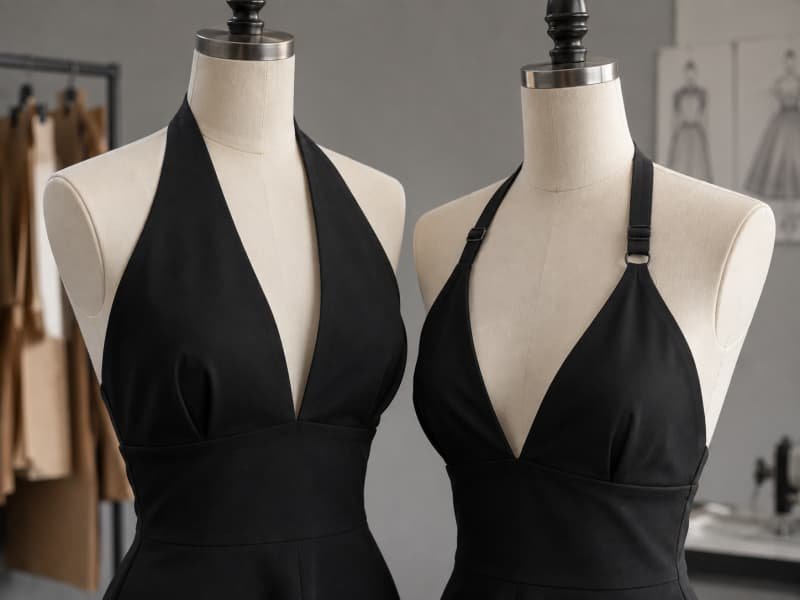
A halter strap looks simple until the first fitting exposes everything it controls. Its finished length can raise or lower the neckline, alter bust placement, change armhole coverage, shift the back opening, and decide whether the wearer feels secure or spends the evening pulling the dress back into place. That is why the choice between fixed and adjustable halter straps should never be made from a sketch alone. The strap has to be considered together with fabric stretch, garment weight, internal support, target sizing, and the way the dress will be worn.
Fixed halter straps usually create a cleaner, more controlled silhouette, while adjustable straps accommodate a wider range of torso lengths and personal fit preferences. Neither is automatically better. Fixed straps work best when the fit block, grading, and bodice support are reliable. Adjustable straps are more useful when moderate fit flexibility is needed, provided the adjustment does not replace proper pattern engineering.
The most expensive strap mistakes are rarely dramatic in the sample room. They appear later as neckline gaping, neck pressure, slider movement, uneven bust position, or returns from customers whose bodies differ from the fit model. One centimeter can be enough to change a polished halter dress into a garment that feels insecure. The sections below explain how to choose, specify, test, and manufacture both systems with fewer surprises.
What Are Fixed and Adjustable Halter Straps?
Fixed halter straps are sewn to a predetermined wearing length, while adjustable straps let the wearer change that length through sliders, rings, ties, buttons, hooks, or buckles. Fixed straps emphasize a clean line and controlled neckline position. Adjustable straps offer more flexibility across different upper-body proportions, but they add hardware, bulk, or greater variation in how the dress is worn.
Fixed Strap Construction
A fixed halter strap is developed as part of the bodice pattern rather than added as an isolated trim. It may be sewn permanently into the neckline, formed as a continuous neck band, attached through fixed loops, or closed with a hook or button that does not change the effective wearing length. Once the length is approved, the wearer cannot raise or lower the neckline without altering the garment.
This controlled length is useful when the design depends on a precise front-neckline height, symmetrical armholes, and a polished line around the neck. It is common in occasion dresses, structured party dresses, fitted satin styles, and garments where sliders would create an unwanted lingerie reference. Fixed construction also removes doubled strap sections and moving hardware, which can be valuable when the strap is narrow or the fabric is delicate.
The weakness is not the lack of adjustment by itself; it is the assumption that one strap length will suit every body within a size. Customers with the same bust circumference may have different bust heights, torso lengths, neck circumferences, and shoulder slopes. A fixed strap must therefore be fitted and graded with the same care as the neckline, cups, armholes, and back opening.
Adjustable Strap Systems
Adjustable halter straps change the effective distance between the bodice and the back of the neck. Slider-and-ring systems provide small, continuous changes. Self-tie straps offer a broad range but depend on how tightly the wearer knots them. Button positions, hook loops, and buckles create preset adjustments that may feel more secure but give fewer choices between loose and tight.
The system should be selected according to the product, not merely because adjustment sounds more customer-friendly. A thin satin party dress may suit a small metal slider, while a soft resort dress may look more natural with long self-ties. A structured corset dress may need only two discreet button positions because its internal bodice already controls the bust and waist. Each method changes the appearance, sewing sequence, inspection process, and wear experience.
Adjustment also has a functional limit. When the strap is shortened, it can raise the neckline, pull the cups upward, reduce the armhole opening, and increase pressure on the neck. When it is lengthened, the neckline may drop, the bust area may lose coverage, and the back may shift. A useful adjustable strap changes fit within a controlled range; it should not be expected to rescue an incorrect bodice.
Common Strap Types
The table below compares the systems most often used in commercial halter dresses. The construction names may vary between brands and factories, but the practical differences remain similar. The strongest choice is the one that supports the intended look while remaining stable through fitting, movement, repeated dressing, and bulk production.
Strap type | Typical construction | Practical benefit | Main development risk |
Fixed sewn strap | Permanently attached at an approved length | Clean appearance and stable neckline | Limited adaptation to torso differences |
Slider-adjustable strap | Ring, slider, and returned strap section | Fine length adjustment | Hardware slippage, twisting, or bulk |
Self-tie halter | Two long extensions tied behind the neck | Broad fit range and relaxed styling | Knot movement and inconsistent tension |
Button-adjustable strap | Two or more fixed button positions | Discreet and secure adjustment | Large jumps between settings |
Buckle-adjustable strap | Buckle with holes or a locking mechanism | Strong visual and functional detail | Weight, abrasion, and dominant hardware |
Multi-loop hook strap | Hook attached to one of several loops | Controlled preset adjustment | Loop durability and visible construction |
A fixed strap is usually the simplest to inspect because the factory checks one finished measurement and two attachment points. A slider system requires verification of minimum and maximum length, hardware movement, strap thickness, and resistance to creeping. Tie straps require length, end finishing, knot security, and balance. The added complexity is worthwhile only when it produces a real improvement in fit or styling.
Ties and Sliders
Ties and sliders are both adjustable, but they do not create the same customer experience. A slider changes length while keeping the fastening path consistent. A tie changes length, knot tension, knot size, and the position of the loose ends. Two wearers can use the same tie strap and place the front neckline at noticeably different heights even when both believe the knot feels secure.
Tie length must be tested on real bodies rather than judged flat on a table. The wearer needs enough length to form a secure knot or bow without creating a bulky bundle at the neck. Excessively long ties can add weight, interfere with hair, or hang awkwardly down the back. Very short ties can be difficult to fasten, especially for customers with limited shoulder mobility.
Sliders provide more repeatable adjustment, but they only work when strap width, thickness, surface friction, and hardware clearance are compatible. If the strap is too thin for the slider, it may creep. If it is too thick, the wearer may struggle to adjust it or damage the stitching by pulling. The distinction is practical: ties prioritize styling freedom, while sliders prioritize measured control.
Which Gives Better Fit and Comfort?
Adjustable straps usually accommodate more variation in torso length and bust height, while fixed straps can feel more stable when the garment is properly fitted and supported. Comfort depends less on adjustability alone than on pressure distribution, strap width, garment weight, fabric recovery, and the amount of support provided by the bodice around the bust, waist, and back.

Body Proportion and Fit
Two customers can purchase the same dress size and still need different halter strap lengths. Bust circumference does not describe the full upper body. Neck-to-bust distance, bust height, torso length, shoulder slope, neck circumference, and the position of the upper back all affect where a halter neckline settles. These differences explain why one customer may report neck pressure while another finds the same strap loose.
Adjustable straps help absorb moderate variation. A wearer can raise the neckline for coverage or lower it slightly to reduce tension. This is valuable in online retail, where customers cannot test the garment before purchase. Yet every adjustment changes several relationships at once. Shortening may lift the bust area, tighten the armhole, and pull the waist upward. Lengthening may reduce pressure but create gaping or lower the neckline beyond the intended coverage.
Fixed straps can perform well across a commercial size range when they are graded rather than copied unchanged from the base size. The size-to-size change may be small, but it should follow the brand’s block and fitting evidence. For shape-sensitive dresses, reviewing the core size plus at least one smaller and one larger size is more reliable than assuming the grade rule will solve every proportion difference.
Neck Pressure and Width
Neck discomfort usually appears when the strap carries more load than the bodice can support. A heavy skirt, dense embellishment, low back, weak underbust structure, or unstable lining can pull the front of the dress downward. The wearer may respond by tightening an adjustable strap, which raises the garment but transfers additional force to the neck. The result can feel secure for a few minutes and painful later.
Width changes how that force is distributed. A narrow strap concentrates pressure over a small contact area, while a wider strap spreads the same load across more skin. Edge construction matters as much as nominal width. A narrow satin strap with a hard turned edge can feel sharper than a soft jersey strap of similar width. Rings, seams, and slider returns should also be kept away from sensitive pressure points whenever possible.
The ranges below are practical development references rather than medical standards. They help teams discuss visual scale and likely pressure distribution before fitting. Actual comfort still depends on garment weight, fabric softness, internal support, and the individual wearer, so every promising width should be confirmed through an extended wear trial.
Finished strap width | Typical visual effect | Comfort and construction considerations |
5-8 mm | Fine, delicate, lingerie-inspired | High pressure concentration; limited space for reinforcement |
9-12 mm | Slim fashion strap | Best for lighter garments with dependable bodice support |
13-20 mm | Balanced and versatile | Improved pressure distribution without appearing heavy |
21-30 mm | Strong, supportive appearance | Useful for heavier or structured dresses; requires shaped neckline |
31-50 mm | Wide halter band | Broad contact area; pattern contour becomes especially important |
Bust Support and Stability
An adjustable strap can change bust position, but it should not be confused with a complete support system. Reliable support normally comes from shaped panels, cups, underbust seams, elastic, boning, stable lining, power mesh, side support, and a back or waist structure that anchors the garment around the torso. The strap should fine-tune the neckline rather than suspend the entire dress from the neck.
This distinction is especially important for fuller busts. Tightening the strap may create immediate lift, yet it can also move the cup upward, pull the underbust seam away from the body, and increase neck pressure. A better solution is to stabilize the lower bodice so the garment distributes force around the torso. Wider straps and reinforced attachment points can then support positioning without becoming the only load-bearing components.
A fixed strap may feel more secure because it cannot creep, loosen, or be tied unevenly. It works particularly well when the internal bodice already sets the bust position. Adjustable straps remain valuable when customers need moderate torso-length flexibility, but the shortest and longest usable settings must both preserve cup placement, coverage, and comfort. Settings that distort the garment should not be counted as valid adjustment range.
Movement and Wear Time
A halter dress should never be approved only while the fit model stands straight with relaxed arms. Real wear includes sitting, reaching, bending, walking, turning, dancing, and getting in and out of a car. These movements can expose neckline gaping, armhole opening, strap twisting, slider movement, or a knot that gradually loosens. Party and occasion dresses deserve particular attention because they are often worn for several active hours.
Comfort should also be evaluated over time. A strap that feels acceptable during the first two minutes may become uncomfortable after twenty or thirty minutes as fabric grows, the skirt pulls downward, or pressure concentrates on the neck. The wearer should report when discomfort begins, where it is felt, and whether she instinctively adjusts the strap or bodice. Those observations often reveal more than a static measurement.
The better system is not simply the one that adjusts more. It is the one that maintains coverage, balance, and comfort with the least unnecessary tension. A correctly engineered fixed strap can outperform a poorly controlled adjustable strap, while a well-designed adjustable system can reduce fit complaints that a single fixed length would create. Movement testing turns that choice from opinion into evidence.
How Do Fabric and Structure Affect the Choice?
Fabric determines whether a halter strap stretches, slips, twists, thickens, or recovers during wear. Satin, mesh, jersey, chiffon, velvet, and embellished materials require different solutions. Cups, boning, lining, elastic, back construction, and garment weight also determine how much force reaches the strap, so the strap type must be selected as part of the complete support system.

Satin, Mesh, and Jersey
Satin creates a smooth, polished strap, but its surface can make adjustment difficult to control. A low-friction satin may creep through a slider, while a bias-cut strap can lengthen after sewing, pressing, hanging, or wearing. The grain direction should be specified clearly. Straight-grain construction usually provides better dimensional control, while bias construction offers softness but needs resting, stabilization, and remeasurement before final approval.
Mesh is lightweight but not automatically strong. Stretch mesh can elongate under load, and delicate mesh may distort where a narrow ring, buckle, or strap tab concentrates force. Reinforcement can be hidden inside the lined bodice with stable tape, an extra mesh layer, or a woven support tab. The goal is to spread the load without creating a visible hard patch or changing the transparency of the design.
Jersey requires attention to both stretch and recovery. Two fabrics can reach a similar extension percentage yet behave very differently after repeated wear. A jersey that returns quickly can maintain neckline position. A fabric that grows gradually may lengthen the strap and lower the bodice. The pattern should be tested in the actual production fabric, because a strap developed in one jersey quality may not remain accurate in another.
Hardware Compatibility
Hardware should be selected for the finished strap thickness, not only its width on paper. A slider may look proportionally correct but become difficult to use after the strap is folded, turned, stitched, and passed through the mechanism more than once. The strap should move without excessive force, while the slider must still hold its setting under normal tension and repeated movement.
Delicate satin, chiffon, and mesh require smooth components with no sharp joins or rough plating. Hardware that touches the skin should not create a raised pressure point at the back of the neck. The finish must also suit the care method and color of the garment. A poorly coated metal component can discolor pale fabric, while a rough edge can catch fine fibers after only a few adjustments.
Some fashion fabrics should not be forced through adjustment hardware at all. Thick velvet may jam inside a narrow slider, and sequins can add abrasion, bulk, and irregular thickness. In those cases, a separate stable strap material can coordinate with the garment while providing cleaner function. The best solution is often less literal than using the main fabric everywhere.
Internal Support
The strap decision becomes clearer when the bodice has an intentional support strategy. Cups shape the bust, but they do not hold the entire garment in place. Boning resists vertical collapse, yet it needs a stable waist, side seam, closure, or back panel to work against. Underbust elastic, power-mesh lining, a waist stay, and reinforced seams can distribute load around the torso instead of sending it directly to the neck.
Low-back halter dresses require particular care because the upper back provides less circumference support. If the design also includes a heavy skirt, deep neckline, or embellished bodice, the remaining structure must do more work. Simply widening the strap or adding a slider may improve the symptom while leaving the underlying balance unchanged. The wearer will still feel the dress pulling downward if the lower bodice is not anchored.
When the internal foundation is strong, a fixed strap can preserve a clean neckline because the bodice already controls bust and waist position. An adjustable strap can still be useful, but it should make small personal corrections rather than major lifting changes. If tightening the strap dramatically reshapes the entire dress, the structure below it is probably carrying too little of the load.
Weight and Embellishment
Garment weight is often underestimated when the first prototype is made in plain fabric. The final production version may include lining, beading, rhinestones, sequins, layered skirts, metal trims, or a longer hem, all of which can increase downward pull. A strap length approved on a light prototype may behave differently when the completed dress is worn for several hours.
The development sample should therefore represent the expected production weight as closely as possible. When full embellishment is not available, the team can simulate the load before approving strap length and attachment. This is especially important for heavily beaded party dresses, sequin halters, multi-layer mesh skirts, velvet occasion styles, and long fitted dresses with low backs.
The table summarizes common material risks and practical responses that can be used during sampling and production planning. These are not fixed formulas, because fabric constructions vary widely in weight, finish, stretch, and recovery. They are practical checkpoints that help teams identify the most relevant tests before the strap, hardware, and attachment method are approved for bulk production.
Material | Main strap risk | Useful development response |
Satin | Slippage, seam show-through, bias growth, and twisting | Control grain, stabilize where needed, rest before final measurement, and test slider holding |
Stretch mesh | Elongation and concentrated stress at attachment points | Reinforce with hidden tape or stable layers and test recovery under load |
Jersey | Length growth and inconsistent recovery | Measure stretch and recovery in the actual production fabric and repeat wear tests |
Chiffon | Fraying, transparency, and low structural strength | Use layered construction, internal tape, or a separate stable strap material |
Velvet | Bulk, nap direction, and restricted slider movement | Reduce seam thickness and verify hardware clearance before approval |
Sequin fabric | Abrasion, irregular thickness, and extra garment weight | Use a stable underlayer or separate strap material and reinforce attachment points |
Attachment strength must be considered separately from the visible strap. A narrow strap joining a heavy bodice through one small seam can pull, stretch, or tear even when the strap material itself is strong. Hidden tape, interfacing, wider internal anchors, extra seam layers, and secure bartacks can spread the load. The visible result should remain refined, but the internal engineering must match the real garment weight.
Which Works Best by Dress Type?
Fixed straps often suit polished occasionwear and structured dresses, while sliders and ties are useful for party, resort, and fit-flexible designs. Bodycon and corset dresses require decisions based on fabric recovery, internal support, and back construction. The best choice follows the commercial purpose and engineering of the individual dress rather than a single category rule.

Occasion and Formal Dresses
Occasion dresses often benefit from fixed straps because the uninterrupted finish looks deliberate in photography, close-up product pages, and formal settings. Shaped satin, crepe, or velvet necklines can flow directly into the bodice without visible sliders breaking the line. When the fit block is established and the internal structure is reliable, a fixed strap also helps maintain a consistent neckline position across repeated production.
Adjustable construction can still work in formal styles when it is discreet or integrated into the design. Hidden hooks, several button positions, or a decorative buckle may provide limited flexibility without creating a lingerie-like appearance. The choice should reflect the price point and visual language of the collection. Hardware that looks appropriate on a club dress may feel out of place on a minimalist ceremony style.
Formalwear is also worn for long periods, so comfort cannot be judged from a quick standing fit. The wearer may sit through dinner, walk, dance, and remain in the dress for several hours. A fixed strap that looks perfect but creates neck pressure after thirty minutes is not a successful solution. The bodice should carry the main load, allowing the strap to control placement rather than suspend the garment.
Party and Bodycon Dresses
Party dresses need to remain secure during movement. Adjustable straps can let customers fine-tune the neckline, but sliders and ties must stay in place when the wearer walks, dances, raises her arms, and turns. A slider that slowly lengthens can create a coverage problem even when it performed well during a short fitting. Tie straps should be tested for knot security in the actual fabric.
Bodycon dresses often rely on stretch and negative ease to anchor the garment around the torso. With strong recovery, a fixed strap can work very well because the bodice remains close to the body while the strap controls neckline height. With weak recovery, the fabric may grow during wear, and the customer may keep tightening an adjustable strap to compensate for a problem that began in the fabric or pattern.
That compensation can raise the waist, distort cups, tighten armholes, and increase neck pressure. The better response is to correct the stretch balance, recovery, and bodice shape before relying on the strap. In commercial fitted dresses, adjustability should provide convenience, not become a repair mechanism for unstable fabric or insufficient torso support.
Corset and Bustier Styles
Corset and bustier halter dresses should derive most of their support from the torso. Cups, boning, seam shaping, waist control, lining, and closures create the foundation. The strap may add security and maintain neckline position, but it should not feel as though it is carrying the entire bust. When that happens, the neck becomes the substitute for a weak internal structure.
Fixed straps often suit these styles because the internal bodice already determines where the bust sits. They preserve a clean neckline and keep decorative cups, draping, or corset seams visually dominant. Adjustable straps can be valuable when the style is sold across customers with different torso lengths, but the adjustment range should remain modest and should not pull the cup away from the underbust.
Low-back corset dresses need even more attention because the upper back cannot provide conventional support. A firm waist, stable side structure, secure closure, and reinforced lining become essential. The strap type should be selected only after those elements work together. A beautifully engineered corset can use a delicate fixed strap; a poorly anchored one may remain uncomfortable even with a wide adjustable band.
Resort and Vacation Dresses
Self-tie halters are a natural choice for resort and vacation dresses because they match the relaxed character of the category. They are easy to understand, flexible across different neck-to-bust distances, and visually appropriate for lightweight fabrics, open backs, and soft silhouettes. A tie can also become part of the styling through a bow, knot, draped end, or decorative tip.
Tie construction still requires control. Lightweight satin and chiffon may loosen, while thick ties can create an uncomfortable knot. The finished length should allow secure fastening without excessive bulk or awkwardly short ends. Wider ties usually distribute pressure more comfortably than narrow strings, particularly when the dress has a fuller skirt or limited internal support.
Adjustable ties can improve flexibility across a broader size range, but they do not replace grading. Bust volume, armhole depth, back width, neckline shape, and waist position must still be developed by size. The tie only changes one relationship within the entire fit system. A resort dress feels effortless only when that engineering has already been resolved behind the relaxed appearance.
How Should Brands Choose and Test Straps?
Brands should choose halter straps through measurable development criteria rather than appearance alone. The tech pack must define length, width, attachment, hardware, adjustment range, reinforcement, and tolerance. Samples should be tested on more than one size and through realistic movement. Bulk production then requires first-piece verification, functional inspection, and a clear approved standard for every strap component.

Tech Pack Details
A note that says only ‘fixed halter strap’ or ‘adjustable neck strap’ leaves too much room for interpretation. The specification should explain exactly how the strap is built, measured, attached, and graded. Finished width, effective wearing length, measuring points, grain direction, layer count, reinforcement, hardware size, stitch method, and approved tolerance should all be clear before the sample moves toward production.
The measuring method should be shown visually. A curved strap can produce different readings depending on whether it is measured along the inner edge, center line, or outer edge. Adjustable straps also need a defined inspection setting. Without that reference, the sample room, production team, and quality inspector may each measure the same component differently and still believe they are following the specification.
Tie straps should state whether the length includes the section caught inside the seam. Slider systems should define minimum and maximum effective wearing length, not merely the total cut length. Hardware should be approved by internal width, finish, material, and a physical reference sample. These details may look small, but they prevent disagreements that otherwise appear only after hundreds of units have been sewn.
- Finished strap width and effective wearing length
- Minimum and maximum adjustment range
- Clear start and end measuring points
- Grain direction, layer count, and reinforcement
- Ring, slider, hook, buckle, or button specification
- Attachment position from stable pattern references
- Stitch type, bartack position, and approved tolerance
- Size-by-size grading rule or confirmation of no grade
Fit and Movement Tests
A useful fit session reviews the complete garment at realistic strap settings. Adjustable styles should be checked near the shortest, middle, and longest usable positions. A setting that technically exists but distorts the cups, waist, armhole, or neckline should not be counted as part of the wearable adjustment range. The goal is not maximum numerical range; it is consistent performance within every approved setting.
The fit model should stand naturally, raise both arms, reach forward, sit, bend, walk, turn, and rotate the upper body. Photographs from the front, side, and back make it easier to see whether a correction that improves the neckline creates a new problem elsewhere. The model should also wear the dress continuously long enough to reveal gradual neck pressure, slider movement, fabric growth, or the need for repeated readjustment.
The following test plan is practical for shape-sensitive halter dresses and gives development teams a consistent starting point for review. The times and repetitions are working references rather than universal standards. Brands can extend them when the garment is heavier, highly embellished, intended for active movement, or likely to be worn for long formal events.
Test | Suggested check | Common failure |
Arms raised overhead | Repeat 3-5 times and observe neckline and armhole | Bodice lifts or armhole cuts in |
Forward reach | Reach forward and across the body | Front neckline gaps or back rises |
Seated wear | Sit for 10-15 minutes | Neck pressure increases or waist rolls |
Bending forward | Check coverage at approved strap settings | Bust containment is lost |
Walking and turning | Walk briskly and turn several times | Slider moves or tie loosens |
Upper-body rotation | Rotate left and right | Side seam or cup position twists |
Extended wear | Wear continuously for 20-30 minutes | Strap grows or discomfort develops |
Repeated adjustment | Move hardware through full range 10 times | Fraying, abrasion, or slider creep |
For fitted or structurally sensitive styles, reviewing the base size plus at least one smaller and one larger size can reveal grading problems that a single fit session cannot show. Wider size ranges may need additional fit models because bust distribution and torso proportions do not always change in a simple linear pattern. The strap should support the size system, not hide weaknesses within it.
Changing Strap Types
A fixed strap can often be redesigned as adjustable, but adding a slider is not a minor afterthought. The strap needs extra length for the return section, enough clearance through the hardware, a ring or connection point, and reinforced attachment areas. The back design may also change because the returned strap and hardware require space that the original fixed construction did not use.
Converting to self-ties requires new pattern pieces and sometimes a different neckline angle. The tie must be long enough to fasten comfortably, yet the bodice must remain stable when customers use different knot tensions. Changing an adjustable strap to fixed construction also requires development because the correct wearing length must be selected, graded, and tested rather than guessed from a preferred slider setting.
Any conversion should be treated as a new sample construction. Front-neckline height, bust apex position, armhole shape, back opening, neck pressure, attachment strength, movement performance, and grading all need to be checked again. A visual change can alter the entire garment balance. Moving directly into bulk because the previous version fitted well creates an avoidable risk.
Bulk Control
Bulk consistency begins with an approved pre-production standard. The production team should have the final pattern, measurement method, hardware reference, reinforcement details, and tolerance before cutting starts. Strap components should be checked at several stages: cut length and grain, turned width, seam rollover, hardware installation, attachment position, left-right symmetry, effective wearing length, and final neckline placement.
The first completed units should be compared with the approved sample before full-line production continues, especially for satin, mesh, jersey, low-back, corset, and embellished halter dresses. Measurement alone is not enough. A strap can meet the stated length and still twist, slip, feel bulky, or pull the neckline unevenly. Functional checks must therefore sit beside dimensional inspection.
For higher-risk styles, a first-piece or small pilot review can confirm that the production method reproduces the approved sample before volume is released. Duolan Apparel applies this type of production-readiness approach to shape-sensitive products such as halter, backless, corset, bodycon, satin, mesh, party, and occasion dresses. The value is practical: critical fit, material, and workmanship points are reviewed before small inconsistencies become large bulk problems.
Fixed straps are usually the stronger choice when the collection requires a clean finish, the bodice has reliable internal support, and the brand can control strap length through fitting and grading. Adjustable straps are more suitable when moderate torso-length flexibility, customer personalization, or a tie-based visual language adds real value. In both cases, the strap should be evaluated as part of the neckline, bust, back, fabric, and support system.
A successful halter dress should stay in the intended position without forcing the wearer to choose between appearance and comfort. The neckline should remain controlled, the bust should feel supported, the armholes should not gap, and the neck should not carry unnecessary weight. Those results come from accurate pattern work, compatible materials, realistic movement tests, and disciplined production control rather than from the word ‘fixed’ or ‘adjustable’ alone.
For custom halter dresses, partywear, occasionwear, bodycon styles, corset dresses, and resort collections, Duolan Apparel can support fabric and trim evaluation, pattern development, sample construction, fit correction, production-readiness review, and bulk manufacturing.
Share:
Our Services
Categories
Table of Contents
Here, developing fashion collections is more than manufacturing garments — it’s a collaborative process focused on transforming ideas into well-executed, market-ready products. From fabric sourcing and sample development to scalable production and delivery coordination, every stage is built to support quality, consistency, and efficient collection launches across global markets.

