Skip to content
Custom Metallic Dress Manufacturer
Metallic dress development and manufacturing for fashion brands building partywear, occasionwear, holiday, festival, and going-out collections.
- Development support across 8 major metallic surface directions, including foil, lamé, lurex, metallic knit, jacquard, sequins, glitter coating, and holographic finishes.
- Risk review covering surface adhesion, stretch distortion, needle marks, gloss variation, wearing comfort, pressing sensitivity, and packing protection.
- Controlled progression from feasibility review and first prototype to PP approval, first-piece verification, bulk production, and final inspection.
- Nearly 30 years of fashion dress development experience supported by 16 owned factories and more than 20 long-term satellite factories.
Metallic Dress Manufacturing for Established Fashion Teams
Fashion Brand Teams
Fashion brands need metallic dresses that look strong in campaign photography and remain commercially wearable across the full size range. Duolan supports product teams from design interpretation and metallic material review through pattern development, sample refinement, and bulk execution. Project discussions may cover:
- Intended retail and campaign positioning
- Collection color and silhouette structure
- Metallic surface intensity
- Fit priorities and target size range
- Launch quantity and repeat-order potential
- Label, packaging, and delivery requirements
A metallic dress should support the brand identity without creating avoidable production or return risks. Material appearance, movement, comfort, and construction are therefore reviewed as one connected product system.
Product Development Teams
- Fabric and silhouette compatibility
- Pattern requirements
- Stretch and recovery behavior
- Lining and support construction
- Seam placement around reflective surfaces
- Decoration weight and attachment
- PP and bulk-readiness requirements
Sourcing and Buying Teams
- Development and manufacturing capability review
- Material and special-process assessment
- Sample and revision planning
- Bulk production path analysis
- Quality checkpoint definition
- Audit and document coordination
- Packing and shipment preparation
Why Metallic Dresses Need Specialized Manufacturing Control
Surface Effect
Metallic appearance may come from foil coating, metallic yarn, lamination, sequins, glitter, reflective printing, or hardware decoration. Every route creates a different visual result and production risk.
Development review considers:
- Gloss level and reflection angle
- Surface texture
- Base fabric color
- Coating coverage
- Stretch compatibility
- Risk of cracking or transfer
- Appearance under studio lighting
Surface selection should begin with the intended retail image and wearing scenario, not with a generic request for “silver fabric.”
Fabric Behavior
- Fabric weight and thickness
- Drape and body
- Stretch direction
- Recovery
- Transparency
- Wrinkle response
- Surface friction
- Width and cutting yield
Fit and Structure
- Bust and waist balance
- Hip contour
- Negative ease
- Neckline stability
- Strap placement
- Backless support
- Corset shaping
- Hem balance
- Size grading
Sewing Sensitivity
- Needle and thread combination
- Stitch length
- Presser-foot pressure
- Seam construction
- Zipper installation
- Edge finishing
- Reinforcement points
- Handling between operations
Wearing Comfort
- Full or partial lining
- Seam covering
- Soft binding
- Protected embellishment edges
- Balanced garment weight
- Stretch panels
- Support elastic
- Skin-contact trim review
Bulk Consistency
A strong sample has limited value when bulk garments show different gloss, color, stretch, measurements, decoration placement, or pressing results.
Bulk consistency depends on:
- Material lot confirmation
- Approved color and surface reference
- Locked pattern version
- Confirmed BOM
- PP sample approval
- First-piece verification
- Inline quality checkpoints
- Packing standard confirmation
The goal is a production standard that can be understood, measured, inspected, and repeated.
Custom Metallic Dress Styles We Develop

Metallic Mini Dresses

Metallic Midi Dresses

Metallic Maxi Dresses

Metallic Bodycon Dresses

Metallic Corset Dresses

Metallic Halter Dresses

Metallic Backless Dresses
Backless metallic dresses require clean back shaping, stable side seams, secure straps, and controlled neckline movement. Reflective materials make gaping or uneven tension easy to notice. Development may involve concealed elastic, waist support, cross straps, adjustable hardware, internal stay tape, shaped lining, or strategic seam placement. Wear testing focuses on movement security and fit balance rather than appearance on a static mannequin alone.

Metallic One-Shoulder Dresses

Metallic Ruched Dresses
Ruching can soften body lines and create strong reflective movement, but it also increases material consumption and affects stretch distribution. Key controls include gathering ratio, placement, seam anchoring, symmetry, lining behavior, and graded consistency. Excessive tension can crack coated surfaces or distort foil finishes. Controlled sample trials determine how much gathering produces the intended texture without weakening the material or changing fit.

Metallic Draped Dresses
Draped dresses depend on fabric weight, fluidity, bias behavior, and surface direction. A material that looks attractive as a flat swatch may not fall correctly around the body.
Development focuses on drape origin, fold depth, grain direction, seam support, lining movement, and pressing. Metallic reflections change across every fold, so drape placement must be reviewed under natural and studio lighting before approval.

Metallic Cut-Out Dresses
Cut-outs introduce stress around edges, curves, waist openings, underbust sections, and side-body areas. Stretch and recovery must support movement without gaping.
Duolan reviews cut-out position, seam reinforcement, binding, lining, elastic support, skin comfort, and graded coverage. Metallic coatings may crack around highly stretched openings, making material choice and edge construction central to bulk feasibility.

Metallic Party Dresses
Party collections often combine metallic fabric with ruching, corset structures, sequins, rhinestones, mesh panels, feathers, chains, or statement hardware.
A successful party dress program balances visual impact with production stability. Material combinations, decoration weight, comfort, fitting, packing, and launch timing are reviewed before committing each style to the collection. The result should feel commercially distinctive rather than overworked or difficult to repeat.
Metallic Materials and Surface Effects We Evaluate

Metallic Foil Fabrics

Lamé Fabrics

Lurex Fabrics

Metallic Knits

Metallic Jacquards

Sequin Surfaces

Glitter Coatings
Glitter surfaces can deliver fine sparkle without individual sequins, but loose particles, stiff handfeel, surface shedding, and transfer require evaluation. Trial checks may include rubbing, folding, stretching, sewing, pressing, and packing contact. Glitter coating should not contaminate lining, labels, packaging, or adjacent garments during production and transport.

Holographic Finishes
Metallic Color and Reflection Need Physical Approval
Silver, Gold, and Gunmetal Development
A clear approval process should define:
- Intended color family
- Gloss level
- Surface texture
- Reflection strength
- Base-fabric tone
- Reference lighting
- Acceptable visual range
Lighting and Camera Evaluation
Metallic garments may look different under daylight, warm retail lighting, cool studio lighting, direct flash, and moving video. A surface that appears refined in daylight may become overly bright under flash. Another may look flat in product photography.
Duolan can review material and sample images across several conditions:
- Flat swatch under neutral light
- Draped swatch on a form
- Stretched material
- Front and angled views
- Direct-flash image
- Garment movement video
Visual evidence helps design and merchandising teams choose a surface aligned with campaign goals and commercial wearability.
Color Continuity Across Bulk
Reflective materials may show batch differences in base color, coating shade, gloss, yarn density, or sequin tone. Even a small change can become noticeable when garments are photographed together or replenished later.
Bulk control may include:
- Approved material reference
- Production lot review
- Color and gloss comparison
- Material-roll identification
- Panel-direction instruction
- First-piece confirmation
- Finished-garment comparison
- Reorder material records
Color approval should therefore connect directly with sourcing, cutting, sewing, quality inspection, and reorder planning.

Metallic Dress Risk and Control Matrix
Metallic garments combine visual opportunity with material, fit, construction, comfort, and packing risks. Early risk identification protects sample accuracy, bulk consistency, launch timing, and repeat production.
| Risk Area | Possible Production Problem | Duolan Control Direction |
|---|---|---|
| Surface adhesion | Foil, glitter, or coating cracks, peels, or transfers | Stretch, fold, friction, sewing, pressing, and packing trials before bulk release |
| Color and gloss | Material lots show different shade or reflection | Physical swatch approval, lot comparison, surface reference, and first-piece review |
| Needle penetration | Visible holes, broken coating, or damaged surface | Needle, thread, stitch length, seam type, and pressure trials |
| Stretch distortion | Reflective layer becomes uneven or transparent | Stretch-direction review, recovery check, pattern adjustment, and graded fit review |
| Seam appearance | Puckering, rippling, bulk, or uneven reflection | Seam-construction trials, controlled feeding, handling instructions, and pressing limits |
| Wearing comfort | Scratching, stiffness, pressure, or heavy garment feel | Lining, binding, edge clearing, weight distribution, and skin-contact assessment |
| Decoration security | Missing sequins, loose stones, unstable chains, or broken attachments | Attachment specification, pilot validation, inspection points, and protective packing |
| Fit consistency | Approved silhouette changes across sizes | Base-size fitting, pattern correction, grading review, measurement standard, and size checks |
| Pressing damage | Heat marks, dull areas, transfer, or permanent pressure lines | Temperature and pressure trial, protective layers, and operation guidance |
| Packing damage | Creases, scratches, surface transfer, or tangled decoration | Fold planning, interleaving, individual protection, carton pressure review, and packing trial |
| Sample-to-bulk gap | Bulk garments differ in material, construction, fit, or finishing | PP approval, BOM locking, workmanship notes, first-piece confirmation, and inline QC |
| Reorder variation | Repeat order uses changed material or an outdated pattern | Pattern version, BOM, surface reference, QC records, and reorder review |
Design Feasibility Before Metallic Dress Sampling
Translate Visual Direction Into Construction
Review may cover:
- Intended dress length
- Bust and waist shaping
- Stretch or woven construction
- Closure method
- Lining coverage
- Internal support
- Ruching ratio
- Cut-out reinforcement
- Slit position
- Decoration method
- Hem finish
Match Material to Silhouette
Metallic material should support the silhouette rather than fight it. A fluid draped design may fail in a stiff coated woven. A sculpted corset may collapse in lightweight lamé. A fitted mini may lose recovery in a weak metallic knit.
Feasibility review considers:
- Required drape or structure
- Stretch and recovery
- Body coverage
- Surface durability
- Seam visibility
- Lining need
- Garment weight
- Movement
- Target price
- Bulk availability
Material alternatives may be suggested when the original direction creates avoidable fit, comfort, cost, or production risks.
Review Bulk Reproducibility
A design may be possible for one handmade sample yet unsuitable for repeat production. High manual adjustment, unstable material, unclear placement, or excessive loss can create inconsistent bulk results.
Before sampling, Duolan considers:
- Can the workmanship be standardized?
- Can material supply support the target quantity?
- Can decoration placement be measured?
- Can every size retain the intended proportions?
- Can sewing operations protect the surface?
- Can the garment be pressed and packed safely?
- Can inspection standards be defined?
The review outcome may be direct development, development with construction changes, or further material testing before the first prototype.
Metallic Fabric Sourcing and Material Validation
Physical Material Assessment
- Fiber composition
- Fabric construction
- Weight and thickness
- Usable width
- Handfeel
- Stretch direction
- Stretch percentage
- Recovery
- Drape
- Transparency
- Surface friction
- Fraying tendency
Production Handling Trials
Material validation should reflect real production conditions.
Relevant trials may include cutting, marking, sewing, turning, pressing, stretching, folding, and packing.
The team may check:
- Whether numbering methods mark the surface
- Whether layers slip during cutting
- Whether needle penetration damages the finish
- Whether seams ripple or pucker
- Whether pressure leaves shine changes
- Whether the coating sticks to itself
- Whether folded areas create permanent lines
- Whether packing materials transfer color
Trial outcomes inform the pattern, seam type, production sequence, ironing limits, and packing method.
Bulk Availability and Reorder Risk
Material suitability includes commercial availability. A strong prototype cannot support a collection when the selected fabric is unavailable, inconsistent, or difficult to replenish. Sourcing review may confirm:
- Supplier production status
- Required material quantity
- Color availability
- Lot size
- Color continuity
- Lead time
- Minimum material requirement
- Reorder possibility
- Alternative source or replacement route
For programs containing 10–30 styles, shared material planning may improve consistency and coordination, but only when the same fabric genuinely suits each silhouette.

Pattern, Fit, and Measurement Control
Base-Size Pattern Development
- Bust placement
- Underbust shaping
- Waist position
- Hip contour
- Side-seam balance
- Centre-front and centre-back alignment
- Neckline shape
- Armhole depth
- Skirt fall
- Hem balance
Fit Review by Construction Type
Different metallic dress constructions require different fitting priorities.
For stretch bodycon dresses: Negative ease, Recovery, Opacity, Seam elasticity, Ride-up control. For corset or bustier dresses: Cup position, Boning balance, Waist control, Neckline stability, Closure strength.
For halter or backless dresses: Strap pressure, Side coverage, Back tension, Bust support, Movement security.
For draped dresses:
- Fold position
- Grain direction
- Waist balance
- Skirt movement
- Lining interaction
Size Grading and Tolerance
A proportion that looks correct in the base size may not transfer automatically to every graded size. Cut-outs, cups, straps, ruching, slits, embellishment placement, and body length require individual attention. The grading review may cover:
- Bust-to-waist proportion
- Cup and neckline growth
- Strap length
- Cut-out coverage
- Ruching distribution
- Slit height
- Skirt length
- Decoration position
- Stretch allowance
Measurement tolerances are defined according to garment construction and material behavior. Stretch garments, structured bodices, and embellished surfaces require different inspection priorities.
Cutting and Sewing Metallic Fabrics Correctly
Surface Direction and Cutting Layout
Cutting preparation may include:
- Face-direction identification
- One-way marker planning
- Motif or sequin direction
- Panel placement
- Shade grouping
- Roll identification
- Surface-protection rules
Cutting and Bundle Protection
Metallic coatings, glitter, sequins, and reflective yarns may scratch, stick, snag, or crease during spreading and bundle movement.
Control measures may involve:
- Clean cutting surfaces
- Limited layer height
- Protective interleaving
- Careful numbering methods
- Controlled bundling
- Separate storage for sensitive panels
- Reduced friction during movement
Cut components should arrive at sewing without surface damage, contamination, or pressure marks.
Needle, Thread, and Stitch Trials
Needle penetration can create permanent marks in coated surfaces. Incorrect stitch density can weaken the fabric, break metallic yarn, cause seam puckering, or damage sequins.
Trial review may cover:
- Needle size and point
- Thread type
- Stitch length
- Seam allowance
- Seam type
- Tension
- Feeding
- Presser-foot pressure
The approved combination is documented for production use.
Sequin Clearing and Seam Construction
For sequin materials, sequins may need controlled removal from :
- seam allowances
- darts
- zipper zones
- armholes
- necklines
- hems.
Sewing directly through dense sequins can break needles, create sharp edges, and damage the base fabric.
After sewing, visible gaps may require controlled replacement or hand finishing. Seam-clearing instructions help maintain both construction strength and visual continuity.
Heat and Pressing Control
Metallic materials may react to temperature, steam, pressure, dwell time, or direct contact with the iron.
Pressing trials determine:
- Safe temperature range
- Need for protective cloth
- Use of steam
- Pressure level
- Pressing direction
- Cooling time
- Risk of transfer or flattening
Some materials require minimal pressing and stronger reliance on pattern accuracy and controlled sewing.
Zippers, Hems, and Edge Finishing
Zipper areas, hems, necklines, slits, and armholes combine repeated handling with high visual exposure.
Development checks may include:
- Zipper tape compatibility
- Seam reinforcement
- Hook-and-eye placement
- Hem bulk
- Binding comfort
- Edge cracking
- Decoration clearance
- Topstitch visibility
Finishing methods are selected according to surface behavior, garment weight, and the intended retail appearance.
Metallic Embellishment and Decoration Development

Sequin Applications

Rhinestone Placement
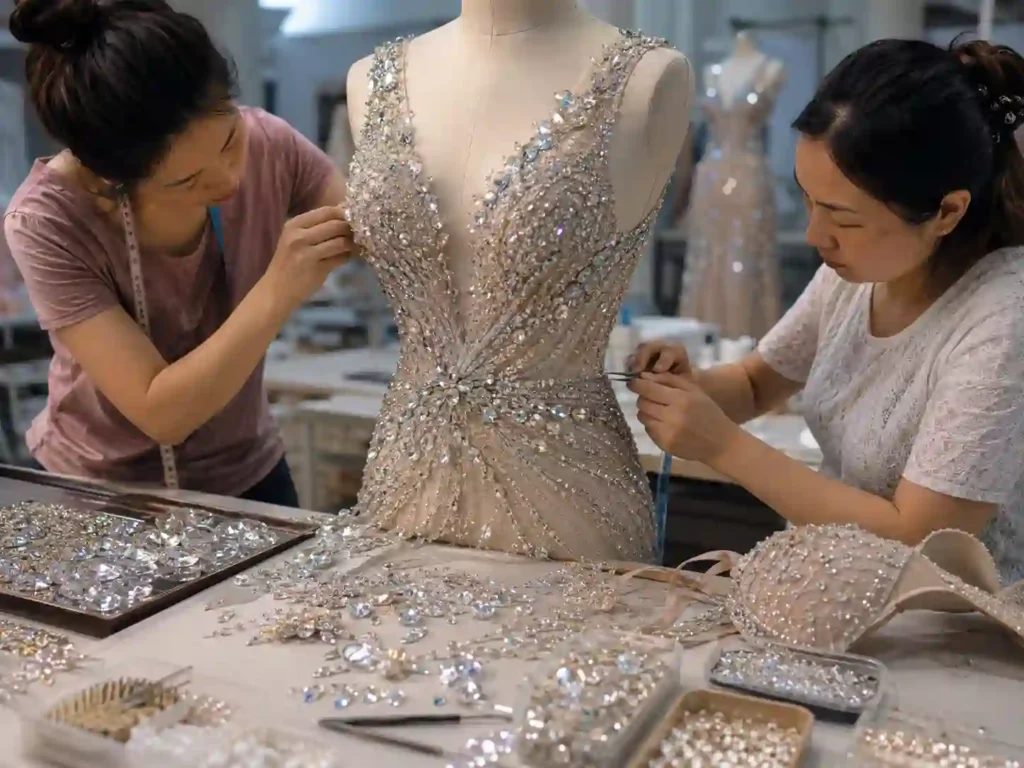
Crystal Detailing
Crystals create premium visual focus but increase garment weight and handling sensitivity.
Attachment method, backing, distribution, and reinforcement should be reviewed around shoulder, neckline, bust, waist, and moving areas. The design should avoid concentrating excessive weight on weak or highly stretched sections.

Metallic Beading

Chains and Hardware

Mixed Decoration
Lining, Support, and Comfort Engineering
Lining Selection and Coverage
- Full lining
- Bodice-only lining
- Skirt lining
- Partial modesty lining
- Power-mesh support
- Stretch lining
- Soft woven lining
- Seam-area protection
Corset and Bust Support
- Cup position and volume
- Boning length and placement
- Centre-front stability
- Side support
- Waist control
- Neckline security
- Zipper strength
- Lining structure
Skin-Contact Protection
- Removing decoration from seam allowances
- Soft binding
- Lining extensions
- Covered seams
- Protected hardware backs
- Smooth attachment points
- Edge polishing or covering
- Placement changes
Weight Distribution and Movement
Heavy decoration may :
- pull at shoulder seams
- straps
- necklines
- waist seams
- zippers.
Weight should be distributed through pattern structure, reinforcement, lining, and suitable attachment.
Movement review may include sitting, walking, raising arms, turning, and stretching. Garments designed for party and event use should remain secure through normal movement rather than only looking correct on a mannequin.
Special Process Support for Metallic Dress Programs
Metallic Printing
The base fabric must tolerate the print process without losing drape, stretch, or comfort.
Embroidery Coordination
Development considers stitch density, base-fabric stability, backing, weight, placement, tension, skin comfort, and distortion. An embroidery panel may be tested before full garment sampling.
Rhinestone Processes
Process review connects stone type, material sensitivity, stretch area, garment movement, production sequence, inspection, and protective packing.
Pleating and Texture
Pleating can create strong light movement across metallic fabrics, but heat and pressure may affect coatings or surface finish.
Trial work evaluates pleat retention, surface reaction, shrinkage, cutting direction, seam bulk, and garment movement before production.
Dyeing and Color Effects
Some metallic projects may combine dyed base fabrics, ombré effects, or special color treatments with metallic yarn or decoration.
Color development must account for base-fabric response, reflective components, batch stability, care requirements, and interaction with later sewing or finishing processes.
Mixed Process Planning
Complex styles may pass through several specialist processes. The sequence must protect material quality and prevent rework.
A project path may involve: Material approval, Strike-off or process sample, Cutting, Embroidery or printing, Sewing, Decoration attachment, Finishing, Inspection, Protective packing.
Metallic Material and Garment Testing Plan
Testing requirements depend on the selected material, garment construction, care method, target market, decoration, hardware, and brand manual. Duolan coordinates relevant checks before or during production planning.
| Test Direction | Why It Matters | Recommended Project Stage |
|---|---|---|
| Surface rubbing | Evaluates loss, transfer, dulling, or damage caused by friction | Material review and pre-production |
| Coating adhesion | Reviews whether foil, glitter, or reflective coating separates from the base | Material validation before bulk commitment |
| Stretch and recovery | Confirms whether the fabric returns after extension without surface distortion | Material selection and fit development |
| Colorfastness | Reviews color transfer or change under relevant care and use conditions | Before PP approval where applicable |
| Snagging tendency | Assesses risk around metallic yarns, sequins, lace, or raised surfaces | Material and garment trial |
| Seam strength | Checks whether seams tolerate normal wear and garment weight | Sample and pilot stage |
| Seam slippage | Reviews woven-material movement near fitted or stressed seams | Sample and pre-production |
| Decoration attachment | Evaluates security of sequins, stones, beads, chains, and hardware | Process sample and pilot stage |
| Zipper performance | Checks opening, closing, seam support, and interaction with thick surfaces | Garment sample and first-piece stage |
| Dimensional stability | Reviews measurement change after relevant care treatment | Before bulk when required |
| Pressing sensitivity | Identifies heat marks, surface transfer, flattening, or gloss change | Sewing trial and production preparation |
| Packing contact | Checks scratching, sticking, transfer, crushing, and fold marks | Packing trial before shipment |
| Hardware review | Supports market-specific requirements for relevant metal components | Material and trim approval |
| Finished garment inspection | Confirms appearance, measurements, workmanship, labels, and packing | Inline and final inspection |
Testing scope, method, laboratory, sample quantity, acceptance criteria, and reporting requirements should be confirmed according to the project and destination market.
Moving From Approved Sample to Bulk Production

Confirm the Approval Status
The team first identifies what the approved sample represents:
- Visual approval
- Fit approval
- Material approval
- PP basis
- Photo sample only
- Sample still requiring refinement
A campaign sample may look correct but still use temporary fabric, trims, hand finishing, or unconfirmed measurements.
Production release requires a clear distinction between visual reference and manufacturing reference.

Lock Materials and Components
- Outer fabric
- Lining
- Interlining
- Cups
- Boning
- Elastic
- Zipper
- Hooks
- Labels
- Decorations
- Packaging materials

Lock Pattern and Measurements
The approved pattern version, measurement sheet, grading direction, and construction notes are aligned before cutting.
Critical points may include:
- Bust and waist
- Hip
- Dress length
- Strap length
- Cup position
- Cut-out dimensions
- Slit height
- Ruching placement
- Decoration position
First-Piece and Pilot Production Verification
First-Piece Review
- Overall appearance
- Metallic direction
- Fit and measurements
- Seam quality
- Pressing
- Lining
- Decoration
- Labels
- Packing readiness
Small Pilot Run
A controlled pilot quantity can reveal issues not visible in one garment, including:
- Operator variation
- Seam consistency
- Surface damage during movement
- Decoration loss
- Pressing marks
- Packing pressure
Pilot size and scope depend on:
- Style complexity
- Quantity
- Risk level
Critical Operation Trial
Some operations require isolated verification before line release:
- Foil seam sewing
- Sequin clearing
- Corset construction
- Stone attachment
- Cut-out binding
- Metallic zipper installation
- Special pressing
- Decorative chain attachment
Size Verification
Packing Trial
Release Decision
Multi-Style Metallic Collection Production Planning
Order Breakdown by Style
- Style
- Color
- Size
- Quantity
- Material
- Construction
- Decoration
- Label version
- Packing route
- Delivery destination
Material and Process Readiness
- Fabric availability
- Color approval
- Lining and trim status
- Special-process lead time
- Decoration preparation
- Label and packaging readiness
- Test requirements
- PP approval
Production Lead-Time Reference
Bulk production timing varies according to material availability, construction, decoration, order structure, and approval speed.
General manufacturing references are:
- Simple styles: approximately 15–20 days
- Regular styles: approximately 20–30 days
- Complex styles: approximately 30–45 days
Metallic corset dresses, dense sequin garments, mixed hand decoration, special printing, multi-process surfaces, or complex packing may require longer planning. Final timing is confirmed after sample and material review.
Factory and Capacity Coordination
Duolan is supported by 16 owned womenswear factories and more than 20 long-term satellite factories, with coordinated manufacturing resources across several regions.
Core factories can lead development-sensitive and high-control styles. Additional coordinated resources can support production peaks, rolling orders, specialized processes, and scaled repeat quantities.
Factory assignment is based on product fit rather than distributing work without control.
Launch and Delivery Milestones
A production schedule may work backward from the warehouse or launch requirement:
- Target receipt date
- Shipping time
- Final inspection
- Packing completion
- Production completion
- Inline quality stages
- Material arrival
- PP approval
Metallic Dress Quality Control From Development Onward

Development Quality Review
Early review identifies risks related to:
- Material and silhouette mismatch
- Surface durability
- Fit and grading
- Lining
- Support structure
- Decoration
- Wearing comfort
- Bulk repeatability
High-risk points become part of the sample and production plan.

Incoming Material Inspection
Metallic materials and trims are checked against approved references before bulk use. Inspection may cover:
- Color
- Gloss
- Surface texture
- Width
- Weight
- Stretch
- Visible defects
- Coating condition
Material issues are easier to manage before cutting than after garments have been assembled.

Pre-Production Alignment
The production team reviews:
- Approved sample
- Pattern version
- Measurement sheet
- BOM
- Material references
- Construction notes
- Special-process standards
- Label instructions
- Packing requirements
- Critical QC points
Metallic handling, pressing, decoration, and surface-protection rules are emphasized.

Inline Quality Control
Inline inspection looks for repeated process problems while correction is still possible. Metallic dress checks may include:
- Panel direction
- Surface scratches
- Needle damage
- Seam puckering
- Coating cracking
- Sequin loss
- Stone placement
- Zipper quality
- Fit measurements
- Lining exposure
- Pressing marks

Final Garment Inspection
Final inspection reviews :
- appearance
- measurement
- workmanship
- decoration
- labels
- packing
against the confirmed project standard.
Garments are viewed under suitable lighting because gloss variation, scratches, missing decoration, and pressure marks may be difficult to see under poor conditions.

Reorder Record Preservation
- Pattern version
- Measurement standard
- BOM
- Material reference
- Color and surface reference
- Workmanship notes
- QC findings
- Packing standard
- Production comments
Protective Packaging for Metallic Dresses
Tissue Interleaving
Individual Polybags
Surface Protection Sheets
Fold Planning
Hanger Packing
Hanger packing may suit structured, heavily embellished, long, or crease-sensitive garments. Hanger type, shoulder support, garment cover, carton height, and shipment method must be coordinated.
The decision depends on cost, garment risk, transport route, and warehouse requirements.
Decoration Protection
- Soft wrapping
- Position restraints
- Separate hardware covering
- Tissue barriers
- Controlled folding
- Reduced carton pressure
Carton Pressure Control
Overfilled cartons can create crushed cups, flattened sequins, permanent coating marks, and distorted hems.
Carton dimensions and packing quantity are reviewed through a packing trial. The objective is shipping efficiency without damaging the product.
Packing Accuracy
- Correct style
- Color
- Size
- Quantity
- Label
- Hangtag
- Barcode
- Polybag mark
- Carton mark
- Assortment
- Destination
Compliance and Project Documentation Support
SMETA Audit Foundation
Material Information
Sample Records
- Sample stage
- Pattern version
- Measurement sheet
- Material direction
- Comment response
- Revision summary
- PP status
- Open points
Production Records
Bulk coordination may use:
- BOM
- Production-readiness note
- Workmanship instructions
- First-piece confirmation
- Timeline
- QC checkpoints
- Packing specification
- Shipment summary
Label and Care Support
Third-Party Coordination
Where required, Duolan can coordinate sample preparation, inspection access, document exchange, and production scheduling for approved third-party laboratories or inspection companies. Testing and inspection remain subject to the agreed standard, scope, and acceptance criteria.
Metallic Dress Programs Developed for Global Markets

North American Holiday Party Collection
A North American fashion company planned an 18-style holiday program totaling 36,000 dresses across metallic mini, ruched bodycon, corset, one-shoulder, and sequin silhouettes. The program included:
- 18 styles
- 4 metallic surface directions
- 3–5 colors per selected style
- 6 sizes
- Total quantity: 36,000 pieces
- Holiday warehouse deadline
The main challenge involved balancing strong campaign shine with wearable comfort and consistent bulk appearance. Several early references used stiff foil surfaces that cracked during stretch, while dense sequin options created excessive weight in fitted and long-sleeve styles.
Duolan divided the range by product role. High-reflection foil was retained for selected visual styles, while stretch metallic knit and lurex materials were introduced for core commercial silhouettes. Sequin density, lining coverage, seam clearing, and zipper zones were adjusted during sampling.
Before production, approved materials, color references, graded measurements, workmanship details, and packing protection were locked by style. Higher-risk corset and sequin pieces entered first-piece verification before full release. The collection moved into bulk through separate production paths based on material and construction complexity. Sensitive surfaces received tissue protection and controlled folding. The full program was prepared within the agreed seasonal production window, with style records retained for repeat and color-extension planning.

United Kingdom Going-Out Metallic Range
A United Kingdom online fashion company developed a 12-style metallic going-out range totaling 24,600 pieces. The program focused on bodycon minis, cut-out midis, halter dresses, asymmetric necklines, and backless styles. Project structure included:
- 12 styles
- 2 core metallic stretch bases
- Silver, gold, black metallic, and rose-gold directions
- 6 graded sizes
- Total quantity: 24,600 pieces
- E-commerce launch and photography milestones
The main risk involved surface distortion across fitted sizes. An early foil material produced strong photographs but showed cracking and transparency when stretched around the hip and bust. Backless styles also required stronger support without visible internal construction.
Duolan compared alternate stretch metallic materials, adjusted negative ease, revised side-seam balance, and developed lining routes by style. Cut-out edges received reinforcement and stretch review. Halter and backless shapes were tested for movement security, strap pressure, and neckline stability. Selected graded sizes were reviewed before production. The PP stage locked the approved metallic surface, measurements, lining, seam method, and packing route. First-piece checks focused on surface tension, seam appearance, fit, and pressing. The range entered production with shared-material planning where suitable, reducing unnecessary variation while preserving independent fit standards for each silhouette. Project records supported later color discussions and reorder evaluation.

European Metallic Occasion Capsule
- 22 styles
- Metallic jacquard, soft lamé, sequin mesh, and crystal decoration
- Midi and maxi lengths
- Corset, draped, one-shoulder, and column silhouettes
- 7 sizes
- Total quantity: 58,000 pieces
- Multiple warehouse destinations
Why Fashion Brands Work With Duolan
Nearly 30 Years
Long-term experience supports better judgment around which visual ideas are suitable for fit, comfort, price position, production, and repeat orders.
Dress Category Focus
Core experience covers fashion dresses, party dresses, occasion dresses, going-out dresses, fitted dresses, resort dresses, and detailed styles involving satin, mesh, sequins, corsets, halters, and backless structures.
Category focus strengthens fit, silhouette, material, and workmanship decisions.
Development Before Production
The objective is not simply to say a design can be made. The objective is to establish a controlled route for making it well and repeating it in bulk.
Multi-Factory System
Duolan is supported by 16 owned womenswear factories and more than 20 long-term satellite factories, with over 12,000 workers across the wider coordinated manufacturing network.
The structure supports core-style control, multi-style programs, repeat orders, production peaks, regional capacity coordination, and scaled delivery.
Special Process Network
Metallic and embellished projects can therefore be reviewed around the most suitable material and process route rather than forced into one generic production method.
Controlled Project Management
Project progress should become more organized with every stage, not more dependent on repeated chasing.
Frequently Asked Metallic Dress Manufacturing Questions
- Tech pack
- Reference images
- Original sample photographs
- Size chart
- Fabric direction
- Color reference
- Artwork
- Label files
- Target quantity
- Size range
- Launch date
- Packaging requirements
- Compliance manual

Start Your Metallic Dress Development Review
Share the available project information with Duolan so the team can review your metallic surface direction, dress structure, material requirements, sample path, production feasibility, and timing. A complete tech pack is helpful, but early projects may also begin with sketches, reference images, an original sample, fabric swatches, or a collection brief.
Clear information allows a more accurate response regarding material sourcing, pattern development, fit priorities, sample stages, special processes, testing, bulk production, quality checkpoints, and protective packing.
Please include as many of the following points as available:
- Company or brand name
- Website or social profile
- Target market
- Metallic dress style
- Tech pack or reference images
- Fabric and surface direction
- Target colors
- Number of styles
- Quantity by style
- Size range
- Required sample stage
- Target launch or delivery date
- Label and packaging requirements
- Testing or inspection requirements