Skip to content
How Do You Control Fabric and Shade in Brown Occasionwear?
Your trusted Women’s Apparel Development & Manufacturing Partner from China
- Jerry
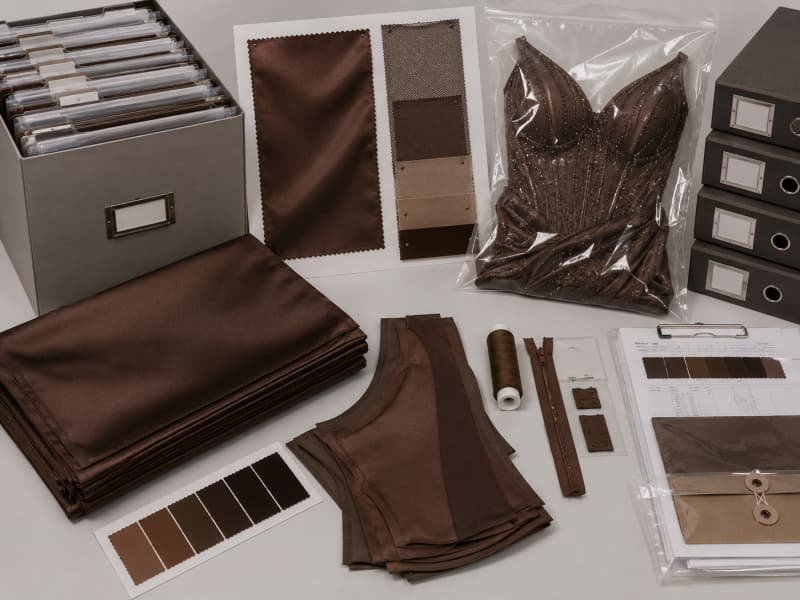
Brown occasionwear can look rich, modern, and far more distinctive than another predictable black dress, but it leaves little room for loose color language. A chocolate satin approved as a small swatch may look red on a full skirt, nearly black in ecommerce photography, or noticeably warmer beside a mesh panel. The shade itself may not be wrong. The problem is often that fabric construction, light, layering, cutting direction, dye-lot control, and trim matching were treated as separate decisions instead of one connected development system.
Brown occasionwear is controlled by defining the undertone and depth, developing the shade on the actual fabric, approving it under agreed light sources, matching linings and trims as a complete material set, separating bulk dye lots and roll groups, and preserving physical standards for reorders. Color names alone cannot protect consistency; traceable samples, tolerances, and cutting records are essential.
The stakes rise when one style combines satin, chiffon, stretch mesh, lace, lining, thread, zippers, boning, cups, sequins, or stones. Each component absorbs and reflects light differently, so an exact-looking match on a sourcing table may separate once the dress is stretched, gathered, pressed, photographed, or worn under warm evening light. Picture a 2,000-piece espresso dress order in which the bodices pass inspection but replacement skirt panels come from a warmer roll. The issue is not discovered until finished garments are hung together. The controls below are designed to stop that story before the first production lay is cut.
What Makes Brown Shades Difficult?
Brown shades are difficult because they combine several color influences rather than one obvious hue. Small shifts toward red, yellow, grey, purple, or black can change chocolate into chestnut, mocha into taupe, or espresso into near-black. Fabric texture, gloss, transparency, finishing, and lighting then amplify those differences once the material is cut and assembled into a dress.
Undertone and Depth
“Brown” is not a production-ready instruction. Chocolate, mocha, espresso, cocoa, chestnut, caramel, coffee, and taupe may all belong to one collection, yet each carries a different balance of warmth, depth, and mutedness. A useful brief identifies the target as light, medium, dark, or near-black; warm, neutral, or cool; and influenced mainly by red, yellow, grey, purple, or olive. Those distinctions have a direct commercial effect. A red-based chocolate can look rich in satin but rusty in matte crepe. A greyed mocha can feel refined in a fitted midi but lifeless in transparent chiffon. Excess black may remove the warmth that made the shade attractive, while too much yellow can move it toward tan. Marketing names remain helpful for collection planning, but mills and factories need an approved physical standard, a fabric-specific reference, and written comments that explain the intended direction. When the team says “slightly deeper while keeping the same neutral undertone,” the instruction is far more repeatable than “make it more chocolate.”
Surface and Construction
Color is always experienced through a surface. Fiber type, yarn shape, weave or knit structure, fabric weight, density, and finishing determine how much light is absorbed, scattered, or reflected. Smooth satin creates large highlights and deep shadows, so one uniform brown may appear to contain several tones. Crepe disperses light more evenly and often makes brown look softer or greyer. Velvet changes with pile direction, while jersey can look lighter when stretched because the loops open and expose more space. The fabric base matters as well. A bright white polyester base, an off-white recycled base, and a polyamide-elastane mesh may require different dye formulas to reach a visually coordinated chocolate. Heat setting, brushing, washing, resin finishing, and calendaring can also change the final depth or gloss. For this reason, a shade approved on one fabric quality should not be transferred automatically to another. The relevant question is whether the exact composition, construction, weight, and final finish can reproduce the approved visual result consistently in bulk.
Light and Metamerism
A shade that looks correct beside a window may appear warmer in a store, duller in an office, and almost black in a restaurant. Different light sources contain different spectral energy, and brown is particularly sensitive because it is built from several color components. Metamerism occurs when two materials look similar under one light but separate under another. A polyester satin shell and nylon mesh panel may coordinate in simulated daylight, yet the satin can shift red while the mesh appears grey under warm LED light. Color-sensitive occasionwear should therefore be reviewed under the environments that matter commercially, commonly including simulated daylight, retail lighting, warm interior lighting, and studio lighting for ecommerce photography. The viewing method also needs discipline: neutral surroundings, controlled sample angles, and no mixed light entering the assessment area. Satin and velvet should be tilted or draped because directional reflection can hide or exaggerate a difference. Phone images help teams communicate quickly, but white balance, exposure, and screen settings make them weak evidence for final approval.
Dark Shade Risks
Deep brown may look easier to control on a small swatch, but finished garments expose differences that fabric inspection can miss. A slight increase in black can make espresso read as black online. A red shift may turn chocolate toward burgundy, while grey or purple influence can make the shade feel flat. Dark variation often becomes obvious only when front and back panels meet, several sizes hang together, or a garment is photographed with flash. Pressing can add another visual change by increasing shine on satin or flattening velvet pile. Inspectors should compare complete garments rather than isolated pieces, paying particular attention to broad skirt panels, bodices, sleeves, waist sections, and replacement components. Exact numerical identity is not always realistic across satin, mesh, lace, lining, and embellishment because each material interacts with light differently. The practical objective is controlled harmony: no accidental reddish panel, no visibly lighter skirt section, and no lining that changes the intended face color of the garment.
Brown Direction | Typical Appearance | Common Risk | Suitable Occasionwear Use |
Chocolate | Rich, warm, medium-dark | Can shift red or orange | Satin party and evening dresses |
Espresso | Deep, neutral to cool | May appear black in low light | Fitted formal and long-sleeve dresses |
Mocha | Soft, greyed medium brown | Can look flat or washed out | Crepe and jersey midi dresses |
Chestnut | Warm, reddish brown | May drift toward burgundy | Autumn occasion collections |
Caramel | Golden, lighter brown | Can become too yellow or tan | Day events and resort styles |
Taupe | Grey-, beige-, or mauve-brown | Complex trim coordination | Minimal and refined occasionwear |

Which Fabrics Suit Brown Occasionwear?
Satin, crepe, velvet, jersey, chiffon, mesh, and lace can all suit brown occasionwear, but each creates a different color effect and production risk. Satin adds depth and shine, crepe gives a more even matte appearance, velvet changes with pile direction, and transparent fabrics build color through layers. The best choice must support the silhouette, fit, opacity, and bulk consistency as well as the shade.
Satin and Crepe
Satin is one of the strongest choices for chocolate, espresso, and bronze-brown occasionwear because its smooth face creates movement and depth without extra decoration. That same reflection makes the shade harder to judge. A flat swatch may look correct while a full skirt shows caramel highlights and near-black shadows. Grain direction, panel angle, cutting direction, pressing, and seam placement all influence the result. Many satin styles therefore need one-way cutting control so the bodice, skirt, sleeves, and replacement panels reflect light consistently. Weight matters too. Lightweight satin supports bias-cut slips and fluid skirts but may reveal seam puckering, lining shadows, or tension marks. Heavier satin suits corset bodices and structured shapes but can add bulk at gathers and layered seams. Crepe is usually more forgiving because its textured surface scatters light and gives brown a quieter, more even appearance. However, lightweight crepe, heavy double crepe, and stretch crepe can produce different depths, so the exact fabric needs to be reviewed at full width and in a sewn sample.
Velvet and Jersey
Velvet can produce exceptionally rich winter occasionwear, but its pile makes it directional. A chocolate velvet may look like espresso when the pile faces away from the light and warm cocoa when it faces toward it. Visible panels should normally be cut in one nap direction unless contrast is intentional. Folding, stacking, transport, and pressing can flatten the pile and create areas that look like shade defects. Some recover with steaming, while others remain. Jersey behaves differently because wearing tension changes both color and opacity. A dark bodycon fabric can look dense on a hanger but lighter across the bust, hips, or seat when the knitted loops open. Development should therefore examine the jersey relaxed, at expected wearing extension, and at the highest realistic stretch area. Recovery and opacity need to be reviewed at the same time. A fabric that passes a flat-table color check may still create pale, transparent zones on the body, so fit approval and shade approval should remain connected.
Chiffon and Mesh
Transparent fabrics never show color independently. Their final shade depends on layer count, backing color, gathers, seam density, stretch, and the wearer’s skin tone. A single layer of mocha chiffon may look pale, while three gathered layers become deep chocolate. Brown mesh can appear neutral over a matching lining and noticeably red over a warm nude base. When the mesh stretches, the holes open and the visible shade becomes lighter. Approval should reproduce the actual construction: one layer or several, relaxed or stretched, over the intended lining, and around cups, boning, elastic, or seam allowances. Chiffon should be reviewed at the planned layer count, while mesh should be stretched over its final backing on a fit model. Seams also need attention because doubled fabric can create dark lines, especially in lighter browns. These lines may be acceptable as part of the design, but they should be visible during sample approval rather than discovered after bulk sewing.
Lace and Embellishment
Lace, embroidery, beads, sequins, and stones add color rather than simply sitting on top of it. Lace contains open and dense areas, so motif concentration creates natural differences in depth. Embroidery thread may be warmer, cooler, or more reflective than the ground, and a lace sold as chocolate may still look redder beside satin. Sequins are even more angle-dependent: a brown coating can flash copper, gold, burgundy, purple, or black. The base mesh and embroidery thread remain visible between sequins and must support the complete effect. Approval should use a full repeat panel or a sewn garment section rather than loose trims. The team needs to assess the surface at rest, during movement, under flash photography, across curved areas, and at production embellishment density. Exact matching is not always the most attractive target. A deliberate tonal relationship may give the dress more depth, but it must be documented so that bulk production and future replenishment reproduce the same relationship.
Fabric | Brown Appearance | Main Control Risk | Best Development Check |
Satin | Rich, bright, high contrast | Directional reflection and seam puckering | Draped swatch and sewn seam |
Crepe | Matte, even, refined | Shade may appear muted or grey | Full-width review and finished sample |
Velvet | Deep and dimensional | Nap direction and pressure marks | One-way cutting trial under directional light |
Jersey | Smooth and body-focused | Lightening and transparency under stretch | Fit-model stretch and recovery review |
Chiffon | Soft and layered | Depth changes with layer count | Layered drape over final lining |
Mesh | Transparent and modern | Backing and stretch alter shade | Stretched sample over final backing |
Lace | Textured and decorative | Motif density changes tonal balance | Full-repeat panel over underlayer |
Sequins | Reflective and dramatic | Gold, red, or black flashes | Movement video and sewn panel |

How Do You Approve the Right Brown?
The right brown is approved through a documented sequence: define the target undertone and fabric, develop lab dips on the actual material, compare them under agreed light sources, evaluate linings and trims as a complete set, and retain the approved reference. Bulk should not begin until the color direction, fabric performance, layered appearance, and production instructions support the same visual result.
Color Brief
A strong color brief turns an attractive idea into instructions that a mill, sample room, trim supplier, and quality team can interpret in the same way. It should identify the physical or digital standard, internal and commercial color names, target depth, undertone, fabric composition, construction, finish, required viewing conditions, sales market, and relationship between the main fabric and supporting materials. The team should also decide what must match closely and what only needs to coordinate. A polyester satin shell, nylon mesh, polyester lining, thread, zipper tape, and elastic may not accept dyes in the same way. Requiring all of them to look mathematically identical can create a visually poorer dress. A clearer brief might state that the satin is the master visual standard, the mesh should be slightly softer but neutral, and the lining may be marginally deeper to prevent show-through. The document must be updated whenever the fabric quality, fiber content, weight, finish, or supplier changes, because the commercial color name alone cannot carry the approval into a different material system.
Lab Dip Review
A lab dip is a controlled dye trial on the selected fabric, not a decorative swatch. It shows whether the requested direction can be reached before the mill commits to production-scale material. Several options may be submitted with small differences in depth or undertone. Comments should be precise and linked to the submission code, such as “maintain depth but reduce red,” “slightly darker without becoming black,” or “acceptable in daylight but too warm under store lighting.” Cropped phone images are useful for discussion but weak for final approval because camera exposure, white balance, screen brightness, and surrounding colors can change brown significantly. The review should answer three questions: Is the direction correct? Does it remain acceptable under the required lights? Does the dyed and finished fabric still deliver the intended hand, drape, stretch, and surface? Heat setting, washing, brushing, resin finishing, or calendaring may change depth or gloss, so the approved submission should represent the final production state as closely as practical.
Tolerance and Lighting
Instrumental color readings can improve consistency, but no single tolerance suits every shade and material. Smooth opaque fabrics are easier to measure than velvet, lace, sequins, or reflective satin, and dark surfaces can produce unstable readings if sample orientation changes. Many brands use CIELAB or CMC systems and may review uniform woven fabrics within an internal color-difference range around Delta E 0.8 to 1.5 as a starting point, but the acceptable limit depends on the brand, instrument settings, shade depth, material, and end use. A number should support visual judgment rather than replace it. The primary light source needs to be agreed before approval, with secondary conditions selected for the retail and wearing environment. Samples should be assessed against a neutral background and without mixed surrounding light. Satin and velvet need more than one viewing angle, while mesh and chiffon should be evaluated over their final backing. A flat swatch can pass a measurement and still fail after it is draped, stretched, layered, or photographed.
Complete Material Set
The main fabric carries most of the color, but the lining and trims often determine whether the finished garment looks controlled. A warm lining can shift the face of lightweight satin or chiffon. Pale zipper tape may show through a fitted side seam, and thread that disappears in one seam can become obvious in dense topstitching, bartacks, or buttonholes. Approval should reproduce the real material relationships: main fabric over lining, mesh stretched over the intended backing, chiffon at final layer count, lace over its underlayer, thread sewn at realistic density, zipper inserted into a sample seam, and embellishment attached at production spacing. Cups, boning covers, elastics, labels, and seam allowances should also be checked wherever transparency makes them visible. Bulk readiness is reached when the approved shade, material set, sample appearance, and production instructions agree. A beautiful lab dip does not make a style ready when the lining, trim, or layered appearance remains unresolved.
Approval Gate | Typical Evidence | Decision to Record | Common Failure |
Color brief | Master standard, undertone, fabric specification | Target direction and matching hierarchy | Vague names such as ‘dark chocolate’ |
Lab dip | Fabric-specific dye submissions | Approved option and precise comments | Approval from phone images only |
Light review | Daylight, retail, warm interior, studio as needed | Pass, conditional pass, or reject by source | Metamerism discovered after launch |
Material set | Lining, mesh, lace, thread, zipper, embellishment | Exact match or intentional tonal relationship | Components approved in isolation |
Finished sample | Sewn, pressed, fitted garment | Production-ready visual standard | Swatch passes but garment fails |

How Is Bulk Shade Controlled?
Bulk shade is controlled by comparing production fabric with the approved standard, creating shade bands, identifying dye lots and roll groups, maintaining traceability through cutting, and checking complete garments during sewing and finishing. Effective control starts before cutting and continues through recuts, repairs, pressing, packing, and final inspection. End-of-line inspection alone cannot correct shade mixing that has already entered assembled garments.
Dye Lots and Shade Bands
A lab dip proves that the target can be approached in a small trial. Bulk dyeing introduces larger machines, longer fabric lengths, finishing conditions, and more opportunities for variation. Representative bulk fabric should therefore be compared with the approved standard before cutting, with attention to depth, undertone, gloss, hand, width, weight, stretch, recovery, and finishing consistency. A shade band arranges pieces from production rolls or different locations within selected rolls for side-by-side comparison. It can reveal roll-to-roll difference, beginning-to-end drift, side-to-center variation, or changes between dye lots. Rolls can then be assigned to approved shade groups. Two groups may both be commercially usable when each is internally consistent and they are never combined within one visible garment. The number of groups should follow the actual fabric rather than a fixed rule. A directional dark satin may need more careful grouping than a matte crepe with similar instrument readings. Shade grouping is not automatically a rejection; it is a way to keep usable variation under control.
Roll Traceability
Every roll used for color-sensitive occasionwear should remain identifiable from receipt to cutting. A practical record includes the supplier, fabric quality, color, dye lot, roll number, delivered and usable length, width, inspection result, shade group, and release status. The grouping decision must connect to the production plan. If one approved group contains fabric for only 180 of 1,200 dresses, those units may need to be assigned to a defined size range, shipment, region, or production batch. Leftover material should not be casually mixed with a newly opened roll, and replacement panels should come from the original roll or a compatible group. New fabric received during production requires its own review before entering the order. Multi-material dresses add another layer because satin, mesh, chiffon, and lining may each carry separate lot structures. The factory needs approved combinations, not four isolated roll-control systems. Traceability later helps determine whether a complaint is linked to one dye lot, one roll, one cutting lay, or one bundle rather than the entire production run.
Cutting and Bundling
Many visible shade problems are created after fabric inspection. Rolls that are individually acceptable can still produce mismatched dresses when panels are mixed in the cutting room or during recuts. A controlled process releases only approved rolls, separates shade groups physically, records each roll used in a lay, maintains one-way cutting for directional materials, numbers panels or bundles where necessary, and prevents loose components from moving between groups. Large skirt pieces, princess panels, waistbands, sleeves, and asymmetric sections need particular care because broad surfaces make differences easier to see. Recuts are a common weak point: a damaged front panel may be replaced from the nearest roll even though the shade is not compatible. The request should identify the original roll or approved group before new material is issued. For satin and velvet, direction must be preserved as well as shade because an opposite-facing panel can appear several tones different. Clear labels, separate racks, controlled storage, and simple internal codes make the system visible on the factory floor rather than leaving it only in paperwork.
Production Checks
Shade should be checked at several production stages because different defects become visible at different times. Incoming inspection finds dye-lot and roll variation. The first cutting lay confirms group and direction. The first completed garment shows whether adjacent panels and supporting materials work together. Inline checks detect mixing caused by repairs, recuts, or bundle movement. Finishing inspection catches heat, steam, pressure, and gloss changes, while final inspection confirms that multiple sizes and cartons remain commercially consistent. The first complete garment from each important shade group should be approved before the line continues at full speed. Inspectors need to compare bodice, skirt, sleeves, lining, and transparent areas as one unit, then hang several garments together because group viewing often reveals variation that an individual check misses. Pressing deserves special attention: excess pressure can create shine on crepe, marks on satin, or flattened velvet pile. These may not be dye faults, but customers experience them as visible color inconsistency and assess them in the same way.
Control Stage | Evidence Reviewed | Main Risk Detected | Release Decision |
Fabric receipt | Roll data, inspection, shade band | Dye-lot and roll variation | Approve, group, hold, or reject |
Cutting start | First lay, panel direction, roll record | Wrong group or reversed direction | Release or correct lay |
Sewing start | First complete garment | Panel and trim mismatch | Approve line start or stop |
Inline production | Garments from active bundles | Mixing during sewing, repair, or recut | Continue, segregate, or rework |
Finishing | Pressed and cleaned garments | Heat, steam, gloss, or pile change | Adjust process or hold |
Final inspection | Multiple sizes, batches, and cartons | Shipment-wide inconsistency | Release, sort, or corrective action |

How Do You Keep Reorders Consistent?
Repeat-order consistency depends on preserving the original approval evidence and treating each new lot as a fresh technical event. Keep approved swatches, bulk references, fabric specifications, trim boards, shade-group records, and a retained garment where practical. New lab dips or material approvals may still be required when the mill, base fabric, finish, dye lot, supplier, or production interval changes.
Retained Standards
The strongest repeat order begins with records created during the first production run. Trying to recreate chocolate brown from an old campaign photograph or a commercial color name introduces unnecessary uncertainty. A retained file should identify one controlling master standard and include the approved lab dip, accepted bulk cutting, fabric composition and construction, weight, width, stretch, finish, supplier information, dye-lot records, light-source comments, approved lining and trim set, shade-band examples, and a finished garment where storage allows. Multiple swatches are useful only when their hierarchy is clear; five slightly different samples without one named authority create disagreement. Physical references should be protected from strong light, heat, humidity, dust, and chemical contamination because dark shades can change during poor storage. The team should also record whether the reorder will sit beside old stock. A commercially close lot may be acceptable after the first delivery has sold out, yet the same difference can be unacceptable when old and new garments are displayed on the same rack or replenished into the same retail program.
Reorder Lab Dips
A repeat order does not always require a complete restart, but it should not depend on assumption. New lab dipping becomes more likely when the fabric mill, dye house, fiber content, construction, weight, finish, or supplier changes; when the original fabric has been discontinued; when a long period has passed; or when the brand wants to correct the earlier shade. Old and new stock being sold together also raises the matching requirement. If the same mill, fabric quality, established dye recipe, and finishing route remain available, the supplier may move faster toward bulk confirmation, but production-scale material should still be compared with the retained standard before cutting. Commercial exposure should determine the depth of review. A small tonal movement may be manageable for a separate seasonal delivery, while it can be unacceptable for replenishment of a core style. Fast repeat production should come from organized records, reserved materials, an established recipe, and clear decision rights, not from removing color checks.
Material Changes
Multi-fabric reorders become difficult when each component has a different availability cycle. The main satin may remain unchanged while the original mesh is discontinued, the lining supplier changes its base yarn, or a sequin coating is updated. Replacement materials should be evaluated in the assembled relationship rather than approved alone. A new mesh may look close to the old mesh on a white card but appear warmer over the retained lining. A new lining can change the visible face of chiffon or lightweight satin even when neither fabric seems problematic by itself. The team should identify what drives customer perception: the shell shade, the complete layered color, the skin-tone illusion, the balance between matte and gloss, the embellishment effect, or continuity with existing stock. When an exact match is not technically realistic, practical choices include redeveloping all related components around a new standard, accepting a deliberate tonal relationship, separating the new lot from old inventory, or treating the delivery as a new color version. Early transparency is safer than forcing a false match that becomes visible after launch.
Supplier Review
A manufacturer’s color-control ability is best evaluated through process questions rather than broad statements about quality. Ask whether lab dips are developed on the actual production fabric, which lighting conditions are used, how satin and velvet are assessed for direction, whether mesh and chiffon are reviewed over their final backing, and whether shade bands are prepared before cutting. The team should also be able to explain roll identification, cutting-batch traceability, recut control, material-set approval, retained standards, and the conditions that trigger a new lab dip. A credible answer connects the reference color to lab dipping, bulk fabric, roll grouping, cutting, sewing, finishing, final inspection, and replenishment. The strongest evidence is consistency between records and floor practice. A shade-band procedure has little value when cutting mixes rolls, and a retained standard is useless when no one knows which sample governs the decision. Reliable shade management does not need theatrical language. It needs clear ownership, traceable evidence, and the discipline to stop production when the visual result no longer matches the approved standard.
Develop Brown Occasionwear with Better Color Control
Brown occasionwear succeeds when color is treated as a product system rather than a final visual check. For established fashion brands developing satin, mesh, velvet, crepe, jersey, lace, or embellished dresses, the most useful manufacturing partner is one that can connect fabric sourcing, lab dips, material matching, fit development, bulk roll control, cutting discipline, and repeat-order records. Duolan Apparel supports fashion-driven dress development through its Guangdong manufacturing network, sample and pattern resources, fabric and trim coordination, color-light-box inspection, fabric checking, automated cutting support, production quality checkpoints, and experience with occasion, party, fitted, and surface-decorated styles. Share your tech pack, reference sample, fabric direction, target brown shade, expected order volume, and launch calendar to receive a practical development review and quotation for your custom occasionwear program.
Share:
Our Services
Categories
Table of Contents
Here, developing fashion collections is more than manufacturing garments — it’s a collaborative process focused on transforming ideas into well-executed, market-ready products. From fabric sourcing and sample development to scalable production and delivery coordination, every stage is built to support quality, consistency, and efficient collection launches across global markets.