...

Custom Ombré Dress Manufacturer

From gradient concept and fabric evaluation to pattern engineering, controlled sampling, bulk production and quality-managed delivery for fashion dress collections.

  • Develop ombré effects from two-color Pantone transitions, multi-color artwork, physical swatches, original garments or collection references.
  • Evaluate digital print, sublimation, fabric dye, dip dye, garment dye and embellishment-gradient routes before sample development.
  • Review gradient position through key size anchors such as XS, M and XL when visual proportions must remain stable across grading.
  • Coordinate 2–3 established supporting resources in printing, dip dye, embroidery and washing according to fabric, effect and production requirements.
  • Plan bulk production around style complexity, with common production references of 15–20 days for simpler dresses, 20–30 days for regular styles and 30–45 days for complex constructions.

Brand-Level Capacity for Ombré Dress Development

An ombré collection requires more than access to printed fabric. It needs development judgment, material coordination, controlled garment construction and sufficient manufacturing depth to carry approved color and fit standards into repeatable production.

30+ Years’ Insight

Duolan’s manufacturing background is built on nearly three decades of womenswear product development, fabric coordination, dress construction and commercial production experience. Gradient dresses are reviewed as complete garments rather than isolated color effects, helping product teams identify issues before expensive sampling or bulk commitments begin.

16 Owned Factories

Owned womenswear production facilities provide direct control over core styles, sensitive developments and the transition from approved samples into production standards. For ombré projects, this control is especially important when panel placement, lining color, seam treatment, size grading and approved shade references must be transferred accurately from the sample room to production teams.

20+ Satellite Factories

Long-term satellite factories add production flexibility for multi-style collections, repeat orders, seasonal demand and larger rollouts. Production is not distributed randomly. Orders are allocated according to style complexity, fabric behavior, special processes, delivery timing and required workmanship, while Duolan maintains centralized project coordination and quality expectations.

300 Sewing Lines

A large sewing-line network supports different production routes for lightweight chiffon, stretch mesh, satin, jersey, embellished party dresses and structured occasion styles. Line allocation is based on handling requirements and construction sensitivity, allowing delicate or high-risk ombré dresses to follow a more suitable path than standard fashion basics.

50+ Flexible Lines

Flexible lines support collection launches, controlled first orders, repeat production and styles requiring shorter manufacturing cycles. Their value is not speed alone. They help bridge the gap between approved development and commercial production while keeping critical details—such as gradient placement, fit, lining and finishing—visible during early production.

SMETA 2-Pillar Audited

Duolan’s manufacturing system has completed SMETA and SMETA 2-Pillar audit requirements. For global fashion programs, audit readiness supports supplier qualification, social compliance review and more structured long-term cooperation. Additional testing, material documentation and market-specific requirements can be coordinated according to the project and destination market.

Built for Established Fashion Dress Programs

Duolan supports organizations with defined product direction, development standards, seasonal calendars and commercial production plans. The working model is designed around collection development and controlled manufacturing rather than isolated garment transactions. Duolan is best suited to fashion organizations with clear development objectives, sampling plans, bulk-production goals and continuing collection potential.

Fast-Fashion Brands

High-frequency fashion brands need multiple styles to move through fabric review, sample development, fitting, photography, launch production and repeat orders without losing track of versions. Duolan can organize ombré projects by style, colorway, size range, development stage and launch priority, helping teams keep visual statements and commercial styles moving through one structured calendar.

Occasionwear Brands

Occasion and party collections demand stronger control of color, silhouette, support, transparency, lining, surface decoration and visual completion. An ombré effect may sit on satin, mesh, chiffon, sequins or layered tulle, and every material changes the final result. Duolan evaluates the gradient together with dress structure, wearing comfort and production repeatability.

Product Development Teams

Product teams usually care about whether a reference can become a production-ready garment, not whether a factory can simply copy its appearance. Development cooperation may include fabric direction, gradient method selection, placement artwork, pattern engineering, fit comments, revised samples, PP preparation and clear records for future production or reorder use.

Buying and Sourcing Teams

Buying and sourcing teams require organized files, reliable quotation logic, material confirmation, measurable quality checkpoints, audit support and production visibility. Duolan can coordinate project updates through email, WhatsApp, video calls, documents, marked photographs and sample comments, allowing international teams to follow development and production with fewer information gaps.

What an Ombré Dress Manufacturer Must Control
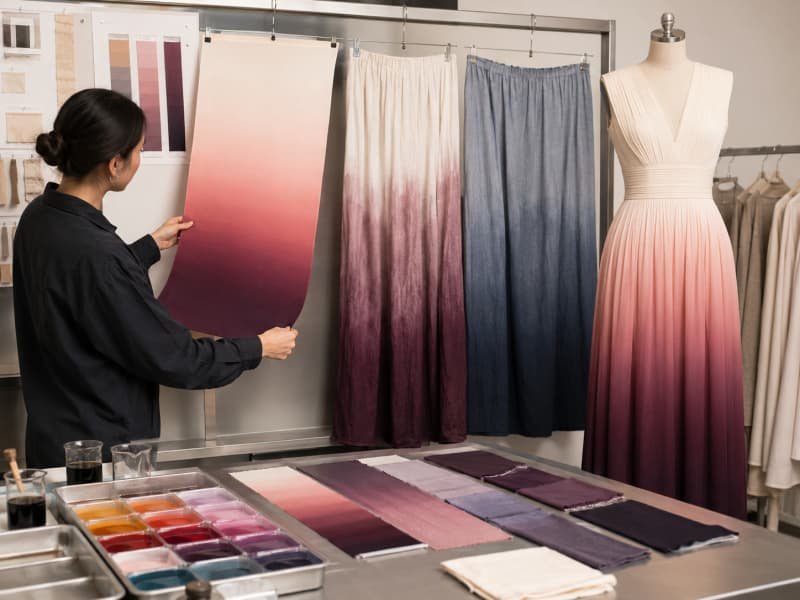
A custom ombré dress manufacturer must manage more than a gradual color change. A production-ready result depends on the relationship between color standards, fabric behavior, artwork scale, pattern shape, panel placement, size grading, garment construction and bulk process control.

Gradient Method Defines Repeatability

Digital printing, sublimation, dip dye, fabric dye, garment dye and embellishment gradients produce different levels of precision. Digital placement can create controlled transitions and repeatable artwork, while dip dye often produces a more fluid and organic appearance. The correct route depends on fiber content, color depth, target quantity, visual tolerance, target price and reorder expectations. Before sampling, Duolan reviews whether the requested effect needs exact placement, natural variation or a combination of methods. A photograph with a soft watercolor transition may require a different process from a sharp waist-to-hem color fade. Choosing the wrong route can produce an attractive first sample that becomes expensive, unstable or impossible to repeat at commercial scale.

Fabric Changes the Color Result

Identical artwork can appear different on mesh, chiffon, satin, jersey and organza. Surface shine changes perceived depth. Transparency allows lining color to influence the gradient. Stretch can widen or distort transitions. Pleats and ruching compress color zones. Layered fabric can make a pale shade appear darker. Fabric evaluation therefore considers fiber composition, weight, surface structure, opacity, stretch, recovery, drape, shrinkage and finishing. Ombré development becomes more reliable when the color concept is tested on the intended production fabric rather than judged only from a digital rendering.

Placement Must Follow the Pattern

A gradient may begin below the bust, at the natural waist, through the hip, along one side or at a defined distance from the hem. Once the dress includes darts, curved seams, princess panels, godets, gathers or asymmetrical cutting, placement can shift. Duolan can establish gradient anchor points on pattern pieces and garment measurements. The objective is to keep the visual effect aligned with the intended body area and silhouette, rather than allowing every cut panel to display an unrelated section of the fabric.

Bulk Standards Need Physical Evidence

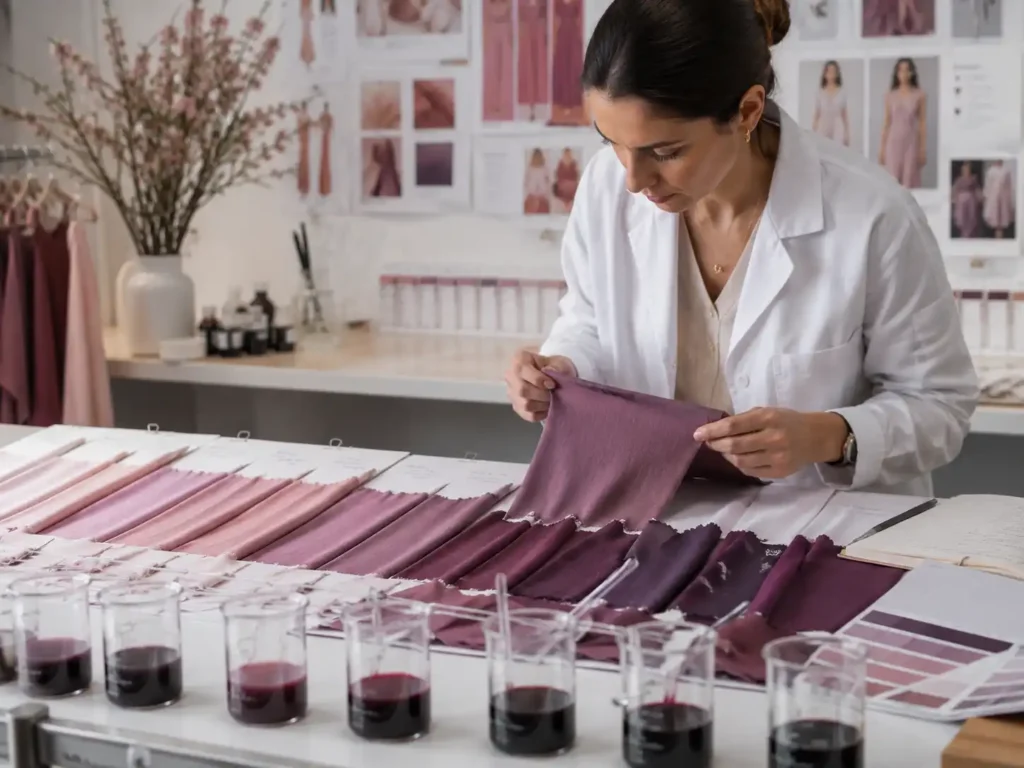
Computer artwork alone is not enough for bulk approval. A controlled project normally moves through Pantone references, lab dips where applicable, printed or dyed strike-offs, approved fabric swatches, garment samples and a PP or approved production reference. Each approval answers a different question: color direction, transition quality, fabric response, garment placement, fit and bulk readiness. These physical references create measurable standards for production and inspection instead of relying on subjective descriptions such as “slightly darker” or “more blended.”

Production Risks Hidden Behind Beautiful Gradients

A strong visual concept can lose commercial value when color placement, fabric behavior or garment construction is not controlled. Duolan links each known risk to a specific development or production checkpoint.

Incorrect Color Direction

Reference photographs often change under studio lighting, screen calibration and image editing. Duolan asks for Pantone references, physical swatches or an approved previous garment whenever possible. Both endpoint colors and the middle transition require confirmation. A gradient can contain the correct start and end colors while still appearing wrong because the intermediate tones are too grey, too saturated or too abrupt.

Visible Color Banding

Banding appears when the transition contains noticeable stripes or sudden tonal steps. Causes may include insufficient artwork resolution, print settings, dye movement, fabric absorption or unsuitable color combinations. Strike-off review helps evaluate smoothness before the color effect reaches a complete garment. Large clean areas and pale-to-dark transitions deserve particular attention because defects become visually obvious.

Misplaced Gradient Zones

A gradient planned on a flat rectangle may shift after pattern cutting. The darkest area can land too high on the hip, the transition can disappear into gathering, or the intended hem color can be removed during shortening. Duolan maps the effect against actual pattern dimensions, seam allowances, garment length and style-specific construction before production artwork is finalized.

Broken Side-Seam Flow

Side seams can expose abrupt color changes when front and back panels are cut from unrelated fabric positions. Perfect matching is not necessary for every design, but the relationship must be intentional. Duolan reviews whether the design requires continuous flow, balanced depth, mirrored placement or controlled asymmetry, then reflects the decision in marker planning and panel identification.

Unstable Size Proportions

Using one fixed artwork without grading review can place the same color band at different body positions across sizes. Smaller sizes may appear mostly dark, while larger sizes contain an oversized pale area. Anchor-point review across selected sizes helps maintain the visual ratio without forcing every garment to use an identical centimeter placement.

Sample-to-Bulk Variation

Bulk shade differences can arise from fabric lots, dye batches, print settings, finishing and replacement materials. Approved references, material lot control, first-piece confirmation and production inspection reduce the chance of uncontrolled variation. Repeat orders require renewed shade comparison because a new fabric or dye lot may not automatically match the earlier shipment.

Custom Ombré Dress Styles for Fashion Collections
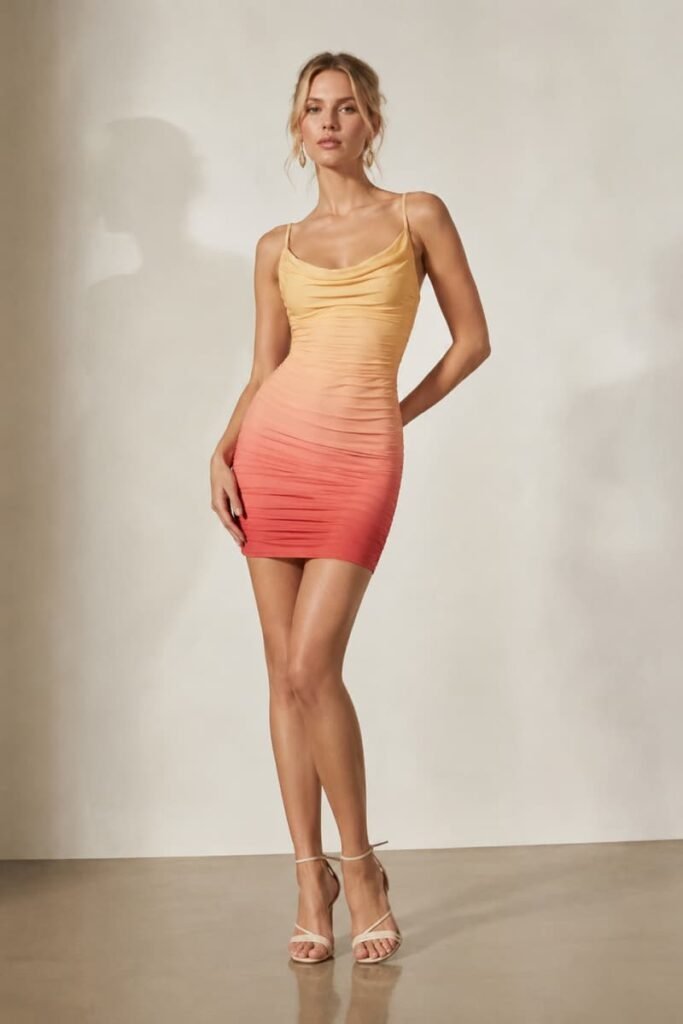
Ombré color can serve as a subtle commercial detail or the central visual statement of a collection. Each silhouette requires a different relationship between color placement, fabric, pattern and construction.

Ombré Mini Dresses

Mini dresses concentrate the gradient within a shorter vertical area, so transition control becomes highly visible. Waist-to-hem fades, diagonal placement and side gradients can work well, but each zone must be compressed without creating obvious color bands. Bodycon, corset, halter and ruched mini dresses also require review of stretch, gathers, lining and seam placement.

Ombré Midi Dresses

Midi lengths offer enough visual space for gradual transitions while maintaining strong commercial wearability. Common directions include pale bodices moving into darker skirts, vertical side fades and watercolor-style all-over effects. Pattern balance around the waist, hip and lower skirt determines whether the garment appears elongated or visually divided.

Ombré Maxi Dresses

Maxi dresses allow long, fluid transitions and are especially suited to resort, vacation and occasion collections. Chiffon, mesh and lightweight woven fabrics can create movement, while fuller hems require careful fabric consumption and artwork planning. The gradient must remain balanced across wide skirt panels, godets, tiers and uneven hemlines.

Ombré Mesh Dresses

Printed or dyed mesh creates depth through transparency and layering. Final color depends on mesh density, stretch, lining shade and the number of fabric layers. For fitted mesh dresses, artwork also changes when stretched around the bust, waist and hip. Strike-offs should be assessed over the intended lining rather than viewed on white paper alone.

Ombré Chiffon Dresses

Chiffon produces soft movement and works well for flowing transitions, sunset colors and occasion silhouettes. Layering can deepen color unexpectedly, while gathers may compress the gradient. Print clarity, colorfastness, fraying, seam visibility, lining coverage and hem finish all influence whether the garment appears refined or visually uneven.

Ombré Satin Dresses

Satin reflects light differently across curved body areas, making the same shade appear lighter or darker. Bias cutting, draping and seam pressure can shift the visual gradient. Color development should consider gloss level, weight, snagging, needle marks, seam puckering, lining and pressing conditions in addition to the printed or dyed effect.

Ombré Bodycon Dresses

Bodycon dresses place high demands on stretch recovery, pattern tension and artwork distortion. A gradient aligned on an unstretched sample may widen after wearing. Development should assess the garment on a form or fit model, checking bust, waist, hip, side seams, transparency and the position of transition zones under realistic tension.

Ombré Halter Dresses

Halter patterns contain angled necklines and narrower upper sections, so standard rectangular artwork may not follow the garment naturally. Gradient planning can emphasize the neckline, waist or long skirt. Neck support, bust coverage, back exposure and the transition between upper-body panels and lower skirt panels should be reviewed together.

Ombré Backless Dresses

Backless designs need controlled placement around straps, side seams, waist seams and open-back edges. A strong gradient may highlight construction imbalance if left and right sides do not align. Support solutions, lining, adhesive compatibility, strap stability and zipper placement must remain visually discreet within the color design.

Ombré Pleated Dresses

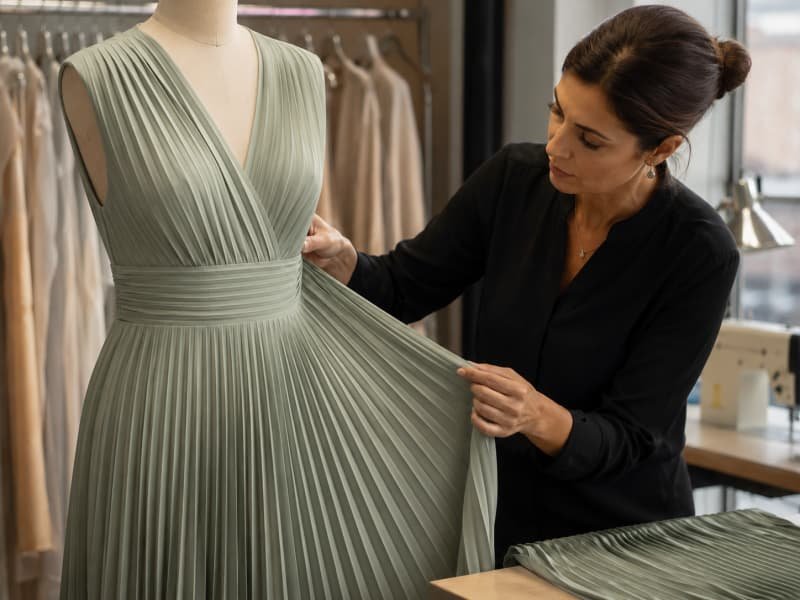
Pleats repeatedly hide and reveal sections of color. A smooth flat gradient may appear striped once pleated, while a bold transition may become more subtle. Development should test pleat depth, direction, heat-setting behavior, fabric shrinkage and final garment width before artwork scale or dye placement is approved.

Ombré Party Dresses

Party styles may combine gradient color with sequins, rhinestones, mesh, corsetry, cut-outs or ruching. Visual impact is important, but workmanship must remain comfortable and repeatable. Duolan reviews decoration density, lining coverage, seam edges, weight distribution, support structures and production time before confirming the commercial route.

Ombré Resort Dresses

Resort dresses favor flowing silhouettes, light fabrics and color stories inspired by ocean, sunset, tropical landscapes or soft tonal movement. Digital printing can deliver controlled artwork, while dip dye can create an organic result. Fabric hand feel, transparency, packing recovery and repeat-color potential should match the intended retail position.

Gradient Directions We Can Evaluate and Develop

The direction of a gradient changes the perceived proportions of a dress. Placement should be selected according to silhouette, fabric behavior, target occasion and the visual role of the garment.

Light-to-Dark Gradient

A pale upper section moving into a deeper hem can create visual stability and reduce visible transparency around the lower body. The darkest area must allow for hemming, length grading and skirt fullness. On layered chiffon or mesh, overlapping fabric may intensify the lower shade.

Dark-to-Light Gradient

A darker bodice can create focus and stronger upper-body definition, while a pale hem adds movement. Color migration, lining shade and seam visibility require review, especially when dark and light fabric areas meet at waist seams or layered construction points.

Two-Color Transition

Two defined endpoint colors create a clear story and are easier to communicate through Pantone references. The transition zone still needs approval because color mixing can produce an unwanted intermediate tone. Blue-to-pink, orange-to-purple and black-to-red combinations require separate strike-off judgment.

Multi-Color Gradient

Three or more colors can create sunset, rainbow, oil-paint or abstract effects. Artwork resolution, color order and transition width become more complex. Multi-color projects are generally better assessed through digital strike-offs on the intended fabric before garment sampling.

Center-Out Gradient

Color can radiate from the center front, waist or body line toward side seams. Such effects depend heavily on pattern symmetry and panel placement. Curved seams, darts and ruching may distort the center point, so garment-pattern mapping is required.

Side-to-Side Gradient

Horizontal color movement can produce asymmetry and a modern visual direction. Front and back relationships must be planned intentionally, and left/right panels require identification during cutting. Side-to-side gradients can also highlight seam mismatch more clearly than vertical transitions.

Placement Gradient

A placement gradient follows defined garment zones rather than repeating continuously across fabric. It may begin at the bust, waist, hip, slit or hem. Artwork must be linked to pattern dimensions and adjusted where multiple sizes or lengths are involved.

Artistic Gradient

Smoke, marble, watercolor, cloud and irregular hand-dyed effects rely on controlled variation rather than perfect symmetry. The acceptable variation range should be agreed before bulk production, especially when each garment is expected to retain a slightly individual appearance.

Comparing Ombré Dress Manufacturing Methods

No single process is ideal for every gradient dress. Fabric composition, visual precision, quantity, price architecture, color count, repeat-order expectations and acceptable variation should determine the final route.

Manufacturing MethodSuitable MaterialsPlacement PrecisionBulk RepeatabilityStrongest ApplicationsKey Development Risk
Engineered Digital PrintMesh, chiffon, satin-look polyester, woven blendsHighHigh when artwork and lots are controlledMulti-color gradients, artwork placement, watercolor effectsColor shifts between screen and fabric; seam alignment
Sublimation PrintPolyester-based fabricsHighHighBright gradients, lightweight dresses, all-over colorLimited fiber compatibility; heat behavior and migration
Fabric-Level Dip DyeCompatible cotton, viscose and selected blendsMediumMedium with controlled processOrganic transitions, resort and flowing dressesPosition and saturation variation between lots
Garment Dip DyeCompatible finished garmentsMediumMediumNatural hem fades and handmade visual effectsConstruction may absorb dye unevenly; trim compatibility
Piece-Dyed Gradient FabricPre-developed gradient textilesMedium to HighDepends on supplier and fabric lotPleated dresses, maxis, simple silhouettesCutting position, shade-lot continuity and reorder availability
Embellishment GradientSequins, beads, rhinestones, embroideryHigh when templates are fixedDepends on craft standardizationParty, occasion and statement dressesDensity variation, weight, comfort and attachment strength

A more expensive process is not automatically a better solution. Digital printing may suit an exact waist-to-hem transition, while dip dye may be preferable when natural variation is central to the design. Embellishment gradients can deliver strong visual value but require detailed density maps, attachment standards and longer inspection time.

How We Select a Production-Ready Gradient Route

Duolan evaluates the intended appearance, fabric reality, construction and production scale before recommending an ombré method. The goal is not merely to make one attractive sample, but to establish a process capable of supporting the required order structure.

Start With the Visual Objective

The first review identifies what the brand wants people to notice. Is the gradient meant to lengthen the silhouette, create a sunset story, emphasize a fitted waist, flow across a wide maxi skirt or shift through sequins? References are broken down into endpoint colors, transition direction, transition width, focal area, symmetry and acceptable variation. A digital image may represent a hand-dyed garment, an edited photograph or an effect produced by layered fabric. Duolan does not assume the original process from appearance alone. Development recommendations are based on the intended result and available production conditions.

Match the Method to Fabric

Fiber content and surface behavior determine which routes remain technically suitable. Sublimation requires polyester content. Reactive processes suit selected cellulosic materials. Satin reflects color differently from matte chiffon. Stretch mesh changes artwork scale while worn. Pleated materials alter visible color after folding. Fabric availability also affects MOQ, lead time, repeatability and cost. When the preferred fabric cannot support the desired process, alternative routes may include changing the fabric, adjusting the artwork, using a printed overlay or creating the gradient through embellishment.

Test Before Full Sampling

A strike-off, lab dip, dip-dye trial or embellishment swatch should answer the highest-risk color question before a complete garment is made. The test should use the intended base fabric and, where relevant, the intended lining or pleat treatment. Early testing reduces the risk of spending time on a correct pattern combined with an unsuitable color method. When the effect passes initial review, it can move into pattern placement, garment sampling and fit evaluation with clearer standards.

Confirm the Bulk Path

Before bulk production, Duolan reviews material readiness, approved artwork, pattern version, size grading, workmanship notes, color references, PP basis, inspection points and packing requirements. Higher-risk styles may require first-piece confirmation or a controlled pilot stage. The chosen route should also account for repeat orders. A hand-dyed result may allow natural variation, while a digital placement project may need preserved artwork files, print settings, pattern versions and color references for later reproduction.

Fabric Options and Their Gradient Behavior

Fabric selection determines how color is absorbed, reflected, stretched, layered and perceived. Duolan evaluates the garment result rather than choosing a textile only because it can accept a print or dye.

Stretch Mesh

Stretch mesh supports fitted dresses, overlays, ruching and body-skimming silhouettes. Gradient development must account for mesh density, stretch percentage, recovery, transparency and lining color. Printed artwork can widen when worn, particularly around the bust and hip. Strike-offs should be viewed both relaxed and stretched over the intended lining. Seam elasticity, edge finishing and shade consistency across multiple mesh layers require defined standards.

Chiffon

Chiffon creates fluid movement and soft tonal transitions for maxi, midi and occasion dresses. Because it is transparent, one layer can appear pale while overlapping areas become considerably darker. Gathers, pleats and double layers also compress the gradient. Development checks include print penetration, colorfastness, fraying, seam visibility, lining coordination, hem treatment and whether the fabric maintains a clean drape after finishing.

Satin

Satin is well suited to premium occasionwear but requires careful handling. Light reflection can make the same shade look inconsistent across curved seams and bias-cut sections. Deep gradient colors may reveal needle marks, pressing shine or seam puckering. Duolan assesses weight, gloss, drape, snagging, lining, shrinkage and how the gradient interacts with darts, drapes and body contours before confirming production suitability.

Organza

Organza delivers volume, transparency and crisp structure. A gradient can appear luminous, especially in layered skirts or sleeves, but overlapping layers intensify shade. Stiffness may also expose abrupt transition lines. Development should consider print clarity, seam finishing, edge treatment, fabric scratching, color interaction between layers and the amount of fullness built into the pattern.

Stretch Jersey

Jersey works for bodycon, ruched and casual-fashion dresses. Color placement changes with stretch, recovery and pattern tension. A gradient printed on flat fabric may move substantially when worn. Evaluation covers fiber composition, four-way or two-way stretch, recovery, opacity, shrinkage, spirality, pilling and seam elasticity. Lining or power mesh may be required for support and visual coverage.

Viscose and Rayon

Viscose and rayon fabrics support soft resort silhouettes and can produce rich dyed effects. Their absorbency, drape and hand feel suit dip-dye or printed ombré concepts, but shrinkage, wet strength, colorfastness and lot variation need control. The development route should reflect fabric finishing, expected washing method, skirt fullness and whether the project requires close repeat-order matching.

From Color Direction to Approved Gradient Standard

Color becomes manageable when every approval stage has a defined purpose. Duolan organizes the path from initial concept to bulk reference so that design teams, printing or dyeing partners, garment production and QC work from aligned standards.

Define Both Endpoint Colors

A two-color ombré requires clear references for the lightest and darkest points. Pantone codes, physical color swatches, approved fabric, an original garment or a previous production sample can provide a stronger basis than edited online imagery.
For multi-color gradients, the order and relative width of each color should also be defined. A blue-to-purple-to-pink transition may look completely different if the purple zone occupies 10% or 40% of the garment.

Approve the Transition Zone

Endpoint colors alone do not control the overall appearance. The middle transition determines whether the effect feels soft, smoky, clean, energetic or muddy. Development should review the number of intermediate tones, banding, grey cast, saturation, visual direction and total transition length.
Strike-offs allow the transition to be viewed on real fabric under natural light and controlled lighting. For transparent materials, the sample should also be checked with lining and layered construction.

Establish a Physical Reference

Approved lab dips, strike-offs and fabric swatches should be labeled with project, style, colorway, fabric quality, version and approval date. The approved garment sample then confirms whether the color remains correct after cutting, sewing, gathering, pleating, lining and finishing.
The PP or production reference links color approval to final construction. It should not contain substitute material or unresolved workmanship if it will be used as the bulk comparison standard.

Control Bulk Lots

Bulk fabric or printed lots are reviewed against approved references before cutting. Shade groups may need separation when visible differences occur. For deep-to-light gradients, inspection should check both overall direction and local defects such as streaks, spots, banding or incomplete transitions.
Repeat orders require a renewed comparison against preserved color standards. The aim is not to assume a new batch will match, but to identify any difference early enough for review.

Artwork Preparation and Gradient Placement Engineering
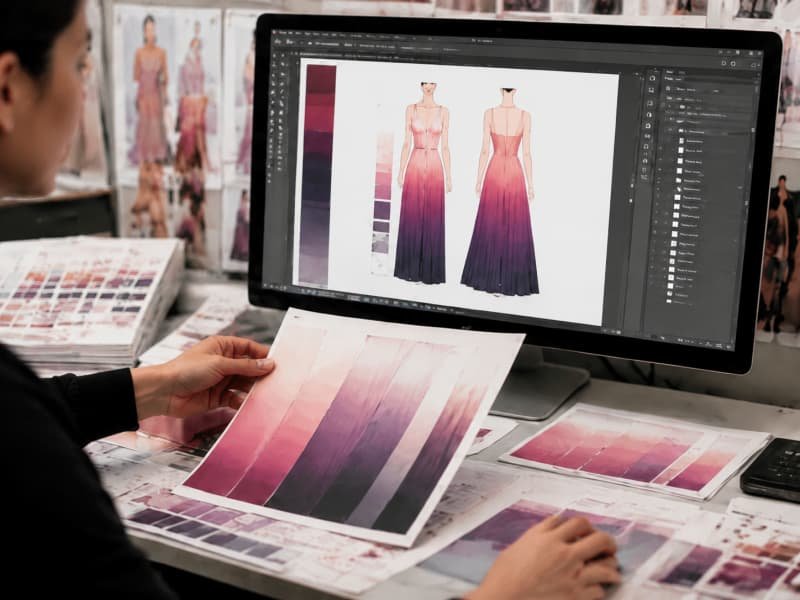
Accurate ombré development begins with clear files and garment-specific placement decisions. Artwork should explain where the effect belongs on the body and how it must behave after pattern cutting.

Files That Support Development

Useful inputs include AI, PSD, EPS or high-resolution TIFF artwork; front and back references; Pantone colors; an original sample; a tech pack; size specifications; target fabric; collection mood boards and photographs showing the intended depth or softness.

Raster artwork must have sufficient resolution at production scale. Vector files are helpful for clean, engineered placement, but photographic or watercolor gradients may remain raster-based. The working file should separate colors, garment views and placement notes where possible.

Establish Placement Anchors

Gradient placement can be linked to garment landmarks such as shoulder point, bust line, under-bust seam, natural waist, high hip, full hip, slit opening and finished hem. Anchor points provide a more reliable reference than phrases such as “start around the middle.”

For styles with adjustable lengths or several regional size standards, placement should be expressed both visually and through measurable relationships. The dark zone may begin a defined distance below the waist or occupy a set percentage of finished skirt length.

Map Artwork to Pattern Pieces

Front, back, sleeves, straps, godets, side panels and lining-related overlays may each require a different section of the artwork.  Duolan reviews the relationship between the artwork and actual pattern dimensions before final production files are approved.

A garment containing a waist seam may use separate bodice and skirt placements. A one-piece bias dress needs continuous visual balance. 

Preserve Version Control

Artwork revisions, approved color versions and pattern updates should use consistent file naming. Production errors often occur when the correct garment pattern is paired with an earlier print file or when a revised color is not carried into the strike-off.

Duolan organizes approved development references so that printing or dyeing, cutting, sampling and bulk production follow the same version basis.

Controlling Panel Matching and Seam Continuity

Ombré fabric cannot be treated like a uniform solid color. Cutting location directly affects the appearance of every panel, and seam relationships must be planned before bulk cutting begins.

Front and Back Balance

Front and back views do not always need an identical gradient, but they should belong to the same visual language. A front panel with a long soft transition can appear disconnected from a back panel that changes abruptly at the waist. Pattern placement maps help define color depth, transition height and the darkest area on each view. For open-back or cut-out designs, back placement must also consider exposed skin, strap locations, zipper positions and waist seams.

Side-Seam Relationships

Side seams can be managed through continuous matching, balanced shade levels, mirrored placement or intentional contrast. The correct choice depends on the design and fabric width. Exact matching may increase fabric consumption because panels must be cut from restricted areas. Duolan can explain whether improved matching justifies the additional material usage or whether a controlled tonal balance delivers the required appearance more efficiently.

Marker and Cutting Control

Marker planning must reflect usable gradient zones, pattern direction, nap or shine, print orientation and shade grouping. Standard high-efficiency nesting may not be appropriate when every panel needs a specific color position. Cut panels can be numbered and bundled by garment, size, colorway and shade group. Clear identification reduces the risk of mixing front and back pieces from different parts of the gradient.

Layered and Full-Skirt Styles

Tiered skirts, gathered panels, godets and circular cuts multiply placement complexity. The visible gradient changes as fabric is gathered or spreads through a wide hem. Development should calculate the flat fabric area required for the final visible effect.
For layered mesh or chiffon, each layer can use aligned, offset or different gradient depths. A sample should confirm whether the final combination creates depth or produces an overly dark, unclear result.

Engineering Gradients Around Dress Silhouettes

The same gradient cannot simply be transferred across bodycon, bias-cut, pleated and ruched dresses. Silhouette engineering determines how color moves around the body and how much of each zone remains visible.

Bodycon and Stretch Silhouettes

Bodycon patterns use negative or reduced ease, causing fabric and artwork to expand during wear. Gradient lines can curve around the bust and hip or move upward under tension. Duolan evaluates fabric stretch, recovery, opacity, lining elasticity and pattern tension together. Fit review should include front, side and back views. A transition that looks correct on a hanger may become uneven on the body if seam tension, lining or panel widths are unbalanced.

Bias-Cut Satin Silhouettes

Bias-cut garments drape and lengthen differently from straight-grain styles. Color areas may shift after hanging, pressing and wearing. The fabric’s shine also changes across the body, which can make a smooth gradient appear irregular under directional light. Development should allow sufficient time for the bias garment to settle before final length and placement are confirmed. Side seams, neckline binding and hem balance deserve close review.

Pleated and Gathered Silhouettes

Pleats hide fabric inside folds, changing visible color density. A 30-centimeter flat transition may appear much shorter after pleating. Gathers compress artwork at the waist and release it through the skirt. Duolan can test the gradient on pleated or gathered material before finalizing artwork scale. For heat-set pleats, shrinkage and color behavior through the setting process also require verification.

Ruched and Draped Silhouettes

Ruching introduces irregular compression, so exact image reproduction may not be possible in heavily gathered areas. The gradient should be designed to remain attractive when partially hidden or folded. Draped sections may cross several body areas, bringing a dark zone over a light zone. Development should evaluate the effect on a mannequin or fit model rather than relying only on flat technical drawings.

Corset and Structured Silhouettes

Corset dresses include multiple narrow panels, cups, boning channels and shaped seams. Gradients can become fragmented unless each section is planned. Printed placement must also account for seam allowance and cup shaping. Support materials, lining and power mesh should not alter the outer color. Boning insertion, pressing and topstitching must remain clean in pale sections where workmanship becomes highly visible.

Full Maxi Silhouettes

Wide maxi skirts consume large fabric areas and may require several panels. Gradient continuity across a full hem can increase material consumption or require engineered artwork widths.

The design should balance visual flow, available fabric width, marker efficiency and final retail positioning.

Maintaining Gradient Proportions Across Size Grading

Grading changes garment width, length, seam position and body landmarks. A professional gradient plan considers how the design should look across the size range rather than applying one fixed print without review.

Use Visual Anchor Points

The intended gradient can be anchored to the bust line, waist, hip, slit, knee or finished hem. Anchor points help determine which areas should move with size grading and which should remain at a consistent visual level.
For example, a transition designed to begin below the waist should follow the graded waist position rather than remain at one fixed distance from the top edge of every pattern.

Review Key Sizes

A size-set review does not always require complete color samples in every size, but selected anchors—such as XS, M and XL—can reveal whether visual proportions remain balanced. Extended size programs may require additional review at the upper end of the range.
Line drawings, digital placement simulations, printed pattern sections or garment samples can be used according to risk and project scale.

Balance Width and Length

Larger sizes gain width and may gain length. If the same gradient file is simply enlarged, the transition can become too wide and weak. If it remains fixed, side areas may contain unexpected colors.
The production artwork may need controlled scaling, repeat adjustment or separate size groups. The most suitable solution depends on pattern shape, fabric width, printing route and the required consistency.

Control Short and Tall Lengths

Petite, regular and tall lengths change the proportion between waist, knee and hem. A hem-based dark zone may disappear during shortening or become excessive in tall sizes. Length variants therefore need a clear rule for where the gradient starts and how the transition expands.

Protect Fit While Adjusting Art

Artwork should adapt to the pattern, not force the pattern to change in ways that damage fit. Bust balance, waist shaping, hip ease and hem level remain primary garment standards. Color placement is then engineered around the approved pattern block.

Construction Details Behind Better Ombré Dresses

Small construction choices can change the appearance of a gradient. Duolan evaluates lining, seams, closures, hems, stretch and fabric manipulation as part of the visual result.

Lining Coverage

Lining color can brighten, mute or shift transparent gradients. White lining may make pastel mesh cleaner, while nude or tonal lining can add depth. Coverage should follow the intended transparency around bust, waist, hip and slit areas. Lining stretch and recovery must also match fitted outer fabrics.

Seam Finishing

Seam allowances may remain visible through chiffon, mesh and pale sections. Overlock thread, binding and seam width should coordinate with the gradient. Dark thread under a light area can create an unwanted line. Delicate fabrics also need controlled tension to avoid puckering.

Zipper Placement

A center-back zipper can divide the gradient and create mismatch if left and right panels are not balanced. Concealed zipper tape, top hook, seam allowance and installation pressure affect appearance. Side zippers may protect a clean back view but influence side-seam continuity.

Hem Construction

Narrow rolled hems, baby hems, clean-finished hems and faced hems remove different amounts of fabric from the darkest or lightest zone. Hem method should be considered before gradient position is finalized. Full chiffon skirts may also require leveling after hanging.

Stretch Recovery

Stretch dresses depend on recovery, seam elasticity and lining compatibility. A gradient may distort permanently if the fabric bags out around the hip or seat. Testing should review stretch before and after recovery, seam performance and visual placement on the body.

Ruching and Pleating

Ruching compresses color, while pleats hide and reveal sections. Stitch density, elastic tension, pleat depth and placement determine how much of the gradient remains visible. Production workmanship needs measurable references rather than relying only on sample photographs.

What to Send for Ombré Dress Development

Clear project inputs help Duolan evaluate fabric, technique, pattern placement, cost structure and timeline before sampling begins. Complete files are valuable, but development can also start from a structured reference package.

Tech Pack

A tech pack should include front and back drawings, construction notes, measurement specifications, size range, materials, trims, artwork and labeling requirements. Ombré projects benefit from a separate gradient placement map showing endpoint colors and transition zones.

Reference Images

Reference images help communicate silhouette, color softness, surface effect and intended styling. Multiple views are preferable. Lighting and editing can alter color, so images should be supported by Pantone references or physical swatches whenever exact matching is important.

Gradient Artwork

Artwork files may include AI, PSD, EPS or high-resolution TIFF formats. The file should show direction, scale, endpoint colors and whether front and back placements differ. Original editable layers support faster technical review and revision.

Pantone Colors

Provide both endpoint colors and any required intermediate shades. Physical color chips or previous production swatches add value when a screen-based Pantone display does not capture the required fabric appearance.

Fabric Direction

Share preferred fiber content, weight, stretch, transparency, shine, hand feel and drape. An original fabric swatch is especially useful. Duolan can review whether the proposed material supports the gradient route, fit and target price architecture.

Quantity and Timing

Target quantity by style, color and size helps determine production method, material sourcing and cost. Share the intended launch date, photography date, buying review or delivery window so sample, approval, production, QC and shipping stages can be planned realistically.

Our Ombré Dress Sample Development Process

Sampling should answer defined product questions in the correct order. Duolan separates color validation, pattern development, fit, visual refinement and production readiness instead of expecting one garment to solve every issue at once.

Brief and Feasibility Review

The project begins with a review of silhouette, color direction, fabric, target market, intended use, quantity, size range, launch timing and required sample stage. Duolan identifies unclear points, high-risk details and missing approvals before committing to a sample route. A reference may look simple but contain several hidden processes: engineered print, layered mesh, bias satin, pleating, bonded support or hand-applied embellishment. 

Fabric and Technique Direction

Suitable fabrics and gradient methods are compared according to color precision, hand feel, fit, structure, price and repeatability. Available fabric swatches, lab dips, print bases or dye trials may be prepared. When a visual effect can be produced through several methods, Duolan can explain the trade-offs rather than defaulting to the first available process. The selected direction becomes the basis for strike-off and garment sampling.

Strike-Off or Dye Trial

The initial color test checks endpoint shades, transition smoothness, saturation, banding, clarity and fabric response. Transparent or stretch fabrics are reviewed under conditions closer to the finished garment, including lining or controlled stretch.

Revisions at this stage are generally more efficient than changing the gradient after a complete garment is sewn.

Pattern and First Sample

Pattern development translates the approved silhouette, measurement standard and gradient placement into garment pieces. The first sample checks overall proportion, construction route, fabric behavior, color position and visible workmanship. The first version may not be intended as a final photography or production sample. Its purpose should be defined in advance so comments focus on the correct development decisions.

Fit and Gradient Revision

Fit comments, measurement changes and color-position changes are reviewed together. Moving a waist seam or shortening a skirt can alter the gradient, while changing fabric can affect both fit and color.

Duolan organizes revision notes by pattern, material, artwork, construction and finishing, helping prevent one correction from being lost when another area changes.

PP and Bulk Readiness

Before production, the approved basis should include fabric, lining, artwork, gradient reference, pattern version, measurements, workmanship, labels and packaging. Complex or sensitive styles may proceed through a first-piece or pilot confirmation before full release.Gradient strike-offs, special fabric preparation, embellishment trials and additional fit rounds may add approval stages, so the calendar should be linked to project complexity rather than one fixed promise.

Ombré Effects Through Sequins and Embellishment

Gradient effects can be created through changing color, density, scale or reflectivity of sequins, beads, rhinestones and embroidery. Such products require detailed craft standards to remain consistent across several thousand garments.

Color-Shift Sequins

Sequins can move through two or more shades across a garment. Color grouping, sequin orientation, base fabric and thread color influence the final visual result. Cutting and seam allowances must avoid loose edges, while lining should prevent scratching and conceal the reverse construction.

Dense-to-Sparse Sequins

A gradient can move from dense coverage to scattered decoration without changing color. The effect requires a density map showing approximate pieces per area, transition zones and focal points. Bulk operators need templates or marked panels to avoid visible differences between garments.

Gradient Beading

Beads create depth through color, transparency and surface reflection. Weight distribution is critical because heavy lower sections can stretch mesh or alter drape. Attachment strength, knot security, reverse finishing and wearing comfort should be checked during craft trials.

Rhinestone Mapping

Rhinestones can follow a waist fade, side gradient or radiating pattern. Stone size, spacing, color, adhesive or setting method and placement tolerance need approval. Washability, heat sensitivity, transport pressure and fallout should be considered before commercial production.

Embroidered Transitions

Thread color can shift gradually across motifs or placement areas. Stitch density and backing affect fabric hand feel and transparency. On mesh or chiffon, embroidery weight may distort the base fabric, so sample testing should review stability, reverse appearance and seam interaction.

Layered Tulle Gradients

Different tulle shades can be layered to create a gradient without printing or dyeing. The number of layers, order of colors, overlap and skirt fullness determine the final effect. Layered construction requires control of bulk, comfort, hem finish and shade consistency.

Samples Required Before Ombré Dress Production

Each sample type supports a different decision. Defining the purpose prevents photo-focused samples, fit samples and production references from being confused.

Fabric Swatch

A fabric swatch confirms base material, color ground, texture, transparency, stretch, shine and hand feel. It is not enough to approve only fiber composition because different constructions using the same fiber can behave differently in printing, dyeing and garment production.

Gradient Strike-Off

The strike-off validates color sequence, transition smoothness, artwork scale and fabric response. It may be smaller than a full garment panel, but placement gradients should include enough area to judge the complete transition.

First Prototype

The first prototype checks silhouette, construction logic, approximate placement and material direction. It identifies whether the concept is technically coherent before additional resources are spent on refined finishing or photography-level appearance.

Fit Sample

A fit sample evaluates measurements, balance, support, ease, length, movement and body placement.
Gradient zones should be reviewed on the body because stretch, drape and curves can change their position.

Photo Sample

A photo sample prioritizes visual completion, approved color, styling details and camera appearance. It may be prepared for campaigns, ecommerce imagery or line presentations. Production readiness still needs separate confirmation when materials or workmanship differ from bulk standards.

PP Sample

The pre-production sample should reflect the confirmed production basis: fabric, lining, trims, color, artwork, measurements, workmanship, labels and packing. It becomes a central comparison reference for first-piece review, inline QC and final inspection.

Turning an Approved Sample Into a Bulk Standard

A visually approved garment does not automatically contain enough information for consistent production. Duolan converts approvals into clear material, pattern, workmanship and inspection references before bulk release.

Lock the Material Basis

Bulk fabric, lining, trims and special-process materials should match approved quality and color. Supplier, composition, weight, width, finish, stretch, shade reference and required testing are recorded where relevant. Substitution should not happen silently. When approved material becomes unavailable, the alternative needs review because even a similar fabric may change gradient appearance, fit, drape and retail perception.

Lock Pattern and Measurements

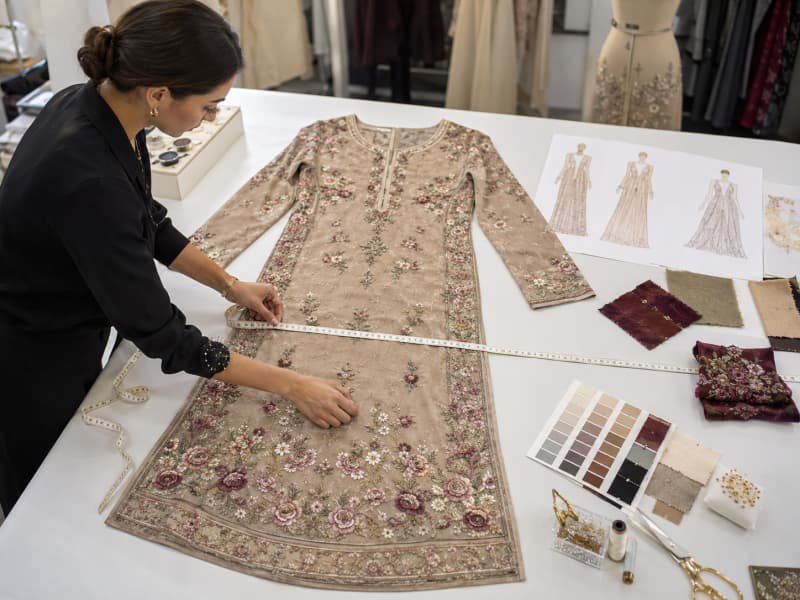
The approved pattern version and measurement specification must correspond. Fit comments are translated into pattern changes and checked against the final sample. Grading rules should identify key points that affect ombré placement, such as waist level, hip level, garment length and seam positions. Production teams need one current standard rather than several partially approved sample versions.

Lock Artwork and Color

Artwork version, print scale, color references, placement map and front/back relationship are confirmed. Physical strike-offs and approved garments should carry clear identification. If several colorways use one pattern, each colorway receives separate approval references. For dip-dyed effects, the acceptable range of natural variation should be documented using samples or visual standards.

Lock Workmanship

Seam type, stitch density, thread color, zipper, lining attachment, hem, pleat depth, ruching, decoration density and finishing are translated into production notes. Close-up photographs and physical samples can support written instructions.

Higher-risk points become first-piece and inline QC checkpoints rather than remaining general comments.

Confirm Production Readiness

Duolan reviews whether the project is fit-confirmed, visually confirmed, PP-based or still awaiting refinement. The order is also classified by purpose—launch, repeat or scale-up—and by style complexity.

A Bulk Start Confirmation or production-readiness note can summarize the approved basis, pending points and planned production route before cutting begins.

Quality Checkpoints Specific to Ombré Dresses

Standard garment inspection remains essential, but gradient products require additional color and placement checkpoints. Inspection criteria should be visible, measurable and linked to approved references.

Color Direction

Inspect endpoint colors, intermediate tones and overall saturation against the approved strike-off or garment. Lighting conditions should remain controlled when close shade decisions are made. Metallic, glossy and transparent fabrics may need viewing from several angles.

Transition Smoothness

Check for banding, abrupt tonal breaks, muddy intermediate shades, uneven dye movement and inconsistent fade width. The acceptable character differs between engineered digital gradients and organic dip-dye effects, so inspection must follow the approved visual standard.

Gradient Position

Measure or visually verify anchor points such as start height, waist transition, hip zone and hem depth. Position tolerance should reflect design sensitivity. A five-centimeter shift may be acceptable on an artistic maxi but unacceptable on a fitted waist-placement design.

Panel Matching

Review front/back balance, side seams, waist seams, sleeves, godets and layered sections.

Exact matching is inspected only where specified; otherwise, the goal may be balanced shade and intentional continuity.

Shade Consistency

Compare garments within the same lot and across lots. Check whether front and back panels come from compatible shade groups.

Deep colors, transparent layers and satin reflections can make lot differences more visible.

Print or Dye Defects

Inspect for streaks, spots, incomplete color, print lines, ghosting, color contamination, white marks, migration, uneven penetration or damage caused by finishing. Defect zones near the bodice or center front may require stricter acceptance than concealed areas.

Fit and Measurements

Confirm bust, waist, hip, length, strap, neckline, slit and key construction measurements. Fit changes can move the gradient, so visual and dimensional inspection should not be separated on body-sensitive styles.

Construction and Packing

Check seams, lining, zipper, hems, pleats, ruching, decoration, labels and packaging. Light-colored zones need protection from dirt, transfer and packing pressure. Folding direction should avoid creating permanent marks on delicate or embellished garments.

Testing Color, Fabric and Garment Performance

Testing plans depend on fiber content, gradient process, color depth, garment use, care instructions, destination market and brand standards. Duolan can coordinate relevant tests rather than applying one generic checklist to every style.

Wash Colorfastness

Wash testing checks whether gradient colors fade, change or stain adjacent materials under the intended care method. Dark-to-light products and contrast linings deserve close review. Results should be interpreted alongside the garment’s care label and expected use.

Rubbing Fastness

Dry and wet rubbing tests evaluate surface color transfer. Deep printed or dyed areas may stain light accessories, upholstery or other garments if rubbing performance is insufficient. Satin, intense colors and heavily saturated dip-dye zones may require additional attention.

Perspiration Fastness

Party, occasion and fitted dresses are worn close to the body, making perspiration resistance relevant. Testing can identify shade change or staining risk around underarm, bust, waist and back areas.

Color Migration

Polyester fabrics, heat processes, dark linings and printed overlays can create dye migration. Migration may appear after heat exposure, storage or contact between dark and light components. Material combinations should be reviewed before bulk production.

Dimensional Stability

Shrinkage and growth affect fit, garment length and gradient position. Fabric or garment testing can evaluate dimensional change after washing, steaming or finishing. Bias-cut and stretch garments may need additional settling or recovery review.

Physical Performance

Depending on the style, testing may include pilling, seam strength, stretch recovery, print adhesion, sequin attachment, bead strength, zipper function and fabric tearing. The testing program should focus on the real risks created by the chosen material and construction.

Ombré Dress Risk and Control Matrix

Every visual or production risk should lead to a defined control point. The matrix below connects common problems with the evidence used to manage them.

RiskLikely CauseDuolan Control ActionApproval or Evidence
Incorrect gradient colorsScreen-based reference or unclear endpointsConfirm Pantone, physical swatch, lab dip or strike-offApproved color reference
Visible color bandingArtwork resolution, print settings or dye behaviorReview full transition on intended fabricGradient strike-off
Gradient position shiftsArtwork not mapped to patternsDefine anchor points and placement mapPattern placement drawing
Side seams appear disconnectedUncontrolled panel cuttingPlan front/back shade and marker positionPanel comparison sample
Size proportions changeFixed artwork applied without grading reviewCheck selected anchor sizes and graded placementXS/M/XL placement review
Bulk differs from sampleMaterial lot, process or version changesLock PP basis, lot controls and first piecePP and first-piece records
Color transfers or fadesInadequate process or care compatibilityCoordinate colorfastness and migration testingLaboratory report
Repeat order shade changesNew fabric or dye batchCompare new lot with preserved standardReorder shade approval
Pleats or ruching distort gradientArtwork not tested after fabric manipulationTrial pleat or gather before final artworkManipulated fabric sample
Decoration density variesNo measurable craft mapEstablish density, color and placement standardApproved craft panel

A Manufacturing System Built for Collection-Scale Production

Duolan combines centralized development and project coordination with owned factories, long-term satellite production and established special-process resources. The structure supports multi-style programs rather than only isolated garment orders.

Development Density

Ombré collections often involve several silhouettes, colorways, fabrics and launch roles. Development teams must coordinate artwork, fabric, pattern, sample comments and approvals without mixing versions. Duolan’s broader manufacturing system can support high development density through separate product, pattern, fabric, craft, sampling, merchandising and quality functions. The value lies in organizing multiple styles through defined stages rather than moving every sample through one informal channel.

Owned Core Production

Sixteen owned womenswear factories provide a stronger base for core styles, complex constructions, PP-to-bulk conversion and repeat standards. Sensitive products can remain under more direct production management when fit, placement or workmanship requires closer control.

Owned production also supports accountability when corrections, first-piece review or repeat-order comparison is required.

Flexible Capacity Network

More than twenty long-term satellite factories and regional manufacturing resources provide additional capacity for seasonal concentration, repeat orders and scale-up programs. The coordinated workforce across supporting bases exceeds 12,000 people.

Satellite production is most effective when patterns, materials, workmanship, QC and delivery plans remain centrally controlled. It should add flexibility without fragmenting standards.

Style-to-Line Matching

Different garments require different sewing experience and handling. Stretch mesh, bias satin, chiffon, pleated fabric and embellished dresses should not automatically share one production route. Duolan breaks orders down by complexity, fabric, special processes, quantity and timing before matching each style to suitable lines or factories. Approximately 300 sewing lines and more than 50 flexible lines support differentiated planning.

Special-Process Coordination

Printing, dip dye, embroidery and washing are supported by 2–3 established cooperating resources in each direction. Such resources can be selected according to fabric, effect, quantity and schedule. Special-process suppliers remain connected to the garment plan so that color approval, cutting, sample review and production timing do not operate as unrelated stages.

Delivery and Repeat Support

After launch, repeat orders require preserved patterns, BOM details, artwork, color references, quality standards and historical production notes.Common logistics references include 3–7 days by express, 5–8 days by air and approximately 20–35 days by sea, subject to destination, customs, carrier schedules and shipment arrangements.

Supplier Qualification for Global Fashion Programs

Manufacturing capability must be supported by audit readiness, quality awareness, documentation and transparent cooperation. Requirements vary by market, product and individual brand standards.

SMETA Audit Record

Duolan’s manufacturing system has completed SMETA audit requirements and SMETA 2-Pillar audit. Audit documentation supports supplier onboarding and social responsibility review for organizations using Sedex-related processes.

Brand Audit Cooperation

Additional factory visits, questionnaires, supplier assessments or third-party audits can be coordinated according to project requirements. Duolan supports scheduled factory, sample-room, production-line, quality and packing visits for qualified programs.

Quality Standards

Projects can be managed with reference to customer specifications, inspection requirements and relevant quality systems. ISO 9001-related quality expectations can be discussed according to the manufacturing entity and required documentation.

Textile Testing

Testing can be coordinated according to AATCC, ASTM, EN, China GB or other specified methods where applicable. Test selection should reflect fabric, color process, garment use, market and care instructions.

Material Documentation

Depending on the project, material suppliers or laboratories may provide composition details, OEKO-TEX-related documentation, GOTS-related documentation or other requested evidence. Availability and scope should be confirmed for the exact fabric and production lot.

Confidential Development

Tech packs, artwork, original samples and unreleased collection information can be managed as confidential project materials. Images used for development evidence or case studies should remove brand names, labels and commercially sensitive details unless written approval is provided.

OEM, ODM and Private-Label Ombré Dress Support

Duolan can enter a project from a complete technical package, an original garment, a strong reference direction or a structured collection brief. The development path changes according to the material provided.

Tech Pack OEM

When measurements, materials, construction and artwork are defined, Duolan reviews manufacturability, cost drivers, fabric availability, gradient placement and production risks before quotation and sampling. Questions are organized by technical area rather than left until the first sample is complete.

Reference Development

A reference photograph can communicate visual direction but may not reveal internal construction, fabric composition or original production method. Duolan evaluates feasible routes and proposes a development basis covering material, pattern, gradient process and sample purpose.

Original Sample Development

An original garment can support pattern analysis, measurement review, fabric comparison and workmanship study. The objective may be a close reproduction, fit correction, material upgrade, cost adjustment or adaptation into a new gradient color story.
Collection Development for Shopify Drops​

Collection Development

A collection brief can be organized into visual pieces, commercial styles, supporting silhouettes and repeatable extensions. Shared gradient colors, fabrics, lining and trims can create stronger range unity and more efficient development.

Labels and Hangtags

Private-label support can include main labels, size labels, care labels, woven labels, heat transfers, hangtags, strings and sticker systems. Material, size, placement, color, wording and country-specific information require approval before bulk production.

Retail Packaging

Packaging options may include individual polybags, tissue, hangers, barcode labels, size stickers, warning text, carton marks and retailer-specific packing instructions. Packing should protect pale gradient areas, delicate satin, pleats and embellishment during transport.

Ombré Dress Development and Production Case Studies

The following anonymized profiles reflect the scale and project structure commonly handled for established fashion-dress programs. Brand identities and unreleased designs remain confidential.

United States Partywear Program

Region: United States
Brand Type: High-frequency partywear and going-out dress brand
Project Structure: 18 styles, 6 gradient color stories, 42,000 garments
The collection included lined mesh bodycon dresses, ruched minis, halter maxis and two corset-led image styles. The primary challenge was keeping gradient zones in consistent body positions while several patterns used different stretch ratios, ruching depths and skirt lengths.
Duolan separated the program into three technical routes. Engineered digital placement was used for fitted mesh styles. Fuller maxi dresses used repeated artwork with controlled panel zones. Two statement styles required individual front-and-back placement files.
Strike-offs were reviewed over the approved lining color. XS, M and XL anchor placements were compared before grading release. Side-seam balance, ruching compression and hem depth became inline QC checkpoints.
Result:
  • 18 styles moved through one coordinated development calendar
  • Six color stories were approved through separate strike-off records
  • First-piece review was used for the two highest-risk corset styles
  • The 42,000-piece order was split according to construction complexity
  • Approved patterns and artwork were preserved for follow-up color extensions

United Kingdom Occasionwear Collection

Region: United Kingdom
Brand Type: Contemporary occasionwear and wedding-guest dress brand
Project Structure: 12 styles, 4 color groups, 26,500 garments
The program focused on chiffon midi dresses, satin maxis and pleated one-shoulder styles. The main difficulty was controlling color perception across transparent chiffon layers, glossy satin and heat-set pleats while maintaining one coherent seasonal palette.
Duolan first separated “same Pantone direction” from “same visual appearance.” Each fabric required its own development because satin reflected more light, chiffon deepened after layering and pleats compressed the transition.
Fabric swatches and gradient trials were reviewed with lining. Pleated test panels were approved before full garment samples. Bias satin styles were allowed to settle before final hem and placement confirmation. Production lots were grouped by fabric and colorway, with shade comparison before cutting.
Result:
  • Four coordinated color groups were developed across three fabric families
  • Twelve styles entered production with fabric-specific gradient standards
  • Pleat-depth and color-compression references were added to workmanship files
  • 26,500 garments were delivered through a staged production and inspection plan
  • Two successful silhouettes were retained for the following occasion season

Australian Resort Collection

Region: Australia
Brand Type: Resort, vacation and warm-weather fashion brand
Project Structure: 24 styles, 8 gradient artworks, 68,000 garments
The collection included halter maxis, cut-out midis, relaxed slip dresses, skirts and coordinated tops. The brand wanted sunset, ocean and tropical gradients with fluid visual movement, but also needed repeatable color for regional ecommerce and retail deliveries.
Digital printing and dip-dye routes were compared during development. Digital print was selected for six artworks requiring defined placement and repeat consistency. Two organic fades remained dip-dyed because natural variation formed part of the design language.
Shared fabrics were used across selected dress and set styles. Marker planning protected the main gradient zones, while lighter supporting pieces used repeat artwork to improve fabric efficiency. Delivery priorities were organized around campaign photography, first launch and later replenishment.
Result:
  • 24 styles were developed as one coordinated resort program
  • Eight gradient artworks were managed through separate approval records
  • Six digital and two dip-dye directions were used according to visual purpose
  • Total order volume reached 68,000 garments
  • Replenishment standards retained artwork, color, pattern and material references

Frequently Asked Questions About Custom Ombré Dresses

Duolan can evaluate engineered digital printing, sublimation for suitable polyester fabrics, fabric-level dip dye, selected garment-dye effects, pre-developed gradient fabrics and gradients created with sequins, beads, rhinestones, embroidery or layered tulle. Final suitability depends on fiber content, required placement, visual tolerance, quantity, cost, care requirements and repeat-order expectations.
Pantone references can define endpoint and intermediate colors, but final approval should be based on the intended fabric. Shine, transparency, fiber content and finishing change perceived color. Duolan normally recommends lab dips, printed strike-offs or dyed swatches where applicable, followed by garment-level confirmation before bulk production.
Yes. A clear front and back reference, color direction, target fabric, size standard, quantity and launch timing can provide a starting basis. Duolan will review likely construction, material and gradient routes. Exact duplication cannot be confirmed from an edited photograph alone when internal structure, fabric composition or original production method is unknown.
Common options include mesh, chiffon, satin-look polyester, organza, stretch jersey, viscose and rayon. The best fabric depends on the required effect and silhouette. Digital print benefits from a suitable printable surface, dip dye depends on fiber behavior, and fitted dresses require stretch, recovery and opacity assessment.
The method depends on design intent. Side seams may require continuous matching, balanced shade levels, mirrored placement or controlled asymmetry. Duolan maps artwork to pattern pieces, plans cutting zones and identifies panels by garment and lot. Exact matching may increase material consumption and should be evaluated against the required retail result.
Gradient anchor points can be linked to waist, hip, slit, knee or hem positions. Selected sizes such as XS, M and XL may be reviewed to confirm visual balance. Artwork may be scaled, repositioned or grouped by size according to pattern changes, fabric width and the required consistency.
A strike-off is strongly recommended when color transition, artwork scale or fabric response carries meaningful risk. It allows the gradient to be corrected before complete garment construction. Simple projects using an already approved production fabric may follow a shorter route, but the approval basis should still be clear.
Fabric minimums, print or dye setup, number of colors, artwork placement, cutting loss, dress construction, lining, trims, decoration, size range, testing, labels, packaging and total quantity all affect MOQ and unit cost. A group of styles sharing one fabric and process may be structured differently from unrelated designs.
Duolan connects the approved sample with confirmed fabric, gradient reference, artwork, pattern, measurements, workmanship, labels and packing. Bulk lots are reviewed before cutting, and sensitive styles may use first-piece confirmation. Inline and final inspection check both standard garment quality and ombré-specific color or placement points.
Private-label support can include main labels, care labels, size labels, hangtags, barcode stickers, polybags and carton marks. Testing can be coordinated according to fabric, color process, market and brand requirements, including relevant colorfastness, dimensional and physical-performance tests.

Start Your Ombré Dress Development Project

Send Duolan the materials your team already has—complete tech packs, gradient artwork, reference images, an original garment, Pantone colors, fabric swatches or a collection brief. We will review the proposed silhouette, gradient route, material behavior, pattern-placement requirements, sample path, main production risks and information needed for quotation.

For a more useful first evaluation, include:

  • Company or brand name and website
  • Product category and intended selling occasion
  • Tech pack, front/back drawing or reference images
  • Editable gradient artwork where available
  • Pantone colors or physical color references
  • Preferred fabric, hand feel, stretch and transparency
  • Size range and measurement standard
  • Estimated quantity by style and color
  • Target launch or delivery date
  • Label, packaging, testing and compliance requirements
  • Current priority: material review, sampling, quotation, supplier evaluation or bulk production

Project files can be handled confidentially. Unreleased designs, labels, artwork and order information will not be used publicly without authorization.


Start Your Apparel Development Project

OEM/ODM Manufacturing Support for Fashion Brands

Share your collection details, estimated quantities, target market, development timeline, and technical requirements. The production team will review your request and provide a tailored manufacturing solution based on your product category, fabric selection, construction needs, and delivery schedule.

Fashion Manufacturing Support with Scalable Production Capacity

From sample development to bulk production, Duolan supports fashion brands with confidential OEM/ODM manufacturing, stable quality management, flexible production planning, and coordinated multi-factory execution for seasonal and capsule collections.

Need Direct Assistance?

Seraphinite AcceleratorOptimized by Seraphinite Accelerator
Turns on site high speed to be attractive for people and search engines.