 Skip to content
Custom Pearl Dress Manufacturer
Pearl-embellished dress development for fashion brands requiring controlled decoration, accurate fit, production-ready samples and consistent bulk delivery.
- Collection programs commonly include 10–30 coordinated styles, from commercial pearl mini dresses to higher-density statement pieces.
- Brand production programs generally total 20,000–80,000 garments across approved styles, colors and size ranges.
- Pearl, fabric, lining, construction and placement standards are locked through revised sample, PP sample and first-piece confirmation.
- Pearl-specific inspection covers color, size, placement, attachment, surface condition, fabric distortion, comfort and packing protection.
Duolan develops pearl dresses as complete garments rather than isolated decorative samples. Every project begins with the intended silhouette, target market, fabric behavior, pearl weight, placement method and production volume. Pattern, lining, reinforcement and packaging are then developed around the approved visual direction.
Pearl Dress Manufacturing for Established Fashion Teams
Fashion Brands
Develop seasonal pearl dress collections with a clear position across mini, midi, bodycon, corset, party and occasion categories. Product planning can balance statement pieces with more commercial styles, keeping fabric direction, embellishment language and fit identity consistent across the collection.
Product Development Teams
Translate sketches, tech packs, reference images and original samples into production-ready garments. Development work covers pearl feasibility, pattern construction, fabric support, lining, fit priorities, workmanship limits and revision records.
Buying and Sourcing Teams
Multi - brand Fashion Groups
Coordinate several styles, colorways and delivery windows through a manufacturing system capable of separating development priorities, production routes and quality requirements by program.
Control Pearl Dress Risks Before Bulk Production
Pearl Detachment
Uneven Placement
Fabric Sagging
Skin Irritation
Bulk Color Variation
Pearl luster, coating and undertone can vary between batches. Approved material references, supplier batch records and incoming comparison checks are needed before bulk allocation.
Size-related Distortion
Sample-to-bulk Drift
Packing Abrasion
Custom Pearl Dress Styles for Commercial Collections
Pearl Mini Dresses
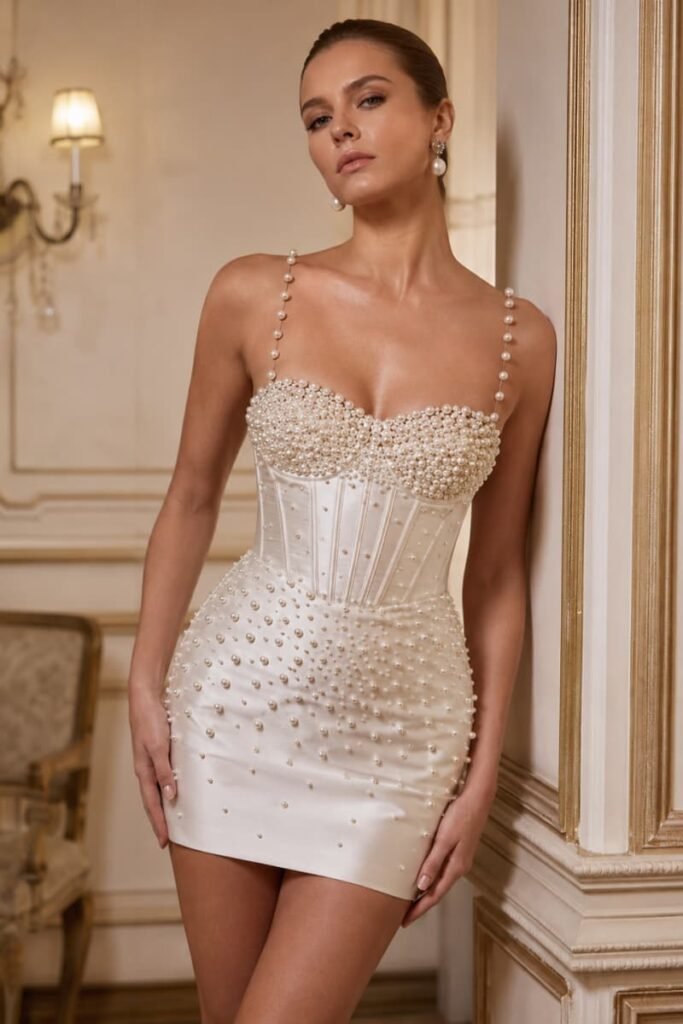
- Stretch mesh with all-over pearls
- Satin mini dresses with concentrated bust decoration
- Structured woven minis with pearl edging
- Strapless corset minis with graduated pearl placement
- Long-sleeve mesh minis with body-mapped coverage

Pearl Bodycon Dresses
- Stretch recovery before and after decoration
- Pearl spacing under body tension
- Lining stretch compatibility
- Side-seam and zip clearance
- Motif continuity across shaped panels
- Comfort during sitting and walking

Pearl Corset Dresses
- Cup edges
- Bust panels
- Boning channels
- Waist seams
- Necklines
- Detachable straps
- Draped overlays

Pearl Mesh Dresses
Mesh allows floating pearl effects but requires careful engineering.
Pearl weight can stretch open structures, reveal thread paths or create uneven transparency.
Development review covers:
- Mesh stretch direction
- Hole size and thread security
- Lining coverage
- Pearl weight per area
- Skin-contact zones
- Seam reinforcement
- Transparent edge finishing
- Size-specific placement

Pearl Satin Dresses
Satin gives pearls a polished occasionwear appearance but also exposes needle marks, puckering, pressure damage and surface abrasion. Pearl placement should avoid unnecessary perforation and excessive tension.

Pearl Party Dresses
Party collections often require a balance between strong photography impact and commercial wearability. Pearl work may be combined with sequins, crystals, metallic trims, feathers or mesh panels.

Pearl Occasion Dresses

Pearl Reception Dresses
Pearl Dress Programs Built Around Selling Occasions

Holiday Party

Birthday Dressing

Cocktail Collections

Homecoming

Graduation

Wedding Guest

Going Out

Bridal Reception
Pearl and Bead Options for Different Dress Effects
Pearl selection influences garment weight, reflection, attachment method, development time, unit cost and production consistency. Material approval should therefore happen together with fabric and silhouette review.
Micro Pearls
Standard Round Pearls
Statement Pearls
Half-round Pearls
Glass Pearls
Acrylic Pearls
Resin Pearls
Resin options allow varied shapes, colors and finishes. They can support fashion-led collections requiring nontraditional pearl effects or mixed-scale decoration.
Pearl Strands and Trims
Pearl Placement Designed for Visual Value and Production
A pearl layout should look intentional from the first sample through every bulk size. Placement decisions affect cost, weight, comfort, sewing access and inspection speed.

All-over Coverage
- Pearl count or density reference
- Start and stop lines
- Seam allowance clearance
- Zip clearance
- Underarm comfort zones
- Hem protection
- Size grading rules
- Repair and replacement standard

Scattered Placement
Scattered pearls can appear random while still requiring a controlled system.
Approved distribution references prevent empty areas, clusters and visual imbalance.
A good scattered layout normally defines:
- Minimum and maximum spacing
- High-density feature zones
- Low-density transition zones
- Areas without decoration
- Left-right balance
- Front-back relationship

Pearl Straps
Pearl straps can be decorative, load-bearing or detachable.
Each version needs a different construction approach.
Review points include:
- Strap function
- Shoulder pressure
- Connector security
- Adjustable hardware
- Back attachment
- Replacement option
- Weight distribution
- Packing method

Pearl Fringe
Fringe adds motion but increases tangling, impact and packing risk. Strand length, end security, spacing and movement clearance need to be checked during fitting and transport testing.
Pearl placement costing may vary substantially. A localized neckline application may involve fewer than 100 decorative units, while a dense all-over mini dress can require several hundred or several thousand pieces depending on size and coverage. Final costing is confirmed only after material, count, layout and attachment review.

Geometric Motifs

Neckline Decoration

Bust and Waist Placement

Gradient Density
A gradient may move from dense to open coverage around the bust, waist, hem or sleeve. Production instructions should establish density bands rather than rely only on a photograph.
Fabric Foundations That Support Pearl Weight and Silhouette
Fabric choice determines whether pearl decoration remains stable, comfortable and visually controlled. Selection must account for weight, stretch, recovery, transparency, needle response and bulk consistency.

Stretch Mesh
Stretch mesh supports fitted and semi-transparent styles, but pearl spacing changes when the fabric is worn. Layout review should include relaxed and stretched measurements.

Tulle

Satin

Crepe

Velvet

Jersey

Lace

Structured Woven Fabrics
Lining and Internal Support for Pearl Dresses
Full Stretch Lining
Partial Coverage Lining
Bodice Support
Seam and Knot Protection
Weight Distribution
Color and Transparency
Custom Options Defined Before Sample Development
A clear specification prevents design decisions from being reopened late in development. Duolan reviews the following areas before confirming the sample route.
| Development Area | Available Review Direction |
|---|---|
| Dress silhouette | Mini, midi, maxi, bodycon, corset, fitted, draped, structured or layered forms |
| Pearl type | Size, material, shape, color, luster, coating, strand or trim construction |
| Pearl placement | Localized, scattered, gradient, geometric, all-over, strap, fringe or border |
| Base fabric | Mesh, tulle, satin, crepe, jersey, lace, velvet or structured woven fabric |
| Lining | Full, partial, stretch, woven, skin-tone, contrast or support lining |
| Internal structure | Cups, boning, power mesh, interfacing, reinforcement and shaping panels |
| Fit direction | Target market, base size, intended ease, body shape and wearing occasion |
| Surface combination | Pearls with sequins, crystals, embroidery, feathers, applique or metallic trims |
| Branding | Main label, size label, care label, hangtag, barcode and price ticket |
| Packing | Folding, hanging, surface separator, shaped support, polybag and carton plan |
Measurement Standards for Consistent Pearl Dress Fit

Critical Body Measurements
Common fitted-dress measurements include:
- Bust
- Underbust
- Waist
- High hip
- Full hip
- Across chest
- Across back
- Shoulder width
- Armhole
- Strap length
- Body length
- Skirt length

Garment Measurements
Garment specifications may also include:
- Neckline width and drop
- Cup position
- Boning length
- Waist seam position
- Side seam length
- Zipper length
- Hem opening
- Slit height
- Sleeve opening
- Lining length
- Pearl motif reference points

Tolerance Planning
Tolerance depends on fabric, construction and measurement sensitivity. A fitted pearl dress may use tighter control around bust, waist, cup and strap positions than around a flowing hem.
Illustrative planning ranges may include:
- Critical fitted points: approximately ±0.5 to ±1.0 cm
- Standard body measurements: approximately ±1.0 cm
- Longer non-critical lengths: approximately ±1.0 to ±1.5 cm
Final tolerance is confirmed by style, fabric, size range and approved specification.
Points of Measure
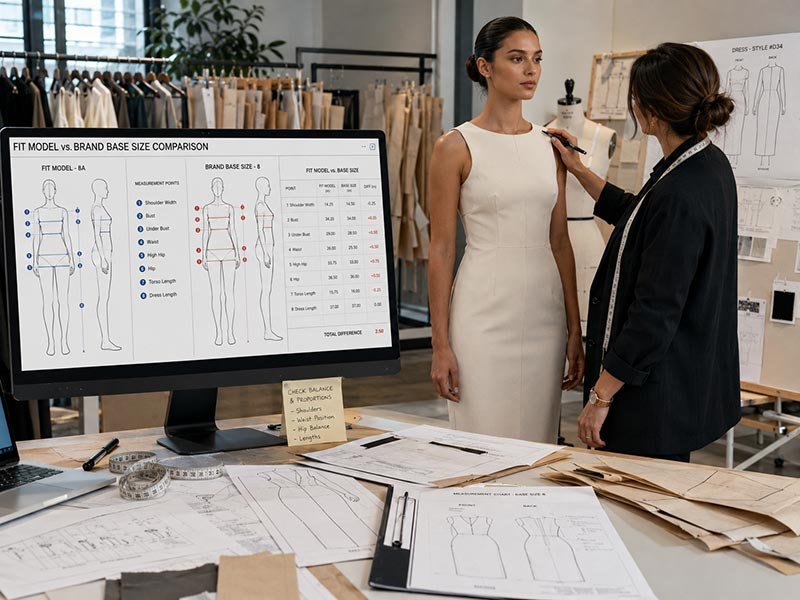
Each POM should define:
- Exact start and end points
- Flat or circumference measurement
- Garment condition during measurement
- Whether stretch is relaxed
- Whether decoration is included
- Allowed tolerance
- Relationship to pattern and grading

Size Grading
Pearl layouts should be reviewed with the graded pattern. Important questions include:
- Should pearl count change by size?
- Should motif spacing remain fixed?
- Should a central motif become wider?
- Will bust decoration remain correctly positioned?
- Will pearl straps require different lengths?

Target Market Fit
- US size expectations
- brand block
- intended body shape
- wearing occasion
should guide pattern work.
A generic size label does not guarantee the intended fit.
Production-aware Pearl Dress Sample Development
Sample development is organized to resolve design, fit, material and production questions in a controlled order.
Brief Review
Fabric and Pearl Sourcing
Decoration Trial
Pattern Development
First Sample
Fit and Embellishment Review
Revised Sample
Pattern, construction and pearl instructions are updated. A revised sample demonstrates the agreed direction before PP preparation.
Planning ranges are confirmed after development review:
- Standard localized-pearl sample: approximately 10–18 working days
- Dense or complex hand-beaded sample: approximately 18–25 working days
- Additional revision: commonly 7–15 working days, depending on changes and material availability
Final timing begins after technical information, fabric direction and decoration materials are sufficiently confirmed.

Fit Review Before Pearl Details Are Locked
Mannequin Review
Live Fitting
Measurement Check
Movement Test
- Walking
- Sitting
- Raising arms
- Turning
- Bending
- Opening and closing the zipper
- Adjusting straps
- Testing slit movement
Pearl Behavior Review
The team checks:
- Pulling around dense areas
- Changes in pearl spacing
- Noise or collision
- Pressure against the body
- Thread visibility
- Pearl movement at fringe
- Stress at straps and openings
Comment Translation
- Pattern
- Measurement specification
- Construction notes
- Pearl placement drawing
- Reinforcement
- Lining
- Revised sample record
Controlled Pearl Dress Manufacturing from Material to Packing
Material Receiving
Fabric Inspection
Pattern and Marker Preparation
Cutting
Pearl Positioning
Beading and Attachment
Garment Assembly
First-piece Confirmation
Pearl Attachment Methods Selected for Each Dress Structure
No single pearl method is suitable for every dress. Attachment is selected according to pearl form, fabric, stress, visual effect, order quantity and repair requirements.

Individual Hand Sewing
Each pearl is secured by thread at a controlled position.
Hand sewing offers flexibility for curves, irregular motifs and structured bodices.

Continuous Hand Beading
Several pearls may be connected through a continuous thread path. The method can improve speed for lines and borders but needs interruption points to prevent extended loss if the thread breaks.

Machine-assisted Positioning

Embroidered Pearl Application

Flat-back Application

Pre-beaded Panels

Pearl Trim Application

Reinforced Pearl Straps
Workmanship Details That Define Pearl Dress Quality
High-quality pearl dresses are recognized by the areas most photographs do not show: backing, seam clearance, edge control, reinforcement and internal finishing.
Clean Backside Treatment
Controlled Seam Allowance
Reinforced Stress Points
Balanced Left and Right Placement
Smooth Lining Coverage
Clean Zipper Areas
Stable Hem Finishing
Controlled Pressing
Pearl-specific Quality Checks Beyond Standard Garment Inspection
Pearl Material Confirmation
Color Consistency
Size Consistency
Surface Condition
Placement Accuracy
Density and Count
Attachment Security
Fabric Distortion
Backside Treatment
Measurement and Fit
Wearing Comfort
Packing Protection
Protective Packaging for Pearl-embellished Dresses

Surface Separators

Controlled Folding

Hanger Packing

Shaped Support

Individual Garment Bags

Carton Planning
Private Label and Retail-ready Pearl Dress Packaging
Main Labels
Size Labels
Care Labels
Hangtags
Spare Pearl Cards
Retail and E-commerce Packing
What Determines Sampling and Production Planning
Pearl dress timing and cost depend on decoration density, material availability, pattern complexity, handwork and approval speed. Final commitments are issued after project review.
| Planning Area | Main Variables | Typical Planning Direction |
|---|---|---|
| Decoration trial | Pearl material, layout complexity, backing and attachment test | 3–7 working days when materials are available |
| Standard sample | Localized pearls, available fabric, established silhouette | Approximately 10–18 working days |
| Complex sample | Dense handwork, corset structure, custom pearls or multiple techniques | Approximately 18–25 working days |
| Sample revision | Pattern change, pearl relocation, material replacement or new fitting | Approximately 7–15 working days |
| Bulk preparation | Material ordering, grading, PP approval and production planning | Confirmed after final approval |
| Bulk production | Quantity, style count, handwork density, factory allocation and packing | Commonly 30–55 days after approvals and material readiness |
| Repeat production | Material continuity, unchanged pattern and retained standards | Reviewed against current material and capacity status |
Compliance Support for Brand-level Production
Duolan’s manufacturing system has completed SMETA audit work, including SMETA 2-Pillar audit and related social audit records.
Project requirements can also be coordinated according to applicable brand, market and product standards, which may involve:
- BSCI-related social compliance requirements
- ISO 9001-related quality management requirements
- AATCC test methods
- ASTM requirements
- OEKO-TEX® material requirements
- EN standards
- China GB standards
- GOTS-related material programs
- Brand-specific quality manuals
- Restricted substance requirements
- Inspection protocols
- Material declarations
Compliance support is handled according to the actual product, destination market and requested documentation. Standards that require third-party testing or certification are confirmed by project rather than presented as automatic coverage.
Material Records
Quality Files
Social Compliance
Pearl Dress Development Cases from Design to Bulk

US Partywear Collection
Region: United States
Program: Pearl mini, bodycon and corset dresses
Style count: 14 styles
Colorways: 2–4 per style
Total order quantity: 28,800 garments
Size range: US 0–14
Delivery structure: Two production releases
The collection combined stretch mesh, satin and structured woven fabrics with scattered pearls, pearl straps and concentrated corset decoration.
Main challenges:
- Mesh distortion after high-density pearl application
- Underarm friction on fitted mini dresses
- Pearl spacing changes across graded sizes
- Pressure marks during folded transport
- Tight launch calendar across several materials
Development actions:
- Split the collection into three decoration-density groups
- Reduced pearl density around underarm and side-seam stress zones
- Added stretch-compatible lining to selected bodycon styles
- Created size-specific placement rules for bust and waist motifs
- Used first-piece comparison before each style entered full production
- Added surface separators and revised folding positions
Result:
- All 14 styles moved through revised sample and PP approval
- Bulk production was released in two controlled groups
- Pearl layout remained aligned across the approved size range
- Follow-up replenishment used retained pattern, BOM and placement records

Structured Pearl Occasionwear Program
Program: Pearl corset, midi and reception dresses
Style count: 22 styles
Total order quantity: 54,400 garments
Size range: UK 6–18
Main fabrics: Satin, crepe, tulle and structured mesh
Decoration: Pearls, crystals and limited sequin combinations
The brand required a coordinated occasionwear collection with stronger visual pieces and commercial core styles.
Main challenges:
- Pearl weight around cups and boning channels
- Motif alignment across princess seams
- Different reflection levels between pearl and crystal batches
- Lining coverage on semi-transparent panels
- Long garments requiring protected folding
- Completed decoration trials before full corset samples
- Moved selected pearls away from boning channels and high-tension seam joins
- Created approved combined-material boards for pearl and crystal matching
- Defined full and partial lining zones by style
- Used garment-specific packing diagrams
- Grouped production according to decoration complexity
- 22 styles were approved across three sample rounds
- Statement styles and commercial styles entered separate production routes
- Final bulk checks used pearl, crystal and placement reference boards
- Repeat-order records were retained by style and colorway

Holiday and Wedding Guest Capsule
Region: Australia
Program: Pearl holiday, cocktail and wedding guest dresses
Style count: 18 styles
Total order quantity: 36,600 garments
Size range: AU 6–16
Delivery structure: Three scheduled drops
The program included pearl-edged satin midi dresses, mesh minis, fitted party dresses and reception-inspired styles.
Main challenges:
- Multiple launch dates
- Color consistency across ivory, blush and black pearl options
- Pearl pressure on soft satin
- Commercial fit across fitted and draped silhouettes
- E-commerce packing requirements
Development actions:
- Locked pearl color standards separately for each fabric color
- Reduced projection in fold-sensitive areas
- Used different lining and support rules for fitted and draped products
- Completed first-piece checks before every scheduled drop
- Introduced surface protection and garment-specific folding instructions
Result:
- Three delivery groups were completed according to the collection plan
- Color and luster references remained separated by SKU
- Packaging checks reduced visible pressure marks
- Selected commercial styles moved into repeat planning
Confidential Development for Unreleased Collections
Duolan can coordinate:
- NDA review by project
- Controlled use of tech packs
- Restricted access to unreleased artwork
- Internal style numbers
- Anonymous case presentation
- No public use of brand names without approval
- Controlled sample photography
- Original sample registration
- Version control for patterns and specifications
- Return or handling instructions for supplied samples
Brand assets may include:
- Tech packs
- Original artwork
- Pearl layouts
- Pattern blocks
- Size charts
- Packaging files
- Labels
- Campaign launch dates
- Unreleased collection details
Frequently Asked Questions About Custom Pearl Dress Manufacturing

Start Your Pearl Dress Development Review
Send your collection direction, technical files or reference product for an initial development assessment. Duolan will review the garment as a complete production project, including silhouette, fabric, lining, pearl selection, attachment, fit, workmanship, bulk control and packing.
Please include:
- Tech pack, sketch, reference image or original sample
- Target dress category
- Pearl size, color or placement direction
- Preferred fabric and lining
- Target size range
- Estimated style count
- Estimated quantity
- Target launch date
- Destination market
- Packaging and quality requirements
Suitable programs commonly involve 10–30 coordinated styles and total order volumes of 20,000–80,000 garments per brand program. Final sampling, pricing and delivery planning are confirmed after design and material review.


