 Skip to content
Custom Rhinestone Dress Manufacturer
Dress-focused development and production for fashion brands building rhinestone partywear, occasionwear, bodycon, corset, mesh, and statement collections.
- Rhinestone layouts are reviewed across density, stretch zones, seam clearance, body placement, and size grading before full sampling.
- Craft-panel, fit-sample, and PP-sample checkpoints help lock stone application, visual balance, construction, and bulk standards.
- Multi-style programs commonly include 10–30 styles and 20,000–80,000 total pieces across planned colors and sizes.
- 16 owned womenswear factories, 20+ satellite factories, and 50+ quick-response lines support controlled development, production allocation, and repeat programs.
- Nearly 30 years of dress development experience supports fitted silhouettes, decorative workmanship, and production-ready execution.
Manufacturing Capacity Built Around Dress Programs
16 Owned Factories
20+ Satellite Factories
12,000+ Supporting Workers
300 Sewing Lines
50+ Flexible Lines
High Development Density
Built for Established Fashion Product Teams
Fashion Brands
Fashion brands need more than visual copies. Product direction must be translated into wearable fit, suitable materials, cost-aware decoration, repeatable workmanship, and delivery plans aligned with a launch window.
Partywear Brands
Product Development Teams
Sourcing Offices
What Strong Rhinestone Dress Production Requires
Accurate Design Translation
Stable Material Sourcing
Stone color, surface finish, backing, size, shape, adhesive system, and batch consistency must be reviewed alongside fabric color, stretch, texture, heat response, and recovery.
Production-ready Sampling
Repeatable Bulk Workmanship
Clear Quality Checkpoints
Order and Delivery Coordination
Where Rhinestone Dress Projects Commonly Fail
Stones Release During Stretch
Layouts Lose Symmetry
Fabric Becomes Distorted
Decoration Causes Discomfort
Samples Cannot Be Repeated
Packing Damages the Finish
Custom Rhinestone Dress Styles We Develop

Rhinestone Mini Dresses

Rhinestone Midi Dresses

Rhinestone Maxi Dresses

Rhinestone Bodycon Dresses

Rhinestone Corset Dresses

Rhinestone Mesh Dresses

Rhinestone Satin Dresses

Rhinestone Halter Dresses

Rhinestone Backless Dresses

Rhinestone Cut-out Dresses

Rhinestone Party Dresses

Rhinestone Occasion Dresses
Building a Commercial Rhinestone Dress Collection
Balance Image Styles and Volume Styles
Image-led products can carry denser layouts, unusual stones, hand placement, corsetry, or complex cut-outs. Volume styles should keep a strong visual signature with more controlled materials, fewer application steps, and clearer production standards.
A 10–30 style program can be divided into several groups:
- Hero styles for campaigns, editorials, and launch imagery
- Commercial mini and bodycon styles for core sales
- Occasion midi and maxi styles for wider use
- Controlled-price options using focused placement
- Repeatable silhouettes prepared for color extensions
- Follow-up styles built around proven fit blocks
Duolan reviews the relationship between style value and production complexity before sampling. Decoration with little visual benefit should not add unnecessary cost, labor, defect exposure, or delivery pressure.
Organize Development by Risk and Launch Priority
Not every style should move at the same speed. A fitted jersey mini with a focused neckline motif can advance faster than an all-over mesh corset dress with graded crystal artwork.
Development priority can follow:
- Campaign deadline
- Material lead time
- Stone availability
- Pattern complexity
- Fit sensitivity
- Craft-panel requirement
- Number of colorways
- Expected order volume
- Replenishment potential
Early priority decisions protect photo samples, buying reviews, PP approval, bulk production, and the final shipping window.
Full Rhinestone Dress Customization Options

Stone Colors

Stone Sizes

Stone Shapes

Pattern Artwork

Placement Density

Dress Silhouette

Lining and Support

Labels and Packaging
Rhinestone and Crystal Options by Design Purpose
Hot-fix Rhinestones
Sew-on Stones
Flat-back Crystals
Shaped Stones
Crystal Mesh
Prepared Motifs
Mixed Embellishment
Tonal Decoration
Choosing the Right Rhinestone Application Method
Hot-fix Application
Hand Placement
Sew-on Application
Motif or Mesh Application
Fabric Selection for Rhinestone Dress Production
Stone performance depends heavily on the base fabric. Stretch, recovery, weight, surface texture, heat response, drape, transparency, and construction must be assessed together.
| Fabric Direction | Suitable Dress Use | Stretch Level | Stone Support | Main Development Risk | Recommended Control |
|---|---|---|---|---|---|
| Stretch Mesh | Bodycon, sheer panels, fitted mini dresses | High | Medium | Layout distortion and local sagging | Test under target extension; reinforce dense areas |
| Power Mesh | Internal support, fitted panels, corset zones | High | High | Excess compression or visible structure | Confirm recovery, opacity, and seam integration |
| Stretch Jersey | Bodycon and ruched party dresses | Medium–High | Medium | Stone release after repeated extension | Test bond after stretch and recovery cycles |
| Velvet | Holiday, party, fitted midi dresses | Low–Medium | High | Pile crushing and heat marks | Trial temperature, pressure, and surface protection |
| Satin | Occasion, cocktail, draped dresses | Low | Medium | Pressure marks, pulling, and loss of drape | Use local trials and controlled placement density |
| Tulle | Layered skirts, sleeves, decorative overlays | Low | Low–Medium | Tearing and excessive decorative weight | Reinforce placement zones and reduce concentrated load |
| Woven Crepe | Occasion and structured silhouettes | Low | High | Surface impression and stiffness | Confirm hand feel after decoration |
| Scuba or Bonded Knit | Structured bodycon and mini styles | Medium | High | Added stiffness and seam bulk | Check mobility and edge thickness |
| Lace | Occasion and statement overlays | Low–Medium | Variable | Uneven surface and pattern conflict | Align decoration with lace motif and backing |
| Sequin Base Fabric | High-impact party and statement styles | Variable | Variable | Excess weight, abrasion, and mixed-surface instability | Approve application order and full material combination |
Fabric approval should use the intended color and finish. Dye, coating, pile, stretch, and surface treatment can change application performance even when the fabric name remains the same.
Lining, Reinforcement, and Wear Comfort

Skin-contact Protection

Local Reinforcement

Weight Distribution

Coverage and Transparency
Fit and Structure for Rhinestone Dress Silhouettes
Bodycon Fit
Corset Support
Strapless Security
Halter Balance
Backless Stability
High-slit Movement
Measurement and Size Grading Discipline
Control High-impact Measurement Points
Key measurements commonly include:
- Bust circumference and bust point
- Underbust and waist
- High hip and full hip
- Front and back body length
- Neckline depth and width
- Strap length and position
- Cup width, height, and spacing
- Back opening and closure length
- Slit height and overlap
- Dress length from defined reference points
- Hem circumference
- Armhole and underarm depth
Tolerance priorities should reflect product risk. A small difference at a corset cup, strapless neckline, or fitted hip can have more impact than the same numerical difference at a loose hem.
Grade Fit and Decoration Together
Grading should preserve silhouette, body coverage, and visual placement across the requested size range.
Stone motifs near the bust, waist, cut-outs, or slit may need positional adjustment as garment dimensions change.
For common XS–XL or extended size programs, Duolan reviews:
- Pattern growth by body zone
- Motif width and height
- Distance from seams and edges
- Stone density perception
- Stretch requirement
- Lining coverage
- Cup and support changes
- Garment length progression
Feasibility Review Before Full Sample Development
What Brand Teams Can Submit
A project can begin with one or more of the following:
- Tech pack
- Front and back sketches
- Reference images
- Original sample
- Rhinestone artwork
- Size chart
- Fabric direction
- Color standards
- Intended order quantity
- Target price level
- Launch date
- Label and packing requirements
More complete information supports faster and more accurate evaluation, but unclear points can be identified during the initial review.
What Duolan Reviews
The development team evaluates:
- Whether the selected fabric can carry the proposed stone load
- Whether heat, pressure, stitching, or adhesive may damage the surface
- Whether dense areas will change stretch or fit
- Whether artwork crosses seams, cups, zippers, or high-movement zones
- Whether lining or reinforcement is needed
- Whether the structure supports the garment weight
- Whether grading can preserve visual balance
- Whether the workmanship can be repeated in bulk
- Whether the schedule allows craft trials and approvals
- Whether cost matches the intended commercial position
The result may be: ready to develop, develop with adjustments, or revise the concept before sampling.
Rhinestone Test Panels Before Full Sampling

Fabric Compatibility

Stone Security

Layout Density

Stretch Recovery
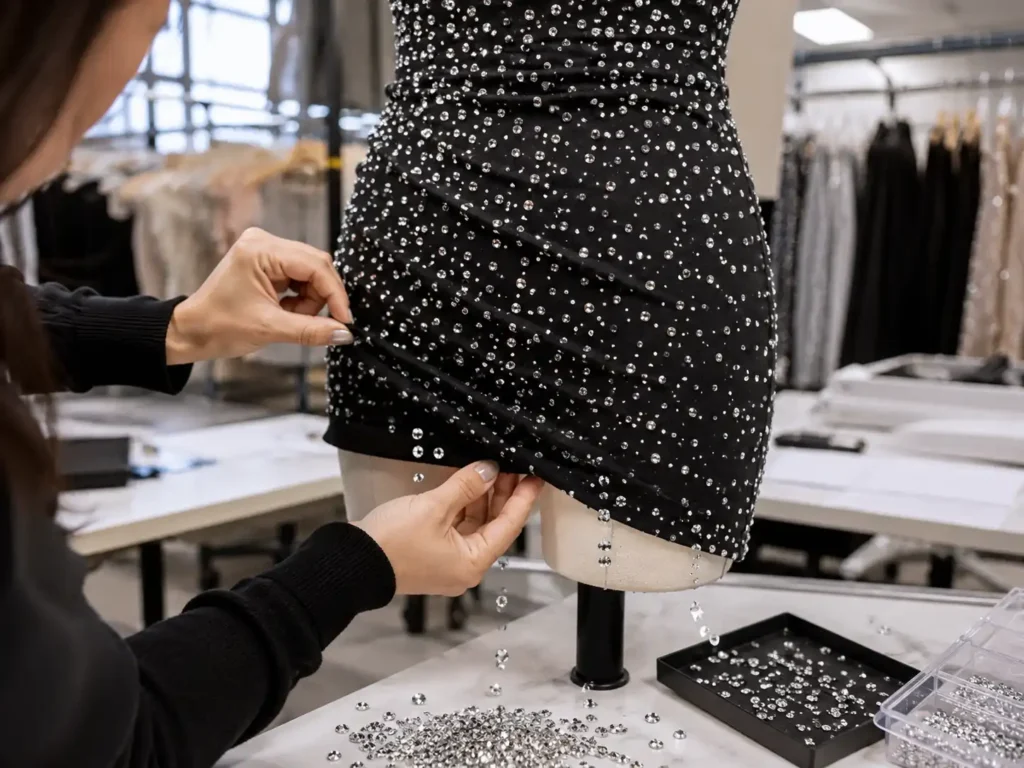
Surface Appearance

Reverse Comfort

Color Under Lighting

Bulk Reference
Production-ready Rhinestone Dress Sample Development
Brief and Material Review
Pattern Development
Craft-panel Approval
First Sample
Revision Sample
PP and Bulk Readiness
Controlled Rhinestone Application Workmanship
Surface Preparation and Position Marking
Fabric must be clean, stable, correctly oriented, and supported during application. Pattern pieces or completed garment sections are positioned according to the approved production method.
Placement references may include centerlines, edge distances, seam exclusions, motif outlines, numbered regions, and stone-size codes. Clear references reduce freehand variation.
Application and Fixing Control
Application method follows the approved material combination. Relevant controls can include: Stone orientation, Spacing and row consistency, Heat and pressure exposure, Adhesive contact, Hand-placement accuracy, Stitch security for sew-on stones, Application order for mixed decoration, Protection of sensitive garment zones.
Production conditions should match the approved panel and PP sample as closely as possible.
Cooling, Curing, and Handling
Appearance and Reverse Inspection
Sewing Control Around Rhinestone Areas
Neckline Control
Armhole Control
Side-seam Alignment
Zipper Clearance
Slit Construction
Hem Finishing
From Approved Sample to Bulk Production Standard
Bulk consistency depends on converting the approved sample into a clear, controlled production basis. Sample approval alone is not enough when materials, workmanship, and placement remain undocumented.
Lock Production-critical Materials
Before line release, Duolan confirms:
- Main fabric quality and approved color
- Lining and support materials
- Stone type, size, shape, color, and batch
- Adhesive or attachment system
- Zipper, cups, boning, straps, elastic, and closures
- Main label, size label, care label, and hangtag
- Packing materials and carton requirements
Substitutions should not enter production without technical and commercial review.
Control Multi-style Order Release
A 10–30 style program is divided by readiness rather than released as one block.
Styles can move according to material arrival, PP status, complexity, production path, and launch priority.
A staggered release reduces the chance of one delayed material holding every style while also protecting higher-risk products from premature production.
Lock the Workmanship Basis
The production basis includes:
- Approved pattern and measurements
- Approved sample or PP sample
- Rhinestone layout map
- Placement and spacing rules
- Seam clearance
- Application order
- Reinforcement points
- Sewing details
- Pressing restrictions
- Measurement priorities
- Inspection points
- Packing method
Higher-risk styles can receive first-piece or pilot confirmation before full production volume is released.

Rhinestone Dress Quality Control Checkpoints
Incoming Stone Inspection
Fabric Inspection
Craft-panel Approval
First-piece Confirmation
Inline Inspection
Final Appearance Inspection
Packing Inspection
Shipment Preparation
Rhinestone Dress Inspection and Testing Matrix
Testing should reflect real garment use, the selected material combination, destination requirements, care instructions, and brand standards. Test methods are confirmed according to the project rather than applied as one fixed package.
| Inspection or Test | Main Purpose | Development Stage | Bulk Stage |
|---|---|---|---|
| Stone Security Check | Identify weak fixing or loose attachments | Craft panel and sample | Inline and final sampling |
| Stretch and Recovery Review | Check performance across fitted zones | Panel and fit sample | First piece and inline |
| Layout Symmetry Check | Control left-right and center balance | Sample approval | Visual inspection during production |
| Measurement Inspection | Protect fit and silhouette | Fit and PP sample | Inline and final |
| Surface Abrasion Review | Evaluate rubbing during wear and packing | Sample and packing trial | Packing inspection |
| Movement Simulation | Identify release, stiffness, or irritation | Fit sample | Random production check |
| Color and Reflection Review | Confirm fabric-stone appearance | Material and sample approval | Final visual inspection |
| Seam and Edge Inspection | Protect neckline, armhole, zipper, slit, and hem | Sample | Inline and final |
| Packing Compression Trial | Reduce pressure marks and stone damage | Packing sample | Pre-shipment packing check |
| Care-related Testing | Support approved care instructions | Pre-production when required | According to agreed standard |
| Needle and Sharp-point Control | Reduce product safety risks | Process planning | Production and final control |
| Carton Quantity Verification | Protect shipment accuracy | Packing setup | Final packing audit |
Protective Packaging for Rhinestone Dresses

Surface Separation

Shape Protection

Individual Garment Protection

Carton and Transport Planning
Manufacturing Structure for Multi-style Rhinestone Programs
Core-style Control
Special-process Matching
Style-by-style Allocation
Parallel Development
Controlled Production Release
Repeat and Replenishment Support
Why Fashion Brands Choose Duolan
Dress Development Background
Decorative Craft Experience
Fabric and Fit Judgment
Production-ready Samples
Scalable Manufacturing Structure
Compliance Coordination
Rhinestone Dress Development Case Studies

United States Partywear Collection
Program Scope
- 18 rhinestone and embellished dress styles
- 42,600 total pieces
- Mini, bodycon, corset, mesh, and cut-out silhouettes
- 4–6 colors by selected style
- XS–XL size range
- Focused hot-fix layouts and mixed-size hand placement
Main Challenge
Several references used dense decoration across high-stretch bust, waist, and hip areas. Initial artwork created excessive stiffness and raised the risk of gaps between stones after extension. Three corset styles also placed decoration too close to cup seams and boning channels.
Duolan Approach
- Produced stone-density panels on approved stretch mesh and jersey
- Reduced density across high-extension zones
- Repositioned motifs away from cup seams and zipper clearances
- Added local power-mesh support to selected bodices
- Created graded layout instructions for XS–XL
- Used first-piece confirmation before full line release
Project Result
All 18 styles moved through coordinated development, with image-led styles and commercial styles released on different production schedules. Approved fit, layout, stone batches, and packing references were retained for repeat planning.

United Kingdom Occasionwear Program
Program Scope
- 12 occasion and cocktail dress styles
- 24,800 total pieces
- Corset midi, satin mini, mesh-sleeve, and halter silhouettes
- Clear crystal, tonal crystal, and pearl-rhinestone combinations
- UK 6–16 size range
- Individual hanging and folded packing by style
Main Challenge
The collection combined satin, velvet, mesh, and crepe. One application method could not deliver acceptable results across every material. Satin showed pressure sensitivity, velvet required pile protection, and mesh needed reinforcement under denser motifs.
Duolan Approach
- Built separate craft panels for each material family
- Changed satin styles from broad hot-fix areas to focused hand placement
- Used controlled temperature trials for velvet
- Added backing support to high-density mesh zones
- Moved rough decorative edges away from underarm and neckline contact
- Created separate folding instructions for satin and velvet products
Project Result
Material-specific workmanship standards allowed the collection to keep a unified visual direction without forcing unsuitable application methods across all styles. Bulk release followed PP approval by material group.

European Multi-drop Fashion Program
Program Scope
- 26 styles across two seasonal drops
- 68,400 total pieces
- Rhinestone mini, maxi, halter, backless, bodycon, and statement dresses
- 7 approved color directions
- Core, campaign, and replenishment style groups
- Mixed hot-fix, motifs, sew-on stones, and sequin combinations
Main Challenge
The program included multiple launch dates, shared fabrics, repeated stone colors, and several high-risk campaign styles. Delays in complex pieces could not be allowed to stop commercial core styles.
Duolan Approach
- Divided styles into low-, medium-, and high-risk development groups
- Prioritized campaign samples and long-lead stones
- Shared approved fabric and stone standards across related styles
- Released commercial styles after PP confirmation without waiting for every campaign style
- Used separate production paths for hand-heavy and scalable applications
- Prepared repeat-order records for selected core silhouettes
Project Result
The two-drop structure allowed material purchasing, sampling, production, and inspection to move in controlled waves. Six core silhouettes were retained as future color-extension and replenishment bases.
Frequently Asked Questions About Rhinestone Dress Manufacturing

Start Your Rhinestone Dress Development Project
- Company name and website
- Style images or collection brief
- Tech pack or original sample
- Front and back sketches
- Size chart and fit standard
- Fabric direction or swatches
- Rhinestone artwork, color, size, and shape
- Quantity by style, color, and size
- Required sample type
- Target launch or warehouse date
- Label, barcode, and packaging specifications
- Destination market and testing requirements


