Skip to content

Drawstring Ruching vs Sewn Ruching: Which Is Better for Fashion Dresses?
Your trusted Women’s Apparel Development & Manufacturing Partner from China
- Jerry
Two dresses can look almost identical in a campaign image and behave very differently once someone wears them. That is especially true with ruching. One style may use a drawstring that lets the wearer shorten the skirt, increase the gathering, or change the height of a slit. Another may use fixed sewn ruching that has already been shaped and secured during construction. The difference seems small on a sketch, yet it can affect fit, fabric consumption, lining behavior, sewing operations, grading, quality control, and whether the bulk order still looks like the approved sample.
Drawstring ruching is generally the better option when adjustability is part of the intended wearing experience, while sewn ruching is usually better when the garment needs a fixed, repeatable silhouette. Neither method is automatically superior. The right choice depends on fabric behavior, intended fit, gathering density, garment length, lining, visual direction, consumer use, and how reliably the approved result can be reproduced from sampling through repeat production.
The real decision often appears only after the sketch reaches the pattern room. A designer may write “ruched side seam,” but the development team still needs to decide how much extra length creates the texture, where the gathering begins and ends, whether the hem moves when the cord is pulled, whether the lining should move with it, and how the effect should grade across sizes. Those details are where a fashionable idea becomes either a practical garment or a recurring production problem.
What Is Drawstring Ruching?
Drawstring ruching creates gathers by pulling a cord through a stitched channel or casing. The wearer can usually change the amount of gathering, which may also change garment length, slit height, or silhouette. It works best when adjustability is part of the product concept, but the channel, cord, reinforcement, lining, and usable adjustment range must be developed as one system rather than as separate details.
How Does Drawstring Ruching Work?
A drawstring-ruching system usually combines four elements: additional fabric length, a channel or casing, a cord or tie, and a controlled exit or anchoring point. The panel begins longer than its final gathered appearance. When the cord is pulled, the fabric compresses along the channel and forms folds. The technical relationship between source length and finished gathered length matters because it determines how dense the ruching will look and how much vertical length will disappear into the folds.
For example, a 450 mm fabric section gathered to 300 mm represents a 1.5:1 gathering relationship. A 600 mm section reduced to the same 300 mm becomes 2:1 and will usually create much deeper or denser folds. Those ratios are useful development references rather than universal formulas because fabric thickness, stretch, drape, surface friction, and construction all change the visual result. A lightweight stretch mesh can absorb a relatively high ratio gracefully, while a heavier compact knit may become bulky much sooner.
Finished Ruched Length | Source Length | Gathering Ratio | Typical Visual Result |
300 mm | 390 mm | 1.3:1 | Light, shallow gathering |
300 mm | 450 mm | 1.5:1 | Moderate, clearly visible ruching |
300 mm | 600 mm | 2.0:1 | Dense, pronounced folds |
The channel itself also needs deliberate development. If the internal width is too tight, the cord can drag and become difficult to adjust. If it is much wider than necessary, the fabric may collapse unevenly around the cord and produce inconsistent folds. The exit point needs reinforcement because repeated pulling can stretch a buttonhole, eyelet, seam opening, or narrow fabric loop. A good sample therefore tests both appearance and repeated operation rather than judging the detail only in a static photo.
What Can the Wearer Adjust?
The strongest reason to use drawstring ruching is functional control. Depending on placement, the wearer may be able to shorten a skirt, increase the height of a slit, change the amount of gathering around the hip, tighten a waist detail, or alter the overall visual balance of an asymmetric garment. This can give one dress several wearing positions, which is attractive for party, going-out, vacation, bodycon, and occasion styles where styling flexibility has real consumer value.
That flexibility also creates more than one acceptable fit condition. A sample should not be approved only in the most photogenic position. During fitting, it is more useful to review at least three states: relaxed, a representative mid-adjustment position, and the maximum approved adjustment. Each position should be checked for hem level, slit exposure, side-seam direction, lining visibility, cord security, and comfort. If the garment looks balanced only after a stylist arranges the folds by hand, the construction is not yet robust enough for normal wear.
Cord length is another small detail that quickly becomes visible in production. If one garment leaves 150 mm of cord below the channel and another leaves 230 mm, the difference is obvious in ecommerce photography and at retail. The development specification should therefore define total cord length and, where relevant, the intended visible tail at a reference adjustment position. The same applies to cord ends, knots, toggles, metal tips, or any trim that changes weight and how the cord hangs.
Which Dress Areas Use Drawstring Ruching?
Side seams are the most familiar placement because one construction can combine hip shaping, adjustable length, and a visible fashion feature. However, drawstring ruching can also be used at the center front, waist, bust, skirt panels, sleeves, slits, and hems. The correct placement depends on whether the drawstring is intended to change fit, change coverage, change garment length, or simply create a decorative focal point.
Placement also determines the risk profile. A side drawstring on a close-fitting dress pulls directly against the hip and may rotate the side seam if the pattern does not accommodate the changing tension. A drawstring beside a slit needs enough reinforcement to withstand repeated pulling while keeping the opening stable during walking and sitting. Bust ruching can create attractive fullness, but it may also influence neckline tension, coverage, and support. Hem ruching can produce a strong asymmetric look, yet the shortest approved position still has to remain wearable.
For product development, the useful question is not whether a drawstring looks current. It is whether the wearer benefits from controlling that part of the garment. If the intended silhouette is supposed to remain the same every time the dress is worn, an adjustable cord may add extra pattern pieces, sewing operations, trim cost, and quality-control points without adding meaningful function. If adjustability is central to the design, however, drawstring ruching can make the garment more versatile and commercially distinctive.
What Is Sewn Ruching?
Sewn ruching is fixed gathering created and secured during garment construction rather than adjusted by the wearer. The gathers may be formed with conventional gathering stitches, elastic, controlled seam construction, or stitched-down folds. Because the finished ruched length is predetermined, this approach usually gives the development team more control over the position, density, and repeatability of the final garment silhouette.

How Is Sewn Ruching Made?
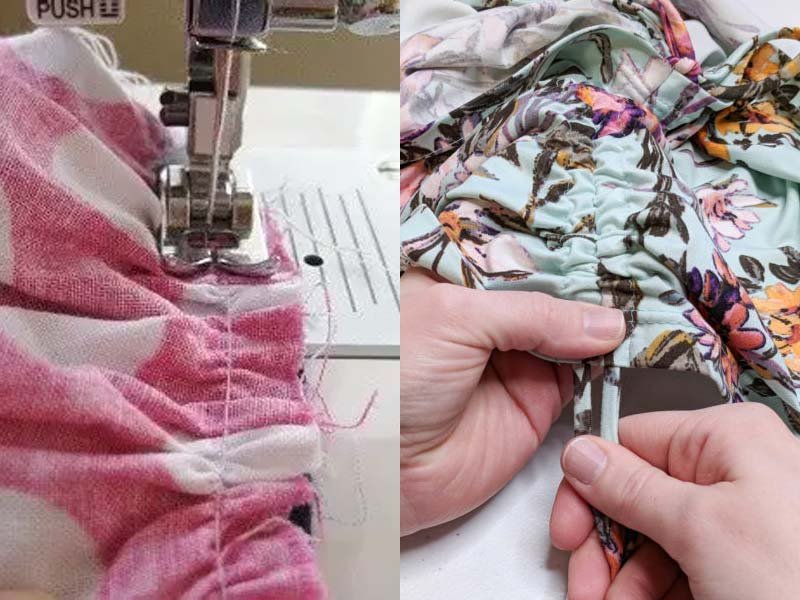
“Sewn ruching” describes a family of constructions rather than one standardized stitch. A longer section can be gathered with temporary stitches and then joined to a shorter seam. Elastic can be stretched during sewing so that it contracts afterward and forms regular folds. Some designs use several stitched channels or seam sections to place fullness exactly where the pattern requires it. What matters in production is not the name of the method but the mechanism that controls the final gathered dimension.
Consider a side panel that measures 480 mm before gathering but must finish at 320 mm. The operator is not simply asked to “make ruching.” The task is to distribute 160 mm of excess length across a defined 320 mm area. If one operator concentrates most of the fullness near the waist while another spreads it toward the hip, both garments may measure 320 mm and still look visibly different. That is why finished length, start and stop points, pattern notches, and an approved visual reference need to work together.
Measurement alone cannot define the exact character of the folds, and a photograph alone cannot communicate a repeatable production standard. The strongest specification combines both. A technical package might identify the source length, finished gathered length, distance from the waist seam, distance from the hem, expected distribution, elastic specification if used, and any areas that must remain relatively flat. This gives the sewing line something objective to follow while preserving the intended visual effect.
Is Sewn Ruching Adjustable?
Fixed sewn ruching can move with the body, particularly when the garment uses stretch fabric or elastic construction, but it is not user-adjustable in the same way as a drawstring. The wearer normally cannot decide to change a 400 mm ruched side section into a 300 mm section. Its basic gathering amount has already been engineered into the garment, which means the approved silhouette is more closely controlled by the product team.
That lack of adjustability can be a strength. A brand may want the waist texture, hip contour, and hem position to appear consistent in campaign photography, showroom samples, customer orders, and repeat production. Fixed ruching removes one major source of variation because the consumer is not independently deciding how much to tighten each side. It is especially useful when the gathering is intended to shape the body visually rather than function as an interactive styling feature.
Fixed does not mean forgiving, however. If the gathered length is wrong, the garment may sit too high on the hip, pull a seam forward, compress the waist, distort the hem, or create diagonal drag lines. The customer cannot correct the problem by loosening a cord. That makes sample fitting and fabric testing especially important for bodycon, party, and occasion dresses, where small changes in tension are highly visible against the body.
Which Dresses Use Sewn Ruching?
Fixed ruching is common in bodycon dresses, mesh dresses, party dresses, fitted tops, skirts, occasion styles, and asymmetric silhouettes. Around the waist or abdomen, the folds can break up a flat surface and create visual shaping. Around the hip, they can soften or emphasize contour lines. Across the bust, carefully placed gathers can direct fullness toward the neckline or side seam while maintaining a cleaner exterior than a visible drawstring system.
Mesh-over-lining constructions often use fixed ruching because the outer layer can be gathered for texture while the lining remains relatively smooth underneath. Stretch jersey can create soft body-contouring folds, while satin can produce a more sculptural, light-catching effect. The same amount of added fabric does not behave the same way in these materials, so the ruching method should be selected after considering weight, thickness, stretch, recovery, and surface sensitivity.
A useful design rule is to decide whether the folds are part of the garment’s permanent silhouette or part of the wearer’s styling control. If the intended look depends on the waist always gathering at a certain level or the hip texture remaining in a specific zone, fixed construction usually provides a clearer route to consistency. The method can still feel soft, flexible, and comfortable; it simply places the final visual decision in development rather than in the customer’s hands.
Which Ruching Gives Better Fit and Appearance?
Drawstring ruching offers greater styling flexibility, while sewn ruching offers more predictable placement and a more controlled fixed silhouette. Neither method automatically creates a better fit. The final result depends on fabric stretch, recovery, gathering amount, lining, pattern balance, garment length, and where the tension is introduced. Adjustable styles must work across several cord positions, while fixed styles must remain consistent across sizes and production runs.

Which Method Gives More Adjustability?
Drawstring ruching clearly provides the wider adjustment range because the wearer controls how much fabric is compressed along the channel. A single dress can offer a longer, more relaxed position for greater coverage and a shorter, more dramatic position for going-out styling. The same feature can also alter slit height or change how much texture sits over the waist and hip, giving the customer a more interactive product experience.
The trade-off is that the garment now has several valid silhouettes rather than one. A fit model may approve the dress with the cord pulled halfway, while a customer may wear it almost fully relaxed or fully tightened. Each position redistributes fabric and changes local tension. A heavily adjusted side seam can rise enough to move the hip line, increase slit exposure, or pull the hem away from its intended angle. Development therefore needs to test the operating range rather than only a single styled position.
Fixed sewn ruching does the opposite. It gives up consumer adjustability in exchange for stronger visual control. If a brand has designed a specific waist shape, body contour, or asymmetry that needs to appear consistently across product photography and customer orders, the fixed method often makes more sense. A practical rule is to use adjustability because it improves the product experience, not merely because a cord looks fashionable. Unnecessary adjustability adds construction variables without always adding meaningful value.
Development Factor | Drawstring Ruching | Sewn Ruching |
Wearer adjustability | High | Low or none |
Finished gathered length | Variable within a set range | Predetermined |
Hem or slit position | Can change during wear | Usually more stable |
Main added elements | Cord, channel, exit reinforcement | Gathering stitches, elastic, fixed seams |
Visual consistency | Depends on user adjustment | Generally easier to standardize |
Main fit risk | Imbalance across adjustment positions | Incorrect fixed length or distribution |
Best use | Functional styling flexibility | Controlled, repeatable silhouette |
How Does Ruching Affect Dress Length?
Ruching changes visible vertical length because fabric is being folded into a smaller area. If a 500 mm side section is gathered to 350 mm, 150 mm of source length has been compressed into folds. The entire dress does not necessarily become 150 mm shorter because surrounding seams and pattern shape redistribute some of that movement, but the local side of the garment can still rise significantly, especially on a fitted mini dress.
With drawstring ruching, that rise changes during wear. A dress may sit at an acceptable length when the cord is half tightened and become noticeably shorter at maximum adjustment. The lining may start to show, the slit may rise beyond the intended coverage point, or the opposite side of the hem may be pulled out of balance. For this reason, relaxed and maximum-adjusted lengths should both be checked, and the maximum adjustment should be limited if it produces a position the brand would not want customers to wear.
Fixed ruching is easier to benchmark because there is one principal approved gathered length. Even then, patternmakers need to anticipate the vertical loss caused by gathering and confirm hem balance on the body. For mini, bodycon, and asymmetric dresses, it is often more useful to measure garment length at several positions instead of relying only on center front and center back. Side length, slit height, and lining length can be just as important as the nominal overall length.
How Does Ruching Affect Waist and Hip Fit?
Ruching stores additional fabric in a concentrated area, so it changes tension as well as surface texture. Around the waist and hip, the added folds can visually soften contour lines, create depth, and make a close-fitting silhouette more forgiving. However, if the gathering pulls unevenly, it can move the side seam, create diagonal drag lines, or make one section grip more tightly than another. These effects are particularly visible on smooth, fitted dresses.
Stretch recovery is critical in this area. A fabric can feel comfortable because it stretches easily and still perform poorly if it does not return toward its original dimensions after sitting or walking. In that situation, the ruching may gradually flatten, migrate, or lose definition even though the stitching remains intact. Fit testing should therefore include movement and recovery rather than relying only on a mannequin or a front-view photograph taken immediately after dressing.
A practical fit review covers front, side, and back appearance; waist balance; hip tension; side-seam position; hem level; slit opening; gather distribution; lining visibility; and behavior after sitting and walking. Adjustable designs should repeat these checks at more than one cord position. The goal is not to force every wearer into an identical shape, but to make sure the garment remains visually intentional and physically comfortable throughout the range the product is designed to offer.
How Do Fabric and Construction Affect Ruching?
Fabric controls the size, softness, depth, and stability of ruching. Lightweight mesh may form fine folds, while heavier satin or compact knit may create larger, firmer gathers. Stretch, recovery, drape, thickness, surface friction, and lining all influence the result. The gathering method should therefore be developed with the intended production fabric, because a substitute fabric with different behavior can give a misleading sample result.

Which Fabrics Work With Drawstring Ruching?
Stretch jersey is a common choice because it can gather into soft folds while moving with the body. Stretch mesh can create a lighter, finer ruched surface, particularly when it is layered over a separate lining. Soft crepe, viscose, lightweight woven fabrics, and some satins can also work well, but as stretch decreases or surface sensitivity increases, the channel construction and reinforcement become more important.
The same gathering relationship will not look the same across different materials. If two side panels both begin at 450 mm and finish at 300 mm, a thin mesh may distribute the extra 150 mm into many small folds, while a compact jersey may produce fewer, rounder ridges. A crisp woven can resist compression and push the fullness outward rather than allowing it to lie close to the body. That is why fabric selection should be made before the ruching structure is considered final.
Friction also matters in drawstring systems because the cord has to move through the channel. A cord that slides smoothly through one jersey casing may drag inside another fabric with a rougher surface or tighter weave. This affects how easily the wearer can adjust the garment and whether the gathers distribute evenly. Sample testing should therefore include repeated pulling and releasing, not just a single successful adjustment, and should confirm that the exit opening remains stable after use.
Which Fabrics Hold Sewn Ruching Better?
There is no single best fabric for fixed ruching because the desired visual effect matters as much as sewing ease. Soft jersey can hold fluid folds, stretch mesh can create fine body-contouring texture, crepe can form controlled soft gathers, and satin can create strong highlights and sculptural depth. Each fabric also changes the practical limit on how much fullness can be compressed into one seam before bulk becomes uncomfortable or visually heavy.
The relationship between gathering ratio and fabric thickness is particularly important. A 2:1 ratio places twice as much source length into the finished distance. On a very light mesh, that may still look delicate. On a thicker knit, the same ratio can create a dense ridge at the seam, increase pressure around the waist or hip, and make pressing more difficult. The right amount of fullness should be determined by testing the actual fabric rather than by copying a ratio from another style.
A simple development test can save several sample rounds. Cut strips from the intended fabric and reduce each to different finished lengths, such as 1.3:1, 1.5:1, and 2:1. Compare how the folds sit, how much thickness accumulates at the seam, how the surface looks under light, and whether the fabric returns after handling. This small experiment gives a much clearer basis for pattern decisions than discussing “more” or “less” ruching in abstract terms.
How Does Lining Affect Ruched Dresses?
Lining can improve comfort, opacity, and stability, but it can also restrict ruching if the outer shell and lining are attached without enough independence. This is especially important in mesh and satin dresses where the shell may need to gather vertically while the lining remains comparatively smooth. If both layers are cut to the same length and fixed together too rigidly, the lining can stop the shell from reaching its intended ruched position.
The opposite problem appears in adjustable styles. If the outer skirt can rise by 80 or 100 mm when the drawstring is fully tightened, a lining that does not move with it may become visible below the outer hem. Shortening the lining excessively is not a perfect solution because the relaxed version may then provide less coverage than intended. Development therefore needs to consider outer-shell length in the relaxed position, outer-shell length at the maximum approved adjustment, and finished lining length as separate but related measurements.
Layer attachment should also be evaluated on the body. A flat table will not reveal whether the lining rides upward when the wearer walks, whether it twists as the shell gathers, or whether it pulls against the outer layer during sitting. In some constructions, the lining needs controlled freedom rather than being caught into every gathered seam. The best solution depends on the silhouette, fabric stretch, opacity requirement, slit design, and how much the outer layer is expected to move during wear.
Which Ruching Is Easier to Control in Bulk Production?
Fixed sewn ruching is often easier to standardize because the finished gathered length and position can be locked before production. Drawstring ruching adds variables such as channel width, cord length, exit reinforcement, adjustment range, and user-operated tension. Both methods can be produced consistently when the approved look is translated into measurable dimensions, clear pattern marks, construction references, first-piece checks, and targeted inline inspection.

How Do You Control Gathering Density?
Bulk consistency improves when ruching is described with measurable information instead of visual phrases such as “make it more gathered” or “same as sample.” Those comments may work in a sample room where one experienced sewer can interpret a reference garment, but they are not strong enough for several operators, production lines, or repeat orders. The technical package should define the source length, finished gathered length, start and end points, and any construction details that control the final result.
For adjustable designs, the specification should also define cord length, channel position, exit location, maximum adjustment, and the reference position used for measurement. For fixed designs, the document should identify the target gathered length and how the fullness should be distributed. If the style has paired left and right ruching, balance becomes a visible quality point even when both sides technically fall within a basic measurement tolerance.
Control Item | Example Development Value | What Production or QC Checks |
Source length | 450 mm | Cut or pattern dimension |
Finished ruched length | 300 mm | Length after gathering |
Gathering relationship | 1.5:1 | Source vs. finished calculation |
Start point | 80 mm below waist seam | Position against pattern notch |
End point | 70 mm above hem | Position against approved reference |
Left/right gathered length | 300 mm / 300 mm | Pair balance |
Pilot quantity | 5 pieces | Repeatability before wider release |
Adjustment positions | 0%, 50%, 100% | Drawstring function and garment balance |
The values in this example are not universal tolerances. They show how a style can be converted into controllable information. Actual measurements should come from the brand’s tech pack, approved sample, fabric performance, size specification, and quality standard. The useful principle is that every important visual difference should be linked to a variable the production team can measure, mark, or compare.
What Can Go Wrong With Drawstring Ruching?
Drawstring ruching can fail through both appearance and function. A channel may twist internally, the cord may drag, one side may gather more easily than the other, or the exit point may stretch after repeated pulling. Unequal cord lengths can make paired ruching look careless, while excessive adjustment can raise a hem or slit beyond the intended position. A side channel that is sewn slightly off line may also pull the side seam forward on a fitted dress.
Another common problem is relying on manual styling to make the sample look better than the construction naturally performs. A sample maker can distribute each fold beautifully before a fitting or photo, but a customer will not have that expertise every time she tightens the cord. If the gathers immediately bunch at the bottom of the channel or collapse into one dense area, the problem should be solved through channel design, fabric choice, source length, and construction rather than hidden through styling.
The strongest bulk controls check function as well as appearance. The cord should move smoothly, the opening should remain secure, left and right systems should operate similarly, and the garment should stay balanced at the approved adjustment positions. If a decorative trim or metal cord end adds weight, it should be tested because that weight can change how the cord hangs and may pull the ruching down during wear or washing.
What Can Go Wrong With Sewn Ruching?
Fixed ruching removes the movable cord but introduces a different set of production risks. Operators may distribute the gathers differently even when the overall finished length is correct. One garment can have dense folds near the waist and relatively flat fabric at the hip, while another spreads the same amount of fullness evenly. Elastic tension can vary, seam allowances can become bulky, and one side of a dress may appear more heavily ruched than the other.
These differences become especially visible on smooth or reflective fabrics such as satin, where light emphasizes every fold, and on bodycon silhouettes, where the fabric sits close to the body. A small imbalance may be hard to see on the sewing table but obvious once the dress is worn. Fixed ruching therefore needs both dimensional control and a visual standard, especially around the waist, hip, bust, and asymmetric hems where the eye naturally compares one side with another.
Quality control should look for patterns rather than waiting for final inspection. If one garment has an isolated uneven fold, it may be a single workmanship issue. If the first 15 or 20 pieces show the same side seam moving forward or the same area losing fullness, the cause may be pattern balance, stretch direction, elastic tension, seam construction, or an unclear work instruction. Correcting the process early is far less disruptive than reworking a large finished quantity.
How Are Ruching Defects Checked?
The first few production pieces are especially valuable for ruching because they reveal whether the approved sample can be repeated under normal line conditions. A small pilot run of several pieces can confirm gathered length, fold distribution, side-seam balance, channel position, cord operation, lining coverage, and hem behavior before full production is released. The exact pilot quantity depends on the factory and style, but the principle is to verify repeatability before the problem is multiplied.
Inline inspection should then focus on the points most likely to drift. Useful checks include gathered length, start and end positions, left-right balance, cord length, channel alignment, exit reinforcement, hem and slit position, lining coverage, seam rotation, and appearance against the approved reference. For fixed ruching, the inspector should also compare where the fullness sits, not only whether the total length measures correctly. For adjustable ruching, the function should be tested at the agreed reference positions.
The goal is not to make every fold mathematically identical. Ruching is inherently organic, and small visual differences are normal. The real quality target is a controlled range in which garments still look like the same style, fit in the same way, and operate as intended. When a brand develops ruched dresses with a manufacturing partner, the most useful evidence is not a claim that the factory “can do ruching,” but a clear method for transferring the approved sample into measurable production and inspection standards.
How Do You Choose the Right Ruching?
Choose drawstring ruching when the wearer should actively control garment length, slit height, or gather density. Choose sewn ruching when the designer wants a fixed, repeatable silhouette. The decision should be based on intended use, fabric behavior, fit, lining, construction complexity, appearance, and production repeatability rather than on trend alone. The better method is the one that supports both the design idea and the finished garment’s everyday behavior.

Which Method Is Better for Adjustable Dresses?
If the product promise includes adjustable length, adjustable slit exposure, or visible styling flexibility, drawstring ruching is usually the logical starting point. The cord is doing real work, and the customer can change the silhouette according to occasion, body proportion, or personal preference. This is particularly useful in mini dresses, vacation styles, going-out dresses, and side-ruched bodycon silhouettes where one adjustable detail can create several distinct looks.
The adjustment range still needs limits. A drawstring should not allow the wearer to pull the hem to a position where the lining is exposed, the side seam twists badly, or the slit exceeds the intended coverage. Product development should therefore define the shortest acceptable position as deliberately as the relaxed position. The cord length, channel, and stop point can then be designed around that range instead of leaving maximum shortening to chance.
If the cord is mainly decorative and the product is intended to remain in one silhouette, the added function may not justify the complexity. The design team should consider whether a fixed ruched construction can achieve the same appearance with fewer operational variables. A visible tie can still be added as a decorative element if it supports the brand aesthetic, but it should not be presented as meaningful adjustability unless the garment performs well throughout the range.
Which Method Is Better for a Fixed Silhouette?
When the designer has already decided exactly where the waist texture, hip fullness, or asymmetric shaping should sit, sewn ruching is usually the stronger choice. The gathering amount can be built into the pattern and construction, allowing the approved shape to appear more consistently across product photography, showroom samples, customer orders, and repeat runs. This is particularly useful for bodycon, occasion, and party dresses where silhouette control is part of the product’s visual identity.
The key is to treat fixed ruching as part of fit rather than as surface decoration. The source length and finished length affect how tightly the garment sits on the body, and the placement of the folds can change the perceived waistline or hip shape. The development team should therefore review the ruched area together with bust, waist, and hip balance rather than approving the fold texture independently from the rest of the pattern.
Grading also deserves attention. Adding the same amount of extra fabric to every size does not automatically preserve the same visual result. A larger size may need a different relationship between body measurement, source length, and gathering distribution to keep the silhouette consistent. The correct grading logic depends on the fabric, stretch, design intent, and the location of the ruching, so it should be checked on size-set samples rather than assumed from one base size.
What Should Be Confirmed Before Sampling?
The best time to solve ruching problems is before the first sample is cut. The development brief should identify where the ruching starts and ends, how dense the folds should appear, what the source and finished lengths are expected to be, which fabric and lining will be used, and what the main fitting priority is. A clear brief reduces the risk that several later revisions are spent solving decisions that were never made at the beginning.
For drawstring designs, confirm the channel construction, cord material, cord diameter, total length, visible tail, exit reinforcement, relaxed position, maximum adjustment, minimum acceptable garment length, and any slit or coverage limit. For fixed designs, confirm source length, finished gathered length, gathering method, elastic specification if used, distribution of fullness, paired-side balance, attachment method, and grading approach. These details turn a visual idea into a testable sample rather than a vague request for “more ruching.”
The first sample should also have a clear purpose. Is the team primarily checking silhouette, fit, drape, construction, or visual styling? A fitted mesh dress may need the first sample to prove layer behavior and contour balance, while a satin party dress may need to confirm whether the fabric forms the intended folds without seam distortion. Defining the decision the sample needs to support helps everyone judge the result against the same priorities.
How Do You Move From Sample to Bulk?
A good sample is not yet a production system. Before the style is released, the approved appearance needs to be translated into information that another operator can reproduce without relying on the original sample maker’s memory. That handover should include the approved fabric and lining, source and finished ruching lengths, pattern marks, channel or elastic specification, cord details, fit measurements, hem position, grading logic, workmanship reference, and the key points quality control should monitor.
Adjustable designs should be checked in at least three repeatable conditions: relaxed, a representative middle position, and the maximum approved adjustment. The team should record what happens to garment length, slit height, side-seam direction, lining coverage, and overall fit. Fixed designs should be checked for consistent gathered length and distribution across size-set samples, because a base-size result does not guarantee the same visual balance after grading.
This is also the point where experienced product-development support can prevent a fashionable detail from becoming a bulk problem. Brands working on bodycon, mesh, satin, party, or occasion dresses can discuss the construction with Duolan during sampling so that fabric behavior, fit, ruching method, and production control are reviewed together rather than separately. The important commercial question is not simply whether a factory can sew ruching, but whether the approved look can be measured, repeated, inspected, reordered, and kept visually consistent at scale.
Drawstring ruching and sewn ruching can both create strong commercial fashion dresses, but they solve different problems. Drawstring construction gives the wearer control and can turn one garment into several styling positions. Sewn ruching gives the development team more control over silhouette, placement, and repeatability. The best decision comes from matching the construction to the intended wearing experience, then testing the fabric, pattern, lining, fit, and production method as one connected system. When those decisions are made early, ruching becomes a controlled design feature rather than a detail that has to be corrected repeatedly after sampling.
Frequently Asked Questions
Is Drawstring Ruching More Expensive Than Sewn Ruching?
Drawstring ruching can cost more when it requires a separate channel, cord, reinforced openings, toggles, metal tips, or extra sewing operations, but the difference is style-specific rather than fixed. Sewn ruching may use fewer trims, yet dense gathering, elastic application, or multiple stitched channels can also increase labor. The more useful comparison is total construction complexity, material usage, sewing time, and quality-control needs for the exact garment rather than assuming one method is always cheaper.
Which Ruching Is Better for Bodycon Dresses?
Both methods can work well in bodycon dresses, but they serve different purposes. Fixed sewn ruching is often a better fit when the brand wants a stable waist or hip silhouette that remains consistent every time the dress is worn. Drawstring ruching makes more sense when adjustable length or hip gathering is part of the product experience. In either case, fabric stretch, recovery, side-seam balance, and movement testing are more important than the technique name alone.
Can Drawstring Ruching Change the Length of a Dress?
Yes. When drawstring ruching runs vertically along a side seam, skirt panel, or slit, pulling the cord compresses fabric and can raise the hem in that area. The amount of change depends on the available source length and the permitted adjustment range. Development should check the relaxed and shortest approved positions because excessive shortening can expose the lining, increase slit height, or distort the opposite side of the hem even when the drawstring itself works correctly.
What Is the Best Fabric for a Ruched Dress?
There is no single best fabric because the desired fold size, silhouette, and construction determine what works. Stretch jersey and mesh are useful for soft, body-contouring ruching, while crepe and some satins can create more structured or sculptural folds. The most important properties to review are weight, thickness, stretch, recovery, drape, surface friction, and opacity. Testing several gathering ratios in the actual production fabric is more reliable than choosing fabric by fiber name alone.
How Do You Keep Ruching Even in Production?
Even ruching comes from combining measurements with a visual reference. Production teams should define the source length, finished gathered length, start and end points, pattern notches, channel or elastic specification, and any left-right balance requirements. A first-piece or small pilot check can confirm whether those instructions produce the approved look before wider release. Inline QC should then watch for repeated drift in gathered length, fold distribution, seam direction, cord function, and hem balance rather than waiting for final inspection.
Does Ruching Make a Dress More Forgiving in Fit?
Ruching can make small fit variations less visually obvious because folds break up a flat fabric surface and add controlled fullness around the waist, abdomen, or hip. It does not replace good pattern development, however. If the garment is too tight, the side seam rotates, the fabric has poor recovery, or the lining restricts movement, ruching will not solve the underlying fit problem. The technique works best when it supports an already balanced pattern and suitable fabric.
Share:
Our Services
Categories
Table of Contents
Here, developing fashion collections is more than manufacturing garments — it’s a collaborative process focused on transforming ideas into well-executed, market-ready products. From fabric sourcing and sample development to scalable production and delivery coordination, every stage is built to support quality, consistency, and efficient collection launches across global markets.