Skip to content
Custom Sheer Dress Manufacturer
Production-ready sheer dresses developed around transparency, coverage, fit, lining structure, workmanship and repeatable bulk manufacturing.
- 8 fabric directions covering stretch mesh, power mesh, tulle, net, lace, chiffon, organza and decorated mesh.
- 9 coverage zones reviewed across the bust, underbust, waist, hip, thigh, side body, back, sleeve and hem.
- 12 core measurement points converted into pattern, grading and inspection standards.
- 3 lighting conditions considered during transparency review: indoor light, natural light and photography flash.
- Supported by 16 owned womenswear factories, 20+ satellite factories and 50+ flexible production lines for multi-style programs and repeat production.
Sheer Dress Development At A Glance
Eight Fabric Directions
Nine Coverage Zones
Coverage is planned by body zone rather than applying one lining solution to the entire garment. Bust, underbust, waist, hip, upper thigh, side body, back, sleeve and hem may require different layer counts, colors or placement methods. Zonal planning allows a dress to remain visually sheer while protecting movement, fit security and photography performance.
Twelve Measurement Points
Three Light Reviews
Five Sample Stages
Depending on project requirements, the sample path can include a first prototype, fit sample, revised sample, photo or salesman sample and pre-production sample. Each stage serves a separate decision. A photo sample may prioritize visual presentation, while a fit or PP sample must establish measurable standards for production.
Structured Bulk Control
Approved samples are transferred into production through fabric, lining, color, pattern, measurement, workmanship, label and packaging confirmation. Higher-risk styles may receive a first-piece review or pilot run before full production release. Bulk manufacturing begins after critical standards are clear enough for production teams and quality teams to follow consistently.
Built For Established Fashion Teams
Fashion Product Teams
Buying And Sourcing Teams
Established Fashion Brands
Going-out, partywear, occasionwear, resort and ecommerce fashion brands often develop 10–30 styles within one program. Such programs may combine fitted mesh minis, printed maxis, sheer panels, lined bodycon dresses and decorated hero pieces. Duolan supports collection-level coordination by separating styles according to material, fit sensitivity, workmanship complexity and launch priority, then planning suitable sampling and production paths.
Control Risks Before They Reach Bulk
Sheer fabrics expose fit, seam, lining and workmanship problems more clearly than opaque materials. Each major risk requires a defined development or production control point before quantities increase.
| Development Risk | Product Consequence | Duolan Control Method |
|---|---|---|
| Transparency differs from the intended visual | The dress appears either too revealing or too heavily covered | Review layer count, fabric stretch, lining color and light response before sample approval |
| Mesh stretch conflicts with the pattern | Side seams twist, hems rise or bust and hip areas distort | Measure stretch direction and recovery, then adjust negative ease and pattern balance |
| Lining changes the shell color | Skin-tone, white, red or pastel mesh appears darker, duller or uneven | Test shell-and-lining combinations together under relevant lighting |
| Coverage shifts between sizes | Larger or smaller sizes expose different body areas | Review graded coverage lines and fit samples at selected size points |
| Seams become visible or wavy | Transparent construction looks rough and loses visual value | Test needle, thread, seam type, stitch density and tension before production |
| Bodysuit and dress pull differently | Torso discomfort, drag lines or unstable movement appears | Match shell and base stretch, review body rise and control attachment points |
| Sample standards are not transferred | Bulk garments differ in fit, transparency or detailing | Lock approved sample, BOM, pattern, measurements, workmanship notes and QC points |
| Decoration overloads the base | Mesh stretches, tears, sags or feels uncomfortable | Validate decoration weight, density, backing and placement through trial panels |
| Fabric batches behave differently | Reorders vary in color depth, recovery or transparency | Confirm batch standards and recheck color, stretch and surface behavior |
| Production starts before risk review | Small sample issues become large-volume defects | Use bulk readiness review and first-piece or pilot confirmation for sensitive styles |
Custom Sheer Dress Product Directions
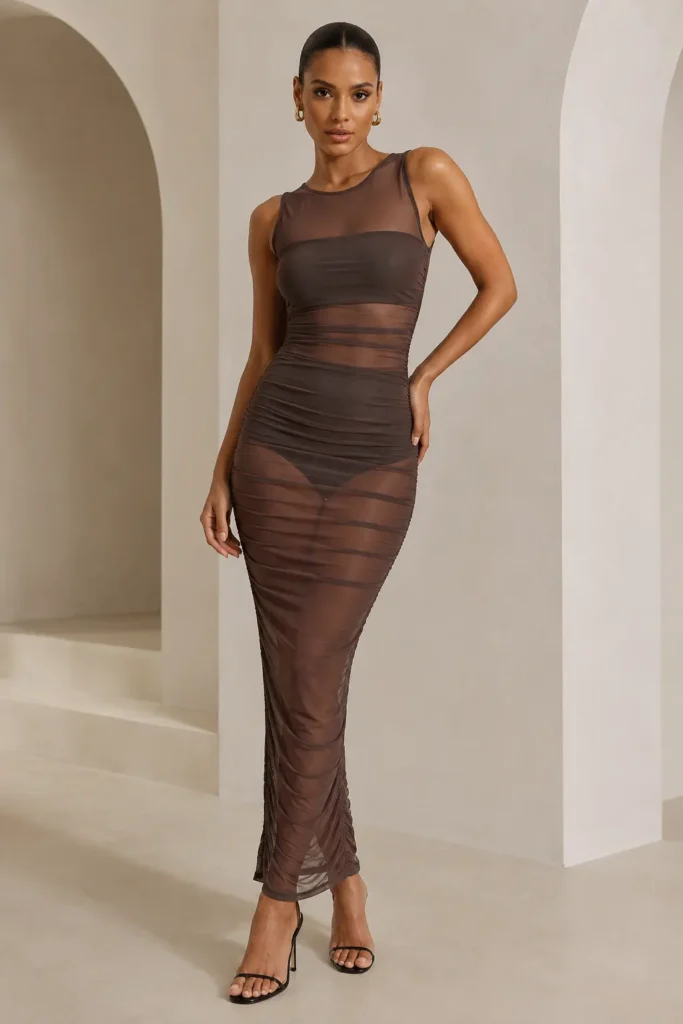
Sheer Bodycon Dresses

Sheer Mini Dresses

Sheer Midi Dresses

Sheer Maxi Dresses
Maxi styles require control of fabric weight, vertical stretch, skirt movement, lining length and hem stability. Fine mesh may lengthen under its own weight, while tulle or organza may require more volume management. Duolan reviews panel direction, skirt sweep, slit height, train length, lining movement and packing method. Printed mesh maxis, resort overlays, occasion styles and evening silhouettes can be developed from brand references.

Sheer Overlay Dresses

Mesh Ruched Dresses

Sheer Panel Dresses

Bodysuit Sheer Dresses
Designed Around Real Selling Occasions

Going Out Collections

Party And Birthday

Holiday Events

Resort And Vacation

Cocktail And Occasion

Wedding Guest Edits
Sheer Fabrics Selected By Product Behavior
Fabric names alone do not define performance. Weight, stretch, recovery, openness, drape, surface feel and sewing response determine whether a material can deliver the intended silhouette and remain stable in bulk production.
| Fabric Direction | Main Behavior | Suitable Applications | Main Development Risk | Control Focus |
|---|---|---|---|---|
| Stretch Mesh | Soft, close-fitting and available in different stretch ratios | Bodycon dresses, ruching, sleeves and overlays | Bagging, low recovery, uneven transparency | Stretch direction, recovery, weight and negative ease |
| Power Mesh | Stronger recovery and greater shaping support | Inner support, fitted panels, bodysuit bases | Excess compression or visible edge lines | Support level, comfort and edge placement |
| Soft Tulle | Light, airy and suitable for layered effects | Overlay skirts, sleeves, gathered panels | Snagging, stiffness variation and seam visibility | Handfeel, layer count and edge finish |
| Fine Net | Open visual texture with light structure | Panels, sleeves, necklines and decorative areas | Hole growth and needle damage | Needle choice, reinforcement and seam allowance |
| Lace | Patterned transparency and strong visual identity | Occasion dresses, sleeves, overlays and panels | Motif mismatch, uneven coverage and edge waste | Motif placement, symmetry and lining interaction |
| Chiffon | Flowing, lightweight and semi-transparent | Draped dresses, resort styles and layered skirts | Slippage, fraying, puckering and shade change | Grain control, narrow seams and lining tone |
| Organza | Crisp transparency and sculptural volume | Statement sleeves, overlays and occasion skirts | Sharp seams, crease marks and excessive stiffness | Structure balance, seam finish and pressing |
| Decorated Mesh | Printed, flocked, glittered, embroidered or embellished surface | Party, holiday and premium occasion dresses | Reduced stretch, surface damage and added weight | Decoration density, backing and production testing |
Fabric Testing Before Pattern And Sample Approval
Stretch And Recovery Review
Key checks include:
- Lengthwise and crosswise stretch direction.
- Recovery after extension.
- Weight change under vertical hanging.
- Edge curling or rolling.
- Distortion around seams.
- Surface whitening when stretched.
- Transparency change under body tension.
Transparency And Color Review
Color depth changes when sheer fabric is stretched, layered or placed over different skin-tone and colored linings.
Pale mesh, white mesh, red mesh and fine black mesh deserve careful review because a small lining difference may noticeably alter the finished garment.
Duolan can compare:
- Single layer against double layer.
- Shell over nude, tonal or contrast lining.
- Relaxed fabric against stretched fabric.
- Indoor light against daylight.
- Standard photography against flash.
- Flat swatch against garment-shaped application.
Color approval should consider shell and lining together. Approving each component separately may still produce an unexpected combined result.
Sewing Response Review
Transparent materials reveal construction, making trial sewing valuable before the full sample.
Tests may compare seam types, stitch density, thread tension, needle size and edge finishing. The objective is to reduce puckering, skipped stitches, needle holes and visible bulk.
Trial areas may include:
- Mesh-to-mesh seams.
- Mesh-to-lining joins.
- Mesh-to-woven joins.
- Elastic attachment.
- Invisible zipper insertion.
- Narrow hems and rolled hems.
- Decoration attachment.
- Reinforcement around openings.

Transparency Controlled By Body Zone
Bust Waist And Hip Coverage
- Tonal stretch lining.
- Skin-tone lining.
- Double mesh layers.
- Cup or bra coverage.
- Printed or embroidered coverage.
- Ruched panel density.
- Bodysuit or brief base.
- Placement appliqué.
- Opaque style lines.
- Layered wrap construction.
Movement And Seating Review
A dress can appear secure while standing yet change significantly during walking, sitting or arm movement. Sheer minis, high slits, backless styles and bodysuit dresses require movement review before approval.
Duolan considers:
- Lining rise while walking.
- Hem and slit movement.
- Side bust exposure.
- Armhole opening during movement.
- Back neckline stability.
- Bodysuit pull through the torso.
- Mesh whitening under stretch.
- Ruching distribution after sitting.
- Lining twist around the hip.
- Coverage consistency across selected sizes.
Movement comments should be converted into pattern, lining or attachment adjustments instead of relying on styling instructions alone.
Lighting And Photography Review
Campaign photography may reveal transparency not visible under sample-room lighting. Flash can expose lining boundaries, seam allowances, internal cups or reinforcement. Daylight can also make pale fabrics more transparent than expected.
For photography-sensitive products, Duolan recommends reviewing:
- Front, side and back under standard light.
- Natural light near a window or outdoor source.
- Flash photography at realistic distance.
- Close-up views of lining edges.
- Stretched areas around bust, waist and hip.
- Decorated areas where base mesh becomes visible.
- Pale shades and skin-tone combinations.
Lining And Bodysuit Systems That Stay Stable
Full Stretch Lining
Partial Body Lining
Mini Slip Bases
Integrated Bodysuits
Brief And Cup Bases
Contrast Lining Effects
Fit Engineering For Sheer And Stretch Dresses
Controlled Fit Across Bust Waist And Hip
- Bust width and projection.
- Underbust position.
- Waist balance.
- High and full hip.
- Front and back length.
- Side seam direction.
- Armhole and sleeve tension.
- Neckline stability.
- Hem rise after movement.
- Lining and shell interaction.
Pattern Correction Instead Of Surface Alteration
- Reshaping side seams.
- Adjusting bust or waist darts.
- Rebalancing front and back length.
- Changing negative ease.
- Repositioning sheer panels.
- Correcting sleeve cap and armhole.
- Adjusting bodysuit rise.
- Changing slit or lining height.
- Revising gather ratios.
- Updating graded nest rules.
Size Range And Grading Discipline
Size development should protect design proportion rather than enlarge every measurement mechanically. Coverage zones, neckline depth, panel width, slit height and bodysuit rise may need controlled grading rules. A lining edge acceptable in a core size may become too high or too low after standard proportional grading.
For brand-specific size ranges, Duolan can work from supplied measurement charts and fit standards. A structured size-set review may use three selected sizes—for example, a smaller, core and larger size—to examine grading behavior before full production. Final size selection depends on the brand’s range, silhouette and risk level.

Tech Packs Measurements And Size Development
Files That Support Accurate Development
- Front, back and side design views.
- Construction callouts.
- Main fabric and lining direction.
- Color reference or Pantone information.
- Measurement chart.
- Size range and grading rules.
- Label and packaging files.
- Artwork for print, embroidery or decoration.
- Original sample or reference garment.
- Target quantity and launch timing.
- Intended market and wearing occasion.
- Fit comments from an existing version.
Twelve Core Measurement References
- Bust
- Underbust
- Waist
- High hip
- Full hip
- Front body length
- Back body length
- Armhole
- Sleeve opening
- Strap length
- Bodysuit rise
- Slit or lining height
Measurement Method And Tolerance
A specification should explain how each point is measured. Half-girth and full-girth measurements should not be mixed. Dress length requires a clear starting point. Strap length should state whether hardware is included. Slit height should define the start and end points. Tolerance depends on garment area and fit sensitivity. A small deviation at bust coverage, bodysuit rise or strap length may create a larger wearing problem than the same deviation at a wide skirt hem. Critical measurements receive tighter review and more frequent inspection than non-critical decorative dimensions. Planning Reference
- Development review after complete files: 1–3 working days
- Material and construction direction: 3–7 working days, depending on sourcing
- Standard first sample after material confirmation: 7–12 working days
- Complex lined, bodysuit or decorated sample: 10–18 working days
- Structured revision round: 5–8 working days
- PP or production-reference sample: 5–10 working days
Final timing is confirmed after fabric availability, structure, decoration and approval requirements are reviewed.

Design Structures Developed For Wearable Results

Ruched Mesh Construction

Cut-Out Panel Placement

Draped Sheer Layers

Halter And Backless Shapes

Slits And Layered Hems

Off-Shoulder Sleeves
Workmanship Details Visible Through Sheer Fabrics
Narrow Overlock Seams
Clean Bound Edges
Baby And Rolled Hems
Invisible Zipper Setting
Stretch Seam Control
Mesh To Woven Joining
Lining Attachment
Stress Point Reinforcement
Decoration Processes Matched To Delicate Bases

Printed Mesh

Embroidered Tulle

Sequin Mesh

Rhinestone Application

Beading And Pearls

Appliqué And Flocking
A Controlled Eight Stage Sample Path
Project Brief Review
Feasibility Review
Fabric Direction
Pattern Development
First Sample
Fit And Light Review
Structured Revision
PP And Bulk Readiness
Before production release, Duolan reviews approved sample status, fabric, lining, trims, measurements, workmanship, labels and packaging. Sensitive styles may receive a first-piece confirmation or pilot stage. The approved direction becomes a measurable production standard.
Sample Comments Converted Into Measurable Corrections
Visual Fit And Construction Comments
- Visual direction: silhouette, proportion, drape, color depth and transparency.
- Fit: bust, waist, hip, length, neckline, armhole, sleeve and movement.
- Material: stretch, recovery, handfeel, lining tone and surface appearance.
- Construction: seam type, edge finish, attachment, zipper and reinforcement.
- Production readiness: repeatability, workmanship sensitivity, decoration control and inspection method.
Before And After Revision Records
- Original comment.
- Affected pattern or component.
- Planned technical action.
- Updated measurement.
- Updated construction note.
- Material or trim change.
- Result in the revised sample.
- Remaining decision required from the brand team.
Approval Status Must Remain Clear
A sample can be visually approved while still awaiting fit correction, or fit approved while material color remains pending.
Duolan separates approval status where needed:
- Visual direction confirmed.
- Fit confirmed.
- Material confirmed.
- Workmanship confirmed.
- Photography sample confirmed.
- PP basis confirmed.
- Pending final refinement.
Clear status prevents an early prototype from being used accidentally as the bulk standard.
Approved Samples Transferred Into Bulk Standards
Standards Locked Before Production
- Approved sample or PP sample.
- Final pattern and graded nest.
- Measurement specification.
- Main fabric and approved batch direction.
- Lining color, stretch and length.
- Trims and components.
- Artwork and decoration placement.
- Workmanship notes.
- Label and care information.
- Packing method and carton instruction.
- Critical QC points.
- Shipment and warehouse requirements.
Order Breakdown And Production Path
Bulk orders are broken down by style, color, size, quantity, material and construction complexity. Styles can be grouped as standard, fit-sensitive, decoration-sensitive or high-risk. Production paths are selected according to available material, workmanship requirements and delivery sequence.
A multi-style program may use:
- Dedicated lines for fitted mesh core styles.
- Separate handling for embroidered or decorated pieces.
- Pilot confirmation for bodysuit or complex lined styles.
- Shared material planning for related products.
- Split production or shipment according to launch priority.
- Repeat production records for established styles.
First-Piece And Pilot Confirmation
Repeat Order Preservation
Repeat production depends on preserved standards. Duolan can retain pattern information, BOM direction, workmanship points, approved measurements, color references and QC notes. Before a repeat order, material batch, stretch, color and component availability are rechecked rather than assuming every input remains unchanged.
Branding Packaging And Delivery Without Snagging Damage

Main And Size Labels

Care Labels

Hangtags And Barcodes

Protective Folding

Individual Packing

Coordinated Delivery
Manufacturing Capacity Planned Around Product Complexity
Sixteen Owned Factories
Twenty Plus Satellite Factories
Twelve Thousand Plus Workers
Fifty Plus Flexible Lines
More than 50 flexible lines support quick-response, launch, repeat and replenishment requirements. Flexible capacity does not replace approval discipline.
Fabric, pattern, workmanship and quality standards must remain confirmed before production acceleration.
Specialized Process Partners
Duolan works with established resources for printing, dyeing, embroidery, washing, trims and special processes.
Several mature partners are available across key special-process directions, allowing projects to be matched according to technique, material and timing requirements.
Project Timing Framework
Planning ranges are confirmed after technical review:
- Complete project review: 1–3 working days
- Standard first sample: 7–12 working days after material confirmation
- Complex sheer sample: 10–18 working days
- Structured revision: 5–8 working days
- Standard bulk manufacturing: 25–45 working days after approvals
Quality Control Built Around Sheer Dress Risks
Fabric Surface Control
Shade And Transparency
Cutting Direction
Seam Appearance
Lining Alignment
Measurement Control
Decoration Security
Movement And Appearance
Final Packing Check
Compliance And Documentation Prepared Before Shipment
Factory Audit Readiness
Fabric And Material Testing
Label And Care Information
Brand Specific Standards
Inspection Documentation
Shipment Documents
Sheer Dress Programs Managed At Brand Scale

North American Going-Out Program
Program Profile
- Region: United States
- Product direction: fitted mesh mini and midi dresses
- Style count: 18 styles
- Total quantity: 42,600 pieces
- Colorways: 5 principal colors
- Size range: XS–XL
- Main structures: ruching, sheer sleeves, lined bodies and bodysuit bases
Challenge
Three stretch-mesh qualities produced different recovery and transparency after fitting. Pale and red colorways also changed visibly over the original lining selection. Several styles shared a visual direction but required different negative ease and coverage.
Duolan Approach
The program was divided into three fabric groups and two principal fit blocks. Four lining tones were reviewed with shell fabrics under indoor, daylight and flash conditions. Core sizes and selected outer sizes were checked before grading release. Bodysuit styles received separate torso-rise and movement review.
Production Result
All 18 styles entered production through approved fabric, lining, pattern and workmanship standards. The order was divided into two shipment waves: 26,000 pieces for the main launch and 16,600 pieces for the second release. Fit and QC records were retained for color and length extensions.

United Kingdom Occasion Program
Program Profile
- Region: United Kingdom
- Product direction: embroidered tulle, sheer overlay and lined midi dresses
- Style count: 12 styles
- Total quantity: 28,800 pieces
- Size range: UK 6–18
- Main materials: tulle, lace, stretch lining and embroidery
- Delivery structure: one main shipment with a campaign-sample priority
Challenge
Embroidery placement needed to remain balanced across several sizes, while bust and hip coverage could not rely on standard proportional grading. Inner lining edges were visible under photography on two pale colorways.
Duolan Approach
Embroidery zones were mapped against pattern pieces before sample approval. Size-set review focused on UK 6, 12 and 18. Lining height and color were adjusted by body zone, and pale shades were reviewed under strong lighting. Seam allowances and zipper reinforcement were positioned away from the most transparent areas.
Production Result
The 12 styles were confirmed through two structured sample rounds followed by PP review. Bulk manufacturing ran across a planned 38-working-day window after material and PP approval. Campaign samples were prioritized ahead of the main quantity without changing the approved bulk standard.

Australian Resort Party Program
Program Profile
- Region: Australia
- Product direction: printed mesh maxis, ruched midis and bodysuit dresses
- Style count: 24 styles
- Total quantity: 61,200 pieces
- Size range: AU 6–16
- Print stories: 6 coordinated directions
- Shipment plan: two delivery waves
Challenge
The program combined printed stretch mesh, soft tulle and fitted inner structures. Print scale changed through ruching and grading, while 24 styles needed to move through sampling and production without mixing comments or material standards.
Duolan Approach
Styles were separated into four production paths according to print, fit and construction risk. Shared mesh bases were grouped for color and print review. Hero maxis and bodysuit styles entered sample development first, followed by commercial ruched styles using established fit blocks. Each style received an individual revision summary and production-readiness status.
Production Result
The full 61,200-piece program was produced across a 41-working-day manufacturing window after final approvals. The first wave prioritized campaign and early-launch products, while the second wave completed supporting and repeat-focused styles. Pattern, print and QC records were retained for future extensions.
Frequently Asked Questions About Sheer Dress Manufacturing

Start Your Sheer Dress Development Project
Send Duolan your tech pack, reference image, original sample, fabric idea or collection brief. Our team will review the silhouette, fabric behavior, transparency, coverage, lining, bodysuit structure, fit priorities, workmanship, sample route and production requirements before preparing the appropriate development path.
For a more accurate review, include:
- Brand or company name
- Target market and sales channel
- Sheer dress type or collection direction
- Tech pack, sketch or reference images
- Main fabric and lining ideas
- Required transparency and coverage
- Size range and measurement chart
- Colors and artwork
- Number of styles
- Estimated quantity by style or program
- Sample purpose
- Target delivery or launch date
- Label and packaging requirements
- Compliance or testing instructions
- Current stage: development, sample revision, supplier evaluation, bulk production or repeat order
Duolan Apparel supports established fashion brands, buying teams, product teams and sourcing organizations seeking a dress-focused manufacturing partner for product development, structured sampling, scalable production and repeat supply.